Compounds Containing Nitrogen


The compound R is
The compound T is
The product $E$ is :
In the following reactions, the major product W is

The major product of the reaction is

Match the four starting materials (P, Q, R, S) given in List I with the corresponding reaction schemes (I, II, III, IV) provided in List II and select the correct answer using the code given below the lists.

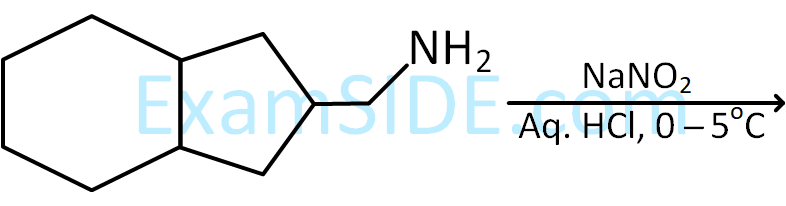
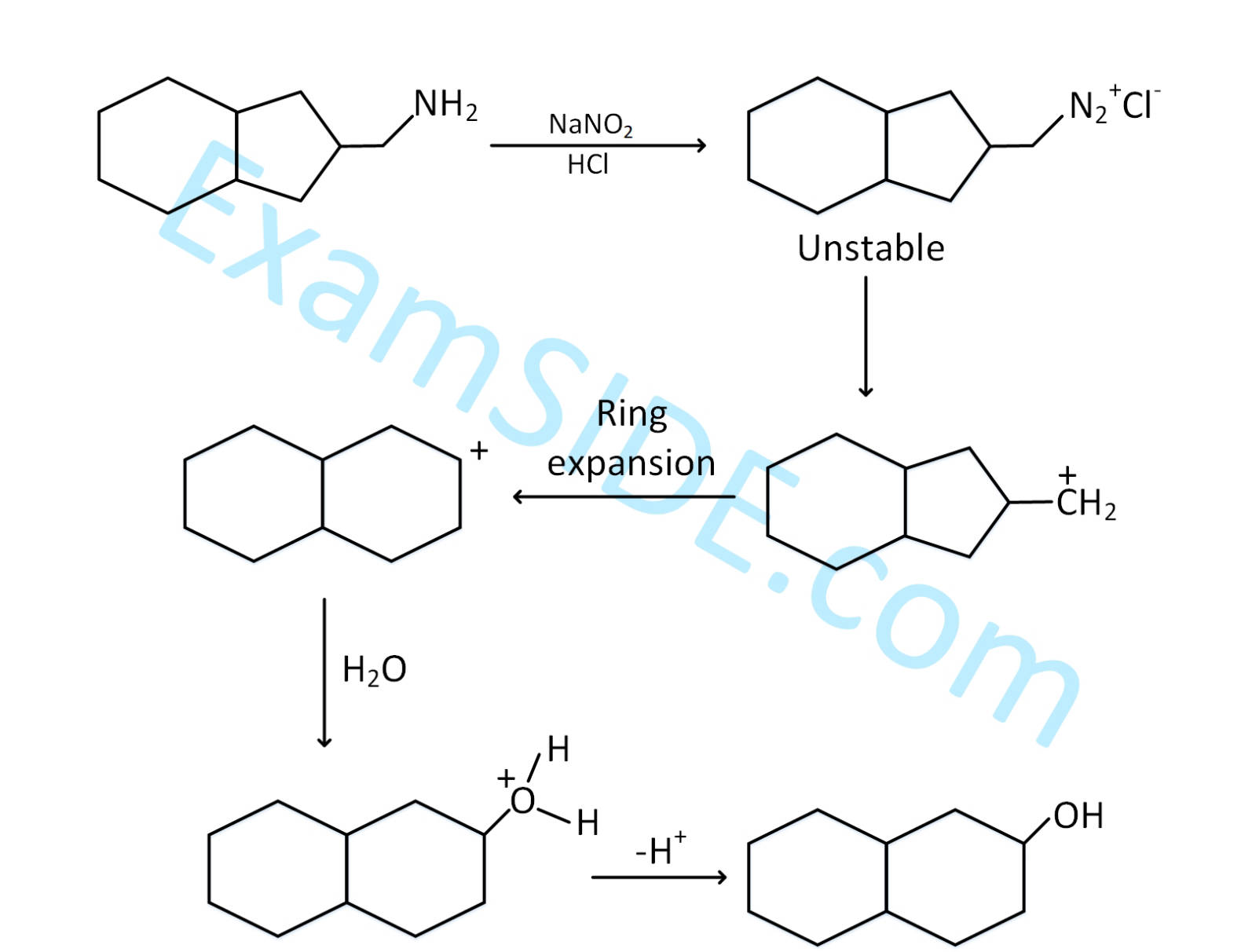
The major product of the following reaction is

Amongst the compounds given, the one that would from a brilliant coloured dye on treatment with NaNO2 in dil. HCl followed by addition to an alkaline solution of $\beta$-naphthlol is
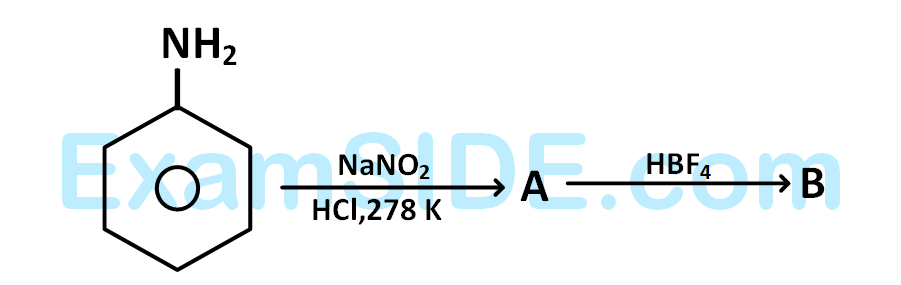
the compounds $'A'$ and $'B'$ respectively are
In the reaction,

The structure of the product T is :
| Column I | Column II |
|---|---|
(A)
|
(P) Racemic mixture |
(B)
|
(Q) Addition reaction |
(C)
|
(R) Substitution reaction |
(D)
|
(S) Coupling reaction |
Match each of the compounds in Column I with its characteristic reaction(s) in Column II.
| Column I | Column II | ||
|---|---|---|---|
| (A) | $C{H_3}C{H_2}C{H_2}CN$ | (P) | Reduction with $Pd - C/{H_2}$ |
| (B) | $C{H_3}C{H_2}OCOC{H_3}$ | (Q) | Reduction with $SnC{l_2}/HCl$ |
| (C) | $C{H_3} - CH = CH - C{H_2}OH$ | (R) | Development of foul smell on treatment with chloroform and alcoholic KOH |
| (D) | $C{H_3}C{H_2}C{H_2}C{H_2}N{H_2}$ | (S) | Reduction with diisobutylaluminium hydride (DIBAL-H) |
| (T) | Alkaline hydrolysis |
Statement 1 : Aniline on reaction with NaNO$_2$/HCl at 0$^\circ$C followed by coupling with $\beta$-naphthol gives a dark blue coloured precipitate.
Statement 2 : The colour of the compound formed in the reaction of aniline with NaNO$_2$/HCl at 0$^\circ$C followed by coupling with $\beta$-naphthol is due to the extended conjugation.
Match the compounds in Column I with their characteristic test(s)/reaction(s) given in Column II. Indicate your answer by darkening the appropriate bubbles of the 4 $\times$ 4 matrix given in the ORS.
| Column I | Column II | ||
|---|---|---|---|
| (A) | ![]() |
(P) | sodium fusion extract of the compound gives Prussian blue colour with FeSO$_4$. |
| (B) | ![]() |
(Q) | gives positive FeCl$_3$ test. |
| (C) | ![]() |
(R) | gives white precipitate with AgNO$_3$. |
| (D) | ![]() |
(S) | reacts with aldehydes to form the corresponding hydrazone derivative. |
CH3CH2NH2 + CHCl3 + 3KOH $\to$ (A) + (B) + 3H2O, the compound (A) and (B) are respectively
$\mathrm{CH}_3 \mathrm{NH}_2+\mathrm{CHCl}_3+\mathrm{KOH} \rightarrow$ Nitrogen containing compound $+\mathrm{KCl}+\mathrm{H}_2 \mathrm{O}$.
Nitrogen containing compound is :
$\mathrm{CH}_3-\mathrm{C} \equiv \mathrm{N}$
$\mathrm{CH}_3-\mathrm{NH}-\mathrm{CH}_3$
$\mathrm{CH}_3-\overline{\mathrm{N}} \equiv \stackrel{+}{\mathrm{C}}$
$\mathrm{CH}_3-\stackrel{+}{\mathrm{N}} \equiv \stackrel{-}{\mathrm{C}}$
How can the conversion of (i) to (ii) be brought about?
KBr
$\mathrm{KBr}+\mathrm{CH}_3 \mathrm{ONa}$
$\mathrm{KBr}+\mathrm{KOH}$
$\mathrm{Br}_2+\mathrm{KOH}$
Which is the rate determining step in Hofmann bromamide degradation?
Formation of (i)
Formation of (ii)
Formation of (iii)
Formation of (iv)
What are the constituent amines formed when the mixture of (i) and (ii) undergoes Hofmann bromamide degradation?
In the following reaction, X is optically active.
$\underset{\mathbf{X}}{\mathrm{C}_5 \mathrm{H}_{13}} \mathrm{~N} \xrightarrow[\mathrm{~N}_2]{\mathrm{NaNO}_2 / \mathrm{HCl}} \mathbf{Y}($ Tertiary alcohol $)+$ Other products
Find X and Y. Is y optically active? Write all the intermediate steps.
Explanation:
Given,
${C_5}{H_{13}}N\mathrel{\mathop{\kern0pt\longrightarrow} \limits_{{N_2}}^{NaN{O_2}/HCl}} Y$ (Tertiary alcohol) + Other products
When primary amine reacts with NaNO$_2$ + HCl, the amine undergoes diazotisation which then hydrolysed to an alcohol.
$R - N{H_2}\buildrel {NaN{O_2} + HCl} \over \longrightarrow R - OH + {N_2}(g) \uparrow $
If nitrogen gas is evolved during the reaction, the amine must be a primary amine. The alcohol Y is a tertiary alcohol. Thus, we can say that X is a primary amine.
There are 2 possibilities for deducing the structure of X.
(1) The possible structure of C$_5$H$_{13}$N is shown below, in which 4 C substituents are arranged on a single C atom. But, the compound is optically inactive.

Hence, this is not the structure of compound X.
(2) In the given structure, the C atoms are arranged in chain form with 2 methyl substituents. The C atom directly attached to amine group is chiral C. Therefore, the compound is optically active.

Hence, this is the structure of compound X. The formation of Y from X with its intermediate steps is shown below.

The compound X when reacts with NaNO$_2$ + HCl, it undergoes diazotisation which on removal of N$_2$ gas, form a secondary carbocation. The secondary carbocation undergoes hydride shift, producing a more stable tertiary carbocation. The tertiary carbocation on hydrolysis produces a tertiary alcohol which is optically inactive. The chemical reaction for formation of Y from X is

Final Answer :

Compound Y is optically inactive.
Hints :
The evolution of nitrogen gas during the reaction confirms that X is a primary amine.
In the following reaction sequence :

Identify A, B, C and D. Also write chemical equations for cons version of A to B and A to C.
Explanation:
The given reaction of compound A are as follows :

Compound A on reaction with NaBr + MnO$_2$ gives brown fumes with pungent smell with the formation of compound B. Also, compound A reacts with conc. HNO$_3$ to produce an intermediate C which on reaction with toluene producing compound D.
The reaction of compound A with NaBr + MnO$_2$ is an example of redox reaction. The compound A is sulphuric acid, H$_2$SO$_4$. The products formed during the reaction are Na$_2$SO$_4$, MnSO$_4$, Br$_2$ and H$_2$O. The bromine gas is brown in colour and have pungent smell. The chemical reaction for the same is shown below.

The compound A that is sulphuric acid on reaction with conc. HNO$_3$ yields nitronium ion as shown below. The compound C formed is an intermediate and is nitronium ion.
$\mathrm{\mathop {{H_2}S{O_4}}\limits_{(A)} + HN{O_3} \to HSO_4^ - + \mathop {NO_2^ \oplus }\limits_{(C)} + {H_2}O}$
The nitronium ion on reaction with toluene, causes its nitration, producing compound D. The nitronium ion is an electrophile and causes substitution of 3 H atoms at two ortho and one para position of benzene ring by nitro group. The compound D is formed which is trinitrotoluene or TNT. The TNT is explosive in nature.

The complete reaction sequence is as shown below.
Final Answer :
A: H$_2$SO$_4$
B : Br$_2$
C: NO$_2^+$


The compound (iii) will loose $\mathrm{Br}^{-}$ion and lone pair of N atom will transfer to adjacent C atom forming a double bond. The compound (iv) is formed from compound (iii) through rearrangement which is slow and rate determining step of the reaction. The reacts with methanol.