Compounds Containing Nitrogen
The compound formed by the reaction of ethanal with semicarbazide contains _________ number of nitrogen atoms.
Explanation:

When ethanal reacts with semicarbazide, semi-carbazone is formed via condensation, number of nitrogen atoms present in product is 3.
The option(s) with correct sequence of reagents for the conversion of $\mathbf{P}$ to $\mathbf{Q}$ is(are)

i) Lindlar's catalyst, $\mathrm{H}_2$;
ii) $\mathrm{SnCl}_2 / \mathrm{HCl}$;
iii) $\mathrm{NaBH}_4$;
iv) $\mathrm{H}_3 \mathrm{O}^{+}$
i) Lindlar's catalyst, $\mathrm{H}_2$;
ii) $\mathrm{H}_3 \mathrm{O}^{+}$;
iii) $\mathrm{SnCl}_2 / \mathrm{HCl}$;
iv) $\mathrm{NaBH}_4$
i) $\mathrm{NaBH}_4$;
ii) $\mathrm{SnCl}_2 / \mathrm{HCl}$;
iii) $\mathrm{H}_3 \mathrm{O}^{+}$;
iv) Lindlar's catalyst, $\mathrm{H}_2$
i) Lindlar's catalyst, $\mathrm{H}_2$;
ii) $\mathrm{NaBH}_4$;
iii) $\mathrm{SnCl}_2 / \mathrm{HCl}$;
iv) $\mathrm{H}_3 \mathrm{O}^{+}$


List-I contains various reaction sequences and List-II contains different phenolic compounds. Match each entry in List-I with the appropriate entry in List-II and choose the correct option.
| List-I | List-II |
|---|---|

|

|

|

|

|

|

|

|

|


What are $X$ and $Y$ respectively in the following reactions?


Conversion of $X$ to $Y$ in the above reaction is

Identify the correct statements about $Z$.
$ \mathrm{C}_2 \mathrm{H}_5 \mathrm{NH}_2 \xrightarrow[0^{\circ} \mathrm{C}]{\mathrm{NaNO}_2 / \mathrm{HCl}} X \xrightarrow{\mathrm{H}_2 \mathrm{O}} Y \xrightarrow{\mathrm{Cu} / 573 \mathrm{~K}} Z $
I. $Z$ is an aldehyde.
II. $Z$ undergòes Cannizzaro reaction.
III. $Z$ gives iodoform test.
IV. $Z$ does not give, test with Tollens' reagent.


| List -I (Amine) | List -II (pKb value) |
| A. N,N-dimethyl aniline | I. 9.30 |
| B. Aniline | II. 8.92 |
| C. N-ethylethanamine | III. 9.38 |
| D. N-methylaniline | IV. 3.00 |


$ \text { What is } Y \text { in the given sequence? } $


$ \text { Identify } B \text { in the given reaction sequence. } $


What are $X$ and $Y$ respectively in the following reactions?



The product ' $\mathrm{B}$ ' is


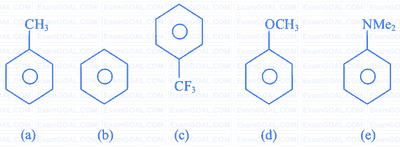

Compound $\mathrm{A}$ from the following reaction sequence is:


Match List I with List II
1 - Bromopropane is reacted with reagents in List I to give product in List II
| LIST I - Reagent | LIST II - Product | ||
|---|---|---|---|
| A. | $\mathrm{KOH}$ (alc) | I. | Nitrile |
| B. | $\mathrm{KCN}$ (alc) | II. | Ester |
| C. | $\mathrm{AgNO_2}$ | III. | Alkene |
| D. | $\mathrm{H_3CCOOAg}$ | IV. | Nitroalkane |
Choose the correct answer from the options given below:
In the reaction given below

'B' is


The incorrect statement regarding the reaction given below is


'X' is


The major product 'P' formed in the given reaction is:


In the reaction given below:

The product 'X' is:


Isomeric amines with molecular formula C$_8$H$_{11}$N give the following tests
Isomer (P) $\Rightarrow$ Can be prepared by Gabriel phthalimide synthesis
Isomer (Q) $\Rightarrow$ Reacts with Hinsberg's reagent to give solid insoluble in NaOH
Isomer (R) $\Rightarrow$ Reacts with HONO followed by $\beta$-naphthol in NaOH to give red dye.
Isomers (P), (Q) and (R) respectively are


The product ($\mathrm{P}$) formed from the following multistep reaction is:


Match List I with List II:

| LIST I (Reagent) | LIST II (Product) | ||
|---|---|---|---|
| A. |  |
I. |  |
| B. | $\mathrm{HBF_4,\Delta}$ | II. |  |
| C. | $\mathrm{Cu,HCl}$ | III. |  |
| D. | $\mathrm{CuCN/KCN}$ | IV. |  |
Choose the correct answer from the options given below:


The major products A and B from the following reactions are:


The major product formed in the following reaction is


Compound $\mathrm{P}$ is neutral, $\mathrm{Q}$ gives effervescence with $\mathrm{NaHCO}_{3}$ while $\mathrm{R}$ reacts with Hinsbergs reagent to give solid soluble in $\mathrm{NaOH}$. Compound $\mathrm{P}$ is


In the following reaction, 'A' is


Consider the above reaction and identify the product B.




In the above conversion of compound $(\mathrm{X})$ to product $(\mathrm{Y})$, the sequence of reagents to be used will be:

Benzyl isocyanide can be obtained by :
A. 
B. 
C. 
D. 
Choose the correct answer from the options given below :


Reaction of propanamide with $\mathrm{Br_2/KOH(aq)}$ produces :
The major product 'P' for the following sequence of reactions is :


Match List I with List II
| List I | List II | ||
|---|---|---|---|
| Reaction | Reagents | ||
| (A) | Hoffmann Degradation | (I) | $\mathrm{Conc. KOH}$, $\Delta$ |
| (B) | Clemenson reduction | (II) | $\mathrm{CHCl_3,NaOH/H_3O}$$^ \oplus $ |
| (C) | Cannizaro reaction | (III) | $\mathrm{Br_2,NaOH}$ |
| (D) | Reimer-Tiemann Reaction | (IV) | $\mathrm{Zn-Hg/HCl}$ |
Choose the correct answer from the options given below :
Match List I with List II
| List I (Amines) | List II ($\mathrm{pK_b}$) | ||
|---|---|---|---|
| A. | Aniline | I. | 3.25 |
| B. | Ethanamine | II. | 3.00 |
| C. | N-Ethylethanamine | III. | 9.38 |
| D. | N, N-Diethylethanamine | IV. | 3.29 |
Choose the correct answer from the options given below :
Match List I with List II
| List I Isomeric pairs |
List II Type of isomers |
||
|---|---|---|---|
| A. | Propanamine and N-Methylethanamine | I. | Metamers |
| B. | Hexan-2-one and Hexan-3-one | II. | Positional isomers |
| C. | Ethanamide and Hydroxyethanimine | III. | Functional isomers |
| D. | o-nitrophenol and p-nitrophenol | IV. | Tautomers |
Choose the correct answer from the options given below :


Given below are two statements :


In the light of the above statements, choose the correct answer from the options given below:

Choose the correct colour of the product for the following reaction.


Given below are two statements:
Statement I : Pure Aniline and other arylamines are usually colourless.
Statement II : Arylamines get coloured on storage due to atmospheric reduction.
In the light of the above statements, choose the most appropriate answer from the options given below :
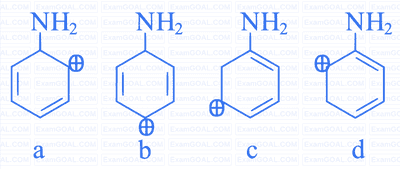
Increasing order of stability of the resonance structures is :

Choose the correct answer from the options given below :
Number of isomeric aromatic amines with molecular formula $\mathrm{C}_{8} \mathrm{H}_{11} \mathrm{~N}$, which can be synthesized by Gabriel Phthalimide synthesis is ____________.
Explanation:

How many of the transformations given below would result in aromatic amines?

Explanation:
Gabriel phthalimide synthesis cannot be used to prepare Aniline.

[Use : Molar mass (in $\left.\mathrm{g} \mathrm{mol}^{-1}\right)$ : $\mathrm{H}=1, \mathrm{C}=12, \mathrm{~N}=14, \mathrm{O}=16, \mathrm{Br}=80, \mathrm{Cl}=35.5$
Atoms other than $\mathrm{C}$ and $\mathrm{H}$ are considered as heteroatoms]
Explanation:


Number of Heteroatoms in $R$ is 9 .
[Use : Molar mass (in $\mathrm{g} \mathrm{mol}^{-1}$ ): $\mathrm{H}=1, \mathrm{C}=12, \mathrm{~N}=14, \mathrm{O}=16, \mathrm{Br}=80, \mathrm{Cl}=35.5$
Atoms other than $\mathrm{C}$ and $\mathrm{H}$ are considered as heteroatoms]
Explanation:

Number of Carbon atoms + Number of Heteroatoms $=51$