Compounds Containing Nitrogen
360 Questions
Start JEE Mains Test
2022
Q201
TS-EAMCET
MCQ
20 May 2026
The starting material that produce pentanamine by Hoffmann bromamide reaction is
A.
$\mathrm{CH}_3 \mathrm{CH}_2 \mathrm{CH}_2 \mathrm{CH}_2 \mathrm{CN}$
B.
$\mathrm{CH}_3 \mathrm{CH}_2 \mathrm{CH}_2 \mathrm{CH}_2 \mathrm{CONH}_2$
C.
$\mathrm{CH}_3 \mathrm{CH}_2 \mathrm{CH}_2 \mathrm{CH}_2 \mathrm{NCO}$
D.
$\mathrm{CH}_3 \mathrm{CH}_2 \mathrm{CH}_2 \mathrm{CH}_2 \mathrm{CH}_2 \mathrm{CONH}_2$
2022
Q202
AP-EAPCET
MCQ
20 May 2026
The relative basic strength of the compounds is correctly shown in the option.
A.
$\mathrm{NH}_2 \mathrm{OH}>\mathrm{NH}_3>\mathrm{N}_2 \mathrm{H}_4$
B.
$\mathrm{N}_2 \mathrm{H}_4>\mathrm{NH}_2 \mathrm{OH}>\mathrm{NH}_3$
C.
$\mathrm{NH}_3>\mathrm{N}_2 \mathrm{H}_4>\mathrm{NH}_2 \mathrm{OH}$
D.
$\mathrm{N}_2 \mathrm{H}_4>\mathrm{NH}_3>\mathrm{NH}_2 \mathrm{OH}$

2022
Q203
AP-EAPCET
MCQ
20 May 2026
Identify the major product formed from the following reaction.

A.

B.

C.

D.


2022
Q204
AP-EAPCET
MCQ
20 May 2026
Arrange the following in decreasing order of their boiling points.

A.
A > B > D > C
B.
A > C > D > B
C.
B > C > D > A
D.
C > A > B > D

2022
Q205
BITSAT
MCQ
11 Jun 2026
Ninhydrin gives yellow colour in paper chromatography with which amino acid?
A.
Tryptophan
B.
Proline
C.
Alanine
D.
Tyrosine
2021
Q206
JEE Mains
MCQ
14 Mar 2026
Identify A in the following reaction.

A.

B.

C.

D.


2021
Q207
JEE Mains
MCQ
14 Mar 2026
Which one of the following gives the most stable Diazonium salt?
A.
CH3$-$CH2$-$CH2$-$NH2
B.

C.

D.


2021
Q208
JEE Mains
MCQ
14 Mar 2026
The major products A and B formed in the following reaction sequence are :
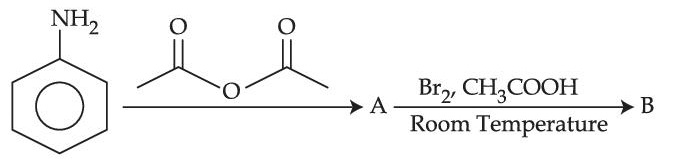
A.

B.

C.

D.


2021
Q209
JEE Mains
MCQ
14 Mar 2026
Identify correct A, B and C in the reaction sequence given below :

A.

B.

C.

D.


2021
Q210
JEE Mains
MCQ
14 Mar 2026
The major products A and B in the following set of reactions are :

A.

B.

C.

D.


2021
Q211
JEE Mains
MCQ
14 Mar 2026
Which one of the following is the major product of the given reaction?
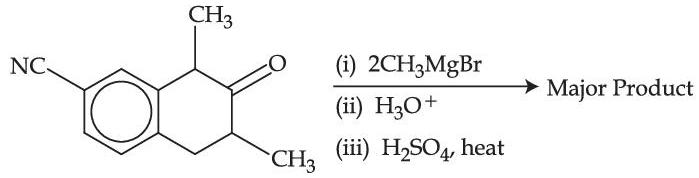
A.

B.

C.

D.


2021
Q212
JEE Mains
MCQ
14 Mar 2026
The correct structures of A and B formed in the following reactions are :
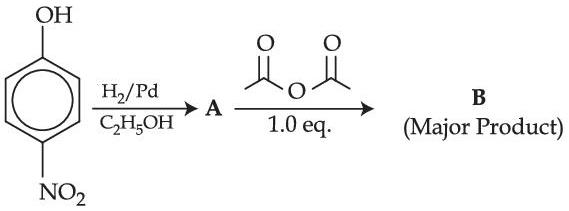
A.

B.

C.

D.


2021
Q213
JEE Mains
MCQ
14 Mar 2026
The major product of the following reaction is :

A.

B.

C.

D.


2021
Q214
JEE Mains
MCQ
14 Mar 2026
Which of the following is not a correct statement for primary aliphatic amines?
A.
The intermolecular association in primary amines is less than the intermolecular association in secondary amines.
B.
Primary amines on treating with nitrous acid solution from corresponding alcohols except mythyl amine.
C.
Primary amines are less basic than the secondary amines.
D.
Primary amines can be prepared by the Gabriel phthalimide synthesis.
2021
Q215
JEE Mains
MCQ
14 Mar 2026
Match List - I with List - II :

Choose the most appropriate match :
Choose the most appropriate match :
A.
a-ii, b-iv, c-iii, d-i
B.
a-iv, b-ii, c-iii, d-i
C.
a-ii, b-iii, c-iv, d-i
D.
a-iii, b-ii, c-i, d-iv

2021
Q216
JEE Mains
MCQ
14 Mar 2026

The major product in the above reaction is :
A.

B.

C.

D.


2021
Q217
JEE Mains
MCQ
14 Mar 2026

Consider the given reaction, identify 'X' and 'Y' :
A.

B.

C.

D.


2021
Q218
JEE Mains
MCQ
14 Mar 2026
The major product formed in the following reaction is :

A.

B.

C.

D.


2021
Q219
JEE Mains
MCQ
14 Mar 2026
$R - CN\mathrel{\mathop{\kern0pt\longrightarrow}
\limits_{(ii){H_2}O}^{(i)DIBAL - H}} R - Y$
Consider the above reaction and identify "Y"
Consider the above reaction and identify "Y"
A.
$-$CH2NH2
B.
$-$CONH2
C.
$-$CHO
D.
$-$COOH

2021
Q220
JEE Mains
MCQ
14 Mar 2026
What is A in the following reaction?

A.

B.

C.

D.


2021
Q221
JEE Mains
MCQ
14 Mar 2026
Given below are two statements :
Statement I : Aniline is less basic than acetamide.
Statement II : In aniline, the lone pair of electrons on nitrogen atom is delocalized over benzene ring due to resonance and hence less available to a proton.
Choose the most appropriate option;
Statement I : Aniline is less basic than acetamide.
Statement II : In aniline, the lone pair of electrons on nitrogen atom is delocalized over benzene ring due to resonance and hence less available to a proton.
Choose the most appropriate option;
A.
Statement I is true but statement II is false.
B.
Statement I is false but statement II is true.
C.
Both statement I and statement II are true.
D.
Both statement I and statement II are false.
2021
Q222
JEE Mains
MCQ
14 Mar 2026

Consider the above reaction, the product "P" is :
A.

B.

C.

D.


2021
Q223
JEE Mains
MCQ
14 Mar 2026
A reaction of benzonitrile with one equivalent CH3MgBr followed by hydrolysis produces a yellow liquid "P". The compound "P" will give positive _________.
A.
Iodoform test
B.
Schiff's test
C.
Ninhydrin's test
D.
Tollen's test

2021
Q224
JEE Mains
MCQ
14 Mar 2026
What is the major product "P" of the following reaction?

A.

B.

C.

D.


2021
Q225
JEE Mains
MCQ
14 Mar 2026
Given below are two statements, one is labelled as Assertion (A) and other is labelled as Reason (R).
Assertion (A) : Gabriel phthalimide synthesis cannot be used to prepare aromatic primary amines.
Reason (R) : Aryl halides do not undergo nucleophilic substitution reaction.
In the light of the above statements, choose the correct answer from the options given below :
Assertion (A) : Gabriel phthalimide synthesis cannot be used to prepare aromatic primary amines.
Reason (R) : Aryl halides do not undergo nucleophilic substitution reaction.
In the light of the above statements, choose the correct answer from the options given below :
A.
Both (A) and (R) true but (R) is not the correct explanation of (A)
B.
(A) is false but (R) is true.
C.
Both (A) and (R) true and (R) is correct explanation of (A).
D.
(A) is true but (R) is false.

2021
Q226
JEE Mains
MCQ
14 Mar 2026
Which one of the products of the following reactions does not react with Hinsberg reagent to form sulphonamide?
A.

B.

C.

D.


2021
Q227
JEE Mains
MCQ
14 Mar 2026

In the chemical reactions given above A and B respectively are :
A.
H3PO2 and CH3CH2Cl
B.
CH3CH2OH and H3PO2
C.
H3PO2 and CH3CH2OH
D.
CH3CH2Cl and H3PO2

2021
Q228
JEE Mains
MCQ
14 Mar 2026
Which one of the following reactions does not occur?
A.

B.

C.

D.


2021
Q229
JEE Mains
MCQ
14 Mar 2026

In the above reactions, product A and product B respectively are :
A.

B.

C.

D.


2021
Q230
JEE Mains
MCQ
14 Mar 2026

Consider the above reaction, compound B is :
A.

B.

C.

D.


2021
Q231
JEE Mains
MCQ
14 Mar 2026
The correct structure of Rhumann's Purple, the compound formed in the reaction of ninhydrin with proteins is :
A.

B.

C.

D.


2021
Q232
JEE Mains
MCQ
14 Mar 2026
Compound A is converted to B on reaction with CHCl3 and KOH. The compound B is toxic and can be decomposed by C. A, B and C respectively are :
A.
primary amine, nitrile compound, conc. HCl
B.
secondary amine, isonitrile compound, conc. NaOH
C.
primary amine, isonitrile compound, conc. HCl
D.
secondary amine, nitrile compound, conc. NaOH

2021
Q233
JEE Mains
MCQ
14 Mar 2026

Consider the given reaction, percentage yield of :
A.
B > C > A
B.
A > C > B
C.
C > A > B
D.
C > B > A

2021
Q234
JEE Mains
MCQ
14 Mar 2026
In the reaction of hypobromite with amide, the carbonyl carbon is lost as :
A.
CO2
B.
CO
C.
HCO$_3^ - $
D.
CO$_3^{2 - }$

2021
Q235
JEE Mains
MCQ
14 Mar 2026
An organic compound "A" on treatment with benzene sulphonyl chloride gives compound B. B is soluble in dil. NaOH solution. Compound A is :
A.

B.
C6H5 $-$ NHCH2CH3
C.
C6H5 $-$ N $-$ (CH3)2
D.
C6H5 $-$ CH2NHCH3

2021
Q236
JEE Mains
MCQ
14 Mar 2026

Considering the above reaction, X and Y respectively are :
A.

B.

C.

D.


2021
Q237
JEE Mains
MCQ
14 Mar 2026
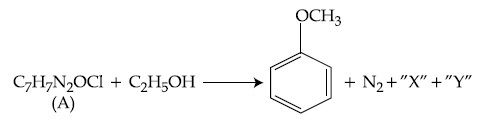
In the above reaction, the structural formula of (A), ''X'' and ''Y'' respectively are :
A.

B.

C.

D.


2021
Q238
JEE Mains
MCQ
14 Mar 2026
Primary, secondary and tertiary amines can be separated using:
A.
Chloroform and KOH
B.
Acetyl amide
C.
Benzene sulphonic acid
D.
para-Toluene sulphonyl chloride

2021
Q239
JEE Mains
MCQ
14 Mar 2026
Hoffmann bromomide degradation of benzamide gives product A, which upon heating with CHCl3 and NaOH gives product B.
The structures of A and B are :
The structures of A and B are :
A.

B.

C.

D.


2021
Q240
JEE Mains
MCQ
14 Mar 2026
Which of the following is least basic?
A.
${(C{H_3}CO)_2}\mathop N\limits^{..} H$
B.
$(C{H_3}CO)\mathop N\limits^{..} H{C_2}{H_5}$
C.
${({C_2}{H_5})_3}\mathop N\limits^{..} $
D.
${({C_2}{H_5})_2}\mathop N\limits^{..} H$

2021
Q241
JEE Mains
MCQ
14 Mar 2026
Ammonolysis of Alkyl halides followed by the treatment with NaOH solution can be used to prepare primary, secondary and tertiary amines. The purpose of NaOH in the reaction is :
A.
to remove acidic impurities
B.
to remove basic impurities
C.
to activate NH3 used in the reaction
D.
to increase the reactivity of alkyl halide

2021
Q242
JEE Mains
MCQ
14 Mar 2026
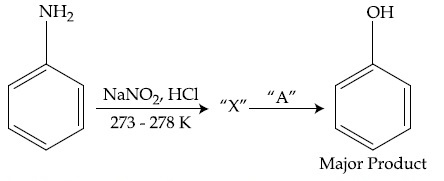
In the above chemical reaction, intermediate ''X'' and reagent/condition ''A'' are :
A.

B.

C.

D.


2021
Q243
JEE Mains
MCQ
14 Mar 2026
Which of the following reactions DOES NOT involve Hoffmann bromamide degradation?
A.

B.

C.

D.


2021
Q244
JEE Mains
MCQ
14 Mar 2026
A. Phenyl methanamine
B. N,N-Dimethylaniline
C. N-Methyl aniline
D. Benzenamine
Choose the correct order of basic nature of the above amines.
B. N,N-Dimethylaniline
C. N-Methyl aniline
D. Benzenamine
Choose the correct order of basic nature of the above amines.
A.
D > C > B > A
B.
A > C > B > D
C.
D > B > C > A
D.
A > B > C > D


2021
Q245
JEE Mains
MCQ
14 Mar 2026
An amine on reaction with benzensulphonyl chloride produces a compound insoluble in alkaline solution. This amine can be prepared by ammonolysis of ethyl chloride. The correct structure of amine is :
A.
CH3CH2NH2
B.
CH3CH2CH2NHCH3
C.
CH3CH2CH2$\mathop N\limits^H $-CH2CH3
D.


2021
Q246
JEE Mains
MCQ
14 Mar 2026

Correct statement about the given chemical reaction is :
A.

B.
Reaction is possible and compound (B) will be the major product.
C.
Reaction is possible and compound (A) will be major product.
D.
The reaction will form sulphonated product instead of nitration.

2021
Q247
JEE Mains
MCQ
14 Mar 2026
Carbylamine test is used to detect the presence of primary amino group in an organic compound. Which of the following compound is formed when this test is performed with aniline?
A.

B.

C.

D.


2021
Q248
JEE Mains
MCQ
14 Mar 2026
Which of the following reaction/s will not give p-aminoazobenzene?

A.
C only
B.
A only
C.
A and B
D.
B only


2021
Q249
JEE Mains
MCQ
14 Mar 2026
What is the correct sequence of reagents used for converting nitrobenzene into m-dibromobenzene?

A.
$\stackrel{\mathrm{NaNO}_{2}}{\longrightarrow} / \stackrel{\mathrm{HCl}}{\longrightarrow} / \stackrel{\mathrm{KBr}}{\longrightarrow} / \stackrel{\mathrm{H}^{+}}{\longrightarrow}$
B.
$\stackrel{\mathrm{Sn} / \mathrm{HCl}}{\longrightarrow} / \stackrel{\mathrm{KBr}}{\longrightarrow} / \stackrel{\mathrm{Br}_{2}}{\longrightarrow} / \stackrel{\mathrm{H}^{+}}{\longrightarrow}$
C.
$\stackrel{\mathrm{B} \mathrm{B}_{2} / \mathrm{Fe}}{\longrightarrow} / \stackrel{\mathrm{Sn} / \mathrm{HCl}}{\longrightarrow} / \stackrel{\mathrm{NaNO}_{2} / \mathrm{HCl}}{\longrightarrow} / \stackrel{\mathrm{CuBr} / \mathrm{HBr}}{\longrightarrow}$
D.
$\stackrel{\mathrm{Sn} / \mathrm{HCl}}{\longrightarrow} / \stackrel{\mathrm{Br}_{2}}{\longrightarrow} / \stackrel{\mathrm{NaNO}_{2}}{\longrightarrow} / \stackrel{\mathrm{NaBr}}{\longrightarrow}$


2021
Q250
JEE Mains
MCQ
14 Mar 2026
The diazonium salt of which of the following compounds will form a coloured dye on reaction with $\beta$-Naphthol in NaOH?
A.

B.

C.

D.

