Compounds Containing Nitrogen


I. Sn $-$ HCl
II. Sn $-$ NH4OH
III. Fe $-$ HCl
IV. Zn $-$ HCl
V. H2 $-$ Pd
VI. H2 $-$ Raney Nickel
Explanation:

(i) Sn + HCl
(ii) Fe + HCl
(iii) Zn + HCl
(iv) H2 $-$ Pd
(v) H2 (Raney Ni)
Explanation:
Explanation:
Three nitrogen atoms are present as per structure below


Explanation:
Gabriel phthalimide synthesis is used to prepare 1o aliphatic or alicyclic amine. Hence, amine which can be synthesised by Gabriel phthalimide synthesis method contains $\alpha $-carbon.
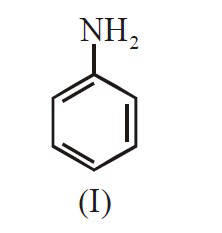
Aniline (C6H5NH2) does not contain $\alpha $-C cannot be prepared by Gabriel reaction.
Remaining amines all contain $\alpha $-C in its respective position, hence they can easily give Gabriel phthalimide reaction.


(Use Molar masses (in g mol$-$1) of H, C, N, O, Cl and Sn as 1, 12, 14, 16, 35 and 119, respectively).
The value of x is _________.
Explanation:

Mass of organic salt produced (aniline) = 1.29 g
Molar mass of organic salt (aniline)
= 12 × 6 + 1 × 8 + 14 × 1 + 35 × 1
= 72 + 8 + 14 + 35
= 129 g/mol
$Moles\ of\ organic\ salt=\frac{Mass\ of\ organic\ salt}{Molar\ mass} $
$ =\frac{1.29}{129} =0.01\ mol $
From reaction 1 moles of salt is produced from 3 mole of Sn. So, 0.01 mole of organic salt is produced by 0.03 mole Sn. Atomic mass of Sn = 119 g mol−1
Mass of Sn = x = mole of Sn × Molar mass
x = 0.03 × 119 $ \Rightarrow $ x = 3.57 g
The value of x is 3.57
(Use Molar masses (in g mol$-$1) of H, C, N, O, Cl and Sn as 1, 12, 14, 16, 35 and 119, respectively).
The value of y is _________.
Explanation:
1 mole of organic salt is produced by 1 mole of nitrobenzene 0.01 mole of organic salt is produced by 0.01 mole nitrobenzene.
Molar mass of nitrobenzene
= 12 × 6 + 1 × 5 + 14 × 1 + 16 × 2
= 72 + 5 + 14 + 32= 123 g mol−1
Mass of nitrobenzene required,
y = moles of nitrobenzene × molar mass
= 0.01 × 123 = 1.23 g
Arrange the following bases in decreasing order of basicity.
1. Aniline
2. o-nitroaniline
3. m-nitroaniline
4. p-nitroaniline
Using Kjeldahl’s method over 1g of a soil sample, the ammonia evolved could neutralise 25 mL of 1 M H$_2$SO$_4$. Then, the percentage of nitrogen present in the sample is
The compound formed on reaction of epoxy ethane with NH3 and H2O is




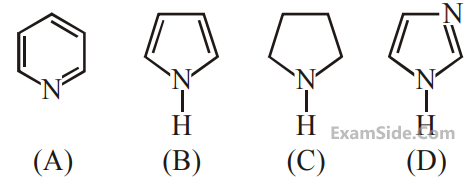


R has lower boiling point than S

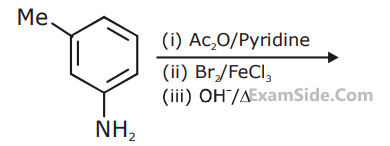
A, B and C, respectively are :


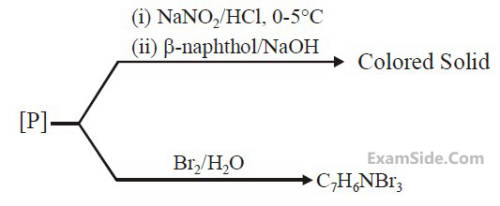
The compound [P] is :


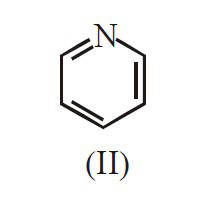
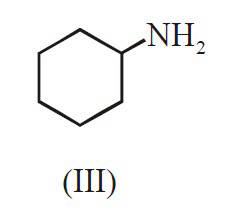
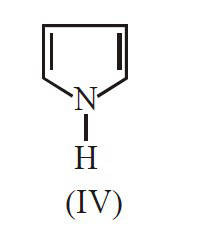


The major product B is :


The product 'X' is used :


Explanation:

Explanation:

Chemical formula of Histamine : C5H9N3
$ \therefore $ % by mas of N = ${{3 \times 14} \over {5 \times 12 + 1 \times 9 + 3 \times 14}} \times 100$
= ${{42} \over {111}} \times 100$
= 37.84%

Explanation:

$\beta $-naphthol couples with phenyldiazonium electrophile to produce an intense orange-red dye (Q) as major product.

Given that, volume of aniline (P) = 9.3 mL (density of P = 1.00 g/mL)
So, mass of aniline = 9.3 g
Molecular mass of aniline (C6H7N) = 93 g/mol
Therefore, moles of aniline = 9.3 / 93 = 0.1 mol of P.
Molecular mass of 2 napthol aniline orange dye (Q) = 248 g/mol
$ \Rightarrow $ 0.1 mol of aniline (P) will produce 0.1 mol of compound (Q).
But, according to the question the major product Q from P is 75%.
Therefore, mass of 'Q' produced
= (0.1 $ \times $ 248 $ \times $ 0.75)g = 18.60 g
$ \text { The major product in the following reactions, is } $


The major product formed by the reaction of benzylamine with nitrous acid is
phenol
benzaldehyde
chlorobenzene
benzyl alcohol

$ \text { The major product formed in the following reactions is } $


$ \text { Following transformation can be accomplished by } $

| (i) | (ii) |
|---|---|
| $ \mathrm{LiAlH}_4 $ |
$ \text { Pyridinium dichromate } $ |
| (i) | (ii) |
|---|---|
| $ \mathrm{Br}_2 / 4 \mathrm{KOH} $ |
$ \mathrm{NaNO}_2, \mathrm{HCl} $ |
| (i) | (ii) |
|---|---|
| $ \mathrm{Br}_2 / 3 \mathrm{KOH} $ |
$ \text { Alc. } \mathrm{KMnO}_4 $ |
| (i) | (ii) |
|---|---|
| $ \mathrm{NaNO}_2, \mathrm{HCl} $ |
$ \mathrm{LiAlH}_4 $ |

In a set of reactions, m-bromobenzoic acid gives a product D. Identify the product D:


An organic base C8H11N(X) reacts with nitrous acid at 0$^\circ$C to give a clear solution. Heating the solution with KCN and cuprous cyanide followed by continued heating with conc. HCl gives a crystalline solid. Heating this solid with alkaline potassium permanganate gives a compound which dehydrates on heating to an anhydride (C8H4O3). Compound X is


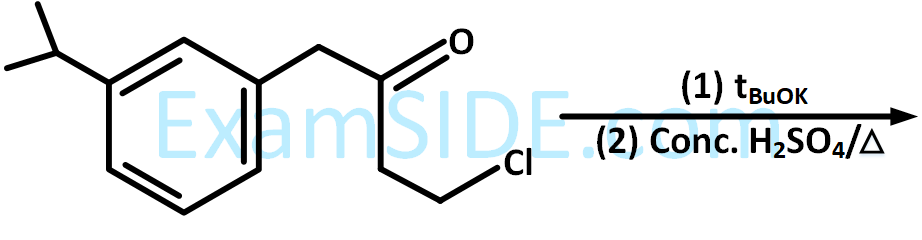


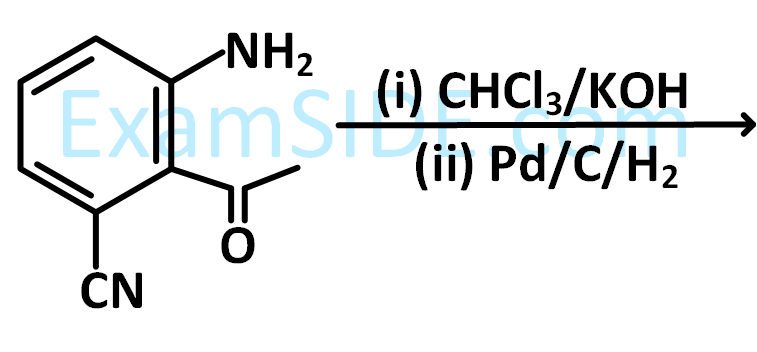


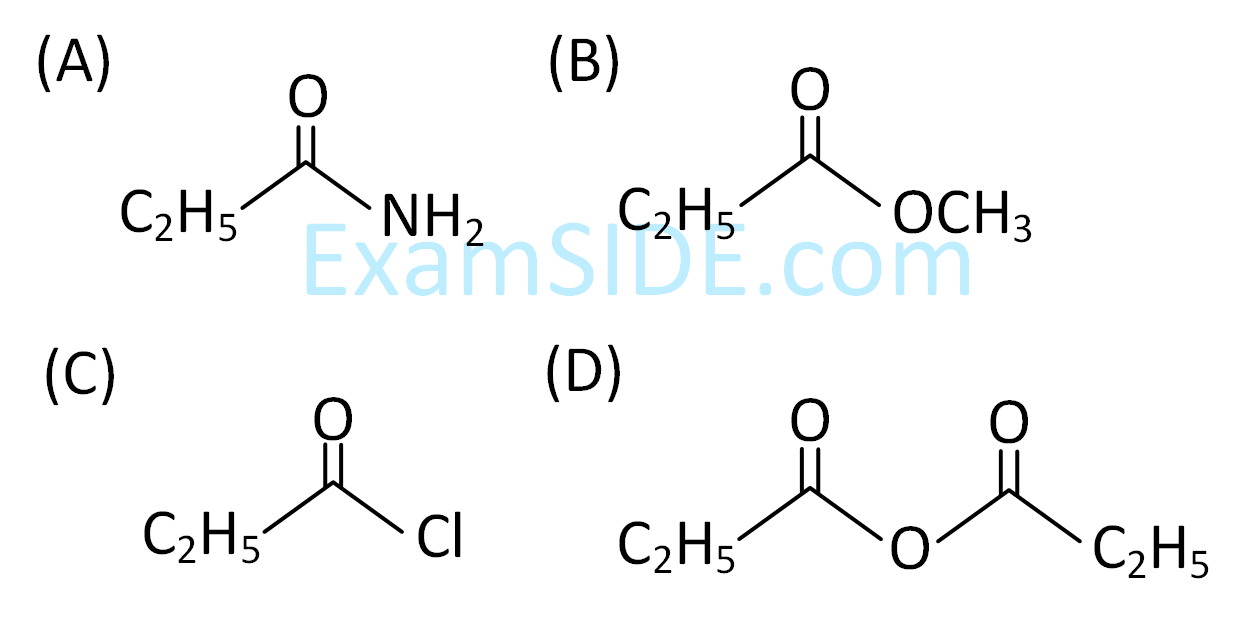





(A)

(B)

(C)
