Chemical Kinetics and Nuclear Chemistry
A → B (first reaction)
C → D (second reaction)
Consider the above two first-order reactions. The rate constant for first reaction at 500 K is double of the same at 300 K. At 500 K, 50% of the reaction becomes complete in 2 hour. The activation energy of the second reaction is half of that of first reaction. If the rate constant at 500 K of the second reaction becomes double of the rate constant of first reaction at the same temperature; then rate constant for the second reaction at 300 K is _______ × 10-1 hour-1 (nearest integer).
Explanation:
$ \text { For } \mathrm{A} \xrightarrow{\mathrm{~K}_1} \mathrm{~B} $
$ \begin{aligned} & \ln (2)=\frac{E_{a_1}}{R}\left[\frac{1}{300}-\frac{1}{500}\right] \\ & E_{a_1}=\frac{\ln 2 \times R \times 1500}{2} \\ & E_{a_2}=\frac{E_{a_1}}{2}=\frac{\ln 2 \times R \times 1500}{4} \\ & \left(K_1\right)_{\text {at } 500 \mathrm{~K}}=\frac{\ln 2}{2} \\ & \left(K_2\right)_{\text {at } 500 \mathrm{~K}}=\ln 2 \end{aligned} $
Now for $\mathrm{C} \xrightarrow{\mathrm{K}_2} \mathrm{D}$
$ \begin{aligned} & \ln \left[\frac{\left(\mathrm{K}_2\right)_{\text {at } 500 \mathrm{~K}}}{\left(\mathrm{~K}_2\right)_{\text {at } 300 \mathrm{~K}}}\right]=\left(\frac{\ln 2 \times \mathrm{R} \times 1500}{4}\right) \times \frac{1}{\mathrm{R}} \times\left[\frac{1}{300}-\frac{1}{500}\right] \\ & \left(\mathrm{K}_2\right)_{\text {at } 300 \mathrm{~K}}=\frac{\ln 2}{\sqrt{2}}=0.49 \\ & \left(\mathrm{~K}_2\right)_{\text {at } 300 \mathrm{~K}}=4.9 \times 10^{-1} \end{aligned} $
Ans is 5 .
The half-life of ${ }^{65} \mathrm{Zn}$ is 245 days. After $x$ days, $75 \%$ of original activity remained. The value of $x$ in days is $\_\_\_\_$ . (Nearest integer)
(Given: $\log 3=0.4771$ and $\log 2=0.3010$ )
Explanation:
$ \begin{aligned} & \mathrm{t}_{1 / 2}=\frac{\ln 2}{\mathrm{~K}} \end{aligned} $
Here, $\mathrm{t}_{1/2}=245$ days, so we find $K$ as:
$ \begin{aligned} & \mathrm{~K}=\frac{\ln 2}{245} \end{aligned} $
Now we use the radioactive decay relation for activity:
$ \begin{aligned} & \mathrm{t}=\frac{1}{\mathrm{~K}} \ln \frac{\mathrm{a}_0}{\mathrm{a}_{\mathrm{t}}} \end{aligned} $
Given that $75\%$ of the original activity remains, so $\mathrm{a}_t = 0.75\,\mathrm{a}_0 = \frac{3}{4}\mathrm{a}_0$.
So,
$ \begin{aligned} & \frac{\mathrm{a}_0}{\mathrm{a}_{\mathrm{t}}}=\frac{\mathrm{a}_0}{\frac{3}{4}\mathrm{a}_0}=\frac{4}{3} \end{aligned} $
Therefore,
$ \begin{aligned} & \mathrm{t}_{25 \%}=\frac{1}{\mathrm{~K}} \ln \frac{4}{3} \end{aligned} $
Substitute $\mathrm{K}=\frac{\ln 2}{245}$:
$ \begin{aligned} & \mathrm{t}_{25 \%}=\frac{1}{\frac{\ln 2}{245}} \ln \frac{4}{3} \end{aligned} $
Simplifying:
$ \begin{aligned} & \mathrm{t}_{25 \%}=245 \frac{\ln \frac{4}{3}}{\ell \mathrm{n} 2}=245\left[\frac{2 \log 2-\log 3}{\log 2}\right] \end{aligned} $
Now use the given values $\log 3=0.4771$ and $\log 2=0.3010$:
$ \begin{aligned} & =245\left[\frac{2 \times 0.3010-0.4771}{0.3010}\right]=101.66 \text { day. } \end{aligned} $
For the thermal decomposition of reactant $\mathrm{AB}(\mathrm{g})$, the following plot is constructed.

The half life of the reaction is ' $x^{\prime} \,\mathrm{min}$.
$x=$ $\_\_\_\_$ min. (Nearest integer)
Explanation:
The graph between concentration $[\mathrm{AB}]$ and time $t$ is a straight line that decreases with time. This type of graph shows that the reaction is zero order in $[\mathrm{AB}]$.
For a zero-order reaction, the integrated rate law is:
$\begin{aligned} & {[\mathrm{AB}]_0-[\mathrm{AB}]_{\mathrm{t}}=\mathrm{kt}} \\ & \mathbf{0 . 6 0 - 0 . 5 5 = k}(100) \\ & \mathrm{k}=5 \times 10^{-4} \\ & \text { Half life }\left(\mathrm{t}_{1 / 2}\right)=\frac{[\mathrm{AB}]_0}{2 \mathrm{k}} \\ & =\frac{0.60}{2 \times 5 \times 10^{-4}} \\ & =600 \mathrm{sec} \\ & =10 \mathrm{~min}\end{aligned}$
From the graph, the initial concentration is $[\mathrm{AB}]_0 = 0.60$ and after $100 \,\text{s}$ the concentration is $0.55$. Substituting these values in the zero-order equation gives the rate constant $k = 5 \times 10^{-4} \,\text{mol L}^{-1}\text{s}^{-1}$.
For a zero-order reaction, the half-life is given by $t_{1/2} = \dfrac{[\mathrm{AB}]_0}{2k}$. Putting the values, we get $t_{1/2} = 600 \,\text{s} = 10 \,\text{min}$. Therefore, $x = 10 \,\text{min}$ (nearest integer).
Consider $\mathrm{A} \xrightarrow{\mathrm{k}_1} \mathrm{~B}$ and $\mathrm{C} \xrightarrow{\mathrm{k}_2} \mathrm{D}$ are two reactions. If the rate constant $\left(\mathrm{k}_1\right)$ of the $\mathrm{A} \longrightarrow \mathrm{B}$ reaction can be expressed by the following equation $\log _{10} \mathrm{k}=14.34-\frac{1.5 \times 10^4}{\mathrm{~T} / \mathrm{K}}$ and activation energy of $C \longrightarrow D$ reaction $\left(E a_2\right)$ is $\frac{1}{5}$ th of the $A \longrightarrow B$ reaction $\left(E a_1\right)$, then the value of $\left(E a_2\right)$ is
$\_\_\_\_$ $\mathrm{kJ} \mathrm{mol}^{-1}$. (Nearest Integer)
Explanation:
Given: $\log _{10} \mathrm{k}=14.34-\frac{1.5 \times 10^4}{\mathrm{~T} / \mathrm{K}}$
From the Arrhenius equation in base-10 form, we write:
$\log_{10} k = \log_{10} A - \frac{E_a}{2.303RT}$
On comparing this with $\log _{10} \mathrm{k}=14.34-\frac{1.5 \times 10^4}{\mathrm{~T} / \mathrm{K}}$, the coefficient of $\frac{1}{T}$ gives:
$\frac{\mathrm{E}_{\mathrm{a}_1}}{2.303 \mathrm{R}}=1.5 \times 10^4$
Now substitute $\mathrm{R}=8.314~\mathrm{J\,mol^{-1}\,K^{-1}}$:
$\mathrm{E}_{\mathrm{a}_1}=1.5 \times 10^4 \times 2.303 \times 8.314$
$\mathrm{E}_{\mathrm{a}_1}=28.7207 \times 10^4 \mathrm{~J}$
Convert joules to kilojoules ($1~\mathrm{kJ}=10^3~\mathrm{J}$):
$\mathrm{E}_{\mathrm{a}_1}=287.207 \mathrm{~kJ}$
Given $\mathrm{E}_{\mathrm{a}_2}=\frac{1}{5}\mathrm{E}_{\mathrm{a}_1}$, so:
$\mathrm{E}_{\mathrm{a}_2}=\frac{\mathrm{E}_{\mathrm{a}_1}}{5}=\frac{287.207}{5}=57.44 \mathrm{~kJ}$
The temperature at which the rate constants of the given below two gaseous reactions become equal is $\_\_\_\_$ K. (Nearest integer)
$ \begin{array}{ll} \mathrm{X} \longrightarrow \mathrm{Y}, & \mathrm{k}_1=10^6 e^{\frac{-30000}{\mathrm{~T}}} \\ \mathrm{P} \longrightarrow \mathrm{Q}, & \mathrm{k}_2=10^4 e^{\frac{-24000}{\mathrm{~T}}} \end{array} $
Given : $\ln 10=2.303$
Explanation:
Given,
$k_1=10^6 e^{-30000/T},\qquad k_2=10^4 e^{-24000/T}$
At the temperature $T$ when $k_1=k_2$:
$10^6 e^{-30000/T}=10^4 e^{-24000/T}$
Divide both sides by $10^4 e^{-30000/T}$:
$10^2=e^{(-24000/T)-(-30000/T)}=e^{6000/T}$
Take natural log on both sides:
$\ln(10^2)=\frac{6000}{T}$
$2\ln 10=\frac{6000}{T}$
Given $\ln 10=2.303$:
$2(2.303)=\frac{6000}{T}$
$4.606=\frac{6000}{T}$
$T=\frac{6000}{4.606}\approx 1302.65\ \text{K}$
Nearest integer:
$\boxed{1303\ \text{K}}$
Pre-exponential factors of two different reactions of same order are identical. Let activation energy of first reaction exceeds the activation energy of second reaction by $20 \mathrm{~kJ} \mathrm{~mol}^{-1}$. If $\mathrm{k}_1$ and $\mathrm{k}_2$ are the rate constants of first and second reaction respectively at 300 K , then $\ln \frac{\mathrm{k}_2}{\mathrm{k}_1}$ will be $\_\_\_\_$ . (nearest integer) $\left[\mathrm{R}=8.3 \mathrm{~J} \mathrm{~K}^{-1} \mathrm{~mol}^{-1}\right]$
Explanation:
Arrhenius equation:
$k=Ae^{-E_a/RT}$
Given pre-exponential factors are identical, so $A_1=A_2$.
Also, activation energy of first reaction exceeds that of second by $20\,\text{kJ mol}^{-1}$:
$E_{a1}=E_{a2}+20{,}000\ \text{J mol}^{-1}$
Now,
$ \frac{k_2}{k_1} =\frac{A e^{-E_{a2}/RT}}{A e^{-E_{a1}/RT}} =e^{-(E_{a2}-E_{a1})/RT} =e^{(E_{a1}-E_{a2})/RT} $
So,
$\ln\left(\frac{k_2}{k_1}\right)=\frac{E_{a1}-E_{a2}}{RT}=\frac{20{,}000}{8.3\times 300}$
Compute:
$8.3\times 300=2490$
$\ln\left(\frac{k_2}{k_1}\right)=\frac{20{,}000}{2490}\approx 8.03$
Nearest integer:
$\boxed{8}$
An organic compound undergoes first order decomposition. The time taken for decomposition to $\left(\frac{1}{8}\right)^{\text {th }}$ and $\left(\frac{1}{10}\right)^{\text {th }}$ of its initial concentration are $\mathrm{t}_{1 / 8}$ and $\mathrm{t}_{1 / 10}$ respectively.
What is the value of $\frac{\mathrm{t}_{1 / 8}}{\mathrm{t}_{1 / 10}} \times 10$ ?
$ (\log 2=0.3) $
30
9
3
0.9
$\mathrm{A} \rightarrow \mathrm{D}$ is an endothermic reaction occurring in three steps (elementary).
(i) $\mathrm{A} \rightarrow \mathrm{B} \Delta \mathrm{H}_i=+\mathrm{ve}$
(ii) $\mathrm{B} \rightarrow \mathrm{C} \Delta \mathrm{H}_{i i}=-\mathrm{ve}$
(iii) $\mathrm{C} \rightarrow \mathrm{D} \Delta \mathrm{H}_{i i i}=-\mathrm{ve}$
Which of the following graphs between potential energy ( $y$-axis) vs reaction coordinate ( $x$-axis) correctly represents the reaction profile of $A \rightarrow D$ ?


At $27^{\circ} \mathrm{C}$ in presence of a catalyst, activation energy of a reaction is lowered by $10 \mathrm{~kJ} \mathrm{~mol}^{-1}$. The logarithm of ratio of $\frac{\mathrm{k} \text { (catalysed) }}{\mathrm{k} \text { (uncatalysed) }}$ is….
(Consider that the frequency factor for both the reactions is same)
1.741
0.1741
17.41
3.482

Given above is the concentration vs time plot for a dissociation reaction : $\mathrm{A} \rightarrow \mathrm{nB}$.
Based on the data of the initial phase of the reaction (initial 10 min ), the value of n is $\_\_\_\_$ .
2
5
4
3
Observe the following reactions at $\mathrm{T}(\mathrm{K})$.
I. $\mathrm{A} \rightarrow$ products.
II. $5 \mathrm{Br}^{-}(\mathrm{aq})+\mathrm{BrO}_3{ }^{-}(\mathrm{aq})+6 \mathrm{H}^{+}(\mathrm{aq}) \rightarrow 3 \mathrm{Br}_2(\mathrm{aq})+3 \mathrm{H}_2 \mathrm{O}(\mathrm{l})$
Both the reactions are started at 10.00 am . The rates of these reactions at 10.10 am are same. The value of $-\frac{\Delta\left[\mathrm{Br}^{-}\right]}{\Delta \mathrm{t}}$ at 10.10 am is $2 \times 10^{-4} \mathrm{~mol} \mathrm{~L}^{-1} \mathrm{~min}^{-1}$. The concentration of A at 10.10 am is $10^{-2} \mathrm{~mol} \mathrm{~L}^{-1}$. What is the first order rate constant (in $\mathrm{min}^{-1}$ ) of reaction $I$ ?
$4 \times 10^{-3}$
$2 \times 10^{-3}$
$10^{-3}$
$10^{-2}$
Correct statements regarding Arrhenius equation among the following are :
A. Factor $e^{-\mathrm{Ea} / \mathrm{RT}}$ corresponds to fraction of molecules having kinetic energy less than Ea.
B. At a given temperature, lower the Ea, faster is the reaction.
C. Increase in temperature by about $10^{\circ} \mathrm{C}$ doubles the rate of reaction.
D. Plot of $\log \mathrm{k}$ vs $\frac{1}{\mathrm{~T}}$ gives a straight line with slope $=-\frac{\mathrm{Ea}}{\mathrm{R}}$.
Choose the correct answer from the options given below :
A and B Only
B and D Only
B and C Only
A and C Only
$\mathrm{A} \rightarrow$ product (First order reaction).
Three sets of experiment were performed for a reaction under similar experimental conditions:
Run $1 \Rightarrow 100 \mathrm{~mL}$ of 10 M solution of reactant A
Run $2 \Rightarrow 200 \mathrm{~mL}$ of 10 M solution of reactant A
Run $3 \Rightarrow 100 \mathrm{~mL}$ of 10 M solution of reactant $\mathrm{A}+100 \mathrm{~mL}$ of $\mathrm{H}_2 \mathrm{O}$ added.
The correct variation of rate of reaction is
Run $1=$ Run $2=$ Run 3
Run $3<\operatorname{Run} 1<\operatorname{Run} 2$
Run $1<$ Run $2<$ Run 3
Run $3<$ Run $1=$ Run 2
Decomposition of A is a first order reaction at T(K) and is given by A(g) → B(g) + C(g).
In a closed 1 L vessel, 1 bar A(g) is allowed to decompose at T(K). After 100 minutes, the total pressure was 1.5 bar. What is the rate constant (in min−1) of the reaction? (log 2 = 0.3)
$6.9 × 10^{-4}$
$6.9 × 10^{-3}$
$6.9 × 10^{-1}$
$6.9 × 10^{-2}$


For a reversible reaction $R \rightleftharpoons P$, at constant temperature, both the forward and the backward reactions are first order elementary reactions with rate constants $k_{{f}}$ and $k_{{b}}$, respectively. At time zero, the concentration of $R$ is $[R]_0$ and the concentration of $P$ is zero. At any given time, $[R]$ and $[P]$ are the concentrations of $R$ and $P$, respectively. If $k_{{b}} = 4k_{{f}}$, the correct graphical representation of the reaction is


Given below are two statements :
$ \mathrm{R}=8.314 \mathrm{~J} \mathrm{~K}^{-1} \mathrm{~mol}^{-1} \text { and } 1 \mathrm{cal}=4.2 \mathrm{~J} $
Statement I : When $\mathrm{Ea}=12.6 \mathrm{kcal} / \mathrm{mol}$, the room temperature rate constant is doubled by a $10^{\circ} \mathrm{C}$ increase in temperature ( 298 K to 308 K )
Statement II : For a first order reactions $\mathrm{A} \rightarrow \mathrm{B}$,

Here $[A]_0$ is the initial concentration of $A$ and $t_{1 / 2}$ is half life of reaction.
In the light of the above statements, choose the correct answer from the options given below :
Both Statement I and Statement II are true
Both Statement I and Statement II are false
Statement I is true but Statement II is false
$ \text { Statement I is false but Statement II is true } $
First order gas phase reaction
$ \mathrm{A} \rightarrow \mathrm{~B}+\mathrm{C} $
$p_t=$ initial pressure of gas $\mathrm{A}, p_t=$ total pressure of the reaction mixture at time $t$
Expression of rate constant ( $k$ ) is
$ \frac{1}{t} \ln \frac{p_i}{2 p_i-p_t} $
$ \frac{1}{t} \ln \frac{2 p_i}{p_i-p_t} $
$ \frac{1}{t} \ln \frac{p_i}{3 p_i-2 p_t} $
$ \frac{1}{t} \ln \frac{3 p_i}{4 p_i-p_t} $

Consider the given graph showing variation of reactant concentration with time.
Three different reactions were started with identical initial concentration of reactants. Which of the following statement is correct?

The order of all the three reactions is same.
The rate constant of reaction 3 is larger than the rate constant of reaction 2 if the order of reaction is same for both.
The SI unit of rate constant of reaction 1 is $\mathrm{s}^{-1}$.
Thermal decomposition of HI on gold surface is an example of reaction 2 .
Consider the first order reaction $\mathrm{R} \rightarrow \mathrm{P}$.
The fraction of molecules decomposed in the given first order reaction can be expressed as
$ 1-e^{k_1 t} $
$ 1+e^{k_1 t} $
$ 1+e^{-k_1 t} $
$ 1-e^{-k_1 t} $
Consider the reaction aX → bY, for which the rate constant at 30°C is $1 \times 10^{-3}\ \text{mol}^{-1}\ \text{L}\ \text{s}^{-1}$. Which of the following statements are true?
A. When concentration of ‘X’ is increased to four times, the rate of reaction becomes 16 times.
B. The reaction is a second order reaction.
C. The half-life period is independent of the concentration of X.
D. Decomposition of N$_2$O$_5$ is an example of the above reaction.
E.  vs time is valid for the above reaction.
Choose the correct answer from the options given below:
A and B Only
A, B and C Only
A, B, D and E Only
C and D Only
t100% is the time required for the 100% completion of the reaction while t1/2 is the time required for 50% of the reaction to be completed. Which of the following option correctly represents the relation between t100% and t1/2 for zero and first order reactions respectively?
$t_{100\%} = (t_{1/2})^2$ and $t_{100\%} = (t_{1/2})^{-\infty}$
$t_{100\%} = 2t_{1/2}$ and $t_{100\%} = (t_{1/2})^{\infty}$
$t_{100\%} = 2t_{1/2}$ and $t_{100\%} = (2t_{1/2})^2$
$t_{100\%} = (t_{1/2})^{\infty}$ and $t_{100\%} = 2t_{1/2}$
Decomposition of a hydrocarbon follows the equation $\mathrm{k}=\left(5.5 \times 10^{11} \mathrm{~s}^{-1}\right) \mathrm{e}^{\frac{-28000 \mathrm{~K}}{\mathrm{~T}}}$. The activation energy of reaction is $\_\_\_\_$ $\mathrm{kJ} \mathrm{mol}^{-1}$. (Nearest Integer)
Given : $\mathrm{R}=8.3 \mathrm{~J} \mathrm{~K}^{-1} \mathrm{~mol}^{-1}$
Explanation:
We are given the Arrhenius equation in the exponential form:
$ k = A \, e^{-\frac{E_a}{R T}} $
Comparing this with the given equation:
$ k = (5.5 \times 10^{11} \, \text{s}^{-1}) \, e^{-\frac{28000}{T}} $
we can see that:
$ \frac{E_a}{R} = 28000 $
Now, substituting the given value of the gas constant $ R = 8.3 \, \text{J mol}^{-1} \text{K}^{-1} $:
$ E_a = 28000 \times 8.3 \, \text{J mol}^{-1} $
$ E_a = 232400 \, \text{J mol}^{-1} $
Converting joules to kilojoules:
$ E_a = \frac{232400}{1000} = 232.4 \, \text{kJ mol}^{-1} $
Rounding to the nearest integer:
$ \boxed{E_a = 232 \, \text{kJ mol}^{-1}} $
Sucrose hydrolyses in acidic medium into glucose and fructose by first order rate law with $t_{1 / 2}=3$ hour. The percentage of sucrose remaining after 6 hours is
$\_\_\_\_$ . (Nearest integer)
(Given $: \log 2=0.3010$ and $\log 3=0.4771$ )
Explanation:
The reaction is of the first order.
The half-life of the reaction, $t_{1/2}$, is 3 hours.
We need to find the percentage of sucrose remaining after a total time, $t$, of 6 hours.
Let's begin.
Step 1: Understand the concept of half-life ($t_{1/2}$)
For a chemical reaction, the half-life is the time it takes for the concentration of a reactant to reduce to exactly half of its initial value.
In this case, it means that every 3 hours, the amount of sucrose will become half of what it was at the start of that 3-hour period.
Step 2: Determine the number of half-lives passed
We are given a total time of 6 hours and a half-life of 3 hours. We can find the number of half-lives that have occurred, which we can call 'n'.
$ n = \frac{\text{Total time}}{\text{Half-life}} = \frac{t}{t_{1/2}} $
Substituting the given values:
$ n = \frac{6 \text{ hours}}{3 \text{ hours}} = 2 $
So, a total of 2 half-lives have passed.
Step 3: Calculate the amount of sucrose remaining
Let's assume the initial percentage of sucrose is 100%.
After the first half-life (at t = 3 hours):
The amount of sucrose remaining will be half of the initial amount.
$ \text{Sucrose remaining} = \frac{1}{2} \times 100\% = 50\% $
After the second half-life (at t = 6 hours):
The amount of sucrose will be half of the amount that was present at the end of the first half-life (which was 50%).
$ \text{Sucrose remaining} = \frac{1}{2} \times 50\% = 25\% $
We can also use a general formula for the fraction of reactant remaining after 'n' half-lives:
$ \text{Fraction remaining} = \left(\frac{1}{2}\right)^n $
In our case, $n=2$, so:
$ \text{Fraction remaining} = \left(\frac{1}{2}\right)^2 = \frac{1}{4} $
To find the percentage remaining, we multiply this fraction by 100:
$ \text{Percentage remaining} = \frac{1}{4} \times 100 = 25\% $
The question asks for the answer as the nearest integer.
Therefore, the percentage of sucrose remaining after 6 hours is 25.
For a reaction $\mathrm{A} \rightarrow \mathrm{P}$ at T K , the half life $\left(\mathrm{t}_{1 / 2}\right)$ is plotted as a function of initial concentration $[\mathrm{A}]_0$ of A as given below.

The value of $x$ in the given figure is $\_\_\_\_$ s (Nearest integer)
Explanation:
From the graph, it is clear that the half-life $ t_{1/2} $ increases directly with the initial concentration $[A]_0$.
We know that for a reaction of order $ N $:
$ t_{1/2} \propto [A]_0^{1-N} $
Here, since $ t_{1/2} \propto [A]_0 $, we can write:
$ 1 - N = 1 \Rightarrow N = 0 $
This means the reaction is of zero order. For a zero-order reaction, the half-life is given by:
$ t_{1/2} = \frac{[A]_0}{2k} $
From the data in the graph: For the first point, $ t_{1/2} = 240 \, s $ and $[A]_0 = 4 \times 10^{-3}$
So,
$ 240 = \frac{4 \times 10^{-3}}{2k} \tag{1} $
For the second point, $[A]_0 = 1.5 \times 10^{-3}$ and $ t_{1/2} = x \, s $
$ x = \frac{1.5 \times 10^{-3}}{2k} \tag{2} $
Now, divide equation (1) by (2):
$ \frac{240}{x} = \frac{4}{1.5} $
Therefore,
$ x = 90 \, s $
If the half life of a first order reaction is 6.93 minutes then the time required for completion of $99 \%$ of the reaction will be $\_\_\_\_$ minutes.
(Given $: \log 2=0.3010$ )
Explanation:
For a first order reaction,
$ t_{1/2}=\frac{0.693}{k} $
Given:
$ t_{1/2}=6.93 \text{ min} $
So,
$ k=\frac{0.693}{6.93}=0.1\ \text{min}^{-1} $
Now, $99\%$ completion means only $1\%$ of the reactant is left.
So,
$ \frac{[A]_0}{[A]}=\frac{100}{1}=100 $
For a first order reaction,
$ t=\frac{2.303}{k}\log\frac{[A]_0}{[A]} $
Substituting the values:
$ t=\frac{2.303}{0.1}\log 100 $
Since,
$ \log 100=2 $
therefore,
$ t=\frac{2.303}{0.1}\times 2 $
$ t=23.03\times 2=46.06 \text{ min} $
Hence, the time required for $99\%$ completion of the reaction is
$ \boxed{46.06\ \text{minutes}} $
$ \text { For a first order reaction } \mathrm{A} \rightarrow \mathrm{~B} $
$ \begin{array}{|l|l|} \hline \mathrm{t} / \min & {[\mathrm{A}] / \mathrm{M}} \\ \hline 0 & 0.6500 \\ \hline x & 0.0650 \\ \hline 20 & 0.00065 \\ \hline \end{array} $
$x=$ $\_\_\_\_$ min. (Nearest integer)
Explanation:
For a first order reaction, the integrated rate law is
$ k=\frac{2.303}{t}\log\frac{[A]_0}{[A]_t} $
We use the data at $t=20$ min:
Initial concentration, $[A]_0=0.6500\ \text{M}$
Concentration at $20$ min, $[A]_{20}=0.00065\ \text{M}$
So,
$ k=\frac{2.303}{20}\log\frac{0.6500}{0.00065} $
Now,
$ \frac{0.6500}{0.00065}=1000 $
and
$ \log 1000 = 3 $
Therefore,
$ k=\frac{2.303}{20}\times 3 $
$ k=\frac{6.909}{20} $
$ k=0.34545\ \text{min}^{-1} $
Now we use the concentration at time $x$:
- $[A]_x=0.0650\ \text{M}$
Again,
$ k=\frac{2.303}{x}\log\frac{[A]_0}{[A]_x} $
$ 0.34545=\frac{2.303}{x}\log\frac{0.6500}{0.0650} $
Now,
$ \frac{0.6500}{0.0650}=10 $
and
$ \log 10 = 1 $
So,
$ 0.34545=\frac{2.303}{x} $
Hence,
$ x=\frac{2.303}{0.34545} $
$ x\approx 6.67\ \text{min} $
Nearest integer:
$ \boxed{7\ \text{min}} $
Consider the following gas phase reaction being carried out in a closed vessel at $25 ^\circ$C.
$2A(g) \longrightarrow 4B(g) + C(g)$
| time (min) | total pressure of the system (mm Hg) |
|---|---|
| 30 | 300 |
| ∞ | 600 |
The pressure of C(g) at 30 minutes time interval would be ________ mm Hg. (nearest integer)
Explanation:
For the reaction
$2A(g) \longrightarrow 4B(g) + C(g)$
let the initial pressure of $A$ be $P_0$.
Since the vessel is closed and temperature is constant, pressure is proportional to number of moles.
At $t=\infty$, reaction is complete.
From the stoichiometry:
- $2$ moles of $A$ produce $4+1=5$ moles of products
So if initially only $A$ is present, total moles increase by a factor
$\frac{5}{2}$
Hence final total pressure is
$P_\infty = \frac{5}{2}P_0$
Given:
$P_\infty = 600 \text{ mm Hg}$
So,
$\frac{5}{2}P_0 = 600$
$P_0 = 600 \times \frac{2}{5} = 240 \text{ mm Hg}$
Now at $30$ min, let the extent of reaction correspond to consumption of $x$ pressure units of $A$ according to:
$2A \to 4B + C$
Then pressure changes are:
$A$: decreases by $x$
$B$: increases by $2x$
$C$: increases by $\frac{x}{2}$
This is because for $2A \to 4B + C$,
if $2$ units of $A$ react, $4$ units of $B$ and $1$ unit of $C$ are formed.
So total pressure at time $t$ is
$P_t = (240 - x) + 2x + \frac{x}{2}$
$P_t = 240 + \frac{3x}{2}$
Given at $30$ min,
$240 + \frac{3x}{2} = 300$
$\frac{3x}{2} = 60$
$x = 40$
Therefore pressure of $C$ at $30$ min is
$P_C = \frac{x}{2} = 20 \text{ mm Hg}$
So, the required pressure is
$\boxed{20 \text{ mm Hg}}$
For reaction A → P, rate constant $k = 1.5 \times 10^3 \ \mathrm{s}^{-1}$ at $27^{\circ}\mathrm{C}$
If activation energy for the above reaction is $60\ \mathrm{kJ}\ \mathrm{mol}^{-1}$, then the temperature (in $^{\circ}\mathrm{C}$) at which rate constant, $k = 4.5 \times 10^3\ \mathrm{s}^{-1}$ is ______. (Nearest integer)
Given : $\log 2 = 0.30$, $\log 3 = 0.48$, $R = 8.3\ \mathrm{J}\ \mathrm{K}^{-1}\ \mathrm{mol}^{-1}$, $\ln 10 = 2.3$
Explanation:
Use the Arrhenius equation in its two-temperature form:
$ \ln \left(\frac{k_2}{k_1}\right)=\frac{E_a}{R}\left(\frac{1}{T_1}-\frac{1}{T_2}\right) $
Given:
$ k_1=1.5\times 10^3\ \mathrm{s}^{-1}, \quad T_1=27^\circ\mathrm{C}=300\ \mathrm{K} $
$ k_2=4.5\times 10^3\ \mathrm{s}^{-1} $
$ E_a=60\ \mathrm{kJ\,mol^{-1}}=60000\ \mathrm{J\,mol^{-1}} $
$ R=8.3\ \mathrm{J\,K^{-1}\,mol^{-1}} $
First, find the ratio:
$ \frac{k_2}{k_1}=\frac{4.5\times 10^3}{1.5\times 10^3}=3 $
So,
$ \ln 3=\frac{60000}{8.3}\left(\frac{1}{300}-\frac{1}{T_2}\right) $
Now convert $\ln 3$ using the given values:
$ \ln 3 = 2.3 \log 3 = 2.3 \times 0.48 = 1.104 $
Also,
$ \frac{60000}{8.3} \approx 7229 $
Hence,
$ 1.104 = 7229\left(\frac{1}{300}-\frac{1}{T_2}\right) $
Therefore,
$ \frac{1}{300}-\frac{1}{T_2}=\frac{1.104}{7229} $
$ \frac{1.104}{7229}\approx 1.53\times 10^{-4} $
So,
$ \frac{1}{T_2}=\frac{1}{300}-1.53\times 10^{-4} $
$ \frac{1}{300}=3.33\times 10^{-3} $
Thus,
$ \frac{1}{T_2}=3.33\times 10^{-3}-0.153\times 10^{-3}=3.18\times 10^{-3} $
$ T_2 \approx \frac{1}{3.18\times 10^{-3}} \approx 314\ \mathrm{K} $
Now convert into Celsius:
$ t = 314 - 273 = 41^\circ\mathrm{C} $
Hence, the required temperature is
$ \boxed{41^\circ\mathrm{C}} $
For the reaction $\mathrm{A} \rightarrow \mathrm{B}$ the following graph was obtained. The time required (in seconds) for the concentration of A to reduce to $2.5 \mathrm{~g} \mathrm{~L}^{-1}$ (if the initial concentration of A was $50 \mathrm{~g} \mathrm{~L}^{-1}$ ) is $\qquad$ . (Nearest integer)
Given : $\log 2=0.3010$
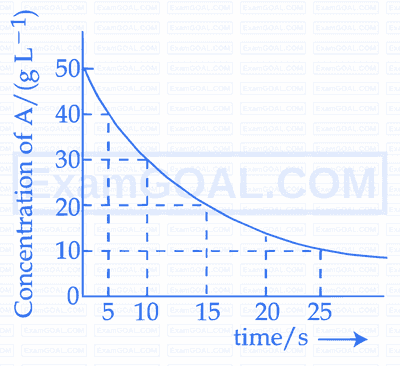
Explanation:
To determine the time required for the concentration of A to decrease from an initial value of $50 \, \mathrm{g} \, \mathrm{L}^{-1}$ to $2.5 \, \mathrm{g} \, \mathrm{L}^{-1}$ in the reaction $ \mathrm{A} \rightarrow \mathrm{B} $, we assume first-order kinetics. Although the graph does not provide a clear indication of the reaction order over the intervals $0-5$, $5-10$, and $10-15$ seconds, where the order appears to be zero, we'll proceed with the assumption of first-order kinetics, since the graph is not a straight line.
The rate constant $ \mathrm{K} $ for first-order reactions can be calculated using the formula:
$ \mathrm{K} = \frac{1}{\mathrm{t}} \ln \frac{\mathrm{A}_0}{\mathrm{A}_{\mathrm{t}}} $
For the interval where $\mathrm{A}_0 = 40 \, \mathrm{g/L}$ and $\mathrm{A}_{\mathrm{t}} = 20 \, \mathrm{g/L}$ after 10 seconds:
$ \mathrm{K} = \frac{1}{10} \ln \frac{40}{20} $
Now, to find the time $ \mathrm{t} $ required for the concentration to reduce to $2.5 \, \mathrm{g/L}$:
$ \mathrm{K} = \frac{1}{\mathrm{t}} \ln \frac{50}{2.5} $
Equating the two expressions for $\mathrm{K}$:
$ \frac{1}{10} \ln 2 = \frac{1}{\mathrm{t}} \ln 20 $
Solving for $\mathrm{t}$:
$ \mathrm{t} = \frac{1.3010 \times 10}{0.3010} = 43.3 \, \mathrm{sec} $
Therefore, the time required for the concentration to decrease to $2.5 \, \mathrm{g/L}$ is approximately 43 seconds.
For the reaction A $\to$ products.

The concentration of A at 10 minutes is _________ $\times 10^{-3} \mathrm{~mol} \mathrm{~L}^{-1}$ (nearest integer). The reaction was started with $2.5 \mathrm{~mol} \mathrm{~L}^{-1}$ of A .
Explanation:
Order of Reaction:
Since $ t_{1/2} \propto [A]_0 $, the reaction follows a zero-order kinetics.
Half-life Equation for Zero-order Reaction:
The half-life ($ t_{1/2} $) is calculated as:
$ t_{1/2} = \frac{[A]_0}{2K} $
Given the slope from the graph is $76.92$, which equals $\frac{1}{2K}$. This implies:
$ K = \frac{1}{2 \times 76.92} $
Concentration of A at 10 Minutes:
Apply the zero-order kinetics equation:
$ [A]_{10} = -Kt + [A]_0 $
Substituting the values:
$ [A]_{10} = -\left(\frac{1}{2 \times 76.92}\right) \times 10 + 2.5 = 2.435 \ \text{mol L}^{-1} $
Final Concentration:
Convert to scientific notation:
$ [A]_{10} = 2435 \times 10^{-3} \ \text{mol L}^{-1} $
Thus, the concentration of A at 10 minutes is approximately $ 2435 \times 10^{-3} \ \text{mol L}^{-1} $.
Consider a complex reaction taking place in three steps with rate constants $\mathrm{k}_1, \mathrm{k}_2$ and $\mathrm{k}_3$ respectively. The overall rate constant $k$ is given by the expression $k=\sqrt{\frac{k_1 k_3}{k_2}}$. If the activation energies of the three steps are 60, 30 and $10 \mathrm{~kJ} \mathrm{~mol}^{-1}$ respectively, then the overall energy of activation in $\mathrm{kJ} \mathrm{mol}^{-1}$ is _________ . (Nearest integer)
Explanation:
To determine the overall energy of activation for the given complex reaction with rate constants $k_1$, $k_2$, and $k_3$, we start with the expression for the overall rate constant $k$:
$ k = \sqrt{\frac{k_1 k_3}{k_2}} $
The rate constant can also be expressed in terms of the Arrhenius equation:
$ A \cdot e^{-E_a / RT} = \sqrt{\frac{A_1 e^{-E_{a_1} / RT} \cdot A_3 e^{-E_{a_3} / RT}}{A_2 e^{-E_{a_2} / RT}}} $
By comparing the exponential terms from both sides, we have:
$ \frac{E_a}{RT} = \frac{1}{2} \left( \frac{E_{a_1}}{RT} + \frac{E_{a_3}}{RT} - \frac{E_{a_2}}{RT} \right) $
This simplifies to:
$ E_a = \frac{E_{a_1} + E_{a_3} - E_{a_2}}{2} $
Substituting the given activation energies—$E_{a_1} = 60 \, \text{kJ mol}^{-1}$, $E_{a_2} = 30 \, \text{kJ mol}^{-1}$, and $E_{a_3} = 10 \, \text{kJ mol}^{-1}$:
$ E_a = \frac{60 + 10 - 30}{2} = \frac{40}{2} = 20 \, \text{kJ mol}^{-1} $
Therefore, the overall energy of activation is 20 kJ/mol.
For the thermal decomposition of $\mathrm{N}_2 \mathrm{O}_5(\mathrm{~g})$ at constant volume, the following table can be formed, for the reaction mentioned below.
$2 \mathrm{~N}_2 \mathrm{O}_5(\mathrm{~g}) \rightarrow 2 \mathrm{~N}_2 \mathrm{O}_4(\mathrm{~g})+\mathrm{O}_2(\mathrm{~g})$
| Sr. No. | Time/s | Total pressure/(atm) |
|---|---|---|
| 1 | 0 | 0.6 |
| 2 | 100 | '$\mathrm{x}$' |
$\mathrm{x}=$ __________ $\times 10^{-3} \mathrm{~atm}$ [nearest integer]
Given : Rate constant for the reaction is $4.606 \times 10^{-2} \mathrm{~s}^{-1}$.
Explanation:
$\begin{aligned} & \mathrm{K}_{\mathrm{N}_2 \mathrm{O}_5}=2 \times 4.606 \times 10^{-2} \mathrm{~S}^{-1} \\ & 2 \mathrm{~N}_2 \mathrm{O}_5(\mathrm{~g}) \longrightarrow 2 \mathrm{~N}_2 \mathrm{O}_4(\mathrm{~g})+\mathrm{O}_2(\mathrm{~g}) \end{aligned}$
$\matrix{ {{P_i}} & {0.6} & 0 & 0 \cr {{P_f}} & {0.6 - P} & P & {{P \over 2}} \cr } $
$\begin{aligned} & 2 \times 4.606 \times 10^{-2}=\frac{2.303}{100} \log \frac{0.6}{0.6-\mathrm{P}} \\ & \quad 4 \log _{10} \frac{0.6}{0.6-\mathrm{P}} \\ & \quad 10^4=\frac{0.6}{0.6-\mathrm{P}} \\ & \Rightarrow 0.6 \times 10^4-10^4 \mathrm{P}=0.6 \end{aligned}$
$\begin{aligned} \begin{aligned} & \Rightarrow 10^4 \mathrm{P}=0.6\left(10^4-1\right) \\ & \mathrm{P}=(6000-0.6) \times 10^{-4} \\ &=5999 . \times 10^{-4} \\ &=0.59994 \\ & \mathrm{P}_{\text {Total }}=0.6+\frac{\mathrm{P}}{2} \\ &= 0.6+0.29997 \\ &= 0.89997 \\ &=899.97 \times 10^{-3} \\ & \text { Ans. } 900 \end{aligned} \end{aligned}$

$\mathrm{P}_{\text {Total }}=0.6+\frac{\mathrm{x}}{2}$
As given in equation
$\mathrm{K}_{\mathrm{r}}=4.606 \times 10^{-2} \mathrm{sec}^{-1}$
(Here language conflict in question)
($\mathrm{K}_{\mathrm{r}}=\frac{\mathrm{KA}}{2}$ not considered)
$\begin{aligned} \mathrm{K}_{\mathrm{r}} \mathrm{t} & =\ln \frac{0.6}{0.6-\mathrm{x}} \\ 4.606 & \times 10^{-2} \times 100=2.303 \log \frac{0.6}{0.6-\mathrm{x}} \\ \mathrm{P}_{\text {Total }} & =0.6+\frac{0.594}{2}=0.897 \mathrm{~atm} \\ \quad & =897 \times 10^{-3} \mathrm{~atm} \end{aligned}$
$\mathrm{A \rightarrow B}$
The molecule A changes into its isomeric form B by following a first order kinetics at a temperature of 1000 K . If the energy barrier with respect to reactant energy for such isomeric transformation is $191.48 \mathrm{~kJ} \mathrm{~mol}^{-1}$ and the frequency factor is $10^{20}$, the time required for $50 \%$ molecules of A to become B is __________ picoseconds (nearest integer). $\left[\mathrm{R}=8.314 \mathrm{~J} \mathrm{~K}^{-1} \mathrm{~mol}^{-1}\right]$
Explanation:
To determine the time required for 50% of molecule A to change into its isomeric form B, follow these steps:
Half-life Formula for First Order Kinetics:
The half-life ($ t_{1/2} $) for a first-order reaction is given by:
$ t_{1/2} = \frac{0.693}{K} $
Calculate the Rate Constant (K):
The rate constant $ K $ can be calculated using the Arrhenius equation:
$ K = A \cdot e^{-\frac{E_a}{RT}} $
Given:
$ A $ (frequency factor) = $ 10^{20} $
$ E_a $ (activation energy) = $ 191.48 \, \text{kJ/mol} = 191.48 \times 10^3 \, \text{J/mol} $
$ R $ (universal gas constant) = $ 8.314 \, \text{J/mol} \cdot \text{K} $
$ T = 1000 \, \text{K} $
Substitute the values into the Arrhenius equation:
$ K = 10^{20} \times e^{-\frac{191.48 \times 10^3}{8.314 \times 1000}} $
Simplify this calculation:
$ K = 10^{20} \times e^{-23.031} $
Simplifying further by recognizing that $ e^{-23.031} $ is a very small number, gives:
$ K \approx \frac{10^{20}}{10^{10}} = 10^{10} \, \text{sec}^{-1} $
Calculate the Half-life:
Using the calculated value of $ K $:
$ t_{1/2} = \frac{0.693}{10^{10}} = 6.93 \times 10^{-11} \, \text{seconds} $
Convert to Picoseconds:
Since $ 1 \, \text{second} = 10^{12} \, \text{picoseconds} $:
$ t_{1/2} = 6.93 \times 10^{-11} \times 10^{12} \, \text{picoseconds} = 69.3 \, \text{picoseconds} $
Therefore, the time required for 50% of the molecules of A to become B is approximately 69 picoseconds (nearest integer).
In a first order decomposition reaction, the time taken for the decomposition of reactant to one fourth and one eighth of its initial concentration are $t_1$ and $t_2$ (s), respectively. The ratio $t_1/t_2$ will be:
$\frac{4}{3}$
$\frac{3}{2}$
$\frac{3}{4}$
$\frac{2}{3}$
A(g) → B(g) + C(g) is a first order reaction.
| Time | t | ∞ |
|---|---|---|
| Psystem | Pt | P∞ |
The reaction was started with reactant A only. Which of the following expressions is correct for rate constant k?

A person's wound was exposed to some bacteria and then bacterial growth started to happen at the same place. The wound was later treated with some antibacterial medicine and the rate of bacterial decay(r) was found to be proportional with the square of the existing number of bacteria at any instance. Which of the following set of graphs correctly represents the 'before' and 'after' situation of the application of the medicine?
[Given: $N=$ No. of bacteria, $t=$ time, bacterial growth follows $1^{\text {st }}$ order kinetics.]


Reaction $\mathrm{A}(\mathrm{g}) \rightarrow 2 \mathrm{~B}(\mathrm{~g})+\mathrm{C}(\mathrm{g})$ is a first order reaction. It was started with pure A
| t/min | Pressure of system at time t/mm Hg |
|---|---|
| 10 | 160 |
| $\infty$ | 240 |
Which of the following option is incorrect?

Consider the following plots of $\log$ of rate constant $\mathrm{k}(\log \mathrm{k})$ vs $\frac{1}{\mathrm{~T}}$ for three different reactions. The correct order of activation energies of these reactions is :

Half life of zero order reaction $\mathrm{A} \rightarrow$ product is 1 hour, when initial concentration of reactant is $2.0 \mathrm{~mol} \mathrm{~L}{ }^{-1}$. The time required to decrease concentration of A from 0.50 to $0.25 \mathrm{~mol} \mathrm{~L}^{-1}$ is :
For $\mathrm{A}_2+\mathrm{B}_2 \rightleftharpoons 2 \mathrm{AB}$
$\mathrm{E}_{\mathrm{a}}$ for forward and backward reaction are 180 and $200 \mathrm{~kJ} \mathrm{~mol}^{-1}$ respectively
If catalyst lowers $\mathrm{E}_{\mathrm{a}}$ for both reaction by $100 \mathrm{~kJ} \mathrm{~mol}^{-1}$.
Which of the following statement is correct?
Rate law for a reaction between $A$ and $B$ is given by
$\mathrm{r}=\mathrm{k}[\mathrm{~A}]^{\mathrm{n}}[\mathrm{~B}]^{\mathrm{m}}$
If concentration of $A$ is doubled and concentration of $B$ is halved from their initial value, the ratio of new rate of reaction to the initial rate of reaction $\left(\frac{r_2}{r_1}\right)$ is
Consider the following statements related to temperature dependence of rate constants.
Identify the correct statements.
A. The Arrhenius equation holds true only for an elementary homogenous reaction.
B. The unit of $A$ is same as that of $k$ in Arrhenius equation.
C. At a given temperature, a low activation energy means a fast reaction.
D. A and Ea as used in Arrhenius equation depend on temperature.
E. When $\mathrm{Ea} \gg \mathrm{RT}, \mathrm{A}$ and Ea become interdependent.
Choose the correct answer from the options given below:
In a reaction $A+B \rightarrow C$, initial concentrations of $A$ and $B$ are related as $[A]_0=8[B]_0$. The half lives of $A$ and $B$ are 10 min and 40 min , respectively. If they start to disappear at the same time, both following first order kinetics, after how much time will the concentration of both the reactants be same?
Reactant A converts to product D through the given mechanism (with the net evolution of heat):
A → B slow; ΔH = +ve
B → C fast; ΔH = -ve
C → D fast; ΔH = -ve
Which of the following represents the above reaction mechanism?


Drug $X$ becomes ineffective after $50 \%$ decomposition. The original concentration of drug in a bottle was $16 \mathrm{mg} / \mathrm{mL}$ which becomes $4 \mathrm{mg} / \mathrm{mL}$ in 12 months. The expiry time of the drug in months is _________.
Assume that the decomposition of the drug follows first order kinetics.
12
3
6
2
The reaction $A_2 + B_2 \rightarrow 2AB$ follows the mechanism:
$A_2 \overset{k_1}{\underset{k_{-1}}{\rightleftharpoons}} A + A$ (fast)
$A + B_2 \xrightarrow{k_2} AB + B$ (slow)
$A + B \rightarrow AB$ (fast)
The overall order of the reaction is:
3
2.5
1.5
2
Consider an elementary reaction
$ \mathrm{A}(\mathrm{~g})+\mathrm{B}(\mathrm{~g}) \rightarrow \mathrm{C}(\mathrm{~g})+\mathrm{D}(\mathrm{~g}) $
If the volume of reaction mixture is suddenly reduced to $\frac{1}{3}$ of its initial volume, the reaction rate will become ' $x^{\prime}$ times of the original reaction rate. The value of $x$ is :
3
9
$\frac{1}{3}$
$\frac{1}{9}$
For bacterial growth in a cell culture, growth law is very similar to the law of radioactive decay. Which of the following graphs is most suitable to represent bacterial colony growth ?
Where N - Number of Bacteria at any time, $\mathrm{N}_0$ - Initial number of Bacteria.


For a given reaction $\mathrm{R} \rightarrow \mathrm{P}, \mathrm{t}_{1 / 2}$ is related to $[\mathrm{A}]_0$ as given in table.
Given: $\log 2=0.30$
Which of the following is true?
A. The order of the reaction is $1 / 2$.
B. If $[\mathrm{A}]_0$ is 1 M , then $\mathrm{t}_{1 / 2}$ is $200 \sqrt{10} \mathrm{~min}$
C. The order of the reaction changes to 1 if the concentration of reactant changes from 0.100 M to 0.500 M.
D. $\mathrm{t}_{1 / 2}$ is 800 min for $[\mathrm{A}]_0=1.6 \mathrm{M}$
Choose the correct answer from the options given below: