Chemical Kinetics and Nuclear Chemistry
O3(g) + Cl${^ \bullet }$ (g) $ \to $ O2(g) + ClO${^ \bullet }$ (g) . . . . . .(i)
ki = 5.2 × 10⁹ L mol−1 s−1
ClO${^ \bullet }$(g) + O${^ \bullet }$(g) $ \to $ O2(g) + Cl${^ \bullet }$ (g) . . . . . . (ii)
kii = 2.6 × 10¹⁰ L mol−1 s−1
The closest rate constant for the overall reaction O3(g) + O${^ \bullet }$ (g) $ \to $ 2 O2(g) is :


Explanation:
${}_{92}{U^{238}} \to {}_{82}P{b^{206}} + 8\,{}_2H{e^4}(g) + 6{}_{ - 1}{\beta ^0}$
To calculate pressure, only gaseous products need to be considered.
Initially, only 1 mol of air is present and finally, after complete decay, 8 moles of $_2^4He$ gas are produced and 1 mol of air will also remain in the mixture.
Ratio of the final pressure to the initial pressure $ = {{8 + 1} \over 1} = 9$
Explanation:
In complex, $\mathop {{{[Fe{{({C_2}{O_4})}_2}{{({H_2}O)}_2}]}^{2 - }}}\limits_{Diaquodioxalatoferrate\,(II)} $,
Fe is in +2 oxidation state.
In acidic medium, $KMn{O_4}$ oxidises $F{e^{2 + }}$ to $F{e^{3 + }}$,
$2MnO_4^ - + 16{H^ + } + 10F{e^{2 + }} \to 2M{n^{2 + }} + 8{H_2}O + 10F{e^{3 + }}$
or $MnO_4^ - + 8{H^ + } + 5F{e^{2 + }} \to M{n^{2 + }} + 4{H_2}O + 5F{e^{3 + }}$
${{Rate\,of\,change\,of\,[{H^ + }]} \over {Rate\,of\,change\,of\,[MnO_4^ - ]}} = {8 \over 1} = 8$
The % yield of ammonia as a function of time in the reaction
N2(g) + 3H2(g) $\rightleftharpoons$ 2NH3(g), $\Delta$H < 0 at (P, T1) is given below:

If this reactions is conducted at (P, T2), with T2 > T1, the % yield of ammonia as a function of time is represented by


| Initial Concentration (A) | Initial Concentration (B) | Initial rate of formation of C (mol L-1 s-1) |
|---|---|---|
| 0.1 M | 0.1 M | 1.2 x 10⁻³ |
| 0.1 M | 0.2 M | 1.2 x 10⁻³ |
| 0.2 M | 0.1 M | 2.4 x 10⁻³ |
The experimental value of d is found to be smaller than the estimate obtained using Graham's law. This is due to
In the reaction, P + Q $\to$ R + S, the time taken for 75% reaction of P is twice the time taken for 50% reaction of P. The concentration of Q varies with reaction time as shown in the figure. The overall order of the reaction is

9Be4 + X $\to$ 8Be4 + Y
(X, Y) is (are) :
Explanation:
$ t=\frac{2.303}{k} \log \frac{\left[\mathrm{A}_0\right]}{[\mathrm{A}]} $
When the compound is decomposed to $1 / 8$ th of its initial value then the time taken is
$ t_{1 / 8}=\left(\frac{2.303}{k}\right) \log \frac{1}{(1 / 8)}=\left(\frac{2.303}{k}\right) \log 8 $ .........(1)
When the compound is decomposed to $1 / 10$ th of its initial value then the time taken is
$ t_{1 / 10}=\left(\frac{2.303}{k}\right) \log \frac{1}{(1 / 10)}=\left(\frac{2.303}{k}\right) \log 10 $ ........(2)
Dividing Eq. (1) by Eq. (2), we get
$ \frac{t_{1 / 8}}{t_{1 / 10}}=\frac{\log 8}{\log 10}=\log \left(2^3\right)=3 \times 0.3=0.9 $
So, the value of
$ \frac{\left[t_{1 / 8}\right]}{\left[t_{1 / 10}\right]} \times 10=9 $
${}_{29}^{63}Cu$ + ${}_1^1H$ $\to$ $6{}_0^1n$ + ${}_2^4\alpha $ + 2${}_1^1H$ + X
Explanation:
$ { }_{29}^{63} \mathrm{Cu}+{ }_1^1 \mathrm{H} \rightarrow 6{ }_0^1 n+{ }_2^4 \mathrm{He}+2{ }_1^1 \mathrm{H}+\mathrm{X} $
Equating mass numbers on both the sides, we get
$ 63+1=1 \times 6+4 \times 1+1 \times 2 + X$
$ \Rightarrow $ $X=64-12=52 $
Equating atomic numbers on both the sides, we get
$ 29+1=6 \times 0+2+2 \times 1+\mathrm{Y} $
$\Rightarrow \mathrm{Y}=30-4=26 $
So, the element is ${ }_{26}^{52} \mathrm{Fe}$ and iron is a $d$-block element, which belongs to Group 8 of the periodic table.
Bombardment of aluminium by $\alpha$-particle leads to its artificial disintegration in two ways : (i) and (ii) as shown. Products X, Y and Z, respectively, are

2N2O5 (g) $\to$ 4NO2 (g) + O2 (g)
Consider the reaction :
Cl2(aq) + H2S(aq) → S(s) + 2H+ (aq) + 2Cl– (aq)
The rate equation for this reaction is rate = k [Cl2] [H2S]
Which of these mechanisms is/are consistent with this rate equation?
(A) Cl2 + H2S $\to$ H+ + Cl– + Cl+ + HS– (slow)
Cl+ + HS– $\to$ H+ + Cl– + S (fast)
(B) H2S $ \Leftrightarrow $ H+ + HS– (fast equilibrium)
Cl2 + HS– $\to$ 2Cl– + H+ + S (slow)
Explanation:
To determine the number of neutrons emitted during the nuclear fission of ${}_{92}^{235}U$ resulting in the products ${}_{54}^{142}Xe$ and ${}_{38}^{90}Sr$, we need to ensure the conservation of mass number and atomic number.
The mass number (A) and atomic number (Z) have to be conserved. This means that the sum of the mass numbers and atomic numbers of the products (including any neutrons emitted) must equal those of the uranium nucleus undergoing fission.
Let's start by writing down the conservation of mass number and atomic number:
- Conservation of Mass Number:
${235 = 142 + 90 + n \times 1}$
Here, $n$ represents the number of neutrons released. We can now calculate $n$:
$ n = 235 - (142 + 90) = 235 - 232 = 3 $
- Conservation of Atomic Number:
${92 = 54 + 38 + 0 \times n}$
Neutrons do not contribute to the atomic number as they have no charge.
This calculation shows that three neutrons are needed to satisfy the conservation of mass number. The atomic number conservation also coincides, as neutrons do not alter it. Therefore, the number of neutrons emitted during this fission process is $3$.
| [R] molar | 1.0 | 0.75 | 0.40 | 0.10 |
|---|---|---|---|---|
| t (min.) | 0.0 | 0.05 | 0.12 | 0.18 |
Plots showing the variation of the rate constant ($k$) with temperature ($T$) are given below. The point that follows Arrhenius equation is


The total number of $\alpha$ and $\beta$ particles emitted in the nuclear reaction $_{92}^{238}U \to _{82}^{214}Pb$ is _________.
Explanation:
$ { }_{92}^{238} \mathrm{U} \longrightarrow{ }_{82}^{214} \mathrm{~Pb} $
It is also written as

So, to find the alpha particle you can solve it by atomic mass of $\mathrm{Pb}$
$ =\text { Atomic mass of } \mathrm{U}-4 a $
Atomic mass of $U=238$
Atomic mass of $\mathrm{Pb}=214$
So, by putting the values in equation (i), you will get
$ 206=238-4 a $
$ \begin{aligned} \therefore \alpha & =\frac{238-214}{4} =6 \end{aligned} $
Now, find the beta particle by using formula
Atomic number of $\mathrm{U}=$ Atomic number of $\mathrm{Pb}+2 \alpha+\beta$.
Where, atomic no. of $U$ is 92 and atomic no. of $\mathrm{Pb}$ is 82 and the value of $\alpha$ that we have find is 6. By putting the values you will get.
$ 92=82+2 \times 6=\beta $
Therefore, $ \beta=92-94=2$
Thus, the number of alpha and beta particles is 6 and 2.
For a first-order reaction A $\to$ P, the temperature (T) dependent rate constant (k) was found to follow the equation $\log k = - (2000){1 \over T} + 6.0$. The pre-exponential factor A and activation energy $E_a$, respectively, are
Under the same reaction conditions, initial concentration of 1.386 mol dm$^{-3}$ of a substance becomes half in 40 seconds and 20 seconds through first order and zero order kinetics, respectively. Ratio $\left( {{{{k_1}} \over {{k_0}}}} \right)$ of the rate constants for first order ($k_1$) and zero order ($k_0$) of the reactions is:
$$k = A\,{e^{ - E/RT}}$$ In this equation, E represents
NO(g) + Br2 (g) $\leftrightharpoons$ NOBr2 (g)
NOBr2 (g) + NO (g) $\to$ 2NOBr (g)
If the second step is the rate determining step, the order of the reaction with respect to NO(g) is
Which of the following option is correct?
In living organisms, circulation of ${ }^{14} \mathrm{C}$ from atmosphere is high, so the carbon content is constant in organism.
Carbon dating can be used to find out the age of earth crust and rocks.
Radioactive absorption due to cosmic radiation is equal to the rate of radioactive decay; hence, the carbon content remains constant in living organism.
Carbon dating cannot be used to determine concentration of ${ }^{14} \mathrm{C}$ in dead beings.
What should be the age of fossil for meaningful determination of its age?
6 years
6000 years
60,000 years
It can be used to calculate any age
A nuclear explosion has taken place leading to increase in concentration of ${ }^{14} \mathrm{C}$ in nearby areas. ${ }^{14} \mathrm{C}$ concentration is $\mathrm{C}_1$ in nearby areas and $C_2$ in areas far away. If the age of the fossil is determined to be $T_1$ and $T_2$ at the places respectively then,
The age of the fossil will increase at the place where explosion has taken place and $\mathrm{T}_1-\mathrm{T}_2=\frac{1}{\lambda} \ln \frac{\mathrm{C}_1}{\mathrm{C}_2}$.
The age of the fossil will decrease at the place where explosion has taken place and $\mathrm{T}_1-\mathrm{T}_2=\frac{1}{\lambda} \ln \frac{\mathrm{C}_1}{\mathrm{C}_2}$.
The age of fossil will be determined to be the same.
$\frac{\mathrm{T}_1}{\mathrm{~T}_2}=\frac{\mathrm{C}_1}{\mathrm{C}_2}$.
$ \text { Match Column I with Column II : } $
| Column I | Column II | ||
|---|---|---|---|
| (A) | $\mathrm{CH}_3-\mathrm{CHBr}-\mathrm{CD}_3$ on treatment with alc. KOH gives $\mathrm{CH}_2=\mathrm{CH}-\mathrm{CD}_3$ as a major product. | (P) | E1 reaction |
| (B) | $ \begin{aligned} &\mathrm{Ph}-\mathrm{CHBr}-\mathrm{CH}_3\\ &\text { reacts faster than }\\ &\mathrm{Ph}-\mathrm{CHBr}-\mathrm{CD}_3 . \end{aligned} $ |
(Q) | E2 reaction |
| (C) | $ \mathrm{Ph}-\mathrm{CH}_2-\mathrm{CH}_2 \mathrm{Br} $ on treatment with $ \mathrm{C}_2 \mathrm{H}_5 \mathrm{OD} / \mathrm{C}_2 \mathrm{H}_5 \mathrm{O}^{-} $ gives $\mathrm{Ph}-\mathrm{CD}=\mathrm{CH}_2$ as the major product. |
(R) | E1 cb reaction |
| (D) | $\mathrm{PhCH}_2, \mathrm{CH}_2 \mathrm{Br}$ and $\mathrm{PhCD}_2 \mathrm{CH}_2 \mathrm{Br}$ react with same rate. | (S) | First order reaction |
$ [\mathrm{A} \rightarrow(\mathrm{Q}) ; \mathrm{B} \rightarrow(\mathrm{Q}) ; \mathrm{C} \rightarrow( \mathrm{~S}) ; \mathrm{D} \rightarrow(\mathrm{P}, \mathrm{~S})] .$
$ [\mathrm{A} \rightarrow(\mathrm{Q}) ; \mathrm{B} \rightarrow(\mathrm{Q}) ; \mathrm{C} \rightarrow(\mathrm{R}, \mathrm{~S}) ; \mathrm{D} \rightarrow(\mathrm{P})] .$
$ [\mathrm{A} \rightarrow(\mathrm{Q}) ; \mathrm{B} \rightarrow(\mathrm{Q}) ; \mathrm{C} \rightarrow(\mathrm{R}, \mathrm{~S}) ; \mathrm{D} \rightarrow(\mathrm{P}, \mathrm{~S})] .$
$ [\mathrm{A} \rightarrow(\mathrm{Q}, P) ; \mathrm{B} \rightarrow(\mathrm{Q}) ; \mathrm{C} \rightarrow(\mathrm{R}, \mathrm{~S}) ; \mathrm{D} \rightarrow(\mathrm{P}, \mathrm{~S})] .$

 Note: The bond between C and deuterium is much strong than that of C and H , hence, elimination takes place from $\mathrm{C}-\mathrm{H}$ bonds only. This chemical reaction undergoes E2 mechanism as two substituents, H and Br atoms are removed simultaneously from the compound to form alkene.

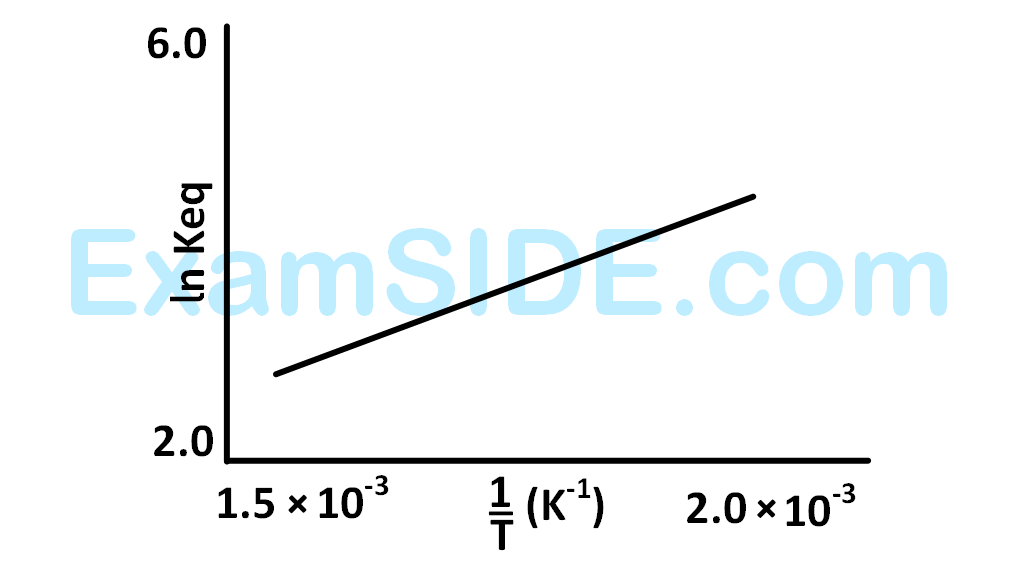
The reaction must be
| Observation No. | Time (in minute) | Px (in mm of Hg) |
|---|---|---|
| 1 | 0 | 800 |
| 2 | 100 | 400 |
| 3 | 200 | 200 |
(i) What is the order of the reaction to X?
(ii) Find the rate constant
(iii) Find the time for 75% completion of the reaction.
(iv) Find the total pressure when pressure of X is 700 mm of Hg
Explanation:
The given reaction is : 2X(g) $\to$ 3Y(g) + 2Z(g)
(1) Partial pressure (of X) trend :
800 mm Hg $\buildrel {100\,\min } \over \longrightarrow $ 400 mm Hg $\buildrel {100\,\min } \over \longrightarrow $ 200 mm Hg Half-life is constant, hence, it is a first order reaction.
(2) For a first order reaction, rate constant $k = {{0.693} \over {half - life}}$
or, $k = {{0.693} \over {100}} = 6.93 \times {10^{ - 3}}$ min$-$1
(3) Time required for the completion of 75% of the reaction is equal to 2 half lives. Hence, Time taken = (2 $\times$ 100) = 200 min
(4) 
$\therefore$ Total pressure = (700 + 150 + 100) mm Hg = 950 mm Hg