JEE Mains
2026
MCQ
An organic compound undergoes first order decomposition. The time taken for decomposition to $\left(\frac{1}{8}\right)^{\text {th }}$ and $\left(\frac{1}{10}\right)^{\text {th }}$ of its initial concentration are $\mathrm{t}_{1 / 8}$ and $\mathrm{t}_{1 / 10}$ respectively.
What is the value of $\frac{\mathrm{t}_{1 / 8}}{\mathrm{t}_{1 / 10}} \times 10$ ?
$ (\log 2=0.3) $
JEE Mains
2026
MCQ
$\mathrm{A} \rightarrow \mathrm{D}$ is an endothermic reaction occurring in three steps (elementary).
(i) $\mathrm{A} \rightarrow \mathrm{B} \Delta \mathrm{H}_i=+\mathrm{ve}$
(ii) $\mathrm{B} \rightarrow \mathrm{C} \Delta \mathrm{H}_{i i}=-\mathrm{ve}$
(iii) $\mathrm{C} \rightarrow \mathrm{D} \Delta \mathrm{H}_{i i i}=-\mathrm{ve}$
Which of the following graphs between potential energy ( $y$-axis) vs reaction coordinate ( $x$-axis) correctly represents the reaction profile of $A \rightarrow D$ ?
JEE Mains
2026
MCQ
At $27^{\circ} \mathrm{C}$ in presence of a catalyst, activation energy of a reaction is lowered by $10 \mathrm{~kJ} \mathrm{~mol}^{-1}$. The logarithm of ratio of $\frac{\mathrm{k} \text { (catalysed) }}{\mathrm{k} \text { (uncatalysed) }}$ is….
(Consider that the frequency factor for both the reactions is same)
JEE Mains
2026
MCQ

Given above is the concentration vs time plot for a dissociation reaction : $\mathrm{A} \rightarrow \mathrm{nB}$.
Based on the data of the initial phase of the reaction (initial 10 min ), the value of n is $\_\_\_\_$ .
JEE Mains
2026
MCQ
Observe the following reactions at $\mathrm{T}(\mathrm{K})$.
I. $\mathrm{A} \rightarrow$ products.
II. $5 \mathrm{Br}^{-}(\mathrm{aq})+\mathrm{BrO}_3{ }^{-}(\mathrm{aq})+6 \mathrm{H}^{+}(\mathrm{aq}) \rightarrow 3 \mathrm{Br}_2(\mathrm{aq})+3 \mathrm{H}_2 \mathrm{O}(\mathrm{l})$
Both the reactions are started at 10.00 am . The rates of these reactions at 10.10 am are same. The value of $-\frac{\Delta\left[\mathrm{Br}^{-}\right]}{\Delta \mathrm{t}}$ at 10.10 am is $2 \times 10^{-4} \mathrm{~mol} \mathrm{~L}^{-1} \mathrm{~min}^{-1}$. The concentration of A at 10.10 am is $10^{-2} \mathrm{~mol} \mathrm{~L}^{-1}$. What is the first order rate constant (in $\mathrm{min}^{-1}$ ) of reaction $I$ ?
JEE Mains
2026
MCQ
Correct statements regarding Arrhenius equation among the following are :
A. Factor $e^{-\mathrm{Ea} / \mathrm{RT}}$ corresponds to fraction of molecules having kinetic energy less than Ea.
B. At a given temperature, lower the Ea, faster is the reaction.
C. Increase in temperature by about $10^{\circ} \mathrm{C}$ doubles the rate of reaction.
D. Plot of $\log \mathrm{k}$ vs $\frac{1}{\mathrm{~T}}$ gives a straight line with slope $=-\frac{\mathrm{Ea}}{\mathrm{R}}$.
Choose the correct answer from the options given below :
JEE Mains
2026
MCQ
$\mathrm{A} \rightarrow$ product (First order reaction).
Three sets of experiment were performed for a reaction under similar experimental conditions:
Run $1 \Rightarrow 100 \mathrm{~mL}$ of 10 M solution of reactant A
Run $2 \Rightarrow 200 \mathrm{~mL}$ of 10 M solution of reactant A
Run $3 \Rightarrow 100 \mathrm{~mL}$ of 10 M solution of reactant $\mathrm{A}+100 \mathrm{~mL}$ of $\mathrm{H}_2 \mathrm{O}$ added.
The correct variation of rate of reaction is
JEE Mains
2026
MCQ
Decomposition of A is a first order reaction at T(K) and is given by A(g) → B(g) + C(g).
In a closed 1 L vessel, 1 bar A(g) is allowed to decompose at T(K). After 100 minutes, the total pressure was 1.5 bar. What is the rate constant (in min−1) of the reaction? (log 2 = 0.3)
JEE Mains
2026
MCQ
Given below are two statements :
$ \mathrm{R}=8.314 \mathrm{~J} \mathrm{~K}^{-1} \mathrm{~mol}^{-1} \text { and } 1 \mathrm{cal}=4.2 \mathrm{~J} $
Statement I : When $\mathrm{Ea}=12.6 \mathrm{kcal} / \mathrm{mol}$, the room temperature rate constant is doubled by a $10^{\circ} \mathrm{C}$ increase in temperature ( 298 K to 308 K )
Statement II : For a first order reactions $\mathrm{A} \rightarrow \mathrm{B}$,

Here $[A]_0$ is the initial concentration of $A$ and $t_{1 / 2}$ is half life of reaction.
In the light of the above statements, choose the correct answer from the options given below :
JEE Mains
2026
MCQ
First order gas phase reaction
$ \mathrm{A} \rightarrow \mathrm{~B}+\mathrm{C} $
$p_t=$ initial pressure of gas $\mathrm{A}, p_t=$ total pressure of the reaction mixture at time $t$
Expression of rate constant ( $k$ ) is
JEE Mains
2026
MCQ
Consider the given graph showing variation of reactant concentration with time.
Three different reactions were started with identical initial concentration of reactants. Which of the following statement is correct?

JEE Mains
2026
MCQ
Consider the first order reaction $\mathrm{R} \rightarrow \mathrm{P}$.
The fraction of molecules decomposed in the given first order reaction can be expressed as
JEE Mains
2026
MCQ
Consider the reaction aX → bY, for which the rate constant at 30°C is $1 \times 10^{-3}\ \text{mol}^{-1}\ \text{L}\ \text{s}^{-1}$. Which of the following statements are true?
A. When concentration of ‘X’ is increased to four times, the rate of reaction becomes 16 times.
B. The reaction is a second order reaction.
C. The half-life period is independent of the concentration of X.
D. Decomposition of N$_2$O$_5$ is an example of the above reaction.
E.  vs time is valid for the above reaction.
Choose the correct answer from the options given below:
JEE Mains
2026
MCQ
t100% is the time required for the 100% completion of the reaction while t1/2 is the time required for 50% of the reaction to be completed. Which of the following option correctly represents the relation between t100% and t1/2 for zero and first order reactions respectively?
JEE Mains
2025
MCQ
In a first order decomposition reaction, the time taken for the decomposition of reactant to one fourth and one eighth of its initial concentration are $t_1$ and $t_2$ (s), respectively. The ratio $t_1/t_2$ will be:
JEE Mains
2025
MCQ
A(g) → B(g) + C(g) is a first order reaction.
The reaction was started with reactant A only. Which of the following expressions is correct for rate constant k?
JEE Mains
2025
MCQ
A person's wound was exposed to some bacteria and then bacterial growth started to happen at the same place. The wound was later treated with some antibacterial medicine and the rate of bacterial decay(r) was found to be proportional with the square of the existing number of bacteria at any instance. Which of the following set of graphs correctly represents the 'before' and 'after' situation of the application of the medicine?
[Given: $N=$ No. of bacteria, $t=$ time, bacterial growth follows $1^{\text {st }}$ order kinetics.]
JEE Mains
2025
MCQ
Reaction $\mathrm{A}(\mathrm{g}) \rightarrow 2 \mathrm{~B}(\mathrm{~g})+\mathrm{C}(\mathrm{g})$ is a first order reaction. It was started with pure A
| t/min |
Pressure of system at time t/mm Hg |
| 10 |
160 |
| $\infty$ |
240 |
Which of the following option is incorrect?
JEE Mains
2025
MCQ
Consider the following plots of $\log$ of rate constant $\mathrm{k}(\log \mathrm{k})$ vs $\frac{1}{\mathrm{~T}}$ for three different reactions. The correct order of activation energies of these reactions is :

JEE Mains
2025
MCQ
Half life of zero order reaction $\mathrm{A} \rightarrow$ product is 1 hour, when initial concentration of reactant is $2.0 \mathrm{~mol} \mathrm{~L}{ }^{-1}$. The time required to decrease concentration of A from 0.50 to $0.25 \mathrm{~mol} \mathrm{~L}^{-1}$ is :
JEE Mains
2025
MCQ
For $\mathrm{A}_2+\mathrm{B}_2 \rightleftharpoons 2 \mathrm{AB}$
$\mathrm{E}_{\mathrm{a}}$ for forward and backward reaction are 180 and $200 \mathrm{~kJ} \mathrm{~mol}^{-1}$ respectively
If catalyst lowers $\mathrm{E}_{\mathrm{a}}$ for both reaction by $100 \mathrm{~kJ} \mathrm{~mol}^{-1}$.
Which of the following statement is correct?
JEE Mains
2025
MCQ
Rate law for a reaction between $A$ and $B$ is given by
$\mathrm{r}=\mathrm{k}[\mathrm{~A}]^{\mathrm{n}}[\mathrm{~B}]^{\mathrm{m}}$
If concentration of $A$ is doubled and concentration of $B$ is halved from their initial value, the ratio of new rate of reaction to the initial rate of reaction $\left(\frac{r_2}{r_1}\right)$ is
JEE Mains
2025
MCQ
Consider the following statements related to temperature dependence of rate constants.
Identify the correct statements.
A. The Arrhenius equation holds true only for an elementary homogenous reaction.
B. The unit of $A$ is same as that of $k$ in Arrhenius equation.
C. At a given temperature, a low activation energy means a fast reaction.
D. A and Ea as used in Arrhenius equation depend on temperature.
E. When $\mathrm{Ea} \gg \mathrm{RT}, \mathrm{A}$ and Ea become interdependent.
Choose the correct answer from the options given below:
JEE Mains
2025
MCQ
In a reaction $A+B \rightarrow C$, initial concentrations of $A$ and $B$ are related as $[A]_0=8[B]_0$. The half lives of $A$ and $B$ are 10 min and 40 min , respectively. If they start to disappear at the same time, both following first order kinetics, after how much time will the concentration of both the reactants be same?
JEE Mains
2025
MCQ
Reactant A converts to product D through the given mechanism (with the net evolution of heat):
A → B slow; ΔH = +ve
B → C fast; ΔH = -ve
C → D fast; ΔH = -ve
Which of the following represents the above reaction mechanism?
JEE Mains
2025
MCQ
Drug $X$ becomes ineffective after $50 \%$ decomposition. The original concentration of drug in a bottle was $16 \mathrm{mg} / \mathrm{mL}$ which becomes $4 \mathrm{mg} / \mathrm{mL}$ in 12 months. The expiry time of the drug in months is _________.
Assume that the decomposition of the drug follows first order kinetics.
JEE Mains
2025
MCQ
The reaction $A_2 + B_2 \rightarrow 2AB$ follows the mechanism:
$A_2 \overset{k_1}{\underset{k_{-1}}{\rightleftharpoons}} A + A$ (fast)
$A + B_2 \xrightarrow{k_2} AB + B$ (slow)
$A + B \rightarrow AB$ (fast)
The overall order of the reaction is:
JEE Mains
2025
MCQ
Consider an elementary reaction
$ \mathrm{A}(\mathrm{~g})+\mathrm{B}(\mathrm{~g}) \rightarrow \mathrm{C}(\mathrm{~g})+\mathrm{D}(\mathrm{~g}) $
If the volume of reaction mixture is suddenly reduced to $\frac{1}{3}$ of its initial volume, the reaction rate will become ' $x^{\prime}$ times of the original reaction rate. The value of $x$ is :
JEE Mains
2025
MCQ
For bacterial growth in a cell culture, growth law is very similar to the law of radioactive decay. Which of the following graphs is most suitable to represent bacterial colony growth ?
Where N - Number of Bacteria at any time, $\mathrm{N}_0$ - Initial number of Bacteria.
JEE Mains
2025
MCQ

For a given reaction $\mathrm{R} \rightarrow \mathrm{P}, \mathrm{t}_{1 / 2}$ is related to $[\mathrm{A}]_0$ as given in table.
Given: $\log 2=0.30$
Which of the following is true?
A. The order of the reaction is $1 / 2$.
B. If $[\mathrm{A}]_0$ is 1 M , then $\mathrm{t}_{1 / 2}$ is $200 \sqrt{10} \mathrm{~min}$
C. The order of the reaction changes to 1 if the concentration of reactant changes from 0.100 M to 0.500 M.
D. $\mathrm{t}_{1 / 2}$ is 800 min for $[\mathrm{A}]_0=1.6 \mathrm{M}$
Choose the correct answer from the options given below:
JEE Mains
2025
MCQ
Given below are two statements :
Statement (I) :  is valid for first order reaction.
Statement (II) :  is valid for first order reaction.
In the light of the above statements, choose the correct answer from the options given below :
JEE Mains
2025
MCQ
For a reaction, $\mathrm{N}_2 \mathrm{O}_{5(\mathrm{~g})} \rightarrow 2 \mathrm{NO}_{2(\mathrm{~g})}+\frac{1}{2} \mathrm{O}_{2(\mathrm{~g})}$ in a constant volume container, no products were present initially. The final pressure of the system when $50 \%$ of reaction gets completed is
JEE Mains
2025
MCQ
Which of the following graphs most appropriately represents a zero order reaction?
JEE Mains
2025
MCQ
Consider the given figure and choose the correct option :

JEE Mains
2025
MCQ
Which of the following statement is not true for radioactive decay?
JEE Mains
2024
MCQ
For a reaction $A \xrightarrow{\mathrm{K}_1} \mathrm{~B} \xrightarrow{\mathrm{K}_2} \mathrm{C}$
If the rate of formation of B is set to be zero then the concentration of B is given by :
JEE Mains
2024
MCQ
Integrated rate law equation for a first order gas phase reaction is given by (where $\mathrm{P}_{\mathrm{i}}$ is initial pressure and $\mathrm{P}_{\mathrm{t}}$ is total pressure at time $t$)
JEE Mains
2023
MCQ
For a chemical reaction $\mathrm{A}+\mathrm{B} \rightarrow$ Product, the order is 1 with respect to $\mathrm{A}$ and $\mathrm{B}$.
$\mathrm{Rate}$
$\mathrm{mol~L^{-1}~S^{-1}}$ |
$\mathrm{[A]}$
$\mathrm{mol~L^{-1}}$ |
$\mathrm{[B]}$
$\mathrm{mol~L^{-1}}$ |
| 0.10 |
20 |
0.5 |
| 0.40 |
$x$ |
0.5 |
| 0.80 |
40 |
$y$ |
What is the value of $x$ and $y$ ?
JEE Mains
2023
MCQ
The correct reaction profile diagram for a positive catalyst reaction.
JEE Mains
2023
MCQ
Consider the following reaction that goes from A to B in three steps as shown below:

Choose the correct option
JEE Mains
2023
MCQ
A student has studied the decomposition of a gas AB$_3$ at 25$^\circ$C. He obtained the following data.
| p (mm Hg) |
50 |
100 |
200 |
400 |
| relative t$_{1/2}$ (s) |
4 |
2 |
1 |
0.5 |
The order of the reaction is
JEE Mains
2022
MCQ
For kinetic study of the reaction of iodide ion with $\mathrm{H}_{2} \mathrm{O}_{2}$ at room temperature :
(A) Always use freshly prepared starch solution.
(B) Always keep the concentration of sodium thiosulphate solution less than that of KI solution.
(C) Record the time immediately after the appearance of blue colour.
(D) Record the time immediately before the appearance of blue colour.
(E) Always keep the concentration of sodium thiosulphate solution more than that of KI solution.
Choose the correct answer from the options given below :
JEE Mains
2022
MCQ
At $30^{\circ} \mathrm{C}$, the half life for the decomposition of $\mathrm{AB}_{2}$ is $200 \mathrm{~s}$ and is independent of the initial concentration of $\mathrm{AB}_{2}$. The time required for $80 \%$ of the $\mathrm{AB}_{2}$ to decompose is
Given: $\log 2=0.30$ $\quad \log 3=0.48$
JEE Mains
2022
MCQ
For a first order reaction, the time required for completion of 90% reaction is 'x' times the half life of the reaction. The value of 'x' is
(Given : ln 10 = 2.303 and log 2 = 0.3010)
JEE Mains
2021
MCQ
Which one of the following given graphs represents the variation of rate constant (k) with temperature (T) for an endothermic reaction?
JEE Mains
2021
MCQ
For a reaction of order n, the unit of the rate constant is :
JEE Mains
2021
MCQ
For the following graphs,
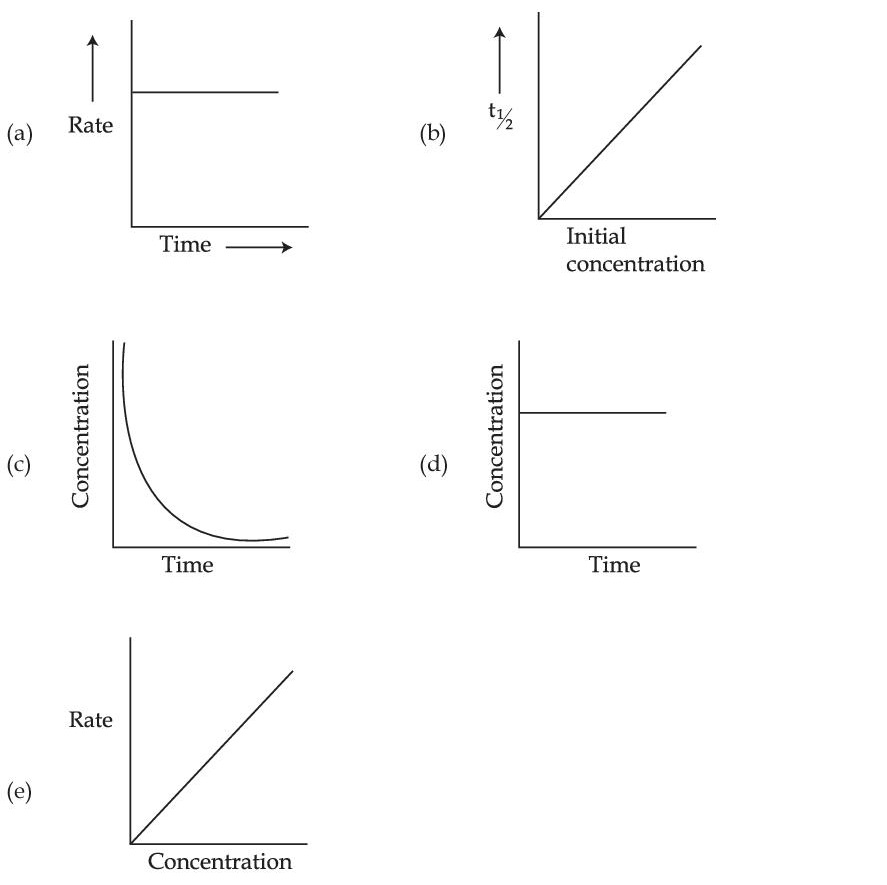
Choose from the options given below, the correct one regarding order of reaction is :
JEE Mains
2021
MCQ
Isotope(s) of hydrogen which emits low energy $\beta$$-$ particles with t1/2 value > 12 years is/are
JEE Mains
2020
MCQ
Consider the following reactions
A $ \to $ P
1 ; B $ \to $ P
2 ; C $ \to $ P
3 ; D $ \to $ P
4,
The order of the above reactions are a, b, c,
and d, respectively. The following graph is
obtained when log[rate] vs. log[conc.] are
plotted

Among the following, the correct sequence for
the order of the reactions is :
JEE Mains
2020
MCQ
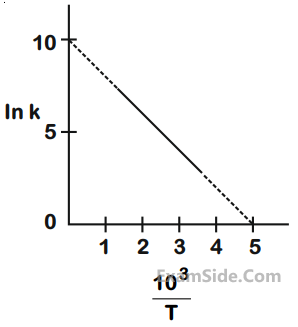
The rate constant (k) of a reaction is measured at differenct temperatures (T), and the data are
plotted in the given figure. The activation energy of the reaction in kJ mol
–1 is :
(R is gas constant)
JEE Mains
2020
MCQ
A flask contains a mixture of compounds A and
B. Both compounds decompose by first-order
kinetics. The half-lives for A and B are 300 s
and 180 s, respectively. If the concentrations
of A and B are equal initially, the time required
for the concentration of A to be four times that
of B(in s) :
(Use ln 2 = 0.693)
JEE Mains
2020
MCQ
For the reaction
2A + 3B +
${3 \over 2}$C
$ \to $ 3P, which
statement is correct ?
JEE Mains
2020
MCQ
It is true that :
JEE Mains
2020
MCQ
The results given in the below table were
obtained during kinetic studies of the following
reaction
2A + B $ \to $ C + D
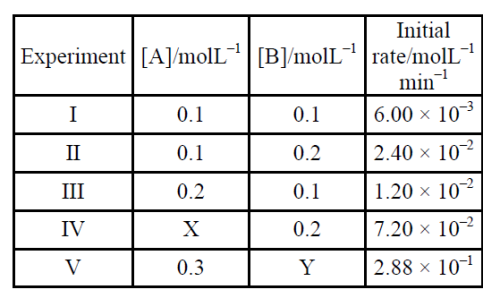
X and Y in the given table are respectively :
JEE Mains
2020
MCQ
For the following reactions
$A\buildrel {700K} \over
\longrightarrow {\mathop{\rm Product}\nolimits} $
$A\mathrel{\mathop{\kern0pt\longrightarrow}
\limits_{catalyst}^{500K}} {\mathop{\rm Product}\nolimits} $
it was found that Ea is decreased by 30 kJ/mol
in the presence of catalyst.
If the rate remains unchanged, the activation
energy for catalysed reaction is (Assume pre
exponential factor is same):
JEE Mains
2020
MCQ
Consider the following plots of rate constant
versus ${1 \over T}$ for four different reactions. Which
of the following orders is correct for the
activation energies of these reactions?

JEE Mains
2020
MCQ
The rate of a certain biochemical reaction at physiological temperature (T) occurs 106 times faster with
enzyme than without. The change in the activation energy upon adding enzyme is :
JEE Mains
2020
MCQ
For the reaction
2H2(g) + 2NO(g) $ \to $ N2(g) + 2H2O(g)
the observed rate expression is, rate = Kf[NO]2[H2]. The rate expression for the reverse reaction is :
JEE Mains
2019
MCQ
NO2 required for a reaction is produced by the decomposition of N2O5 in CCl4 as per the equation,
2N2O5(g) $ \to $ 4NO2(g) + O2(g).
The initial concentration of N2O5 is 3.00 mol L–1
and it is 2.75 mol L–1
after 30 minutes. The rate of
formation of NO2 is :
JEE Mains
2019
MCQ
In the following reaction; xA $ \to $ yB
${\log _{10}}\left[ { - {{d\left[ A \right]} \over {dt}}} \right] = {\log _{10}}\left[ {{{d\left[ B \right]} \over {dt}}} \right] + 0.3010$
'A' and 'B' respectively can be :
JEE Mains
2019
MCQ
For the reaction of H2 with I2, the rate constant is 2.5 × 10⁻⁴ dm3
mol–1s–1
at 327°C and 1.0 dm3
mol–1
at
527°C. The activation energy for the reaction, in kJ mole–1
is : (R = 8.314 JK–1
mol–1
)
JEE Mains
2019
MCQ
A bacterial infection in an internal wound grows as N'(t) = N0 exp(t), where the time t is in hours. A does of antibiotic, taken orally, needs 1 hour to reach the wound. Once it reaches there, the bacterial population goes down as ${{dN} \over {dt}} = - 5{N^2}$.
What will be the plot of ${{{N_0}} \over N}$
vs. t after 1 hour?
JEE Mains
2019
MCQ
Consider the given plot of enthalpy of the
following reaction between A and B.
A+ B $ \to $ C + D
Identify the incorrect statement.

JEE Mains
2019
MCQ
The given plots represent the variation of the
concentration of a reactant R with time for two
different reactions (i) and (ii). The respective
orders of the reactions are :

JEE Mains
2019
MCQ
For a reaction scheme $A\buildrel {{k_1}} \over
\longrightarrow B\buildrel {{k_2}} \over
\longrightarrow C$,
if
the rate of formation of B is set to be zero then
the concentration of B is given by :
JEE Mains
2019
MCQ
For the reaction 2A + B $ \to $ C, the values of initial rate at diffrent reactant concentrations are
given in the table below. The rate law for the reaction is :
| [A] (mol L-1) |
[B] (mol L-1) |
Initial Rate (mol L-1s-1) |
| 0.05 |
0.05 |
0.045 |
| 0.10 |
0.05 |
0.090 |
| 0.20 |
0.10 |
0.72 |
JEE Mains
2019
MCQ
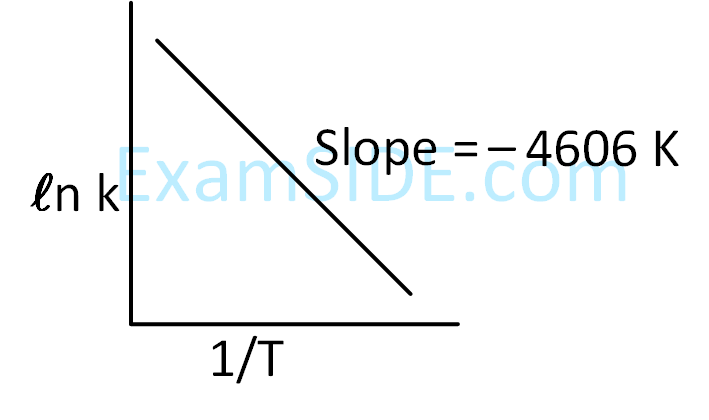
For a reaction consider the plot of $\ell $n k versus 1/T given in the figure. If the rate constant of this reaction at 400 K is 10
–5 s
–1, then the rate constant at 500 K is –
JEE Mains
2019
MCQ
Decomposition of X exhibits a rate constant of 0.05 $\mu $g/year. How many year are required for the decomposition of 5$\mu $g of X into 2.5 $\mu $g?
JEE Mains
2019
MCQ
The reaction 2X $ \to $ B is a zeroth order reaction. If the initial concentration of X is 0.2 M, the half-life is 6 h. When the initial concentration of X is 0.5 M, the time required to reach its final concentration of 0.2 M will
be:
JEE Mains
2019
MCQ
If a reaction follows the Arrhenius equation, the plot ln k vs ${1 \over {\left( {RT} \right)}}$ gives straight line with a gradient ($-$ y) unit.
The energy required to active the reactant is :
JEE Mains
2019
MCQ
For an elementary chemical reaction,

the expression for ${{d\left[ A \right]} \over {dt}}$ is
JEE Mains
2019
MCQ
Consider the given plots for a reaction obeying Arrhenius equation (0
oC < T < 300
oC) : (K and Ea are rate constant and activation energy, respectively)
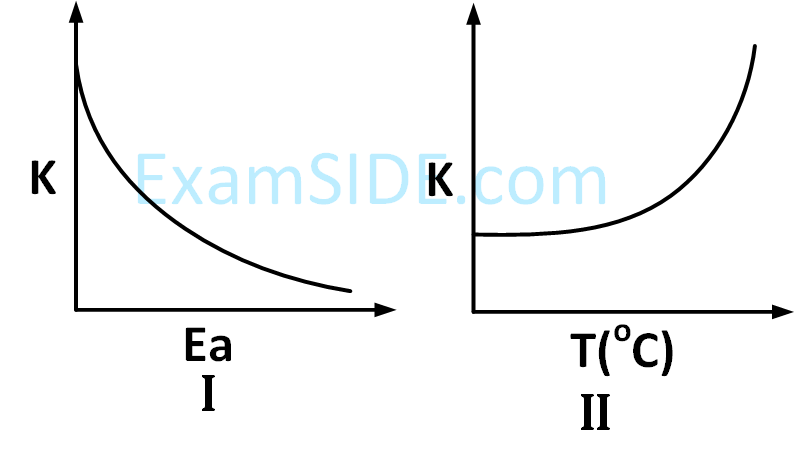
Choose the correct option :
JEE Mains
2019
MCQ
For the reaction, 2A + B $ \to $ products, when the concentrations of A and B both were doubled, the rate of the reaction increased from 0.3 mol L$-$1s$-$1 to 2.4 mol L$-$1s$-$1. When the concentration of A alone is doubled, the rate increased from 0.3 mol L$-$1s$-$1 to 0.6 mol L$-$1s$-$1.
JEE Mains
2019
MCQ
The following results were obtained during kinetic studies of the reaction ;
2A + B $ \to $ Products
| Experiment |
[A] (in mol L$-$1) |
[b] (in mol L$-$1) |
Initial Rate of reaction
(In mol L$-$1 min$-$1) |
| I |
0.10 |
0.20 |
6.93 G 10$-$3 |
| II |
0.10 |
0.25 |
6.93 G 10$-$3 |
| III |
0.20 |
0.30 |
1.386 G 10$-$2 |
The time (in minutes) required to consume half of A is :
JEE Mains
2018
MCQ
If 50% of a reaction occurs in 100 second and 75% of the reaction occurs in 200 secod, the order of this reaction is :
JEE Mains
2018
MCQ
At 518oC the rate of decomposition of a sample of gaseous acetaldehyde initially at a pressure of 363 Torr,
was 1.00 Torr s–1 when 5% had reacted and 0.5 Torr s–1 when 33% had reacted. The order of the reaction is
JEE Mains
2018
MCQ
For a first order reaction, A $ \to $ P, t1/2 (half-life) is 10 days The time required for ${1 \over 4}$th conversion of A (in days) is : (ln 2 = 0.693, ln 3 = 1.1)
JEE Mains
2018
MCQ
N2O5 decomposes to NO2 and O2 and follows first order kinetics. After 50 minutes, the pressure inside the vessel increases from 50 mmHg to 87.5 mmHg. The pressure of the gaseous mixture after 100 minute at constant temperature will be :
JEE Mains
2017
MCQ
The rate of a reaction quadruples when the temperature changes from 300 to 310 K. The activation energy of this reaction is :
(Assume activation energy and preexponential factor are independent of
temperature; ln 2 = 0.693; R = 8.314 J mol−1 K−1)
JEE Mains
2017
MCQ
The rate of a reaction A doubles on increasing the temperature from 300 to 310 K. By how much, the temperature of reaction B should be Increased from 300 K so that rate doubles if activation energy of the reaction B is twice to that of reaction A.
JEE Mains
2017
MCQ
Two reactions R1 and R2 have identical pre-exponential factors. Activation energy of R1 exceeds that of R2 by 10 kJ mol–1. If k1 and k2 are rate constants for reactions R1 and R2 respectively at 300 K, then ln(k2/k1) is equal to :
(R = 8.314 J mol–1 K–1)
JEE Mains
2016
MCQ
The rate law for the reaction below is given by the expression k [A] [B]
A + B $ \to $ Product
If the concentration of B is increased from 0.1 to 0.3 mole, keeping the value of A at 0.1 mole, the rate constant will be :
JEE Mains
2016
MCQ
The reaction of ozone with oxygen atoms in the presence of chlorine atoms can occur
by a two step process shown below :
O3(g) + Cl${^ \bullet }$ (g) $ \to $ O2(g) + ClO${^ \bullet }$ (g) . . . . . .(i)
ki = 5.2 × 10⁹ L mol−1 s−1
ClO${^ \bullet }$(g) + O${^ \bullet }$(g) $ \to $ O2(g) + Cl${^ \bullet }$ (g) . . . . . . (ii)
kii = 2.6 × 10¹⁰ L mol−1 s−1
The closest rate constant for the overall reaction O3(g) + O${^ \bullet }$ (g) $ \to $ 2 O2(g) is :
JEE Mains
2016
MCQ
Decomposition of H2O2 follows a first order reaction. In fifty minutes the concentration of H2O2 decreases
from 0.5 to 0.125 M in one such decomposition. When the concentration of H2O2 reaches 0.05 M, the rate of formation of O2 will be :
JEE Mains
2015
MCQ
Higher order (>3) reactions are rare due to
JEE Mains
2014
MCQ
For the non – stoichiometre reaction 2A + B $\to$ C + D, the following kinetic data were obtained in three
separate experiments, all at 298 K.
| Initial Concentration (A) |
Initial Concentration (B) |
Initial rate of formation of C (mol L-1 s-1) |
| 0.1 M |
0.1 M |
1.2 x 10⁻³ |
| 0.1 M |
0.2 M |
1.2 x 10⁻³ |
| 0.2 M |
0.1 M |
2.4 x 10⁻³ |
The rate law for the formation of C is:
JEE Mains
2013
MCQ
The rate of a reaction doubles when its temperature changes from 300K to 310K. Activation energy of such
a reaction will be:(R = 8.314 JK–1 mol–1 and log 2 = 0.301)
JEE Mains
2012
MCQ
For a first order reaction, (A) $\to$ products, the concentration of A changes from 0.1 M to 0.025 M in 40
minutes. The rate of reaction when the concentration of A is 0.01 M is :
JEE Mains
2011
MCQ
The rate of a chemical reaction doubles for every 10oC rise of temperature. If the temperature is raised
by 50oC , the rate of the reaction increases by about :
JEE Mains
2010
MCQ
The time for half life period of a certain reaction A $\to$ products is 1 hour. When the initial
concentration of the reactant ‘A’, is 2.0 mol L–1, how much time does it take for its concentration to
come from 0.50 to 0.25 mol L–1 if it is a zero order reaction ?
JEE Mains
2010
MCQ
Consider the reaction :
Cl2(aq) + H2S(aq) → S(s) + 2H+ (aq) + 2Cl– (aq)
The rate equation for this reaction is rate = k [Cl2] [H2S]
Which of these mechanisms is/are consistent with this rate equation?
(A) Cl2 + H2S $\to$ H+ + Cl– + Cl+ + HS– (slow)
Cl+ + HS– $\to$ H+ + Cl– + S (fast)
(B) H2S $ \Leftrightarrow $ H+ + HS– (fast equilibrium)
Cl2 + HS– $\to$ 2Cl– + H+ + S (slow)
JEE Mains
2009
MCQ
The half life period of a first order chemical reaction is 6.93 minutes. The time required for the
completion of 99% of the chemical reaction will be (log 2=0.301) :
JEE Mains
2008
MCQ
For a reaction ${1 \over 2}A \to 2B$ rate of disappearance of ‘A’ is related to the rate of appearance of ‘B’ by the
expression
JEE Mains
2007
MCQ
Consider the reaction, 2A + B $\to$ products. When concentration of B alone was doubled, the half-life did not change. When the concentration of A
alone was doubled, the rate increased by two times. The unit of rate constant for this reaction is
JEE Mains
2007
MCQ
A radioactive element gets spilled over the floor of a room. Its half-life period is 30 days. If the initial
activity is ten times the permissible value, after how many days will it be safe to enter the room?
JEE Mains
2007
MCQ
Which of the following nuclear reactions will generate an isotope?
JEE Mains
2007
MCQ
The energies of activation for forward and reverse reactions for A2 + B2 $\leftrightharpoons$ 2AB are 180 kJ mol−1
and 200 kJ mol−1 respectively. The presence of catalyst lowers the activation energy of both (forward and reverse) reactions by 100 kJ mol−1. The enthalpy change of the reaction ( A2 + B2 $\to$ 2AB) in the presence of catalyst will be (in kJ mol−1)
JEE Mains
2006
MCQ
Rate of a reaction can be expressed by Arrhenius equation as:
$$k = A\,{e^{ - E/RT}}$$
In this equation, E represents
JEE Mains
2006
MCQ
In the transformation of ${}_{92}^{238}U$ to ${}_{92}^{234}U$, if one emission is an α-particle, what should be the other
emission(s)?
JEE Mains
2006
MCQ
The following mechanism has been proposed for the reaction of NO with Br2 to form NOBr:
NO(g) + Br2 (g) $\leftrightharpoons$ NOBr2 (g)
NOBr2 (g) + NO (g) $\to$ 2NOBr (g)
If the second step is the rate determining step, the order of the reaction with respect to NO(g) is
JEE Mains
2006
MCQ
A reaction was found to be second order with respect to the concentration of carbon monoxide. If the
concentration of carbon monoxide is doubled, with everything else kept the same, the rate of reaction
will
JEE Mains
2005
MCQ
A reaction involving two different reactants can never be
JEE Mains
2005
MCQ
Hydrogen bomb is based on the principle of
JEE Mains
2005
MCQ
A schematic plot of $ln$ ${K_{eq}}$ versus inverse of temperature for a reaction is shown below
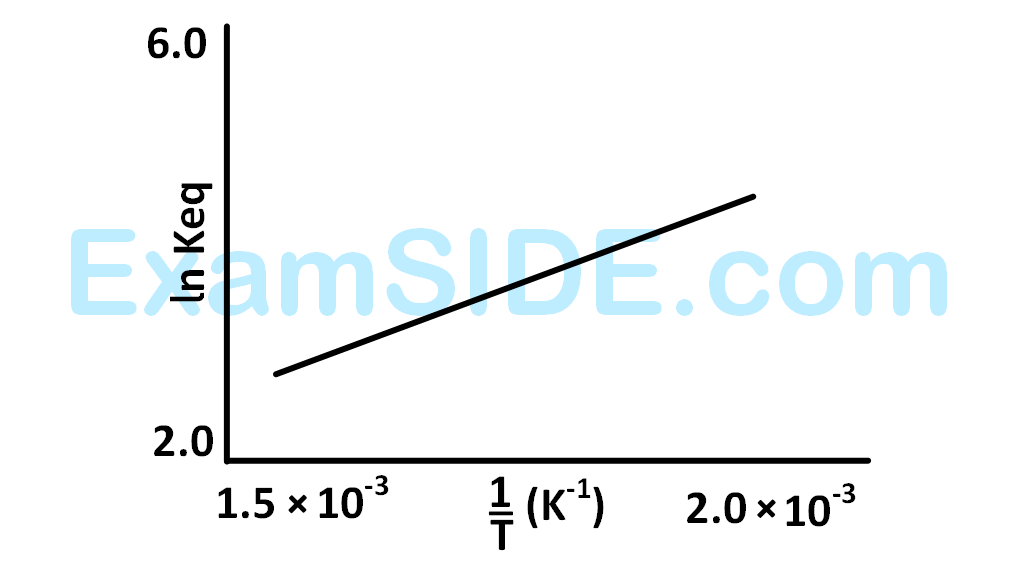
The reaction must be
JEE Mains
2005
MCQ
t1/4 can be taken as the time taken for the concentration of a reactant to drop to $3 \over 4$ of its initial value. If the rate constant for a first order reaction is K, the t1/4 can be written as
JEE Mains
2005
MCQ
The photon of hard gamma radiation knocks a proton out of ${}_{12}^{24}Mg$ nucleus to form
JEE Mains
2004
MCQ
Consider the following nuclear reactions
${}_{92}^{238}M \to {}_Y^XN + 2{}_2^4He$
${}_Y^XN \to {}_B^AL + 2{\beta ^ + }$
The number of neutrons in the element L is
JEE Mains
2004
MCQ
The rate equation for the reaction 2A + B $\to$ C is found to be: rate k[A][B]. The correct
statement in relation to this reaction is that the
JEE Mains
2004
MCQ
In a first order reaction, the concentration of the reactant decreases from 0.8 M to 0.4 M in 15
minutes. The time taken for the concentration to change from 0.1 M to 0.025 M is
JEE Mains
2004
MCQ
The half – life of a radioisotope is four hours. If the initial mass of the isotope was 200 g, the
mass remaining after 24 hours undecayed is
JEE Mains
2003
MCQ
The half-life of a radioactive isotope is three hours. If the initial mass of the isotope were 256 g, the mass of
it remaining undecayed after 18 hours would be
JEE Mains
2003
MCQ
For the reaction system:
2NO(g) + O2(g) $\to$ 2NO2(g) volume is suddenly reduce to half its value by increasing the pressure on it. If the reaction is of first order with respect to O2 and second order with respect to NO, the rate of reaction will
JEE Mains
2003
MCQ
The rate law for a reaction between the substances A and B is given by Rate = k[A]n [B]m On doubling the concentration of A and halving the concentration of B, the ratio of the new rate to the earlier rate of the reaction will be as
JEE Mains
2003
MCQ
The radionucleide ${}_{90}^{234}Th$ undergoes two successive $\beta$ -decays followed by one $\alpha$-decay. The atomic number
and the mass number respectively of the resulting radionucleide are
JEE Mains
2003
MCQ
In respect of the equation k = Ae-Ea/RT in chemical kinetics, which one of the following statements is correct?
JEE Mains
2002
MCQ
The integrated rate equation is Rt = log C0 - log Ct . The straight line graph is obtained by
plotting
JEE Mains
2002
MCQ
Units of rate constant of first and zero order reactions in terms of molarity M unit are respectively
JEE Mains
2002
MCQ
$\beta$ - particle is emitted in radioactivity by
JEE Mains
2002
MCQ
If half-life of a substance is 5 yrs, then the total amount of substance left after 15 years, when initial amount is 64 grams is
JEE Mains
2002
MCQ
For the reaction A + 2B $\to$ C, rate is given by R = [A] [B]2 then the order of the reaction is
JEE Mains
2002
MCQ
The differential rate law for the reaction H2 + I2 $\to$ 2HI is