Chemical Kinetics and Nuclear Chemistry
A → B (first reaction)
C → D (second reaction)
Consider the above two first-order reactions. The rate constant for first reaction at 500 K is double of the same at 300 K. At 500 K, 50% of the reaction becomes complete in 2 hour. The activation energy of the second reaction is half of that of first reaction. If the rate constant at 500 K of the second reaction becomes double of the rate constant of first reaction at the same temperature; then rate constant for the second reaction at 300 K is _______ × 10-1 hour-1 (nearest integer).
Explanation:
$ \text { For } \mathrm{A} \xrightarrow{\mathrm{~K}_1} \mathrm{~B} $
$ \begin{aligned} & \ln (2)=\frac{E_{a_1}}{R}\left[\frac{1}{300}-\frac{1}{500}\right] \\ & E_{a_1}=\frac{\ln 2 \times R \times 1500}{2} \\ & E_{a_2}=\frac{E_{a_1}}{2}=\frac{\ln 2 \times R \times 1500}{4} \\ & \left(K_1\right)_{\text {at } 500 \mathrm{~K}}=\frac{\ln 2}{2} \\ & \left(K_2\right)_{\text {at } 500 \mathrm{~K}}=\ln 2 \end{aligned} $
Now for $\mathrm{C} \xrightarrow{\mathrm{K}_2} \mathrm{D}$
$ \begin{aligned} & \ln \left[\frac{\left(\mathrm{K}_2\right)_{\text {at } 500 \mathrm{~K}}}{\left(\mathrm{~K}_2\right)_{\text {at } 300 \mathrm{~K}}}\right]=\left(\frac{\ln 2 \times \mathrm{R} \times 1500}{4}\right) \times \frac{1}{\mathrm{R}} \times\left[\frac{1}{300}-\frac{1}{500}\right] \\ & \left(\mathrm{K}_2\right)_{\text {at } 300 \mathrm{~K}}=\frac{\ln 2}{\sqrt{2}}=0.49 \\ & \left(\mathrm{~K}_2\right)_{\text {at } 300 \mathrm{~K}}=4.9 \times 10^{-1} \end{aligned} $
Ans is 5 .
The half-life of ${ }^{65} \mathrm{Zn}$ is 245 days. After $x$ days, $75 \%$ of original activity remained. The value of $x$ in days is $\_\_\_\_$ . (Nearest integer)
(Given: $\log 3=0.4771$ and $\log 2=0.3010$ )
Explanation:
$ \begin{aligned} & \mathrm{t}_{1 / 2}=\frac{\ln 2}{\mathrm{~K}} \end{aligned} $
Here, $\mathrm{t}_{1/2}=245$ days, so we find $K$ as:
$ \begin{aligned} & \mathrm{~K}=\frac{\ln 2}{245} \end{aligned} $
Now we use the radioactive decay relation for activity:
$ \begin{aligned} & \mathrm{t}=\frac{1}{\mathrm{~K}} \ln \frac{\mathrm{a}_0}{\mathrm{a}_{\mathrm{t}}} \end{aligned} $
Given that $75\%$ of the original activity remains, so $\mathrm{a}_t = 0.75\,\mathrm{a}_0 = \frac{3}{4}\mathrm{a}_0$.
So,
$ \begin{aligned} & \frac{\mathrm{a}_0}{\mathrm{a}_{\mathrm{t}}}=\frac{\mathrm{a}_0}{\frac{3}{4}\mathrm{a}_0}=\frac{4}{3} \end{aligned} $
Therefore,
$ \begin{aligned} & \mathrm{t}_{25 \%}=\frac{1}{\mathrm{~K}} \ln \frac{4}{3} \end{aligned} $
Substitute $\mathrm{K}=\frac{\ln 2}{245}$:
$ \begin{aligned} & \mathrm{t}_{25 \%}=\frac{1}{\frac{\ln 2}{245}} \ln \frac{4}{3} \end{aligned} $
Simplifying:
$ \begin{aligned} & \mathrm{t}_{25 \%}=245 \frac{\ln \frac{4}{3}}{\ell \mathrm{n} 2}=245\left[\frac{2 \log 2-\log 3}{\log 2}\right] \end{aligned} $
Now use the given values $\log 3=0.4771$ and $\log 2=0.3010$:
$ \begin{aligned} & =245\left[\frac{2 \times 0.3010-0.4771}{0.3010}\right]=101.66 \text { day. } \end{aligned} $
For the thermal decomposition of reactant $\mathrm{AB}(\mathrm{g})$, the following plot is constructed.

The half life of the reaction is ' $x^{\prime} \,\mathrm{min}$.
$x=$ $\_\_\_\_$ min. (Nearest integer)
Explanation:
The graph between concentration $[\mathrm{AB}]$ and time $t$ is a straight line that decreases with time. This type of graph shows that the reaction is zero order in $[\mathrm{AB}]$.
For a zero-order reaction, the integrated rate law is:
$\begin{aligned} & {[\mathrm{AB}]_0-[\mathrm{AB}]_{\mathrm{t}}=\mathrm{kt}} \\ & \mathbf{0 . 6 0 - 0 . 5 5 = k}(100) \\ & \mathrm{k}=5 \times 10^{-4} \\ & \text { Half life }\left(\mathrm{t}_{1 / 2}\right)=\frac{[\mathrm{AB}]_0}{2 \mathrm{k}} \\ & =\frac{0.60}{2 \times 5 \times 10^{-4}} \\ & =600 \mathrm{sec} \\ & =10 \mathrm{~min}\end{aligned}$
From the graph, the initial concentration is $[\mathrm{AB}]_0 = 0.60$ and after $100 \,\text{s}$ the concentration is $0.55$. Substituting these values in the zero-order equation gives the rate constant $k = 5 \times 10^{-4} \,\text{mol L}^{-1}\text{s}^{-1}$.
For a zero-order reaction, the half-life is given by $t_{1/2} = \dfrac{[\mathrm{AB}]_0}{2k}$. Putting the values, we get $t_{1/2} = 600 \,\text{s} = 10 \,\text{min}$. Therefore, $x = 10 \,\text{min}$ (nearest integer).
Consider $\mathrm{A} \xrightarrow{\mathrm{k}_1} \mathrm{~B}$ and $\mathrm{C} \xrightarrow{\mathrm{k}_2} \mathrm{D}$ are two reactions. If the rate constant $\left(\mathrm{k}_1\right)$ of the $\mathrm{A} \longrightarrow \mathrm{B}$ reaction can be expressed by the following equation $\log _{10} \mathrm{k}=14.34-\frac{1.5 \times 10^4}{\mathrm{~T} / \mathrm{K}}$ and activation energy of $C \longrightarrow D$ reaction $\left(E a_2\right)$ is $\frac{1}{5}$ th of the $A \longrightarrow B$ reaction $\left(E a_1\right)$, then the value of $\left(E a_2\right)$ is
$\_\_\_\_$ $\mathrm{kJ} \mathrm{mol}^{-1}$. (Nearest Integer)
Explanation:
Given: $\log _{10} \mathrm{k}=14.34-\frac{1.5 \times 10^4}{\mathrm{~T} / \mathrm{K}}$
From the Arrhenius equation in base-10 form, we write:
$\log_{10} k = \log_{10} A - \frac{E_a}{2.303RT}$
On comparing this with $\log _{10} \mathrm{k}=14.34-\frac{1.5 \times 10^4}{\mathrm{~T} / \mathrm{K}}$, the coefficient of $\frac{1}{T}$ gives:
$\frac{\mathrm{E}_{\mathrm{a}_1}}{2.303 \mathrm{R}}=1.5 \times 10^4$
Now substitute $\mathrm{R}=8.314~\mathrm{J\,mol^{-1}\,K^{-1}}$:
$\mathrm{E}_{\mathrm{a}_1}=1.5 \times 10^4 \times 2.303 \times 8.314$
$\mathrm{E}_{\mathrm{a}_1}=28.7207 \times 10^4 \mathrm{~J}$
Convert joules to kilojoules ($1~\mathrm{kJ}=10^3~\mathrm{J}$):
$\mathrm{E}_{\mathrm{a}_1}=287.207 \mathrm{~kJ}$
Given $\mathrm{E}_{\mathrm{a}_2}=\frac{1}{5}\mathrm{E}_{\mathrm{a}_1}$, so:
$\mathrm{E}_{\mathrm{a}_2}=\frac{\mathrm{E}_{\mathrm{a}_1}}{5}=\frac{287.207}{5}=57.44 \mathrm{~kJ}$
The temperature at which the rate constants of the given below two gaseous reactions become equal is $\_\_\_\_$ K. (Nearest integer)
$ \begin{array}{ll} \mathrm{X} \longrightarrow \mathrm{Y}, & \mathrm{k}_1=10^6 e^{\frac{-30000}{\mathrm{~T}}} \\ \mathrm{P} \longrightarrow \mathrm{Q}, & \mathrm{k}_2=10^4 e^{\frac{-24000}{\mathrm{~T}}} \end{array} $
Given : $\ln 10=2.303$
Explanation:
Given,
$k_1=10^6 e^{-30000/T},\qquad k_2=10^4 e^{-24000/T}$
At the temperature $T$ when $k_1=k_2$:
$10^6 e^{-30000/T}=10^4 e^{-24000/T}$
Divide both sides by $10^4 e^{-30000/T}$:
$10^2=e^{(-24000/T)-(-30000/T)}=e^{6000/T}$
Take natural log on both sides:
$\ln(10^2)=\frac{6000}{T}$
$2\ln 10=\frac{6000}{T}$
Given $\ln 10=2.303$:
$2(2.303)=\frac{6000}{T}$
$4.606=\frac{6000}{T}$
$T=\frac{6000}{4.606}\approx 1302.65\ \text{K}$
Nearest integer:
$\boxed{1303\ \text{K}}$
Pre-exponential factors of two different reactions of same order are identical. Let activation energy of first reaction exceeds the activation energy of second reaction by $20 \mathrm{~kJ} \mathrm{~mol}^{-1}$. If $\mathrm{k}_1$ and $\mathrm{k}_2$ are the rate constants of first and second reaction respectively at 300 K , then $\ln \frac{\mathrm{k}_2}{\mathrm{k}_1}$ will be $\_\_\_\_$ . (nearest integer) $\left[\mathrm{R}=8.3 \mathrm{~J} \mathrm{~K}^{-1} \mathrm{~mol}^{-1}\right]$
Explanation:
Arrhenius equation:
$k=Ae^{-E_a/RT}$
Given pre-exponential factors are identical, so $A_1=A_2$.
Also, activation energy of first reaction exceeds that of second by $20\,\text{kJ mol}^{-1}$:
$E_{a1}=E_{a2}+20{,}000\ \text{J mol}^{-1}$
Now,
$ \frac{k_2}{k_1} =\frac{A e^{-E_{a2}/RT}}{A e^{-E_{a1}/RT}} =e^{-(E_{a2}-E_{a1})/RT} =e^{(E_{a1}-E_{a2})/RT} $
So,
$\ln\left(\frac{k_2}{k_1}\right)=\frac{E_{a1}-E_{a2}}{RT}=\frac{20{,}000}{8.3\times 300}$
Compute:
$8.3\times 300=2490$
$\ln\left(\frac{k_2}{k_1}\right)=\frac{20{,}000}{2490}\approx 8.03$
Nearest integer:
$\boxed{8}$
Decomposition of a hydrocarbon follows the equation $\mathrm{k}=\left(5.5 \times 10^{11} \mathrm{~s}^{-1}\right) \mathrm{e}^{\frac{-28000 \mathrm{~K}}{\mathrm{~T}}}$. The activation energy of reaction is $\_\_\_\_$ $\mathrm{kJ} \mathrm{mol}^{-1}$. (Nearest Integer)
Given : $\mathrm{R}=8.3 \mathrm{~J} \mathrm{~K}^{-1} \mathrm{~mol}^{-1}$
Explanation:
We are given the Arrhenius equation in the exponential form:
$ k = A \, e^{-\frac{E_a}{R T}} $
Comparing this with the given equation:
$ k = (5.5 \times 10^{11} \, \text{s}^{-1}) \, e^{-\frac{28000}{T}} $
we can see that:
$ \frac{E_a}{R} = 28000 $
Now, substituting the given value of the gas constant $ R = 8.3 \, \text{J mol}^{-1} \text{K}^{-1} $:
$ E_a = 28000 \times 8.3 \, \text{J mol}^{-1} $
$ E_a = 232400 \, \text{J mol}^{-1} $
Converting joules to kilojoules:
$ E_a = \frac{232400}{1000} = 232.4 \, \text{kJ mol}^{-1} $
Rounding to the nearest integer:
$ \boxed{E_a = 232 \, \text{kJ mol}^{-1}} $
Sucrose hydrolyses in acidic medium into glucose and fructose by first order rate law with $t_{1 / 2}=3$ hour. The percentage of sucrose remaining after 6 hours is
$\_\_\_\_$ . (Nearest integer)
(Given $: \log 2=0.3010$ and $\log 3=0.4771$ )
Explanation:
The reaction is of the first order.
The half-life of the reaction, $t_{1/2}$, is 3 hours.
We need to find the percentage of sucrose remaining after a total time, $t$, of 6 hours.
Let's begin.
Step 1: Understand the concept of half-life ($t_{1/2}$)
For a chemical reaction, the half-life is the time it takes for the concentration of a reactant to reduce to exactly half of its initial value.
In this case, it means that every 3 hours, the amount of sucrose will become half of what it was at the start of that 3-hour period.
Step 2: Determine the number of half-lives passed
We are given a total time of 6 hours and a half-life of 3 hours. We can find the number of half-lives that have occurred, which we can call 'n'.
$ n = \frac{\text{Total time}}{\text{Half-life}} = \frac{t}{t_{1/2}} $
Substituting the given values:
$ n = \frac{6 \text{ hours}}{3 \text{ hours}} = 2 $
So, a total of 2 half-lives have passed.
Step 3: Calculate the amount of sucrose remaining
Let's assume the initial percentage of sucrose is 100%.
After the first half-life (at t = 3 hours):
The amount of sucrose remaining will be half of the initial amount.
$ \text{Sucrose remaining} = \frac{1}{2} \times 100\% = 50\% $
After the second half-life (at t = 6 hours):
The amount of sucrose will be half of the amount that was present at the end of the first half-life (which was 50%).
$ \text{Sucrose remaining} = \frac{1}{2} \times 50\% = 25\% $
We can also use a general formula for the fraction of reactant remaining after 'n' half-lives:
$ \text{Fraction remaining} = \left(\frac{1}{2}\right)^n $
In our case, $n=2$, so:
$ \text{Fraction remaining} = \left(\frac{1}{2}\right)^2 = \frac{1}{4} $
To find the percentage remaining, we multiply this fraction by 100:
$ \text{Percentage remaining} = \frac{1}{4} \times 100 = 25\% $
The question asks for the answer as the nearest integer.
Therefore, the percentage of sucrose remaining after 6 hours is 25.
For a reaction $\mathrm{A} \rightarrow \mathrm{P}$ at T K , the half life $\left(\mathrm{t}_{1 / 2}\right)$ is plotted as a function of initial concentration $[\mathrm{A}]_0$ of A as given below.

The value of $x$ in the given figure is $\_\_\_\_$ s (Nearest integer)
Explanation:
From the graph, it is clear that the half-life $ t_{1/2} $ increases directly with the initial concentration $[A]_0$.
We know that for a reaction of order $ N $:
$ t_{1/2} \propto [A]_0^{1-N} $
Here, since $ t_{1/2} \propto [A]_0 $, we can write:
$ 1 - N = 1 \Rightarrow N = 0 $
This means the reaction is of zero order. For a zero-order reaction, the half-life is given by:
$ t_{1/2} = \frac{[A]_0}{2k} $
From the data in the graph: For the first point, $ t_{1/2} = 240 \, s $ and $[A]_0 = 4 \times 10^{-3}$
So,
$ 240 = \frac{4 \times 10^{-3}}{2k} \tag{1} $
For the second point, $[A]_0 = 1.5 \times 10^{-3}$ and $ t_{1/2} = x \, s $
$ x = \frac{1.5 \times 10^{-3}}{2k} \tag{2} $
Now, divide equation (1) by (2):
$ \frac{240}{x} = \frac{4}{1.5} $
Therefore,
$ x = 90 \, s $
If the half life of a first order reaction is 6.93 minutes then the time required for completion of $99 \%$ of the reaction will be $\_\_\_\_$ minutes.
(Given $: \log 2=0.3010$ )
Explanation:
For a first order reaction,
$ t_{1/2}=\frac{0.693}{k} $
Given:
$ t_{1/2}=6.93 \text{ min} $
So,
$ k=\frac{0.693}{6.93}=0.1\ \text{min}^{-1} $
Now, $99\%$ completion means only $1\%$ of the reactant is left.
So,
$ \frac{[A]_0}{[A]}=\frac{100}{1}=100 $
For a first order reaction,
$ t=\frac{2.303}{k}\log\frac{[A]_0}{[A]} $
Substituting the values:
$ t=\frac{2.303}{0.1}\log 100 $
Since,
$ \log 100=2 $
therefore,
$ t=\frac{2.303}{0.1}\times 2 $
$ t=23.03\times 2=46.06 \text{ min} $
Hence, the time required for $99\%$ completion of the reaction is
$ \boxed{46.06\ \text{minutes}} $
$ \text { For a first order reaction } \mathrm{A} \rightarrow \mathrm{~B} $
$ \begin{array}{|l|l|} \hline \mathrm{t} / \min & {[\mathrm{A}] / \mathrm{M}} \\ \hline 0 & 0.6500 \\ \hline x & 0.0650 \\ \hline 20 & 0.00065 \\ \hline \end{array} $
$x=$ $\_\_\_\_$ min. (Nearest integer)
Explanation:
For a first order reaction, the integrated rate law is
$ k=\frac{2.303}{t}\log\frac{[A]_0}{[A]_t} $
We use the data at $t=20$ min:
Initial concentration, $[A]_0=0.6500\ \text{M}$
Concentration at $20$ min, $[A]_{20}=0.00065\ \text{M}$
So,
$ k=\frac{2.303}{20}\log\frac{0.6500}{0.00065} $
Now,
$ \frac{0.6500}{0.00065}=1000 $
and
$ \log 1000 = 3 $
Therefore,
$ k=\frac{2.303}{20}\times 3 $
$ k=\frac{6.909}{20} $
$ k=0.34545\ \text{min}^{-1} $
Now we use the concentration at time $x$:
- $[A]_x=0.0650\ \text{M}$
Again,
$ k=\frac{2.303}{x}\log\frac{[A]_0}{[A]_x} $
$ 0.34545=\frac{2.303}{x}\log\frac{0.6500}{0.0650} $
Now,
$ \frac{0.6500}{0.0650}=10 $
and
$ \log 10 = 1 $
So,
$ 0.34545=\frac{2.303}{x} $
Hence,
$ x=\frac{2.303}{0.34545} $
$ x\approx 6.67\ \text{min} $
Nearest integer:
$ \boxed{7\ \text{min}} $
Consider the following gas phase reaction being carried out in a closed vessel at $25 ^\circ$C.
$2A(g) \longrightarrow 4B(g) + C(g)$
| time (min) | total pressure of the system (mm Hg) |
|---|---|
| 30 | 300 |
| ∞ | 600 |
The pressure of C(g) at 30 minutes time interval would be ________ mm Hg. (nearest integer)
Explanation:
For the reaction
$2A(g) \longrightarrow 4B(g) + C(g)$
let the initial pressure of $A$ be $P_0$.
Since the vessel is closed and temperature is constant, pressure is proportional to number of moles.
At $t=\infty$, reaction is complete.
From the stoichiometry:
- $2$ moles of $A$ produce $4+1=5$ moles of products
So if initially only $A$ is present, total moles increase by a factor
$\frac{5}{2}$
Hence final total pressure is
$P_\infty = \frac{5}{2}P_0$
Given:
$P_\infty = 600 \text{ mm Hg}$
So,
$\frac{5}{2}P_0 = 600$
$P_0 = 600 \times \frac{2}{5} = 240 \text{ mm Hg}$
Now at $30$ min, let the extent of reaction correspond to consumption of $x$ pressure units of $A$ according to:
$2A \to 4B + C$
Then pressure changes are:
$A$: decreases by $x$
$B$: increases by $2x$
$C$: increases by $\frac{x}{2}$
This is because for $2A \to 4B + C$,
if $2$ units of $A$ react, $4$ units of $B$ and $1$ unit of $C$ are formed.
So total pressure at time $t$ is
$P_t = (240 - x) + 2x + \frac{x}{2}$
$P_t = 240 + \frac{3x}{2}$
Given at $30$ min,
$240 + \frac{3x}{2} = 300$
$\frac{3x}{2} = 60$
$x = 40$
Therefore pressure of $C$ at $30$ min is
$P_C = \frac{x}{2} = 20 \text{ mm Hg}$
So, the required pressure is
$\boxed{20 \text{ mm Hg}}$
For reaction A → P, rate constant $k = 1.5 \times 10^3 \ \mathrm{s}^{-1}$ at $27^{\circ}\mathrm{C}$
If activation energy for the above reaction is $60\ \mathrm{kJ}\ \mathrm{mol}^{-1}$, then the temperature (in $^{\circ}\mathrm{C}$) at which rate constant, $k = 4.5 \times 10^3\ \mathrm{s}^{-1}$ is ______. (Nearest integer)
Given : $\log 2 = 0.30$, $\log 3 = 0.48$, $R = 8.3\ \mathrm{J}\ \mathrm{K}^{-1}\ \mathrm{mol}^{-1}$, $\ln 10 = 2.3$
Explanation:
Use the Arrhenius equation in its two-temperature form:
$ \ln \left(\frac{k_2}{k_1}\right)=\frac{E_a}{R}\left(\frac{1}{T_1}-\frac{1}{T_2}\right) $
Given:
$ k_1=1.5\times 10^3\ \mathrm{s}^{-1}, \quad T_1=27^\circ\mathrm{C}=300\ \mathrm{K} $
$ k_2=4.5\times 10^3\ \mathrm{s}^{-1} $
$ E_a=60\ \mathrm{kJ\,mol^{-1}}=60000\ \mathrm{J\,mol^{-1}} $
$ R=8.3\ \mathrm{J\,K^{-1}\,mol^{-1}} $
First, find the ratio:
$ \frac{k_2}{k_1}=\frac{4.5\times 10^3}{1.5\times 10^3}=3 $
So,
$ \ln 3=\frac{60000}{8.3}\left(\frac{1}{300}-\frac{1}{T_2}\right) $
Now convert $\ln 3$ using the given values:
$ \ln 3 = 2.3 \log 3 = 2.3 \times 0.48 = 1.104 $
Also,
$ \frac{60000}{8.3} \approx 7229 $
Hence,
$ 1.104 = 7229\left(\frac{1}{300}-\frac{1}{T_2}\right) $
Therefore,
$ \frac{1}{300}-\frac{1}{T_2}=\frac{1.104}{7229} $
$ \frac{1.104}{7229}\approx 1.53\times 10^{-4} $
So,
$ \frac{1}{T_2}=\frac{1}{300}-1.53\times 10^{-4} $
$ \frac{1}{300}=3.33\times 10^{-3} $
Thus,
$ \frac{1}{T_2}=3.33\times 10^{-3}-0.153\times 10^{-3}=3.18\times 10^{-3} $
$ T_2 \approx \frac{1}{3.18\times 10^{-3}} \approx 314\ \mathrm{K} $
Now convert into Celsius:
$ t = 314 - 273 = 41^\circ\mathrm{C} $
Hence, the required temperature is
$ \boxed{41^\circ\mathrm{C}} $
For the reaction $\mathrm{A} \rightarrow \mathrm{B}$ the following graph was obtained. The time required (in seconds) for the concentration of A to reduce to $2.5 \mathrm{~g} \mathrm{~L}^{-1}$ (if the initial concentration of A was $50 \mathrm{~g} \mathrm{~L}^{-1}$ ) is $\qquad$ . (Nearest integer)
Given : $\log 2=0.3010$
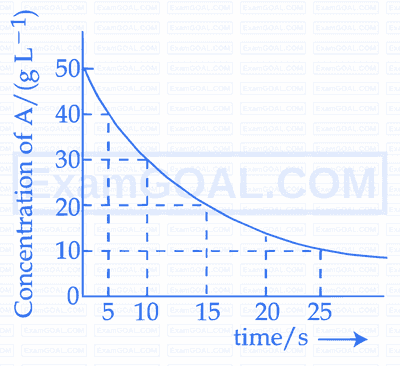
Explanation:
To determine the time required for the concentration of A to decrease from an initial value of $50 \, \mathrm{g} \, \mathrm{L}^{-1}$ to $2.5 \, \mathrm{g} \, \mathrm{L}^{-1}$ in the reaction $ \mathrm{A} \rightarrow \mathrm{B} $, we assume first-order kinetics. Although the graph does not provide a clear indication of the reaction order over the intervals $0-5$, $5-10$, and $10-15$ seconds, where the order appears to be zero, we'll proceed with the assumption of first-order kinetics, since the graph is not a straight line.
The rate constant $ \mathrm{K} $ for first-order reactions can be calculated using the formula:
$ \mathrm{K} = \frac{1}{\mathrm{t}} \ln \frac{\mathrm{A}_0}{\mathrm{A}_{\mathrm{t}}} $
For the interval where $\mathrm{A}_0 = 40 \, \mathrm{g/L}$ and $\mathrm{A}_{\mathrm{t}} = 20 \, \mathrm{g/L}$ after 10 seconds:
$ \mathrm{K} = \frac{1}{10} \ln \frac{40}{20} $
Now, to find the time $ \mathrm{t} $ required for the concentration to reduce to $2.5 \, \mathrm{g/L}$:
$ \mathrm{K} = \frac{1}{\mathrm{t}} \ln \frac{50}{2.5} $
Equating the two expressions for $\mathrm{K}$:
$ \frac{1}{10} \ln 2 = \frac{1}{\mathrm{t}} \ln 20 $
Solving for $\mathrm{t}$:
$ \mathrm{t} = \frac{1.3010 \times 10}{0.3010} = 43.3 \, \mathrm{sec} $
Therefore, the time required for the concentration to decrease to $2.5 \, \mathrm{g/L}$ is approximately 43 seconds.
For the reaction A $\to$ products.

The concentration of A at 10 minutes is _________ $\times 10^{-3} \mathrm{~mol} \mathrm{~L}^{-1}$ (nearest integer). The reaction was started with $2.5 \mathrm{~mol} \mathrm{~L}^{-1}$ of A .
Explanation:
Order of Reaction:
Since $ t_{1/2} \propto [A]_0 $, the reaction follows a zero-order kinetics.
Half-life Equation for Zero-order Reaction:
The half-life ($ t_{1/2} $) is calculated as:
$ t_{1/2} = \frac{[A]_0}{2K} $
Given the slope from the graph is $76.92$, which equals $\frac{1}{2K}$. This implies:
$ K = \frac{1}{2 \times 76.92} $
Concentration of A at 10 Minutes:
Apply the zero-order kinetics equation:
$ [A]_{10} = -Kt + [A]_0 $
Substituting the values:
$ [A]_{10} = -\left(\frac{1}{2 \times 76.92}\right) \times 10 + 2.5 = 2.435 \ \text{mol L}^{-1} $
Final Concentration:
Convert to scientific notation:
$ [A]_{10} = 2435 \times 10^{-3} \ \text{mol L}^{-1} $
Thus, the concentration of A at 10 minutes is approximately $ 2435 \times 10^{-3} \ \text{mol L}^{-1} $.
Consider a complex reaction taking place in three steps with rate constants $\mathrm{k}_1, \mathrm{k}_2$ and $\mathrm{k}_3$ respectively. The overall rate constant $k$ is given by the expression $k=\sqrt{\frac{k_1 k_3}{k_2}}$. If the activation energies of the three steps are 60, 30 and $10 \mathrm{~kJ} \mathrm{~mol}^{-1}$ respectively, then the overall energy of activation in $\mathrm{kJ} \mathrm{mol}^{-1}$ is _________ . (Nearest integer)
Explanation:
To determine the overall energy of activation for the given complex reaction with rate constants $k_1$, $k_2$, and $k_3$, we start with the expression for the overall rate constant $k$:
$ k = \sqrt{\frac{k_1 k_3}{k_2}} $
The rate constant can also be expressed in terms of the Arrhenius equation:
$ A \cdot e^{-E_a / RT} = \sqrt{\frac{A_1 e^{-E_{a_1} / RT} \cdot A_3 e^{-E_{a_3} / RT}}{A_2 e^{-E_{a_2} / RT}}} $
By comparing the exponential terms from both sides, we have:
$ \frac{E_a}{RT} = \frac{1}{2} \left( \frac{E_{a_1}}{RT} + \frac{E_{a_3}}{RT} - \frac{E_{a_2}}{RT} \right) $
This simplifies to:
$ E_a = \frac{E_{a_1} + E_{a_3} - E_{a_2}}{2} $
Substituting the given activation energies—$E_{a_1} = 60 \, \text{kJ mol}^{-1}$, $E_{a_2} = 30 \, \text{kJ mol}^{-1}$, and $E_{a_3} = 10 \, \text{kJ mol}^{-1}$:
$ E_a = \frac{60 + 10 - 30}{2} = \frac{40}{2} = 20 \, \text{kJ mol}^{-1} $
Therefore, the overall energy of activation is 20 kJ/mol.
For the thermal decomposition of $\mathrm{N}_2 \mathrm{O}_5(\mathrm{~g})$ at constant volume, the following table can be formed, for the reaction mentioned below.
$2 \mathrm{~N}_2 \mathrm{O}_5(\mathrm{~g}) \rightarrow 2 \mathrm{~N}_2 \mathrm{O}_4(\mathrm{~g})+\mathrm{O}_2(\mathrm{~g})$
| Sr. No. | Time/s | Total pressure/(atm) |
|---|---|---|
| 1 | 0 | 0.6 |
| 2 | 100 | '$\mathrm{x}$' |
$\mathrm{x}=$ __________ $\times 10^{-3} \mathrm{~atm}$ [nearest integer]
Given : Rate constant for the reaction is $4.606 \times 10^{-2} \mathrm{~s}^{-1}$.
Explanation:
$\begin{aligned} & \mathrm{K}_{\mathrm{N}_2 \mathrm{O}_5}=2 \times 4.606 \times 10^{-2} \mathrm{~S}^{-1} \\ & 2 \mathrm{~N}_2 \mathrm{O}_5(\mathrm{~g}) \longrightarrow 2 \mathrm{~N}_2 \mathrm{O}_4(\mathrm{~g})+\mathrm{O}_2(\mathrm{~g}) \end{aligned}$
$\matrix{ {{P_i}} & {0.6} & 0 & 0 \cr {{P_f}} & {0.6 - P} & P & {{P \over 2}} \cr } $
$\begin{aligned} & 2 \times 4.606 \times 10^{-2}=\frac{2.303}{100} \log \frac{0.6}{0.6-\mathrm{P}} \\ & \quad 4 \log _{10} \frac{0.6}{0.6-\mathrm{P}} \\ & \quad 10^4=\frac{0.6}{0.6-\mathrm{P}} \\ & \Rightarrow 0.6 \times 10^4-10^4 \mathrm{P}=0.6 \end{aligned}$
$\begin{aligned} \begin{aligned} & \Rightarrow 10^4 \mathrm{P}=0.6\left(10^4-1\right) \\ & \mathrm{P}=(6000-0.6) \times 10^{-4} \\ &=5999 . \times 10^{-4} \\ &=0.59994 \\ & \mathrm{P}_{\text {Total }}=0.6+\frac{\mathrm{P}}{2} \\ &= 0.6+0.29997 \\ &= 0.89997 \\ &=899.97 \times 10^{-3} \\ & \text { Ans. } 900 \end{aligned} \end{aligned}$

$\mathrm{P}_{\text {Total }}=0.6+\frac{\mathrm{x}}{2}$
As given in equation
$\mathrm{K}_{\mathrm{r}}=4.606 \times 10^{-2} \mathrm{sec}^{-1}$
(Here language conflict in question)
($\mathrm{K}_{\mathrm{r}}=\frac{\mathrm{KA}}{2}$ not considered)
$\begin{aligned} \mathrm{K}_{\mathrm{r}} \mathrm{t} & =\ln \frac{0.6}{0.6-\mathrm{x}} \\ 4.606 & \times 10^{-2} \times 100=2.303 \log \frac{0.6}{0.6-\mathrm{x}} \\ \mathrm{P}_{\text {Total }} & =0.6+\frac{0.594}{2}=0.897 \mathrm{~atm} \\ \quad & =897 \times 10^{-3} \mathrm{~atm} \end{aligned}$
$\mathrm{A \rightarrow B}$
The molecule A changes into its isomeric form B by following a first order kinetics at a temperature of 1000 K . If the energy barrier with respect to reactant energy for such isomeric transformation is $191.48 \mathrm{~kJ} \mathrm{~mol}^{-1}$ and the frequency factor is $10^{20}$, the time required for $50 \%$ molecules of A to become B is __________ picoseconds (nearest integer). $\left[\mathrm{R}=8.314 \mathrm{~J} \mathrm{~K}^{-1} \mathrm{~mol}^{-1}\right]$
Explanation:
To determine the time required for 50% of molecule A to change into its isomeric form B, follow these steps:
Half-life Formula for First Order Kinetics:
The half-life ($ t_{1/2} $) for a first-order reaction is given by:
$ t_{1/2} = \frac{0.693}{K} $
Calculate the Rate Constant (K):
The rate constant $ K $ can be calculated using the Arrhenius equation:
$ K = A \cdot e^{-\frac{E_a}{RT}} $
Given:
$ A $ (frequency factor) = $ 10^{20} $
$ E_a $ (activation energy) = $ 191.48 \, \text{kJ/mol} = 191.48 \times 10^3 \, \text{J/mol} $
$ R $ (universal gas constant) = $ 8.314 \, \text{J/mol} \cdot \text{K} $
$ T = 1000 \, \text{K} $
Substitute the values into the Arrhenius equation:
$ K = 10^{20} \times e^{-\frac{191.48 \times 10^3}{8.314 \times 1000}} $
Simplify this calculation:
$ K = 10^{20} \times e^{-23.031} $
Simplifying further by recognizing that $ e^{-23.031} $ is a very small number, gives:
$ K \approx \frac{10^{20}}{10^{10}} = 10^{10} \, \text{sec}^{-1} $
Calculate the Half-life:
Using the calculated value of $ K $:
$ t_{1/2} = \frac{0.693}{10^{10}} = 6.93 \times 10^{-11} \, \text{seconds} $
Convert to Picoseconds:
Since $ 1 \, \text{second} = 10^{12} \, \text{picoseconds} $:
$ t_{1/2} = 6.93 \times 10^{-11} \times 10^{12} \, \text{picoseconds} = 69.3 \, \text{picoseconds} $
Therefore, the time required for 50% of the molecules of A to become B is approximately 69 picoseconds (nearest integer).
Consider a reaction $A+R \rightarrow$ Product. The rate of this reaction is measured to be $k[A][R]$. At the start of the reaction, the concentration of $R,[R]_0$, is 10-times the concentration of $A,[A]_0$. The reaction can be considered to be a pseudo first order reaction with assumption that $k[R]=k^{\prime}$ is constant. Due to this assumption, the relative error (in %) in the rate when this reaction is $40 \%$ complete, is ___________.
[ $k$ and $k^{\prime}$ represent corresponding rate constants]
Explanation:
 $\begin{aligned} & \text { Rate }=k[\mathrm{~A}][\mathrm{R}] \\\\ & \operatorname{Rate}_1=k\left(0.6 \mathrm{~A}_0\right) \times 9.6 \mathrm{~A}_0\end{aligned}$
 $\begin{aligned} & \text { Rate }=\mathrm{k}^{\prime}[\mathrm{A}], \mathrm{k}^{\prime}=\mathrm{k}[\mathrm{R}] \end{aligned}$
The relative error between the actual rate and the pseudo-first order rate is computed by:
$ \text{Relative Error (%)} = \frac{\text{Rate}_2 - \text{Rate}_1}{\text{Rate}_1} \times 100 $
Plugging the calculations:
$ \text{Relative Error (%)} = \frac{(0.6 \times 10 - 0.6 \times 9.6)}{0.6 \times 9.6} \times 100 = 4.1666\% $
Consider the following first order gas phase reaction at constant temperature $ \mathrm{A}(\mathrm{g}) \rightarrow 2 \mathrm{B}(\mathrm{~g})+\mathrm{C}(\mathrm{g})$
If the total pressure of the gases is found to be 200 torr after 23 $\mathrm{sec}$. and 300 torr upon the complete decomposition of A after a very long time, then the rate constant of the given reaction is ________ $\times 10^{-2} \mathrm{~s}^{-1}$ (nearest integer)
[Given : $\log _{10}(2)=0.301$]
Explanation:
To find the rate constant of the first-order reaction indicated, let us first understand the reaction dynamics based on the total pressure change over time. The reaction is:
$\mathrm{A(g)} \rightarrow 2\mathrm{B(g)} + \mathrm{C(g)}$
Initially, only A is present. As the reaction progresses, A decreases, and B and C are formed. For each mole of A that reacts, a total of 3 moles of gas are produced (2 moles of B and 1 mole of C), leading to an increase in the total pressure of the system if the volume remains constant.
At the start: Total pressure due to A only.
Finally, when A has completely decomposed: Total pressure is due to 3 times the initial amount of A, as no A is left and for every mole of A decomposed, 3 moles of gas (2B + 1C) are produced.
The total pressure change thus directly relates to the extent of reaction, i.e., how much A has decomposed into B and C.
The total pressure at 23 sec is 200 torr, and the final total pressure is 300 torr after a very long time, indicating that the pressure increases by 100 torr due to the complete decomposition of A.
To use this information, we need to understand the relationship between pressure change and concentration in a closed system, especially for a first-order reaction. For a first-order reaction:
$\ln\left(\frac{[A]_0}{[A]}\right) = kt$
Where: $[A]_0$ is the initial concentration (or in this context, partial pressure), $[A]$ is the concentration (or partial pressure) at time t, $k$ is the rate constant, and $t$ is the time.
Let's denote the initial total pressure due to A as $P_0$. At complete decomposition, the pressure increase is from the conversion of A to 2B + C which increases the total pressure to 300 torr, indicating that initially, $P_0$ must have been 100 torr since the pressure increase is due to the tripling effect of the reaction, completing to 300 torr.
At 23 sec, the total pressure is at 200 torr. This means 100 torr is due to the unreacted A, and the additional 100 torr is from the formation of 2B + C. Given the nature of the reaction (1:3 stoichiometry of A to the total gas), we can deduce that at 23 seconds, half of A has reacted because the pressure due to the products matches the pressure due to the unreacted A.
Hence, at 23 sec, $[A] = \frac{1}{2}[A]_0$. Plugging this into the first-order reaction formula:
$\ln\left(\frac{[A]_0}{\frac{1}{2}[A]_0}\right) = kt$
$\ln(2) = k \times 23$
Given that $\log_{10}(2) = 0.301$, and knowing that $\ln(2) = \log_{e}(2)$ (where $\log_{e}(2) \approx 0.693$, for conversion from base 10 to e we can use the natural logarithm of 2 directly), we have:
$0.693 = k \times 23$
$k = \frac{0.693}{23} = 0.0301 \, \mathrm{s}^{-1}$
When expressed in the format requested, $k = 3.01 \times 10^{-2} \, \mathrm{s}^{-1}$. Rounding to the nearest integer, $k = 3 \times 10^{-2} \, \mathrm{s}^{-1}$.
Given below are two statements :
Statement I : The rate law for the reaction $A+B \rightarrow C$ is rate $(r)=k[A]^2[B]$. When the concentration of both $\mathrm{A}$ and $\mathrm{B}$ is doubled, the reaction rate is increased "$x$" times.
Statement II : 
The figure is showing "the variation in concentration against time plot" for a "$y$" order reaction.
The Value of $x+y$ is __________.Explanation:
$\begin{aligned} & x=8, y=0 \\ & \frac{r_2}{r_1}=\left(\frac{C_{\mathrm{A}_2}}{C_{\mathrm{A}_1}}\right)^2\left(\frac{\mathrm{C}_{\mathrm{B}_2}}{\mathrm{C}_{\mathrm{B}_1}}\right) \\ & \frac{\mathrm{r}_2}{\mathrm{r}_1}=\left(\frac{2 \mathrm{C}_{\mathrm{A}_1}}{\mathrm{C}_{\mathrm{A}_1}}\right)^2\left(\frac{2 \mathrm{C}_{\mathrm{B}_1}}{\mathrm{C}_{\mathrm{B}_1}}\right) \\ & \mathrm{r}_2=8 \mathrm{r}_1 \\ & x=8 \end{aligned}$

$\begin{aligned} & \Rightarrow \text { Zero order } \\ & y=0 \end{aligned}$
Consider the following reaction
$\mathrm{A}+\mathrm{B} \rightarrow \mathrm{C}$
The time taken for A to become $1 / 4^{\text {th }}$ of its initial concentration is twice the time taken to become $1 / 2$ of the same. Also, when the change of concentration of B is plotted against time, the resulting graph gives a straight line with a negative slope and a positive intercept on the concentration axis.
The overall order of the reaction is ________.
Explanation:
To determine the overall order of the reaction given by $\mathrm{A} + \mathrm{B} \rightarrow \mathrm{C}$, we can derive the information based on the given details about the kinetics of reactant A and the graphical behavior of reactant B.
The first piece of information tells us that the time for the concentration of A to reduce to $1/4$ of its initial concentration ($[A]_0/4$) is twice the time it takes to reduce to half of its initial concentration ($[A]_0/2$). This characteristic is a hallmark of first-order reactions. In first-order reactions, the time it takes for the concentration of the reactant to reduce to half of its initial value (known as the half-life, $t_{1/2}$) is constant and does not depend on the initial concentration. Specifically, the fact that the concentration decreases by a factor of 4 (to $1/4$ its initial value) in twice the time it takes to decrease by a factor of 2 (to $1/2$ its initial value) indicates a constant half-life, consistent with first-order kinetics for reactant A.
As for reactant B, the information provided is that a plot of its concentration change over time is a straight line with a negative slope and a positive intercept on the concentration axis. This description matches the behavior of a reactant in a reaction of zero-order kinetics with respect to B, where the rate of reaction is constant and independent of the concentration of B. In zero-order reactions, the concentration of the reactant decreases linearly over time, since the rate of decrease is constant.
Therefore, considering the kinetics of both A and B:
- Reactant A shows first-order kinetics.
- Reactant B shows zero-order kinetics.
The overall order of the reaction is the sum of the individual orders with respect to each reactant, which gives us:
$\text{Overall order} = \text{Order with respect to A} + \text{Order with respect to B} = 1 (A) + 0 (B) = 1.$
Hence, the overall order of the reaction is 1.
Consider the two different first order reactions given below
$\begin{aligned} & \mathrm{A}+\mathrm{B} \rightarrow \mathrm{C} \text { (Reaction 1) } \\ & \mathrm{P} \rightarrow \mathrm{Q} \text { (Reaction 2) } \end{aligned}$
The ratio of the half life of Reaction 1 : Reaction 2 is $5: 2$ If $t_1$ and $t_2$ represent the time taken to complete $2 / 3^{\text {rd }}$ and $4 / 5^{\text {th }}$ of Reaction 1 and Reaction 2 , respectively, then the value of the ratio $t_1: t_2$ is _________ $\times 10^{-1}$ (nearest integer). [Given : $\log _{10}(3)=0.477$ and $\log _{10}(5)=0.699$]
Explanation:
$\mathrm{A+B \rightarrow C}$ Reaction .... (1)
$\mathrm{P} \rightarrow \mathrm{Q} \quad$ Reaction .... (2)
$\frac{\left(t_{\frac{1}{2}}\right)_1}{\left(t_{\frac{1}{2}}\right)_2}=\frac{k}{k_1}= \frac{5}{2}$
$\begin{aligned} & \frac{\frac{t_2}{3}}{t_{\frac{4}{5}}^5}=\frac{k_2}{k_1} \frac{\log 3}{\log 5} \\ & =\left(\frac{5}{2}\right) \frac{0.477}{0.699}=1.7 \\ & =17 \times 10^{-1} \\ & =x=17 \end{aligned}$
Time required for $99.9 \%$ completion of a first order reaction is _________ times the time required for completion of $90 \%$ reaction.(nearest integer)
Explanation:
To determine the time required for a certain level of completion ($x\%$) of a first-order reaction, we can use the formula that relates the time $ t $, the rate constant $ k $, and the concentration of the reactant. The formula for a first-order reaction, when expressed in terms of the initial concentration $[A]_0$ and the concentration at time $t$, $[A]_t$, is given by the integrated rate law for first-order reactions:
$\ln\left(\frac{[A]_0}{[A]_t}\right) = kt$
For a given percentage of completion, we use the fact that $[A]_t = [A]_0(1-\frac{x}{100})$, where $x$ is the percentage completion. Thus, the equation becomes:
$\ln\left(\frac{[A]_0}{[A]_0(1-\frac{x}{100})}\right) = kt$
Simplifying, we get:
$\ln\left(\frac{1}{1-\frac{x}{100}}\right) = kt$
Let's calculate the time required for $99.9\%$ and $90\%$:
- For $99.9\%$ completion ($x = 99.9\%$):
$\ln\left(\frac{1}{1-\frac{99.9}{100}}\right) = kt_{99.9}$
$\ln\left(\frac{1}{0.001}\right) = kt_{99.9}$
$\ln(1000) = kt_{99.9}$
- For $90\%$ completion ($x = 90\%$):
$\ln\left(\frac{1}{1-\frac{90}{100}}\right) = kt_{90}$
$\ln\left(\frac{1}{0.1}\right) = kt_{90}$
$\ln(10) = kt_{90}$
Since $k$ is a constant for a given reaction at a constant temperature, we can compare the times $t_{99.9}$ and $t_{90}$ directly by comparing the logarithmic values:
$\frac{t_{99.9}}{t_{90}} = \frac{\ln(1000)}{\ln(10)}$
Using the property of logarithms, we know that $\ln(1000) = 3\ln(10)$ because $1000 = 10^3$, so:
$\frac{t_{99.9}}{t_{90}} = \frac{3\ln(10)}{\ln(10)} = 3$
Therefore, the time required for $99.9\%$ completion of a first-order reaction is $3$ times the time required for completion of $90\%$ of the reaction. The nearest integer to this value is $3$.
Consider the following single step reaction in gas phase at constant temperature.
$2 \mathrm{~A}_{(\mathrm{g})}+\mathrm{B}_{(\mathrm{g})} \rightarrow \mathrm{C}_{(\mathrm{g})}$
The initial rate of the reaction is recorded as $\mathrm{r}_1$ when the reaction starts with $1.5 \mathrm{~atm}$ pressure of $\mathrm{A}$ and $0.7 \mathrm{~atm}$ pressure of B. After some time, the rate $r_2$ is recorded when the pressure of C becomes $0.5 \mathrm{~atm}$. The ratio $\mathrm{r}_1: \mathrm{r}_2$ is _________ $\times 10^{-1}$. (Nearest integer)
Explanation:
$2 \mathrm{~A}(\mathrm{~g})+\mathrm{B}(\mathrm{g}) \rightarrow \mathrm{C}(\mathrm{g})$
As this is single step reaction,
$\mathrm{r}=\mathrm{k}_{\mathrm{f}}[\mathrm{A}]^2[\mathrm{~B}]^2$
$\begin{array}{lllll} & 2 \mathrm{~A}(\mathrm{~g})+ & \mathrm{B}(\mathrm{g}) \rightarrow & \mathrm{C}(\mathrm{g}) \\ \mathrm{t}=0 & 1.5 & 0.7 & 0 \\ \mathrm{t}=\mathrm{t}^{\prime} & 1.5-2 \mathrm{x} \quad & 0.7-\mathrm{x} & \mathrm{x} \end{array}$
$\begin{aligned} & \Rightarrow x=0.5 \mathrm{~atm} \\ & \mathrm{r}_1=\mathrm{k}_{\mathrm{f}}(1.5)^2(0.7) \\ & \mathrm{r}_2=\mathrm{k}_{\mathrm{f}}(0.5)^2(0.2) \\ & \frac{r_1}{r_2}=\frac{9 \times 7}{2}=31.5 \\ & =315 \times 10^{-1} \end{aligned}$
During Kinetic study of reaction $\mathrm{2 A+B \rightarrow C+D}$, the following results were obtained :
| $\mathrm{A [M]}$ | $\mathrm{B [M]}$ | initial rate of formation of $\mathrm{D}$ | |
|---|---|---|---|
| I | 0.1 | 0.1 | $6.0\times10^{-3}$ |
| II | 0.3 | 0.2 | $7.2\times10^{-2}$ |
| III | 0.3 | 0.4 | $2.88\times10^{-1}$ |
| IV | 0.4 | 0.1 | $2.40\times10^{-2}$ |
Based on above data, overall order of the reaction is _________.
Explanation:
$\begin{aligned} & \text { Rate }=k[A]^x[B]^y \\ & \frac{6 \times 10^{-}}{2.4 \times 10^{-}}=\left(\frac{0.1}{0.4}\right)^x \Rightarrow x=1 \\ & \frac{7.2 \times 10^{-}}{2.88 \times 10^{-}}=\left(\frac{0.2}{0.4}\right)^y \Rightarrow y=2 \end{aligned}$
Consider the following reaction, the rate expression of which is given below
$\begin{aligned} & \mathrm{A}+\mathrm{B} \rightarrow \mathrm{C} \\ & \text { rate }=\mathrm{k}[\mathrm{A}]^{1 / 2}[\mathrm{~B}]^{1 / 2} \end{aligned}$
The reaction is initiated by taking $1 \mathrm{~M}$ concentration of $\mathrm{A}$ and $\mathrm{B}$ each. If the rate constant $(\mathrm{k})$ is $4.6 \times 10^{-2} \mathrm{~s}^{-1}$, then the time taken for $\mathrm{A}$ to become $0.1 \mathrm{~M}$ is _________ sec. (nearest integer)
Explanation:
$\begin{aligned} & A+B \rightarrow C \\ & \frac{-d[A]}{d t}=k[A]^{1 / 2}[B]^{1 / 2} \end{aligned}$
Since, $[A]=[B]$
$\begin{aligned} & \Rightarrow \quad \frac{-d[A]}{d t}=k[A] \\ & \Rightarrow \quad k t=\ln \frac{[A]_0}{[A]} \\ & \Rightarrow \quad t=\frac{1}{4.6 \times 10^{-2}} \times \ln \left(\frac{1}{0.1}\right) \\ & =\frac{2.303}{4.6} \times 100 \approx 50 \end{aligned}$
Consider the following transformation involving first order elementary reaction in each step at constant temperature as shown below.

Some details of the above reactions are listed below.
| Step | Rate constant (sec$^{-1}$) | Activation energy (kJ mol$^{-1}$) |
|---|---|---|
| 1 | $\mathrm{k_1}$ | 300 |
| 2 | $\mathrm{k_2}$ | 200 |
| 3 | $\mathrm{k_3}$ | $\mathrm{Ea_3}$ |
If the overall rate constant of the above transformation (k) is given as $\mathrm{k=\frac{k_1 k_2}{k_3}}$ and the overall activation energy $(\mathrm{E}_{\mathrm{a}})$ is $400 \mathrm{~kJ} \mathrm{~mol} \mathrm{~m}^{-1}$, then the value of $\mathrm{Ea}_3$ is ________ integer)
Explanation:
$\begin{aligned} & k=\frac{k_1 k_2}{k_3} \\ & E_{a_{e f f}}=E_{a_1}+E_{a_2}-E_{a_3} \end{aligned}$
$\begin{aligned} & 400=300+200-E_{\mathrm{a}_3} \\ & 400=500-E_{\mathrm{a}_3} \\ & E_{\mathrm{a}_3}=100 \mathrm{~kJ} \mathrm{~mole}^{-1} \end{aligned}$
$\mathrm{A}(\mathrm{g}) \rightarrow 2 \mathrm{~B}(\mathrm{~g})+\mathrm{C}(\mathrm{g})$
| S.No. | Time /s | Total pressure /(atm) |
|---|---|---|
| 1. | 0 | 0.1 |
| 2. | 115 | 0.28 |
The rate constant of the reaction is ________ $\times 10^{-2} \mathrm{~s}^{-1}$ (nearest integer)
Explanation:

$\begin{aligned} & 0.1+2 \mathrm{x}=0.28 \\\\ & 2 \mathrm{x}=0.18 \\\\ & \mathrm{x}=0.09 \\\\ & \mathrm{~K}=\frac{1}{115} \ln \frac{0.1}{0.1-0.09} \\\\ & =0.0200 \mathrm{sec}^{-1} \\\\ & =2 \times 10^{-2} \mathrm{sec}^{-1}\end{aligned}$
Explanation:
The given problem involves calculating the age of a wood sample using the carbon-14 dating method. Carbon-14 ($^{14}C$) is a radioactive isotope of carbon that decays over time, and its ratio compared to carbon-12 ($^{12}C$) can be used to date organic materials. The ratio of $\frac{^{14}C}{^{12}C}$ in the wood is $\frac{1}{8}$th of that in the atmosphere, suggesting the $^{14}C$ has decayed. The half-life of $^{14}C$ is given as 5730 years, which is the time for half the $^{14}C$ to decay.
To solve for the age of the wood, we use the formula for radioactive decay:
$N = N_0 e^{-\lambda t},$where $N$ is the remaining amount of $^{14}C$, $N_0$ is the original amount of $^{14}C$, $\lambda$ is the decay constant, and $t$ is the time (age of the wood).
Since the ratio $\frac{N}{N_0} = \frac{1}{8}$, we infer that $N = \frac{N_0}{8}$. Substituting into the decay equation and solving for $t$, first we find the decay constant $\lambda$:
$\lambda = \frac{0.693}{t_{1/2}} = \frac{0.693}{5730}.$Substitute $\lambda$ and rearrange to solve for $t$:
$t = \frac{\ln(8)}{\lambda} = \frac{\ln(8)}{0.693} \times 5730 = 3 \times 5730 = 17190 \text{ years}.$This calculation shows that the wood sample is 17190 years old.
$\mathrm{r}=\mathrm{k}[\mathrm{A}]$ for a reaction, $50 \%$ of $\mathrm{A}$ is decomposed in 120 minutes. The time taken for $90 \%$ decomposition of $\mathrm{A}$ is _________ minutes.
Explanation:
$\mathrm{r}=\mathrm{k}[\mathrm{A}]$
So, order of reaction $=1$
$\mathrm{t}_{1 / 2}=120 \mathrm{~min}$
For $90 \%$ completion of reaction
$\begin{aligned} & \Rightarrow \mathrm{k}=\frac{2.303}{\mathrm{t}} \log \left(\frac{\mathrm{a}}{\mathrm{a}-\mathrm{x}}\right) \\ & \Rightarrow \frac{0.693}{\mathrm{t}_{1 / 2}}=\frac{2.303}{\mathrm{t}} \log \frac{100}{10} \\ & \therefore \mathrm{t}=399 \mathrm{~min} . \end{aligned}$
$\mathrm{NO}_2$ required for a reaction is produced by decomposition of $\mathrm{N}_2 \mathrm{O}_5$ in $\mathrm{CCl}_4$ as by equation
$2 \mathrm{~N}_2 \mathrm{O}_{5(\mathrm{~g})} \rightarrow 4 \mathrm{NO}_{2(\mathrm{~g})}+\mathrm{O}_{2(\mathrm{~g})}$
The initial concentration of $\mathrm{N}_2 \mathrm{O}_5$ is $3 \mathrm{~mol} \mathrm{~L}^{-1}$ and it is $2.75 \mathrm{~mol} \mathrm{~L}^{-1}$ after 30 minutes.
The rate of formation of $\mathrm{NO}_2$ is $\mathrm{x} \times 10^{-3} \mathrm{~mol} \mathrm{~L}^{-1} \mathrm{~min}^{-1}$, value of $\mathrm{x}$ is _________. (nearest integer)
Explanation:
Rate of reaction (ROR)
$\begin{aligned} & =-\frac{1}{2} \frac{\Delta\left[\mathrm{N}_2 \mathrm{O}_5\right]}{\Delta \mathrm{t}}=\frac{1}{4} \frac{\left[\mathrm{NO}_2\right]}{\Delta \mathrm{t}}=\frac{\Delta\left[\mathrm{O}_2\right]}{\Delta \mathrm{t}} \\ & \mathrm{ROR}=-\frac{1}{2} \frac{\Delta\left[\mathrm{N}_2 \mathrm{O}_5\right]}{\Delta \mathrm{t}}=-\frac{1}{2} \frac{(2.75-3)}{30} \mathrm{~mol} \mathrm{~L}^{-1} \mathrm{~min}^{-1} \\ & \mathrm{ROR}=-\frac{1}{2} \frac{(-0.25)}{30} \mathrm{~mol} \mathrm{~L}^{-1} \mathrm{~min}^{-1} \\ & \text { ROR }=\frac{1}{240} \mathrm{~mol} \mathrm{~L}^{-1} \mathrm{~min}^{-1} \end{aligned}$
Rate of formation of $\mathrm{NO}_2=\frac{\Delta\left[\mathrm{NO}_2\right]}{\Delta \mathrm{t}}=4 \times \mathrm{ROR}$
$=\frac{4}{240}=16.66 \times 10^{-3} \mathrm{molL}^{-1} \mathrm{~min}^{-1} \simeq 17 \times 10^{-3} \text {. }$
The rate of First order reaction is $0.04 \mathrm{~mol} \mathrm{~L}^{-1} \mathrm{~s}^{-1}$ at 10 minutes and $0.03 \mathrm{~mol} \mathrm{~L}^{-1} \mathrm{~s}^{-1}$ at 20 minutes after initiation. Half life of the reaction is _______ minutes.
(Given $\log 2=0.3010, \log 3=0.4771$)
Explanation:
$\begin{aligned} & 0.04=\mathrm{k}[\mathrm{A}]_0 \mathrm{e}^{-\mathrm{k} \times 10 \times 60} \quad \text{..... (1)}\\ & 0.03=\mathrm{k}[\mathrm{A}]_0 \mathrm{e}^{-\mathrm{k} \times 20 \times 60} \quad \text{..... (2)} \end{aligned}$
$\begin{aligned} \frac{4}{3} & =\mathrm{e}^{600 \mathrm{k}(2-1)} /(2) \\ \frac{4}{3} & =\mathrm{e}^{600 \mathrm{k}} \\ \ln \frac{4}{3} & =600 \mathrm{k} \\ \ln \frac{4}{3} & =600 \times \frac{\ln 2}{\mathrm{t}_{1 / 2}} \\ \mathrm{t}_{1 / 2} & =600 \frac{\ln 2}{\ln \frac{4}{3}} \sec \\ \mathrm{t}_{1 / 2} & =600 \times \frac{\log 2}{\log 4-\log 3} \mathrm{sec} .=10 \times \frac{0.3010}{0.6020-0.477} \mathrm{~min} \\ \mathrm{t}_{1 / 2} & =24.08 \mathrm{~min} \end{aligned}$
Ans. 24
The half-life of radioisotope bromine - 82 is 36 hours. The fraction which remains after one day is ________ $\times 10^{-2}$.
(Given antilog $0.2006=1.587$)
Explanation:
Half life of bromine $-82=36$ hours
$\begin{aligned} & \mathrm{t}_{1 / 2}=\frac{0.693}{\mathrm{~K}} \\ & \mathrm{~K}=\frac{0.693}{36}=0.01925 \mathrm{~hr}^{-1} \\ & 1^{\text {st }} \text { order rxn kinetic equation } \\ & \mathrm{t}=\frac{2.303}{\mathrm{~K}} \log \frac{\mathrm{a}}{\mathrm{a}-\mathrm{x}} \\ & \log \frac{\mathrm{a}}{\mathrm{a}-\mathrm{x}}=\frac{\mathrm{t} \times \mathrm{K}}{2.303}(\mathrm{t}=1 \text { day }=24 \mathrm{~hr}) \\ & \log \frac{\mathrm{a}}{\mathrm{a}-\mathrm{x}}=\frac{24 \mathrm{hr} \times 0.01925 \mathrm{hr}^{-1}}{2.303} \\ & \log \frac{\mathrm{a}}{\mathrm{a}-\mathrm{x}}=0.2006 \\ & \frac{\mathrm{a}}{\mathrm{a}-\mathrm{x}}=\mathrm{anti} \log (0.2006) \\ & \frac{\mathrm{a}}{\mathrm{a}-\mathrm{x}}=1.587 \\ & \text { If }=1 \\ & \frac{1}{1-\mathrm{x}}=1.587 \Rightarrow 1-\mathrm{x}=0.6301=\text { Fraction remain } \\ & \mathrm{after} \text { one day } \end{aligned}$
For a reaction taking place in three steps at same temperature, overall rate constant $\mathrm{K}=\frac{\mathrm{K}_1 \mathrm{~K}_2}{\mathrm{~K}_3}$. If $\mathrm{Ea}_1, \mathrm{Ea}_2$ and $\mathrm{Ea}_3$ are 40, 50 and $60 \mathrm{~kJ} / \mathrm{mol}$ respectively, the overall $\mathrm{Ea}$ is ________ $\mathrm{kJ} / \mathrm{mol}$.
Explanation:
$\begin{aligned} & \mathrm{K}=\frac{\mathrm{K}_1 \cdot \mathrm{K}_2}{\mathrm{~K}_3}=\frac{\mathrm{A}_1 \cdot \mathrm{A}_2}{\mathrm{~A}_3} \cdot \mathrm{e}^{-\frac{\left(\mathrm{E}_{\mathrm{a}_1}+\mathrm{E}_{\mathrm{a}_2}-\mathrm{E}_{\mathrm{a}_3}\right)}{R T}} \\ & \mathrm{~A} \cdot \mathrm{e}^{-\mathrm{E}_{\mathrm{a}} / \mathrm{RT}}=\frac{\mathrm{A}_1 \mathrm{~A}_2}{\mathrm{~A}_3} \cdot \mathrm{e}^{-\frac{\left(\mathrm{E}_{\mathrm{a}_1}+\mathrm{E}_{\mathrm{a}_2}-\mathrm{E}_{\mathrm{a}_3}\right)}{R T}}\end{aligned}$
$\mathrm{E}_{\mathrm{a}}=\mathrm{E}_{\mathrm{a}_1}+\mathrm{E}_{\mathrm{a}_2}-\mathrm{E}_{\mathrm{a}_3}=40+50-60=30 \mathrm{~kJ} / \mathrm{mole} .$
Time required for completion of $99.9 \%$ of a First order reaction is ________ times of half life $\left(t_{1 / 2}\right)$ of the reaction.
Explanation:
$\frac{\mathrm{t}_{99.9 \%}}{\mathrm{t}_{1 / 2}}=\frac{\frac{2.303}{\mathrm{k}}\left(\frac{\mathrm{a}}{\mathrm{a}-\mathrm{x}}\right)}{\frac{2.303}{\mathrm{k}} \log 2}=\frac{\log \left(\frac{100}{100-99.9}\right)}{\log 2}=\frac{\log 10^3}{\log 2}=\frac{3}{0.3}=10$
Consider the following data for the given reaction
$2 \mathrm{HI}_{(\mathrm{g})} \rightarrow \mathrm{H}_{2(\mathrm{~g})}+\mathrm{I}_{2(\mathrm{~g})}$

The order of the reaction is _________.
Explanation:
Let, $\mathrm{R}=\mathrm{k}[\mathrm{HI}]^{\mathrm{n}}$
using any two of given data,
$\begin{aligned} & \frac{3 \times 10^{-3}}{7.5 \times 10^{-4}}=\left(\frac{0.01}{0.005}\right)^{\mathrm{n}} \\\\ & \mathrm{n}=2 \end{aligned}$
A sample initially contains only U-238 isotope of uranium. With time, some of the U-238 radioactively decays into $\mathrm{Pb}-206$ while the rest of it remains undisintegrated.
When the age of the sample is $\mathbf{P} \times 10^8$ years, the ratio of mass of $\mathrm{Pb}-206$ to that of $\mathrm{U}-238$ in the sample is found to be 7. The value of $\mathbf{P}$ is _______.
[Given: Half-life of $\mathrm{U}-238$ is $4.5 \times 10^9$ years; $\log _e 2=0.693$ ]
Explanation:
- Given Data:
- Ratio of mass of $ \mathrm{Pb}^{206} $ to $ \mathrm{U}^{238} $ = $ \frac{7}{1} $
- Mass of $ \mathrm{Pb}^{206} $ = 7 g
- Mass of $ \mathrm{U}^{238} $ = 1 g
- Half-life of $ \mathrm{U}^{238} $ = $ 4.5 \times 10^9 $ years
- $ \log_e 2 = 0.693 $
- Calculate Moles:
- Moles of $ \mathrm{Pb}^{206} $:
$ \text{Moles of } \mathrm{Pb}^{206} = \frac{7}{206} = 34 \times 10^{-3} \text{ moles} $
- Moles of $ \mathrm{U}^{238} $:
$ \text{Moles of } \mathrm{U}^{238} = \frac{1}{238} = 4.2 \times 10^{-3} \text{ moles} $
- Initial Moles of $ \mathrm{U}^{238} $ ( $ N_0 $ ):
$ N_0 = \text{Moles of } \mathrm{U}^{238} \text{ initially} = \text{Moles of } \mathrm{Pb}^{206} + \text{Moles of remaining } \mathrm{U}^{238} $
$ N_0 = 34 \times 10^{-3} + 4.2 \times 10^{-3} = 38.2 \times 10^{-3} \text{ moles} $
- Calculate the Time:
- Using the decay formula:
$ \lambda t = \ln \frac{N_0}{N_t} $
- Where $ \lambda $ (decay constant):
$ \lambda = \frac{\ln 2}{t_{1/2}} = \frac{0.693}{4.5 \times 10^9 \text{ years}} $
- Calculate $ \ln \frac{N_0}{N_t} $:
$ \ln \frac{N_0}{N_t} = \ln \frac{38.2}{4.2} = \ln 9.09 $
- Simplify $ \ln 9.09 $:
$ \ln 9.09 \approx 2.21 $
- Plug in the Values:
$ t = \frac{4.5 \times 10^9 \text{ years}}{0.693} \times \ln 9.09 $
$ t = 4.5 \times 10^9 \text{ years} \times \frac{2.21}{0.693} $
$ t \approx 4.5 \times 10^9 \times 3.184 \approx 14.33 \times 10^9 \text{ years} $
- Convert to $ P \times 10^8 $:
$ t = P \times 10^8 \text{ years} $
$ P \times 10^8 = 14.33 \times 10^9 $
$ P = 143.28 $
Thus, the value of $ P $ is $ \boxed{143.28} $.
Consider the following reaction,
$ 2 \mathrm{H}_2(\mathrm{~g})+2 \mathrm{NO}(\mathrm{g}) \rightarrow \mathrm{N}_2(\mathrm{~g})+2 \mathrm{H}_2 \mathrm{O}(\mathrm{g}) $
which follows the mechanism given below :
$ \begin{array}{ll} 2 \mathrm{NO}(\mathrm{g}) \stackrel{k_1}{\underset{k_{-1}}{\rightleftharpoons}} \mathrm{N}_2 \mathrm{O}_2(\mathrm{~g}) & \text { (fast equlibrium) } \\\\ \mathrm{N}_2 \mathrm{O}_2(\mathrm{~g})+\mathrm{H}_2(\mathrm{~g}) \xrightarrow{k_2} \mathrm{~N}_2 \mathrm{O}(\mathrm{g})+\mathrm{H}_2 \mathrm{O}(\mathrm{g}) & \text { (slow reaction) } \\\\ \mathrm{N}_2 \mathrm{O}(\mathrm{g})+\mathrm{H}_2(\mathrm{~g}) \xrightarrow{k_3} \mathrm{~N}_2(\mathrm{~g})+\mathrm{H}_2 \mathrm{O}(\mathrm{g}) & \text { (fast reaction) } \end{array} $
The order of the reaction is __________.
Explanation:
The given reaction is:
$2 \mathrm{H}_2(\mathrm{~g}) + 2 \mathrm{NO}(\mathrm{g}) \rightarrow \mathrm{N}_2(\mathrm{~g}) + 2 \mathrm{H}_2 \mathrm{O}(\mathrm{g})$
And it follows the mechanism below:
$ \begin{array}{ll} 2 \mathrm{NO}(\mathrm{g}) \stackrel{k_1}{\underset{k_{-1}}{\rightleftharpoons}} \mathrm{N}_2 \mathrm{O}_2(\mathrm{~g}) & \text { (fast equilibrum) } \\\\ \mathrm{N}_2 \mathrm{O}_2(\mathrm{~g}) + \mathrm{H}_2(\mathrm{~g}) \xrightarrow{k_2} \mathrm{~N}_2 \mathrm{O}(\mathrm{g}) + \mathrm{H}_2 \mathrm{O}(\mathrm{g}) & \text { (slow reaction) } \\\\ \mathrm{N}_2 \mathrm{O}(\mathrm{g}) + \mathrm{H}_2(\mathrm{~g}) \xrightarrow{k_3} \mathrm{~N}_2(\mathrm{~g}) + \mathrm{H}_2 \mathrm{O}(\mathrm{g}) & \text { (fast reaction) } \end{array} $
To determine the order of the reaction, we need to focus on the slow step, as it is the rate-determining step. The slow step is:
$ \mathrm{N}_2 \mathrm{O}_2(\mathrm{~g}) + \mathrm{H}_2(\mathrm{~g}) \xrightarrow{k_2} \mathrm{~N}_2 \mathrm{O}(\mathrm{g}) + \mathrm{H}_2 \mathrm{O}(\mathrm{g}) $
The rate law for this step can be written as:
$ \text{Rate} = k_2 [\mathrm{N}_2\mathrm{O}_2][\mathrm{H}_2] $
However, $[\mathrm{N}_2 \mathrm{O}_2]$ is an intermediate and its concentration can be expressed in terms of the reactants. From the fast equilibrium step:
$ 2 \mathrm{NO}(\mathrm{g}) \stackrel{k_1}{\underset{k_{-1}}{\rightleftharpoons}} \mathrm{N}_2 \mathrm{O}_2(\mathrm{~g}) $
The equilibrium constant for this step can be written as:
$\frac{\mathrm{k}_1}{\mathrm{k}_{-1}}$ = $ K = \frac{[\mathrm{N}_2 \mathrm{O}_2]}{[\mathrm{NO}]^2} $
Hence, the concentration of the intermediate $\mathrm{N}_2 \mathrm{O}_2$ can be expressed as:
$ [\mathrm{N}_2 \mathrm{O}_2] = K[\mathrm{NO}]^2 $
Substituting this into the rate law for the slow step gives:
$ \text{Rate} = k_2 K [\mathrm{NO}]^2[\mathrm{H}_2] $
Let's combine $k_2$ and $K$ into a single constant, say $k'$:
$ \text{Rate} = k' [\mathrm{NO}]^2[\mathrm{H}_2] $
This implies that the reaction is second-order in $\mathrm{NO}$ and first-order in $\mathrm{H}_2$. Therefore, the overall order of the reaction is:
$ 2 + 1 = 3 $
Thus, the order of the reaction is 3.
The activation energy of the catalysed backward reaction is ___________ $\mathrm{kJ}~ \mathrm{mol}^{-1}$.
Explanation:
$k = Ae^{-E_a/RT}$
where $k$ is the rate constant, $A$ is the pre-exponential factor, $E_a$ is the activation energy, $R$ is the gas constant, and $T$ is the temperature in Kelvin.
The equation is used for both the uncatalyzed forward reaction and the catalyzed backward reaction. By setting the two equations equal to each other and cancelling out the pre-exponential factor, we get:
$e^{\frac{300 \times 10^3}{600 \times R}} = e^{\frac{-E_a}{300 \times R}}$
Simplifying the equation, we get:
$\frac{300 \times 10^3}{600 \times R} = \frac{E_a}{300 \times R}$
Solving for $E_a$, we get:
$E_a = \frac{10^3}{2}\times 300 = 150 \times 10^3\ \mathrm{J~mol^{-1}} = 150\ \mathrm{kJ~mol^{-1}}$
This gives us the activation energy for the uncatalyzed forward reaction.
To find the activation energy for the catalyzed backward reaction, we use the relationship:
$E_{\text{rev,catalysed}} = E_{\text{fwd,uncat}} - \Delta H_{\text{forward reaction}}$
Substituting the given values, we get:
$E_{\text{rev,catalysed}} = 150\ \mathrm{kJ~mol^{-1}} - 20\ \mathrm{kJ~mol^{-1}} = 130\ \mathrm{kJ~mol^{-1}}$
Therefore, the activation energy for the catalyzed backward reaction is $\boxed{130\ \mathrm{kJ~mol^{-1}}}$.
A(g) $\to$ 2B(g) + C(g) is a first order reaction. The initial pressure of the system was found to be 800 mm Hg which increased to 1600 mm Hg after 10 min. The total pressure of the system after 30 min will be _________ mm Hg. (Nearest integer)
Explanation:
$800 + 2x = 1600$
$2x = 800$
$x = 400$
The rate constant (k) can be found as:
$k = \frac{2.303}{10} \log \frac{800}{400} = \frac{2.303 \times \log 2}{10}$
For 30 minutes, we can set up the equation:
$k = \frac{2.303}{30} \log \frac{800}{800 - y}$
$\frac{2.303 \times \log 2}{10} = \frac{2.303}{30} \log \left(\frac{800}{800 - y}\right)$
Solving for y:
$\left(\frac{800}{800 - y}\right) = 8$
$800 - y = 100$
$y = 700$
Now we can find the total pressure after 30 minutes:
Total pressure = (800 - y) + 2y + y
Total pressure = 100 + 1400 + 700
Total pressure = 2200 mm Hg
So, the total pressure of the system after 30 minutes is 2200 mm Hg.
$\mathrm{t}_{87.5}$ is the time required for the reaction to undergo $87.5 \%$ completion and $\mathrm{t}_{50}$ is the time required for the reaction to undergo $50 \%$ completion. The relation between $\mathrm{t}_{87.5}$ and $\mathrm{t}_{50}$ for a first order reaction is $\mathrm{t}_{87.5}=x \times \mathrm{t}_{50}$ The value of $x$ is ___________. (Nearest integer)
Explanation:
$\ln\left(\frac{1}{1-p}\right) = kt$
For t₅₀ (50% completion), p = 0.5:
$\ln\left(\frac{1}{1-0.5}\right) = k\cdot t_{50}$
$\ln\left(\frac{1}{0.5}\right) = k\cdot t_{50}$
$\ln(2) = k\cdot t_{50}$
For t₈₇.₅ (87.5% completion), p = 0.875:
$\ln\left(\frac{1}{1-0.875}\right) = k\cdot t_{87.5}$
$\ln\left(\frac{1}{0.125}\right) = k\cdot t_{87.5}$ $\ln(8) = k\cdot t_{87.5}$
Now, we need to find the relationship between t₈₇.₅ and t₅₀:
$\frac{k\cdot t_{87.5}}{k\cdot t_{50}} = \frac{\ln(8)}{\ln(2)}$
Since the k's cancel out, we have:
$\frac{t_{87.5}}{t_{50}} = \frac{\ln(8)}{\ln(2)}$
Using the property of logarithms, we get:
$\frac{t_{87.5}}{t_{50}} = \frac{\ln(2^3)}{\ln(2)}$
$\frac{t_{87.5}}{t_{50}} = 3$
So, the value of x is 3.
The reaction $2 \mathrm{NO}+\mathrm{Br}_{2} \rightarrow 2 \mathrm{NOBr}$
takes places through the mechanism given below:
$\mathrm{NO}+\mathrm{Br}_{2} \Leftrightarrow \mathrm{NOBr}_{2}$ (fast)
$\mathrm{NOBr}_{2}+\mathrm{NO} \rightarrow 2 \mathrm{NOBr}$ (slow)
The overall order of the reaction is ___________.
Explanation:
The overall order of a reaction is determined by the slow (rate-determining) step.
Here, the slow step is: $ \text{NOBr}_2 + \text{NO} \rightarrow 2 \text{NOBr} $
This is a second-order reaction: first-order with respect to $\text{NOBr}_2$ and first-order with respect to NO.
However, $\text{NOBr}_2$ is not a reactant in the overall reaction. It's an intermediate. So, we need to express it in terms of the initial reactants.
From the first (fast) step, we get: $ \text{NO} + \text{Br}_2 \rightleftharpoons \text{NOBr}_2 $
In the steady state approximation, the rate of formation of $\text{NOBr}_2$ equals the rate of its consumption. We can write this as:
$ k_1[\text{NO}][\text{Br}_2] = k_{-1}[\text{NOBr}_2] + k_2[\text{NOBr}_2][\text{NO}] $
Since the second reaction (slow step) is much slower than the first one, $k_2[\text{NOBr}_2][\text{NO}]$ term is negligible in comparison to $k_{-1}[\text{NOBr}_2]$.
So, we can simplify to:
$ k_1[\text{NO}][\text{Br}_2] \approx k_{-1}[\text{NOBr}_2] $
Solving for $[\text{NOBr}_2]$, we get: $ [\text{NOBr}_2] \approx \frac{k_1}{k_{-1}} [\text{NO}][\text{Br}_2] $
Substitute $[\text{NOBr}_2]$ into the rate equation for the slow step:
$ \text{Rate} = k_2[\text{NO}][\text{NOBr}_2] $
$ \text{Rate} = k_2[\text{NO}] \left( \frac{k_1}{k_{-1}} [\text{NO}][\text{Br}_2] \right) $
So the overall reaction order is 3 (2 with respect to NO and 1 with respect to $\text{Br}_2$).
$\mathrm{KClO}_{3}+6 \mathrm{FeSO}_{4}+3 \mathrm{H}_{2} \mathrm{SO}_{4} \rightarrow \mathrm{KCl}+3 \mathrm{Fe}_{2}\left(\mathrm{SO}_{4}\right)_{3}+3 \mathrm{H}_{2} \mathrm{O}$
The above reaction was studied at $300 \mathrm{~K}$ by monitoring the concentration of $\mathrm{FeSO}_{4}$ in which initial concentration was $10 \mathrm{M}$ and after half an hour became 8.8 M. The rate of production of $\mathrm{Fe}_{2}\left(\mathrm{SO}_{4}\right)_{3}$ is _________ $\times 10^{-6} \mathrm{~mol} \mathrm{~L} \mathrm{~s}^{-1}$ (Nearest integer)
Explanation:
$\mathrm{KClO}_{3}+6 \mathrm{FeSO}_{4}+3 \mathrm{H}_{2} \mathrm{SO}_{4} \rightarrow \mathrm{KCl}+3 \mathrm{Fe}_{2}\left(\mathrm{SO}_{4}\right)_{3}+3 \mathrm{H}_{2} \mathrm{O}$
The rates of reaction can be written as :
$ \begin{aligned} & \mathrm{ROR}=-\frac{\Delta\left[\mathrm{KClO}_3\right]}{\Delta \mathrm{t}}=\frac{-1}{6} \frac{\Delta\left[\mathrm{FeSO}_4\right]}{\Delta \mathrm{t}} \\\\ &=\frac{+1}{3} \frac{\Delta\left[\mathrm{Fe}_2\left(\mathrm{SO}_4\right)_3\right]}{\Delta \mathrm{t}} \\ \end{aligned} $
From this, we can express the rate of formation of $\mathrm{Fe}_2\left(\mathrm{SO}_4\right)_3$ in terms of the change in concentration of $\mathrm{FeSO}_4$ :
$ \frac{\Delta\left[\mathrm{Fe}_2\left(\mathrm{SO}_4\right)_3\right]}{\Delta \mathrm{t}}=\frac{1}{2} \frac{-\Delta\left[\mathrm{FeSO}_4\right]}{\Delta \mathrm{t}} $
We know that the initial concentration of $\mathrm{FeSO}_4$ was 10 M and after 30 minutes (or 1800 seconds), it became 8.8 M. Substituting these values in, we get :
$=\frac{1}{2} \frac{(10-8.8)}{30 \times 60} = 0.333 \times 10^{-3} $
To express the rate in terms of $10^{-6} \, \mathrm{mol \, L^{-1} \, s^{-1}}$, we multiply the rate by $10^{3}$ :
$ =333 \times 10^{-6} \, \mathrm{mol \, L^{-1} \, s^{-1}}$
Therefore, the rate of production of $\mathrm{Fe}_{2}\left(\mathrm{SO}_{4}\right)_{3}$ is $333 \times 10^{-6} \, \mathrm{mol \, L^{-1} \, s^{-1}}$.
The number of incorrect statement/s from the following is ___________
A. The successive half lives of zero order reactions decreases with time.
B. A substance appearing as reactant in the chemical equation may not affect the rate of reaction
C. Order and molecularity of a chemical reaction can be a fractional number
D. The rate constant units of zero and second order reaction are $\mathrm{mol} ~\mathrm{L}^{-1} \mathrm{~s}^{-1}$ and $\mathrm{mol}^{-1} \mathrm{~L} \mathrm{~s}^{-1}$ respectively
Explanation:
A. The successive half lives of zero order reactions decreases with time. This statement is correct. The half-life of a zero-order reaction is given by the formula $t_{1/2} = [A]_0/2k$, where $[A]_0$ is the initial concentration and k is the rate constant. As the concentration decreases, the half-life also decreases.
B. A substance appearing as reactant in the chemical equation may not affect the rate of reaction. This statement is correct. For example, in a zero-order reaction, the rate of reaction does not depend on the concentration of reactants.
C. Order and molecularity of a chemical reaction can be a fractional number. This statement is incorrect. The order of a reaction can be zero, fractional or negative. However, molecularity, which refers to the number of reactant molecules taking part in an elementary reaction, can only be a whole number.
D. The rate constant units of zero and second order reaction are $\mathrm{mol} ~\mathrm{L}^{-1} \mathrm{~s}^{-1}$ and $\mathrm{mol}^{-1} \mathrm{~L} \mathrm{~s}^{-1}$ respectively. This statement is correct. The units of the rate constant for a zero-order reaction are M/s or mol·L−1·s−1 . The units of the rate constant for a second-order reaction are 1/(M·s) or L·mol−1·s−1 .
A molecule undergoes two independent first order reactions whose respective half lives are 12 min and 3 min. If both the reactions are occurring then the time taken for the 50% consumption of the reactant is ___________ min. (Nearest integer)
Explanation:
In the given problem, a molecule is undergoing two separate, simultaneous first-order reactions. Each of these reactions has its own rate constant and half-life. The half-life ($T$) of a first-order reaction is related to its rate constant ($k$) by the equation:
$T = \frac{\ln(2)}{k}$
When two or more first-order reactions are occurring independently and simultaneously (also known as parallel or competing reactions), the overall rate constant for the disappearance of the reactant is the sum of the rate constants for the individual reactions:
$k_{\text{total}} = k_1 + k_2$
Conversely, the overall half-life for the disappearance of the reactant is determined by the reciprocal of the sum of the reciprocals of the individual half-lives:
$\frac{1}{T_{\text{total}}} = \frac{1}{T_1} + \frac{1}{T_2}$
This equation reflects the fact that the reactant is disappearing more quickly than it would due to any single reaction, because it is being consumed by two reactions at once.
Substituting the given half-lives of $12$ minutes and $3$ minutes into this equation gives:
$\begin{align} \frac{1}{T_{\text{total}}} &= \frac{1}{12\text{ min}} + \frac{1}{3\text{ min}} \\\\ &= \frac{5}{12\text{ min}} \end{align}$
Solving for $T_{\text{total}}$ then gives:
$T_{\text{total}} = \frac{12}{5}\text{ min} = 2.4\text{ min}$
This is the time taken for $50\%$ of the reactant to be consumed when both reactions are occurring. Rounding to the nearest integer gives an answer of $2$ minutes.
The number of given statement/s which is/are correct is __________.
(A) The stronger the temperature dependence of the rate constant, the higher is the activation energy.
(B) If a reaction has zero activation energy, its rate is independent of temperature.
(C) The stronger the temperature dependence of the rate constant, the smaller is the activation energy.
(D) If there is no correlation between the temperature and the rate constant then it means that the reaction has negative activation energy.
Explanation:
Clearly, if $\mathrm{E}_a=0, \mathrm{~K}$ is temperature independent if $\mathrm{E}_a>0, \mathrm{~K}$ increase with increase in temperature if $\mathrm{E}_a<0, \mathrm{~K}$ decrease with increase in temperature
- Rate constant increases with increase in temperature. This is due to a greater number of collisions whose energy exceeds the activation energy.
- Higher the magnitude of activation energy, stronger is the temperature dependence of the rate constant.
- The pre-exponential factor is a measure of the rate at which collisions occur, irrespective of their energy.
a. A high activation energy usually implies a slow reaction.
b. $k=\mathrm{P} \times \mathrm{Z} \times \mathrm{e}^{-\mathrm{E}_a / \mathrm{RT}}$
c. The pre-exponential factor $(\mathrm{A}=\mathrm{P} \times \mathrm{Z})$ is independent of the activation energy and the energy of molecules.
$\mathrm{A}$ $\rightarrow \mathrm{B}$
The above reaction is of zero order. Half life of this reaction is $50 \mathrm{~min}$. The time taken for the concentration of $\mathrm{A}$ to reduce to one-fourth of its initial value is ____________ min. (Nearest integer)
Explanation:

$ \mathrm{a}-\mathrm{x}=\frac{\mathrm{a}}{4} \Rightarrow \mathrm{x}=\frac{3 \mathrm{a}}{4} $
$ \mathrm{t}_{1 / 2}=\frac{\mathrm{a}}{2 \mathrm{~K}}=50 \mathrm{~min} .$
$ \Rightarrow \frac{\mathrm{a}}{\mathrm{K}}=100 \mathrm{~min} . $
$ \mathrm{t}=\frac{\mathrm{x}}{\mathrm{K}}=\frac{3 \mathrm{a}}{4 \mathrm{~K}}=75 \mathrm{~min} $
A and B are two substances undergoing radioactive decay in a container. The half life of A is 15 min and that of B is 5 min. If the initial concentration of B is 4 times that of A and they both start decaying at the same time, how much time will it take for the concentration of both of them to be same? _____________ min.
Explanation:

After $15 \min ,[A]=[B]=\frac{Co}{2}$
(Given : $\ln 10=2.303$ and $ \log 2=0.3010 \text { )}$
Explanation:
$ \mathrm{t}_{1 / 2}=\frac{0.6932}{20}=\frac{\ln 2}{20} $
Required time $=\mathrm{n} \times \mathrm{t}_{1 / 2}$
$C = {{{C_0}} \over {{2^n}}} = {{{C_0}} \over {32}}$
$ \Rightarrow $ ${2^n} = 32$ = ${2^5}$
$ \Rightarrow $ n = 5
$ \begin{aligned} \text { Required time } & =\frac{5 \times 0.6932}{20} \\\\ & =0.173 \mathrm{~min} \\\\ & =17.3 \times 10^{-2} \mathrm{~min} \end{aligned} $