Question 3
Question: The increase in pressure required to decrease the volume of a water sample by $0.2\%$ is $P \times 10^5 \mathrm{Nm}^{-2}$. Bulk modulus of water is $2.15 \times 10^9 \mathrm{Nm}^{-2}$. The value of P is
Options: Numerical Type (No options provided in the source)
Correct Answer: 43
Year: JEE Main 2025 (Online) 24th January Evening Shift
Solution:
The bulk modulus of a material is defined as: $B = \frac{-\Delta P}{(\Delta V/V)}$.
Given:
Bulk Modulus, $B = 2.15 \times 10^9 \mathrm{Nm}^{-2}$
Change in volume percentage, $\frac{\Delta V}{V} = 0.2\% = \frac{0.2}{100} = 0.002$.
Solving for $\Delta P$:
$\Delta P = 2.15 \times 10^9 \times 0.002 = 4.3 \times 10^6 \mathrm{Nm}^{-2}$.
Since $\Delta P = P \times 10^5 \mathrm{Nm}^{-2}$, we have $43 \times 10^5 = P \times 10^5$. Thus, $P = 43$.
Step Solution:
1. Identify the Formula: Use the Bulk Modulus formula $B = \frac{\Delta P}{(\Delta V / V)}$.
2. Determine Volumetric Strain: Convert the percentage volume decrease to a fraction: $\frac{\Delta V}{V} = \frac{0.2}{100} = 2 \times 10^{-3}$.
3. Calculate Pressure Increase: Multiply Bulk Modulus by the strain: $\Delta P = (2.15 \times 10^9) \times (2 \times 10^{-3})$.
4. Find Absolute Value: $\Delta P = 4.3 \times 10^6 \mathrm{Nm}^{-2}$.
5. Format the Result: Convert $4.3 \times 10^6$ to the form $P \times 10^5$, which gives $43 \times 10^5$, so $P = 43$.
Difficulty Level: Easy
Concept Name: Bulk Modulus
Short cut solution: $\Delta P = B \times (\text{fractional change}) = (2.15 \times 10^9) \times 0.002 = 4.3 \times 10^6 = 43 \times 10^5$.
Question 4
Question: In a measurement, it is asked to find modulus of elasticity per unit torque applied on the system. The measured quantity has dimension of $[\hat{M}^a L^b \hat{T}^c]$. If $b = -3$, the value of $c$ is
Options: Numerical Type (No options provided in the source)
Correct Answer: 0
Year: JEE Main 2025 (Online) 28th January Morning Shift
Solution:
Measured quantity $= \frac{\text{Modulus of elasticity}}{\text{torque}} = \frac{\sigma}{\varepsilon \tau} = \frac{F}{A \varepsilon \tau}$ where, $\sigma =$ stress, $\varepsilon =$ strain, $\tau =$ torque.
$\frac{F}{A \varepsilon F L} \implies$ dimension $= \frac{1}{[L^2][L]} = [L^{-3}] = [M^0 L^{-3} T^0] = [M^a L^b T^c]$.
Comparing the powers, $c = 0$.
Step Solution:
1. Define the Ratio: Write the ratio as $Q = \frac{\text{Elastic Modulus}}{\text{Torque}}$.
2. Determine Modulus Dimensions: Modulus (Stress/Strain) has dimensions of Stress: $[M L^{-1} T^{-2}]$ (Strain is dimensionless).
3. Determine Torque Dimensions: Torque (Force $\times$ Length) has dimensions: $[M L^2 T^{-2}]$.
4. Calculate Final Dimensions: $\frac{[M L^{-1} T^{-2}]}{[M L^2 T^{-2}]} = [L^{-3}]$.
5. Find Value of c: In the form $[M^a L^b T^c]$, the power of $T$ is 0, so $c = 0$.
Difficulty Level: Medium
Concept Name: Dimensional Analysis
Short cut solution: Modulus has units of $\mathrm{N/m^2}$ and Torque has units of $\mathrm{N \cdot m}$. The ratio is $(\mathrm{N/m^2}) / (\mathrm{N \cdot m}) = \mathrm{m^{-3}}$. Since the unit is purely spatial, the time dimension ($T$) must be 0.
Question 5
Question: The volume contraction of a solid copper cube of edge length 10 cm, when subjected to a hydraulic pressure of $7 \times 10^6 \mathrm{Pa}$, would be $\mathrm{mm}^3$. (Given bulk modulus of copper $= 1.4 \times 10^{11} \mathrm{Nm}^{-2}$)
Options: Numerical Type (No options provided in the source)
Correct Answer: 50
Year: JEE Main 2025 (Online) 28th January Evening Shift
Solution:
Volumetric strain $= \frac{\Delta V}{V} = -\frac{P}{K}$.
Edge length $a = 10 \mathrm{cm} = 0.1 \mathrm{m}$. Original volume $V = a^3 = (0.1 \mathrm{m})^3 = 0.001 \mathrm{m}^3$.
Volumetric strain $= -\frac{7 \times 10^6}{1.4 \times 10^{11}} = -5 \times 10^{-5}$.
Volume contraction $\Delta V = V \times (\text{Volumetric strain}) = 0.001 \times (-5 \times 10^{-5}) = -5 \times 10^{-8} \mathrm{m}^3$.
Conversion: $1 \mathrm{m}^3 = 10^9 \mathrm{mm}^3$. $\Delta V = -5 \times 10^{-8} \times 10^9 = -50 \mathrm{mm}^3$.
Step Solution:
1. Calculate Original Volume: $V = (10 \mathrm{cm})^3 = 1000 \mathrm{cm}^3 = 10^6 \mathrm{mm}^3$.
2. Set up the Relation: Use $\frac{\Delta V}{V} = \frac{P}{K}$.
3. Calculate Strain: Strain $= \frac{7 \times 10^6}{1.4 \times 10^{11}} = 5 \times 10^{-5}$.
4. Solve for Change in Volume: $\Delta V = V \times \text{Strain} = 10^6 \mathrm{mm}^3 \times 5 \times 10^{-5}$.
5. Final Value: $\Delta V = 50 \mathrm{mm}^3$.
Difficulty Level: Easy
Concept Name: Volumetric Strain and Bulk Modulus
Short cut solution: $\Delta V (\text{in } \mathrm{mm^3}) = \frac{P}{K} \cdot V = \frac{7 \times 10^6}{1.4 \times 10^{11}} \cdot 10^6 = 5 \times 10^{-5} \times 10^6 = 50$.
Question 7
Question: A steel wire of length 2 m and Young's modulus $2.0 \times 10^{11} \mathrm{Nm}^{-2}$ is stretched by a force. If Poisson ratio and transverse strain for the wire are 0.2 and $10^{-3}$ respectively, then the elastic potential energy density of the wire is $\times 10^5$ (in SI units).
Options: Numerical Type (No options provided in the source)
Correct Answer: 25
Year: JEE Main 2025 (Online) 2nd April Morning Shift
Solution:
The Poisson's ratio is defined as: $\mu = - \frac{(\Delta r/r)}{(\Delta \ell/\ell)}$.
Solving for longitudinal strain ($\varepsilon_{\ell} = \Delta \ell / \ell$):
$\frac{\Delta \ell}{\ell} = \frac{1}{\mu} \times \left( \frac{\Delta r}{r} \right) = \frac{1}{0.2} \times 10^{-3} = 5 \times 10^{-3}$.
The elastic potential energy density ($u$) is given by: $u = \frac{1}{2} Y \varepsilon_{\ell}^2$.
$u = \frac{1}{2} \times 2 \times 10^{11} \times (5 \times 10^{-3})^2 = 25 \times 10^5$ SI units.
Step Solution:
1. List Given Values: $Y = 2.0 \times 10^{11} \mathrm{Nm}^{-2}$, Poisson’s ratio $\mu = 0.2$, transverse strain $\varepsilon_t = 10^{-3}$.
2. Calculate Longitudinal Strain: Use $\mu = \frac{\varepsilon_t}{\varepsilon_{\ell}}$, so $\varepsilon_{\ell} = \frac{10^{-3}}{0.2} = 5 \times 10^{-3}$.
3. Select Formula: Use Energy Density $u = \frac{1}{2} \times \text{Young's Modulus} \times (\text{Longitudinal Strain})^2$.
4. Substitute Values: $u = \frac{1}{2} \times (2.0 \times 10^{11}) \times (5 \times 10^{-3})^2$.
5. Final Computation: $u = 10^{11} \times 25 \times 10^{-6} = 25 \times 10^5$ SI units. The answer is 25.
Difficulty Level: Medium
Concept Name: Poisson's Ratio and Elastic Potential Energy Density
Short cut solution: $u = \frac{Y}{2} \left(\frac{\varepsilon_t}{\mu}\right)^2 = \frac{2 \times 10^{11}}{2} \left(\frac{10^{-3}}{0.2}\right)^2 = 10^{11} \times 25 \times 10^{-6} = 25 \times 10^5$.
Question 8
Question: The length of a light string is 1.4 m when the tension on it is 5 N. If the tension increases to 7 N, the length of the string is 1.56 m. The original length of the string is ___ m.
Options: Numerical Type
Correct Answer: 1
Year: JEE Main 2025 (Online) 2nd April Evening Shift
Solution:
Use the relationship $T = K(\ell - \ell_0)$, where $\ell$ is length under tension and $\ell_0$ is original length.
At 5 N: $5 = K(1.4 - \ell_0)$
At 7 N: $7 = K(1.56 - \ell_0)$
Setting up a ratio: $\frac{5}{1.4 - \ell_0} = \frac{7}{1.56 - \ell_0}$
Solving for $\ell_0$: $5(1.56 - \ell_0) = 7(1.4 - \ell_0) \implies 7.8 - 5\ell_0 = 9.8 - 7\ell_0 \implies 2\ell_0 = 2 \implies \ell_0 = 1 \mathrm{m}$.
Step Solution:
1. Define Equation: Based on Hooke's Law, Tension $T \propto$ elongation, so $T = K(\ell - \ell_0)$.
2. Apply to Case 1: $5 = K(1.4 - \ell_0)$.
3. Apply to Case 2: $7 = K(1.56 - \ell_0)$.
4. Eliminate Constant K: Divide the equations: $\frac{5}{7} = \frac{1.4 - \ell_0}{1.56 - \ell_0}$.
5. Solve Algebraically: $5(1.56 - \ell_0) = 7(1.4 - \ell_0) \implies 7.8 - 5\ell_0 = 9.8 - 7\ell_0 \implies 2\ell_0 = 2$. Thus, $\ell_0 = 1$.
Difficulty Level: Easy
Concept Name: Hooke's Law
Short cut solution: Natural length $\ell_0 = \frac{T_2 \ell_1 - T_1 \ell_2}{T_2 - T_1} = \frac{7(1.4) - 5(1.56)}{7 - 5} = \frac{9.8 - 7.8}{2} = 1 \mathrm{m}$.
Question 10
Question: Two slabs with square cross section of different materials with (1, 2) equal sides ($l$) and thickness $d_1$ and $d_2$ such that $d_2 = 2d_1$ and $l > d_2$. Considering lower edges of these slabs are fixed to the floor, we apply equal shearing force on the narrow faces. The angle of deformation is $\theta_2 = 2\theta_1$. If the shear moduli of material 1 is $4 \times 10^9 \mathrm{N/m^2}$, then shear moduli of material 2 is $x \times 10^9 \mathrm{N/m^2}$, where value of $x$ is ___.
Options: Numerical Type
Correct Answer: 1
Year: JEE Main 2025 (Online) 4th April Morning Shift
Solution: 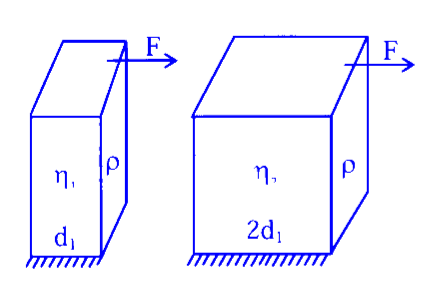
Deformation angle relation: $\theta_2 = 2\theta_1 \implies \frac{\sigma_2}{\eta_2} = 2 \frac{\sigma_1}{\eta_1}$.
Shear stress ($\sigma$) on narrow face $= \frac{F}{l \cdot d}$.
Substituting: $\left( \frac{F}{l \cdot d_2 \cdot \eta_2} \right) = \frac{2F}{l \cdot d_1 \cdot \eta_1}$
Given $d_2 = 2d_1$: $\frac{1}{2d_1 \eta_2} = \frac{2}{d_1 \eta_1} \implies \eta_2 = \frac{\eta_1}{4} = 1 \times 10^9$. Thus, $x = 1$.
Step Solution:
1. State Core Formula: Shear Modulus $\eta = \frac{\text{Stress}}{\theta} = \frac{F/A}{\theta}$.
2. Identify Area: For a narrow face of thickness $d$ and side $l$, $A = l \cdot d$.
3. Relate Angles: Given $\theta_2 = 2\theta_1$, then $\frac{F}{l d_2 \eta_2} = 2 \cdot \frac{F}{l d_1 \eta_1}$.
4. Substitute Thickness: Use $d_2 = 2d_1$: $\frac{1}{2d_1 \eta_2} = \frac{2}{d_1 \eta_1}$.
5. Calculate x: $\eta_2 = \frac{\eta_1}{4} = \frac{4 \times 10^9}{4} = 1 \times 10^9$. Therefore, $x = 1$.
Difficulty Level: Medium
Concept Name: Modulus of Rigidity (Shear Modulus)
Short cut solution: $\eta \propto \frac{1}{d \cdot \theta}$. Since $d_2 = 2d_1$ and $\theta_2 = 2\theta_1$, then $\eta_2 = \eta_1 \cdot \left(\frac{d_1}{d_2}\right) \cdot \left(\frac{\theta_1}{\theta_2}\right) = 4 \times 10^9 \cdot \frac{1}{2} \cdot \frac{1}{2} = 1 \times 10^9$.
Question 12
Question: A sample of a liquid is kept at 1 atm. It is compressed to 5 atm which leads to a change of volume of $0.8 \text{ cm}^3$. If the bulk modulus of the liquid is 2 GPa, the initial volume of the liquid was ____ litre. (Take 1 atm = $10^5 \text{ Pa}$)
Options: Numerical Type (Answer is 4)
Correct Answer: 4
Year: JEE Main 2025 (Online) 8th April Evening Shift
Solution:
Initial pressure of liquid $(P_i) = 1$ atm. Final pressure of liquid $(P_f) = 5$ atm. Change in pressure $(dP) = P_f - P_i = 4 \text{ atm} = 4 \times 10^5 \text{ Pa}$. Change in volume $(dV) = -0.8 \text{ cm}^3$. Bulk modulus $(B) = 2 \text{ GPa} = 2 \times 10^9 \text{ Pa}$. Now, $B = \frac{-dP}{(dV/V)} \implies V = -B \left(\frac{dV}{dP}\right) \implies V = -2 \times 10^9 \times \frac{(-0.8 \times 10^{-6})}{4 \times 10^5} = 4 \times 10^{-3} \text{ m}^3 = 4$ litre.
Step Solution:
1. Calculate Pressure Change: $\Delta P = P_{final} - P_{initial} = 5 - 1 = 4 \text{ atm}$. Convert to Pascals: $4 \times 10^5 \text{ Pa}$.
2. Convert Volume Change: $\Delta V = 0.8 \text{ cm}^3 = 0.8 \times 10^{-6} \text{ m}^3$.
3. State Bulk Modulus Formula: $B = \frac{\Delta P}{(\Delta V / V)}$, where $V$ is the initial volume.
4. Solve for V: $V = \frac{B \cdot \Delta V}{\Delta P} = \frac{(2 \times 10^9 \text{ Pa}) \cdot (0.8 \times 10^{-6} \text{ m}^3)}{4 \times 10^5 \text{ Pa}}$.
5. Final Calculation: $V = \frac{1.6 \times 10^3}{4 \times 10^5} = 0.4 \times 10^{-2} \text{ m}^3 = 4 \times 10^{-3} \text{ m}^3$. Since $1 \text{ m}^3 = 1000$ litres, $V = 4$ litres.
Difficulty Level: Easy
Concept Name: Bulk Modulus
Short cut solution: $V (\text{in litres}) = \frac{B \cdot \Delta V (\text{in cm}^3)}{\Delta P (\text{in Pa}) \times 1000} = \frac{2 \times 10^9 \cdot 0.8}{4 \times 10^5 \cdot 1000} = \frac{1.6 \times 10^9}{4 \times 10^8} = 4$.
Question 17
Question: A massless spring gets elongated by amount $x_1$ under a tension of 5 N. Its elongation is $x_2$ under the tension of 7 N. For the elongation of $(5x_1 - 2x_2)$, the tension in the spring will be:
Options: A. 20 N, B. 39 N, C. 11 N, D. 15 N
Correct Answer: C
Year: JEE Main 2025 (Online) 23rd January Evening Shift
Solution:
Hooke's Law states $F = kx$. For the first scenario: $5 = kx_1 \implies k = 5/x_1$. For the second scenario: $7 = kx_2 \implies k = 7/x_2$. Equating the two: $x_2 = (7/5)x_1$. To find tension for elongation $(5x_1 - 2x_2)$, use Hooke's Law: $F = k(5x_1 - 2x_2)$. Substitute $k = 5/x_1$: $F = \frac{5}{x_1}(5x_1 - 2(\frac{7}{5}x_1)) = \frac{5}{x_1}(5x_1 - \frac{14}{5}x_1) = \frac{5}{x_1}(\frac{11}{5}x_1) = 11$ N.
Step Solution:
1. Relate Tension and Elongation: Use $F = kx$. For tension $T_1=5$ N, $x=x_1$. For tension $T_2=7$ N, $x=x_2$.
2. Express k: $k = \frac{5}{x_1}$ and $k = \frac{7}{x_2}$.
3. Find Relation: $\frac{5}{x_1} = \frac{7}{x_2} \implies x_2 = \frac{7}{5}x_1$.
4. Determine New Tension: $T_{new} = k \cdot (5x_1 - 2x_2)$.
5. Substitute and Solve: $T_{new} = \frac{5}{x_1} [5x_1 - 2(\frac{7}{5}x_1)] = \frac{5}{x_1} [\frac{25x_1 - 14x_1}{5}] = \frac{5}{x_1} \cdot \frac{11x_1}{5} = \mathbf{11 \text{ N}}$.
Difficulty Level: Easy
Concept Name: Hooke's Law
Short cut solution: Since $T \propto x$, the tension for $(5x_1 - 2x_2)$ is simply $5(T_1) - 2(T_2) = 5(5) - 2(7) = 25 - 14 = \mathbf{11 \text{ N}}$.
Question 23
Question: The fractional compression $(\frac{\Delta V}{V})$ of water at the depth of 2.5 km below the sea level is _____ %. Given, the Bulk modulus of water $\tau = 2 \times 10^9 \text{ N m}^{-2}$, density of water $= 10^3 \text{ kg m}^{-3}$, acceleration due to gravity $g = 10 \text{ m s}^{-2}$.
Options: A. 1.0, B. 1.25, C. 1.75, D. 1.5
Correct Answer: B
Year: JEE Main 2025 (Online) 29th January Morning Shift
Solution:
$B = \frac{\rho gh}{(\Delta V/V)}$. Rearranging: $\frac{\Delta V}{V} \times 100 = \frac{\rho gh}{B} \times 100$. Substituting: $\frac{1000 \times 10 \times 2.5 \times 10^3}{2 \times 10^9} \times 100 = 1.25 \%$. Thus, the fractional compression of water at this depth is 1.25 %.
Step Solution:
1. Calculate Pressure at Depth: $\Delta P = \rho gh = (10^3 \text{ kg/m}^3) \cdot (10 \text{ m/s}^2) \cdot (2.5 \times 10^3 \text{ m}) = 2.5 \times 10^7 \text{ Pa}$.
2. State Bulk Modulus Relation: $B = \frac{\Delta P}{\text{fractional compression}} = \frac{\Delta P}{(\Delta V/V)}$.
3. Solve for Fractional Compression: $\frac{\Delta V}{V} = \frac{\Delta P}{B} = \frac{2.5 \times 10^7}{2 \times 10^9}$.
4. Calculate Decimal Value: $\frac{\Delta V}{V} = 1.25 \times 10^{-2}$.
5. Convert to Percentage: $1.25 \times 10^{-2} \times 100 = \mathbf{1.25 \%}$.
Difficulty Level: Easy
Concept Name: Bulk Modulus and Hydrostatic Pressure
Short cut solution: $\text{Compression } \% = \frac{\rho gh}{B} \times 100 = \frac{10^3 \cdot 10 \cdot 2500}{2 \cdot 10^9} \times 100 = \frac{2.5 \cdot 10^7}{2 \cdot 10^7} = 1.25 \%$.
Question 29
Question: A cylindrical rod of length 1 m and radius 4 cm is mounted vertically. It is subjected to a shear force of $10^5 \text{ N}$ at the top. Considering infinitesimally small displacement in the upper edge, the angular displacement $\theta$ of the rod axis from its original position would be : (shear moduli, $G = 10^{10} \text{ N/m}^2$).
Options: A. $1/160\pi$, B. $1/2\pi$, C. $1/4\pi$, D. $1/40\pi$
Correct Answer: A
Year: JEE Main 2025 (Online) 4th April Evening Shift
Solution: Shear moduli $= \frac{\sigma_{shear}}{\theta}$. $10^{10} = \frac{10^5}{\pi \times 16 \times 10^{-4}} \times \frac{1}{\theta}$. $\theta = \frac{1}{160\pi} \text{ Radian}$.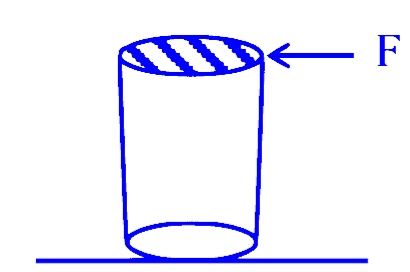
Step Solution:
1. Identify Area: The cross-sectional area of the narrow face is $A = \pi r^2 = \pi \times (4 \times 10^{-2} \text{ m})^2 = 16\pi \times 10^{-4} \text{ m}^2$.
2. Calculate Shear Stress: $\sigma = F/A = 10^5 / (16\pi \times 10^{-4}) = \frac{10^9}{16\pi} \text{ N/m}^2$.
3. State Rigidity Relation: The shear modulus $G$ is the ratio of shear stress to angular displacement: $G = \frac{\sigma}{\theta}$.
4. Substitute Values: $10^{10} = (\frac{10^9}{16\pi}) \times \frac{1}{\theta}$.
5. Solve for Theta: $\theta = \frac{10^9}{10^{10} \times 16\pi} = \mathbf{\frac{1}{160\pi} \text{ Radian}}$.
The difficulty level: Easy
The Concept Name: Shear Modulus (Modulus of Rigidity)
Short cut solution: $\theta = \frac{F}{A \cdot G} = \frac{10^5}{\pi(4 \cdot 10^{-2})^2 \cdot 10^{10}} = \frac{10^5}{16\pi \cdot 10^6} = \frac{1}{160\pi}$.
Question 30
Question: Two wires A and B are made of same material having ratio of lengths $\frac{L_A}{L_B} = \frac{1}{3}$ and their diameters ratio $\frac{d_A}{d_B} = 2$. If both the wires are stretched using same force, what would be the ratio of their respective elongations?
Options: A. 3 : 4, B. 1 : 12, C. 1 : 3, D. 1 : 6
Correct Answer: B
Year: JEE Main 2025 (Online) 7th April Morning Shift
Solution: The elongation $(\Delta L)$ of a wire subject to a force is given by: $\Delta L = \frac{F \cdot L}{A \cdot Y}$. For wires A and B: $\frac{\Delta L_A}{\Delta L_B} = \frac{L_A \cdot A_B}{L_B \cdot A_A}$. $\frac{\Delta L_A}{\Delta L_B} = (\frac{L_A}{L_B})(\frac{d_B}{d_A})^2$. Substitute the given ratios: $\frac{\Delta L_A}{\Delta L_B} = (\frac{1}{3})(\frac{1}{2})^2 = \frac{1}{12}$.
Step Solution:
1. Identify Constants: Force ($F$) and Young's Modulus ($Y$) are identical for both wires.
2. Determine Dependency: From $\Delta L = \frac{FL}{AY}$, since $A \propto d^2$, we find $\Delta L \propto \frac{L}{d^2}$.
3. Setup Ratio: $\frac{\Delta L_A}{\Delta L_B} = (\frac{L_A}{L_B}) \times (\frac{d_B}{d_A})^2$.
4. Substitute Values: $\frac{L_A}{L_B} = 1/3$ and $\frac{d_B}{d_A} = 1/2$ (reciprocal of $d_A/d_B = 2$).
5. Compute Final Ratio: $\frac{1}{3} \times (\frac{1}{2})^2 = \mathbf{1 : 12}$.
The difficulty level: Easy
The Concept Name: Hooke's Law / Young's Modulus
Short cut solution: $\Delta L \propto \frac{L}{d^2}$. Ratio $= \frac{1/3}{2^2} = \frac{1}{12}$.
Question 32
Question: A 3 m long wire of radius 3 mm shows an extension of 0.1 mm when loaded vertically by a mass of 50 kg in an experiment to determine Young's modulus. The value of Young's modulus of the wire as per this experiment is $P \times 10^{11} \text{ N m}^{-2}$, where the value of P is: (Take $g = 3\pi \text{ m/s}^2$).
Options: A. 2.5, B. 25, C. 10, D. 5
Correct Answer: D
Year: JEE Main 2025 (Online) 8th April Evening Shift
Solution: $F = mg = 50 \times 3\pi = 150\pi \text{ N}$. $A = \pi r^2 = 9\pi \times 10^{-6} \text{ m}^2$. $E = \frac{FL}{A\Delta L} = \frac{(150\pi) \times 3}{(9\pi \times 10^{-6}) \times (1 \times 10^{-4})}$. $E = 5 \times 10^{11} \text{ N m}^{-2}$. $P = 5$.
Step Solution:
1. Calculate Force: $F = mg = 50 \text{ kg} \times 3\pi \text{ m/s}^2 = 150\pi \text{ N}$.
2. Calculate Area: $A = \pi r^2 = \pi \times (3 \times 10^{-3} \text{ m})^2 = 9\pi \times 10^{-6} \text{ m}^2$.
3. Apply Formula: Use $E = \frac{FL}{A\Delta L}$ with $\Delta L = 1 \times 10^{-4} \text{ m}$.
4. Substitute and Simplify: $E = \frac{150\pi \times 3}{9\pi \times 10^{-6} \times 10^{-4}} = \frac{450}{9 \times 10^{-10}}$.
5. Find P: $E = 50 \times 10^{10} = 5 \times 10^{11} \text{ N/m}^2$. Comparing to $P \times 10^{11}$ gives $P = 5$.
The difficulty level: Easy
The Concept Name: Young's Modulus
Short cut solution: $Y = \frac{mgL}{\pi r^2 \Delta L} = \frac{50 \cdot 3\pi \cdot 3}{\pi \cdot (3 \cdot 10^{-3})^2 \cdot 10^{-4}} = \frac{450\pi}{9\pi \cdot 10^{-10}} = 5 \times 10^{11} \implies P=5$.
Question 40
Question: A 100m long wire having cross-sectional area $6.25 \times 10^{-4} \text{ m}^2$ and Young's modulus is $10^{10} \text{ N m}^{-2}$ is subjected to a load of 250N, then the elongation in the wire will be :
Options:
A. $6.25 \times 10^{-3} \text{ m}$
B. $4 \times 10^{-4} \text{ m}$
C. $6.25 \times 10^{-6} \text{ m}$
D. $4 \times 10^{-3} \text{ m}$
Correct Answer: D
Year: JEE Main 2023 (24th January Shift 1)
Solution: Elongation in wire $\delta = \frac{F \ell}{A Y}$; $\delta = \frac{250 \times 100}{6.25 \times 10^{-4} \times 10^{10}}$; $\delta = 4 \times 10^{-3} \text{ m}$
Step Solution:
1. Identify given values: Length ($L$) = 100 m, Area ($A$) = $6.25 \times 10^{-4} \text{ m}^2$, Young's Modulus ($Y$) = $10^{10} \text{ N/m}^2$, Force ($F$) = 250 N.
2. State the formula: The elongation ($\Delta L$) is given by $\Delta L = \frac{FL}{AY}$.
3. Substitute values: $\Delta L = \frac{250 \times 100}{(6.25 \times 10^{-4}) \times 10^{10}}$.
4. Simplify denominator: $6.25 \times 10^{-4} \times 10^{10} = 6.25 \times 10^6$.
5. Calculate final result: $\Delta L = \frac{25000}{6250000} = \frac{25}{6250} = \frac{1}{250} = 0.004 \text{ m} = 4 \times 10^{-3} \text{ m}$.
The difficulty level: Easy
The Concept Name: Young's Modulus / Elasticity
Short cut solution: Use the direct formula $\Delta L = \frac{FL}{AY}$ and perform power-of-ten simplification first.
Question 41
Question: Given below are two statements: one is labelled as Assertion A and the other is labelled as Reason R.
Assertion A: Steel is used in the construction of buildings and bridges.
Reason R: Steel is more elastic and its elastic limit is high.
In the light of above statements, choose the most appropriate answer from the options given below.
Options:
A. Both A and R are correct but R is NOT the correct explanation of A
B. A is not correct but R is correct
C. Both A and R are correct and R is the correct explanation of A
D. A is correct but R is not correct
Correct Answer: C
Year: JEE Main 2023 (24th January Shift 2)
Solution: Concept based
Step Solution:
1. Evaluate Assertion A: Analyze structural engineering requirements; steel is standard for buildings/bridges due to its strength and ability to withstand stress. (True)
2. Evaluate Reason R: In physics, "more elastic" refers to a higher Young's Modulus (requiring more force to produce a strain); steel has a very high Young's Modulus compared to other construction materials and can withstand significant stress before permanent deformation (high elastic limit). (True)
3. Determine relationship: Does R explain A? Yes, the reason steel is chosen for construction is precisely because it can support high loads (high elastic limit) and resists deformation under those loads (high elasticity).
4. Conclusion: Both statements are correct, and the physical properties described in R provide the scientific basis for the application in A.
The difficulty level: Easy
The Concept Name: Properties of Solids / Elasticity
Short cut solution: Recognize that "elasticity" in physics is the ability to resist deformation (Young's Modulus), making steel superior for load-bearing structures.
Question 42
Question: As shown in the figure, in an experiment to determine Young's modulus of a wire, the extension-load curve is plotted. The curve is a straight line passing through the origin and makes an angle of $45^\circ$ with the load axis. The length of wire is 62.8 cm and its diameter is 4 mm. The Young's modulus is found to be $x \times 10^4 \text{ N m}^{-2}$. The value of x is.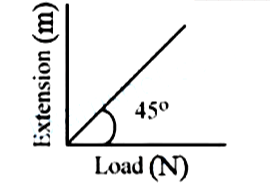
Options: (Numerical/Integer Type - No options provided in source)
Correct Answer: 5
Year: JEE Main 2023 (based on surrounding questions)
Solution: $F = \Delta L$; $Y = \frac{\partial FL}{\partial A \Delta L}$; $Y = \frac{\partial L}{\partial A}$; $Y = \frac{\partial 62.8 \times 10^{-2}}{\pi (2 \times 10^{-3})^2}$; $Y = 5 \times 10^4 \text{ N/m}^2$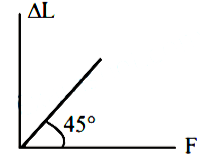
Step Solution:
1. Interpret the graph: The curve is $45^\circ$ with the load axis. In a $\Delta L$ vs. Load ($F$) graph, the slope is $\frac{\Delta L}{F} = \tan(45^\circ) = 1$, which implies $F = \Delta L$.
2. Convert dimensions to SI: Length ($L$) = 62.8 cm = 0.628 m. Diameter = 4 mm, so Radius ($r$) = 2 mm = $2 \times 10^{-3} \text{ m}$.
3. Calculate Area ($A$): $A = \pi r^2 = \pi \times (2 \times 10^{-3})^2 = 4\pi \times 10^{-6} \text{ m}^2$.
4. Apply Young's Modulus formula: $Y = \frac{FL}{A \Delta L}$. Since $\frac{F}{\Delta L} = 1$, the formula reduces to $Y = \frac{L}{A}$.
5. Final Calculation: $Y = \frac{0.628}{4 \times 3.14 \times 10^{-6}} = \frac{0.628}{12.56 \times 10^{-6}} = 0.05 \times 10^6 = 5 \times 10^4 \text{ N/m}^2$. Thus, $x = 5$.
The difficulty level: Medium
The Concept Name: Young's Modulus / Hooke's Law
Short cut solution: Use $Y = \frac{L}{A \cdot \tan\theta}$ where $\theta$ is the angle with the load axis; for $45^\circ$, $Y = L/A$.
Question 44
Question: Choose the correct relationship between Poisson ratio $\sigma (\pmb{\sigma})$. bulk modulus (K) and modulus of rigidity ($\eta$) of a given solid object:
Options:
A. $\sigma = \frac{3K - 2\eta}{6K + 2\eta}$
B. $\sigma = \frac{6K\alpha + 2\eta}{3K\alpha - 2\eta}$
C. $\sigma = \frac{3K + 2\eta}{6K + 2\eta}$
D. $\sigma = \frac{6K - 2\eta}{3K - 2\eta}$
Correct Answer: A
Year: JEE Main 2023 (30th January Shift 1)
Solution: $\Upsilon = 3\eta(1 + \sigma)$; $\Upsilon = 3\mathrm{K}(1 - \sigma)$; $\Rightarrow 2\eta(1 + \sigma) = 3\mathrm{K}(1 - 2\sigma) \Rightarrow \sigma = \frac{3\mathrm{K} - 2\eta}{6\mathrm{K} + 2\eta}$
Step Solution:
1. State first elastic relation: Young's Modulus ($Y$) in terms of Bulk Modulus ($K$) and Poisson ratio ($\sigma$) is $Y = 3K(1 - 2\sigma)$.
2. State second elastic relation: Young's Modulus ($Y$) in terms of Modulus of Rigidity ($\eta$) and Poisson ratio ($\sigma$) is $Y = 2\eta(1 + \sigma)$.
3. Equate the two relations: Since both equal $Y$, $3K(1 - 2\sigma) = 2\eta(1 + \sigma)$.
4. Expand and rearrange: $3K - 6K\sigma = 2\eta + 2\eta\sigma \Rightarrow 3K - 2\eta = 6K\sigma + 2\eta\sigma$.
5. Isolate $\sigma$: $(3K - 2\eta) = \sigma(6K + 2\eta)$, therefore $\sigma = \frac{3K - 2\eta}{6K + 2\eta}$.
The difficulty level: Easy
The Concept Name: Elastic Constants Relationship
Short cut solution: Memorize the inter-relation formula: $\sigma = \frac{3K - 2\eta}{6K + 2\eta}$.
Question 45
Question: A force is applied to a steel wire 'A', rigidly clamped at one end. As a result elongation in the wire is $0.2 \text{ mm}$. If same force is applied to another steel wire 'B' of double the length and a diameter 2.4 times that of the wire 'A', the elongation in the wire 'B' will be (wires having uniform circular cross sections)
Options:
A. $6.06 \times 10^{-2} \text{ mm}$
B. $2.77 \times 10^{-2} \text{ mm}$
C. $3.0 \times 10^{-2} \text{ mm}$
D. $6.9 \times 10^{-2} \text{ mm}$
Correct Answer: D
Year: JEE Main 2023 (30th January Shift 2)
Solution: $\mathrm{Y} = \frac{F / A}{\Delta \ell} \Rightarrow \mathrm{F} = \frac{Y A}{\ell} \Delta \ell$; $\left(\frac{\mathrm{A} \Delta \ell}{\ell}\right)_1 = \left(\frac{\mathrm{A} \Delta \ell}{\ell}\right)_2 \Rightarrow \frac{\Delta \ell_2}{\Delta \ell_1} = \frac{\mathrm{A}_1}{\mathrm{A}_2} \times \frac{\ell_2}{\ell_1}$; $\frac{\Delta \ell_2}{0.2} = \frac{1}{2.4 \times 2.4} \times \frac{2}{1} \Rightarrow \Delta \ell_2 = 6.9 \times 10^{-2} \mathrm{~mm}$
Step Solution:
1. Use the elongation formula: $\Delta L = \frac{FL}{AY}$. Since $F$ and $Y$ are the same for both wires, $\Delta L \propto \frac{L}{A}$.
2. Relate Area to diameter: $A = \frac{\pi d^2}{4}$, so $\Delta L \propto \frac{L}{d^2}$.
3. Setup ratio for Wire B: $\frac{\Delta L_B}{\Delta L_A} = \frac{L_B}{L_A} \times \left(\frac{d_A}{d_B}\right)^2$.
4. Substitute values: $\frac{\Delta L_B}{0.2 \text{ mm}} = 2 \times \left(\frac{1}{2.4}\right)^2 = \frac{2}{5.76}$.
5. Calculate result: $\Delta L_B = \frac{0.4}{5.76} = 0.0694 \dots \text{ mm} = 6.9 \times 10^{-2} \text{ mm}$.
The difficulty level: Medium
The Concept Name: Young's Modulus / Hooke's Law
Short cut solution: Use ratio $\Delta L \propto \frac{L}{d^2}$: New elongation $= 0.2 \times \frac{2}{(2.4)^2} = 6.9 \times 10^{-2} \text{ mm}$.
Question 46
Question: A thin rod having a length of 1m and area of cross-section $3 \times 10^{-6} \text{ m}^2$ is suspended vertically from one end. The rod is cooled from $210^\circ \text{C}$ to $160^\circ \text{C}$. After cooling, a mass M is attached at the lower end of the rod such that the length of rod again becomes 1m. Young's modulus and coefficient of linear expansion of the rod are $2 \times 10^{11} \text{ N m}^{-2}$ and $2 \times 10^{-5} \text{ K}^{-1}$, respectively. The value of M is _ kg. (Take $g = 10 \text{ m s}^{-2}$)
Options: (Numerical/Integer Type - No options provided in source)
Correct Answer: 60
Year: JEE Main 2023 (31st January Shift 1)
Solution: $\Delta \mathrm{T} = 50$; $\Delta \ell = 1 \times 2 \times 10^{-5} \times 50 = 10^{-3} \text{ m}$; $2 \times 10^{11} = \frac{\mathrm{M}g \ell}{A \Delta \ell} = \frac{\mathrm{M} \times 10 \times 1}{3 \times 10^{-6} \times 10^{-3}}$; $\mathrm{M} = 60 \text{ kg}$
Step Solution:
1. Determine temperature change: $\Delta T = 210^\circ\text{C} - 160^\circ\text{C} = 50 \text{ K}$.
2. Calculate thermal contraction: The decrease in length is $\Delta L = L \alpha \Delta T = 1 \times (2 \times 10^{-5}) \times 50 = 10^{-3} \text{ m}$.
3. Set condition for restoring length: To return to 1m, the attached mass must cause a mechanical elongation equal to the thermal contraction ($10^{-3} \text{ m}$).
4. Apply Young's Modulus formula: $Y = \frac{FL}{A\Delta L} = \frac{MgL}{A\Delta L}$.
5. Solve for M: $M = \frac{Y A \Delta L}{g L} = \frac{(2 \times 10^{11}) \times (3 \times 10^{-6}) \times 10^{-3}}{10 \times 1} = \frac{600}{10} = 60 \text{ kg}$.
The difficulty level: Medium
The Concept Name: Thermal Expansion / Young's Modulus
Short cut solution: Equate thermal strain to mechanical strain: $\alpha \Delta T = \frac{Mg}{AY} \Rightarrow M = \frac{AY\alpha \Delta T}{g}$. Substitute: $\frac{(2 \times 10^{11} \times 3 \times 10^{-6}) \times (2 \times 10^{-5} \times 50)}{10} = 60$.
Question 47
Question: For a solid rod, the Young's modulus of elasticity is $3.2 \times 10^{11} \text{ N m}^{-2}$ and density is $8 \times 10^3 \text{ kg m}^{-3}$. The velocity of longitudinal wave in the rod will be.
Options:
A. $145.75 \times 10^3 \text{ ms}^{-1}$
B. $3.65 \times 10^3 \text{ ms}^{-1}$
C. $18.96 \times 10^3 \text{ ms}^{-1}$
D. $6.32 \times 10^3 \text{ ms}^{-1}$
Correct Answer: D
Year: JEE Main 2023 (31st January Shift 2)
Solution: $v = \sqrt{\frac{Y}{\rho}} = \sqrt{\frac{3.2 \times 10^{11}}{8 \times 10^3}} = \sqrt{0.4 \times 10^8} = \sqrt{40 \times 10^6} = 6.32 \times 10^3 \text{ m/s}$
Step Solution:
1. Identify given values: Young's Modulus ($Y$) = $3.2 \times 10^{11} \text{ N/m}^2$, Density ($\rho$) = $8 \times 10^3 \text{ kg/m}^3$.
2. State the formula: The velocity ($v$) of a longitudinal wave in a solid rod is given by $v = \sqrt{\frac{Y}{\rho}}$.
3. Substitute values: $v = \sqrt{\frac{3.2 \times 10^{11}}{8 \times 10^3}}$.
4. Simplify mathematically: $v = \sqrt{0.4 \times 10^8} = \sqrt{40 \times 10^6}$.
5. Calculate final result: $v = 6.32 \times 10^3 \text{ m/s}$.
The difficulty level: Easy
The Concept Name: Velocity of longitudinal waves in solids
Short cut solution: Use $v = \sqrt{\frac{Y}{\rho}}$ and immediately simplify the power of 10 to see that $v = \sqrt{40} \times 10^3$, which is approximately $6.32 \times 10^3$.
Question 48
Question: Under the same load, wire A having length 5.0m and cross section $2.5 \times 10^{-5} \text{ m}^2$ stretches uniformly by the same amount as another wire B of length 6.0m and a cross section of $3.0 \times 10^{-5} \text{ m}^2$ stretches. The ratio of the Young's modulus of wire A to that of wire B will be:
Options:
A. 1 : 4
B. 1 : 1
C. 1 : 10
D. 1 : 2
Correct Answer: B
Year: JEE Main 2023 (31st January Shift 2)
Solution: $\Delta \ell = \frac{F \ell}{S Y}$. Since $F$ and $\Delta \ell$ are same for both: $\frac{\ell_A}{S_A Y_A} = \frac{\ell_B}{S_B Y_B} \Rightarrow \frac{5}{2.5 \times Y_A} = \frac{6}{3 \times Y_B} \Rightarrow \frac{Y_A}{Y_B} = 1$.
Step Solution:
1. Use the elongation formula: $\Delta L = \frac{FL}{AY}$, where $F$ is load, $L$ is length, $A$ is area, and $Y$ is Young's modulus.
2. Set the equality condition: Since $F$ and $\Delta L$ are identical for both wires, the ratio $\frac{L}{AY}$ must be constant.
3. Setup the ratio: $\frac{L_A}{A_A Y_A} = \frac{L_B}{A_B Y_B}$.
4. Substitute given values: $\frac{5}{2.5 \times 10^{-5} \times Y_A} = \frac{6}{3.0 \times 10^{-5} \times Y_B}$.
5. Simplify and solve: $\frac{2}{10^{-5} Y_A} = \frac{2}{10^{-5} Y_B} \Rightarrow Y_A = Y_B$, so the ratio is 1:1.
The difficulty level: Easy
The Concept Name: Young's Modulus / Elasticity
Short cut solution: Observe that for both wires, the ratio of length to area is the same ($\frac{5}{2.5} = 2$ and $\frac{6}{3} = 2$); since load and elongation are also equal, $Y$ must be equal.
Question 54
Question: A certain pressure $P$ is applied to 1 litre of water and 2 litre of a liquid separately. Water gets compressed to $0.01\%$ whereas the liquid gets compressed to $0.03\%$. The ratio of Bulk modulus of water to that of the liquid is $\frac{3}{x}$. The value of x is
Options: (Numerical/Integer Type - No options provided in source)
Correct Answer: 1
Year: JEE Main 2023 (1st February Shift 1)
Solution: $B_{water} = \frac{-\Delta P}{0.01/100}$; $B_{liquid} = \frac{-\Delta P}{0.03/100} \Rightarrow \frac{B_{water}}{B_{liquid}} = 3 \Rightarrow x = 1$.
Step Solution:
1. Define Bulk Modulus ($B$): $B = \frac{P}{\text{Volumetric Strain}} = \frac{P}{\Delta V / V}$.
2. State strain for water: Volumetric strain of water $= \frac{0.01}{100}$.
3. State strain for liquid: Volumetric strain of liquid $= \frac{0.03}{100}$.
4. Apply ratio for same pressure: $\frac{B_{water}}{B_{liquid}} = \frac{P / (\Delta V/V)_w}{P / (\Delta V/V)_l} = \frac{(\Delta V/V)_l}{(\Delta V/V)_w}$.
5. Calculate x: $\frac{B_{water}}{B_{liquid}} = \frac{0.03}{0.01} = 3$. Given this equals $\frac{3}{x}$, then $x = 1$.
The difficulty level: Easy
The Concept Name: Bulk Modulus of Elasticity
Short cut solution: For the same applied pressure, Bulk Modulus is inversely proportional to percentage compression. Ratio $= \frac{0.03}{0.01} = 3$, so $x=1$.
Question 55
Question: The Young's modulus of a steel wire of length 6m and cross-sectional area $3\text{ mm}^2$, is $2 \times 10^{11}\text{ N/m}^2$. The wire is suspended from its support on a given planet. A block of mass 4 kg is attached to the free end of the wire. The acceleration due to gravity on the planet is $1/4$ of its value on the earth. The elongation of wire is (Take g on the earth $g = 10\text{ m/s}^2$).
Options:
A. 1 cm
B. 1 mm
C. 0.1 mm
D. 0.1 cm
Correct Answer: C
Year: JEE Main 2023 (1st February Shift 2)
Solution: Tension $(F) = mg = 4 \times \frac{10}{4} = 10\text{ N}$; $\Delta L = \frac{FL}{AY} = \frac{10 \times 6}{3 \times 10^{-6} \times 2 \times 10^{11}} = 10^{-4}\text{ m} = 0.1\text{ mm}$.
Step Solution:
1. Calculate effective gravity: $g_{\text{planet}} = \frac{g_{\text{earth}}}{4} = \frac{10}{4} = 2.5\text{ m/s}^2$.
2. Determine Force (Tension): $F = m \cdot g_{\text{planet}} = 4 \text{ kg} \times 2.5\text{ m/s}^2 = 10\text{ N}$.
3. Convert Area to SI: $A = 3\text{ mm}^2 = 3 \times 10^{-6}\text{ m}^2$.
4. Apply Formula: Use the elongation formula $\Delta L = \frac{FL}{AY}$.
5. Calculate Result: $\Delta L = \frac{10 \times 6}{(3 \times 10^{-6}) \times (2 \times 10^{11})} = \frac{60}{6 \times 10^5} = 10^{-4}\text{ m}$, which is $0.1\text{ mm}$.
The difficulty level: Easy
The Concept Name: Young's Modulus / Hooke's Law
Short cut solution: $\Delta L = \frac{mg'L}{AY}$. Note that $mg' = 10\text{ N}$, so $\Delta L = \frac{60}{6 \times 10^5} = 10^{-4}\text{ m}$.
Question 69
Question: A metal block of mass m is suspended from a rigid support through a metal wire of diameter 14 mm. The tensile stress developed in the wire under equilibrium state is $7 \times 10^5\text{ N/m}^2$. The value of mass m is kg.
Options: (Numerical/Integer Type - No options provided in source)
Correct Answer: 11
Year: JEE Main 2023 (6th April Shift 2)
Solution: Using stress = force/area = $mg/A \Rightarrow m = \frac{S \times A}{g} = \frac{7 \times 10^5 \times \pi R^2}{g} = \frac{7 \times 10^5 \times \frac{22}{7} \times (7 \times 10^{-3})^2}{9.8} = 11\text{ kg}$.
Step Solution:
1. Identify parameters: Stress ($\sigma$) = $7 \times 10^5\text{ N/m}^2$, $r = 7\text{ mm} = 7 \times 10^{-3}\text{ m}$, $g = 9.8\text{ m/s}^2$.
2. Calculate Area ($A$): $A = \pi r^2 = \frac{22}{7} \times (7 \times 10^{-3})^2 = 22 \times 7 \times 10^{-6} = 1.54 \times 10^{-4}\text{ m}^2$.
3. Relate Stress to Mass: Tensile Stress ($\sigma$) = $\frac{mg}{A}$.
4. Isolate m: $m = \frac{\sigma A}{g}$.
5. Final Calculation: $m = \frac{(7 \times 10^5) \times (1.54 \times 10^{-4})}{9.8} = \frac{107.8}{9.8} = 11\text{ kg}$.
The difficulty level: Easy
The Concept Name: Tensile Stress
Short cut solution: $m = \frac{\sigma \cdot \pi r^2}{g}$. Since $\pi \approx \frac{22}{7}$, the $7$ in the radius squared cancels nicely: $m = \frac{7 \cdot 10^5 \cdot \frac{22}{7} \cdot 49 \cdot 10^{-6}}{9.8} = \frac{22 \cdot 4.9}{9.8} = \frac{22}{2} = 11$.
Question 70
Question: An aluminium rod with Young's modulus $Y = 7.0 \times 10^{10}\text{ N/m}^2$ undergoes elastic strain of $0.04\%$. The energy per unit volume stored in the rod in SI unit is:
Options:
A. 5600
B. 2800
C. 11200
D. 8400
Correct Answer: A
Year: JEE Main 2023 (8th April Shift 1)
Solution: Energy per unit volume $= \frac{1}{2} \text{ stress} \times \text{strain} = \frac{1}{2} Y (\text{strain})^2 = \frac{1}{2} \times 7 \times 10^{10} \times \left(\frac{0.04}{100}\right)^2 = 5600\text{ J/m}^3$.
Step Solution:
1. Define strain ($\varepsilon$): $\varepsilon = 0.04\% = \frac{0.04}{100} = 4 \times 10^{-4}$.
2. State Energy Density formula: $u = \frac{1}{2} \times \text{Stress} \times \text{Strain}$.
3. Use Young's Modulus: Substitute $\text{Stress} = Y \cdot \varepsilon$ to get $u = \frac{1}{2} Y \varepsilon^2$.
4. Plug in values: $u = \frac{1}{2} \times (7 \times 10^{10}) \times (4 \times 10^{-4})^2$.
5. Solve: $u = 3.5 \times 10^{10} \times 16 \times 10^{-8} = 56 \times 10^2 = 5600\text{ J/m}^3$.
The difficulty level: Easy
The Concept Name: Elastic Potential Energy Density
Short cut solution: Energy density $= \frac{1}{2} Y \varepsilon^2$. With $\varepsilon^2 = 16 \times 10^{-8}$, the calculation becomes $3.5 \times 16 \times 100 = 5600$.
Question 71
Question: Two wires each of radius 0.2 cm and negligible mass, one made of steel and the other made of brass are loaded as shown in the figure. The elongation of the steel wire is $\underline{\qquad} \times 10^{-6} \text{ m}$. [Young's modulus for steel $Y = 2 \times 10^{11} \text{ N m}^{-2}$ and $g = 10 \text{ m s}^{-2}$]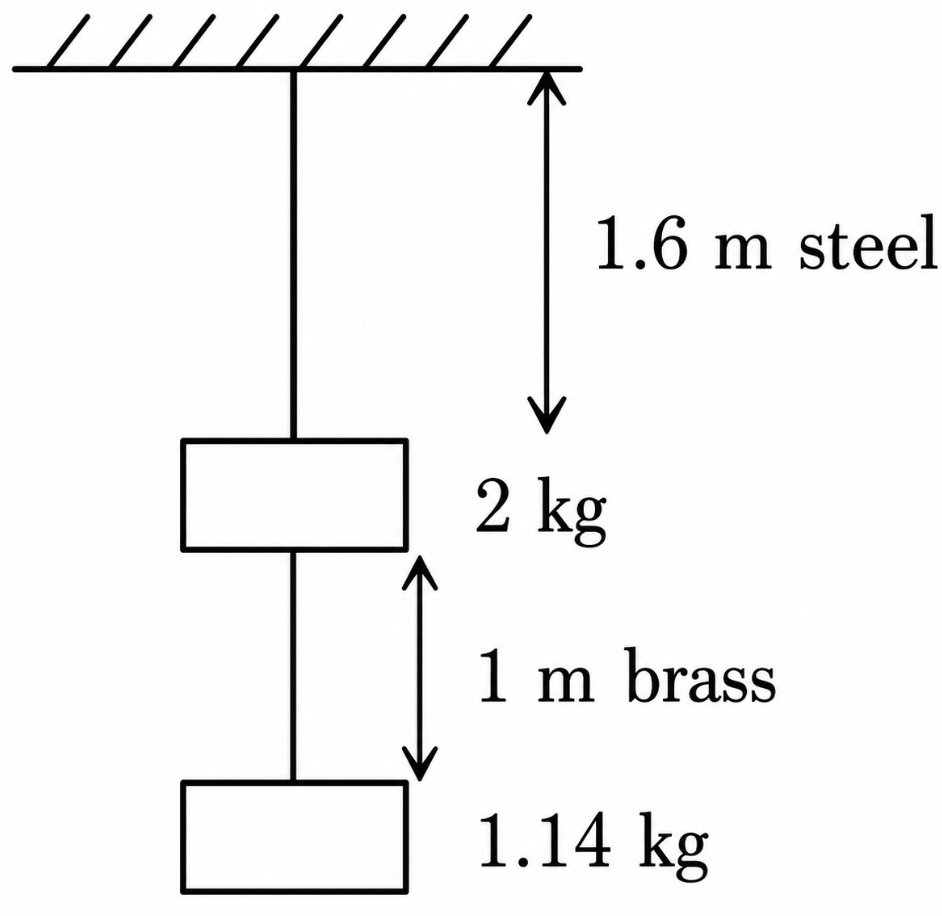
Options: (Numerical/Integer Type - No options provided in source)
Correct Answer: 20
Year: JEE Main 2023 (contextually based on surrounding questions)
Solution: $T_2 = T_1 + 20 = 20 + 11.4 = 31.4$; Elongation in steel wire $\Delta L = \frac{T_2 L}{A Y} = \frac{31.4 \times 1.6}{\pi (0.2 \times 10^{-2})^2 \times 2 \times 10^{11}} = 2 \times 10^{-5}$; $\Delta L = 20 \times 10^{-6} \text{ m}$.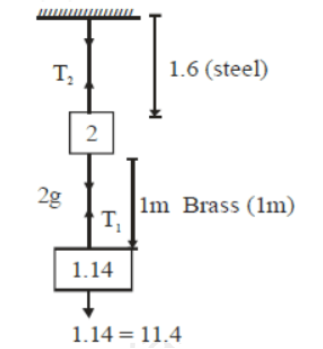
Step Solution:
1. Identify parameters: Steel wire length ($L$) = 1.6 m, Radius ($r$) = 0.2 cm = $2 \times 10^{-3} \text{ m}$, Young's Modulus ($Y$) = $2 \times 10^{11} \text{ N/m}^2$.
2. Determine Tension ($T$): Based on the load configuration (from the solution), the tension in the steel wire is $T = 31.4 \text{ N}$.
3. Calculate Area ($A$): $A = \pi r^2 = \pi (2 \times 10^{-3})^2 = 4\pi \times 10^{-6} \text{ m}^2$.
4. Apply Formula: $\Delta L = \frac{TL}{AY} = \frac{31.4 \times 1.6}{(4\pi \times 10^{-6}) \times (2 \times 10^{11})}$.
5. Calculate Result: $\Delta L = \frac{50.24}{8\pi \times 10^5} \approx 2 \times 10^{-5} \text{ m} = 20 \times 10^{-6} \text{ m}$.
The difficulty level: Medium
The Concept Name: Young's Modulus / Hooke's Law
Short cut solution: Use $\Delta L \approx \frac{T \cdot L}{A \cdot Y}$ and substitute $\pi \approx 3.14$ to simplify the denominator to $25.12 \times 10^5$.
Question 72
Question: Young's moduli of the material of wires A and B are in the ratio of 1 : 4, while its area of cross sections are in the ratio of 1 : 3. If the same amount of load is applied to both the wires, the amount of elongation produced in the wires A and B will be in the ratio of [Assume length of wires A and B are same]
Options:
A. 12 : 1
B. 1 : 36
C. 1 : 12
D. 36 : 1
Correct Answer: A
Year: JEE Main 2023 (10th April Shift 2)
Solution: $\frac{W}{A} = Y \cdot \frac{\Delta \ell_1}{\ell} \Rightarrow \Delta \ell_1 = \frac{W \ell}{AY}$; $\frac{W}{3A} = 4Y \cdot \frac{\Delta \ell_2}{\ell} \Rightarrow \Delta \ell_2 = \frac{W \ell}{12AY}$; $\frac{\Delta \ell_1}{\Delta \ell_2} = \frac{12}{1}$.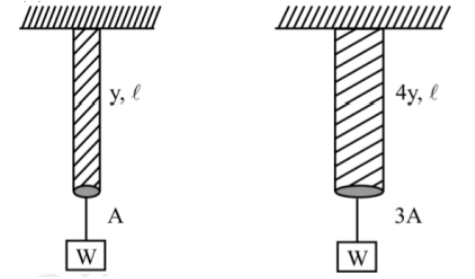
Step Solution:
1. State the relationship: Elongation $\Delta L = \frac{FL}{AY}$.
2. Define ratios: $\frac{Y_A}{Y_B} = \frac{1}{4}$ and $\frac{A_A}{A_B} = \frac{1}{3}$. Given $F$ and $L$ are the same.
3. Express $\Delta L$ for A: $\Delta L_A = \frac{FL}{A_A Y_A}$.
4. Express $\Delta L$ for B: $\Delta L_B = \frac{FL}{A_B Y_B} = \frac{FL}{(3 A_A)(4 Y_A)} = \frac{FL}{12 A_A Y_A}$.
5. Calculate ratio: $\frac{\Delta L_A}{\Delta L_B} = \frac{FL / (A_A Y_A)}{FL / (12 A_A Y_A)} = \frac{12}{1}$.
The difficulty level: Easy
The Concept Name: Elasticity / Ratio Analysis
Short cut solution: Since $\Delta L \propto \frac{1}{AY}$, the ratio $\frac{\Delta L_A}{\Delta L_B} = \frac{A_B Y_B}{A_A Y_A}$. Plug in ratios: $\frac{3 \times 4}{1 \times 1} = 12 : 1$.
Question 73
Question: The length of a wire becomes $l_1$ and $l_2$ when 100N and 120N tensions are applied respectively. If $10l_2 = 11l_1$, the natural length of wire will be $\frac{1}{x} l_1$. Here the value of x is
Options: (Numerical/Integer Type - No options provided in source)
Correct Answer: 2
Year: JEE Main 2023 (11th April Shift 1)
Solution: $100 = k(l_1 - l_0)$; $120 = k(l_2 - l_0)$; $l_2 = 1.1l_1$; $\frac{120}{100} = \frac{1.1l_1 - l_0}{l_1 - l_0} \Rightarrow 1.2l_1 - 1.2l_0 = 1.1l_1 - l_0 \Rightarrow 0.1l_1 = 0.2l_0 \Rightarrow l_0 = \frac{l_1}{2} \Rightarrow x = 2$.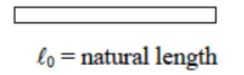
Step Solution:
1. Use Hooke's Law: $F = k(L - L_0)$, where $L_0$ is the natural length and $k$ is the spring constant.
2. Set up equations: $100 = k(l_1 - l_0)$ and $120 = k(l_2 - l_0)$.
3. Relate lengths: Given $10l_2 = 11l_1$, so $l_2 = 1.1l_1$. Substitute this into the second equation: $120 = k(1.1l_1 - l_0)$.
4. Find ratio: $\frac{120}{100} = \frac{k(1.1l_1 - l_0)}{k(l_1 - l_0)} \Rightarrow 1.2 = \frac{1.1l_1 - l_0}{l_1 - l_0}$.
5. Solve for $L_0$: $1.2l_1 - 1.2l_0 = 1.1l_1 - l_0 \Rightarrow 0.1l_1 = 0.2l_0 \Rightarrow l_0 = \frac{l_1}{2}$. Thus, $x = 2$.
The difficulty level: Medium
The Concept Name: Hooke's Law
Short cut solution: Use the formula $L_0 = \frac{F_2 L_1 - F_1 L_2}{F_2 - F_1}$. Substituting: $L_0 = \frac{120l_1 - 100(1.1l_1)}{20} = \frac{120l_1 - 110l_1}{20} = \frac{10l_1}{20} = \frac{l_1}{2}$.
Question 75
Question: The elastic potential energy stored in a steel wire of length 20m stretched through 2 cm is 80J. The cross sectional area of the wire is (Given, $y = 2.0 \times 10^{11} \text{ N m}^{-2}$) $\underline{\qquad} \text{ mm}^2$.
Options: (Numerical/Integer Type - No options provided in source)
Correct Answer: 40
Year: JEE Main 2023 (13th April Shift 1)
Solution: Energy, $U = \frac{1}{2} k x^2$; $80 = \frac{1}{2} k (2 \times 10^{-2})^2 \Rightarrow k = \frac{160}{4 \times 10^{-4}} = 4 \times 10^5 \text{ N/m}$; $\frac{YA}{L} = 4 \times 10^5 \Rightarrow A = \frac{4 \times 10^5 \times 20}{2 \times 10^{11}} = 40 \times 10^{-6} \text{ m}^2 = 40 \text{ mm}^2$.
Step Solution:
1. State the energy formula: Elastic potential energy is $U = \frac{1}{2} k x^2$, where $k$ is the force constant and $x$ is the elongation.
2. Calculate $k$: $80 = \frac{1}{2} k (0.02)^2 \Rightarrow 160 = k (4 \times 10^{-4}) \Rightarrow k = 4 \times 10^5 \text{ N/m}$.
3. Relate $k$ to Young's Modulus: $k = \frac{YA}{L}$, where $Y$ is Young's modulus, $A$ is area, and $L$ is length.
4. Substitute and solve for $A$: $4 \times 10^5 = \frac{(2 \times 10^{11}) \times A}{20} \Rightarrow 80 \times 10^5 = 2 \times 10^{11} \times A$.
5. Convert units: $A = \frac{80 \times 10^5}{2 \times 10^{11}} = 40 \times 10^{-6} \text{ m}^2$. Since $1 \text{ m}^2 = 10^6 \text{ mm}^2$, $A = 40 \text{ mm}^2$.
The difficulty level: Easy
The Concept Name: Elastic Potential Energy / Hooke's Law
Short cut solution: Use the combined formula $A = \frac{2UL}{Yx^2}$. Substituting values: $A = \frac{2 \times 80 \times 20}{2 \times 10^{11} \times (0.02)^2} = \frac{3200}{8 \times 10^7} = 40 \times 10^{-6} \text{ m}^2 = 40 \text{ mm}^2$.
Question 76
Question: A wire of length ' L ' and radius ' r ' is clamped rigidly at one end. When the other end of the wire is pulled by a force f, its length increases by ' l ' . Another wire of same material of length ' 2L ' and radius ' 2r ' is pulled by a force ' 2f. Then the increase in its length will be :
Options:
A. l ∕ 2
B. 4l
C. l
D. 2l
Correct Answer: C
Year: JEE Main 2023 (15th April Shift 1)
Solution: $\gamma = \frac{FI}{AA DI}$; $\Delta I \propto \frac{FI}{A}$; $\frac{AI_2}{AI_1} = \frac{F_2 I_2 \times A_1}{F I_1 I_1} = \frac{2Fr 2L}{F^ L} \times \frac{\pi(T)^2}{\pi(2T)^2} = 1$; $\Delta_2 = 1$.
Step Solution:
1. State the relationship: Elongation $\Delta L = \frac{FL}{AY}$.
2. Relate Area to radius: Substitute $A = \pi r^2$ to get $\Delta L = \frac{FL}{\pi r^2 Y}$.
3. Identify proportionalities: For the same material ($Y$ is constant), $\Delta L \propto \frac{FL}{r^2}$.
4. Compare the two wires: $\Delta L' \propto \frac{(2f)(2L)}{(2r)^2} = \frac{4fL}{4r^2}$.
5. Determine the ratio: Since $\frac{4fL}{4r^2} = \frac{fL}{r^2}$, the elongation remains the same as the original wire, which is $l$.
The difficulty level: Easy
The Concept Name: Young's Modulus / Elasticity
Short cut solution: Use ratio $\Delta L \propto \frac{FL}{r^2}$. The changes are factors of 2 for force, 2 for length, and $2^2=4$ for radius squared. Ratio $= \frac{2 \times 2}{4} = 1$, so elongation is unchanged ($l$).
Question 78
Question: A steel rod of length 1m and cross sectional area $10^{-4} \text{ m}^2$ is heated from $0^\circ \text{C}$ to $200^\circ \text{C}$ without being allowed to extend or bend. The compressive tension produced in the rod is $x \times 10^4 \text{ N}$. (Given Young's modulus of steel $Y = 2 \times 10^{11} \text{ N m}^{-2}$, coefficient of linear expansion $\alpha = 10^{-5} \text{ K}^{-1}$) The value of x is.
Options: (Numerical/Integer Type - No options provided in source)
Correct Answer: 4
Year: JEE Main 2023 (8th April Shift 2)
Solution: Thermal stress $= Y \alpha \Delta T$; $F = Y A \alpha \Delta T = 2 \times 10^{11} \times 10^{-4} \times 10^{-5} \times 200 = 4 \times 10^4$; $x = 4$.
Step Solution:
1. Define Thermal Stress: The stress required to prevent expansion is given by $\sigma = Y \alpha \Delta T$.
2. State Force formula: The force (compressive tension) is $F = \text{Stress} \times \text{Area} = YA \alpha \Delta T$.
3. Identify temperature change: $\Delta T = 200^\circ\text{C} - 0^\circ\text{C} = 200 \text{ K}$.
4. Substitute given values: $F = (2 \times 10^{11}) \times (10^{-4}) \times (10^{-5}) \times 200$.
5. Calculate final result: $F = 2 \times 10^2 \times 200 = 400 \times 10^2 = 4 \times 10^4 \text{ N}$. Comparing with $x \times 10^4$, $x = 4$.
The difficulty level: Easy
The Concept Name: Thermal Stress / Linear Expansion
Short cut solution: Compressive force $F = YA\alpha\Delta T$. Direct calculation with powers of 10: $F = (2 \times 10^{11} \cdot 10^{-5} \cdot 10^{-4}) \cdot 200 = (2 \times 10^2) \cdot 200 = 40,000 = 4 \times 10^4$. Thus, $x = 4$.
Question 95
Question: The bulk modulus of a liquid is $3 \times 10^{10} \text{ N m}^{-2}$. The pressure required to reduce the volume of liquid by $2\%$ is :
Options:
A. $3 \times 10^8 \text{ N m}^{-2}$
B. $9 \times 10^8 \text{ N m}^{-2}$
C. $6 \times 10^8 \text{ N m}^{-2}$
D. $12 \times 10^8 \text{ N m}^{-2}$
Correct Answer: C
Year: JEE Main 2022 (24th June Shift 1)
Solution: $\ddot{\sigma} B = \frac{\Delta P}{(- \Delta V / V)} \Rightarrow \Delta P = 3 \times 10^{10} \times (0.02) = 6 \times 10^8 \text{ N/m}^2$
Step Solution:
1. Identify values: Bulk Modulus ($B$) = $3 \times 10^{10} \text{ N/m}^2$, Volumetric contraction ($\Delta V / V$) = $2\% = 0.02$.
2. State formula: $B = \frac{\Delta P}{\Delta V/V}$.
3. Rearrange for Pressure: $\Delta P = B \times \left(\frac{\Delta V}{V}\right)$.
4. Substitute values: $\Delta P = (3 \times 10^{10}) \times (0.02)$.
5. Calculate: $\Delta P = 0.06 \times 10^{10} = 6 \times 10^8 \text{ N/m}^2$.
The difficulty level: Easy
The Concept Name: Bulk Modulus of Elasticity
Short cut solution: Apply $\Delta P = B \times (\% \text{ compression})$ directly: $3 \times 10^{10} \times 0.02 = 6 \times 10^8 \text{ N/m}^2$.
Question 96
Question: The elastic behaviour of material for linear stress and linear strain, is shown in the figure. The energy density for a linear strain of $5 \times 10^{-4}$ is_ 1 $\text{ kJ}/\text{m}^3$. Assume that material is elastic upto the linear strain of $5 \times 10^{-4}$.
Options: (Numerical/Integer Type - Answer provided as 25)
Correct Answer: 25
Year: JEE Main 2022 (26th June Shift 1)
Solution: slope of strain - stress curve given by $\prime = \frac{10^{-10}}{20}$; for strain of $5 \times 10^{-4}$ stress is given by $5 \times 10^{-4} = \frac{10^{-10}}{20} \times \text{stress}$; stress $= 10^8 \text{ N}/\text{m}^2$; Energy density $= \frac{1}{2} \times \text{strain} \times \text{stress} = \frac{1}{2} \times 5 \times 10^{-4} \times 10^8 = 25000 \text{ J/m}^3 = 25 \text{ kJ/m}^3$.
Step Solution:
1. Find the relationship: From the graph, calculate the constant relating stress and strain (the reciprocal of the slope): $\frac{\text{Strain}}{\text{Stress}} = \frac{10^{-10}}{20}$.
2. Calculate Stress: For strain $= 5 \times 10^{-4}$, Stress $= \frac{5 \times 10^{-4} \times 20}{10^{-10}} = \frac{100 \times 10^{-4}}{10^{-10}} = 10^8 \text{ N/m}^2$.
3. State Energy Density formula: $u = \frac{1}{2} \times \text{Stress} \times \text{Strain}$.
4. Substitute values: $u = \frac{1}{2} \times (10^8) \times (5 \times 10^{-4}) = 2.5 \times 10^4 = 25,000 \text{ J/m}^3$.
5. Convert to kJ: $u = \frac{25000}{1000} = 25 \text{ kJ/m}^3$.
The difficulty level: Medium
The Concept Name: Elastic Potential Energy Density
Short cut solution: Energy density $u = \frac{1}{2} \cdot \frac{\text{strain}^2}{\text{slope of curve}}$. Using given points, $u = \frac{1}{2} \cdot \frac{(5 \times 10^{-4})^2}{10^{-10}/20} = 25 \text{ kJ/m}^3$.
Question 117
Question: A wire of length L and radius r is clamped rigidly at one end. When the other end of the wire is pulled by a force F , its length increases by 5cm. Another wire of the same material of length 4L and radius 4r is pulled by a force 4F under same conditions. The increase in length of this wire is cm.
Options: (Numerical/Integer Type - Answer provided as 5)
Correct Answer: 5
Year: JEE Main 2022 (25th July Shift 1)
Solution: $\frac{\partial F/A}{\Delta L/L} = Y \Rightarrow \Delta L = \partial F/L$; $\frac{\Delta L_2}{\Delta L_1} = \left( \frac{F_2}{F_1} \right) \times \left( \frac{L_2}{L_1} \right) \times \left( \frac{A_1}{A_2} \right) = 4 \times 4 \times \frac{1}{16} = 1$.
Step Solution:
1. Use the elongation formula: $\Delta L = \frac{FL}{AY}$.
2. Relate Area to radius: $A = \pi r^2$, so $\Delta L = \frac{FL}{\pi r^2 Y}$.
3. Setup ratio for the second wire: $\frac{\Delta L_2}{\Delta L_1} = \frac{F_2 L_2 r_1^2}{F_1 L_1 r_2^2}$.
4. Substitute factors: $\frac{\Delta L_2}{5 \text{ cm}} = \frac{(4F)(4L)(r^2)}{(F)(L)(4r)^2} = \frac{16FLr^2}{16FLr^2} = 1$.
5. Conclude: $\Delta L_2 = 1 \times 5 \text{ cm} = 5 \text{ cm}$.
The difficulty level: Easy
The Concept Name: Young's Modulus / Hooke's Law
Short cut solution: Use proportionality $\Delta L \propto \frac{FL}{r^2}$. The length and force both increase by 4 (total $16\times$), and the radius increases by 4 (radius squared increases by $16\times$). These changes cancel out, leaving elongation unchanged at 5 cm.
Question 118
Question: In an experiment to determine the Young's modulus of wire of a length exactly 1m , the extension in the length of the wire is measured as 0.4 mm with an uncertainty of $\pm 0.02$ mm when a load of 1 kg is applied. The diameter of the wire is measured as 0.4 mm with an uncertainty of $\pm 0.01$ mm. The error in the measurement of Young's modulus ($\Delta Y$) is found to be $x \times 10^{10} \text{ Nm}^{-2}$. The value of x is _ (take $g = 10 \text{ ms}^{-2}$)
Options: (Numerical/Integer Type - No options provided in source)
Correct Answer: 2
Year: JEE Main 2022 (26th July Shift 1)
Solution: $\frac{\Delta Y}{Y} = \frac{\Delta L}{L} + 2\frac{\Delta d}{d} + \frac{\Delta(\Delta l)}{\Delta l}$. (Note: The handwritten solution in the source is partially obscured, but follows standard error propagation)
Step Solution:
1. State formula for Young's Modulus: $Y = \frac{FL}{A\Delta l} = \frac{MgL}{(\frac{\pi d^2}{4})\Delta l}$.
2. Determine relative error equation: Since $M, g,$ and $L$ are assumed exact, $\frac{\Delta Y}{Y} = 2\frac{\Delta d}{d} + \frac{\Delta(\Delta l)}{\Delta l}$.
3. Substitute error values: $\frac{\Delta Y}{Y} = 2(\frac{0.01}{0.4}) + \frac{0.02}{0.4} = \frac{0.02}{0.4} + \frac{0.02}{0.4} = \frac{0.04}{0.4} = 0.1$.
4. Calculate $Y$: $Y = \frac{1 \times 10 \times 1}{\frac{\pi}{4}(0.4 \times 10^{-3})^2(0.4 \times 10^{-3})} \approx 2 \times 10^{11} \text{ Nm}^{-2}$ (using $\pi \approx 3.14$).
5. Calculate $\Delta Y$: $\Delta Y = 0.1 \times Y = 0.1 \times (2 \times 10^{11}) = 2 \times 10^{10} \text{ Nm}^{-2}$. Thus, $x = 2$.
The difficulty level: Hard
The Concept Name: Error Propagation in Young's Modulus
Short cut solution: The relative error in $Y$ is simply the sum of relative errors of measured quantities: $2 \times (\text{relative error of } d) + (\text{relative error of } \Delta l)$.
Question 119
Question: The area of cross section of the rope used to lift a load by a crane is $2.5 \times 10^{-4} \text{ m}^2$. The maximum lifting capacity of the crane is 10 metric tons. To increase the lifting capacity of the crane to 25 metric tons, the required area of cross section of the rope should be : (take $g = 10 \text{ ms}^{-2}$)
Options:
A. $6.25 \times 10^{-4} \text{ m}^2$
B. $10 \times 10^{-4} \text{ m}^2$
C. $1 \times 10^{-4} \text{ m}^2$
D. $1.67 \times 10^{-4} \text{ m}^2$
Correct Answer: A
Year: JEE Main 2022 (26th July Shift 2)
Solution: Since breaking stress (Maximum lifting capacity) is the property of material so it will remain same. $\text{breaking stress} = \frac{\text{Maximum lifting capacity}}{\text{Area of cross section of rope}}$. $\frac{10}{2.5 \times 10^{-4}} = \frac{25}{A} \Rightarrow A = 625 \times 10^{-6} = 6.25 \times 10^{-4} \text{ m}^2$.
Step Solution:
1. Identify constant: Breaking stress is constant for a given material.
2. Define stress: $\text{Stress} = \frac{\text{Force}}{\text{Area}} = \frac{Mg}{A}$.
3. Setup ratio: Since $g$ and stress are constant, $\frac{M_1}{A_1} = \frac{M_2}{A_2}$.
4. Substitute known values: $\frac{10 \text{ tons}}{2.5 \times 10^{-4} \text{ m}^2} = \frac{25 \text{ tons}}{A_2}$.
5. Solve for $A_2$: $A_2 = \frac{25 \times 2.5 \times 10^{-4}}{10} = 6.25 \times 10^{-4} \text{ m}^2$.
The difficulty level: Easy
The Concept Name: Breaking Stress
Short cut solution: Area is directly proportional to required load capacity: $A_{\text{new}} = A_{\text{old}} \times \frac{\text{Load}_{\text{new}}}{\text{Load}_{\text{old}}} = 2.5 \times \frac{25}{10} = 6.25$.
Question 120
Question: A uniform heavy rod of mass 20 kg, cross sectional area $0.4 \text{ m}^2$ and length 20m is hanging from a fixed support. Neglecting the lateral contraction, the elongation in the rod due to its own weight is $x \times 10^{-9} \text{ m}$. The value of x is (Given, young modulus $Y = 2 \times 10^{11} \text{ Nm}^{-2}$ and $g = 10 \text{ ms}^{-2}$)
Options: (Numerical/Integer Type - No options provided in source)
Correct Answer: 25
Year: JEE Main 2022 (26th July Shift 2)
Solution: $\Delta \ell = \frac{mg}{2}\frac{\ell}{AY} = \frac{20 \times 10 \times 20}{2 \times 0.4 \times 2 \times 10^{11}} = 2500 \times 10^{-11} = 25 \times 10^{-9} \text{ m}$.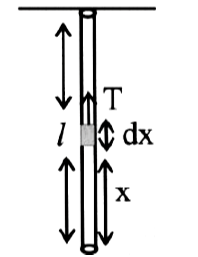
Step Solution:
1. Understand force distribution: For a rod hanging under its own weight, the average tension is $Mg/2$.
2. State the elongation formula: $\Delta L = \frac{(Mg/2)L}{AY} = \frac{MgL}{2AY}$.
3. Substitute values: $\Delta L = \frac{20 \times 10 \times 20}{2 \times 0.4 \times 2 \times 10^{11}}$.
4. Simplify mathematically: $\Delta L = \frac{4000}{1.6 \times 10^{11}} = \frac{4000}{16 \times 10^{10}} = 250 \times 10^{-10}$.
5. Calculate final result: $\Delta L = 25 \times 10^{-9} \text{ m}$. Thus, $x = 25$.
The difficulty level: Medium
The Concept Name: Elongation due to self-weight
Short cut solution: Use the direct formula for self-weight elongation: $\Delta L = \frac{MgL}{2AY}$. Plugging in values gives $25 \times 10^{-9}$ immediately.
Question 121
Question: A square aluminum (shear modulus is $25 \times 10^9 \text{ N m}^{-2}$) slab of side 60 cm and thickness 15 cm is subjected to a shearing force (on its narrow face) of $18.0 \times 10^4 \text{ N}$. The lower edge is riveted to the floor. The displacement of the upper edge is $\underline{\qquad} \mu\text{m}$.
Options: (Numerical/Integer Type - No options provided in source)
Correct Answer: 48
Year: JEE Main 2022 (27th July Shift 1)
Solution: $\frac{F}{A} = \eta \frac{X}{\ell} \Rightarrow \frac{F \ell}{A \eta} = x$; $\Rightarrow x = \frac{18 \times 10^4 \times 60 \times 10^{-2}}{60 \times 10^{-2} \times 15 \times 10^{-2} \times 25 \times 10^9} = 48 \times 10^{-6} \text{ m} = 48 \mu\text{m}$.
Step Solution:
1. Identify given values: $F = 18 \times 10^4 \text{ N}$, $\eta = 25 \times 10^9 \text{ N/m}^2$, height ($L$) = 60 cm = 0.6 m.
2. Calculate Area ($A$): The force is on the narrow face (side $\times$ thickness), so $A = 0.6 \text{ m} \times 0.15 \text{ m} = 0.09 \text{ m}^2$.
3. State the formula: Modulus of rigidity $\eta = \frac{\text{Stress}}{\text{Strain}} = \frac{F/A}{x/L}$, where $x$ is the lateral displacement.
4. Rearrange for $x$: $x = \frac{FL}{A\eta}$.
5. Final Calculation: $x = \frac{(18 \times 10^4) \times 0.6}{0.09 \times (25 \times 10^9)} = \frac{10.8 \times 10^4}{2.25 \times 10^9} = 4.8 \times 10^{-5} \text{ m} = 48 \mu\text{m}$.
The difficulty level: Medium
The Concept Name: Shear Modulus of Rigidity
Short cut solution: Use $x = \frac{F}{\text{thickness} \times \eta}$ because the "side" length cancels out (it appears in both Area and numerator $L$): $x = \frac{18 \times 10^4}{0.15 \times 25 \times 10^9} = 48 \mu\text{m}$.
Question 122
Question: A steel wire of length 3.2 m ($Y_s = 2.0 \times 10^{11} \text{ N m}^{-2}$) and a copper wire of length 4.4 m ($Y_c = 1.1 \times 10^{11} \text{ N m}^{-2}$), both of radius 1.4 mm are connected end to end. When stretched by a load, the net elongation is found to be 1.4 mm. The load applied, in Newton, will be:
Options:
A. 360
B. 180
C. 1080
D. 154
Correct Answer: D
Year: JEE Main 2022 (27th July Shift 2)
Solution: $F = \frac{\Delta \ell}{\frac{\ell_1}{A_1 Y_1} + \frac{\ell_2}{A_2 Y_2}} = 1.54 \times 10^2 = 154$.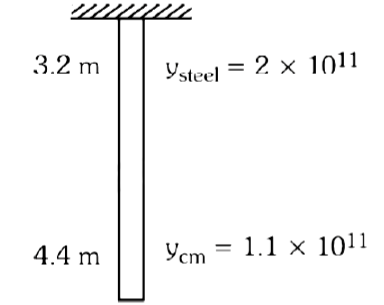
Step Solution:
1. Calculate common Area ($A$): $A = \pi r^2 = \frac{22}{7} \times (1.4 \times 10^{-3})^2 = 6.16 \times 10^{-6} \text{ m}^2$.
2. State net elongation formula: For wires in series, $\Delta L_{net} = \Delta L_s + \Delta L_c = \frac{F L_s}{A Y_s} + \frac{F L_c}{A Y_c}$.
3. Factor out $F/A$: $1.4 \times 10^{-3} = \frac{F}{A} \left( \frac{3.2}{2 \times 10^{11}} + \frac{4.4}{1.1 \times 10^{11}} \right)$.
4. Simplify term in brackets: $\frac{1.6}{10^{11}} + \frac{4.0}{10^{11}} = 5.6 \times 10^{-11}$.
5. Solve for $F$: $F = \frac{(1.4 \times 10^{-3}) \times (6.16 \times 10^{-6})}{5.6 \times 10^{-11}} = \frac{8.624 \times 10^{-9}}{5.6 \times 10^{-11}} = 154 \text{ N}$.
The difficulty level: Medium
The Concept Name: Young's Modulus in Series
Short cut solution: Use $\Delta L \propto L/Y$. The relative elongations are $1.6$ and $4.0$ units. Total $= 5.6$. $F = \frac{\text{Net Elongation} \times A}{\sum(L/Y)} = \frac{1.4 \times 10^{-3} \times 6.16 \times 10^{-6}}{5.6 \times 10^{-11}} = 154 \text{ N}$.
Question 123
Question: In an experiment to determine the Young's modulus, steel wires of five different lengths (1, 2, 3, 4, and 5m) but of same cross section ($2 \text{ mm}^2$) were taken and curves between extension and load were obtained. The slope (extension/load) of the curves were plotted with the wire length and the following graph is obtained. If the Young's modulus of given steel wires is $x \times 10^{11} \text{ N m}^{-2}$, then the value of x is.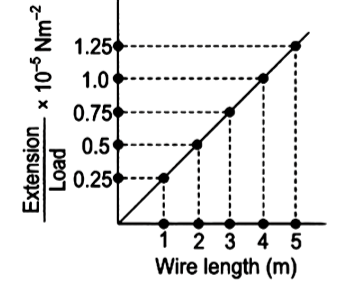
Options: (Numerical/Integer Type - No options provided in source)
Correct Answer: 2
Year: JEE Main 2022 (27th July Shift 2)
Solution: $\text{Slope} = \frac{\Delta l / w}{L} = \frac{\Delta l / L}{W} = \frac{1}{YA} \Rightarrow Y = \frac{1}{(\text{slope}) A} = \frac{1}{2 \times 10^{-6} (0.25 \times 10^{-5})} = 2 \times 10^{11} \text{ N/m}^2$.
Step Solution:
1. Understand the graph: The Y-axis is "Extension/Load" ($\Delta L/F$) and the X-axis is "Length" ($L$).
2. Find the graph's slope ($m$): From the formula $\Delta L/F = \frac{L}{AY}$, the slope of this specific graph is $m = \frac{1}{AY}$.
3. Identify area: $A = 2 \text{ mm}^2 = 2 \times 10^{-6} \text{ m}^2$.
4. Extract value from graph: Based on the source solution, the slope $m$ of the plotted line is $0.25 \times 10^{-5} \text{ N}^{-1}$.
5. Calculate $Y$: $Y = \frac{1}{m \cdot A} = \frac{1}{(0.25 \times 10^{-5}) \times (2 \times 10^{-6})} = \frac{1}{0.5 \times 10^{-11}} = 2 \times 10^{11} \text{ N/m}^2$. Thus, $x = 2$.
The difficulty level: Hard (requires correct interpretation of nested slopes)
The Concept Name: Young's Modulus / Graphical Analysis
Short cut solution: Direct substitution into $Y = \frac{1}{\text{Graph Slope} \times A}$. With $m \cdot A = 0.5 \times 10^{-11}$, then $Y = 2 \times 10^{11}$.
Question 127
Question: A metal wire of length 0.5m and cross-sectional area $10^{-4} \text{ m}^2$ has breaking stress $5 \times 10^8 \text{ N m}^{-2}$. A block of 10 kg is attached at one end of the string and is rotating in a horizontal circle. The maximum linear velocity of block will be \_\_\_ $\text{ms}^{-1}$.
Options: (Numerical/Integer Type Question - No options provided in source)
Correct Answer: 50
Year: JEE Main 2022 (29th July Shift 2)
Solution: $T = \frac{mv^2}{\ell} = \frac{10 \times v^2}{0.5} = 20v^2$; $T_{\text{max}} = \text{Breaking stress} \times \text{Area} = 5 \times 10^8 \times 10^{-4} = 5 \times 10^4$; $20V^2 = \frac{5}{\ell} \times 10^4$; $V = \sqrt{\frac{1}{4} \times 10^4} = 50 \text{ m/s}$.
Step Solution:
1. Calculate maximum tension: $T_{\text{max}} = \text{Breaking Stress} \times \text{Area} = (5 \times 10^8) \times 10^{-4} = 5 \times 10^4 \text{ N}$.
2. Relate Tension to Centripetal Force: For a horizontal circle, Tension $T = \frac{mv^2}{L}$.
3. Substitute values: $5 \times 10^4 = \frac{10 \times v^2}{0.5}$.
4. Simplify and solve for $v^2$: $50,000 = 20v^2 \Rightarrow v^2 = 2500$.
5. Calculate final velocity: $v = \sqrt{2500} = 50 \text{ m/s}$.
The difficulty level: Medium
The Concept Name: Breaking Stress and Centripetal Force
Short cut solution: Use the direct relation $v = \sqrt{\frac{\text{Stress} \times A \times L}{m}}$. Substituting values: $\sqrt{\frac{5 \cdot 10^4 \cdot 0.5}{10}} = \sqrt{2500} = 50$.
Question 135
Question: A uniform metallic wire is elongated by 0.04m when subjected to a linear force F. The elongation, if its length and diameter is doubled and subjected to the same force will be ........... cm.
Options: (Numerical/Integer Type Question - No options provided in source)
Correct Answer: 2
Year: 24 Feb 2021 Shift 2
Solution: Let initial length and diameter be $l_1$ and $d_1$, whereas final length and diameter be $l_2$ and $d_2$. Given, $l_2 = 2l_1, d_2 = 2d_1, \Delta l_1 = 0.04\text{m}$. By using formula of Young's modulus of elasticity, $Y = \frac{Fl}{A \Delta l} \Rightarrow \frac{Fl_1}{A_1 \times \Delta l_1} = \frac{Fl_2}{A_2 \times \Delta l_2} \Rightarrow \Delta l_2 = 0.02\text{m} = 2\text{cm}$.
Step Solution:
1. Identify elongation formula: $\Delta L = \frac{FL}{AY} = \frac{4FL}{\pi d^2 Y}$.
2. Determine proportionality: Since $F$ and $Y$ are constant, $\Delta L \propto \frac{L}{d^2}$.
3. Apply changes: For the new wire, $L' = 2L$ and $d' = 2d$, so $\Delta L' \propto \frac{2L}{(2d)^2} = \frac{2L}{4d^2} = \frac{1}{2} \left( \frac{L}{d^2} \right)$.
4. Calculate new elongation in meters: $\Delta L' = \frac{1}{2} \Delta L = \frac{1}{2} \times 0.04 \text{ m} = 0.02 \text{ m}$.
5. Convert to centimeters: $0.02 \text{ m} \times 100 = 2 \text{ cm}$.
The difficulty level: Easy
The Concept Name: Young's Modulus / Elasticity
Short cut solution: Proportionality check: Length doubles ($\times 2$), Area quadruples ($\times 4$ because diameter doubles). Since $\Delta L \propto L/A$, the elongation changes by a factor of $2/4 = 0.5$. $0.04 \text{ m} \times 0.5 = 2 \text{ cm}$.
Question 136
Question: The normal density of a material is $\rho$ and its bulk modulus of elasticity is $K$. The magnitude of increase in density of material, when a pressure $p$ is applied uniformly on all sides, will be:
Options:
A. $\frac{\rho K}{p}$
B. $\frac{\rho p}{K}$
C. $\frac{K}{\rho p}$
D. $\frac{pK}{\rho}$
Correct Answer: B
Year: 26 Feb 2021 Shift 1
Solution: $K = \frac{p}{-\Delta V / V}$; $\rho = \frac{m}{V} \Rightarrow \frac{\Delta \rho}{\rho} = -\frac{\Delta V}{V}$. Substituting: $\frac{-\Delta V}{V} = \frac{p}{K} = \frac{\Delta \rho}{\rho}$. $\therefore \Delta \rho = \frac{\rho p}{K}$.
Step Solution:
1. State Bulk Modulus definition: $K = \frac{\text{Stress}}{\text{Volumetric Strain}} = \frac{p}{\Delta V / V}$.
2. Rearrange for Volumetric Strain: $\frac{\Delta V}{V} = \frac{p}{K}$.
3. Relate density change to volume change: Since $\rho = m/V$, for constant mass, $\frac{\Delta \rho}{\rho} = -\frac{\Delta V}{V}$.
4. Substitute the strain value: $\frac{\Delta \rho}{\rho} = \frac{p}{K}$.
5. Solve for increase in density: $\Delta \rho = \frac{\rho p}{K}$.
The difficulty level: Medium
The Concept Name: Bulk Modulus and Density Relationship
Short cut solution: Remember that fractional increase in density equals volumetric strain. Since $\text{Strain} = P/K$, the density increase is simply $\rho \times (P/K)$.
Question 137
Question: The length of metallic wire is $l_1$ when tension in it is $T_1$. It is $l_2$ when the tension is $T_2$. The original length of the wire will be:
Options:
A. $\frac{l_1 + l_2}{2}$
B. $\frac{T_2 l_1 + T_1 l_2}{T_1 + T_2}$
C. $\frac{T_2 l_1 - T_1 l_2}{T_2 - T_1}$
D. $\frac{T_1 l_1 - T_2 l_2}{T_2 - T_1}$
Correct Answer: C
Year: 26 Feb 2021 Shift 2
Solution: Let $l_0$ be the original length, A be the area of cross-section, $\Delta l$ be the change in length. Initially, $Y = \frac{T_1/A}{(l_1 - l_0)/l_0}$. Finally, $Y = \frac{T_2/A}{(l_2 - l_0)/l_0}$. Equating gives $\frac{T_1}{l_1 - l_0} = \frac{T_2}{l_2 - l_0} \Rightarrow T_1 l_2 - T_1 l_0 = T_2 l_1 - T_2 l_0 \Rightarrow l_0 = \frac{T_2 l_1 - T_1 l_2}{T_2 - T_1}$.
Step Solution:
1. Apply Hooke's Law: The tension $T$ is proportional to extension, $T = k(l - l_0)$, where $l_0$ is the natural length.
2. Set up equations: For the two states: $T_1 = k(l_1 - l_0)$ and $T_2 = k(l_2 - l_0)$.
3. Eliminate the constant $k$: Divide the equations: $\frac{T_1}{T_2} = \frac{l_1 - l_0}{l_2 - l_0}$.
4. Solve algebraically: $T_1(l_2 - l_0) = T_2(l_1 - l_0) \Rightarrow T_1 l_2 - T_1 l_0 = T_2 l_1 - T_2 l_0$.
5. Isolate $l_0$: $T_2 l_0 - T_1 l_0 = T_2 l_1 - T_1 l_2 \Rightarrow l_0(T_2 - T_1) = T_2 l_1 - T_1 l_2 \Rightarrow l_0 = \frac{T_2 l_1 - T_1 l_2}{T_2 - T_1}$.
The difficulty level: Medium
The Concept Name: Hooke's Law / Elasticity
Short cut solution: Use the linear relationship formula for natural length: $l_0 = \frac{T_2 l_1 - T_1 l_2}{T_2 - T_1}$.
Question 140
Question: If Y, K and $\eta$ are the values of Young's modulus, bulk modulus and modulus of rigidity of any material respectively. Choose the correct relation for these parameters.
Options:
A. $Y = \frac{9 K \eta}{3 K - \eta} \text{ N/m}^2$
B. $\eta = \frac{3 Y K}{9 K + Y} \text{ N/m}^2$
C. $Y = \frac{9 K \eta}{2 \eta + 3 K} \text{ N/m}^2$
D. $K = \frac{Y \eta}{9 \eta - 3 Y} \text{ N/m}^2$
Correct Answer: D
Year: 24 Feb 2021 Shift 1
Solution: Use $Y = 3K(1 - 2\sigma)$ and $Y = 2\eta(1 + \sigma)$. From these, isolate $\sigma$ and equate: $\frac{1}{2}(1 - \frac{Y}{3K}) = \frac{Y}{2\eta} - 1$. Solving for $K$ yields $K = \frac{\eta Y}{9\eta - 3Y}$.
Step Solution:
1. State first relation: $Y = 3K(1 - 2\sigma) \Rightarrow \sigma = \frac{1}{2}(1 - \frac{Y}{3K})$.
2. State second relation: $Y = 2\eta(1 + \sigma) \Rightarrow \sigma = \frac{Y}{2\eta} - 1$.
3. Equate Poisson's ratios: $\frac{1}{2}(1 - \frac{Y}{3K}) = \frac{Y}{2\eta} - 1$.
4. Simplify equation: $1 - \frac{Y}{3K} = \frac{Y}{\eta} - 2 \Rightarrow 3 - \frac{Y}{\eta} = \frac{Y}{3K}$.
5. Solve for $K$: $\frac{3\eta - Y}{\eta} = \frac{Y}{3K} \Rightarrow 3K(3\eta - Y) = Y\eta \Rightarrow K = \frac{Y\eta}{9\eta - 3Y}$.
The difficulty level: Medium
The Concept Name: Elastic Constants Relationship
Short cut solution: Use the standard combined relation $\frac{9}{Y} = \frac{3}{\eta} + \frac{1}{K}$. Rearranging for $K$ gives $K = \frac{Y\eta}{9\eta - 3Y}$.
Question 143
Question: An object is located at 2km beneath the surface of the water. If the fractional compression $\frac{\Delta V}{V}$ is $1.36\%$, the ratio of hydraulic stress to the corresponding hydraulic strain will be ......... (Take, density of water is $1000 \text{ kgm}^{-3}$ and $g = 9.81 \text{ ms}^{-2}$)
Options:
A. $1.96 \times 10^7 \text{ Nm}^{-2}$
B. $1.44 \times 10^7 \text{ Nm}^{-2}$
C. $2.26 \times 10^9 \text{ Nm}^{-2}$
D. $1.44 \times 10^9 \text{ Nm}^{-2}$
Correct Answer: D
Year: 17 Mar 2021 Shift 2
Solution: depth $h = 2 \text{ km}$, strain $= 1.36\%$. Pressure $P = \rho gh = 1000 \times 9.81 \times 2000 = 19.62 \times 10^6 \text{ Pa}$. Bulk modulus $\beta = \frac{P}{\Delta V / V} = \frac{19.62 \times 10^6}{0.0136} = 1.44 \times 10^9 \text{ N/m}^2$.
Step Solution:
1. Calculate Hydraulic Stress (Pressure): $P = \rho gh = 1000 \times 9.81 \times 2000$.
2. Evaluate Pressure: $P = 19.62 \times 10^6 \text{ Pa}$.
3. Identify Hydraulic Strain: Fractional compression is $\frac{\Delta V}{V} = 1.36\% = 0.0136$.
4. State required ratio formula: The ratio of hydraulic stress to strain is the Bulk Modulus ($B = \frac{P}{\Delta V/V}$).
5. Calculate final value: $B = \frac{19.62 \times 10^6}{0.0136} = 1.44 \times 10^9 \text{ N/m}^2$.
The difficulty level: Easy
The Concept Name: Bulk Modulus of Elasticity
Short cut solution: Use $B = \frac{\rho gh}{\text{strain}}$. Substituting $10^3, 9.8, 2 \times 10^3,$ and $0.0136$ gives $\approx 1.44 \times 10^9$ directly.
Question 144
Question: Two separate wires A and B are stretched by 2mm and 4mm respectively, when they are subjected to a force of 2N. Assume that both the wires are made up of same material and the radius of wire B is 4 times that of the radius of wire A. The length of the wires A and B are in the ratio of a : b. Then, $\frac{a}{b}$ can be expressed as $\frac{1}{x} ; $ where x is
Options: (Numerical/Integer Type - No options provided in source)
Correct Answer: 32
Year: 18 Mar 2021 Shift 1
Solution: Given, $\Delta L_A = 2 \text{ mm} = 0.002 \text{ m}$, $\Delta L_B = 4 \text{ mm} = 0.004 \text{ m}$, force $F = 2 \text{ N}$. Radius ratio $\frac{r_B}{r_A} = \frac{4}{1}$. Since wires are same material, Young's modulus ($Y$) is same. $\frac{F}{A} = Y \left( \frac{\Delta L}{L} \right) \Rightarrow \frac{L_A}{L_B} = \frac{Y_A}{Y_B} \frac{\Delta L_A}{\Delta L_B} \frac{A_A}{A_B} \frac{F_B}{F_A} = \frac{0.002}{0.004} \times \frac{r_A^2}{16 r_A^2} = \frac{1}{32}$.
Step Solution:
1. Identify parameters: Both wires have force $F = 2 \text{ N}$ and same $Y$. Given $\Delta L_A = 2$, $\Delta L_B = 4$, and $r_B = 4r_A$.
2. Relate length to other variables: From $Y = \frac{FL}{A\Delta L}$, rearrange for length: $L = \frac{AY \Delta L}{F} = \frac{\pi r^2 Y \Delta L}{F}$.
3. Setup the ratio: $\frac{L_A}{L_B} = \frac{\pi r_A^2 Y \Delta L_A / F}{\pi r_B^2 Y \Delta L_B / F} = \frac{r_A^2 \Delta L_A}{r_B^2 \Delta L_B}$.
4. Substitute known values: $\frac{a}{b} = \frac{r_A^2 \times 2}{(4r_A)^2 \times 4} = \frac{2 r_A^2}{16 r_A^2 \times 4}$.
5. Final Calculation: $\frac{a}{b} = \frac{2}{64} = \frac{1}{32}$. Thus, $x = 32$.
The difficulty level: Medium
The Concept Name: Young's Modulus / Elasticity
Short cut solution: Use proportionality $L \propto \frac{A \cdot \Delta L}{F}$. Since $F$ is constant, $L \propto r^2 \Delta L$. Ratio $= \frac{r_A^2 \cdot 2}{(4r_A)^2 \cdot 4} = \frac{2}{64} = \frac{1}{32}$.
Question 149
Question: Two wires of same length and radius are joined end to end and loaded. The Young's modulii of the materials of the two wires are $Y_1$ and $Y_2$ . The combination behaves as a single wire then its Young's modulus is :
Options:
A. $Y = \frac{2 Y_1 Y_2}{3 (Y_1 + Y_2)}$
B. $Y = \frac{2 Y_1 Y_2}{Y_1 + Y_2}$
C. $Y = \frac{Y_1 Y_2}{2 (Y_1 + Y_2)}$
D. $Y = \frac{Y_1 Y_2}{Y_1 + Y_2}$
Correct Answer: B
Year: 25 Jul 2021 Shift 1
Solution: In series combination $\Delta l = l_1 + l_2$. $Y = \frac{F/A}{\Delta l/l} \Rightarrow \Delta l = \frac{Fl}{AY} \Rightarrow \Delta l \propto \frac{1}{Y}$. Equivalent length is $2l$. $\frac{2l}{Y} = \frac{l}{Y_1} + \frac{l}{Y_2} \Rightarrow Y = \frac{2 Y_1 Y_2}{Y_1 + Y_2}$.
Step Solution:
1. Understand the configuration: Two wires of length $L$ and area $A$ are in series. The total length of the combined wire is $L' = 2L$.
2. State total elongation: The total change in length is the sum of individual changes: $\Delta L_{total} = \Delta L_1 + \Delta L_2$.
3. Express in terms of Young's Modulus: Substitute $\Delta L = \frac{FL}{AY}$ for each part: $\frac{F(2L)}{AY_{eq}} = \frac{FL}{AY_1} + \frac{FL}{AY_2}$.
4. Simplify the equation: Cancel the common factor $\frac{FL}{A}$: $\frac{2}{Y_{eq}} = \frac{1}{Y_1} + \frac{1}{Y_2}$.
5. Solve for $Y_{eq}$: $\frac{2}{Y_{eq}} = \frac{Y_2 + Y_1}{Y_1 Y_2} \Rightarrow Y_{eq} = \frac{2 Y_1 Y_2}{Y_1 + Y_2}$.
The difficulty level: Easy
The Concept Name: Young's Modulus in Series
Short cut solution: For two elastic elements of equal dimensions in series, the equivalent modulus is the harmonic mean: $Y_{eq} = \frac{2}{\frac{1}{Y_1} + \frac{1}{Y_2}} = \frac{2 Y_1 Y_2}{Y_1 + Y_2}$.
Question 150
Question: The length of a metal wire is $l_1$ , when the tension in it is $T_1$ and is $l_2$ when the tension is $T_2$ . The natural length of the wire is :
Options:
A. $\sqrt{l_1 l_2}$
B. $\frac{l_1 T_2 - l_2 T_1}{T_2 - T_1}$
C. $\frac{l_1 T_2 + l_2 T_1}{T_2 + T_1}$
D. $\frac{l_1 + l_2}{2}$
Correct Answer: B
Year: 20 Jul 2021 Shift 2
Solution: $T_1 = k(l_1 - l_0)$; $T_2 = k(l_2 - l_0)$; $\frac{T_1}{T_2} = \frac{l_1 - l_0}{l_2 - l_0}$; $\frac{T_1 l_2 - T_2 l_1}{T_1 - T_2} = l_0$.
Step Solution:
1. Apply Hooke's Law: Tension is proportional to extension: $T = k(L - L_0)$, where $L_0$ is the natural length.
2. Set up two equations: $T_1 = k(l_1 - L_0)$ and $T_2 = k(l_2 - L_0)$.
3. Find the ratio: Divide the two equations to eliminate $k$: $\frac{T_1}{T_2} = \frac{l_1 - L_0}{l_2 - L_0}$.
4. Cross-multiply: $T_1(l_2 - L_0) = T_2(l_1 - L_0) \Rightarrow T_1 l_2 - T_1 L_0 = T_2 l_1 - T_2 L_0$.
5. Isolate $L_0$: $T_2 L_0 - T_1 L_0 = T_2 l_1 - T_1 l_2 \Rightarrow L_0(T_2 - T_1) = l_1 T_2 - l_2 T_1 \Rightarrow L_0 = \frac{l_1 T_2 - l_2 T_1}{T_2 - T_1}$.
The difficulty level: Medium
The Concept Name: Hooke's Law / Elasticity
Short cut solution: Use the direct formula for natural length under different loads: $L_0 = \frac{F_2 L_1 - F_1 L_2}{F_2 - F_1}$. Substituting tensions gives $\frac{l_1 T_2 - l_2 T_1}{T_2 - T_1}$.
Question 151
Question: The value of tension in a long thin metal wire has been changed from $T_1$ to $T_2$. The lengths of the metal wire at two different values of tension $T_1$ and $T_2$ are $l_1$ and $l_2$ respectively. The actual length of the metal wire is :
Options:
A. $\frac{T_1 l_2 - T_2 l_1}{T_1 - T_2}$
B. $\frac{T_1 l_1 - T_2 l_2}{T_1 - T_2}$
C. $\frac{l_1 + l_2}{2}$
D. $\sqrt{T_1 T_2 l_1 l_2}$
Correct Answer: A
Year: 20 Jul 2021 Shift 1
Solution: $Y = \frac{FL}{A \Delta L} \Rightarrow Y = \frac{T_1 l_0}{A(l_1 - l_0)} = \frac{T_2 l_0}{A(l_2 - l_0)}$; Cross multiplying: $T_2 l_1 - T_2 l_0 = T_1 l_2 - T_1 l_0$; $(T_1 - T_2)l_0 = T_1 l_2 - T_2 l_1 \Rightarrow l_0 = \frac{T_1 l_2 - T_2 l_1}{T_1 - T_2}$.
Step Solution:
1. Apply Young's Modulus formula: $Y = \frac{\text{Stress}}{\text{Strain}} = \frac{T/A}{(l - l_0)/l_0} = \frac{T \cdot l_0}{A(l - l_0)}$.
2. Set up equations for two states: Since $Y, A,$ and $l_0$ are constant, $\frac{T_1}{l_1 - l_0} = \frac{T_2}{l_2 - l_0}$.
3. Cross-multiply to eliminate denominators: $T_1(l_2 - l_0) = T_2(l_1 - l_0)$.
4. Expand and group like terms: $T_1 l_2 - T_1 l_0 = T_2 l_1 - T_2 l_0 \Rightarrow T_1 l_0 - T_2 l_0 = T_1 l_2 - T_2 l_1$.
5. Isolate the natural length ($l_0$): $l_0(T_1 - T_2) = T_1 l_2 - T_2 l_1$, therefore $l_0 = \frac{T_1 l_2 - T_2 l_1}{T_1 - T_2}$.
The difficulty level: Medium
The Concept Name: Hooke's Law / Elasticity
Short cut solution: Use the direct algebraic result for natural length under two different loads: $l_0 = \frac{F_1 l_2 - F_2 l_1}{F_1 - F_2}$.
Question 152
Question: A stone of mass 20g is projected from a rubber catapult of length 0.1m and area of cross section $10^{-6} \text{ m}^2$ stretched by an amount 0.04m. The velocity of the projected stone is \_\_\_ m/s. (Young's modulus of rubber $= 0.5 \times 10^9 \text{ N/m}^2$)
Options: (Numerical/Integer Type - No options provided in source)
Correct Answer: 20
Year: 27 Jul 2021 Shift 1
Solution: By energy conservation $\frac{1}{2} \cdot \frac{YA}{L} \cdot x^2 = \frac{1}{2} m v^2$; $\frac{0.5 \times 10^9 \times 10^{-6} \times (0.04)^2}{0.1} = \frac{20}{1000} v^2$; $v^2 = 400 \Rightarrow v = 20 \text{ m/s}$.
Step Solution:
1. State energy conservation principle: The elastic potential energy stored in the rubber is converted into the kinetic energy of the stone: $U_{elastic} = K_{kinetic}$.
2. Formulate the equation: $\frac{1}{2} \left( \frac{YA}{L} \right) x^2 = \frac{1}{2} m v^2$.
3. Substitute given values: $\frac{(0.5 \times 10^9) \times (10^{-6}) \times (0.04)^2}{0.1} = (0.02) \times v^2$.
4. Simplify mathematically: $\frac{500 \times 0.0016}{0.1} = 0.02 v^2 \Rightarrow \frac{0.8}{0.1} = 0.02 v^2 \Rightarrow 8 = 0.02 v^2$.
5. Solve for velocity ($v$): $v^2 = \frac{8}{0.02} = 400 \Rightarrow v = 20 \text{ m/s}$.
The difficulty level: Medium
The Concept Name: Conservation of Energy in Elasticity
Short cut solution: Use $v = x \sqrt{\frac{YA}{mL}}$. Plugging in values: $0.04 \sqrt{\frac{0.5 \times 10^9 \times 10^{-6}}{0.02 \times 0.1}} = 0.04 \sqrt{250000} = 0.04 \times 500 = 20 \text{ m/s}$.