Question 9
Question: A rectangular loop of length 2.5m and width 2 m is placed at $60^{\circ}$ to a magnetic field of 4T. The loop is removed from the field in 10 sec. The average emf induced in the loop during this time is:
Options:
A. $-2V$
B. $+2V$
C. $+1V$
D. $-1V$
Correct Answer: Option C
Year: JEE Main 27-Jan-2024 Shift 1
Solution: Average emf $= \frac{\text{Change in flux}}{\text{Time}} = \frac{\Delta \Phi}{\Delta t}$. $\Phi_{initial} = 4 \times (2.5 \times 2) \cos 60^{\circ}$. $\Delta t = 10$. Average emf $= \frac{0 - (4 \times 5 \times 0.5)}{10} = +1V$.
Step Solution:
1. Calculate Area ($A$): $A = \text{Length} \times \text{Width} = 2.5 \times 2 = 5 \, \text{m}^2$.
2. Calculate Initial Flux ($\Phi_i$): $\Phi_i = B \cdot A \cos \theta$. Given $B = 4T$ and $\theta = 60^{\circ}$, $\Phi_i = 4 \times 5 \times \cos(60^{\circ}) = 20 \times 0.5 = 10 \, \text{Wb}$.
3. Identify Final Flux ($\Phi_f$): Since the loop is removed from the field, $\Phi_f = 0 \, \text{Wb}$.
4. Find Change in Flux ($\Delta \Phi$): $\Delta \Phi = \Phi_f - \Phi_i = 0 - 10 = -10 \, \text{Wb}$.
5. Calculate Average EMF ($\varepsilon$): $\varepsilon = -\frac{\Delta \Phi}{\Delta t} = -\frac{(-10)}{10} = 1 \, \text{V}$.
Difficulty Level: Easy
Concept Name: Faraday’s Law of Induction / Magnetic Flux
Short cut solution: $\varepsilon = \frac{B A \cos \theta}{t} = \frac{4 \times 5 \times 0.5}{10} = 1 \text{V}$.
Question 11
Question: A square loop of side 10cm and resistance $0.7 \Omega$ is placed vertically in east-west plane. A uniform magnetic field of 0.20T is set up across the plane in north east direction. The magnetic field is decreased to zero in 1 s at a steady rate. Then, magnitude of induced emf is $\sqrt{x} \times 10^{-3} V$. The value of $x$ is:
Options: (Integer type question, no options provided)
Correct Answer: 2
Year: JEE Main 29-Jan-2024 Shift 1
Solution: $\vec{A} = (0.1)^2 \hat{j}$; $\vec{B} = \frac{0.2}{\sqrt{2}} \hat{i} + \frac{0.2}{\sqrt{2}} \hat{j}$. Magnitude of induced emf $e = \frac{\Delta \Phi}{\Delta t} = \frac{\vec{B} \cdot \vec{A} - 0}{1} = \sqrt{2} \times 10^{-3} V$.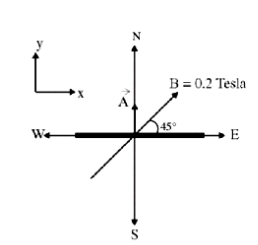
Step Solution:
1. Calculate Area ($A$): $A = (10 \, \text{cm})^2 = 0.01 \, \text{m}^2 = 10^{-2} \, \text{m}^2$.
2. Determine the Angle ($\theta$): The loop is in the East-West plane (Area vector points North). The field is North-East. The angle between North and North-East is $45^{\circ}$.
3. Calculate Initial Flux ($\Phi_i$): $\Phi_i = B \cdot A \cos 45^{\circ} = 0.20 \times 10^{-2} \times \frac{1}{\sqrt{2}}$.
4. Simplify Flux: $\Phi_i = \frac{2 \times 10^{-3}}{\sqrt{2}} = \sqrt{2} \times 10^{-3} \, \text{Wb}$.
5. Calculate Magnitude of EMF: Since $t = 1 \, \text{s}$ and $\Phi_f = 0$, $|\varepsilon| = \frac{|\Delta \Phi|}{t} = \frac{\sqrt{2} \times 10^{-3}}{1} = \sqrt{2} \times 10^{-3} \, \text{V}$. Comparing to $\sqrt{x} \times 10^{-3}$, $x = 2$.
Difficulty Level: Medium
Concept Name: Faraday's Law / Scalar Product of Vectors
Short cut solution: EMF $= \frac{B A \cos \theta}{\Delta t} = \frac{0.2 \times 10^{-2} \times \cos 45^{\circ}}{1} = \sqrt{2} \times 10^{-3}$. Therefore $x = 2$.
Question 15
Question: The magnetic flux $\Phi$ (in weber) linked with a closed circuit of resistance $8 \Omega$ varies with time (in seconds) as $\Phi = 5t^2 - 36t + 1$. The induced current in the circuit at $t = 2$ s is \_\_\_\_ A.
Options: (Integer type question, no options provided)
Correct Answer: 2
Year: JEE Main 31-Jan-2024 Shift 2
Solution: $\varepsilon = -\frac{d\Phi}{dt} = 10t - 36$. At $t=2$, $\varepsilon = 16V$. $i = \frac{\varepsilon}{R} = \frac{16}{8} = 2A$.
Step Solution:
1. Differentiate Flux to find EMF ($\varepsilon$): $\varepsilon = -\frac{d\Phi}{dt} = -\frac{d}{dt}(5t^2 - 36t + 1)$.
2. Find the EMF Equation: $\varepsilon = -(10t - 36) = 36 - 10t$.
3. Calculate EMF at $t = 2$ s: $\varepsilon = 36 - 10(2) = 36 - 20 = 16 \, \text{V}$.
4. Apply Ohm's Law for Induced Current ($i$): $i = \frac{|\varepsilon|}{R}$.
5. Final Calculation: $i = \frac{16 \, \text{V}}{8 \, \Omega} = 2 \, \text{A}$.
Difficulty Level: Easy
Concept Name: Faraday’s Law of Induction / Ohm's Law
Short cut solution: $i = \frac{|10t - 36|}{R}$. At $t=2$, $i = \frac{|20-36|}{8} = \frac{16}{8} = 2 \text{A}$.
Question 18
Question: A conducting loop of radius $\frac{10}{\sqrt{\pi}} \text{ cm}$ is placed perpendicular to a uniform magnetic field of $0.5\text{T}$. The magnetic field is decreased to zero in $0.5\text{ s}$ at a steady rate. The induced emf in the circular loop at $0.25\text{ s}$ is:
Options:
A. emf $= 1 \text{ mV}$
B. emf $= 100 \text{ mV}$
C. emf $= 10 \text{ mV}$
D. emf $= 5 \text{ mV}$
Correct Answer: Answer: B (Note: While the source labels the answer as B, the internal calculation in the source results in $10 \text{ mV}$, which corresponds to Option C).
Year: 24-Jan-2023 Shift 1.
Solution: $\text{EMF} = \frac{d\varphi}{dt} = \frac{BA - 0}{t}$. $A = \pi r^2 = \pi \left(\frac{0.1^2}{\pi}\right) = 0.01$. $\text{EMF} = \frac{(0.5)(0.01)}{0.5} = 0.01 \text{ V} = 10 \text{ mV}$.
Step Solution:
1. Calculate Area ($A$): $A = \pi r^2 = \pi \left( \frac{10}{\sqrt{\pi}} \times 10^{-2} \right)^2 = \pi \left( \frac{0.1}{\sqrt{\pi}} \right)^2 = 0.01 \text{ m}^2$.
2. Determine Change in Magnetic Field ($\Delta B$): $\Delta B = B_{final} - B_{initial} = 0 - 0.5 = -0.5 \text{ T}$.
3. Identify Time Interval ($\Delta t$): The field reaches zero in $0.5 \text{ s}$.
4. Calculate Rate of Change of Flux: Since the rate is steady, $\frac{d\Phi}{dt} = A \frac{\Delta B}{\Delta t} = 0.01 \times \frac{0.5}{0.5} = 0.01 \text{ Wb/s}$.
5. Final EMF Calculation: $\varepsilon = \left| \frac{d\Phi}{dt} \right| = 0.01 \text{ V} = 10 \text{ mV}$.
Difficulty Level: Easy
Concept Name: Faraday’s Law of Induction
Short cut solution: $\varepsilon = A \frac{B}{t} = (0.01) \times \frac{0.5}{0.5} = 0.01 \text{ V} = 10 \text{ mV}$.
Question 24
Question: The induced emf can be produced in a coil by:
A. moving the coil with uniform speed inside uniform magnetic field
B. moving the coil with non uniform speed inside uniform magnetic field
C. rotating the coil inside the uniform magnetic field
D. changing the area of the coil inside the uniform magnetic field
Choose the correct answer from the options given below :
Options:
A. B and D only
B. C and D only
C. B and C only
D. A and C only
Correct Answer: Option B
Year: 6-Apr-2023 shift 1.
Solution: Induced emf can be induced in a coil by changing magnetic flux. $\Phi = \vec{B} \cdot \vec{dA}$. By rotating coil, angle between coil and magnetic field changes and hence flux changes. By changing area, magnetic flux changes.
Step Solution:
1. Define Faraday's Law: $\varepsilon = -\frac{d\Phi}{dt}$, meaning a change in magnetic flux is required.
2. Analyze Flux Formula: $\Phi = BA \cos \theta$. EMF is induced if $B$, $A$, or $\theta$ change over time.
3. Evaluate Rotation (C): Rotating the coil changes the angle $\theta$ between the area vector and $B$, causing $\frac{d\Phi}{dt} \neq 0$.
4. Evaluate Area Change (D): Changing the physical area $A$ of the loop directly changes $\Phi$, inducing EMF.
5. Evaluate Translation (A & B): Moving a coil at any speed (uniform or non-uniform) inside a uniform field does not change the flux linked with it, so no EMF is induced.
Difficulty Level: Easy
Concept Name: Magnetic Flux / Faraday's Law
Short cut solution: EMF requires a change in $B$, $A$, or orientation ($\theta$). Only C (orientation) and D (area) provide this in a uniform field.
Question 31
Question: The magnetic field $B$ crossing normally a square metallic plate of area $4 \text{ m}^2$ is changing with time as shown in figure. The magnitude of induced emf in the plate during $t = 2 \text{ s}$ to $t = 4 \text{ s}$, is \_\_\_\_ mV.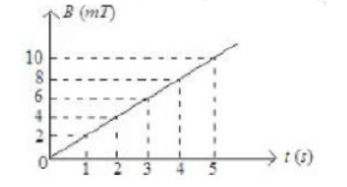
Options: (Integer type question, no options provided in source).
Correct Answer: 8 (Note: The source calculation results in $8 \text{ Volt}$, though the question asks for $mV$).
Year: 11-Apr-2023 shift 1.
Solution: $\text{Emf} = \frac{d\Phi}{dt} = \frac{A dB}{dt} = 4 \cdot \text{Slope of B-t curve} = 4 \cdot \left[ \frac{8 - 4}{4 - 2} \right] = 4 \times 2 = 8 \text{ Volt}$.
Step Solution:
1. Identify Formula: For a constant area, the induced EMF is $|\varepsilon| = A \left| \frac{dB}{dt} \right|$.
2. Calculate Slope ($\frac{dB}{dt}$): From the graph (implied by solution math), between $2 \text{ s}$ and $4 \text{ s}$, $B$ changes from $4 \text{ T}$ to $8 \text{ T}$. Slope $= \frac{8 - 4}{4 - 2} = \frac{4}{2} = 2 \text{ T/s}$.
3. Substitute Values: Given $Area (A) = 4 \text{ m}^2$ and $\frac{dB}{dt} = 2 \text{ T/s}$.
4. Calculate EMF: $\varepsilon = 4 \text{ m}^2 \times 2 \text{ T/s} = 8 \text{ V}$.
5. Final Unit Check: Although the question asks for $mV$, the source provides "8" as the numerical answer based on the "8 Volt" calculation.
Difficulty Level: Easy
Concept Name: Faraday’s Law / Graphical Analysis
Short cut solution: $\text{EMF} = \text{Area} \times \text{Slope} = 4 \times \left(\frac{4}{2}\right) = 8 \text{ V}$.
Question 34
Question: A conducting circular loop is placed in a uniform magnetic field of 0.4T with its plane perpendicular to the field. Somehow, the radius of the loop starts expending at a constant rate of $1\text{ mm/s}$ The magnitude of induced emf in the loop at an instant when the radius of the lop is 2 cm will be µV.
Options: (Integer type question, numerical answer required).
Correct Answer: 50
Year: 12-Apr-2023 shift 1
Solution: $\text{B} = 0.4\text{ T}$ Rate $\frac{dr}{dt} = 1\text{ mm/sec}$ $\text{Einduced} = ?$ $\text{R} = 2\text{ cm}$ $\phi = \text{B}\pi r^2$ $\varepsilon = \frac{d\phi}{dt} = \text{B}\pi(2r)\frac{dr}{dt}$ $\text{Ein} = 0.4 \times \pi \times 4 \times 10^{-2} \times 10^{-3} = 16\pi \times 10^{-6} \approx 50\mu\text{V}$.
Step Solution:
1. State the Flux Formula: Magnetic flux through the loop is $\Phi = \text{B} \cdot \text{A} = \text{B}(\pi r^2)$.
2. Apply Faraday's Law: Induced EMF is the time derivative of flux: $\varepsilon = \frac{d\Phi}{dt} = \text{B}\pi \frac{d}{dt}(r^2)$.
3. Differentiate with Chain Rule: $\varepsilon = \text{B}\pi (2r \frac{dr}{dt})$.
4. Substitute Values: $\text{B} = 0.4\text{ T}$, $r = 0.02\text{ m}$, and $\frac{dr}{dt} = 0.001\text{ m/s}$.
5. Final Calculation: $\varepsilon = 0.4 \times 3.14 \times 2 \times 0.02 \times 0.001 \approx 50.24 \times 10^{-6}\text{ V} = 50\mu\text{V}$.
Difficulty Level: Easy
Concept Name: Faraday’s Law / Chain Rule of Differentiation
Short cut solution: $\varepsilon = 2\pi r\text{B}v$, where $v$ is the expansion rate. $\varepsilon = 2\pi(0.02)(0.4)(0.001) \approx 50\mu\text{V}$.
Question 37
Question: An insulated copper wire of 100 turns is wrapped around a wooden cylindrical core of the cross-sectional area $24\text{ cm}^2$. The two ends of the wire are connected to a resistor. The total resistance in the circuit is 12Ω. If an externally applied uniform magnetic field in the core along its axis changes from 1.5T in one direction to 1.5T in the opposite direction, the charge flowing through a point in the circuit during the change of magnetic field will be mC.
Options: (Integer type question, numerical answer required).
Correct Answer: 60
Year: 13-Apr-2023 shift 2
Solution: $|\Delta\text{Q}| = \frac{\Delta\Phi}{\text{R}} = \frac{2 \cdot \text{NBA}}{\text{R}} = \frac{2 \times 100 \times 1.5 \times 24 \times 10^{-4}}{12} = 6 \times 10^{-2}\text{ C} = 60\text{ mC}$.
Step Solution:
1. Establish Charge Formula: The net charge flown is $\Delta\text{Q} = \frac{\Delta\Phi}{\text{R}}$.
2. Calculate Initial and Final Flux: $\Phi_i = \text{NBA}$ and $\Phi_f = -\text{NBA}$.
3. Determine Change in Flux: $\Delta\Phi = |\Phi_f - \Phi_i| = 2\text{NBA}$.
4. Insert Numerical Values: $\Delta\Phi = 2 \times 100 \times 1.5 \times (24 \times 10^{-4}\text{ m}^2)$.
5. Calculate Charge: $\Delta\text{Q} = \frac{0.72}{12} = 0.06\text{ C} = 60\text{ mC}$.
Difficulty Level: Easy
Concept Name: Induced Charge Flow
Short cut solution: $\Delta\text{Q} = \frac{2\text{NBA}}{\text{R}}$. Since $B$ reverses, the flux change is double. $\Delta\text{Q} = \frac{2 \times 100 \times 1.5 \times 24 \times 10^{-4}}{12} = 60\text{ mC}$.
Question 42
Question: The magnetic flux through a coil perpendicular to its plane is varying according to the relation $\Phi = (5t^3 + 4t^2 + 2t - 5)$ Weber. If the resistance of the coil is 5 ohm, then the induced current through the coil at $t = 2\text{ s}$ will be:
Options:
A. 15.6A
B. 16.6A
C. 17.6A
D. 18.6A
Correct Answer: Option A
Year: 26-Jun-2022-Shift-1
Solution: $\Phi = 5t^3 + 4t^2 + 2t - 5$; $|e| = \frac{d\Phi}{dt} = 15t^2 + 8t + 2$; At $t = 2, |e| = 15 \times 2^2 + 8 \times 2 + 2 \Rightarrow e = 78\text{ V}$; $\Rightarrow \text{I} = \frac{e}{\text{R}} = \frac{78}{5} = 15.60$.
Step Solution:
1. Identify Induced EMF Equation: Using Faraday's Law, $e = \frac{d\Phi}{dt}$.
2. Differentiate the Flux Equation: $\frac{d}{dt}(5t^3 + 4t^2 + 2t - 5) = 15t^2 + 8t + 2$.
3. Evaluate EMF at $t = 2\text{ s}$: $e = 15(2)^2 + 8(2) + 2 = 60 + 16 + 2 = 78\text{ V}$.
4. Apply Ohm's Law: Current $\text{I} = \frac{e}{\text{R}}$.
5. Final Calculation: $\text{I} = \frac{78}{5} = 15.6\text{ A}$.
Difficulty Level: Easy
Concept Name: Faraday’s Law of Induction / Power Rule of Differentiation
Short cut solution: $\text{I} = \frac{\Phi'(2)}{\text{R}} = \frac{15(4) + 8(2) + 2}{5} = \frac{78}{5} = 15.6\text{ A}$.
Question 49
Question: Magnetic flux (in weber) in a closed circuit of resistance 20Ω varies with time t(s) at $\Phi = 8t^2 - 9t + 5$. The magnitude of the induced current at $t = 0.25s$ will be \_\_\_\_mA.
Options: (Numerical type question; no options provided in the source).
Correct Answer: 250.
Year: 25-Jul-2022-Shift-2.
Solution: $R = 20 \Omega$, $\Phi = 8t^2 - 9t + 5$. $\varepsilon = | - \frac{d\Phi}{dt} | = | 16t - 9 | = | 16(0.25) - 9 | = 5$. $i = \frac{\varepsilon}{R} = \frac{5}{20} = 0.25 A = \frac{0.25}{10^3} \times 10^3 A = 250 mA$.
Step Solution:
1. State Faraday's Law: The induced EMF is the absolute rate of change of flux: $\varepsilon = |\frac{d\Phi}{dt}|$.
2. Differentiate the Flux Equation: $\frac{d}{dt}(8t^2 - 9t + 5) = 16t - 9$.
3. Calculate EMF at $t = 0.25 s$: $\varepsilon = |16(0.25) - 9| = |4 - 9| = 5\text{ V}$.
4. Apply Ohm's Law: Induced current $i = \frac{\varepsilon}{R} = \frac{5}{20} = 0.25\text{ A}$.
5. Convert to Milliamperes: $0.25\text{ A} \times 1000 = 250\text{ mA}$.
Difficulty Level: Easy
Concept Name: Faraday’s Law of Induction / Power Rule
Short cut solution: $i = \frac{|\Phi'(0.25)|}{R} = \frac{|16(0.25) - 9|}{20} = \frac{5}{20} = 250\text{ mA}$.
Question 52
Question: A conducting circular loop is placed in X-Y plane in presence of magnetic field $\vec{B} = (3t^3 \hat{j} + 3t^2 \hat{k})$ in SI unit. If the radius of the loop is 1m, the induced emf in the loop, at time, $t = 2s$ is $n\pi V$. The value of n is.
Options: (Numerical type question; no options provided in the source).
Correct Answer: 12.
Year: 27-Jul-2022-Shift-2.
Solution: $\Phi = \vec{B} \cdot \vec{A} = (3t^3 \hat{j} + 3t^2 \hat{k}) \cdot (\pi(1)^2 \hat{k}) = 3t^2 \pi$. $\varepsilon_{IND} = |\frac{d\Phi}{dt}| = 6t\pi$. At $t = 2$, $\varepsilon_{IND} = 12\pi$.
Step Solution:
1. Define Area Vector ($\vec{A}$): For a loop in the X-Y plane, the area vector is along the Z-axis: $\vec{A} = \pi r^2 \hat{k} = \pi(1)^2 \hat{k} = \pi \hat{k}$.
2. Calculate Magnetic Flux ($\Phi$): Use the dot product $\Phi = \vec{B} \cdot \vec{A} = (3t^3 \hat{j} + 3t^2 \hat{k}) \cdot (\pi \hat{k}) = 3t^2 \pi$.
3. Apply Faraday's Law: Differentiate flux with respect to time: $\varepsilon = \frac{d\Phi}{dt} = \frac{d}{dt}(3t^2 \pi) = 6t\pi$.
4. Evaluate at $t = 2 s$: $\varepsilon = 6(2)\pi = 12\pi\text{ V}$.
5. Determine n: Comparing $12\pi$ to the given $n\pi$, we find $n = 12$.
Difficulty Level: Easy
Concept Name: Faraday's Law / Vector Dot Product
Short cut solution: Only the $\hat{k}$ component of $\vec{B}$ contributes to flux. $\varepsilon = \frac{d}{dt}(3t^2)\pi = 6t\pi$. At $t=2$, $\varepsilon = 12\pi$, so $n=12$.
Question 59
Question: In the given figure the magnetic flux through the loop increases according to the relation $\Phi_B(t) = 10t^2 + 20t$, where $\Phi_B$ is in milliwebers and t is in seconds. The magnitude of current through $R = 2 \Omega$ resistor at $t = 5 s$ is \_\_\_\_mA.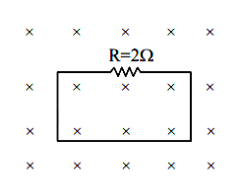
Options: (Numerical type question; no options provided in the source).
Correct Answer: 60.
Year: 27 Jul 2021 Shift 2.
Solution: $|\bar{E}| = \frac{d\Phi}{dt} = 20t + 20\text{ mV}$. $|i| = \frac{|\bar{E}|}{R} = 10t + 10\text{ mA}$. At $t = 5$, $|i| = 60\text{ mA}$.
Step Solution:
1. Differentiate Flux to find EMF ($\varepsilon$): Since $\Phi$ is in mWb, the derivative will be in mV. $\varepsilon = \frac{d}{dt}(10t^2 + 20t) = 20t + 20\text{ mV}$.
2. Calculate EMF at $t = 5 s$: $\varepsilon = 20(5) + 20 = 100 + 20 = 120\text{ mV}$.
3. Apply Ohm's Law: Current $i = \frac{\varepsilon}{R}$.
4. Substitute Resistance ($R = 2\Omega$): $i = \frac{120\text{ mV}}{2\Omega}$.
5. Final Calculation: $i = 60\text{ mA}$.
Difficulty Level: Easy
Concept Name: Faraday’s Law of Induction / Ohm's Law
Short cut solution: $i = \frac{\Phi'(t)}{R} = \frac{20t + 20}{2} = 10t + 10$. For $t=5$, $i = 10(5) + 10 = 60\text{ mA}$.
Question 70
Question: At time $t = 0$ magnetic field of 1000 Gauss is passing perpendicularly through the area defined by the closed loop shown in the figure. If the magnetic field reduces linearly to 500 Gauss, in the next 5 s, then induced EMF in the loop is: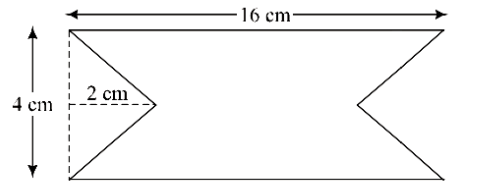
Options:
A. $56 \mu V$
B. $28 \mu V$
C. $48 \mu V$
D. $36 \mu V$
Correct Answer: Option A
Year: NA 8 Jan. 2020 I
Solution (as given in source): $\Delta B = 1000 - 500 = 500 \text{ Gauss} = 500 \times 10^{-4} T$. Time $dt = 5 s$. $\frac{dB}{dt} = \frac{1000 - 500}{5} \times 10^{-4} = 10^{-2} T/sec$. Area $A = (16 \times 4 - 2 \times \text{Area of triangle}) cm^2 = (64 - 2 \times \frac{1}{2} \times 2 \times 4) cm^2 = 56 \times 10^{-4} m^2$. $\varepsilon_{induced} = |A \frac{dB}{dt}| = 56 \times 10^{-4} \times 10^{-2} = 56 \times 10^{-6} V = 56 \mu V$.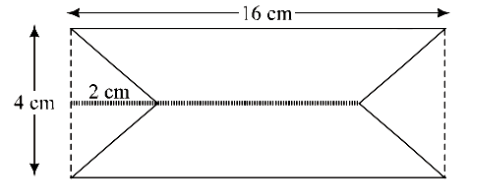
Step Solution:
1. Calculate the Rate of Change of Magnetic Field ($\frac{dB}{dt}$): Convert Gauss to Tesla ($1 G = 10^{-4} T$). $\frac{dB}{dt} = \frac{(1000 - 500) \times 10^{-4} T}{5 s} = 10^{-2} T/s$.
2. Determine the Loop Area ($A$): The total rectangular area ($16 \times 4 = 64 cm^2$) minus the area of the two missing triangles ($2 \times \frac{1}{2} \times 2 \times 4 = 8 cm^2$). $A = 64 - 8 = 56 cm^2$.
3. Convert Area to SI Units: $A = 56 \times (10^{-2} m)^2 = 56 \times 10^{-4} m^2$.
4. Apply Faraday's Law: Induced EMF $\varepsilon = A \cdot \frac{dB}{dt}$.
5. Final Calculation: $\varepsilon = (56 \times 10^{-4}) \times (10^{-2}) = 56 \times 10^{-6} V = 56 \mu V$.
Difficulty Level: Easy
Concept Name: Faraday’s Law of Induction
Short cut solution: $\varepsilon = (\text{Area}) \times (\text{Slope of B-t graph}) = (56 \times 10^{-4}) \times 10^{-2} = 56 \mu V$.
Question 72
Question: A long solenoid of radius $R$ carries a time (t) - dependent current $I(t) = I_0 t(1 - t)$. A ring of radius 2R is placed coaxially near its middle. During the time interval $0 \leq t \leq 1$, the induced current ($I_R$) and the induced EMF ($V_R$) in the ring change as:
Options:
A. Direction of $I_R$ remains unchanged and $V_R$ is maximum at $t = 0.5$
B. At $t = 0.25$ direction of $I_R$ reverses and $V_R$ is maximum
C. Direction of $I_R$ remains unchanged and $V_R$ is zero at $t = 0.25$
D. At $t = 0.5$ direction of $I_R$ reverses and $V_R$ is zero
Correct Answer: Option D
Year: 7 Jan. 2020 I
Solution (as given in source): $I(t) = I_0 (t - t^2)$. $\phi = B \cdot A = (\mu_0 n I) \cdot (\pi R^2)$. $V_R = -\frac{d\phi}{dt} = \mu_0 n \pi R^2 (I_0 - 2I_0 t)$. $V_R = 0$ at $t = 1/2 s$.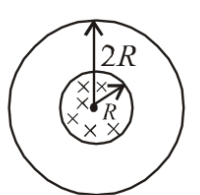 ;
;
Step Solution:
1. Define Flux ($\phi$): The magnetic field $B$ is only non-zero inside the solenoid ($radius = R$). Thus, the flux linked with the outer ring is $\phi = B \times (\pi R^2) = \mu_0 n I(t) \pi R^2$.
2. Express Flux as a Function of Time: Substitute $I(t) = I_0(t - t^2)$ into the flux equation: $\phi(t) = (\mu_0 n \pi R^2 I_0)(t - t^2)$.
3. Find Induced EMF ($V_R$): $V_R = -\frac{d\phi}{dt} = -(\mu_0 n \pi R^2 I_0) \frac{d}{dt}(t - t^2) = -(\mu_0 n \pi R^2 I_0)(1 - 2t)$.
4. Identify Zero EMF Point: Set $V_R = 0$: $1 - 2t = 0 \Rightarrow t = 0.5 s$. At this instant, the EMF is zero.
5. Determine Current Reversal: Because the expression $(1 - 2t)$ changes from positive to negative at $t = 0.5$, the polarity of the EMF and the direction of the induced current $I_R$ reverse at that point.
Difficulty Level: Medium
Concept Name: Power Rule / Faraday's Law
Short cut solution: $V_R \propto \frac{dI}{dt}$. Since $I = t - t^2$, its derivative is $1 - 2t$. This is zero and changes sign at $t = 0.5$.
Question 78
Question: A uniform magnetic field $B$ exists in a direction perpendicular to the plane of a square loop made of a metal wire. The wire has a diameter of 4 mm and a total length of 30 cm. The magnetic field changes with time at a steady rate $dB/dt = 0.032 T s^{-1}$. The induced current in the loop is close to (Resistivity of the metal wire is $1.23 \times 10^{-8} \Omega m$):
Options:
A. 0.43 A
B. 0.61 A
C. 0.34 A
D. 0.53 A
Correct Answer: Option B
Year: Sep. 03, 2020 (II)
Solution (as given in source): $l = 30 cm$, wire radius $r = 2 mm$, $\rho = 1.23 \times 10^{-8} \Omega m$. $|e| = \frac{dB}{dt}(A)$. $i = e/R$. $R = \rho l / A_{wire}$. $i = |\frac{dB}{dt}| \frac{(A)^2}{\rho l} = \frac{0.032 \times \{\pi \times 2 \times 10^{-3}\}^2}{1.23 \times 10^{-8} \times 0.3} = 0.61 A$. (Note: The source text contains minor notation errors but follows this logic).
Step Solution:
1. Find Loop Dimensions: The total wire length is $30 cm = 0.3 m$. For a square loop, the side is $s = 0.3 / 4 = 0.075 m$. The loop area is $A_{loop} = (0.075)^2 = 5.625 \times 10^{-3} m^2$.
2. Calculate Induced EMF ($\varepsilon$): $\varepsilon = A_{loop} \times \frac{dB}{dt} = (5.625 \times 10^{-3}) \times 0.032 = 1.8 \times 10^{-4} V$.
3. Calculate Wire Cross-section Area ($a$): Wire diameter $= 4 mm \Rightarrow radius = 2 \times 10^{-3} m$. $a = \pi r^2 = \pi \times (2 \times 10^{-3})^2 \approx 1.257 \times 10^{-5} m^2$.
4. Calculate Resistance ($R$): $R = \rho \frac{L}{a} = \frac{1.23 \times 10^{-8} \times 0.3}{1.257 \times 10^{-5}} \approx 2.936 \times 10^{-4} \Omega$.
5. Calculate Current ($i$): $i = \frac{\varepsilon}{R} = \frac{1.8 \times 10^{-4}}{2.936 \times 10^{-4}} \approx 0.613 A$.
Difficulty Level: Hard
Concept Name: Faraday's Law / Resistance Formula
Short cut solution: $i = \frac{dB}{dt} \frac{L \cdot a}{16 \rho}$. Substituting values: $0.032 \times \frac{0.3 \times (\pi \times 4 \times 10^{-6})}{16 \times 1.23 \times 10^{-8}} \approx 0.61 A$.
Question 86
Question: A conducting circular loop made of a thin wire, has area $3.5 \times 10^{-3} \text{ m}^2$ and resistance $10\Omega$. It is placed perpendicular to a time dependent magnetic field $B(t) = (0.4T) \sin (50\pi t)$. The net charge flowing through the loop during $t = 0$ s and $t = 10$ ms is close to:
Options:
A. 14 mC
B. 7 mC
C. 21 mC
D. [Bonus]
Correct Answer: Option D
Year: 9 Jan. 2019 I
Solution: Net charge $Q = \frac{\Delta \phi}{R} = \frac{1}{10} A(B_f - B_i) = \frac{1}{10} \times 3.5 \times 10^{-3} (0.4 \sin \frac{\pi}{2} - 0) = 1.4 \times 10^{-4}$. No option matches, so it should be a bonus.
Step Solution:
1. Identify Time Interval: $t_{initial} = 0\text{ s}$ and $t_{final} = 10\text{ ms} = 0.01\text{ s}$.
2. Calculate Initial Flux ($\Phi_i$): $B(0) = 0.4 \sin(0) = 0$. Since $\Phi = B \cdot A$, $\Phi_i = 0$.
3. Calculate Final Flux ($\Phi_f$): $B(0.01) = 0.4 \sin(50\pi \times 0.01) = 0.4 \sin(\pi/2) = 0.4\text{ T}$. Thus, $\Phi_f = 0.4 \times (3.5 \times 10^{-3}) = 1.4 \times 10^{-3}\text{ Wb}$.
4. Find Change in Flux ($\Delta \Phi$): $\Delta \Phi = \Phi_f - \Phi_i = 1.4 \times 10^{-3} - 0 = 1.4 \times 10^{-3}\text{ Wb}$.
5. Calculate Induced Charge ($Q$): $Q = \frac{\Delta \Phi}{R} = \frac{1.4 \times 10^{-3}}{10} = 1.4 \times 10^{-4}\text{ C}$.
Difficulty Level: Medium
Concept Name: Induced Charge Flow / Faraday's Law
Short cut solution: $Q = \frac{A \cdot \Delta B}{R} = \frac{3.5 \times 10^{-3} \times (0.4 \sin(50\pi \times 0.01) - 0)}{10} = 1.4 \times 10^{-4}\text{ C}$.
Question 97
Question: In a coil of resistance $100 \Omega$, a current is induced by changing the magnetic flux through it as shown in the figure. The magnitude of change in flux through the coil is: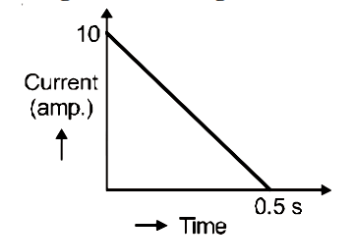
Options:
A. 250 Wb
B. 275 Wb
C. 200 Wb
D. 225 Wb
Correct Answer: Option A
Year: 2017
Solution: According to Faraday's law, $\varepsilon = \frac{d\phi}{dt}$ and $\varepsilon = iR$. Therefore, $\int d\phi = R \int i dt$. Magnitude of change in flux $(d\phi) = R \times$ area under current vs time graph. $d\phi = 100 \times \frac{1}{2} \times 0.5 \times 10 = 250\text{ Wb}$.
Step Solution:
1. State Relationship: Using Faraday's Law ($e = d\Phi/dt$) and Ohm's Law ($e = iR$), we get $d\Phi = R \cdot i dt$.
2. Integrate: Integrating both sides over time gives $\Delta \Phi = R \int i dt$.
3. Find Area under Graph: The integral $\int i dt$ is the area of the triangle in the current-time graph.
4. Calculate Area: Area $= \frac{1}{2} \times \text{base} \times \text{height} = \frac{1}{2} \times 0.5\text{ s} \times 10\text{ A} = 2.5\text{ A}\cdot\text{s}$.
5. Final Flux Calculation: $\Delta \Phi = 100 \Omega \times 2.5\text{ A}\cdot\text{s} = 250\text{ Wb}$.
Difficulty Level: Easy
Concept Name: Faraday's Law / Graphical Integration
Short cut solution: $\Delta \Phi = R \times (\text{Area of } i\text{-}t \text{ graph}) = 100 \times (0.5 \times 10 \times 0.5) = 250\text{ Wb}$.
Question 101
Question: A coil of circular cross-section having 1000 turns and $4 \text{ cm}^2$ face area is placed with its axis parallel to a magnetic field which decreases by $10^{-2} \text{ Wb m}^{-2}$ in 0.01 s. The e.m.f. induced in the coil is:
Options:
A. 400 mV
B. 200 mV
C. 4 mV
D. 0.4 mV
Correct Answer: Option A
Year: Online April 11, 2014
Solution: Induced emf, $e = \frac{-d\Phi}{dt} = N \left(\frac{\Delta B}{\Delta t}\right) A \cos \theta$. Given $N = 1000$, $\Delta B = 10^{-2}\text{ T}$, $\Delta t = 10^{-2}\text{ s}$, $A = 4 \times 10^{-4}\text{ m}^2$. $e = \frac{1000 \times 10^{-2} \times 4 \times 10^{-4}}{10^{-2}} = 400\text{ mV}$.
Step Solution:
1. Identify Constants: $N = 1000$ and $A = 4 \text{ cm}^2 = 4 \times 10^{-4} \text{ m}^2$.
2. Determine Field Change Rate: Change in field $\Delta B = 10^{-2} \text{ T}$ and time $\Delta t = 0.01 \text{ s}$. Rate $= \frac{10^{-2}}{10^{-2}} = 1 \text{ T/s}$.
3. Establish Geometry: The axis is parallel to the field, so $\theta = 0^\circ$ and $\cos(0^\circ) = 1$.
4. Apply Induction Formula: $\varepsilon = N \cdot A \cdot \left(\frac{\Delta B}{\Delta t}\right)$.
5. Final Calculation: $\varepsilon = 1000 \times (4 \times 10^{-4}) \times 1 = 0.4 \text{ V} = 400 \text{ mV}$.
Difficulty Level: Easy
Concept Name: Faraday’s Law of Induction
Short cut solution: $\varepsilon = N \cdot A \cdot (\text{Rate of change of } B) = 1000 \times (4 \times 10^{-4}) \times (0.01/0.01) = 0.4\text{ V} = 400\text{ mV}$.
Question 104
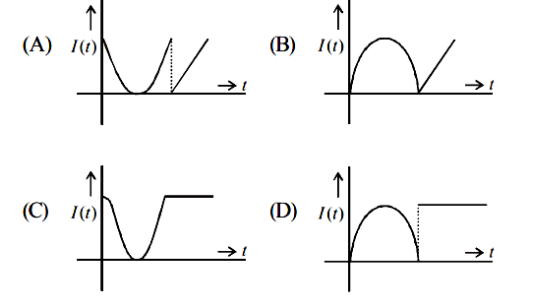
Question: Two coils, X and Y, are kept in close vicinity of each other. When a varying current, $I(t)$, flows through coil X, the induced emf $V(t)$ in coil Y, varies in the manner shown here. The variation of $I(t)$, with time, can then be represented by the graph labelled as graph: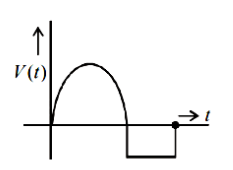 ;
;
Options:
A. A
B. C
C. B
D. D
Correct Answer: Option A
Year: Online April 9, 2013
Solution: Induced emf $\varepsilon \propto -\frac{di}{dt}$.
Step Solution:
1. Identify Relationship: The induced EMF in the second coil is proportional to the negative rate of change of current in the first coil: $\varepsilon = -M \frac{dI}{dt}$.
2. Analyze Graph Properties: If the EMF is constant over an interval, the current $I(t)$ must change at a constant rate (linear slope).
3. Determine Slope Sign: According to the formula, a positive constant EMF implies a constant negative slope for the current graph ($\frac{dI}{dt} < 0$).
4. Analyze Zero EMF: When the EMF is zero, the rate of change of current $\frac{dI}{dt}$ must be zero, meaning the current is constant.
5. Match with Options: Graph A correctly represents these piecewise linear relationships where the slopes correspond to the step-like changes in the EMF graph.
Difficulty Level: Medium
Concept Name: Faraday’s Law of Induction / Mutual Inductance
Short cut solution: $\varepsilon$ is proportional to the negative slope of the $I(t)$ graph. Select the current graph whose slopes match the polarity and duration of the EMF pulses.
Question 107
Question: Magnetic flux through a coil of resistance $10\Omega$ is changed by $\Delta \phi$ in $0.1\text{ s}$. The resulting current in the coil varies with time as shown in the figure. Then $|\Delta \phi|$ is equal to (in weber):
Options:
A. 6
B. 4
C. 2
D. 8
Correct Answer: Option C
Year: Online May 12, 2012
Solution: As $e = \frac{\Delta \Phi}{\Delta t}$ or $Ri = \frac{\Delta \phi}{\Delta t}$ ($\because e = Ri$) $\Rightarrow \Delta \phi = R(i \cdot \Delta t) = R \times \text{area under } i-t \text{ graph} = 10 \times \frac{1}{2} \times 4 \times 0.1 = 2$ weber.
Step Solution:
1. State the Core Principle: Induced EMF is $\varepsilon = \frac{d\Phi}{dt}$. By Ohm's Law, $\varepsilon = iR$. Thus, $\frac{d\Phi}{dt} = iR$.
2. Rearrange for Flux: The change in flux is $d\Phi = R \cdot i \cdot dt$.
3. Integrate over Time: Integrating gives the total change in flux: $\Delta \Phi = R \int i \, dt$.
4. Find Area under the Graph: The integral $\int i \, dt$ is the area of the triangle in the $i-t$ graph. Based on the solution values, Area $= \frac{1}{2} \times \text{base} \times \text{height} = \frac{1}{2} \times 0.1 \times 4 = 0.2\text{ A}\cdot\text{s}$.
5. Final Calculation: $\Delta \Phi = 10 \, \Omega \times 0.2\text{ A}\cdot\text{s} = 2\text{ Wb}$.
Difficulty Level: Easy
Concept Name: Faraday's Law / Graphical Integration
Short cut solution: $\Delta \Phi = R \times (\text{Area of } i\text{-}t \text{ graph}) = 10 \times (0.5 \times 4 \times 0.1) = 2$ Wb.
Question 114
Question: The flux linked with a coil at any instant 't' is given by $\Phi = 10t^2 - 50t + 250$. The induced emf at $t = 3\text{ s}$ is:
Options:
A. $-190\text{V}$
B. $-10\text{V}$
C. $10\text{V}$
D. $190\text{V}$
Correct Answer: Option B
Year: 2006
Solution: Electric flux, $\phi = 10t^2 - 50t + 250$. Induced emf, $e = -\frac{d\Phi}{dt} = -(20t - 50)$.
Step Solution:
1. Apply Faraday's Law: The induced EMF is the negative time derivative of magnetic flux: $\varepsilon = -\frac{d\Phi}{dt}$.
2. Differentiate Flux Equation: $\frac{d}{dt}(10t^2 - 50t + 250) = 20t - 50$.
3. Evaluate at Given Time: For $t = 3\text{ s}$, the derivative is $20(3) - 50 = 60 - 50 = 10$.
4. Substitute into EMF Formula: $\varepsilon = -(20t - 50)$.
5. Final Calculation: $\varepsilon = -(10) = -10\text{ V}$.
Difficulty Level: Easy
Concept Name: Faraday’s Law of Induction / Power Rule of Differentiation
Short cut solution: $\varepsilon = -\Phi'(3) = -(20 \times 3 - 50) = -10\text{ V}$.
Question 117
Question: A coil having $n$ turns and resistance $R\Omega$ is connected with a galvanometer of resistance $4R\Omega$. This combination is moved in time $t$ seconds from a magnetic field $W_1$ weber to $W_2$ weber. The induced current in the circuit is:
Options:
A. $-(W_2 - W_1)$
B. $-\frac{n(W_2 - W_1)}{5Rt}$
C. $\frac{(W_2 - W_1)}{5Rnt}$
D. $-\frac{n(W_2 - W_1)}{Rt}$
Correct Answer: Option B
Year: 2004
Solution: $\frac{\Delta \phi}{\Delta t} = \frac{(W_2 - W_1)}{t}$. $R_{tot} = (R + 4R)\Omega = 5R\Omega$. $i = \frac{n \cdot d\phi}{R_{tot} \cdot dt} = \frac{-n(W_2 - W_1)}{5Rt}$.
Step Solution:
1. Calculate Total Resistance ($R_{net}$): The coil ($R$) and galvanometer ($4R$) are in series: $R_{net} = R + 4R = 5R$.
2. Find Rate of Flux Change: The change in flux per turn is $\Delta \Phi = W_2 - W_1$, so the rate is $\frac{W_2 - W_1}{t}$.
3. Apply Faraday's Law for $n$ Turns: Total induced EMF $e = -n \frac{\Delta \Phi}{t} = -n \frac{(W_2 - W_1)}{t}$.
4. Apply Ohm's Law for Current: Induced current $i = \frac{e}{R_{net}}$.
5. Final Expression: $i = \frac{-n(W_2 - W_1)}{5R \cdot t} = -\frac{n(W_2 - W_1)}{5Rt}$.
Difficulty Level: Easy
Concept Name: Faraday’s Law / Ohm's Law in Series Circuits
Short cut solution: $i = \frac{\text{Net EMF}}{\text{Net Resistance}} = \frac{-n \cdot (\Delta \Phi / t)}{5R} = -\frac{n(W_2 - W_1)}{5Rt}$.