Question 1
Question: The net current flowing in the given circuit is \_\_\_ A.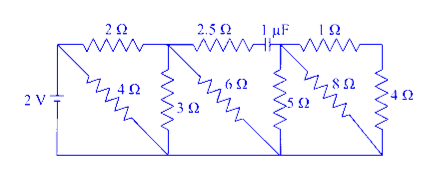
Options: (Numerical entry Question; options not provided)
Correct Answer: 1
Year: JEE Main 2025 (Online) 22nd January Evening Shift
Solution: 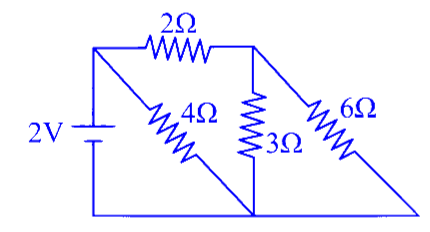
$$\begin{array} { l } { \displaystyle \mathrm { R _ { e q } } = 2 \Omega } \\ { \displaystyle \mathrm { I } = \frac { 2 } { 2 } = 1 \mathrm { ~ A ~ } } \end{array}$$
Step Solution:
1. Identify Equivalent Resistance ($R_{eq}$): Based on the circuit configuration shown in the source, $R_{eq}$ is determined to be $2 \Omega$.
2. Apply Ohm's Law: Use the formula $I = \frac{V}{R_{eq}}$.
3. Substitute Values: From the solution, the applied voltage $V$ is $2 V$ and $R_{eq}$ is $2 \Omega$.
4. Calculate Net Current: $I = \frac{2}{2} = 1 A$.
Difficulty Level: Easy
Concept Name: Ohm’s Law and Equivalent Resistance
Short cut solution: Direct calculation using $I = V / R$ once the equivalent resistance of the network is identified.
Question 18
Question: Current passing through a wire as function of time is given as $I ( t ) = 0.02 t + 0.01 A$. The charge that will flow through the wire from $t = 1$ s to $t = 2$ s is:
Options:
A. 0.02 C
B. 0.07 C
C. 0.06 C
D. 0.04 C
Correct Answer: D
Year: JEE Main 2025 (Online) 4th April Morning Shift
Solution:
The formula for the charge $q$ is the integral of current with respect to time: $\textstyle q = \int I ( t ) d t$.
Integrating from $t=1$ to $t=2$: $q = \int _ { 1 } ^ { 2 } ( 0.02 t + 0.01 ) d t = \left[ 0.01 t^2 + 0.01 t \right]_1^2$.
Evaluating at bounds: $(0.01(2)^2 + 0.01(2)) - (0.01(1)^2 + 0.01(1)) = 0.06 - 0.02 = 0.04 C$.
Step Solution:
1. Formula Setup: Recall $q = \int I(t) dt$.
2. Define Integral: Set limits from $t=1$ to $t=2$: $q = \int_1^2 (0.02t + 0.01) dt$.
3. Find Antiderivative: $q = [ 0.02 \frac{t^2}{2} + 0.01t ]_1^2 = [ 0.01t^2 + 0.01t ]_1^2$.
4. Plug in Values: Subtract lower bound result from upper: $(0.04 + 0.02) - (0.01 + 0.01)$.
5. Final Calculation: $0.06 - 0.02 = 0.04 C$.
Difficulty Level: Medium
Concept Name: Calculus in Current Electricity (Integration of Current)
Short cut solution: Since the current is a linear function, the charge can be calculated using the average current:
$I_{avg} = I(1.5 s) = 0.02(1.5) + 0.01 = 0.04 A$.
Total charge $Q = I_{avg} \times \Delta t = 0.04 A \times 1 s = 0.04 C$.
Question 27
Question: The electric current through a wire varies with time as $I = I_0 + \beta t$, where $I_0 = 20 A$ and $\beta = 3 A/s$. The amount of electric charge crossed through a section of the wire in 20 s is:
Options:
A. 80 C
B. 1000 C
C. 800 C
D. 1200 C
Correct Answer: B
Year: JEE Main 2024 (Online) 29th January Shift 1
Solution:
Current $I = 20 + 3t$.
Integrating current to find charge: $q = \int_0^{20} (20 + 3t) dt$.
$q = [20t + \frac{3}{2}t^2]_0^{20} = (20 \times 20 + 1.5 \times 400) = 400 + 600 = 1000 C$.
Step Solution:
1. Expression for Current: $I = 20 + 3t$.
2. Integration Relationship: Charge $q$ is the integral $\int I dt$.
3. Perform Integration: $\int_0^{20} (20 + 3t) dt = [20t + 1.5t^2]_0^{20}$.
4. Evaluate Limits: Substitute $t=20$ into the integrated expression.
5. Final Addition: $400 + 600 = 1000 C$.
Difficulty Level: Medium
Concept Name: Relation between Current and Charge (Temporal variation)
Short cut solution: The charge is the area under the I-t graph. This forms a trapezoid from $t=0$ to $t=20$.
$I(0) = 20 A$, $I(20) = 20 + 3(20) = 80 A$.
Area $= \frac{1}{2} \times (\text{sum of parallel sides}) \times \text{time interval} = \frac{1}{2} \times (20 + 80) \times 20 = 50 \times 20 = 1000 C$.
Question 42
Question: The current in a conductor is expressed as $I = 3t^2 + 4t^3$, where $I$ is in Ampere and $t$ is in second. The amount of electric charge that flows through a section of the conductor during $t = 1$ s to $t = 2$ s is \_\_\_C.
Options: (Numerical entry Question; no options provided in the sources)
Correct Answer: 22
Year: JEE Main 1-Feb-2024 Shift 1
Solution:
$\begin{array} { l } { { \displaystyle q = \int _ { 1 } ^ { 2 } i \mathrm { d } { \mathbf { t } } = \int _ { 1 } ^ { 2 } ( 3 t ^ { 2 } + 4 t ^ { 3 } ) \mathrm { d } { \mathbf { t } } } } \\ { \textstyle q = ( t ^ { 3 } + t ^ { 4 } ) _ { 1 } ^ { 2 } = 2 2 C } \end{array}$
Step Solution:
1. Fundamental Relation: Recall that charge is the integral of current: $q = \int I dt$.
2. Setup Integral: Use the given function and time limits: $q = \int_1^2 (3t^2 + 4t^3) dt$.
3. Integrate: Find the antiderivative: $[ \frac{3t^3}{3} + \frac{4t^4}{4} ] = [t^3 + t^4]_1^2$.
4. Evaluate at Limits: Plug in $t=2$ and $t=1$: $(2^3 + 2^4) - (1^3 + 1^4) = (8 + 16) - (1 + 1)$.
5. Final Calculation: $24 - 2 = 22 C$.
Difficulty Level: Medium
Concept Name: Calculus in Current Electricity (Integration of Current)
Short cut solution: No significant shortcut available for polynomial integration; direct integration is the standard method.
Question 56
Question: The charge flowing in a conductor changes with time as $Q(t) = at - \beta t^2 + \gamma t^3$. Where $a, \beta$ and $\gamma$ are constants. Minimum value of current is:
Options:
A. $\alpha - 3\beta^2$
B. $\alpha - \frac{\gamma^2}{3\beta}$
C. $\beta - \frac{\alpha^2}{3\gamma}$
D. $a - \frac{\beta^2}{3\gamma}$
Correct Answer: D
Year: JEE Main 30-Jan-2023 Shift 1
Solution:
$i = \frac{dQ}{dt} = (a - 2\beta t + 3\gamma t^2)$. For minimum, $\frac{di}{dt} = (3\gamma t - 2\beta) = 0 \Rightarrow t = \frac{\beta}{3\gamma}$. Substituting $t$ back: $i = a - \frac{\beta^2}{3\gamma}$.
Step Solution:
1. Differentiate Charge: Find current $I$ as $I = \frac{dQ}{dt} = a - 2\beta t + 3\gamma t^2$.
2. Find Critical Time: To minimize current, set its derivative to zero: $\frac{dI}{dt} = -2\beta + 6\gamma t = 0$.
3. Solve for $t$: $t = \frac{2\beta}{6\gamma} = \frac{\beta}{3\gamma}$.
4. Verify Minimum: Since $\frac{d^2I}{dt^2} = 6\gamma$ (positive constant), $t = \frac{\beta}{3\gamma}$ yields a minimum.
5. Calculate $I_{min}$: Substitute $t$ into the $I$ expression: $a - 2\beta(\frac{\beta}{3\gamma}) + 3\gamma(\frac{\beta}{3\gamma})^2 = a - \frac{2\beta^2}{3\gamma} + \frac{\beta^2}{3\gamma} = a - \frac{\beta^2}{3\gamma}$.
Difficulty Level: Hard
Concept Name: Maxima and Minima in Calculus
Short cut solution: The current is a quadratic equation in the form $At^2 + Bt + C$. Its minimum value is given by the formula $C - \frac{B^2}{4A}$. Here, $A = 3\gamma, B = -2\beta, C = a$.
$\text{Minimum} = a - \frac{(-2\beta)^2}{4(3\gamma)} = a - \frac{4\beta^2}{12\gamma} = a - \frac{\beta^2}{3\gamma}$.
Question 60
Question: The drift velocity of electrons for a conductor connected in an electrical circuit is $V_d$. The conductor in now replaced by another conductor with same material and same length but double the area of cross section. The applied voltage remains same. The new drift velocity of electrons will be:
Options:
A. $V_d$
B. $\frac{V_d}{2}$
C. $\frac{V_d}{4}$
D. $2V_d$
Correct Answer: A
Year: JEE Main 31-Jan-2023 Shift 1
Solution:
$V_d = \frac{eE}{m}\tau$, that is independent of area.
Step Solution:
1. Formula for $v_d$: Recall drift velocity $v_d = \frac{eE\tau}{m}$.
2. Express $E$: Relate electric field to applied voltage $V$ and length $L$: $E = \frac{V}{L}$.
3. Combine Formulas: Substitute $E$ into $v_d$ formula: $v_d = \frac{eV\tau}{mL}$.
4. Analyze Parameters: The material is the same ($\tau, m, e$ are constant), length $L$ is same, and voltage $V$ is same.
5. Conclusion: Since none of the factors in the final formula changed, the drift velocity remains $V_d$, independent of the area.
Difficulty Level: Easy
Concept Name: Factors affecting Drift Velocity
Short cut solution: Use $v_d = \frac{I}{neA}$. Substitute $I = \frac{V}{R}$ and $R = \frac{\rho L}{A}$.
$v_d = \frac{V/(\rho L/A)}{neA} = \frac{VA/\rho L}{neA} = \frac{V}{ne\rho L}$. Notice that Area ($A$) cancels out, meaning area changes do not affect $v_d$ if voltage and length are fixed.
Question 73
Question: A current of 2A through a wire of cross-sectional area $25.0\text{ mm}^2$. The number of free electrons in a cubic meter are $2.0 \times 10^{28}$. The drift velocity of the electrons is \_\_\_ $\times 10^{-6}\text{ m s}^{-1}$ (given, charge on electron $e = 1.6 \times 10^{-19}\text{ C}$).
Options: (Numerical entry Question; options not provided)
Correct Answer: 25
Year: JEE Main 8-Apr-2023 Shift 1
Solution:
$I = neAV_d$
$V_d = \frac{I}{neA} \Rightarrow V_d = \frac{2}{2 \times 10^{28} \times 1.6 \times 10^{-19} \times 25 \times 10^{-6}}$
$V_d = 25\text{ m/s}$ (Note: The solution indicates the value of the multiplier $x$ for the $10^{-6}$ factor is 25).
Step Solution:
1. Formula Setup: Use the relationship $I = neAv_d$.
2. Identify Given Values: $I = 2\text{ A}$, $n = 2.0 \times 10^{28}\text{ m}^{-3}$, $A = 25 \times 10^{-6}\text{ m}^2$, $e = 1.6 \times 10^{-19}\text{ C}$.
3. Rearrange for $v_d$: $v_d = \frac{I}{neA}$.
4. Substitute and Calculate Denominator: $(2 \times 10^{28}) \times (1.6 \times 10^{-19}) \times (25 \times 10^{-6}) = 80 \times 10^3$.
5. Final Result: $v_d = \frac{2}{80 \times 10^3} = 0.025 \times 10^{-3} = 25 \times 10^{-6}\text{ m/s}$. Thus, the answer is 25.
Difficulty Level: Easy
Concept Name: Drift Velocity Formula
Short cut solution: Directly substitute into $v_d = \frac{I}{neA}$ and track exponents carefully.
Question 75
Question: The number density of free electrons in copper is nearly $8 \times 10^{28}\text{ m}^{-3}$. A copper wire has its area of cross section $A = 2 \times 10^{-6}\text{ m}^2$ and is carrying a current of 3.2A. The drift speed $\times 10^{-6}\text{ ms}^{-1}$ of the electrons is \_\_\_.
Options: (Numerical entry Question; options not provided)
Correct Answer: 125
Year: JEE Main 8-Apr-2023 Shift 2
Solution:
$3.2 = 8 \times 10^{28} \times 1.6 \times 10^{-19} \times 2 \times 10^{-6} (v_d)$
$v_d = \frac{1}{8 \times 10^{-6} \times 10^9}$
$v_d = 125 \times 10^{-6}\text{ m/s}$
Step Solution:
1. Formula Recall: Use $I = neAv_d$.
2. Substitute Values: $3.2 = (8 \times 10^{28}) \times (1.6 \times 10^{-19}) \times (2 \times 10^{-6}) \times v_d$.
3. Combine Terms: $3.2 = (8 \times 1.6 \times 2) \times (10^{28-19-6}) \times v_d = 25.6 \times 10^3 \times v_d$.
4. Solve for $v_d$: $v_d = \frac{3.2}{25.6 \times 10^3} = \frac{1}{8 \times 10^3}$.
5. Final Answer: $v_d = 0.125 \times 10^{-3} = 125 \times 10^{-6}\text{ m/s}$. The required value is 125.
Difficulty Level: Easy
Concept Name: Drift Velocity Formula
Short cut solution: Standard calculation via $v_d = \frac{I}{neA}$.
Question 78
Question: In a metallic conductor, under the effect of applied electric field, the free electrons of the conductor:
Options:
A. Move with the uniform velocity throughout from lower potential to higher potential
B. Move in the curved paths from lower potential to higher potential
C. Move in the straight line paths in the same direction
D. Drift from higher potential to lower potential.
Correct Answer: B
Year: JEE Main 10-Apr-2023 Shift 2
Solution: 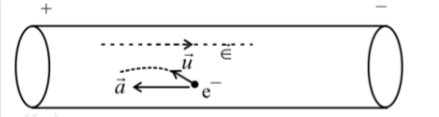
Electrons moves in curved path because there velocity $\vec{u}$ may make any angle $\theta$ with acceleration $\vec{a}$ between time interval of two successive collisions. Also electron moves from lower potential to higher potential.
Step Solution:
1. Analyze Acceleration: An electric field creates acceleration $\vec{a}$ for electrons.
2. Consider Initial Velocity: Electrons already have random thermal velocity $\vec{u}$ before the field is applied.
3. Determine Path Geometry: Because the acceleration vector and initial velocity vector typically make an angle, the motion between collisions follows a parabolic (curved) trajectory.
4. Check Direction: Electrons move from lower potential to higher potential due to their negative charge.
5. Synthesize Findings: The overall motion is a drift in curved paths toward higher potential.
Difficulty Level: Medium
Concept Name: Microscopic Model of Electron Motion
Short cut solution: Remember that random thermal motion combined with constant field acceleration always results in curved trajectories between collisions, and negative charges always seek higher potential.
Question 94
Question: The current density in a cylindrical wire of radius 4 mm is $4 \times 10^6 \text{ Am}^{-2}$. The current through the outer portion of the wire between radial distances $R/2$ and $R$ is \_\_\_ $\pi$A.
Options: (Numerical entry Question)
Correct Answer: 48
Year: JEE Main 2022, 27th June Shift 1
Solution:
$i = A \times j = \pi \left( R^2 - \frac{R^2}{4} \right) j = \frac{3\pi R^2}{4} \times j = \frac{3\pi \times (4 \times 10^{-3})^2}{4} \times 4 \times 10^6 = 48\pi$
Step Solution:
1. Identify Area of Interest: The region between $r = R/2$ and $r = R$ is an annular ring.
2. Calculate Ring Area: $A = \pi R^2 - \pi (R/2)^2 = \pi R^2 - \pi R^2/4 = \frac{3}{4}\pi R^2$.
3. Insert Given Values: $R = 4 \times 10^{-3} \text{ m}$ and current density $j = 4 \times 10^6 \text{ A/m}^2$.
4. Compute current ($I$): $I = j \times A = (4 \times 10^6) \times \left( \frac{3}{4}\pi (4 \times 10^{-3})^2 \right)$.
5. Final Calculation: $I = (4 \times 10^6) \times (\frac{3}{4}\pi \times 16 \times 10^{-6}) = 48\pi$. The value is 48.
Difficulty Level: Medium
Concept Name: Current Density and Geometric Cross-section
Short cut solution: The area of the outer portion (from $R/2$ to $R$) is always 75% of the total area. $I = 0.75 \times (\text{Total Area}) \times j$. Total area current would be $(\pi \cdot 16 \cdot 10^{-6}) \times (4 \cdot 10^6) = 64\pi$. Thus, $0.75 \times 64\pi = 48\pi$.
Question 95
Question: The current density in a cylindrical wire of radius $r = 4.0$ mm is $1.0 \times 10^6 \text{ A/m}^2$. The current through the outer portion of the wire between radial distances $r/2$ and $r$ is $x\pi$A; where $x$ is:
Options: (Numerical entry Question)
Correct Answer: 12
Year: JEE Main 2022, 27th June Shift 2
Solution:
$i = A \times j = \pi(R^2 - R^2/4)j = \frac{3\pi R^2}{4} \times j = \frac{3\pi \times (4 \times 10^{-3})^2}{4} \times 1.0 \times 10^6 = 12\pi$
Step Solution:
1. Define Area: Area $A = \frac{3}{4}\pi r^2$.
2. Plug in Radius: $r = 4 \times 10^{-3} \text{ m}$.
3. Calculate Area Value: $A = \frac{3}{4}\pi (16 \times 10^{-6}) = 12\pi \times 10^{-6} \text{ m}^2$.
4. Use Current Formula: $I = j \times A$.
5. Solve for $I$: $I = (1.0 \times 10^6) \times (12\pi \times 10^{-6}) = 12\pi$. Therefore, $x = 12$.
Difficulty Level: Medium
Concept Name: Current Density
Short cut solution: Similar to Q94, current through the outer 75% area is $0.75 \times (\pi r^2 j)$. Here, $0.75 \times \pi \times (16 \times 10^{-6}) \times (10^6) = 12\pi$.
Question 132
Question: A 1m long copper wire carries a current of 1A. If the cross section of the wire is $2.0 \text{ mm}^2$ and the resistivity of copper is $1.7 \times 10^{-8} \Omega\text{m}$, the force experienced by moving electron in the wire is \_\_\_ $\times 10^{-23} \text{ N}$. (charge on electron $e = 1.6 \times 10^{-19} \text{ C}$).
Options: (Numerical entry Question)
Correct Answer: 136
Year: JEE Main 2022, 27th July Shift 1
Solution: (Fragmentary in source, identifying $I=1\text{A}$ and $Area=2\times 10^{-6}\text{ m}^2$, concluding 136)
Step Solution:
1. Calculate Current Density ($j$): $j = I/A = 1 \text{ A} / (2.0 \times 10^{-6} \text{ m}^2) = 5 \times 10^5 \text{ A/m}^2$.
2. Determine Electric Field ($E$): Use $E = \rho j = (1.7 \times 10^{-8} \Omega\text{m}) \times (5 \times 10^5 \text{ A/m}^2) = 8.5 \times 10^{-3} \text{ V/m}$.
3. Apply Force Formula: The force on an electron is $F = eE$.
4. Substitute Values: $F = (1.6 \times 10^{-19} \text{ C}) \times (8.5 \times 10^{-3} \text{ V/m})$.
5. Final Calculation: $F = 13.6 \times 10^{-22} \text{ N} = 136 \times 10^{-23} \text{ N}$.
Difficulty Level: Hard
Concept Name: Relationship between Current Density and Electric Field ($E = \rho j$)
Short cut solution: Use the combined formula $F = \frac{e \rho I}{A}$ directly: $F = \frac{1.6 \times 10^{-19} \cdot 1.7 \times 10^{-8} \cdot 1}{2 \times 10^{-6}} = \frac{2.72}{2} \times 10^{-21} = 1.36 \times 10^{-21} = 136 \times 10^{-23} \text{ N}$.
Question 133
Question:
(A) The drift velocity of electrons decreases with the increase in the temperature of conductor.
(B) The drift velocity is inversely proportional to the area of cross-section of given conductor.
(C) The drift velocity does not depend on the applied potential difference to the conductor.
(D) The drift velocity of electron is inversely proportional to the length of the conductor.
(E) The drift velocity increases with the increase in the temperature of conductor.
Choose the correct answer from the options given below:
Options:
A. (A) and (B) only
B. (A) and (D) only
C. (B) and (E) only
D. (B) and (C) only
Correct Answer: B
Year: JEE Main 2022, 27th July Shift 2
Solution:
$v_d = \left( \frac { e \tau } { m } \right) E = \left( \frac { e \tau } { m } \right) \left( \frac { \Delta V } { \ell } \right)$. As temperature increases, relaxation time $\tau$ decreases, hence $v_d$ decreases. As per formula, $v_d \propto 1 / \ell$. Statement (B) is incorrect because $v_d = I / neA$ only holds if current $I$ is constant; here $I$ changes with area for a fixed voltage. First and fourth statements are correct.
Step Solution:
1. Formula Recall: Use the drift velocity formula involving voltage: $v_d = \frac{e \tau V}{m L}$.
2. Analyze Temperature: As temperature rises, collisions increase, and relaxation time ($\tau$) decreases, thus $v_d$ decreases (Statement A is true).
3. Analyze Potential: $v_d$ is directly proportional to applied potential difference $V$ (Statement C is false).
4. Analyze Length: From the formula, $v_d$ is inversely proportional to the length $L$ of the wire (Statement D is true).
5. Analyze Area: For fixed voltage, $v_d = \frac{V}{ne\rho L}$, which is independent of area (Statement B is false).
Difficulty Level: Medium
Concept Name: Dependencies of Drift Velocity
Short cut solution: Remember $v_d = \mu E$. Since mobility $\mu$ decreases with temperature and $E = V/L$, $v_d$ must decrease with temperature and be inversely proportional to $L$.
Question 144
Question: A cylindrical wire of radius 0.5mm and conductivity $5 \times 10^7\text{ S/m}$ is subjected to an electric field of $10\text{ mV/m}$. The expected value of current in the wire will be $x^3 \pi\text{ mA}$. The value of $x$ is:
Options: (Numerical entry Question; no options provided)
Correct Answer: 5
Year: JEE Main 2021, 24th February Shift 2
Solution:
$J = \sigma E = (5 \times 10^7) \times (10 \times 10^{-3}) = 5 \times 10^5\text{ A/m}^2$. Current $I = J \times A = (5 \times 10^5) \times \pi \times (0.5 \times 10^{-3})^2 = 125 \pi \times 10^{-3}\text{ A} = 125 \pi\text{ mA}$. Thus $x^3 = 125 \Rightarrow x = 5$.
Step Solution:
1. Identify Current Density ($J$): Use $J = \sigma E$ with $\sigma = 5 \times 10^7$ and $E = 10 \times 10^{-3}$.
2. Calculate $J$: $J = 5 \times 10^5\text{ A/m}^2$.
3. Find Area ($A$): $A = \pi r^2 = \pi (0.5 \times 10^{-3})^2 = 0.25 \pi \times 10^{-6}\text{ m}^2$.
4. Find Current ($I$): $I = J \times A = (5 \times 10^5) \times (0.25 \pi \times 10^{-6}) = 0.125 \pi\text{ A}$.
5. Convert and Solve: $I = 125 \pi\text{ mA}$. Since $I = x^3 \pi\text{ mA}$, then $x^3 = 125$, so $x = 5$.
Difficulty Level: Easy
Concept Name: Ohm’s Law in Vector Form ($J = \sigma E$)
Short cut solution: Use the direct formula $I = \sigma E \pi r^2$ and solve for $x$ by equating powers of 5.
Question 148
Question: A current through a wire depends on time as $i = \alpha_0 t + \beta t^2$ where $\alpha_0 = 20\text{ A/s}$ and $\beta = 8\text{ A/s}^2$. Find the charge crossed through a section of the wire in 15s.
Options:
A. 2250 C
B. 11250 C
C. 2100 C
D. 260 C
Correct Answer: B
Year: JEE Main 2021, 24th February Shift 1
Solution:
$q = \int i dt = \int_0^{15} (20t + 8t^2) dt = [10t^2 + \frac{8}{3}t^3]_0^{15} = 10(15)^2 + \frac{8}{3}(15)^3 = 2250 + 9000 = 11250\text{ C}$.
Step Solution:
1. Fundamental Relationship: Use $q = \int i dt$.
2. Define Integral: $q = \int_0^{15} (20t + 8t^2) dt$.
3. Integrate Terms: The antiderivative is $\frac{20t^2}{2} + \frac{8t^3}{3} = 10t^2 + \frac{8}{3}t^3$.
4. Substitute Limit ($t=15$): $10(225) + \frac{8}{3}(3375)$.
5. Final Calculation: $2250 + 8(1125) = 2250 + 9000 = 11250\text{ C}$.
Difficulty Level: Medium
Concept Name: Calculus in Current Electricity (Integration of Current)
Short cut solution: No specific shortcut for this polynomial integration beyond direct calculation.
Question 154
Question: A current of 10A exists in a wire of cross sectional area of $5\text{ mm}^2$ with a drift velocity of $2 \times 10^{-3}\text{ ms}^{-1}$. The number of free electrons in each cubic metre of the wire is:
Options:
A. $2 \times 10^6$
B. $625 \times 10^{25}$
C. $2 \times 10^{25}$
D. $1 \times 10^{23}$
Correct Answer: B
Year: JEE Main 17 Mar 2021 Shift 1
Solution:
$I = neAv_d \Rightarrow n = \frac{10}{1.6 \times 10^{-19} \times 5 \times 10^{-6} \times 2 \times 10^{-3}}$
$n = 0.625 \times 10^{28} = 625 \times 10^{25}$
Step Solution:
1. Identify Given Values: $I = 10\text{ A}$, $A = 5 \times 10^{-6}\text{ m}^2$, $v_d = 2 \times 10^{-3}\text{ m/s}$, $e = 1.6 \times 10^{-19}\text{ C}$.
2. State Formula: Use $I = neAv_d$.
3. Isolate $n$: $n = \frac{I}{eAv_d}$.
4. Substitute Values: $n = \frac{10}{(1.6 \times 10^{-19}) \times (5 \times 10^{-6}) \times (2 \times 10^{-3})}$.
5. Calculate Denominator and Final Result: Denominator $= 16 \times 10^{-28}$, so $n = 0.625 \times 10^{28} = 625 \times 10^{25}\text{ m}^{-3}$.
Difficulty Level: Easy
Concept Name: Drift Velocity Formula
Short cut solution: Directly substitute into $n = \frac{I}{eAv_d}$ and perform numerical calculation.
Question 164
Question: In Bohr's atomic model, the electron is assumed to revolve in a circular orbit of radius $0.5\text{Å}$. If the speed of electron is $2.2 \times 10^6\text{ m/s}$, then the current associated with the electron will be \_\_\_ $\times 10^{-2}\text{ mA}$. [ Take $\pi$ as $22/7$ ]
Options: (Numerical entry Question)
Correct Answer: 112
Year: JEE Main 27 Jul 2021 Shift 1
Solution:
$I = \frac{e}{T} = \frac{e\omega}{2\pi} = \frac{ev}{2\pi r}$
$I = \frac{1.6 \times 10^{-19} \times 2.2 \times 10^6 \times 7}{2 \times 22 \times 0.5 \times 10^{-10}} = 1.12\text{ mA} = 112 \times 10^{-2}\text{ mA}$
Step Solution:
1. Define Relationship: Current is charge divided by time period: $I = \frac{e}{T}$.
2. Express Time Period: For a circular orbit, $T = \frac{2\pi r}{v}$.
3. Combine for Current: $I = \frac{ev}{2\pi r}$.
4. Substitute Data: $I = \frac{(1.6 \times 10^{-19}) \times (2.2 \times 10^6)}{2 \times (22/7) \times (0.5 \times 10^{-10})}$.
5. Final Calculation: $I = \frac{3.52 \times 10^{-13}}{3.14 \times 10^{-10}} \approx 1.12 \times 10^{-3}\text{ A} = 1.12\text{ mA} = 112 \times 10^{-2}\text{ mA}$.
Difficulty Level: Medium
Concept Name: Equivalent Current of a Revolving Charge
Short cut solution: Use the formula $I = \frac{ev}{2\pi r}$ directly with the provided $\pi$ approximation.
Question 166
Question: In the given figure, a battery of emf E is connected across a conductor PQ of length "l" and different area of cross-sections having radii $r_1$ and $r_2$ ($r_2 < r_1$). Choose the correct option as one moves from P to Q: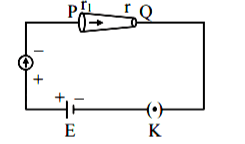
Options:
A. Drift velocity of electron increases.
B. Electric field decreases.
C. Electron current decreases.
D. All of these
Correct Answer: A
Year: JEE Main 27 Jul 2021 Shift 1
Solution:
Current is constant in conductor. $E = \frac{i\rho}{\pi r^2}$ and $v_d = \frac{eE\tau}{m}$. Thus $E \propto \frac{1}{r^2}$. If radius $r$ decreases (from $P$ to $Q$), $E$ will increase, and therefore $v_d$ will increase.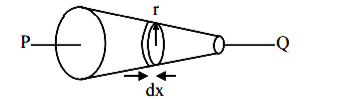
Step Solution:
1. Analyze Current: For a single conductor in series with a source, the current $I$ is constant at every cross-section.
2. Express Electric Field ($E$): Using $J = \sigma E$ or $I/A = E/\rho$, we get $E = \frac{I \rho}{A} = \frac{I \rho}{\pi r^2}$.
3. Determine $E$ Trend: As we move from $P$ to $Q$, the radius decreases ($r_2 < r_1$), so the cross-sectional area $A$ decreases.
4. Evaluate Drift Velocity ($v_d$): Recall $v_d = \frac{I}{neA}$.
5. Conclusion: Since $I, n, e$ are constant and $A$ decreases, the drift velocity $v_d$ must increase.
Difficulty Level: Medium
Concept Name: Variation of Drift Velocity in Non-uniform Conductors
Short cut solution: Remember that for a constant current, drift velocity is inversely proportional to the cross-sectional area ($v_d \propto 1/A$). If area decreases, $v_d$ increases.
Question 171
Question: A current of 5A is passing through a non-linear magnesium wire of cross-section $0.04 \text{ m}^2$. At every point the direction of current density is at an angle of $60^\circ$ with the unit vector of area of cross-section. The magnitude of electric field at every point of the conductor is: (Resistivity of magnesium $\rho = 44 \times 10^{-8} \Omega\text{m}$)
Options:
A. $11 \times 10^{-2} \text{ V/m}$
B. $11 \times 10^{-7} \text{ V/m}$
C. $11 \times 10^{-5} \text{ V/m}$
D. $11 \times 10^{-3} \text{ V/m}$
Correct Answer: C
Year: JEE Main 20 Jul 2021 Shift 1
Solution:
$I = \vec{J} \cdot \vec{A} = J A \cos(\Theta)$
$5 = J \left( \frac{4}{100} \right) \times \cos(60)$
$J = 5 \times 50 = 250 \text{ A/m}^2$
Now, $E = \rho \cdot J = 44 \times 10^{-8} \times 250 = 11 \times 10^{-5} \text{ V/m}$
Step Solution:
1. Current Definition: Use the relationship $I = JA \cos \theta$ where $J$ is current density.
2. Calculate $J$: Substitute the given current ($5\text{A}$), area ($0.04\text{ m}^2$), and angle ($60^\circ$): $5 = J \times 0.04 \times 0.5$.
3. Solve for $J$: $J = \frac{5}{0.02} = 250 \text{ A/m}^2$.
4. Ohm's Law in Vector Form: Apply $E = \rho J$ using the given resistivity.
5. Final Calculation: $E = (44 \times 10^{-8}) \times 250 = 11000 \times 10^{-8} = 11 \times 10^{-5} \text{ V/m}$.
Difficulty Level: Medium
Concept Name: Current Density and Ohm’s Law in Vector Form ($J = \sigma E$)
Short cut solution: Use the consolidated formula $E = \frac{\rho I}{A \cos \theta}$. Plugging in values directly: $E = \frac{44 \times 10^{-8} \times 5}{0.04 \times 0.5} = 44 \times 10^{-8} \times 250 = 11 \times 10^{-5} \text{ V/m}$.
Question 221
Question: The charge on a capacitor plate in a circuit, as a function of time, is shown in the figure: What is the value of current at $t = 4\text{ s}$?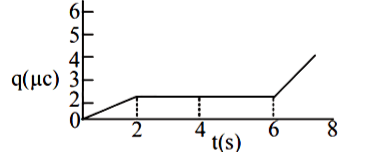
Options:
A. Zero
B. $3 \text{ \mu A}$
C. $2 \text{ \mu A}$
D. $1.5 \text{ \mu A}$
Correct Answer: A
Year: JEE Main 12 Jan 2019 II
Solution: Clearly, from graph Current, $I = \frac{dq}{dt} = 0$ at $t = 4\text{s}$ [Since $q$ is constant]
Step Solution:
1. Relate Current and Charge: Recall that current is the time derivative of charge: $I = \frac{dq}{dt}$.
2. Examine Graph: Locate the point $t = 4\text{s}$ on the charge-time ($q-t$) graph.
3. Identify State: Note that at $t = 4\text{s}$, the graph shows a horizontal line.
4. Evaluate Derivative: A horizontal line represents a constant charge value, meaning its slope ($\frac{dq}{dt}$) is zero.
5. Final Conclusion: Therefore, the instantaneous current at that moment is $0 \text{ A}$.
Difficulty Level: Easy
Concept Name: Relationship between Current and Charge ($I = dq/dt$)
Short cut solution: In any $q-t$ graph, if the curve is horizontal, the current is automatically zero because there is no change in charge over time.
Question 223
Question: Drift speed of electrons, when $1.5\text{A}$ of current flows in a copper wire of cross section $5\text{ mm}^2$, is $v$. If the electron density in copper is $9 \times 10^{28} \text{ /m}^3$ the value of $v$ in $\text{mm/s}$ close to (Take charge of electron to be $e = 1.6 \times 10^{-19} \text{ C}$)
Options:
A. 0.02
B. 3
C. 2
D. 0.2
Correct Answer: A
Year: JEE Main 9 Jan 2019 I
Solution: Using, $I = neAv_d \therefore$ Drift speed $v_d = \frac{I}{neA} = \frac{1.5}{9 \times 10^{28} \times 1.6 \times 10^{-19} \times 5 \times 10^{-6}} = 0.02 \text{ mm s}^{-1}$
Step Solution:
1. Formula Setup: Start with the fundamental drift velocity formula $I = neAv_d$.
2. Identify Constants: Use $n = 9 \times 10^{28} \text{ m}^{-3}$, $e = 1.6 \times 10^{-19} \text{ C}$, $A = 5 \times 10^{-6} \text{ m}^2$, and $I = 1.5 \text{ A}$.
3. Isolate $v_d$: $v_d = \frac{I}{neA}$.
4. Numerical Substitution: $v_d = \frac{1.5}{(9 \times 10^{28}) \times (1.6 \times 10^{-19}) \times (5 \times 10^{-6})}$.
5. Calculate Final Value: $v_d \approx 2.08 \times 10^{-5} \text{ m/s}$, which converts to $0.0208 \text{ mm/s}$.
Difficulty Level: Easy
Concept Name: Drift Velocity Formula
Short cut solution: Directly apply the formula $v_d = \frac{I}{neA}$ and track units carefully; converting the area to $m^2$ initially is the only trick.
Question 237
Question: A current of 5 A passes through a copper conductor (resistivity $\rho = 1.7 \times 10^{-8} \ \Omega \text{m}$) of radius of cross-section 5 mm. Find the mobility of the charges if their drift velocity is $1.1 \times 10^{-3} \ \text{m/s}$.
Options:
A. $1.8 \ \text{m}^2/\text{V s}$
B. $1.5 \ \text{m}^2/\text{V s}$
C. $1.3 \ \text{m}^2/\text{V s}$
D. $1.0 \ \text{m}^2/\text{V s}$
Correct Answer: D
Year: JEE Main 10 Apr. 2019 I
Solution:
Charge mobility $(\mu) = \frac{V_d}{E}$. Resistivity $(\rho) = \frac{E}{j} = \frac{EA}{I} \Rightarrow E = \frac{I\rho}{A}$.
$\mu = \frac{V_d A}{I \rho} = \frac{1.1 \times 10^{-3} \times \pi \times (5 \times 10^{-3})^2}{5 \times 1.7 \times 10^{-8}} = 1.0 \ \text{m}^2/\text{V s}$.
Step Solution:
1. Identify Formulas: Recall $\mu = \frac{v_d}{E}$ and $E = \rho J = \frac{\rho I}{A}$.
2. Combine for Mobility: Substitute $E$ into the mobility formula: $\mu = \frac{v_d A}{I \rho}$.
3. Calculate Area ($A$): $A = \pi r^2 = \pi \times (5 \times 10^{-3} \text{ m})^2 = 25\pi \times 10^{-6} \text{ m}^2$.
4. Substitute Data: $\mu = \frac{(1.1 \times 10^{-3}) \times (25\pi \times 10^{-6})}{5 \times (1.7 \times 10^{-8})}$.
5. Final Calculation: $\mu = \frac{27.5\pi \times 10^{-9}}{8.5 \times 10^{-8}} \approx \frac{86.39 \times 10^{-9}}{85 \times 10^{-9}} \approx 1.0 \ \text{m}^2/\text{V s}$.
Difficulty Level: Medium
Concept Name: Relation between Mobility, Drift Velocity, and Resistivity
Short cut solution: Use the direct ratio $\mu = \frac{v_d A}{I \rho}$. With $v_d \approx 10^{-3}, A \approx 8 \times 10^{-5}, I = 5, \rho \approx 2 \times 10^{-8}$, the magnitude is $\frac{10^{-3} \cdot 8 \cdot 10^{-5}}{5 \cdot 2 \cdot 10^{-8}} = \frac{8 \cdot 10^{-8}}{10 \cdot 10^{-8}} \approx 0.8$, pointing clearly to option D after exact $\pi$ calculation.
Question 249
Question: A copper rod of cross-sectional area A carries a uniform current I through it. At temperature T, if the volume charge density of the rod is $\rho$, how long will the charges take to travel a distance d?
Options:
A. $\frac{2 \rho d A}{I T}$
B. $2 \rho d A$
C. $\frac{\rho d A}{I}$
D. $\frac{\rho d A}{I T}$
Correct Answer: C
Year: JEE Main Online April 15, 2018
Solution:
Charge density $\rho = \frac{\text{charge}}{\text{volume}} = \frac{q}{Ad} \Rightarrow q = \rho Ad$.
$q = IT \Rightarrow \text{Time } T = \frac{q}{I} = \frac{\rho Ad}{I}$.
Step Solution:
1. Charge in Volume: Define total charge $q$ in terms of volume charge density: $q = \rho \times \text{Volume}$.
2. Geometry: The volume of the rod segment of length $d$ is $V = A \times d$.
3. Current Definition: Recall that charge $q$ is also $I \times t$, where $t$ is time.
4. Equate: Set the two expressions for charge equal: $I \times t = \rho \times A \times d$.
5. Solve for Time: $t = \frac{\rho Ad}{I}$.
Difficulty Level: Easy
Concept Name: Definition of Current and Charge Density
Short cut solution: Use Dimensional Analysis. The only option that has the units of time (Charge $\times$ Volume / (Current $\times$ Area)) is $\frac{\rho Ad}{I}$.
Question 267
Question: Suppose the drift velocity $v_d$ in a material varied with the applied electric field $E$ as $v_d \propto \sqrt{E}$. Then V - I graph for a wire made of such a material is best given by:
Options:
A.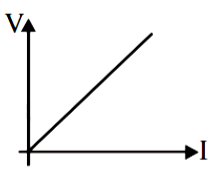
B.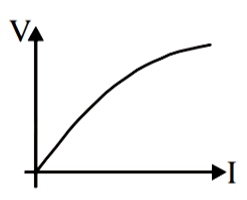
C.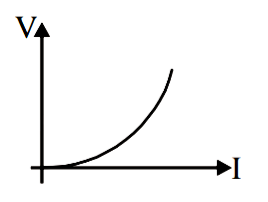
D.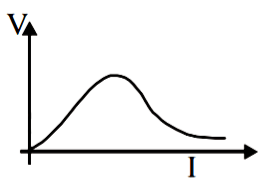
Correct Answer: C
Year: JEE Main Online April 10, 2015
Solution:
$i = neAV_d$ and $V_d \propto \sqrt{E}$ (Given). Or $i \propto \sqrt{E} \Rightarrow i^2 \propto E \Rightarrow i^2 \propto V$.
Hence graph (c) correctly depicts the V - I graph for a wire made of such type of material.
Step Solution:
1. Microscopic Current: Start with $I = neAv_d$.
2. Apply Given Condition: Substitute the relationship $v_d \propto \sqrt{E}$.
3. Relate Current to Field: This implies $I \propto \sqrt{E}$.
4. Relate to Voltage: Since $E = V/L$, then $E \propto V$, meaning $I \propto \sqrt{V}$.
5. Determine Graph Shape: Squaring both sides gives $V \propto I^2$, which is a parabolic relationship.
Difficulty Level: Medium
Concept Name: Microscopic Model of Current and Non-Ohmic Conductors
Short cut solution: Since $v_d \propto \sqrt{E}$ and $I \propto v_d$, then $I \propto \sqrt{V}$. This means the current grows slower than the voltage, resulting in a curve that bends toward the Voltage axis ($V = kI^2$).
Question 295
Question: For current entering at A, the electric field at a distance 'r' from A is:
Options:
A. $\frac{\rho I}{8 \pi r^2}$
B. $\frac{\rho I}{r^2}$
C. $\frac{\rho I}{2 \pi r^2}$
D. $\frac{\rho I}{4 \pi r^2}$
Correct Answer: C
Year: 2008
Solution: As shown in Answer (a) $E = \frac{\rho I}{2 \pi r^2}$.
Step Solution:
1. Understand Current Distribution: When current $I$ enters a bulk conductor through a point on its flat surface, it spreads out hemispherically.
2. Identify Area: The area through which the current passes at a distance $r$ is the surface area of a hemisphere: $A = 2 \pi r^2$.
3. Determine Current Density ($j$): Use $j = \frac{I}{A} = \frac{I}{2 \pi r^2}$.
4. Relate Electric Field to Density: Recall the vector form of Ohm's Law: $E = \rho j$.
5. Final Calculation: Substitute $j$ into the formula: $E = \rho \left( \frac{I}{2 \pi r^2} \right)$.
Difficulty Level: Medium
Concept Name: Current Density and Ohm’s Law in Vector Form ($J = \sigma E$)
Short cut solution: For point entry into a semi-infinite medium, the current spreads over a hemisphere ($2 \pi r^2$). Since $E \propto j$ and $j = I/A$, then $E = \rho I / (2 \pi r^2)$.
Question 313
Question: An electric current is passed through a circuit containing two wires of the same material, connected in parallel. If the lengths and radii are in the ratio of $4/3$ and $2/3$, then the ratio of the current passing through the wires will be:
Options:
A. 8/9
B. 1/3
C. 3
D. 2
Correct Answer: B
Year: 2004
Solution: Given, $\frac{r_1}{r_2} = \frac{2}{3}$. $R_1 = \frac{\rho l_1}{\pi r_1^2}; R_2 = \frac{\rho l_2}{\pi r_2^2}$. When wires are in parallel, potential difference is same: $i_1 R_1 = i_2 R_2 \Rightarrow \frac{i_1}{i_2} = \frac{R_2}{R_1} = \frac{l_2}{l_1} \times \frac{r_1^2}{r_2^2} = \frac{3}{4} \times \frac{4}{9} = \frac{1}{3}$.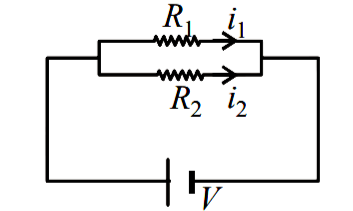
Step Solution:
1. Identify Ratios: From the question, length ratio $\frac{l_1}{l_2} = \frac{4}{3}$ and radius ratio $\frac{r_1}{r_2} = \frac{2}{3}$.
2. Define Resistance ($R$): Use $R = \rho \frac{l}{A} = \frac{\rho l}{\pi r^2}$.
3. Parallel Circuit Rule: For parallel resistors, current is inversely proportional to resistance: $\frac{i_1}{i_2} = \frac{R_2}{R_1}$.
4. Express Resistance Ratio: $\frac{R_2}{R_1} = \left( \frac{l_2}{l_1} \right) \times \left( \frac{r_1}{r_2} \right)^2$.
5. Substitute and Calculate: $\frac{i_1}{i_2} = \left( \frac{3}{4} \right) \times \left( \frac{2}{3} \right)^2 = \frac{3}{4} \times \frac{4}{9} = \frac{3}{9} = \frac{1}{3}$.
Difficulty Level: Medium
Concept Name: Current Distribution in Parallel Circuits
Short cut solution: In parallel, current $I \propto \frac{1}{R} \propto \frac{r^2}{l}$.
$\text{Ratio} = \frac{r_1^2}{l_1} : \frac{r_2^2}{l_2} \Rightarrow \frac{(2)^2}{4} : \frac{(3)^2}{3} \Rightarrow \frac{4}{4} : \frac{9}{3} \Rightarrow 1 : 3$. Thus, the ratio is $1/3$.