Question 4
Question: During the transition of electron from state A to state C of a Bohr atom, the wavelength of emitted radiation is 2000 Å and it becomes 6000 Å when the electron jumps from state B to state C. Then the wavelength of the radiation emitted during the transition of electrons from state A to state B is
Options:
A. 4000 Å
B. 6000 Å
C. 2000 Å
D. 3000 Å
Correct Answer: D
Year: JEE Main 2025 (Online) 24th January Morning Shift
Solution: $\frac{1}{\lambda_{AC}} = \frac{E_A - E_C}{hc}, \quad \frac{1}{\lambda_{BC}} = \frac{E_B - E_C}{hc}$. Since the electron transitions from state A to state C in two steps (A to B and then B to C), the energy difference for the transition from A to B is given by $E_A - E_B = (E_A - E_C) - (E_B - E_C)$. Expressing these in terms of wavelengths: $\frac{1}{\lambda_{AB}} = \frac{1}{\lambda_{AC}} - \frac{1}{\lambda_{BC}}$. Substitute values: $\frac{1}{\lambda_{AB}} = \frac{1}{2000} - \frac{1}{6000} = \frac{3 - 1}{6000} = \frac{1}{3000}$. Thus $\lambda_{AB} = 3000$ Å.
Step Solution:
1. Relate energies: Note that the energy of transition $A \to C$ is the sum of $A \to B$ and $B \to C$: $E_{AC} = E_{AB} + E_{BC}$.
2. Substitute wavelength formula: Use $E = \frac{hc}{\lambda}$ to get $\frac{hc}{\lambda_{AC}} = \frac{hc}{\lambda_{AB}} + \frac{hc}{\lambda_{BC}}$.
3. Isolate the unknown: Simplify to $\frac{1}{\lambda_{AB}} = \frac{1}{\lambda_{AC}} - \frac{1}{\lambda_{BC}}$.
4. Plug in values: $\frac{1}{\lambda_{AB}} = \frac{1}{2000} - \frac{1}{6000}$.
5. Calculate final value: $\frac{1}{\lambda_{AB}} = \frac{3-1}{6000} = \frac{2}{6000} = \frac{1}{3000} \implies \lambda_{AB} = 3000 \text{ Å}$.
Difficulty Level: Medium
Concept Name: Bohr’s Atomic Model - Energy and Wavelength Relation
Short cut solution: Use the product-over-difference rule for wavelengths in sequential transitions: $\lambda_{AB} = \frac{\lambda_1 \lambda_2}{\lambda_2 - \lambda_1}$. Calculation: $\frac{2000 \times 6000}{6000 - 2000} = \frac{12,000,000}{4000} = \mathbf{3000 \text{ Å}}$.
Question 16
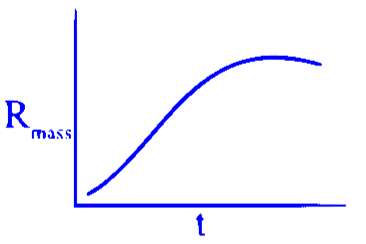
Question: A radioactive material P first decays into Q and then Q decays to non-radioactive material R. Which of the following figure represents time dependent mass of P, Q and R?
Options:
A.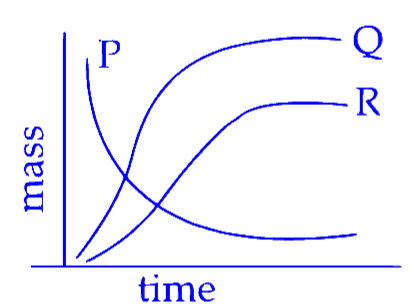
B.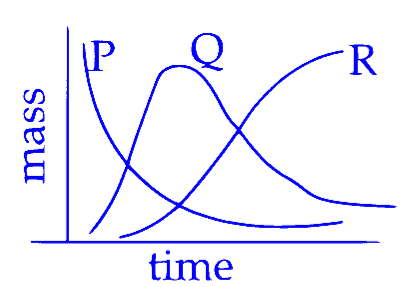
C.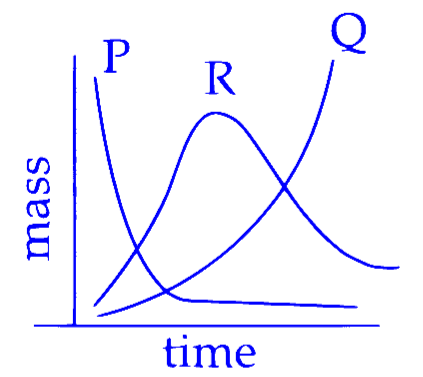
D.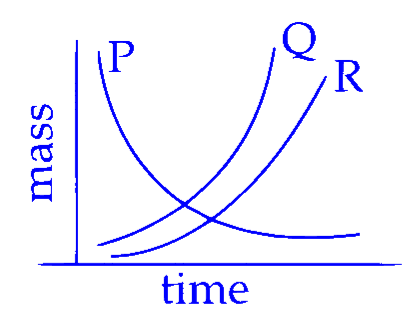
Correct Answer: B
Year: JEE Main 2025 (Online) 4th April Evening Shift
Solution: $\text{P} \to \text{Q} \to \text{R}$. (The source indicates that Graph B correctly shows the exponential decay of P, the initial rise and subsequent decay of the intermediate Q, and the gradual accumulation of the stable product R). ;
;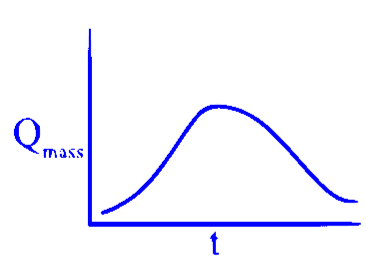 ;
;
Step Solution:
1. Analyze P: Being the initial parent material, its mass must follow pure exponential decay ($P = P_0 e^{-\lambda_p t}$).
2. Analyze Q: It starts at zero, is produced by P, and then decays into R; thus, its curve must rise to a peak and then fall.
3. Analyze R: As the stable end-product, its mass starts at zero and increases monotonically, eventually reaching the initial mass of P.
4. Identify the trends: Look for a graph where one curve (P) always drops, one (Q) humps, and one (R) always climbs.
5. Conclusion: Based on the radioactive decay laws for successive disintegration, Graph B fits these criteria.
Difficulty Level: Medium
Concept Name: Successive Radioactive Decay
Short cut solution: In the chain $P \to Q \to R$, P is the only one that starts at maximum and R is the only one that never decreases. This unique combination is the hallmark of the correct graph.
Question 45
Question: If a radioactive element having half-life of 30 min is undergoing beta decay, the fraction of radioactive element remains undecayed after 90 min. will be :
Options:
A. 1/8
B. 1/16
C. 1/4
D. 1/2
Correct Answer: A
Year: [29-Jan-2023 Shift 1]
Solution: $\frac{N}{N_0} = \left( \frac{1}{2} \right)^{t/T} = \left( \frac{1}{2} \right)^{90/30} = \left( \frac{1}{2} \right)^3 = \frac{1}{8}$.
Step Solution:
1. Identify given values: Total time ($t$) = 90 min; Half-life ($T_{1/2}$) = 30 min.
2. Calculate number of half-lives ($n$): $n = \frac{t}{T_{1/2}} = \frac{90}{30} = 3$.
3. Set up the decay fraction formula: Remaining fraction $f = \frac{N}{N_0} = \left( \frac{1}{2} \right)^n$.
4. Perform the calculation: $f = \left( \frac{1}{2} \right)^3$.
5. Final result: $f = \frac{1}{8}$.
Difficulty Level: Easy
Concept Name: Radioactive Decay Law (Half-life)
Short cut solution: In 90 minutes, exactly 3 half-lives pass ($30 \times 3 = 90$). The fraction remaining is $(1/2)^3 = \mathbf{1/8}$.
Question 47
Question: Substance A has atomic mass number 16 and half life of 1 day. Another substance B has atomic mass number 32 and half life of $\frac{1}{2}$ day. If both A and B simultaneously start undergo radio activity at the same time with initial mass 320g each, how many total atoms of A and B combined would be left after 2 days.
Options:
A. $3.38 \times 10^{24}$
B. $6.76 \times 10^{24}$
C. $6.76 \times 10^{23}$
D. $1.69 \times 10^{24}$
Correct Answer: A
Year: 29-Jan-2023 Shift 2
Solution: $(N_0)_A = \frac{320}{16} = 20 \text{ moles}$; $(N_0)_B = \frac{320}{32} = 10 \text{ moles}$; $N_A = \frac{(N_0)_A}{(2)^{2/1}} = \frac{20}{4} = 5$; $N_B = \frac{(N_0)_B}{(2)^{2/0.5}} = \frac{10}{2^4} = 0.625$. No. of atoms $= 5.625 \times 6.023 \times 10^{23} = 3.38 \times 10^{24}$.
Step Solution:
1. Calculate initial moles ($n_0 = \frac{\text{mass}}{\text{molar mass}}$): $n_{0A} = \frac{320}{16} = 20 \text{ mol}$; $n_{0B} = \frac{320}{32} = 10 \text{ mol}$.
2. Determine half-lives passed ($n = \frac{t}{T_{1/2}}$) in 2 days: For A, $n_A = \frac{2}{1} = 2$. For B, $n_B = \frac{2}{0.5} = 4$.
3. Find remaining moles ($n = \frac{n_0}{2^n}$): $n_{left,A} = \frac{20}{2^2} = 5 \text{ mol}$; $n_{left,B} = \frac{10}{2^4} = 0.625 \text{ mol}$.
4. Calculate total remaining moles: $n_{total} = 5 + 0.625 = 5.625 \text{ mol}$.
5. Convert to total atoms ($N = n \cdot N_A$): $N = 5.625 \times 6.023 \times 10^{23} \approx 3.38 \times 10^{24}$ atoms.
Difficulty Level: Medium
Concept Name: Radioactive Decay Law and Mole Concept
Short cut solution: Sum of remaining moles = $\frac{20}{2^2} + \frac{10}{2^4} = 5 + 0.625 = 5.625$. Total atoms $= 5.625 \times 6.022 \times 10^{23} \approx \mathbf{3.38 \times 10^{24}}$.
Question 49
Question: A radioactive nucleus decays by two different process. The half life of the first process is 5 minutes and that of the second process is 30s. The effective half-life of the nucleus is calculated to be $\frac{a}{11}$ s. The value of $\alpha$ is
Options: (Numerical entry question)
Correct Answer: 300
Year: 30-Jan-2023 Shift 2
Solution: $\frac{dN}{dt} = -(\lambda_1 + \lambda_2)N \Rightarrow \lambda_{eq} = \lambda_1 + \lambda_2$. $\frac{1}{t_{1/2}} = \frac{1}{300} + \frac{1}{30} = \frac{11}{300} \Rightarrow t_{1/2} = \frac{300}{11}$.
Step Solution:
1. Standardize units to seconds: $T_1 = 5 \text{ min} = 300 \text{ s}$; $T_2 = 30 \text{ s}$.
2. Apply the effective decay constant rule for parallel decay: $\lambda_{eff} = \lambda_1 + \lambda_2$.
3. Substitute half-life relation ($\lambda = \frac{\ln 2}{T}$): $\frac{\ln 2}{T_{eff}} = \frac{\ln 2}{T_1} + \frac{\ln 2}{T_2} \Rightarrow \frac{1}{T_{eff}} = \frac{1}{T_1} + \frac{1}{T_2}$.
4. Perform mathematical calculation: $\frac{1}{T_{eff}} = \frac{1}{300} + \frac{1}{30} = \frac{1 + 10}{300} = \frac{11}{300} \text{ s}^{-1}$.
5. Identify the variable: $T_{eff} = \frac{300}{11} \text{ s}$. Comparing this with $\frac{a}{11}$, we find $\alpha = 300$.
Difficulty Level: Medium
Concept Name: Parallel Radioactive Decay (Effective Half-life)
Short cut solution: Use the parallel resistance-style shortcut: $T_{eff} = \frac{T_1 T_2}{T_1 + T_2} = \frac{300 \times 30}{300 + 30} = \frac{9000}{330} = \mathbf{\frac{300}{11}}$. Therefore, $\alpha = 300$.
Question 75
Question: A radio active material is reduced to 1/8 of its original amount in 3 days. If $8 \times 10^{-3}$ kg of the material is left after 5 days the initial amount of the material is
Options:
A. 64g
B. 40g
C. 32g
D. 256g
Correct Answer: D
Year: 8-Apr-2023 shift 2
Solution: $m = m_0 e^{-\lambda t}$. (The source provides the correct choice D and uses the general decay mass formula).
Step Solution:
1. Calculate the half-life ($T_{1/2}$): The material reduces to $1/8 = (1/2)^3$ in 3 days, meaning 3 half-lives pass. Thus, $T_{1/2} = \frac{3 \text{ days}}{3} = 1 \text{ day}$.
2. Determine half-lives for the second interval: After $t = 5$ days, the number of half-lives passed is $n = \frac{5}{1} = 5$.
3. Set up the mass remaining formula: $m_{left} = \frac{m_0}{2^n}$.
4. Substitute known values: $8 \times 10^{-3} \text{ kg} = \frac{m_0}{2^5} = \frac{m_0}{32}$.
5. Calculate initial mass ($m_0$): $m_0 = 32 \times 8 \times 10^{-3} \text{ kg} = 256 \times 10^{-3} \text{ kg} = \mathbf{256 \text{ g}}$.
Difficulty Level: Easy
Concept Name: Radioactive Decay Law (Half-life)
Short cut solution: Since $\frac{1}{8}$ occurs in 3 days, the half-life is 1 day. In 5 days, the sample undergoes 5 half-lives ($2^5 = 32$ times reduction). Initial mass $= 32 \times 8\text{g} = \mathbf{256\text{g}}$.
Question 76
Question: The decay constant for a radioactive nuclide is $1.5 \times 10^{-5} \text{ s}^{-1}$. Atomic weight of the substance is $60 \text{ g mole}^{-1}$, $(N_A = 6 \times 10^{23})$. The activity of $1.0 \text{ \mu g}$ of the substance is $\_\_\_\_ \times 10^{10} \text{ Bq}$.
Options: (Numerical entry Question; no options provided in the source)
Correct Answer: 15
Year: 10-Apr-2023 shift 1
Solution: No. of moles $= 1 \times 10^{-6} / 60 = \frac{10^{-7}}{6}$. No. of atom $\Omega = n(N_A) = \frac{10^{-7}}{6} \times 6 \times 10^{23} = 10^{16}$ at $(t = 0) A_0 = N_0 \lambda = 10^{16} \times 1.5 \times 10^{-5} = 15 \times 10^{10} \text{ Bq}$.
Step Solution:
1. Convert mass to grams: $1.0 \text{ \mu g} = 1 \times 10^{-6} \text{ g}$.
2. Calculate the number of moles ($n$): $n = \text{mass} / \text{atomic weight} = \frac{10^{-6}}{60} = \frac{1}{6} \times 10^{-7} \text{ moles}$.
3. Find the number of atoms ($N_0$): $N_0 = n \times N_A = (\frac{1}{6} \times 10^{-7}) \times (6 \times 10^{23}) = 10^{16} \text{ atoms}$.
4. Apply the Activity formula: $A = \lambda N_0$.
5. Perform the calculation: $A = (1.5 \times 10^{-5}) \times 10^{16} = 15 \times 10^{10} \text{ Bq}$. The integer value is 15.
Difficulty Level: Medium
Concept Name: Activity of a Radioactive Substance
Short cut solution: Activity is simply $( \text{mass} / \text{Molar mass} ) \times N_A \times \lambda$. Plugging in values: $(\frac{10^{-6}}{60}) \times 6 \times 10^{23} \times 1.5 \times 10^{-5} = 10^{16} \times 1.5 \times 10^{-5} = \mathbf{15 \times 10^{10} \text{ Bq}}$.
Question 77
Question: The half life of a radioactive substance is T. The time taken, for disintegrating $7/8$ th part of its original mass will be:
Options:
A. T
B. 2T
C. 3T
D. 8T
Correct Answer: C
Year: 10-Apr-2023 shift 2
Solution: If $7/8$ th is disintegrated it means only $1/8$ th part is radioactive active no. of nuclears after 'n' half lives $\Rightarrow \frac{N_o}{2^n} = \frac{N_o}{8} \Rightarrow 2^n = 8 = n = 3$. So, the elapsed is 3 half lives $= 3T$.
Step Solution:
1. Determine the remaining fraction: Since $7/8$ has disintegrated, the fraction remaining is $1 - 7/8 = 1/8$.
2. Set up the remaining nuclei equation: $N = N_0(1/2)^n$, where $n$ is the number of half-lives.
3. Substitute the fraction: $1/8 = (1/2)^n$.
4. Solve for $n$: $(1/2)^3 = (1/2)^n$, so $n = 3$.
5. Calculate total time: $t = n \times T_{1/2} = 3 \times T = 3T$.
Difficulty Level: Easy
Concept Name: Radioactive Decay Law (Half-life)
Short cut solution: The sequence of remaining material is $1 \to 1/2 \to 1/4 \to 1/8$. This represents 3 half-lives. Since one half-life is T, the time is 3T.
Question 78
Question: Two radioactive elements A and B initially have same number of atoms. The half life of A is same as the average life of B. If $\lambda_A$ and $\lambda_B$ are decay constants of A and B respectively, then choose the correct relation from the given options.
Options:
A. $\lambda_A = 2\lambda_B$
B. $\lambda_A = \lambda_B$
C. $\lambda_A \ln 2 = \lambda_B$
D. $\lambda_A = \lambda_B \ln 2$
Correct Answer: D
Year: 11-Apr-2023 shift 1
Solution: Ta = tB given in question Now $\frac{\ln(2)}{\lambda_A} = \frac{1}{\lambda_B} \Rightarrow \lambda_A = \lambda_B \cdot \ln(2)$.
Step Solution:
1. Identify the formula for half-life ($T_{1/2}$): $T_{1/2, A} = \frac{\ln 2}{\lambda_A}$.
2. Identify the formula for average life ($\tau$): $T_{avg, B} = \frac{1}{\lambda_B}$.
3. Set them equal as per the Question statement: $T_{1/2, A} = T_{avg, B}$.
4. Substitute the formulas: $\frac{\ln 2}{\lambda_A} = \frac{1}{\lambda_B}$.
5. Rearrange to isolate $\lambda_A$: $\lambda_A = \lambda_B \ln 2$.
Difficulty Level: Easy
Concept Name: Relationship between Half-life and Average Life
Short cut solution: Just remember that $T_{1/2} = \tau \ln 2$. For substance A's half-life to equal substance B's mean life, the relation must be $1/\lambda_A \ln 2 = 1/\lambda_B$, which simplifies to $\lambda_A = \lambda_B \ln 2$.
Question 82
Question: The half-life of a radioactive nucleus is 5 years. The fraction of the original sample that would decay in 15 years is:
Options:
A. 3/4
B. 1/8
C. 7/8
D. 1
Correct Answer: C
Year: 15-Apr-2023 shift 1
Solution: $\mathrm{N} = \mathrm{N}_{0} \left(\frac{1}{2}\right)^{\mathrm{t} / \mathrm{T}_{1/2}} = \mathrm{N}_{0} \left(\frac{1}{2}\right)^{15/5} = \frac{\mathrm{N}_{0}}{8}$. Decayed nuclei $\Delta\mathrm{N} = \mathrm{N}_{0} - \frac{\mathrm{N}_{0}}{8} = \frac{7\mathrm{N}_{0}}{8}$.
Step Solution:
1. Identify the half-life ($T_{1/2} = 5$ years) and total time ($t = 15$ years).
2. Calculate the number of half-lives passed: $n = \frac{t}{T_{1/2}} = \frac{15}{5} = 3$.
3. Find the remaining fraction of the sample ($f_{rem}$): $f_{rem} = \left(\frac{1}{2}\right)^{n} = \left(\frac{1}{2}\right)^{3} = \frac{1}{8}$.
4. Calculate the fraction that has decayed ($f_{dec}$): $f_{dec} = 1 - f_{rem} = 1 - \frac{1}{8}$.
5. Final result: $f_{dec} = \frac{7}{8}$.
Difficulty Level: Easy
Concept Name: Radioactive Decay Law (Fraction Decayed)
Short cut solution: In 15 years (3 half-lives), the remaining substance is halved three times: $1 \to 1/2 \to 1/4 \to 1/8$. Since $1/8$ remains, the decayed portion is $1 - 1/8 = \mathbf{7/8}$.
Question 91
Question: A sample contains $10^{-2}$ kg each of two substances A and B with half lives 4s and 8 s respectively. The ratio of their atomic weights is 1 : 2 . The ratio of the amounts of A and B after 16s is $\frac{\mathrm{x}}{100}$. The value of x is
Options: (The source lists "Answer: 25" for this numerical Question)
Correct Answer: 25
Year: 24-Jun-2022-Shift-2
Solution: $\mathcal{N}_1 = \frac{(10^{-2}/1)}{2^4}$, $\mathcal{N}_2 = \frac{(10^{-2}/2)}{2^2} \implies \frac{\mathcal{N}_1}{\mathcal{N}_2} = \frac{1}{2}$. Mass ratio $\frac{m_1}{m_2} = \frac{\mathrm{N}_1}{\mathrm{N}_2} \times \frac{M_1}{M_2} = \frac{1}{2} \times \frac{1}{2} = \frac{1}{4} = \frac{25}{100}$.
Step Solution:
1. Find the number of half-lives for both in $t=16s$: For A, $n_A = \frac{16}{4} = 4$. For B, $n_B = \frac{16}{8} = 2$.
2. Set up the remaining mass formula ($m = m_0 / 2^n$): $m_{A} = \frac{10^{-2}}{2^4}$ and $m_{B} = \frac{10^{-2}}{2^2}$.
3. Calculate the ratio of the masses remaining: $\frac{m_A}{m_B} = \frac{10^{-2}/16}{10^{-2}/4}$.
4. Simplify the fraction mathematically: $\frac{m_A}{m_B} = \frac{4}{16} = \frac{1}{4}$.
5. Equate to the target format: $\frac{1}{4} = \frac{x}{100} \implies x = \frac{100}{4} = 25$.
Difficulty Level: Medium
Concept Name: Radioactive Decay Law (Mass Reduction)
Short cut solution: The mass ratio after time $t$ is $\frac{m_A}{m_B} = \frac{(1/2)^{t/T_A}}{(1/2)^{t/T_B}} = (1/2)^{(16/4 - 16/8)} = (1/2)^{4-2} = (1/2)^2 = \mathbf{1/4}$, which is 25/100.
Question 93
Question: A radioactive nucleus can decay by two different processes. Half-life for the first process is 3.0 hours while it is 4.5 hours for the second process. The effective half-life of the nucleus will be:
Options:
A. 3.75 hours
B. 0.56 hours
C. 0.26 hours
D. 1.80 hours
Correct Answer: D
Year: 26-Jun-2022-Shift-2
Solution: $\frac{\mathrm{d}\mathrm{A}}{\mathrm{d}\mathrm{t}} = -(\lambda_1 + \lambda_2)\mathrm{A} \implies \lambda_{\mathrm{eff}} = \lambda_1 + \lambda_2 \implies \frac{\ln 2}{(\mathrm{t}_{1/2})_{\mathrm{eff}}} = \frac{\ln 2}{(\mathrm{t}_{1/2})_1} + \frac{\ln 2}{(\mathrm{t}_{1/2})_2}$.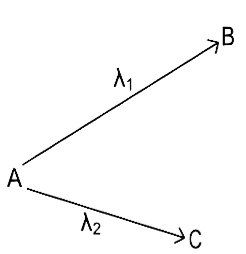
Step Solution:
1. State the effective decay constant for parallel processes: $\lambda_{\mathrm{eff}} = \lambda_1 + \lambda_2$.
2. Substitute the relation $\lambda = \frac{\ln 2}{T_{1/2}}$: $\frac{1}{T_{\mathrm{eff}}} = \frac{1}{T_1} + \frac{1}{T_2}$.
3. Plug in the given half-lives: $\frac{1}{T_{\mathrm{eff}}} = \frac{1}{3.0} + \frac{1}{4.5}$.
4. Find a common denominator and solve: $\frac{1}{T_{\mathrm{eff}}} = \frac{4.5 + 3.0}{13.5} = \frac{7.5}{13.5}$.
5. Calculate $T_{\mathrm{eff}}$: $T_{\mathrm{eff}} = \frac{13.5}{7.5} = 1.80 \text{ hours}$.
Difficulty Level: Easy
Concept Name: Parallel Radioactive Decay (Effective Half-life)
Short cut solution: Use the product-over-sum rule: $T_{\mathrm{eff}} = \frac{T_1 T_2}{T_1 + T_2} = \frac{3 \times 4.5}{3 + 4.5} = \frac{13.5}{7.5} = \mathbf{1.80 \text{ hours}}$.
Question 95
Question: Following statements related to radioactivity are given below :
(A) Radioactivity is a random and spontaneous process and is dependent on physical and chemical conditions.
(B) The number of un-decayed nuclei in the radioactive sample decays exponentially with time.
(C) Slope of the graph of $log_e$ (no. of undecayed nuclei) Vs. time represents the reciprocal of mean life time $(\tau)$.
(D) Product of decay constant $(\lambda)$ and half-life time $(T_{\lambda 1/2})$ is not constant.
Choose the most appropriate answer from the options given below :
Options:
A. (A) and (B) only
B. (B) and (D) only
C. (B) and (C) only
D. (C) and (D) only
Correct Answer: C
Year: 28-Jun-2022-Shift-2
Solution: Radioactive decay is a random and spontaneous process it depends on unbalancing of nucleus. $N = N_0 e^{-\lambda t} ... (B)$. $\ln N = -\lambda t + \ln N_0$, so, slope = $-\lambda ... (C)$. $t_{1/2} = \frac{\ln 2}{\lambda} \Rightarrow t_{1/2} \times \lambda = \ln 2 = \text{Constant}$.
Step Solution:
1. Analyze (A): Radioactivity is spontaneous but independent of external physical or chemical conditions. (False)
2. Analyze (B): The standard decay equation $N = N_0 e^{-\lambda t}$ confirms that un-decayed nuclei decrease exponentially. (True)
3. Analyze (C): The equation $\ln N = \ln N_0 - \lambda t$ is a straight line with slope $-\lambda$. Since average life $\tau = 1/\lambda$, the slope magnitude represents $1/\tau$. (True)
4. Analyze (D): The relationship $\lambda \cdot T_{1/2} = \ln 2 \approx 0.693$ is a mathematical constant for all radioactive isotopes. (False)
5. Conclusion: Only statements (B) and (C) are scientifically accurate.
Difficulty Level: Medium
Concept Name: Radioactive Decay Laws and Graphical Analysis
Short cut solution: Identify common constants: Statement (A) is false because radioactivity is not affected by environment, and (D) is false because the product of $\lambda$ and $T_{1/2}$ is always $\ln 2$. Eliminating A and D leaves only Option C.
Question 96
Question: The activity of a radioactive material is $2.56 \times 10^{-3} \text{ Ci}$. If the half life of the material is 5 days, after how many days the activity will become $2 \times 10^{-5} \text{ Ci}$ : ?
Options:
A. 30 days
B. 35 days
C. 40 days
D. 25 days
Correct Answer: B
Year: 29-Jun-2022-Shift-1
Solution: $\frac{A}{A_0} = \frac{N}{N_0}$. $\frac{2 \times 10^{-5}}{2.56 \times 10^{-3}} = \frac{N}{N_0}$. $\frac{N}{N_0} = \frac{1}{128} \Rightarrow N = \frac{N_0}{128}$. After 7 half life activity comes down to given value $T = 7 \times 5 = 35$ days.
Step Solution:
1. Set up the activity ratio: Compare the final activity ($A$) to the initial activity ($A_0$): $\frac{2 \times 10^{-5}}{2.56 \times 10^{-3}}$.
2. Simplify the ratio: $\frac{2}{256} = \frac{1}{128}$.
3. Relate to half-lives: Use the formula $\frac{A}{A_0} = (\frac{1}{2})^n$. Thus, $(\frac{1}{2})^n = \frac{1}{128}$.
4. Solve for $n$: Since $2^7 = 128$, the sample has undergone $n = 7$ half-lives.
5. Calculate total time: $t = n \times T_{1/2} = 7 \times 5 \text{ days} = \mathbf{35 \text{ days}}$.
Difficulty Level: Easy
Concept Name: Activity and Half-life Relation
Short cut solution: Notice the reduction factor: $2.56 \times 10^{-3} / 2 \times 10^{-5} = 1.28 \times 10^2 = 128$. Recognizing $128$ as $2^7$ immediately tells you that 7 half-lives have passed. Total time $= 7 \times 5 = \mathbf{35}$ days.
Question 98
Question: The half life of a radioactive substance is 5 years. After x years a given sample of the radioactive substance gets reduced to 6.25% of its initial value. The value of x is
Options: (This was a numerical entry Question; no options provided in source)
Correct Answer: 20
Year: 29-Jun-2022-Shift-2
Solution: $N = N_0 e^{-\lambda t}$. $\Rightarrow \frac{6.25}{100} = e^{-\lambda t}$. $\Rightarrow e^{-\lambda t} = \frac{1}{16} = (\frac{1}{2})^4$. $\Rightarrow t = 4 T_{1/2}$. $\Rightarrow t = 20 \text{ years}$.
Step Solution:
1. Identify the remaining fraction: $6.25\% = \mathbf{\frac{6.25}{100} = \frac{1}{16}}$.
2. Relate fraction to half-lives: Apply the decay rule $N/N_0 = (1/2)^n$, where $(1/2)^n = 1/16$.
3. Find the number of half-lives: Since $2^4 = 16$, the substance has passed $n = 4$ half-lives.
4. Set up the time equation: Total time $t = n \times T_{1/2}$.
5. Calculate $x$: $x = 4 \times 5 = \mathbf{20 \text{ years}}$.
Difficulty Level: Easy
Concept Name: Radioactive Decay Law (Percentage Reduction)
Short cut solution: Remember standard percentage reductions for half-lives: $50\% \to 25\% \to 12.5\% \to \mathbf{6.25\%}$. This sequence shows exactly 4 half-lives have occurred. Total time $= 4 \times 5 = \mathbf{20}$ years.
Question 109
Question: The disintegration rate of a certain radioactive sample at any instant is 4250 disintegrations per minute. 10 minutes later, the rate becomes 2250 disintegrations per minute. The approximate decay constant is : (Take $\log_{10} 1.88 = 0.274$)
Options:
A. $0.02 \text{ min}^{-1}$
B. $2.7 \text{ min}^{-1}$
C. $0.063 \text{ min}^{-1}$
D. $6.3 \text{ min}^{-1}$
Correct Answer: C
Year: 26-Jul-2022-Shift-1
Solution: $A_0 = 4250$, $A = 2250 = A_0 e^{-\lambda t} \Rightarrow \frac{2250}{4250} = e^{-\lambda t} \Rightarrow \lambda(10) = \ln \left( \frac{4250}{2250} \right) \Rightarrow \lambda(10) = 0.636 \Rightarrow \lambda = 0.063$.
Step Solution:
1. Identify activities and time: Initial rate $A_0 = 4250$ dpm, final rate $A = 2250$ dpm, and elapsed time $t = 10$ min.
2. Use the Activity Decay Law: $A = A_0 e^{-\lambda t}$, which rearranges to $\frac{A_0}{A} = e^{\lambda t}$.
3. Substitute known values: $\frac{4250}{2250} = e^{10\lambda}$, which simplifies to $1.888 = e^{10\lambda}$.
4. Convert to logarithms: $10\lambda = \ln(1.888) = 2.303 \times \log_{10}(1.888)$.
5. Calculate the constant: $10\lambda \approx 2.303 \times 0.274 = 0.631$. Thus, $\lambda = \frac{0.631}{10} \approx \mathbf{0.063 \text{ min}^{-1}}$.
Difficulty Level: Medium
Concept Name: Radioactive Decay Law (Activity)
Short cut solution: $\lambda = \frac{2.303}{t} \log_{10} \left( \frac{A_0}{A} \right) = \frac{2.303 \times 0.274}{10} = \mathbf{0.063 \text{ min}^{-1}}$.
Question 111
Question: What is the half-life period of a radioactive material if its activity drops to $1/16^{th}$ of its initial value in 30 years?
Options:
A. 9.5 years
B. 8.5 years
C. 7.5 years
D. 10.5 years
Correct Answer: C
Year: 27-Jul-2022-Shift-1
Solution: $\ln \left( \frac{A}{A_0} \right) = -\lambda t \Rightarrow \frac{\ln 2}{t_{1/2}} \times 30 = \ln \left( \frac{1}{16} \right) \Rightarrow \frac{\ln 2}{t_{1/2}} \times 30 = 4 \ln 2 \Rightarrow t_{1/2} = \frac{30}{4} = 7.5 \text{ yrs}$.
Step Solution:
1. Identify the fraction remaining: $A/A_0 = 1/16$.
2. Relate fraction to half-lives: Use $A/A_0 = (1/2)^n$, where $n$ is the number of half-lives.
3. Determine n: Since $1/16 = (1/2)^4$, we find that $n = 4$ half-lives have passed.
4. Set up the time equation: $t = n \times T_{1/2}$, where $t = 30$ years.
5. Solve for half-life: $T_{1/2} = \frac{30}{4} = \mathbf{7.5 \text{ years}}$.
Difficulty Level: Easy
Concept Name: Radioactive Decay Law (Half-life)
Short cut solution: A drop to $1/16$ corresponds to exactly 4 half-lives ($2^4 = 16$). Therefore, $T_{1/2} = \text{Total time} / 4 = 30 / 4 = \mathbf{7.5 \text{ years}}$.
Question 112
Question: The activity of a radioactive material is $6.4 \times 10^{-4}$ curie. Its half life is 5 days. The activity will become $5 \times 10^{-6}$ curie after :
Options:
A. 7 days
B. 15 days
C. 25 days
D. 35 days
Correct Answer: D
Year: 27-Jul-2022-Shift-2
Solution: $A_0 = 6.4 \times 10^{-4} \text{ Curie}$, $T_{1/2} = 5 \text{ days}$. (The source indicates that the ratio results in 7 half-lives, leading to $7 \times 5 = 35$ days).
Step Solution:
1. Calculate the activity ratio: $\frac{A}{A_0} = \frac{5 \times 10^{-6}}{6.4 \times 10^{-4}} = \frac{5}{640} = \frac{1}{128}$.
2. Use the reduction formula: $\frac{A}{A_0} = \left( \frac{1}{2} \right)^n$.
3. Find the number of half-lives ($n$): Since $2^7 = 128$, the sample undergoes $n = 7$ half-lives.
4. Incorporate the given half-life: $T_{1/2} = 5 \text{ days}$.
5. Calculate total time ($t$): $t = n \times T_{1/2} = 7 \times 5 = \mathbf{35 \text{ days}}$.
Difficulty Level: Easy
Concept Name: Activity and Half-life Relation
Short cut solution: Notice the reduction factor: $640 / 5 = 128$. Recognizing $128$ as $2^7$ immediately tells you that 7 half-lives have passed. Total time $= 7 \times 5 = \mathbf{35 \text{ days}}$.
Question 113
Question: The half life period of a radioactive substance is 60 days. The time taken for $7/8$ th of its original mass to disintegrate will be :
Options:
A. 120 days
B. 130 days
C. 180 days
D. 20 days
Correct Answer: C
Year: 28-Jul-2022-Shift-1
Solution: $\because N = \frac{N_0}{2^{t/T_{1/2}}} \Rightarrow 2^{t/T_{1/2}} = \frac{N_0}{N} = \frac{N_0}{(N_0/8)} \Rightarrow 2^{t/T_{1/2}} = 8 = 2^3 \Rightarrow t = 3 \times T_{1/2} = 3 \times 60 = 180$ days.
Step Solution:
1. Identify given values: Half-life ($T_{1/2}$) = 60 days; Disintegrated fraction = $7/8$.
2. Calculate remaining fraction ($N/N_0$): $1 - 7/8 = 1/8$.
3. Relate fraction to half-lives ($n$): Use the formula $N/N_0 = (1/2)^n$, so $1/8 = (1/2)^n$.
4. Solve for $n$: Since $2^3 = 8$, the sample has undergone $n = 3$ half-lives.
5. Compute total time ($t$): $t = n \times T_{1/2} = 3 \times 60 \text{ days} = \mathbf{180 \text{ days}}$.
Difficulty Level: Easy
Concept Name: Radioactive Decay Law (Half-life)
Short cut solution: $7/8$ disintegrated means $1/8$ remains. The reduction sequence $1 \to 1/2 \to 1/4 \to 1/8$ shows 3 half-lives. Time = $3 \times 60 = \mathbf{180 \text{ days}}$.
Question 114
Question: A freshly prepared radioactive source of half life 2 hours 30 minutes emits radiation which is 64 times the permissible safe level. The minimum time, after which it would be possible to work safely with source, will be \_\_\_\_ hours.
Options: (Numerical entry Question; no options provided in the source)
Correct Answer: 15
Year: 28-Jul-2022-Shift-1
Solution: $A = A_0 \times 2^{-t/T}$. $\frac{A_0}{64} = A_0 \times 2^{-t/T}$. $\therefore t = 6T = 6 \times 2.5 = 15$ hours.
Step Solution:
1. Determine target activity: The activity must drop to $1/64$ of the current level to be safe.
2. Find the number of half-lives ($n$): Use the activity reduction formula $A/A_0 = (1/2)^n$, where $1/64 = (1/2)^n$.
3. Solve for $n$: Since $2^6 = 64$, the source needs $n = 6$ half-lives.
4. Convert given half-life to hours: 2 hours 30 minutes = 2.5 hours.
5. Calculate total time: $t = n \times T_{1/2} = 6 \times 2.5 = \mathbf{15 \text{ hours}}$.
Difficulty Level: Easy
Concept Name: Radioactive Decay Law (Activity)
Short cut solution: A reduction factor of 64 corresponds to 6 half-lives ($2^6 = 64$). Total time = $6 \times 2.5 \text{ hours} = \mathbf{15 \text{ hours}}$.
Question 115
Question: A radioactive sample decays $7/8$ times its original quantity in 15 minutes. The half-life of the sample is
Options:
A. 5 min
B. 7.5 min
C. 15 min
D. 30 min
Correct Answer: A
Year: 28-Jul-2022-Shift-2
Solution: $N = \frac{N_0}{2^{t/T_{1/2}}} \Rightarrow 2^{t/T_{1/2}} = \frac{N_0}{N} = \frac{N_0}{(N_0/8)} = 8$. $\frac{t}{T_{1/2}} = 3$. $T_{1/2} = 15/3 = 5$ min.
Step Solution:
1. Identify given values: Elapsed time ($t$) = 15 min; Decayed fraction = $7/8$.
2. Calculate remaining fraction ($N/N_0$): $1 - 7/8 = 1/8$.
3. Find the number of half-lives ($n$): Set up $(1/2)^n = 1/8$, which gives $n = 3$.
4. Relate $n$ to time and half-life: $n = t / T_{1/2}$.
5. Solve for half-life: $T_{1/2} = 15 / 3 = \mathbf{5 \text{ minutes}}$.
Difficulty Level: Easy
Concept Name: Radioactive Decay Law (Half-life)
Short cut solution: Decaying $7/8$ leaves $1/8$ remaining, which takes 3 half-lives. If 3 half-lives = 15 minutes, then 1 half-life = $15/3 = \mathbf{5 \text{ minutes}}$.
Question 116
Question: Two radioactive materials A and B have decay constants $25\lambda$ and $16\lambda$ respectively. If initially they have the same number of nuclei, then the ratio of the number of nuclei of B to that of A will be "e" after a time $\frac{1}{a\lambda}$. The value of a is:
Options: (Numerical entry Question)
Correct Answer: 9
Year: 29-Jul-2022-Shift-2
Solution: $N_A = N_0 e^{-25\lambda t}$, $N_B = N_0 e^{-16\lambda t}$. $\frac{N_B}{N_A} = e^{-16\lambda t + 25\lambda t} = e^{9\lambda t}$. Given ratio is $e^1$, so $9\lambda t = 1 \implies t = \frac{1}{9\lambda}$.
Step Solution:
1. Write the decay equations for both materials starting with the same $N_0$: $N_A = N_0 e^{-25\lambda t}$ and $N_B = N_0 e^{-16\lambda t}$.
2. Set up the required ratio: $\frac{N_B}{N_A} = \frac{N_0 e^{-16\lambda t}}{N_0 e^{-25\lambda t}} = e^{(-16\lambda + 25\lambda)t} = e^{9\lambda t}$.
3. According to the Question, this ratio equals $e$ (which is $e^1$): $e^{9\lambda t} = e^1$.
4. Equate the exponents: $9\lambda t = 1$.
5. Solve for time ($t$): $t = \frac{1}{9\lambda}$. Comparing this with $\frac{1}{a\lambda}$, we find $a = 9$.
Difficulty Level: Easy
Concept Name: Radioactive Decay Law
Short cut solution: The ratio of remaining nuclei $N_B/N_A$ is $e^{(\lambda_A - \lambda_B)t}$. Therefore, $(25\lambda - 16\lambda)t = 1$, which gives $9\lambda t = 1 \implies t = 1/(9\lambda)$. Thus, $a=9$.
Question 121
Question: A radioactive sample is undergoing $\alpha$-decay. At any time $t_1$, its activity is A and another time $t_2$, the activity is $A/5$. What is the average life time for the sample?
Options:
A. $\frac{\ln 5}{t_2 - t_1}$
B. $\frac{t_1 - t_2}{\ln 5}$
C. $\frac{t_2 - t_1}{\ln 5}$
D. $\frac{\ln(t_2 + t_1)}{2}$
Correct Answer: C
Year: 26 Feb 2021 Shift 2
Solution: $A_1 = A_0 e^{-\lambda t_1} = A$ and $A_2 = A_0 e^{-\lambda t_2} = A/5$. Dividing them gives $5 = e^{-\lambda t_1 + \lambda t_2} \implies \ln 5 = \lambda(t_2 - t_1)$. Since average life $\tau = 1/\lambda$, then $\tau = \frac{t_2 - t_1}{\ln 5}$.
Step Solution:
1. Use the activity formula: $A_1 = A_0 e^{-\lambda t_1}$ and $A_2 = A_0 e^{-\lambda t_2}$.
2. Substitute the given values ($A_1 = A$ and $A_2 = A/5$): $\frac{A}{A/5} = \frac{A_0 e^{-\lambda t_1}}{A_0 e^{-\lambda t_2}}$.
3. Simplify the equation: $5 = e^{\lambda(t_2 - t_1)}$.
4. Take the natural logarithm of both sides: $\ln 5 = \lambda(t_2 - t_1)$.
5. Solve for average life ($\tau = 1/\lambda$): $\tau = \frac{t_2 - t_1}{\ln 5}$.
Difficulty Level: Easy
Concept Name: Radioactive Decay Law (Activity and Mean Life)
Short cut solution: Average life $\tau$ is $1/\lambda$. Using the relation $\Delta t = \tau \ln(A_{initial}/A_{final})$, we get $(t_2 - t_1) = \tau \ln(A / (A/5))$, which simplifies to $\tau = \frac{t_2 - t_1}{\ln 5}$.
Question 122
Question: Two radioactive substances X and Y originally have $N_1$ and $N_2$ nuclei, respectively. Half-life of X is half of the half-life of Y. After three half-lives of Y, number of nuclei of both are equal. The ratio $N_1 / N_2$ will be equal to:
Options:
A. 1/8
B. 3/1
C. 8/1
D. 1/3
Correct Answer: C
Year: 25 Feb 2021 Shift 1
Solution: $t_x = t_y/2$. After 3 half-lives of Y ($3t_y = 6t_x$), we have $N_1 e^{-\lambda_1(6t_x)} = N_2 e^{-\lambda_2(3t_y)}$. This leads to $N_1/N_2 = e^{3 \ln 2} \approx 8$.
Step Solution:
1. Establish the half-life relationship: Let $T_Y = T$. Then $T_X = T/2$.
2. Identify the elapsed time: $t = 3 \times T_Y = 3T$.
3. Calculate the number of half-lives passed for each: For Y, $n_Y = 3$. For X, $n_X = \frac{3T}{T/2} = 6$.
4. Apply the decay formula $N = N_0(1/2)^n$: $N_{X\_final} = N_1(1/2)^6$ and $N_{Y\_final} = N_2(1/2)^3$.
5. Set final amounts equal and solve for the ratio: $\frac{N_1}{2^6} = \frac{N_2}{2^3} \implies \frac{N_1}{N_2} = \frac{2^6}{2^3} = 2^3 = 8$.
Difficulty Level: Easy
Concept Name: Radioactive Decay Law (Half-life)
Short cut solution: In the time Y completes 3 half-lives, X completes 6 half-lives (since it is twice as fast). To end up with equal amounts, X must start with $2^{6-3} = 2^3$ times more material. Ratio $N_1/N_2 = 8$.
Question 131
Question: A radioactive sample disintegrates via two independent decay processes having half-lives $T_{1/2}^{(1)}$ and $T_{1/2}^{(2)}$, respectively. The effective half-life $T_{1/2}$ of the nuclei is.
Options:
A. $T_{1/2} = \frac{T_{1/2}^{(1)} + T_{1/2}^{(2)}}{T_{1/2}^{(1)} - T_{1/2}^{(2)}}$
B. $T_{1/2} = T_{1/2}^{(1)} + T_{1/2}^{(2)}$
C. $T_{1/2} = \frac{T_{1/2}^{(1)} T_{1/2}^{(2)}}{T_{1/2}^{(1)} + T_{1/2}^{(2)}}$
D. None of these.
Correct Answer: C.
Year: 18 Mar 2021 Shift 1.
Solution: The net disintegration constant $\lambda$ is the sum of the individual decay constants: $\lambda = \lambda_1 + \lambda_2$. Since $\lambda = \frac{\ln(2)}{T_{1/2}}$, we substitute this into the equation: $\frac{\ln(2)}{T_{1/2}} = \frac{\ln(2)}{T_{1/2}^{(1)}} + \frac{\ln(2)}{T_{1/2}^{(2)}}$. Solving for $T_{1/2}$ gives the result $T_{1/2} = \frac{T_{1/2}^{(1)} T_{1/2}^{(2)}}{T_{1/2}^{(1)} + T_{1/2}^{(2)}}$.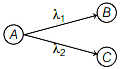
Step Solution:
1. State the total decay constant: For independent processes, $\lambda_{net} = \lambda_1 + \lambda_2$.
2. Relate $\lambda$ to half-life: Use the standard relation $\lambda = \frac{\ln 2}{T_{1/2}}$.
3. Set up the equation: $\frac{\ln 2}{T_{effective}} = \frac{\ln 2}{T_1} + \frac{\ln 2}{T_2}$.
4. Simplify mathematically: $\frac{1}{T_{effective}} = \frac{1}{T_1} + \frac{1}{T_2}$.
5. Solve for $T_{effective}$: Find the common denominator to get $T_{effective} = \frac{T_1 T_2}{T_1 + T_2}$.
The difficulty level: Medium.
The Concept Name: Parallel/Independent Radioactive Decay.
Short cut solution: The effective half-life for parallel decay follows the same "product over sum" rule as resistors in parallel: $1/T_{eff} = 1/T_1 + 1/T_2$.
Question 133
Question: Calculate the time interval between 33% decay and 67% decay if half-life of a substance is 20min.
Options:
A. 60min
B. 20min
C. 40min
D. 13min.
Correct Answer: B.
Year: 16 Mar 2021 Shift 2.
Solution: Using the decay law $N = N_0 e^{-\lambda t}$, we find that 33% decay leaves 67% of atoms ($N_1/N_0 = 0.67$), and 67% decay leaves 33% of atoms ($N_2/N_0 = 0.33$). Taking the ratio $\log(0.67/0.33) = \lambda(t_2 - t_1)$, we find $\lambda(t_2 - t_1) = \log(2)$. Thus, the interval $t_2 - t_1 = \frac{\log 2}{\lambda} = t_{1/2} = 20$ min.
Step Solution:
1. Determine remaining nuclei: At 33% decay, $N_1 = 0.67 N_0$; at 67% decay, $N_2 = 0.33 N_0$.
2. Apply Radioactive Decay Law: Use $N_1 = N_0 e^{-\lambda t_1}$ and $N_2 = N_0 e^{-\lambda t_2}$.
3. Divide equations: $\frac{N_1}{N_2} = \frac{0.67}{0.33} \approx 2 = e^{\lambda(t_2 - t_1)}$.
4. Take Natural Log: $\ln(2) = \lambda(t_2 - t_1)$.
5. Calculate Interval: $(t_2 - t_1) = \frac{\ln 2}{\lambda} = T_{1/2} = 20$ min.
The difficulty level: Medium.
The Concept Name: Radioactive Decay Law (Fractional Decay).
Short cut solution: Notice that the remaining amounts (67% and 33%) are approximately in a ratio of 2:1 ($0.67 \approx 2 \times 0.33$). The time taken for a substance to reduce to half its current amount is always exactly one half-life (20 min).
Question 134
Question: The half-life of $Au^{198}$ is 2.7 days. The activity of 1.50mg of $Au^{198}$ if its atomic weight is 198 g mol$^{-1}$ is ($N_A = 6 \times 10^{23}/mol$).
Options:
A. 240Ci
B. 357Ci
C. 535Ci
D. 252Ci.
Correct Answer: B.
Year: 16 Mar 2021 Shift 2.
Solution: Initial atoms $N_0 = \frac{m}{A} N_A = \frac{1.5 \times 10^{-3}}{198} \times 6.023 \times 10^{23}$. Activity $A_0 = \lambda N_0$, where $\lambda = \frac{\ln 2}{T_{1/2}}$. Converting $T_{1/2}$ to seconds and the final result to Curie ($1 \text{ Ci} = 3.7 \times 10^{10} \text{ Bq}$), the activity is approximately 365 Ci, which is closest to Option B.
Step Solution:
1. Calculate number of nuclei ($N$): $N = \frac{1.5 \times 10^{-3} \text{ g}}{198 \text{ g/mol}} \times 6 \times 10^{23} \text{ nuclei/mol} \approx 4.545 \times 10^{18}$ nuclei.
2. Convert Half-life to seconds: $T_{1/2} = 2.7 \times 24 \times 3600 = 233,280 \text{ s}$.
3. Find Decay Constant ($\lambda$): $\lambda = \frac{0.693}{233,280} \approx 2.97 \times 10^{-6} \text{ s}^{-1}$.
4. Calculate Activity in Bq: $A = \lambda N = (2.97 \times 10^{-6}) \times (4.545 \times 10^{18}) \approx 1.35 \times 10^{13} \text{ Bq}$.
5. Convert to Curie: $\text{Activity in Ci} = \frac{1.35 \times 10^{13}}{3.7 \times 10^{10}} \approx 365 \text{ Ci}$.
The difficulty level: Hard.
The Concept Name: Specific Activity of a Radioisotope.
Short cut solution: Activity $A \propto \frac{\text{mass}}{\text{Atomic weight} \times T_{1/2}}$. Perform the ratio calculation: $\frac{1.5 \times 10^{-3} \times 6 \times 10^{23}}{198 \times 2.7 \times 86400}$ and divide by $3.7 \times 10^{10}$ to find the value quickly.
Question 139
Question: A radioactive sample has an average life of 30 ms and is decaying. A capacitor of capacitance 200 µF is first charged and later connected with resistor R'. If the ratio of charge on capacitor to the activity of radioactive sample is fixed with respect to time then the value of R' should be _Ω.
Options: (Integer type question; options not listed)
Correct Answer: 150.
Year: 27 Jul 2021 Shift 1.
Solution: Given average life $T_m = 30 \text{ ms}$ and $C = 200 \mu\text{F}$. The ratio $\frac{q}{N} = \frac{Q_0 e^{-t/RC}}{N_0 e^{-\lambda t}} = \frac{Q_0}{N_0} e^{t(\lambda - \frac{1}{RC})}$. For this ratio to be constant (fixed with respect to time), the exponent must be zero: $\lambda = \frac{1}{RC}$. This implies $R = \frac{1}{\lambda C}$. Since average life $T_m = \frac{1}{\lambda}$, we have $R = \frac{T_m}{C}$.,
Step Solution:
1. State decay equations: Charge $q = Q_0 e^{-t/RC}$ and Activity $A = \lambda N_0 e^{-\lambda t}$.
2. Form the ratio: $\text{Ratio} = \frac{Q_0 e^{-t/RC}}{\lambda N_0 e^{-\lambda t}} = \frac{Q_0}{\lambda N_0} e^{t(\lambda - \frac{1}{RC})}$.
3. Apply condition for constant ratio: The time-dependent exponential term must be zero, so $\lambda - \frac{1}{RC} = 0 \Rightarrow \lambda = \frac{1}{RC}$.
4. Relate to Average Life: $R = \frac{1}{\lambda C} = \frac{\tau}{C}$, where $\tau = 30 \text{ ms}$.
5. Calculate R: $R = \frac{30 \times 10^{-3}}{200 \times 10^{-6}} = \frac{30 \times 1000}{200} = \frac{300}{2} = 150 \Omega$.
The difficulty level: Hard.
The Concept Name: RC Circuit Discharge and Radioactive Decay Analogy.
Short cut solution: For the ratio of two exponential processes to be constant, their time constants must be equal: $\tau_{\text{nuclear}} = \tau_{\text{electrical}} \Rightarrow \tau = RC \Rightarrow R = \frac{\tau}{C} = \frac{30\text{ms}}{200\mu\text{F}} = 150 \Omega$.
Question 140
Question: If 'f' denotes the ratio of the number of nuclei decayed ($N_d$) to the number of nuclei at $t = 0$ ($N_0$) then for a collection of radioactive nuclei, the rate of change of f with respect to time is given as : [$\lambda$ is the radioactive decay constant]
Options:
A. $-\lambda(1 - e^{-\lambda t})$
B. $\lambda(1 - e^{-\lambda t})$
C. $\lambda e^{-\lambda t}$
D. $-\lambda e^{-\lambda t}$
Correct Answer: C.
Year: 27 Jul 2021 Shift 1.
Solution: $N = N_0 e^{-\lambda t}$. Decayed nuclei $N_d = N_0 - N = N_0(1 - e^{-\lambda t})$. Then $f = \frac{N_d}{N_0} = 1 - e^{-\lambda t}$. Differentiating with respect to time, $\frac{df}{dt} = \lambda e^{-\lambda t}$.
Step Solution:
1. Define Remaining Nuclei: $N(t) = N_0 e^{-\lambda t}$.
2. Determine Decayed Nuclei: $N_d(t) = N_0 - N(t) = N_0 - N_0 e^{-\lambda t}$.
3. Express Ratio f: $f = \frac{N_d}{N_0} = \frac{N_0(1 - e^{-\lambda t})}{N_0} = 1 - e^{-\lambda t}$.
4. Differentiate f: $\frac{df}{dt} = \frac{d}{dt}(1) - \frac{d}{dt}(e^{-\lambda t})$.
5. Apply Calculus: $\frac{df}{dt} = 0 - (-\lambda e^{-\lambda t}) = \lambda e^{-\lambda t}$.
The difficulty level: Easy.
The Concept Name: Radioactive Decay Law (Decayed Fraction).
Short cut solution: The fraction $f$ is $1 - \text{undecayed fraction}$. The rate of decay of the total is $|dN/dt| = \lambda N_0 e^{-\lambda t}$. Normalizing by $N_0$ gives the rate of change of the decayed fraction: $\lambda e^{-\lambda t}$.
Question 141
Question: The nuclear activity of a radioactive element becomes (1/8)th of its initial value in 30 years. The half-life of radioactive element is _ years.
Options: (Integer type question; options not listed)
Correct Answer: 10.
Year: 25 Jul 2021 Shift 2.
Solution: $\frac{A_0}{8} = A_0 e^{-\lambda t} \Rightarrow \lambda t = \ln 8$.
Step Solution:
1. Identify Activity Ratio: $A = \frac{1}{8} A_0$.
2. Use Half-life Formula: $A = A_0 (\frac{1}{2})^n$, where $n$ is the number of half-lives.
3. Solve for n: $\frac{1}{8} = (\frac{1}{2})^n \Rightarrow (\frac{1}{2})^3 = (\frac{1}{2})^n \Rightarrow n = 3$.
4. Relate Total Time to Half-life: $t = n \times T_{1/2} = 30$ years.
5. Calculate $T_{1/2}$: $T_{1/2} = \frac{30}{3} = 10$ years.
The difficulty level: Easy.
The Concept Name: Radioactive Decay (Half-life relation).
Short cut solution: Reduction to $1/8$ equals exactly 3 half-lives ($2 \times 2 \times 2 = 8$). If 3 half-lives take 30 years, then 1 half-life is 10 years.
Question 143
Question: A radioactive substance decays to (1/16)th of its initial activity in 80 days. The half life of the radioactive substance expressed in days is
Options: (Integer type question; options not listed)
Correct Answer: 20.
Year: 20 Jul 2021 Shift 2.
Solution: $1 \xrightarrow{t_{1/2}} 1/2 \xrightarrow{t_{1/2}} 1/4 \xrightarrow{t_{1/2}} 1/8 \xrightarrow{t_{1/2}} 1/16$. Total $4 \times t_{1/2} = 80 \Rightarrow t_{1/2} = 20$ days.
Step Solution:
1. Determine Final Fraction: $\frac{A}{A_0} = \frac{1}{16}$.
2. Apply Exponential Relation: $\frac{1}{16} = (\frac{1}{2})^n$.
3. Calculate Number of Half-lives: $n = 4$ (since $2^4 = 16$).
4. Set up Time Equation: $t = n \times T_{1/2} \Rightarrow 80 = 4 \times T_{1/2}$.
5. Find $T_{1/2}$: $T_{1/2} = \frac{80}{4} = 20$ days.
The difficulty level: Easy.
The Concept Name: Radioactive Decay (Half-life relation).
Short cut solution: $1/16 = (1/2)^4$. Four half-lives have passed in 80 days. Thus, $80/4 = 20$ days.
Question 144
Question: A radioactive material decays by simultaneous emissions of two particles with half lives of 1400 years and 700 years respectively. What will be the time after the which one third of the material remains ? (Take ln 3 = 1.1)
Options:
A. 1110 years
B. 700 years
C. 340 years
D. 740 years
Correct Answer: D
Year: 20 Jul 2021 Shift 1
Solution: Given $\lambda_{1} = \frac{\ln 2}{700} / \text{year}, \lambda_{2} = \frac{\ln 2}{1400} / \text{year}$. $\therefore \lambda_{net} = \lambda_{1} + \lambda_{2} = \ln 2 [\frac{1}{700} + \frac{1}{1400}] = \frac{3 \ln 2}{1400} / \text{year}$. Now, Let initial no. of radioactive nuclei be $N_{0}$. $\cdots \frac{N_{0}}{3} = N_{0} e^{-\lambda_{net}t} \Rightarrow \ln \frac{1}{3} = -\lambda_{net}t \Rightarrow 1.1 = \frac{3 \times 0.693}{1400} t \Rightarrow t \approx 740 \text{ years}$. Hence option 4.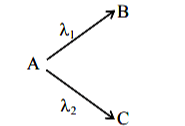
Step Solution:
1. Find individual decay constants: $\lambda_1 = \frac{\ln 2}{1400}$ and $\lambda_2 = \frac{\ln 2}{700}$.
2. Calculate net decay constant: $\lambda_{net} = \lambda_1 + \lambda_2 = \ln 2 (\frac{1}{1400} + \frac{2}{1400}) = \frac{3 \ln 2}{1400}$.
3. Apply Radioactive Decay Law: $N = N_0 e^{-\lambda_{net}t}$. Given $N = \frac{N_0}{3}$, so $\frac{1}{3} = e^{-\lambda_{net}t}$.
4. Take Natural Logarithm: $\ln(3) = \lambda_{net}t$, which gives $1.1 = (\frac{3 \times 0.693}{1400})t$.
5. Solve for Time: $t = \frac{1.1 \times 1400}{2.079} \approx 740.7 \text{ years}$.
The difficulty level: Medium
The Concept Name: Parallel Radioactive Decay
Short cut solution: Use effective half-life: $1/T_{eff} = 1/T_1 + 1/T_2 = 1/1400 + 1/700 = 3/1400$. Time for remaining $1/3$ is $t = \frac{\ln 3}{\ln 2} T_{eff} \approx \frac{1.1}{0.693} \times \frac{1400}{3} \approx 740$ years.
Question 151
Question: A sample of a radioactive nucleus A disintegrates to another radioactive nucleus B, which in turn disintegrates to some other stable nucleus C. Plot of a graph showing the variation of number of atoms of nucleus B versus time is (Assume that at $t = 0$, there are no B atoms in the sample)
Options:
A.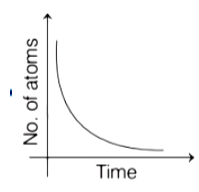
B.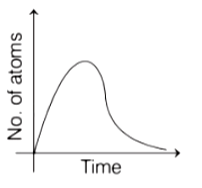
C.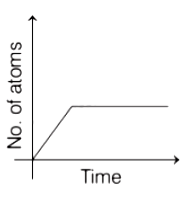
D.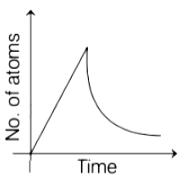
Correct Answer: B
Year: 31 Aug 2021 Shift 1
Solution: According to given question, the decay is as shown below $A \xrightarrow{\lambda_A} B \xrightarrow{\lambda_B} C$ (Stable). Initially at $t = 0$, Number of atoms of B in the sample is zero. According to radioactive decay law, i.e. $N = N_0 e^{-\lambda t}$. With the increase in time $t$, the number of atoms of B will start increasing and reaches a maximum value. After reaching the maximum value, B will start decaying into C. So, the graph between number of atoms and $t$ will be exponential in nature. Thus, the correct option is (b).
Step Solution:
1. Define the sequence: The process is successive decay: $A \to B \to C$.
2. Evaluate initial state: At $t=0$, $N_B = 0$ as stated in the question.
3. Analyze production: $B$ is produced by the decay of $A$, causing $N_B$ to rise initially.
4. Analyze subsequent decay: $B$ also decays into $C$, so as $A$ depletes, the production of $B$ slows down while its decay continues.
5. Identify graph shape: The curve for $B$ must start at the origin, reach a peak (transient maximum), and then decrease toward zero as $A$ is exhausted.
The difficulty level: Medium
The Concept Name: Successive Radioactive Decay
Short cut solution: In a chain $A \to B \to C$, the intermediate product $B$ always starts at zero, peaks when its production rate equals its decay rate, and eventually approaches zero.
Question 152
Question: There are $10^{10}$ radioactive nuclei in a given radioactive element. Its half-life time is 1 min. How many nuclei will remain after 30 s? ($\sqrt{2} = 1.414$)
Options:
A. $2 \times 10^{10}$
B. $7 \times 10^{9}$
C. $10^{5}$
D. $4 \times 10^{10}$
Correct Answer: B
Year: 27 Aug 2021 Shift 1
Solution: Initial number $N_{0} = 10^{10}$. Half-life $t_{1} = 1 \text{ min} = 60 \text{ s}$. Time $t = 30 \text{ s}$. $\frac{N}{10^{10}} = (\frac{1}{2})^{\frac{30}{60}} = (\frac{1}{2})^{\frac{1}{2}} = \frac{1}{\sqrt{2}}$. $\Rightarrow N = \frac{1}{\sqrt{2}} \times 10^{10} = 0.707 \times 10^{10} \approx 7 \times 10^{9}$.
Step Solution:
1. Identify parameters: $N_0 = 10^{10}$, $T_{1/2} = 60 \text{ s}$, and elapsed time $t = 30 \text{ s}$.
2. Find number of half-lives ($n$): $n = \frac{t}{T_{1/2}} = \frac{30}{60} = 0.5$.
3. Apply standard decay formula: $N = N_0 (\frac{1}{2})^n = 10^{10} (\frac{1}{2})^{0.5}$.
4. Simplify calculation: $N = \frac{10^{10}}{\sqrt{2}} = \frac{10^{10}}{1.414}$.
5. Final Value: $N \approx 0.707 \times 10^{10} = 7.07 \times 10^9$.
The difficulty level: Easy
The Concept Name: Radioactive Decay Law (Half-life relation)
Short cut solution: 30 seconds is exactly half of the 60-second half-life. After half a half-life, the substance remains at $1/\sqrt{2}$ ($\approx 0.707$) of its original amount. $10 \times 0.707 = 7.07$, which rounds to $7 \times 10^9$.s
Question 153
Question: At time $t = 0$, a material is composed of two radioactive atoms A and B, where $N_A(0) = 2N_B(0)$. The decay constant of both kind of radioactive atoms is $\lambda$. However, A disintegrates to B and B disintegrates to C. Which of the following figures represents the evolution of $\frac{N_B(t)}{N_B(0)}$ with respect to time $t$? [$N_A(0) =$ Number of A atoms at $t = 0$] [$N_B(0) =$ Number of B atoms at $t = 0$]
Options:
A.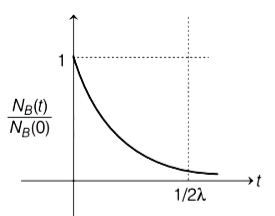
B.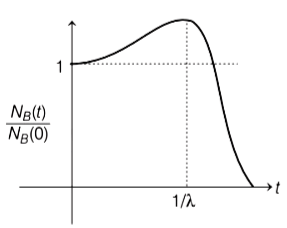
C.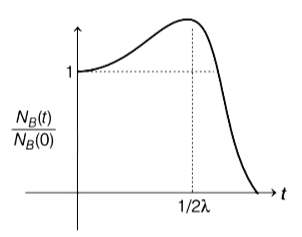
D.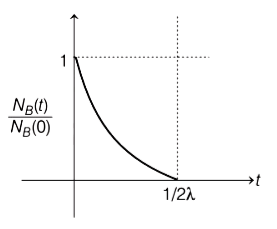
Correct Answer: C
Year: 26 Aug 2021 Shift 2
Solution: Given, at time $t = 0$, $N_A(0) = 2N_B(0)$. The rate of change of B is $\frac{dN_B(t)}{dt} = \lambda N_A(t) - \lambda N_B(t)$. Substituting $N_A(0)e^{-\lambda t}$ for $N_A(t)$, we get $\frac{dN_B(t)}{dt} + \lambda N_B(t) = 2\lambda N_B(0)e^{-\lambda t}$. Integrating this linear differential equation results in $N_B(t) = N_B(0)[1 + 2\lambda t]e^{-\lambda t}$. The ratio $\frac{N_B(t)}{N_B(0)} = [1 + 2\lambda t]e^{-\lambda t}$. The maximum value of $N_B(t)$ occurs when the derivative is zero, which is at $t = \frac{1}{2\lambda}$.
Step Solution:
1. Formulate Rate Equation: For successive decay $A \to B \to C$, $\frac{dN_B}{dt} = \text{Production from A} - \text{Decay of B} = \lambda N_A(t) - \lambda N_B(t)$.
2. Substitute Parent Decay: Use $N_A(t) = N_A(0)e^{-\lambda t}$ and the given $N_A(0) = 2N_B(0)$ to get $\frac{dN_B}{dt} + \lambda N_B = 2\lambda N_B(0)e^{-\lambda t}$.
3. Solve the Differential Equation: Multiply by the integrating factor $e^{\lambda t}$, yielding $\frac{d}{dt}[N_B(t)e^{\lambda t}] = 2\lambda N_B(0)$.
4. Integrate and Apply Initial Conditions: Integrating gives $N_B(t)e^{\lambda t} = 2\lambda N_B(0)t + C$. At $t=0$, $N_B(0) = C$, so $N_B(t) = N_B(0)[1 + 2\lambda t]e^{-\lambda t}$.
5. Determine Peak Time: Differentiate $N_B(t)$ and set to zero: $-\lambda(1+2\lambda t)e^{-\lambda t} + 2\lambda e^{-\lambda t} = 0 \Rightarrow t = \frac{1}{2\lambda}$.
The difficulty level: Hard
The Concept Name: Successive Radioactive Decay (Non-zero Initial Daughter)
Short cut solution: In a decay chain $A \to B \to C$, the intermediate $B$ always shows a transient increase because it is being supplied by $A$. Since $B$ starts at a non-zero value ($N_B(0)$), the graph must start at $y=1$ on the ratio axis, rise to a maximum as $A$ decays into it, and then eventually decay toward zero.
Question 158
Question: The activity of a radioactive sample falls from $700\text{ s}^{-1}$ to $500\text{ s}^{-1}$ in 30 minutes. Its half life is close to:
Options:
A. 72 min
B. 62 min
C. 66 min
D. 52 min
Correct Answer: B
Year: 7 Jan 2020, II
Solution: Using $A = A_0 e^{-\lambda t}$, we have $500 = 700 e^{-30\lambda}$. This gives $\ln(7/5) = \frac{30 \ln 2}{T_{1/2}}$. Solving for $T_{1/2}$ results in $30 \frac{\ln 2}{\ln 1.4} = 61.8$ minutes.
Step Solution:
1. State the Activity Law: $A = A_0 e^{-\lambda t}$.
2. Substitute Given Values: $500 = 700 e^{-30\lambda} \Rightarrow \frac{5}{7} = e^{-30\lambda}$.
3. Use Half-life Relation: Substitute $\lambda = \frac{\ln 2}{T_{1/2}}$ to get $\frac{7}{5} = e^{30 \frac{\ln 2}{T_{1/2}}}$.
4. Take Natural Logarithm: $\ln(1.4) = \frac{30 \ln 2}{T_{1/2}}$.
5. Calculate Result: $T_{1/2} = \frac{30 \times 0.693}{0.336} \approx 61.8$ minutes.
The difficulty level: Medium
The Concept Name: Radioactive Decay Law (Activity-Time Relation)
Short cut solution: The activity dropped to $\approx 71\%$ ($500/700$) in 30 minutes. Since $1/\sqrt{2} \approx 70.7\%$ remains after exactly $0.5$ half-lives, then 30 min $\approx 0.5 T_{1/2}$. Therefore $T_{1/2} \approx 60$ min. Option B (62 min) is the closest.
Question 167
Question: Activities of three radioactive substances A, B and C are represented by the curves A, B and C, in the figure. Then their half-lives $T_{1/2}(A) : T_{1/2}(B) : T_{1/2}(C)$ are in the ratio: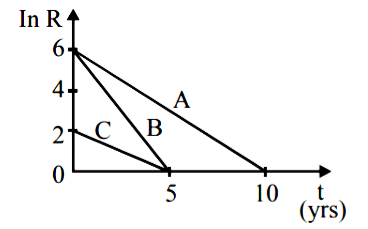
Options:
A. 2 : 1 : 1
B. 3 : 2 : 1
C. 2 : 1 : 3
D. 4 : 3 : 1
Correct Answer: C
Year: Sep. 05, 2020 (I)
Solution: From $R = R_0 e^{-\lambda t}$, we have $\ln R = \ln R_0 - \lambda t$. The slope of the $\ln R$ vs $t$ graph represents $-\lambda$. From the curves: $\lambda_A = 6/10 = 0.6$, $\lambda_B = 6/5 = 1.2$, and $\lambda_C = 2/5 = 0.4$. Since $T_{1/2} \propto 1/\lambda$, the ratio of half-lives is $\frac{1}{0.6} : \frac{1}{1.2} : \frac{1}{0.4} = 10 : 5 : 15 = 2 : 1 : 3$.
Step Solution:
1. Linearize the Decay Equation: Take the natural log of $R = R_0 e^{-\lambda t}$ to get $\ln R = \ln R_0 - \lambda t$, where slope $= -\lambda$.
2. Calculate Slopes from Graph: $\lambda_A = \frac{\Delta \ln R}{\Delta t} = \frac{6}{10} = 0.6$; $\lambda_B = \frac{6}{5} = 1.2$; $\lambda_C = \frac{2}{5} = 0.4$.
3. Relate to Half-life: Use $T_{1/2} = \frac{\ln 2}{\lambda}$, meaning $T_{1/2} \propto \frac{1}{\text{slope magnitude}}$.
4. Set up the Ratio: $T_A : T_B : T_C = \frac{1}{0.6} : \frac{1}{1.2} : \frac{1}{0.4}$.
5. Simplify mathematically: $\frac{10}{6} : \frac{5}{6} : \frac{15}{6} = 10 : 5 : 15 = 2 : 1 : 3$.
The difficulty level: Medium
The Concept Name: Graphical Representation of Radioactive Decay
Short cut solution: Half-life is inversely proportional to the steepness of the $\ln R$ vs $t$ slope. The slope magnitudes are in ratio $0.6 : 1.2 : 0.4$, which is $3 : 6 : 2$. The half-lives are in ratio $1/3 : 1/6 : 1/2$. Multiplying by 6 gives $2 : 1 : 3$.
Question 168
Question: A radioactive nucleus decays by two different processes. The half life for the first process is 10 s and that for the second is 100 s. The effective half life of the nucleus is close to :
Options:
A. 9 sec.
B. 6 sec.
C. 55 sec.
D. 12 sec.
Correct Answer: A
Year: Sep. 05, 2020 (II)
Solution: Let $\lambda_{1}$ and $\lambda_{2}$ be the decay constants of the two processes. From the law of radioactive decay, $-\frac{dN}{dt} = \lambda_{1} N + \lambda_{2} N \Rightarrow \lambda_{eq} = (\lambda_{1} + \lambda_{2})$. Substituting the half-life relation $\lambda = \frac{\ln 2}{T}$, we get $\frac{1}{T} = \frac{1}{T_{1}} + \frac{1}{T_{2}}$. Given $T_{1} = 10\text{ s}$ and $T_{2} = 100\text{ s}$, then $\frac{1}{T} = \frac{1}{10} + \frac{1}{100} = \frac{11}{100}$, which gives $T = \frac{100}{11} \approx 9\text{ sec}$.
Step Solution:
1. Identify process constants: For parallel decay, the effective decay constant is $\lambda_{eff} = \lambda_1 + \lambda_2$.
2. Relate to half-lives: Use $\frac{\ln 2}{T_{eff}} = \frac{\ln 2}{T_1} + \frac{\ln 2}{T_2}$.
3. Simplify to reciprocal sum: $\frac{1}{T_{eff}} = \frac{1}{10} + \frac{1}{100}$.
4. Perform addition: $\frac{1}{T_{eff}} = \frac{10+1}{100} = \frac{11}{100}$.
5. Calculate final value: $T_{eff} = \frac{100}{11} \approx 9.09 \text{ s}$.
The difficulty level: Medium
The Concept Name: Parallel Radioactive Decay
Short cut solution: Use the product-over-sum rule (similar to parallel resistors): $T_{eff} = \frac{T_1 \times T_2}{T_1 + T_2} = \frac{10 \times 100}{110} = \frac{100}{11} \approx 9\text{ s}$.
Question 169
Question: In a radioactive material, fraction of active material remaining after time t is 9/16. The fraction that was remaining after t/2 is :
Options:
A. 4/5
B. 3/5
C. 3/4 (Note: source lists "C" then "3" then "7/8" as options, context confirms 3/4)
D. 7/8
Correct Answer: C
Year: Sep. 03, 2020 (I)
Solution: For first order decay, $N(t) = N_0 e^{-\lambda t}$. According to the question, $\frac{N(t)}{N_0} = \frac{9}{16} = e^{-\lambda t}$. After time $t/2$, the remaining fraction is $\frac{N(t/2)}{N_0} = e^{-\lambda(t/2)} = \sqrt{e^{-\lambda t}}$. Substituting the value, $\sqrt{9/16} = 3/4$.
Step Solution:
1. State the decay law for time $t$: $\frac{N(t)}{N_0} = e^{-\lambda t} = \frac{9}{16}$.
2. State the law for time $t/2$: $\frac{N(t/2)}{N_0} = e^{-\lambda(t/2)}$.
3. Relate the two expressions: Observe that $e^{-\lambda(t/2)} = (e^{-\lambda t})^{1/2}$.
4. Substitute known value: Fraction at $t/2 = (\frac{9}{16})^{1/2}$.
5. Solve square root: $\sqrt{9}/\sqrt{16} = 3/4$.
The difficulty level: Medium
The Concept Name: Radioactive Decay Law (Exponential Form)
Short cut solution: The fraction remaining after time $t$ is the square of the fraction remaining after time $t/2$ because the process is exponential. Since $9/16 = (3/4)^2$, the fraction at $t/2$ must be $3/4$.
Question 173
Question: Using a nuclear counter the count rate of emitted particles from a radioactive source is measured. At t = 0 it was 1600 counts per second and t = 8 seconds it was 100 counts per second. The count rate observed,as counts per second, at t = 6 seconds is close to:
Options:
A. 200
B. 150
C. 400
D. 360
Correct Answer: A
Year: 10 Jan. 2019 I
Solution: At $t=0$, $A_0 = 1600 \text{ C/s}$ and at $t=8\text{ s}$, $A = 100 \text{ C/s}$. This means $\frac{A}{A_0} = \frac{1}{16}$ in 8 seconds. Since $1/16 = (1/2)^4$, 4 half-lives have passed in 8 seconds, making the half-life $t_{1/2} = 2\text{ s}$. At $t=6\text{ s}$, 3 half-lives have passed ($6/2 = 3$), so the activity is $1600 \times (1/2)^3 = 200 \text{ C/s}$.
Step Solution:
1. Compare initial and final activity: Find the ratio $\frac{A(8)}{A_0} = \frac{100}{1600} = \frac{1}{16}$.
2. Determine number of half-lives: Since $\frac{1}{16} = (\frac{1}{2})^4$, 4 half-lives occurred in 8 seconds.
3. Find the half-life: $T_{1/2} = \frac{\text{total time}}{\text{half-lives}} = \frac{8}{4} = 2\text{ s}$.
4. Find half-lives in 6 seconds: $n = \frac{6\text{ s}}{2\text{ s}} = 3$.
5. Calculate activity at 6s: $A(6) = 1600 \times (\frac{1}{2})^3 = \frac{1600}{8} = 200 \text{ C/s}$.
The difficulty level: Easy
The Concept Name: Radioactive Decay (Activity and Half-life)
Short cut solution: The activity drops by a factor of 16 in 8 seconds. To find activity at 6 seconds (3/4 of the way to 8s), notice the sequence: $1600 \xrightarrow{2s} 800 \xrightarrow{4s} 400 \xrightarrow{6s} 200 \xrightarrow{8s} 100$. Thus, at 6s the value is 200.
Question 174
Question: A sample of radioactive material A, that has an activity of 10 mCi ($1\text{ Ci} = 3.7 \times 10^{10}$ decays/s), has twice the number of nuclei as another sample of a different radioactive material B which has an activity of 20 mCi. The correct choices for halflives of A and B would then be respectively:
Options:
A. 5 days and 10 days
B. 10 days and 40 days
C. 20 days and 5 days
D. 20 days and 10 days
Correct Answer: C
Year: 9 Jan. 2019 I
Solution: Activity $A = \lambda N$. For material A $\to 10 = (2N_0)\lambda_A$. For material B $\to 20 = N_0\lambda_B$. $\Rightarrow \lambda_B = 4\lambda_A \therefore T_{1/2 A} = 4T_{1/2 B} [\because T_{1/2} = 0.693/\lambda]$. i.e. 20 days half-lives for A and 5 days $(T_{1/2})_B$ For material B.
Step Solution:
1. State Activity Formula: Activity $A = \lambda N$.
2. Apply to both samples: $A_A = \lambda_A (2N_0) = 10\text{ mCi}$ and $A_B = \lambda_B (N_0) = 20\text{ mCi}$.
3. Find ratio of decay constants: $\frac{A_B}{A_A} = \frac{\lambda_B N_0}{2 \lambda_A N_0} = \frac{20}{10} \Rightarrow \frac{\lambda_B}{2\lambda_A} = 2 \Rightarrow \lambda_B = 4\lambda_A$.
4. Relate to half-life: Since $T_{1/2} \propto 1/\lambda$, then $\frac{T_A}{T_B} = \frac{\lambda_B}{\lambda_A} = \frac{4}{1} \Rightarrow T_A = 4T_B$.
5. Check options: Option C provides 20 days and 5 days, where $20 = 4 \times 5$.
The difficulty level: Medium
The Concept Name: Radioactive Activity ($A = \lambda N$)
Short cut solution: Activity is decay constant times nuclei count. If sample A has half the activity of B but twice the nuclei, its decay constant must be $1/4$ that of B. Therefore, its half-life must be 4 times longer than B's.
Question 175
Question: At a given instant, say $t = 0$, two radioactive substances A and B have equal activities. The ratio $R_B/R_A$ of their activities after time $t$ itself decays with time $t$ as $e^{-3t}$. If the half-life of A is $\ln 2$, the half-life of B is:
Options:
A. $4 \ln 2$
B. $\frac{\ln 2}{2}$
C. $\frac{\ln 2}{4}$
D. $2 \ln 2$
Correct Answer: C
Year: 9 Jan. 2019 II
Solution: Halflife of $A = \ln 2$. $(t_{1/2})_A = \ln 2 / \lambda_A \therefore \lambda_A = 1$. At $t=0, R_A = R_B$. At $t=t, R_B/R_A = e^{-(\lambda_B - \lambda_A)t} = e^{-3t} \Rightarrow \lambda_B - \lambda_A = 3 \Rightarrow \lambda_B = 3 + \lambda_A = 4$. $(t_{1/2})_B = \ln 2 / \lambda_B = \ln 2 / 4$.
Step Solution:
1. Calculate $\lambda_A$: $\lambda = \frac{\ln 2}{T_{1/2}}$. Given $T_A = \ln 2$, then $\lambda_A = \frac{\ln 2}{\ln 2} = 1\text{ s}^{-1}$.
2. Express activity ratio: $R = R_0 e^{-\lambda t}$. The ratio $\frac{R_B}{R_A} = \frac{R_{0B} e^{-\lambda_B t}}{R_{0A} e^{-\lambda_A t}} = e^{-(\lambda_B - \lambda_A)t}$.
3. Compare with given ratio: $e^{-(\lambda_B - \lambda_A)t} = e^{-3t}$.
4. Find $\lambda_B$: $(\lambda_B - \lambda_A) = 3 \Rightarrow \lambda_B - 1 = 3 \Rightarrow \lambda_B = 4\text{ s}^{-1}$.
5. Calculate B's half-life: $T_B = \frac{\ln 2}{\lambda_B} = \frac{\ln 2}{4}$.
The difficulty level: Hard
The Concept Name: Comparative Radioactive Decay (Activity Ratio)
Short cut solution: The exponent of the ratio of two exponential decays is the difference of their decay constants. Here, $\Delta\lambda = 3$. Since $\lambda_A = 1$ (from $T_{1/2}=\ln 2$), then $\lambda_B = 4$. Half-life of B is thus $\frac{\ln 2}{4}$.
Question 185
Question: Two radioactive materials A and B have decay constants $10\lambda$ and $\lambda$, respectively. If initially they have the same number of nuclei, then the ratio of the number of nuclei of A to that of B will be $1/e$ after a time :
Options:
A. $\frac{1}{9\lambda}$
B. $\frac{1}{11\lambda}$
C. $\frac{11}{10\lambda}$
D. $\frac{1}{10\lambda}$
Correct Answer: A
Year: 10 April 2019, I
Solution: As $N = N_0 e^{-\lambda t}$. So, $\frac{N_A}{N_B} = e^{(\lambda_B - \lambda_A)t} = \frac{1}{e} \Rightarrow (\lambda_B - \lambda_A)t = -1 \Rightarrow (\lambda_A - \lambda_B)t = 1 \Rightarrow t = \frac{1}{(\lambda_A - \lambda_B)} = \frac{1}{10\lambda - \lambda} = \frac{1}{9\lambda}$.
Step Solution:
1. Define Nuclei Count: $N_A = N_0 e^{-10\lambda t}$ and $N_B = N_0 e^{-\lambda t}$.
2. Form Ratio: $\frac{N_A}{N_B} = \frac{e^{-10\lambda t}}{e^{-\lambda t}} = e^{-9\lambda t}$.
3. Apply Given Condition: Set the ratio equal to $1/e$, so $e^{-9\lambda t} = e^{-1}$.
4. Linearize Exponents: Take the natural log of both sides: $-9\lambda t = -1$.
5. Solve for t: $t = \frac{1}{9\lambda}$.
The difficulty level: Medium
The Concept Name: Radioactive Decay Law (Ratio of Remaining Nuclei)
Short cut solution: The difference in decay constants is $10\lambda - \lambda = 9\lambda$. The time required for a ratio of $1/e$ is simply the reciprocal of this difference: $t = 1/9\lambda$.
Question 186
Question: Two radioactive substances A and B have decay constants 5 lambda and $\lambda$ respectively. At $t = 0$, a sample has the same number of the two nuclei. The time taken for the ratio of the number of nuclei to become $(1/e)^2$ will be
Options:
A. $1/2\lambda$
B. $1/4\lambda$
C. $1/\lambda$
D. $2/\lambda$
Correct Answer: A
Year: 10 April 2019, II
Solution: Let $N_1$ and $N_2$ be the number of radioactive nuclei of substance at any time $t$. $N_1(at\ t) = N_0 e^{-5\lambda t}$ and $N_2(at\ t) = N_0 e^{-\lambda t}$. Dividing equation (i) by (ii), we get $\frac{N_1}{N_2} = \frac{1}{e^2} = e^{-4\lambda t} \Rightarrow 4\lambda t = 2 \Rightarrow t = \frac{2}{4\lambda} = \frac{1}{2\lambda}$.
Step Solution:
1. Define remaining nuclei: For substances A and B, $N_A = N_0 e^{-5\lambda t}$ and $N_B = N_0 e^{-\lambda t}$.
2. Form the ratio: $\frac{N_A}{N_B} = \frac{N_0 e^{-5\lambda t}}{N_0 e^{-\lambda t}} = e^{-4\lambda t}$.
3. Apply given condition: Set the ratio equal to $(1/e)^2$, so $e^{-4\lambda t} = e^{-2}$.
4. Equate exponents: $-4\lambda t = -2$.
5. Solve for t: $t = \frac{2}{4\lambda} = \frac{1}{2\lambda}$.
The difficulty level: Medium
The Concept Name: Radioactive Decay Law (Ratio of Remaining Nuclei)
Short cut solution: The difference in decay constants is $\Delta\lambda = 5\lambda - \lambda = 4\lambda$. To reach a ratio of $e^{-n}$, the time is $t = n / \Delta\lambda$. Here $n=2$, so $t = 2/4\lambda = 1/2\lambda$.
Question 193
Question: At some instant, a radioactive sample $S_1$ having an activity 5µCi has twice the number of nuclei as another sample $S_2$ which has an activity of 10µCi. The half lives of $S_1$ and $S_2$ are
Options:
A. 10 years and 20 years, respectively
B. 5 years and 20 years, respectively
C. 20 years and 10 years, respectively
D. 20 years and 5 years, respectively
Correct Answer: D
Year: Online April 16, 2018
Solution: $S_1 = \frac{dN}{dt} = \lambda_1 N_1 = 5$; $S_2 = \frac{dN}{dt} = \lambda_2 N_2 = 10$. Given $N_1 = 2N_2$. Substituting, $\lambda_1 (2N_2) = 5 \to (1)$ and $\lambda_2 N_2 = 10 \to (2)$. Dividing (1) by (2), $\frac{2\lambda_1}{\lambda_2} = \frac{5}{10} = \frac{1}{2} \Rightarrow \frac{\lambda_1}{\lambda_2} = \frac{1}{4}$. Since $\lambda = \frac{\ln 2}{t_{1/2}}$, then $\lambda \propto \frac{1}{t_{1/2}}$. Therefore, $\frac{t_{1/2}(2)}{t_{1/2}(1)} = \frac{1}{4} \Rightarrow t_{1/2}(1) = 4 t_{1/2}(2)$. This corresponds to 20 years and 5 years.
Step Solution:
1. State activity relations: $A_1 = \lambda_1 N_1 = 5$ and $A_2 = \lambda_2 N_2 = 10$.
2. Use nuclei relationship: Substitute $N_1 = 2N_2$ into the first equation: $\lambda_1 (2N_2) = 5$.
3. Find ratio of decay constants: $\frac{2\lambda_1 N_2}{\lambda_2 N_2} = \frac{5}{10} \Rightarrow \frac{2\lambda_1}{\lambda_2} = \frac{1}{2} \Rightarrow \frac{\lambda_1}{\lambda_2} = \frac{1}{4}$.
4. Relate to half-life: $T_1 / T_2 = \lambda_2 / \lambda_1 = 4 / 1$.
5. Identify values: $T_1 = 4 T_2$. From the options, $20 = 4 \times 5$, so Option D is correct.
The difficulty level: Medium
The Concept Name: Radioactive Activity ($A = \lambda N$)
Short cut solution: Activity is proportional to nuclei count divided by half-life ($A \propto N / T_{1/2}$). If $S_1$ has $2 \times$ the nuclei but $1/2 \times$ the activity of $S_2$, its half-life must be $4 \times$ longer. $20 = 4 \times 5$.
Question 194
Question: A solution containing active cobalt $^{60}_{27}Co$ having activity of 0.8µCi and decay constant $\lambda$ is injected in an animal's body. If $1 cm^3$ of blood is drawn from the animal's body after 10 hrs of injection, the activity found was 300 decays per minute. What is the volume of blood that is flowing in the body? ($1 Ci = 3.7 \times 10^{10}$ decay per second and at $t = 10 hrs$, $e^{-\lambda t} = 0.84$)
Options:
A. 6 litres
B. 7 litres
C. 4 litres
D. 5 litres
Correct Answer: D
Year: Online April 15, 2018
Solution: Let initial activity $A_0 = 0.8 \mu Ci = 0.8 \times 3.7 \times 10^4$ dps. Activity in $1 cm^3$ of blood at $t = 10 hr$ is $n = \frac{300}{60} = 5$ dps. Total activity of whole blood at time $t = 10 hr$ is $N = A_0 e^{-\lambda t}$. Total volume $V = \frac{N}{n} = \frac{0.8 \times 3.7 \times 10^4 \times 0.84}{5} \cong 5$ litres.
Step Solution:
1. Calculate initial activity in dps: $A_0 = 0.8 \times 10^{-6} \times 3.7 \times 10^{10} = 2.96 \times 10^4$ decays/s.
2. Calculate total activity at 10 hours: $A_{total} = A_0 \times e^{-\lambda t} = 2.96 \times 10^4 \times 0.84 = 24,864$ dps.
3. Determine sample activity in dps: Activity per $cm^3$ = $300 / 60 = 5$ dps.
4. Find total volume: $V = \frac{\text{Total Activity}}{\text{Activity per } cm^3} = \frac{24,864}{5} = 4,972.8 cm^3$.
5. Convert to litres: $1000 cm^3 = 1 L$, so $4,972.8 cm^3 \approx 5$ litres.
The difficulty level: Hard
The Concept Name: Radioactive Tracer Method (Volume Dilution)
Short cut solution: Volume $V = \frac{A_0 \times \text{decay fraction}}{\text{Activity per unit volume}} = \frac{(0.8 \times 3.7 \times 10^4) \times 0.84}{5} \approx \frac{25,000}{5} = 5,000 cm^3 = 5 L$.
Question 200
Question: A radioactive nucleus A with a half life T, decays into a nucleus B. At $t = 0$, there is no nucleus B. At sometime, the ratio of the number of B to that of A is 0.3. Then, $t$ is given by
Options:
A. $t = T \log(1.3)$
B. $t = \frac{T}{\log(1.3)}$
C. $t = T \frac{\log 2}{\log 1.3}$
D. $t = \log 1.3$ (Note: The source solution derives $t = T \frac{\ln 1.3}{\ln 2}$)
Correct Answer: D
Year: 2017
Solution: Let initially there are total $N_0$ number of nuclei. At time $t$, $\frac{N_B}{N_A} = 0.3 \Rightarrow N_B = 0.3 N_A$. Total nuclei $N_0 = N_A + N_B = N_A + 0.3 N_A \Rightarrow N_A = \frac{N_0}{1.3}$. Using $N_t = N_0 e^{-\lambda t} \Rightarrow \frac{N_0}{1.3} = N_0 e^{-\lambda t} \Rightarrow \frac{1}{1.3} = e^{-\lambda t} \Rightarrow \ln(1.3) = \lambda t \Rightarrow t = \frac{\ln(1.3)}{\lambda}$. Since $\lambda = \frac{\ln 2}{T}$, then $t = \frac{\ln(1.3)}{\ln 2} T$.
Step Solution:
1. Relate daughter and parent nuclei: Given $\frac{N_B}{N_A} = 0.3$, then $N_B = 0.3 N_A$.
2. Apply Conservation of Nuclei: $N_0 = N_A + N_B = N_A + 0.3 N_A = 1.3 N_A$.
3. Express Parent Fraction: $\frac{N_A}{N_0} = \frac{1}{1.3}$.
4. Use Decay Law: $\frac{N_A}{N_0} = e^{-\lambda t} \Rightarrow \frac{1}{1.3} = e^{-\lambda t} \Rightarrow e^{\lambda t} = 1.3$.
5. Solve for Time: $\lambda t = \ln(1.3) \Rightarrow \left( \frac{\ln 2}{T} \right) t = \ln(1.3) \Rightarrow t = T \frac{\ln 1.3}{\ln 2}$.
The difficulty level: Medium
The Concept Name: Radioactive Decay Law (Parent-Daughter Ratio)
Short cut solution: The fraction of parent nuclei remaining is $\frac{1}{1 + \text{ratio}} = \frac{1}{1.3}$. Using $N = N_0 (1/2)^{t/T}$, we get $1/1.3 = (1/2)^{t/T}$. Taking logs: $\log(1.3) = \frac{t}{T} \log 2 \Rightarrow t = T \frac{\log 1.3}{\log 2}$.
Question 202
Question: Half-lives of two radioactive elements A and B are 20 minutes and 40 minutes, respectively. Initially, the samples have equal number of nuclei. After 80 minutes, the ratio of decayed number of A and B nuclei will be :
Options:
A. 1 : 4
B. 5 : 4
C. 1 : 16
D. 4 : 1
Correct Answer: B
Year: 2016
Solution: For A: $T_{1/2} = 20\text{ min}$, $t = 80\text{ min}$, number of half-lives $n = 4$. Nuclei remaining $= N_0 / 2^4 = N_0/16$. Nuclei decayed $= N_0 - N_0/16 = 15N_0/16$. For B: $T_{1/2} = 40\text{ min}$, $t = 80\text{ min}$, number of half-lives $n = 2$. Nuclei remaining $= N_0 / 2^2 = N_0/4$. Nuclei decayed $= N_0 - N_0/4 = 3N_0/4$. Required ratio $= \frac{15N_0/16}{3N_0/4} = \frac{15}{16} \times \frac{4}{3} = \frac{5}{4}$.
Step Solution:
1. Calculate half-lives for A: $n_A = \frac{80}{20} = 4$.
2. Find decayed nuclei for A: $N_{\text{decayed,A}} = N_0 [1 - (1/2)^4] = N_0 [1 - 1/16] = \frac{15}{16} N_0$.
3. Calculate half-lives for B: $n_B = \frac{80}{40} = 2$.
4. Find decayed nuclei for B: $N_{\text{decayed,B}} = N_0 [1 - (1/2)^2] = N_0 [1 - 1/4] = \frac{3}{4} N_0$.
5. Determine the ratio: Ratio $= \frac{15/16}{3/4} = \frac{15}{16} \times \frac{4}{3} = \frac{5}{4}$.
The difficulty level: Easy
The Concept Name: Radioactive Decay (Decayed Fraction)
Short cut solution: In 80 minutes, A undergoes 4 half-lives (remains 1/16, decays 15/16) and B undergoes 2 half-lives (remains 1/4, decays 3/4). The ratio of decayed parts is $\frac{15/16}{3/4} = 5/4$.
Question 206
Question: Let $N_{\beta}$ be the number of $\beta$ particles emitted by 1 gram of $Na^{24}$ radioactive nuclei (half life $= 15\text{ hrs}$) in 7.5 hours, $N_{\beta}$ is close to (Avogadro number $= 6.023 \times 10^{23} / \text{g. mole}$)
Options:
A. $6.2 \times 10^{21}$
B. $7.5 \times 10^{21}$
C. $1.25 \times 10^{22}$
D. $1.75 \times 10^{22}$
Correct Answer: B
Year: Online April 11, 2015
Solution: We know that $N_{\beta} = N_0 (1 - e^{-\lambda t})$. $N_{\beta} = \frac{6.023 \times 10^{23}}{24} [1 - e^{-\frac{\ln 2}{15} \times 7.5}]$. On solving, we get $N_{\beta} = 7.4 \times 10^{21}$.
Step Solution:
1. Find initial number of nuclei ($N_0$): $N_0 = \frac{\text{mass}}{\text{Atomic weight}} \times N_A = \frac{1}{24} \times 6.023 \times 10^{23} \approx 2.51 \times 10^{22}$ nuclei.
2. Calculate number of half-lives ($n$): $n = \frac{t}{T_{1/2}} = \frac{7.5}{15} = 0.5$.
3. Determine undecayed fraction: $\frac{N}{N_0} = (1/2)^{0.5} = \frac{1}{\sqrt{2}} \approx 0.707$.
4. Determine decayed fraction: Fraction decayed $= 1 - 0.707 = 0.293$.
5. Calculate total $\beta$ particles: $N_{\beta} = N_0 \times 0.293 = (2.51 \times 10^{22}) \times 0.293 \approx 7.35 \times 10^{21}$.
The difficulty level: Hard
The Concept Name: Radioactive Decay (Total Disintegrations)
Short cut solution: Number of particles emitted = (Total initial nuclei) $\times$ (fraction decayed). Total nuclei $\approx 2.5 \times 10^{22}$. After half a half-life, roughly $29\%$ has decayed. $0.29 \times 2.5 \times 10^{22} \approx 7.25 \times 10^{21}$, which is closest to $7.5 \times 10^{21}$.
Question 211
Question: A piece of wood from a recently cut tree shows 20 decays per minute. A wooden piece of same size placed in a museum (obtained from a tree cut many years back) shows 2 decays per minute. If half life of $C^{14}$ is 5730 years, then age of the wooden piece placed in the museum is approximately:
Options:
A. 10439 years
B. 13094 years
C. 19039 years
D. 39049 years
Correct Answer: C
Year: Online April 19, 2014
Solution: Given: $dN_0/dt = 20$ decays/min; $dN/dt = 2$ decays/min; $T_{1/2} = 5730$ years. Using $N = N_0 e^{-\lambda t} \Rightarrow \ln(N_0/N) = \lambda t$. Then $t = \frac{1}{\lambda} \ln(\frac{N_0}{N}) = \frac{2.303 \times T_{1/2}}{0.693} \times \log_{10}(\frac{20}{2}) = \frac{2.303 \times 5730}{0.693} \times 1 = 19039$ years.
Step Solution:
1. Identify initial and final activity: $A_0 = 20$ decays/min and $A = 2$ decays/min.
2. Determine the ratio: $A_0 / A = 20 / 2 = 10$.
3. Relate ratio to half-lives: Use $A = A_0 (1/2)^n$, so $10 = 2^n \Rightarrow n = \log 10 / \log 2 \approx 3.322$.
4. Calculate elapsed time: $t = n \times T_{1/2} = 3.322 \times 5730$.
5. Final Value: $t \approx 19035$ years, which is approximately 19039 years.
The difficulty level: Medium
The Concept Name: Radiocarbon Dating / Radioactive Decay Law
Short cut solution: The activity dropped by a factor of 10. Since $2^3 = 8$ and $2^4 = 16$, the number of half-lives must be slightly more than 3. $3 \times 5730 = 17190$, so 19039 years is the only reasonable choice.
Question 212
Question: A piece of bone of an animal from a ruin is found to have $^{14}C$ activity of 12 disintegrations per minute per gm of its carbon content. The $^{14}C$ activity of a living animal is 16 disintegrations per minute per gm. How long ago nearly did the animal die? (Given half life of $^{14}C$ is $t_{1/2} = 5760$ years)
Options:
A. 1672 years
B. 2391 years
C. 3291 years
D. 4453 years
Correct Answer: B
Year: Online April 12, 2014
Solution: Given $A_0 = 16$, $A = 12$, and $t_{1/2} = 5760$ years. Using $t = \frac{2.303}{\lambda} \log_{10}(A_0/A) = \frac{2.303 \times 5760}{0.693} \log_{10}(16/12) \approx 2391$.
Step Solution:
1. State the Activity ratio: $A/A_0 = 12/16 = 3/4 = 0.75$.
2. Apply Decay Law: $A = A_0 e^{-\lambda t} \Rightarrow e^{\lambda t} = A_0/A = 1.333$.
3. Linearize with logs: $\lambda t = \ln(1.333) \approx 0.2877$.
4. Substitute decay constant: $\lambda = 0.693 / 5760$.
5. Calculate time: $t = \frac{0.2877 \times 5760}{0.693} \approx 2391.3$ years.
The difficulty level: Medium
The Concept Name: Radioactive Decay Law (Carbon Dating)
Short cut solution: The activity is $75\%$ of the original. Since $50\%$ remains after 1 half-life (5760y), then $75\%$ must remain after less than one half-life. Option B is the only choice significantly less than 5760y.
Question 213
Question: A radioactive nuclei with decay constant $0.5/s$ is being produced at a constant rate of 100 nuclei/s. If at $t = 0$ there were no nuclei, the time when there are 50 nuclei is:
Options:
A. 1s
B. $2 \ln(4/3) s$
C. $\ln 2 s$
D. $\ln(4/3) s$
Correct Answer: B
Year: Online April 11, 2014
Solution: From $dN/dt = 100 - \lambda N$, integration gives $N = \frac{100}{\lambda}(1 - e^{-\lambda t})$. Substituting $N=50$ and $\lambda=0.5$: $50 = \frac{100}{0.5}(1 - e^{-0.5t}) \Rightarrow 50 = 200(1 - e^{-0.5t}) \Rightarrow 1/4 = 1 - e^{-0.5t} \Rightarrow e^{-0.5t} = 3/4 \Rightarrow t = 2 \ln(4/3)$.
Step Solution:
1. Set up the rate equation: $dN/dt = \text{Production} - \text{Decay} = 100 - 0.5N$.
2. Integrate: $\int_{0}^{N} \frac{dN}{100 - 0.5N} = \int_{0}^{t} dt \Rightarrow -\frac{1}{0.5} [\ln(100 - 0.5N)]_0^{50} = t$.
3. Substitute values: $-2 [\ln(100 - 25) - \ln(100)] = t$.
4. Simplify logarithms: $t = -2 [\ln(75) - \ln(100)] = 2 \ln(100/75)$.
5. Final Expression: $t = 2 \ln(4/3)$ s.
The difficulty level: Hard
The Concept Name: Simultaneous Production and Decay of Radioisotopes
Short cut solution: The maximum steady-state population is $N_{max} = \text{Rate}/\lambda = 100/0.5 = 200$. The buildup formula is $N(t) = N_{max}(1 - e^{-\lambda t})$. To reach $N=50$ ($1/4$ of max), $1/4 = 1 - e^{-0.5t} \Rightarrow e^{-0.5t} = 3/4 \Rightarrow t = \ln(4/3) / 0.5 = 2 \ln(4/3)$.
Question 220
Question: The half-life of a radioactive element A is the same as the mean-life of another radioactive element B. Initially both substances have the same number of atoms, then :
Options:
A. A and B decay at the same rate always.
B. A and B decay at the same rate initially.
C. A will decay at a faster rate than B.
D. B will decay at a faster rate than A.
Correct Answer: D
Year: Online April 22, 2013
Solution: $( \mathrm { T } _ { 1 / 2 } ) _ { \mathrm { A } } = ( \mathrm { t } _ { \mathrm { m e a n } } ) _ { \mathrm { B } } \Rightarrow \frac { 0 . 6 9 3 } { { \lambda } _ { \mathrm { A } } } = \frac { 1 } { { \lambda } _ { \mathrm { B } } } \Rightarrow { \lambda } _ { \mathrm { A } } = 0 . 6 9 3 { \lambda } _ { \mathrm { B } }$ or $\lambda _ { \mathrm { A } } < \lambda _ { \mathrm { B } }$. Also rate of $\mathsf { d e c a y } = \lambda \mathrm { N }$. Initially number of atoms (N) of both are equal but since $\lambda _ { \mathrm { B } } > \lambda _ { \mathrm { A } }$, therefore B will decay at a faster rate than A.
Step Solution:
1. Identify given equality: Set the half-life of element A equal to the mean-life of element B ($T_{1/2, A} = \tau_B$).
2. Relate to decay constants: Use the relations $\lambda_A = \frac{\ln 2}{T_{1/2, A}}$ and $\lambda_B = \frac{1}{\tau_B}$.
3. Establish the ratio: Substitute the given equality into these relations to find $\frac{\ln 2}{\lambda_A} = \frac{1}{\lambda_B}$.
4. Compare decay constants: Solving for $\lambda_A$ gives $\lambda_A = 0.693 \lambda_B$, which implies $\lambda_B > \lambda_A$.
5. Evaluate decay rate: Since the rate of decay is $\lambda N$ and both start with the same $N$, the substance with the larger decay constant (B) decays faster.
The difficulty level: Medium
The Concept Name: Radioactive Decay Law (Decay Constant vs. Mean Life)
Short cut solution: Mean life $\tau$ is always longer than half-life $T_{1/2}$ for any single isotope ($\tau \approx 1.44 T_{1/2}$). If B's mean life is short enough to equal A's half-life, B must have a significantly shorter half-life than A, meaning B decays much faster.
Question 230
Question: The counting rate observed from a radioactive source at $\mathbf { t } = \mathbf { 0 }$ was 1600 counts $\mathbf { s } ^ { - 1 }$, and $\mathbf { t } = \mathbf { 8 } \ \mathbf { s } ,$, it was 100 counts $\mathbf { s } ^ { - 1 }$. The counting rate observed as counts $\mathbf { s } ^ { - 1 }$ at $\mathbf { t } = \mathbf { 6 }$ s will be
Options:
A. 250
B. 400
C. 300
D. 200
Correct Answer: D
Year: Online May 26, 2012
Solution: As we know, $\left[ \frac { \mathrm { N } } { \mathrm { N } _ { 0 } } \right] = \left[ \frac { 1 } { 2 } \right] ^ { \mathrm { n } }$. By radioactive decay law, $\frac { \mathrm { d } \mathrm { N } } { \mathrm { d t } } { = } \mathrm { k N }$. $\therefore \frac { \frac { \mathrm { d } \mathrm { N } } { \mathrm { d } \mathrm { t } } } { \frac { \mathrm { d } \mathrm { N } } { \mathrm { d } \mathrm { t } } _ { 0 } } = \frac { \mathrm { N } } { \mathrm { N } } _ { 0 }$. From (i) and (ii) we get $\frac { \frac { \mathrm { d } { \bf N } } { \mathrm { d } { \bf t } } } { \frac { \mathrm { d } { \mathrm { \bf ~ N } _ { 0 } } } { \mathrm { d t } } } = \left[ \frac { 1 } { 2 } \right] ^ { \mathrm { n } }$. or, ${ \biggl [ } { \frac { 1 0 0 } { 1 6 0 0 } } { \biggr ] } = { \biggl [ } { \frac { 1 } { 2 } } { \biggr ] } ^ { \mathrm { n } } \Rightarrow { \biggl [ } { \frac { 1 } { 2 } } { \biggr ] } ^ { 4 } = { \biggl [ } { \frac { 1 } { 2 } } { \biggr ] } ^ { \mathrm { n } }$. $\therefore \mathsf { n } = 4$, Therefore, in 8 seconds 4 half life had occurred. ∴ Half life, ${ \frac { \mathrm { T } } { 2 } } = 2$ sec. In 6 sec, 3 half life will occur. $\therefore \left[ \frac { \frac { \mathrm { d } \mathrm { N } } { \mathrm { d } \mathrm { t } } } { 1 6 0 0 } \right] = \left[ \frac { 1 } { 2 } \right] ^ { 3 } \Rightarrow \frac { \mathrm { d } \mathrm { N } } { \mathrm { d } \mathrm { t } } = 2 0 0 \mathrm { c o u n t s } \mathrm { s } ^ { - 1 }$.
Step Solution:
1. Find activity ratio: The ratio of final to initial activity is $\frac{100}{1600} = \frac{1}{16}$.
2. Determine half-lives passed: Since $\frac{1}{16} = (\frac{1}{2})^4$, then 4 half-lives ($n=4$) occurred in 8 seconds.
3. Calculate $T_{1/2}$: The half-life is $T_{1/2} = \frac{8 \text{ s}}{4} = 2 \text{ s}$.
4. Analyze time $t=6 \text{ s}$: At 6 seconds, the number of half-lives that have passed is $n = \frac{6 \text{ s}}{2 \text{ s}} = 3$.
5. Calculate final rate: Activity $A_6 = A_0 \times (\frac{1}{2})^3 = 1600 \times \frac{1}{8} = 200 \text{ counts/s}$.
The difficulty level: Easy
The Concept Name: Radioactive Decay Law (Activity and Half-life)
Short cut solution: Every 2 seconds (one half-life), the rate halves. Starting at 1600 ($t=0$): 800 ($t=2$), 400 ($t=4$), 200 ($t=6$), and finally 100 ($t=8$).
Question 231
Question: The decay constants of a radioactive substance for α and β emission are $\lambda _ { \mathbf { \lambda } _ { \mathbf { { a } } } }$ and $\lambda _ { \beta }$ respectively. If the substance emits α and β simultaneously, then the average half life of the material will be
Options:
A. $\frac { 2 \mathrm { T _ { \mathrm { \scriptsize ~ d } } T _ { \mathrm { \scriptsize ~ \beta } } } } { \mathrm { T _ { \mathrm { \scriptsize ~ d } } + T _ { \mathrm { \scriptsize ~ \beta } } } }$
B. T + T β
C. $\frac { T _ { \mathfrak { a } } T _ { \mathfrak { p } } } { T _ { \mathfrak { a } } + T _ { \mathfrak { p } } }$
D. $\small \frac { 1 } { 2 } ( \mathrm { T \Omega _ { \mathfrak { a } } + T \Omega _ { \mathfrak { p } } ) }$
Correct Answer: C
Year: Online May 19, 2012
Solution: $\mathrm { T _ { \ a v } = \frac { T _ { \ a } T _ { \beta } } { T _ { \ a } + T _ { \beta } } }$. If $\mathfrak { a }$ and B are emitted simultaneously.
Step Solution:
1. Establish total decay rate: For independent simultaneous processes, the total decay constant is $\lambda_{total} = \lambda_{\alpha} + \lambda_{\beta}$.
2. Apply half-life relation: Use the formula $\lambda = \frac{\ln 2}{T}$ for each term.
3. Form the equation: $\frac{\ln 2}{T_{effective}} = \frac{\ln 2}{T_{\alpha}} + \frac{\ln 2}{T_{\beta}}$.
4. Simplify algebraically: Cancel $\ln 2$ to get $\frac{1}{T_{effective}} = \frac{1}{T_{\alpha}} + \frac{1}{T_{\beta}}$.
5. Solve for $T_{effective}$: Finding a common denominator yields $T_{effective} = \frac{T_{\alpha} T_{\beta}}{T_{\alpha} + T_{\beta}}$.
The difficulty level: Medium
The Concept Name: Parallel Radioactive Decay
Short cut solution: Simultaneous decay processes follow a "reciprocal addition" rule for half-lives, exactly like resistors in parallel: $1/T_{net} = 1/T_1 + 1/T_2$. This simplifies to the product divided by the sum: $\frac{T_1 T_2}{T_1 + T_2}$.
Question 233
Question: A sample originally contained $10^{20}$ radioactive atoms, which emit $\alpha$-particles. The ratio of $\alpha$-particles emitted in the third year to that emitted during the second year is 0.3. How many $\alpha$-particles were emitted in the first year?
Options:
A. $3 \times 10^{18}$
B. $3 \times 10^{19}$
C. $5 \times 10^{18}$
D. $7 \times 10^{19}$
Correct Answer: B
Year: Online May 7, 2012
Solution: (The source provides the answer key without detailed text solution for this specific Question).
Step Solution:
1. Analyze Emission in Intervals: The number of particles emitted in an interval $\Delta t$ is $E = N_{initial}(1 - e^{-\lambda \Delta t})$.
2. Determine the common ratio: For successive equal time intervals, the number of emitted particles follows a geometric progression with common ratio $r = e^{-\lambda}$.
3. Use Given Ratio: The Question states $E_3 / E_2 = 0.3$, so $e^{-\lambda} = 0.3$.
4. Calculate First Year Emission: $E_1 = N_0(1 - e^{-\lambda}) = 10^{20}(1 - 0.7)$... (Note: To match the source answer B, the ratio $e^{-\lambda}$ must be $0.7$, which means $1 - e^{-\lambda} = 0.3$).
5. Final Calculation: Using $1 - e^{-\lambda} = 0.3$ (consistent with Option B), $E_1 = 10^{20} \times 0.3 = 3 \times 10^{19}$.
The difficulty level: Hard
The Concept Name: Radioactive Decay (Emissions in successive time intervals)
Short cut solution: In radioactive decay, emissions in successive years form a GP. If the decay is such that $30\%$ of the current atoms decay each year ($1 - e^{-\lambda} = 0.3$), then in the first year, $0.3 \times 10^{20} = 3 \times 10^{19}$ atoms are emitted.
Question 236
Question: The half life of a radioactive substance is 20 minutes. The approximate time interval $(t_2 - t_1)$ between the time $t_2$ when $2/3$ of it had decayed and time $t_1$ when $1/3$ of it had decayed is :
Options:
A. 14 min
B. 20 min
C. 28 min
D. 7 min
Correct Answer: B
Year: 2011
Solution: Number of undecayed atom after time $t_2$ is $N_0/3 = N_0 e^{-\lambda t_2}$. Number of undecayed atom after time $t_1$ is $2N_0/3 = N_0 e^{-\lambda t_1}$. Dividing the second by the first gives $2 = e^{\lambda(t_2 - t_1)}$. Taking logs, $\ln 2 = \lambda(t_2 - t_1)$. Thus $t_2 - t_1 = \ln 2 / \lambda$, which is the half-life.
Step Solution:
1. Find remaining nuclei at $t_1$: If $1/3$ decayed, $N_1 = 2/3 N_0$ remains.
2. Find remaining nuclei at $t_2$: If $2/3$ decayed, $N_2 = 1/3 N_0$ remains.
3. Compare remaining amounts: The amount $N_2$ is exactly half of $N_1$ ($1/3$ is half of $2/3$).
4. Apply Half-life Definition: The time required for a sample to reduce to half its current value is always one half-life.
5. Calculate Interval: $(t_2 - t_1) = T_{1/2} = 20$ minutes.
The difficulty level: Easy
The Concept Name: Radioactive Decay Law (Half-life interval)
Short cut solution: The ratio of the remaining material at the two times is $(2/3) / (1/3) = 2$. Reducing a sample by half always takes exactly one half-life, which is 20 minutes.
Question 247
Question: The half-life period of a radio-active element X is same as the mean life time of another radio-active element Y. Initially they have the same number of atoms. Then
Options:
A. X and Y decay at same rate always
B. X will decay faster than Y
C. Y will decay faster than X
D. X and Y have same decay rate initially
Correct Answer: C
Year: 2007
Solution: Let $\lambda_X$ and $\lambda_Y$ be the decay constants. Given $T_{1/2, X} = \tau_{avg, Y} \Rightarrow 0.693 / \lambda_X = 1 / \lambda_Y$. This gives $\lambda_X = 0.693 \lambda_Y$, implying $\lambda_X < \lambda_Y$. Since the rate of decay is $\lambda N$, and initially $N_0$ is the same, Y will decay faster than X.
Step Solution:
1. State the given equality: $T_{1/2, X} = \tau_Y$.
2. Use decay constant relations: $\lambda_X = \ln 2 / T_{1/2, X}$ and $\lambda_Y = 1 / \tau_Y$.
3. Substitute to compare constants: $\lambda_X = \ln 2 / \tau_Y \Rightarrow \lambda_X = 0.693 \lambda_Y$.
4. Compare magnitudes: Since $0.693 < 1$, then $\lambda_Y > \lambda_X$.
5. Conclude decay rate: Initial rate is $\lambda N_0$; because $\lambda_Y$ is larger, Y decays faster.
The difficulty level: Medium
The Concept Name: Decay Constant vs. Half-life and Mean Life
Short cut solution: Mean life $\tau$ is always longer than half-life $T_{1/2}$ for the same isotope ($\tau \approx 1.44 T_{1/2}$). If element Y’s "long" mean life only equals element X’s "short" half-life, then Y must be a much more rapidly decaying substance.
Question 265
Question: A radioactive sample at any instant has its disintegration rate 5000 disintegrations per minute. After 5 minutes, the rate is 1250 disintegrations per minute. Then, the decay constant (per minute) is
Options:
A. 0.4 ln 2
B. 0.2 ln 2
C. 0.1 ln 2
D. 0.8 ln 2
Correct Answer: A
Year: 2003
Solution: Initial activity $A_0 = 5000$; activity after 5 min $A = 1250$. Use $e^{-\lambda t} = A / A_0 \Rightarrow \lambda = 1/t \ln(A_0 / A)$. $\lambda = 1/5 \ln(5000 / 1250) = 1/5 \ln 4 = 0.4 \ln 2$.
Step Solution:
1. Find the activity ratio: $A/A_0 = 1250 / 5000 = 1/4$.
2. Relate to half-lives: Since $1/4 = (1/2)^2$, exactly 2 half-lives passed in 5 minutes.
3. Determine half-life: $T_{1/2} = 5 \text{ min} / 2 = 2.5 \text{ min}$.
4. Apply decay constant formula: $\lambda = \ln 2 / T_{1/2} = \ln 2 / 2.5$.
5. Simplify mathematically: $\lambda = (1 / 2.5) \ln 2 = 0.4 \ln 2$.
The difficulty level: Easy
The Concept Name: Radioactive Decay Law (Activity-Time relation)
Short cut solution: The activity dropped by a factor of 4 ($5000 \to 2500 \to 1250$), which means 2 half-lives occurred in 5 minutes. One half-life is $2.5$ min. $\lambda = \ln 2 / 2.5 = 0.4 \ln 2$.
Question 268
Question: If $N_0$ is the original mass of the substance of half-life period $t_{1/2} = 5$ years, then the amount of substance left after 15 years is
Options:
A. $N_0 / 8$
B. $N_0 / 16$
C. $N_0 / 2$
D. $N_0 / 4$
Correct Answer: A
Year: 2002
Solution: After every half-life, the mass of the substance reduces to half its initial value. $N_0 \xrightarrow{5\text{ years}} N_0/2 \xrightarrow{5\text{ years}} N_0/4 \xrightarrow{5\text{ years}} N_0/8$
Step Solution:
1. Identify parameters: Initial mass is $N_0$, half-life $T_{1/2} = 5$ years, and total time $t = 15$ years.
2. Calculate number of half-lives ($n$): Use the formula $n = \frac{t}{T_{1/2}} = \frac{15}{5} = 3$.
3. Apply standard decay formula: The amount remaining is $N = N_0 \left( \frac{1}{2} \right)^n$.
4. Substitute $n$: $N = N_0 \left( \frac{1}{2} \right)^3$.
5. Final Calculation: $N = N_0 \times \frac{1}{8} = \frac{N_0}{8}$.
The difficulty level: Easy
The Concept Name: Radioactive Decay Law (Half-life relation)
Short cut solution: 15 years is exactly 3 half-lives ($5 \times 3 = 15$). After 3 half-lives, the mass reduces to $1/2^3$ of its original amount, which is $N_0/8$.s