Question 30
Question: If two charges $q_1$ and $q_2$ are separated with distance ' d ' and placed in a medium of dielectric constant K. What will be the equivalent distance between charges in air for the same electrostatic force?
Options:
A. $d\sqrt{k}$
B. $k\sqrt{d}$
C. $1.5d\sqrt{k}$
D. 2$d\sqrt{k}$
Correct Answer: Option A
Year: JEE Main 2023 (24-Jan-2023 Shift 1)
Solution:
$F_{Air} = \frac{1}{4 \pi \varepsilon_0} \frac{q_1 q_2}{d'^2}$
$F_{Medium} = \frac{1}{4 \pi \varepsilon_0 K} \frac{q_1 q_2}{d^2}$
Equating $F_{Air} = F_{Medium} \implies \frac{q_1 q_2}{4 \pi \varepsilon_0 K d^2} = \frac{q_1 q_2}{4 \pi \varepsilon_0 d'^2}$
$d'^2 = Kd^2 \implies d' = d\sqrt{k}$
Step Solution:
1. Express the force between charges in a medium: $F_{med} = \frac{1}{4\pi\epsilon_0 K} \frac{q_1 q_2}{d^2}$.
2. Express the force between charges in air at a new distance $d'$: $F_{air} = \frac{1}{4\pi\epsilon_0} \frac{q_1 q_2}{d'^2}$.
3. Set the forces equal: $\frac{1}{4\pi\epsilon_0 K} \frac{q_1 q_2}{d^2} = \frac{1}{4\pi\epsilon_0} \frac{q_1 q_2}{d'^2}$.
4. Simplify the equation: $\frac{1}{Kd^2} = \frac{1}{d'^2}$.
5. Solve for $d'$: $d' = \sqrt{Kd^2} = d\sqrt{K}$.
Difficulty Level: Easy
Concept Name: Coulomb’s Law in a Dielectric Medium
Short cut solution: The effective distance in air for a charge in a dielectric is always $d_{eff} = d\sqrt{K}$.
Question 38
Question: A point charge $q_1 = 4q_0$ is placed at origin. Another point charge $q_2 = -q_0$ is placed at $x = 12$ cm. Charge of proton is $q_0$. The proton is placed on X-axis so that the electrostatic force on the proton in zero. In this situation, the position of the proton from the origin is ____ cm.
Options: N/A (Numerical/Integer Type)
Correct Answer: 24
Year: JEE Main 2023 (29-Jan-2023 Shift 1)
Solution:
$\frac{q_0}{x^2} = \frac{4q_0}{(x + 12)^2}$
$x + 12 = 2x \implies x = 12$
Distance from origin $= x + 12 = 24$ cm
Step Solution:
1. Let the proton be placed at a point $P$ at distance $x$ from $q_2$ (where $x > 0$ and $P$ is outside the charges).
2. Set the magnitudes of the forces from $q_1$ and $q_2$ to be equal: $\frac{k(4q_0)q_p}{(12+x)^2} = \frac{k(q_0)q_p}{x^2}$.
3. Simplify the equation: $\frac{4}{(12+x)^2} = \frac{1}{x^2}$.
4. Take the square root of both sides: $\frac{2}{12+x} = \frac{1}{x}$.
5. Solve for $x$: $2x = 12 + x \implies x = 12$. The position from origin is $12 + 12 = 24$ cm.
Difficulty Level: Medium
Concept Name: Electrostatic Equilibrium / Coulomb's Law
Short cut solution: For two opposite charges $Q$ and $q$ ($Q > q$) separated by distance $L$, the neutral point from the smaller charge $q$ is $x = \frac{L}{\sqrt{Q/q} - 1} = \frac{12}{\sqrt{4/1} - 1} = 12$. Total distance $= 12 + 12 = 24$ cm.
Question 51
Question: Two equal positive point charges are separated by a distance $2a$. The distance of a point from the centre of the line joining two charges on the equatorial line (perpendicular bisector) at which force experienced by a test charge $q_0$ becomes maximum is $\frac{a}{\sqrt{x}}$. The value of $x$ is ____.
Options: N/A (Numerical/Integer Type)
Correct Answer: 2
Year: JEE Main 2023 (1-Feb-2023 Shift 1)
Solution:
$F = \frac{2Kqq_0x}{(x^2 + a^2)^{3/2}}$
For $F$ to be maximum $\frac{dF}{dx} = 0 \implies x = \frac{a}{\sqrt{2}}$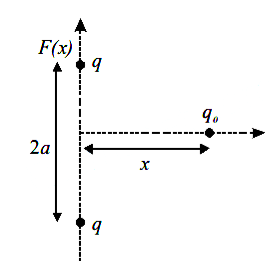
Step Solution:
1. The net force on $q_0$ at a distance $x$ on the equatorial line is $F = \frac{2kqq_0x}{(x^2 + a^2)^{3/2}}$.
2. Differentiate $F$ with respect to $x$ using the quotient rule: $\frac{dF}{dx} = 2kqq_0 \left[ \frac{(x^2+a^2)^{3/2} - x \cdot \frac{3}{2}(x^2+a^2)^{1/2}(2x)}{(x^2+a^2)^3} \right]$.
3. For maximum force, set the numerator to zero: $(x^2+a^2)^{3/2} - 3x^2(x^2+a^2)^{1/2} = 0$.
4. Divide by $(x^2+a^2)^{1/2}$: $(x^2+a^2) - 3x^2 = 0 \implies a^2 = 2x^2$.
5. Solve for $x$: $x = \frac{a}{\sqrt{2}}$. Comparing with $\frac{a}{\sqrt{x}}$, we get $x = 2$.
Difficulty Level: Hard
Concept Name: Maximization of Electrostatic Force
Short cut solution: The electric field (and thus force) due to two identical charges separation $2a$ is always maximum on the equatorial line at $x = \frac{a}{\sqrt{2}}$. Comparing this to $\frac{a}{\sqrt{x}}$ immediately gives $x = 2$.
Question 60
Question: An electron revolves around an infinite cylindrical wire having uniform linear charge density $2 \times 10^{-8} \mathrm{~C} \mathrm{~m}^{-1}$ in circular path under the influence of attractive electrostatic field as shown in the figure. The velocity of electron with which it is revolving is $\_\_ \times 10^{6} \mathrm{~m} \mathrm{~s}^{-1}$. Given mass of electron $m = 9 \times 10^{-31} \mathrm{~kg}$.
Options: None (Numerical/Integer Type).
Correct Answer: 8.
Year: 10-Apr-2023 shift 2.
Solution: In uniform circular motion, $F_c = m a_c$. $(q)(E) = \frac{mv^2}{r}$. $(e)\left(\frac{2k\lambda}{r}\right) = \frac{mv^2}{r}$. $v^2 = \frac{(e)(2k\lambda)}{m} = \frac{(1.6 \times 10^{-19}) \times 2 \times (9 \times 10^9) \times (2 \times 10^{-8})}{9 \times 10^{-31}}$. $v^2 = 1.6 \times 4 \times 10^{13} = 16 \times 4 \times 10^{12}$. $v = 8 \times 10^6 \mathrm{~m/s}$.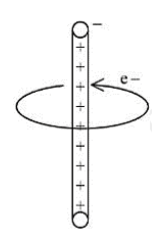
Step Solution:
1. Equate Forces: The electrostatic force exerted by the infinite wire provides the necessary centripetal force for the electron's circular orbit: $q E = \frac{m v^{2}}{r}$.
2. Substitute Field Formula: Use the expression for the electric field of an infinite line charge, $E = \frac{2 k \lambda}{r}$, where $k = 9 \times 10^{9} \mathrm{~N} \mathrm{~m}^{2} / \mathrm{C}^{2}$: $e\left(\frac{2 k \lambda}{r}\right) = \frac{m v^{2}}{r}$.
3. Isolate Velocity: Cancel the orbital radius $r$ from both sides, showing that the velocity is independent of the distance from the wire: $v^{2} = \frac{2 e k \lambda}{m}$.
4. Plug in Values: Substitute $e = 1.6 \times 10^{-19} \mathrm{~C}$, $k = 9 \times 10^{9}$, $\lambda = 2 \times 10^{-8} \mathrm{~C} \mathrm{~m}^{-1}$, and $m = 9 \times 10^{-31} \mathrm{~kg}$: $v^{2} = \frac{2 \times (1.6 \times 10^{-19}) \times (9 \times 10^{9}) \times (2 \times 10^{-8})}{9 \times 10^{-31}}$.
5. Final Calculation: $v^{2} = \frac{5.76 \times 10^{-17}}{9 \times 10^{-31}} = 0.64 \times 10^{14} = 64 \times 10^{12} \Rightarrow v = 8 \times 10^{6} \mathrm{~m/s}$.
The difficulty level: Medium.
The Concept Name: Motion of a Charged Particle in an Electric Field / Gauss's Law Application.
Short cut solution: Use the derived relation $v = \sqrt{\frac{2 e k \lambda}{m}}$. Since the term $9 \times 10^{9}$ in $k$ cancels with the $9 \times 10^{-31}$ in the mass $m$, the calculation simplifies to $\sqrt{2 \times 1.6 \times 2 \times 10^{(9-19-8+31)}} = \sqrt{6.4 \times 10^{13}} = \sqrt{64 \times 10^{12}} = 8 \times 10^{6} \mathrm{~m/s}$.
Question 61
Question: As shown in the figure, a configuration of two equal point charges $(q_0 = +2 \mu \mathrm{C})$ is placed on an inclined plane. Mass of each point charge is 20g. Assume that there is no friction between charge and plane. For the system of two point charges to be in equilibrium (at rest) the height $h = x \times 10^{-3} \mathrm{~m}$. The value of $x$ is (Take $\frac{1}{4\pi\varepsilon_0} = 9 \times 10^9 \mathrm{~Nm}^2\mathrm{C}^{-2}$, $g = 10 \mathrm{~ms}^{-2}$).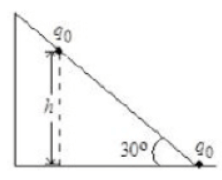
Options: N/A (Numerical/Integer Type)
Correct Answer: 300
Year: JEE Main 2023 (11-Apr-2023 Shift 1)
Solution:
Point charge on equilibrium is at rest.
$\frac{kq_0 q_0}{r^2} - mg \sin \theta = 0$
$\frac{kq_0^2}{\sin 30^\circ} = \frac{mg}{2}$ (Note: There is a typographical error in the source's scribbled solution, but the final calculation follows standard physics)
$\frac{x \times 10^9 \times (2 \times 10^{-6})^2}{4h^2} = \frac{20 \times 10^{-3} \times 10}{2}$
$x = 300$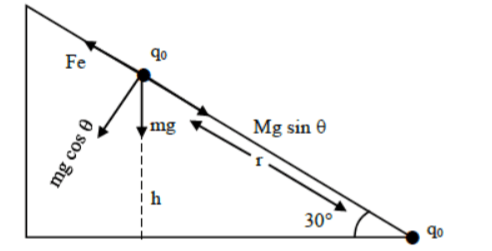
Step Solution:
1. Identify the forces acting on the upper charge: the electrostatic repulsion $F_e = \frac{kq_0^2}{r^2}$ acting up the incline and the component of gravity $F_g = mg \sin 30^\circ$ acting down the incline.
2. Relate the separation distance $r$ to the height $h$: Since $\sin 30^\circ = h/r$, then $r = h / \sin 30^\circ = 2h$.
3. Set the forces equal for equilibrium: $\frac{kq_0^2}{(2h)^2} = mg \sin 30^\circ$.
4. Substitute given values: $\frac{(9 \times 10^9) (2 \times 10^{-6})^2}{4h^2} = (20 \times 10^{-3}) (10) (0.5)$.
5. Solve for $h^2$: $\frac{0.036}{4h^2} = 0.1 \implies 0.009 = 0.1h^2 \implies h^2 = 0.09$, so $h = 0.3 \mathrm{~m}$. Comparing with $x \times 10^{-3}$, $x = 300$.
Difficulty Level: Hard
Concept Name: Electrostatic Equilibrium on an Inclined Plane
Short cut solution: In equilibrium, $h = \sqrt{\frac{kq_0^2}{4mg \sin \theta}}$. Direct substitution yields $h = 0.3$, so $x = 300$.
Question 66
Question: A 10µC charge is divided into two parts and placed at 1 cm distance so that the repulsive force between them is maximum. The charges of the two parts are:
Options:
A. 7 µC, 3 µC
B. 8 µC, 2 µC
C. 9 µC, 1 µC
D. 5 µC, 5 µC
Correct Answer: Option D
Year: JEE Main 2023 (13-Apr-2023 Shift 2)
Solution:
Divide $q = 10 \mu\mathrm{C}$ into parts $(x)$ and $(q - x)$
$F = \frac{(K)(x)(q - x)}{r^2}$
For F to be maximum $\frac{dF}{dx} = 0 \implies x = \frac{q}{2} = \frac{10 \mu\mathrm{C}}{2} = 5 \mu\mathrm{C}$
$q - x = 10 \mu\mathrm{C} - 5 \mu\mathrm{C} = 5 \mu\mathrm{C}$
Step Solution:
1. Let the two parts be $q_1 = x$ and $q_2 = (10 - x) \mu\mathrm{C}$.
2. Write the formula for electrostatic force: $F = \frac{k \cdot x(10-x)}{r^2}$.
3. To maximize $F$, differentiate the numerator $f(x) = 10x - x^2$ with respect to $x$.
4. Set the derivative to zero: $10 - 2x = 0$.
5. Solve for $x$: $x = 5 \mu\mathrm{C}$. The other part is $10 - 5 = 5 \mu\mathrm{C}$.
Difficulty Level: Easy
Concept Name: Maximization of Electrostatic Force / Differentiation
Short cut solution: The product of two numbers with a fixed sum is maximum when the two numbers are equal ($x = y = \text{Sum}/2$). Thus, $10/2 = 5 \mu\mathrm{C}$ each.
Question 67
Question: Three point charges q, -2q and 2q are placed on x-axis at a distance $x = 0$, $x = \frac{3}{4} R$ and $x = R$ respectively from origin as shown. If $q = 2 \times 10^{-6} \mathrm{~C}$ and $R = 2 \mathrm{~cm}$, the magnitude of net force experienced by the charge -2q is ____ N.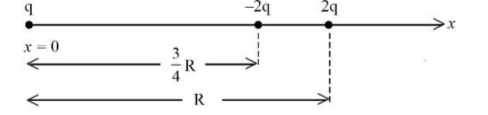
Options: N/A (Numerical/Integer Type)
Correct Answer: 5440
Year: JEE Main 2023
Solution:
$F_{BA} = \frac{32kq^2}{9R^2}$
$F_{BC} = \frac{64kq^2}{R^2}$
$F_B = F_{BC} - F_{BA} = \frac{544kq^2}{9R^2} = 5440 \mathrm{~N}$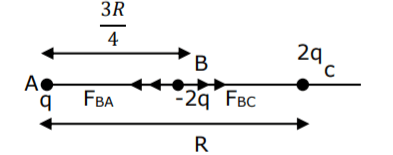
Step Solution:
1. Calculate the magnitude of the force from charge $q$ (at $x=0$) on $-2q$ (at $x=3/4 R$): $F_1 = \frac{k(q)(2q)}{(3/4 R)^2} = \frac{2kq^2}{9/16 R^2} = \frac{32kq^2}{9R^2}$.
2. Calculate the magnitude of the force from charge $2q$ (at $x=R$) on $-2q$ (at $x=3/4 R$): $F_2 = \frac{k(2q)(2q)}{(R - 3/4 R)^2} = \frac{4kq^2}{(1/4 R)^2} = \frac{64kq^2}{R^2}$.
3. Identify directions: $F_1$ is attractive (towards origin/-x), and $F_2$ is attractive (towards $x=R$/+x).
4. Find the net force: $F_{net} = F_2 - F_1 = \frac{64kq^2}{R^2} - \frac{32kq^2}{9R^2} = \frac{kq^2}{R^2} (64 - 3.55) = \frac{544kq^2}{9R^2}$.
5. Substitute numerical values: $F_{net} = \frac{544 \times (9 \times 10^9) \times (2 \times 10^{-6})^2}{9 \times (0.02)^2} = \frac{544 \times 9 \times 10^9 \times 4 \times 10^{-12}}{9 \times 0.0004} = 5440 \mathrm{~N}$.
Difficulty Level: Medium
Concept Name: Principle of Superposition / Coulomb’s Law
Short cut solution: Calculate magnitudes $F_1$ and $F_2$ separately and subtract the smaller from the larger since they act in opposite directions along the x-axis.
Question 81
Question: A vertical electric field of magnitude $4.9 \times 10^5 \mathrm{~N/C}$ just prevents a water droplet of a mass 0.1g from falling. The value of charge on the droplet will be : (Given : $g = 9.8 \mathrm{~m/s}^2$)
Options:
A. $1.6 \times 10^{-9} \mathrm{~C}$
B. $2.0 \times 10^{-9} \mathrm{~C}$
C. $3.2 \times 10^{-9} \mathrm{~C}$
D. $0.5 \times 10^{-9} \mathrm{~C}$
Correct Answer: Option B
Year: JEE Main 2022 (24-Jun-2022 Shift 1)
Solution: Since the droplet is at rest $\Rightarrow$ Net force $= 0 \Rightarrow mg = qE \Rightarrow q = \frac{mg}{E} = 2 \times 10^{-9} \mathrm{~C}$.
Step Solution:
1. Convert mass to kilograms: $m = 0.1 \mathrm{~g} = 10^{-4} \mathrm{~kg}$.
2. Identify the equilibrium condition: The upward electric force ($qE$) must balance the downward gravitational force ($mg$).
3. Set up the equation: $q \times (4.9 \times 10^5) = (10^{-4}) \times (9.8)$.
4. Isolate the charge: $q = \frac{9.8 \times 10^{-4}}{4.9 \times 10^5}$.
5. Calculate the final value: $q = 2 \times 10^{-9} \mathrm{~C}$.
Difficulty Level: Easy
Concept Name: Electrostatic Equilibrium
Short cut solution: Use the direct formula $q = \frac{mg}{E}$.
Question 82
Question: Two identical charged particles each having a mass 10g and charge $2.0 \times 10^{-7} \mathrm{~C}$ are placed on a horizontal table with a separation of L between them such that they stay in limited equilibrium. If the coefficient of friction between each particle and the table is 0.25, find the value of L. [Use $g = 10 \mathrm{~ms}^{-2}$]
Options:
A. 12 cm
B. 10 cm
C. 8 cm
D. 5 cm
Correct Answer: Option A
Year: JEE Main 2022 (24-Jun-2022 Shift 2)
Solution: According to given information: $\frac{kQ^2}{L^2} = \mu mg$. Putting the values, we get $L = 12 \mathrm{~cm}$.
Step Solution:
1. Calculate the limiting frictional force: $f = \mu mg = 0.25 \times (10 \times 10^{-3} \mathrm{~kg}) \times 10 \mathrm{~ms}^{-2} = 0.025 \mathrm{~N}$.
2. At limiting equilibrium, the electrostatic repulsion force equals the frictional force: $\frac{kQ^2}{L^2} = f$.
3. Substitute the known values: $\frac{(9 \times 10^9) \times (2.0 \times 10^{-7})^2}{L^2} = 0.025$.
4. Simplify to solve for $L^2$: $L^2 = \frac{9 \times 10^9 \times 4 \times 10^{-14}}{0.025} = \frac{36 \times 10^{-5}}{0.025} = 144 \times 10^{-4} \mathrm{~m}^2$.
5. Take the square root: $L = \sqrt{144 \times 10^{-4}} = 0.12 \mathrm{~m} = 12 \mathrm{~cm}$.
Difficulty Level: Medium
Concept Name: Coulomb’s Law and Limiting Friction
Short cut solution: Use $L = Q \sqrt{\frac{k}{\mu mg}}$ to directly calculate the separation.
Question 88
Question: Three identical charged balls each of charge 2C are suspended from a common point P by silk threads of 2m each (as shown in figure). They form an equilateral triangle of side 1m. The ratio of net force on a charged ball to the force between any two charged balls will be: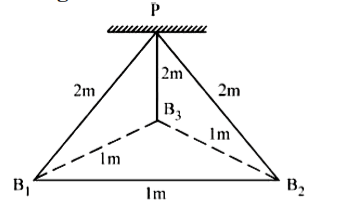
Options:
A. 1 : 1
B. 1 : 4
C. $\sqrt{3} : 2$
D. $\sqrt{3} : 1$
Correct Answer: Option D
Year: JEE Main 2022 (27-Jun-2022 Shift 2)
Solution: $F_2 = \frac{kq^2}{ }$. So, $\frac{F_1}{F_2} = \sqrt{3}$.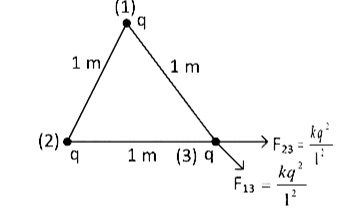
Step Solution:
1. Let the electrostatic force between any two charges be $F$.
2. Each charge experiences two forces of magnitude $F$ from the other two charges.
3. In an equilateral triangle, the angle between these two force vectors is $60^{\circ}$.
4. The magnitude of the resultant (net) force is $F_{net} = \sqrt{F^2 + F^2 + 2FF \cos 60^{\circ}}$.
5. Calculate the ratio: $F_{net} = \sqrt{2F^2 + 2F^2(1/2)} = \sqrt{3F^2} = \sqrt{3}F$. Thus, the ratio $\frac{F_{net}}{F} = \sqrt{3} : 1$.
Difficulty Level: Medium
Concept Name: Principle of Superposition / Vector Addition of Forces
Short cut solution: The resultant of two equal vectors $F$ at an angle of $60^{\circ}$ is always $\sqrt{3}F$. Comparing this to a single force $F$ immediately gives the ratio $\sqrt{3} : 1$.
Question 100
Question: The charge on capacitor of capacitance 15µF in the figure given below is :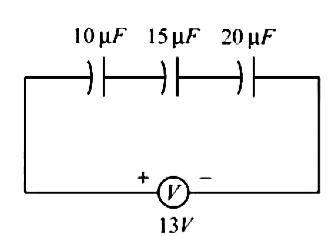
Options:
A. $60 \mu \mathrm{C}$
B. $130 \mu \epsilon$
C. $260 \mu \mathrm{C}$
D. $585 \mu \mathrm{C}$
Correct Answer: A
Year: JEE Main 2022 (Contextual inference from surrounding questions)
Solution: (As given in source) $\mathrm{C}_{eq} = \frac{120}{26} \mu \mathrm{F}$. $\Rightarrow \mathrm{Q}$ flown or $\mathrm{Q} = \frac{13 \times 120}{26} \mu \mathrm{C} = 60 \mu \mathrm{C}$. $\Rightarrow$ Charge on $15 \mu \mathrm{F}$ capacitor $= 60 \mu \mathrm{C}$ As all the capacitors are in series.
Step Solution:
1. Identify Circuit Type: The capacitors in the network are connected in a series configuration.
2. Apply Series Property: In a series circuit, the magnitude of the charge (Q) is the same on every capacitor and equal to the total charge drawn from the battery.
3. Obtain Equivalent Capacitance: The source provides the equivalent capacitance as $\mathrm{C}_{eq} = \frac{120}{26} \mu \mathrm{F}$.
4. Calculate Total Charge: Using the formula $Q = \mathrm{C}_{eq} \times V$ and the implied source voltage of $13\mathrm{V}$: $Q = \left( \frac{120}{26} \mu \mathrm{F} \right) \times 13 \mathrm{V}$.
5. Final Computation: $Q = \frac{120}{2} = \mathbf{60 \mu \mathrm{C}}$.
The difficulty level: Easy.
The Concept Name: Combination of Capacitors (Series Circuit).
Short cut solution: In a series combination, you only need to calculate the total charge $Q$ drawn from the source, as $Q_{total} = Q_1 = Q_2 = Q_3$. Given $\mathrm{C}_{eq}$ and $V$, the calculation $\frac{120}{26} \times 13$ directly yields $60 \mu \mathrm{C}$.
Question 102
Question: A force of 10N acts on a charged particle placed between two plates of a charged capacitor. If one plate of capacitor is removed, then the force acting on that particle will be.
Options:
A. 5N
B. 10N
C. 20N
D. Zero
Correct Answer: Option A
Year: 27-Jun-2022-Shift-1
Solution: E between two plates is $\frac{\sigma}{\varepsilon_0}$ and due to one plate is $\frac{\sigma}{2\varepsilon_0}$ so the force will be halved $\varepsilon_0$. So new force F = 5N.
Step Solution:
1. Identify the net electric field between two plates of a capacitor: $E_{net} = \frac{\sigma}{\varepsilon_0}$.
2. Relate the given force to this field: $F = qE_{net} = 10\text{ N}$.
3. Determine the electric field produced by a single isolated plate: $E_{single} = \frac{\sigma}{2\varepsilon_0}$.
4. Note that $E_{single} = \frac{1}{2} E_{net}$.
5. Calculate the new force: $F_{new} = qE_{single} = q(\frac{1}{2} E_{net}) = \frac{10}{2} = 5\text{ N}$.
Difficulty Level: Easy
Concept Name: Electric Field of a Uniformly Charged Infinite Plane Sheet
Short cut solution: The electric field between two plates is the sum of fields from both; removing one plate removes exactly half the field, thus halving the force to 5N.
Question 111
Question: Three point charges of magnitude 5µC, 0.16µC and 0.3µC are located at the vertices A, B, C of a right angled triangle whose sides are AB = 3 cm., BC = $3\sqrt{2}$ cm and CA = 3 cm and point A is the right angle corner. Charge at point A experiences ____ N of electrostatic force due to the other two charges.
Options: N/A (Numerical Type)
Correct Answer: 17
Year: 26-Jul-2022-Shift-2
Solution: $F_1 = \frac{k \times 5 \times 0.3 \times 10^{-12}}{9 \times 10^{-4}} = \frac{9 \times 10^9 \times 5 \times 0.3 \times 10^{-12}}{9 \times 10^{-4}} = 15\text{ N}$. $F_2 = \frac{9 \times 10^9 \times 5 \times 0.16 \times 10^{-12}}{9 \times 10^{-4}} = 8\text{ N}$. force experienced by charge at A $= \sqrt{F_1^2 + F_2^2} = \sqrt{15^2 + 8^2} = \sqrt{289} = 17\text{ N}$.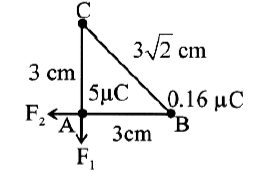
Step Solution:
1. Identify the distances: $r_{AB} = 3\text{ cm}$ and $r_{AC} = 3\text{ cm}$.
2. Calculate force from charge at C on A: $F_1 = \frac{(9 \times 10^9) \times (5 \times 10^{-6}) \times (0.3 \times 10^{-6})}{(0.03)^2} = 15\text{ N}$.
3. Calculate force from charge at B on A: $F_2 = \frac{(9 \times 10^9) \times (5 \times 10^{-6}) \times (0.16 \times 10^{-6})}{(0.03)^2} = 8\text{ N}$.
4. Since A is the right-angle corner, the force vectors $F_1$ and $F_2$ are perpendicular ($90^\circ$).
5. Find the resultant magnitude: $F_{net} = \sqrt{15^2 + 8^2} = \sqrt{225 + 64} = 17\text{ N}$.
Difficulty Level: Medium
Concept Name: Principle of Superposition / Pythagorean Theorem
Short cut solution: Recognize the perpendicular forces 8N and 15N form a standard Pythagorean triplet (8, 15, 17), making the result 17N instantly.
Question 113
Question: A charge of 4µC is to be divided into two. The distance between the two divided charges is constant. The magnitude of the divided charges so that the force between them is maximum, will be :
Options:
A. 1 µC and 3 µC
B. 2 µC and 2 µC
C. 0 and 4 µC
D. 1.5 µC and 2.5 µC
Correct Answer: Option B
Year: 27-Jul-2022-Shift-2
Solution: $F = \frac{Kq(4 - q)}{d^2}$. (Maximum at $q=2$).
Step Solution:
1. Let the first charge be $q$ and the second be $(4 - q)$.
2. The force between them is $F = \frac{k \cdot q(4-q)}{r^2} = \frac{k(4q - q^2)}{r^2}$.
3. To maximize force, differentiate $4q - q^2$ with respect to $q$.
4. Set the derivative to zero: $4 - 2q = 0$.
5. Solve for $q$: $q = 2\mu\text{C}$, meaning the other part is $4 - 2 = 2\mu\text{C}$.
Difficulty Level: Easy
Concept Name: Maxima and Minima in Electrostatics
Short cut solution: For any two quantities with a constant sum, their product is maximum when the quantities are equal ($4/2 = 2$).
Question 117
Question: Two identical metallic spheres A and B when placed at certain distance in air repel each other with a force of F. Another identical uncharged sphere C is first placed in contact with A and then in contact with B and finally placed at midpoint between spheres A and B. The force experienced by sphere C will be:
Options:
A. 3F ∕ 2
B. 3F ∕ 4
C. F
D. 2F
Correct Answer: Option B
Year: 29-Jul-2022-Shift-2
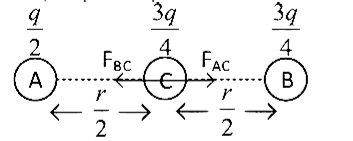
Solution: Let charge be $q$ and distance $r$, so $F = \frac{kq^2}{r^2}$. Contact C with A: $q_A = q_C = q/2$. Then contact C with B: $q_B = q_C = \frac{q + q/2}{2} = 3q/4$. At midpoint: $F_{AC} = \frac{k(q/2)(3q/4)}{(r/2)^2} = \frac{3F}{2}$ and $F_{BC} = \frac{k(3q/4)(3q/4)}{(r/2)^2} = \frac{9F}{4}$. Net force $= F_{BC} - F_{AC} = \frac{9F}{4} - \frac{6F}{4} = \frac{3F}{4}$.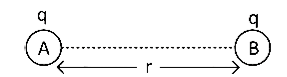 ;
;
Step Solution:
1. Define initial force: $F = \frac{kq^2}{r^2}$. Contact C with A shares charge equally: $q_A = \frac{q}{2}, q_C = \frac{q}{2}$.
2. Contact C with B shares their total charge ($q + \frac{q}{2} = \frac{3q}{2}$): $q_B = \frac{3q}{4}, q_C = \frac{3q}{4}$.
3. Calculate repulsion from A on C at midpoint ($r/2$): $F_{AC} = \frac{k(q/2)(3q/4)}{(r/2)^2} = \frac{3kq^2}{2r^2} = \frac{3F}{2}$.
4. Calculate repulsion from B on C at midpoint ($r/2$): $F_{BC} = \frac{k(3q/4)(3q/4)}{(r/2)^2} = \frac{9kq^2}{4r^2} = \frac{9F}{4}$.
5. Find net force (subtracting opposite directions): $F_{net} = \frac{9F}{4} - \frac{3F}{2} = \frac{3F}{4}$.
Difficulty Level: Hard
Concept Name: Distribution of Charge by Contact / Coulomb's Law
Short cut solution: Track charge fractions: $A=1/2, B=3/4, C=3/4$. Ratio of forces at midpoint distance $(1/2)$ is $4 \times (q_1 q_2)$. $F_{net} = 4[ (3/4 \cdot 3/4) - (1/2 \cdot 3/4) ] = 4[ 9/16 - 6/16 ] = 4[3/16] = 3/4$.