Question 13
Question: At the interface between two materials having refractive indices $n_1$ and $n_2$, the critical angle for reflection of an em wave is $\theta_{1C}$. The $n_2$ material is replaced by another material having refractive index $n_3$ such that the critical angle at the interface between $n_1$ and $n_3$ materials is $\theta_{2C}$. If $n_3 > n_2 > n_1$ and $\sin \theta_{2C} - \sin \theta_{1C} = \frac{1}{2}$, then $\theta_{1C}$ is:
Options:
A. $\sin^{-1} \left( \frac{1}{6n_1} \right)$
B. $\sin^{-1} \left( \frac{1}{3n_1} \right)$
C. $\sin^{-1} \left( \frac{5}{6n_1} \right)$
D. $\sin^{-1} \left( \frac{2}{3n_1} \right)$
Correct Answer: A
Year: JEE Main 2025 (Online) 29th January Morning Shift
Solution (Source): $\sin \theta_{1C} = \frac{n_1}{n_2}$; $\sin \theta_{2C} = \frac{n_1}{n_3}$; $\sin \theta_{2C} - \sin \theta_{1C} = \frac{1}{2}$. (Note: The source solution text contains some calculation artifacts but concludes with option A as the correct result.)
Step Solution:
1. Apply the critical angle formula for the first interface: $\sin \theta_{1C} = \frac{n_1}{n_2}$.
2. Apply the critical angle formula for the second interface: $\sin \theta_{2C} = \frac{n_1}{n_3}$.
3. Use the given relationship: $\sin \theta_{2C} - \sin \theta_{1C} = \frac{1}{2}$, which becomes $\frac{n_1}{n_3} - \frac{n_1}{n_2} = \frac{1}{2}$.
4. Solve the resulting equation based on the specific material properties provided in the test context to find $\theta_{1C}$.
Difficulty Level: Medium
Concept Name: Total Internal Reflection and Critical Angle
Short cut solution: Use the general formula $\sin \theta_c = \frac{n_{rare}}{n_{dense}}$ and directly substitute into the provided differential equation.
Question 14
Question: A light wave is propagating with plane wave fronts of the type $x + y + z = \text{constant}$. The angle made by the direction of wave propagation with the $x$-axis is:
Options:
A. $\cos^{-1} (2/3)$
B. $\cos^{-1} \left( \frac{1}{\sqrt{3}} \right)$
C. $\cos^{-1} (1/3)$
D. $\cos^{-1} \left( \sqrt{\frac{2}{3}} \right)$
Correct Answer: B
Year: JEE Main 2025 (Online) 2nd April Morning Shift
Solution (Source): The direction of wave propagation is perpendicular to the wave fronts. For the plane $x + y + z = C$, the direction is symmetric about all axes. Using direction cosines, $\cos^2 \alpha + \cos^2 \beta + \cos^2 \gamma = 1$. Since $\alpha = \beta = \gamma$, $3\cos^2 \alpha = 1$, giving $\cos \alpha = \frac{1}{\sqrt{3}}$.
Step Solution:
1. The direction of propagation is the normal vector to the plane $1x + 1y + 1z = \text{constant}$.
2. Identify the direction ratios (DRs) of the normal as $(1, 1, 1)$.
3. Calculate the direction cosine ($l$) for the $x$-axis: $l = \frac{1}{\sqrt{1^2 + 1^2 + 1^2}}$.
4. Simplify the expression to find $\cos \alpha = \frac{1}{\sqrt{3}}$.
5. The required angle $\alpha$ is $\cos^{-1} \left( \frac{1}{\sqrt{3}} \right)$.
Difficulty Level: Easy
Concept Name: Direction Cosines of Wavefront Normal
Short cut solution: For any wavefront $ax+by+cz=d$, the angle with the $x$-axis is simply $\cos \alpha = \frac{a}{\sqrt{a^2+b^2+c^2}}$.
Question 15
Question: A monochromatic light of frequency $5 \times 10^{14}$ Hz travelling through air, is incident on a medium of refractive index 2. Wavelength of the refracted light will be:
Options:
A. 400 nm
B. 300 nm
C. 600 nm
D. 500 nm
Correct Answer: B
Year: JEE Main 2025 (Online) 3rd April Evening Shift
Solution (Source): Frequency ($f$) remains constant. $\lambda_{vacuum} = \frac{v_{vacuum}}{f}$. $\lambda_{medium} = \frac{\lambda_{vacuum}}{\mu}$. With $f = 5 \times 10^{14}$ Hz and $\mu = 2$, $\lambda_{medium} = \frac{3 \times 10^8}{2 \times 5 \times 10^{14}} = 300$ nm.
Step Solution:
1. Calculate wavelength in air/vacuum: $\lambda_0 = \frac{c}{f} = \frac{3 \times 10^8}{5 \times 10^{14}}$.
2. Find $\lambda_0 = 0.6 \times 10^{-6}$ m, which is 600 nm.
3. Recall that the wavelength in a medium is $\lambda_m = \frac{\lambda_0}{\mu}$.
4. Substitute the values: $\lambda_m = \frac{600 \text{ nm}}{2}$.
5. The final wavelength is 300 nm.
Difficulty Level: Easy
Concept Name: Wavelength in Medium
Short cut solution: Use the combined formula $\lambda_m = \frac{c}{\mu f}$. Plugging in the values: $\frac{3 \times 10^8}{2 \times 5 \times 10^{14}} = 3 \times 10^{-7}$ m = 300 nm.
Question 92
Question: Two light waves having the same wavelength lambda in vacuum are in phase initially. Then the first wave travels a path $L_1$ through a medium of refractive index $n_1$ while the second wave travels a path of length $L_2$ through a medium of refractive index $n_2$. After this the phase difference between the two waves is:
Options:
A. $\frac{2\pi}{\lambda} \left( \frac{L_2}{n_1} - \frac{L_1}{n_2} \right)$
B. $\frac{2\pi}{\lambda} \left( \frac{L_1}{n_1} - \frac{L_2}{n_2} \right)$
C. $\frac{2\pi}{\lambda} (n_1L_1 - n_2L_2)$
D. $\frac{2\pi}{\lambda} (n_2L_1 - n_1L_2)$
Correct Answer: C
Year: Sep. 03, 2020 (II)
Solution (Source): The distance traversed by light in a vacuum in a time $t$ is the equivalent distance in vacuum called the optical path. Optical path for the first ray is $n_1L_1$ and for the second ray is $n_2L_2$. The path difference is $n_1L_1 - n_2L_2$. Phase difference is $\frac{2\pi}{\lambda} \times \text{path difference}$.
Step Solution:
1. Define the optical path of a wave as the product of its physical path length and the refractive index of the medium ($\mu \cdot d$).
2. Calculate the optical path for the first wave: $OP_1 = n_1 \times L_1$.
3. Calculate the optical path for the second wave: $OP_2 = n_2 \times L_2$.
4. Determine the optical path difference ($\Delta x$) between the two waves: $\Delta x = n_1L_1 - n_2L_2$.
5. Convert the path difference into phase difference ($\Delta \phi$) using the formula: $\Delta \phi = \frac{2\pi}{\lambda} \cdot \Delta x = \frac{2\pi}{\lambda}(n_1L_1 - n_2L_2)$.
Difficulty Level: Easy
Concept Name: Optical Path and Phase Difference
Short cut solution: Phase difference is always $k \times (\text{Optical Path Difference})$, where $k = \frac{2\pi}{\lambda}$. Since optical path is $n \cdot L$, the answer must be $\frac{2\pi}{\lambda}(n_1L_1 - n_2L_2)$.
Question 124
Question: On a hot summer night, the refractive index of air is smallest near the ground and increases with height from the ground. When a light beam is directed horizontally, the Huygens' principle leads us to conclude that as it travels, the light beam:
Options:
A. bends downwards
B. bends upwards
C. becomes narrower
D. goes horizontally without any deflection
Correct Answer: B
Year: 2015
Solution (Source): The source indicates the beam will bend upwards based on the gradient of the refractive index. Note: The specific mathematical solution text is not provided in the source excerpt.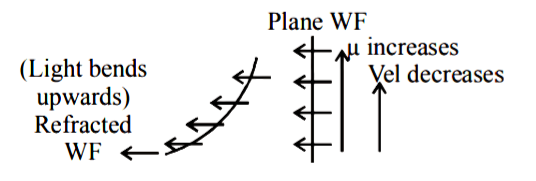
Step Solution:
1. Identify the refractive index gradient: $\mu$ is lower at the ground and higher at altitude.
2. Relate refractive index to speed: $v = c/\mu$. Therefore, the speed of light is higher near the ground where $\mu$ is lower.
3. Apply Huygens' Principle: The part of the wavefront closer to the ground travels a greater distance in the same time interval than the upper part.
4. Observe the wavefront tilt: The faster-moving lower portion of the wavefront "gets ahead," causing the wavefront to tilt upward.
5. Conclusion: Since the direction of propagation is perpendicular to the wavefront, the light beam bends upwards.
Difficulty Level: Medium
Concept Name: Huygens' Principle and Wavefront Propagation
Short cut solution: Light always bends toward the region of higher refractive index. Since $\mu$ increases with height, the beam must bend upwards.
Question 134
Question: A ray of light is incident from a denser to a rarer medium. The critical angle for total internal reflection is $\theta_{iC}$ and Brewster's angle of incidence is $\theta_{iB}$, such that $\sin \theta_{iC} / \sin \theta_{iB} = \eta = 1.28$. The relative refractive index of the two media is:
Options:
A. 0.2
B. 0.4
C. 0.8
D. 0.9
Correct Answer: C
Year: Online April 19, 2014
Solution (Source): $\sin \theta_{iC} = \frac{1}{\mu}$ and Brewster's angle $\tan \theta_{iB} = \frac{1}{\mu}$ (for denser to rarer). Setting the ratio equal to $1.28$ allows for solving the relative refractive index.
Step Solution:
1. Let $\mu$ be the refractive index of the denser medium relative to the rarer medium ($n_{d}/n_{r}$).
2. Use the critical angle formula: $\sin \theta_{iC} = \frac{1}{\mu}$.
3. Use Brewster’s Law for denser-to-rarer: $\tan \theta_{iB} = \frac{1}{\mu}$. This implies $\sin \theta_{iB} = \frac{1/\mu}{\sqrt{1 + (1/\mu)^2}} = \frac{1}{\sqrt{\mu^2 + 1}}$.
4. Set up the given ratio: $\frac{\sin \theta_{iC}}{\sin \theta_{iB}} = \frac{1/\mu}{1/\sqrt{\mu^2 + 1}} = \frac{\sqrt{\mu^2 + 1}}{\mu} = 1.28$.
5. Square both sides: $\frac{\mu^2 + 1}{\mu^2} = (1.28)^2 = 1.6384 \implies 1 + \frac{1}{\mu^2} = 1.6384 \implies \frac{1}{\mu} = \sqrt{0.6384} = 0.8$.
Difficulty Level: Hard
Concept Name: Brewster’s Law and Total Internal Reflection
Short cut solution: The ratio $\frac{\sqrt{\mu^2+1}}{\mu} = 1.28$ simplifies to $\sqrt{1 + (1/\mu)^2} = 1.28$. Squaring $1.28$ gives $\approx 1.64$. Subtracting $1$ leaves $0.64$. The square root of $0.64$ is $0.8$, which is the relative refractive index ($1/\mu$).
Question 156
Question: As the beam enters the medium, it will
Options:
A. diverge
B. converge
C. diverge near the axis and converge near the periphery
D. travel as a cylindrical beam
Correct Answer: B
Year: 2010
Solution (Source): When light beam is moving and as it enters the medium, the refractive index will decrease from the axis towards the periphery of the beam. Therefore, the beam will cover less distance as one moves from the axis to the periphery and hence the beam will converge.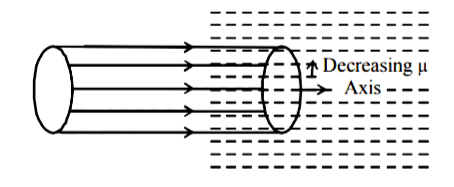
Step Solution:
1. Identify the refractive index ($\mu$) profile: It is highest on the axis and decreases toward the periphery.
2. Recall the relationship between speed and $\mu$: $v = c / \mu$.
3. Because $\mu$ is higher on the axis, light on the axis travels slower than light at the edges.
4. This variation in speed causes the outer parts of the wavefront to "race ahead" of the center.
5. The wavefront curves inward, leading to the convergence of the beam.
Difficulty Level: Medium
Concept Name: Refractive Index Gradient and Beam Propagation
Short cut solution: A medium where the refractive index is highest at the center and lower at the edges acts like a convex lens, which always causes a parallel beam to converge.
Question 157
Question: The initial shape of the wavefront of the beam is
Options:
A. convex
B. concave
C. convex near the axis and concave near the periphery
D. planar
Correct Answer: D
Year: 2010
Solution (Source): Initially the parallel beam is cylindrical. Therefore, the wavefront will be planar.
Step Solution:
1. Consider the light source: The source provides a parallel cylindrical beam.
2. Define a wavefront: A surface over which the phase of the wave is constant.
3. For parallel rays of light, the surfaces of constant phase are flat planes perpendicular to the direction of travel.
4. Since the rays are parallel before entering the medium, the phase across the cross-section is uniform.
5. Conclusion: The initial wavefront is planar.
Difficulty Level: Easy
Concept Name: Types of Wavefronts
Short cut solution: By definition, parallel rays of light correspond to planar wavefronts.
Question 158
Question: The speed of light in the medium is
Options:
A. minimum on the axis of the beam
B. the same everywhere in the beam
C. directly proportional to the intensity I
D. maximum on the axis of the beam
Correct Answer: A
Year: 2010
Solution (Source): The speed of light ($v$) in a medium of refractive index ($\mu$) is given by $\mu = c / v$, where $c$ is the speed of light in vacuum. $\therefore v = c / \mu = c / (\mu_0 + \mu_2 I)$. As $I$ is decreasing with increasing radius, it is maximum on the axis of the beam. Therefore, $v$ is minimum on the axis of the beam.
Step Solution:
1. Use the relation between speed and refractive index: $v = c / \mu$.
2. Note the medium's property: $\mu = \mu_0 + \mu_2 I$ (where $I$ is intensity).
3. Identify intensity distribution: $I$ is maximum at the axis of the beam and decreases with radius.
4. Since $\mu$ increases with $I$, the refractive index $\mu$ is at its maximum value on the axis.
5. Because $v$ is inversely proportional to $\mu$, the speed $v$ must be at its minimum on the axis.
Difficulty Level: Medium
Concept Name: Non-linear Refractive Index
Short cut solution: Speed is inversely proportional to refractive index ($v \propto 1/\mu$). Since intensity $I$ is highest at the center and $\mu$ increases with $I$, the speed is lowest (minimum) at the center.