Question 19
Question: Given below are two statements: one is labelled as Assertion (A) and the other is labelled as Reason (R).
Assertion (A): The density of the copper ($_{29}^{64}Cu$) nucleus is greater than that of the carbon ($_{6}^{12}C$) nucleus.
Reason (R): The nucleus of mass number A has a radius proportional to $A^{1/3}$ (Note: Source text in says "proportional to .A", but the calculation in correctly uses $A^{1/3}$).
In the light of the above statements, choose the most appropriate answer from the options given below:
Options:
A. (A) is correct but (R) is not correct
B. Both (A) and (R) are correct but (R) is not the correct explanation of (A)
C. (A) is not correct but (R) is correct
D. Both (A) and (R) are correct and (R) is the correct explanation of (A)
Correct Answer: C (Note: While the source lists C as the correct answer, its own internal solution logic in states that the densities are "effectively the same," which would typically make Assertion A false).
Year: JEE Main 2025 (Online) 7th April Evening Shift
Solution: Density $\rho = \frac{M}{V} = \frac{m_n \times A}{\frac{4}{3} \pi R^3}$. According to the formula for the radius: $R = R_0 A^{1/3}$. By substituting the expression for R back into the formula for density, we get: $\rho = \frac{m_n \times A}{\frac{4}{3} \pi (A^{1/3} R_0)^3}$. Simplifying the equation shows that the A terms cancel out: $\rho = \frac{m_n}{\frac{4}{3} \pi R_0^3}$.
Step Solution:
1. State the empirical formula for nuclear radius: $R = R_0 A^{1/3}$, where $R_0$ is a constant.
2. Write the expression for nuclear density: $\rho = \frac{\text{Mass}}{\text{Volume}} = \frac{m \cdot A}{\frac{4}{3} \pi R^3}$ (where $m$ is the average nucleon mass).
3. Substitute the radius formula into the density expression: $\rho = \frac{m \cdot A}{\frac{4}{3} \pi (R_0 A^{1/3})^3}$.
4. Perform the mathematical simplification of the denominator: $\rho = \frac{m \cdot A}{\frac{4}{3} \pi R_0^3 A}$.
5. Cancel the mass number ($A$) from the numerator and denominator to show that $\rho = \frac{3m}{4\pi R_0^3}$, which is constant for all nuclei.
Difficulty Level: Medium (due to the conflict between the assertion and the constant density result).
Concept Name: Nuclear Density and Radius Proportionality
Short cut solution: Nuclear density is a universal constant ($\approx 2.3 \times 10^{17} \text{ kg/m}^3$) and does not depend on the mass number ($A$). Therefore, copper and carbon have the same nuclear density.
Question 20
Question: For a nucleus of mass number A and radius R, the mass density of nucleus can be represented as:
Options:
A. $A^{2/3}$
B. Independent of A
C. $A^3$
D. $A^{1/3}$
Correct Answer: B
Year: JEE Main 2025 (Online) 8th April Evening Shift
Solution: The radius R of a nucleus is given by the empirical relation: $R = r_0 A^{1/3}$. The volume V is $\frac{4}{3} \pi R^3 = \frac{4}{3} \pi r_0^3 A$. The mass density $\rho$ is defined as the mass (proportional to A) divided by the volume: $\rho = \frac{A}{V} = \frac{A}{\frac{4}{3} \pi r_0^3 A}$. Notice that A cancels out, so the density is constant.
Step Solution:
1. Identify the radius relationship: $R = r_0 A^{1/3}$.
2. Use the spherical volume formula: $V = \frac{4}{3} \pi R^3$.
3. Substitute $R$ into $V$: $V = \frac{4}{3} \pi (r_0 A^{1/3})^3 = \frac{4}{3} \pi r_0^3 A$.
4. Set up the density ratio: $\rho = \frac{\text{Mass}}{\text{Volume}} \propto \frac{A}{A}$.
5. Conclude that density is independent of the mass number A.
Difficulty Level: Easy
Concept Name: Constant Nuclear Density
Short cut solution: Since the mass of a nucleus increases linearly with $A$ and its volume also increases linearly with $A$ (because $V \propto R^3 \propto (A^{1/3})^3$), the ratio of mass to volume remains constant for all atoms.
Question 35
Question: The mass number of nucleus having radius equal to half of the radius of nucleus with mass number 192 is:
Options:
A. 24
B. 32
C. 40
D. 20
Correct Answer: A
Year: [31-Jan-2024 Shift 2]
Solution: $R_1 = R_2 / 2 \Rightarrow R_0 (A_1)^{1/3} = \frac{R_0}{2} (A_2)^{1/3} \Rightarrow A_1 = \frac{1}{8} A_2 \Rightarrow A_1 = \frac{192}{8} = 24$.
Step Solution:
1. Apply the nuclear radius proportionality: $R \propto A^{1/3}$.
2. Set up the ratio for two nuclei: $\frac{R_1}{R_2} = \left( \frac{A_1}{A_2} \right)^{1/3}$.
3. Substitute the given condition ($R_1 = \frac{1}{2} R_2$): $\frac{1}{2} = \left( \frac{A_1}{192} \right)^{1/3}$.
4. Cube both sides of the equation to isolate the mass numbers: $(\frac{1}{2})^3 = \frac{A_1}{192} \Rightarrow \frac{1}{8} = \frac{A_1}{192}$.
5. Solve for $A_1$: $A_1 = \frac{192}{8} = 24$.
Difficulty Level: Medium
Concept Name: Nuclear Radius and Mass Number Relation
Short cut solution: The mass number is proportional to the cube of the radius ($A \propto R^3$). If the radius is halved ($1/2$), the mass number must be scaled by $(1/2)^3 = 1/8$. Thus, $192 \times \frac{1}{8} = 24$.
Question 36
Question: A nucleus has mass number $A_1$ and volume $V_1$. Another nucleus has mass number $A_2$ and volume $V_2$. If relation between mass number is $A_2 = 4A_1$, then $\frac{V_2}{V_1} =$ \_\_\_\_
Options: (This was a numerical entry question in the source)
Correct Answer: 4
Year: 31-Jan-2024 Shift 2
Solution: Volume $V = \frac{4}{3} \pi R^3$. Given $R = R_0 (A)^{1/3}$. Therefore, $V = \frac{4}{3} \pi R_0^3 A$.
Step Solution:
1. State the formula for the volume of a spherical nucleus: $V = \frac{4}{3} \pi R^3$.
2. Use the empirical formula for nuclear radius: $R = R_0 A^{1/3}$.
3. Substitute the radius formula into the volume formula: $V = \frac{4}{3} \pi (R_0 A^{1/3})^3$.
4. Simplify the expression to find the relationship with $A$: $V = (\frac{4}{3} \pi R_0^3) A$, which means $V \propto A$.
5. Calculate the ratio: $\frac{V_2}{V_1} = \frac{A_2}{A_1} = \frac{4A_1}{A_1} = 4$.
Difficulty Level: Easy
Concept Name: Nuclear Volume and Mass Number Relationship
Short cut solution: Since nuclear volume is directly proportional to the mass number ($V \propto A$), the ratio of volumes is simply the ratio of their mass numbers. If $A_2$ is 4 times $A_1$, then $V_2$ is 4 times $V_1$.
Question 39
Question: The radius of a nucleus of mass number 64 is 4.8 fermi. Then the mass number of another nucleus having radius of 4 fermi is $\frac{1000}{x}$, where x is
Options: (This was a numerical entry question in the source)
Correct Answer: 27
Year: 1-Feb-2024 Shift 1
Solution: $R = R_0 A^{1/3}$. $(\frac{4.8}{4})^3 = \frac{64}{A}$. $A = \frac{64}{1.44 \times 1.2}$. $x = 27$.
Step Solution:
1. Use the proportionality $R \propto A^{1/3}$, which implies $A \propto R^3$.
2. Set up the ratio for the two nuclei: $\frac{A_2}{A_1} = (\frac{R_2}{R_1})^3$.
3. Substitute the given values ($R_1 = 4.8, A_1 = 64, R_2 = 4$): $A_2 = 64 \times (\frac{4}{4.8})^3 = 64 \times (\frac{5}{6})^3$.
4. Calculate $A_2$: $A_2 = 64 \times \frac{125}{216} = \frac{8000}{216} = \frac{1000}{27}$.
5. Equate $A_2$ to the requested form $\frac{1000}{x}$: $\frac{1000}{27} = \frac{1000}{x} \implies \mathbf{x = 27}$.
Difficulty Level: Medium
Concept Name: Nuclear Radius and Mass Number Relationship
Short cut solution: The mass number scales with the cube of the radius ratio. $(\frac{4.8}{4}) = 1.2$. Cube of 1.2 is 1.728. $A_{new} = \frac{64}{1.728} \approx 37$. Setting $37 = \frac{1000}{x}$ yields $x = 27$.
Question 44
Question: The ratio of the density of oxygen nucleus $(_{8}^{16}O)$ and helium nucleus $(_{2}^{4}He)$ is
Options:
A. 4 : 1
B. 8 : 1
C. 1 : 1
D. 2 : 1
Correct Answer: C
Year: 25-Jan-2023 Shift 1
Solution: Nuclear density is independent of mass number. $\rho = \frac{Au}{\frac{4}{3} \pi R^3}$. Since $R^3 = R_0^3 A$, then $\rho = \frac{3u}{4 \pi R_0^3}$.
Step Solution:
1. Define nuclear density as $\rho = \frac{\text{Mass}}{\text{Volume}}$.
2. Approximate nuclear mass as $M = A \cdot u$ and volume as $V = \frac{4}{3} \pi R^3$.
3. Substitute $R = R_0 A^{1/3}$ into the density formula: $\rho = \frac{A \cdot u}{\frac{4}{3} \pi (R_0 A^{1/3})^3}$.
4. Simplify the expression: $\rho = \frac{A \cdot u}{\frac{4}{3} \pi R_0^3 A}$.
5. Observe that $A$ cancels out, leaving $\rho = \frac{3u}{4 \pi R_0^3}$, which is constant for all nuclei.
Difficulty Level: Easy
Concept Name: Constant Nuclear Density
Short cut solution: Because nuclear mass and volume both increase linearly with the mass number $A$, the density (mass/volume) remains constant for all elements. The ratio is always 1:1.s
Question 48
Question: Given below are two statements: one is labelled as Assertion A and the other is labelled as Reason R.
Assertion A: The nuclear density of nuclides ${}_{5}^{10}B, {}_{3}^{6}Li, {}_{26}^{56}Fe, {}_{10}^{20}Ne$ and ${}_{83}^{209}Bi$ can be arranged as $p_{Bi}^N > p_{Fe}^N > p_{Ne}^N > p_{B}^N > p_{Li}^N$.
Reason R: The radius R of nucleus is related to its mass number A as $R = R_0 A^{1/3}$, where $R_0$ is a constant.
In the light of the above statement, choose the correct answer from the options given below:
Options:
A. Both A and R are true and R is the correct explanation of A
B. A is false but R is true
C. A is true but R is false
D. Both A and R are true but R is NOT the correct explanation of A
Correct Answer: B
Year: 30-Jan-2023 Shift 2
Solution: Nuclear density is independent of A.
Step Solution:
1. State the empirical formula for nuclear radius: $R = R_0 A^{1/3}$.
2. Write the formula for nuclear density: $\rho = \frac{\text{Mass}}{\text{Volume}} = \frac{A \cdot m}{\frac{4}{3} \pi R^3}$, where $m$ is the nucleon mass.
3. Substitute the expression for $R$ into the density formula: $\rho = \frac{A \cdot m}{\frac{4}{3} \pi (R_0 A^{1/3})^3}$.
4. Simplify the denominator: $\rho = \frac{A \cdot m}{\frac{4}{3} \pi R_0^3 A}$.
5. Cancel the mass number $A$ to show that $\rho = \frac{3m}{4\pi R_0^3}$, proving density is constant for all nuclei. Assertion A is thus false.
Difficulty Level: Medium
Concept Name: Nuclear Density and Radius Proportionality
Short cut solution: Nuclear density is a universal constant ($\approx 2.3 \times 10^{17} \text{ kg/m}^3$) and does not vary with mass number ($A$). Therefore, all listed elements have the same density.
Question 55
Question: Assume that protons and neutrons have equal masses. Mass of a nucleon is $1.6 \times 10^{-27} \text{ kg}$ and radius of nucleus is $1.5 \times 10^{-15} A^{1/3} \text{ m}$. The approximate ratio of the nuclear density and water density is $n \times 10^{13}$. The value of n is
Options: (This is a numerical entry problem)
Correct Answer: 11
Year: 24-Jan-2023 Shift 1
Solution: $\text{density of nuclei} = \frac{\text{mass of nuclei}}{\text{volume of nuclei}}$. $p = \frac{1.6 \times 10^{-27} A}{\frac{4}{3} \pi (1.5 \times 10^{-15})^3 A} = 0.113 \times 10^{18}$. $p_w = 10^3$. $\frac{p}{p_w} = 11.31 \times 10^{13}$.
Step Solution:
1. Define nuclear density ($\rho_n$): $\rho_n = \frac{m \cdot A}{\frac{4}{3} \pi R^3}$.
2. Substitute the given radius $R = (1.5 \times 10^{-15}) A^{1/3}$: $\rho_n = \frac{1.6 \times 10^{-27} A}{\frac{4}{3} \pi (1.5 \times 10^{-15})^3 A}$.
3. Calculate the value of $\rho_n$ after canceling $A$: $\rho_n = \frac{1.6 \times 10^{-27}}{1.333 \times 3.14 \times 3.375 \times 10^{-45}} \approx 1.13 \times 10^{17} \text{ kg/m}^3$.
4. Divide by the density of water ($\rho_w = 10^3 \text{ kg/m}^3$): $\text{Ratio} = \frac{1.13 \times 10^{17}}{10^3} = 1.13 \times 10^{14}$.
5. Adjust to the power of 10 requested ($10^{13}$): $11.3 \times 10^{13}$. Therefore, $n \approx 11$.
Difficulty Level: Hard
Concept Name: Nuclear Density Calculation
Short cut solution: The ratio of nuclear density to water density is always roughly $10^{14}$. Calculating with $R_0 = 1.5$ gives $\approx 1.1 \times 10^{14}$, or $11 \times 10^{13}$.
Question 86
Question: Which of the following figure represents the variation of $\ln(R/R_0)$ with $\ln(A)$ (if R = radius of a nucleus and A = its mass number)?
Options:
A.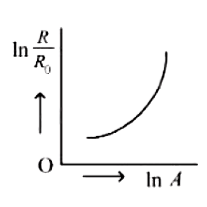
B.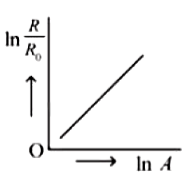
C.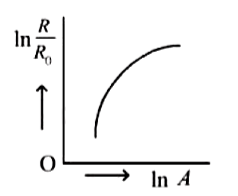
D.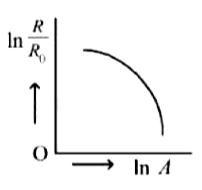
Correct Answer: (Visual graph corresponding to $y = 1/3x$)
Year: 25-Jun-2022-Shift-2
Solution: (The solution logic is derived from the standard radius formula).
Step Solution:
1. Identify the base empirical relation: $R = R_0 A^{1/3}$.
2. Divide both sides by the constant $R_0$ to isolate the ratio: $\frac{R}{R_0} = A^{1/3}$.
3. Take the natural logarithm ($\ln$) of both sides of the equation: $\ln\left(\frac{R}{R_0}\right) = \ln(A^{1/3})$.
4. Use logarithmic properties ($\ln(x^y) = y \ln x$): $\ln\left(\frac{R}{R_0}\right) = \frac{1}{3} \ln(A)$.
5. Match this to the linear form $y = mx$: The graph of $\ln(R/R_0)$ vs $\ln(A)$ is a straight line passing through the origin with a slope of 1/3.
Difficulty Level: Medium
Concept Name: Logarithmic Form of nuclear Radius Relation
Short cut solution: Since $R \propto A^{1/3}$, taking logs on both sides turns the power into a constant slope. $\ln(R) - \ln(R_0) = \frac{1}{3} \ln A$, which is the equation of a straight line.
Question 105
Question: Mass numbers of two nuclei are in the ratio of 4 : 3. Their nuclear densities will be in the ratio of:
Options:
A. 4 : 3
B. $(4/3)^{1/3}$
C. 1 : 1
D. $(4/3)^3$
Correct Answer: C
Year: 26-Jul-2022-Shift-2
Solution: Radius of nucleus $R = R_0 A^{1/3}$. Density of nucleus = Mass of nucleus / volume of nucleus. $\rho = \frac{m \times A}{\frac{4}{3} \pi R^3}$. $\rho = \frac{m \times A}{\frac{4}{3} \pi R_0^3 A}$. $\rho \propto A^0$. Hence density of nucleus is independent of mass number.
Step Solution:
1. Recall the formula for nuclear radius: $R = R_0 A^{1/3}$, where $R_0$ is a constant.
2. State the formula for nuclear density: $\rho = \frac{\text{Mass}}{\text{Volume}} = \frac{m \cdot A}{\frac{4}{3} \pi R^3}$ (where $m$ is nucleon mass).
3. Substitute the radius formula into the density expression: $\rho = \frac{m \cdot A}{\frac{4}{3} \pi (R_0 A^{1/3})^3}$.
4. Simplify the denominator mathematically: $\rho = \frac{m \cdot A}{\frac{4}{3} \pi R_0^3 A}$.
5. Cancel the mass number ($A$) to show that $\rho = \frac{3m}{4\pi R_0^3}$, which is constant for all nuclei, resulting in a ratio of 1 : 1.
Difficulty Level: Easy
Concept Name: Constant Nuclear Density
Short cut solution: Since nuclear mass and nuclear volume are both directly proportional to the mass number ($A$), their ratio (density) remains constant regardless of the atom's size. Thus, the ratio is always 1 : 1.
Question 108
Question: Read the following statements:
(A) Volume of the nucleus is directly proportional to the mass number.
(B) Volume of the nucleus is independent of mass number.
(C) Density of the nucleus is directly proportional to the mass number.
(D) Density of the nucleus is directly proportional to the cube root of the mass number.
(E) Density of the nucleus is independent of the mass number.
Choose the correct option from the following options:
Options:
A. (A) and (D) only.
B. (A) and (E) only.
C. (B) and (E) only.
D. (A) and (C) only.
Correct Answer: B
Year: 29-Jul-2022-Shift-2
Solution: We know, Radius of nucleus, $r = r_0 A^{1/3}$. Volume $(v) = \frac{4}{3} \pi r^3 = \frac{4}{3} \pi r_0^3 \cdot A \implies v \propto A$. Density $(d) = \frac{m}{v} = \frac{A m_0}{\frac{4}{3} \pi r_0^3 A} = \frac{m_0}{\frac{4}{3} \pi r_0^3}$. Density of nucleus is independent of mass number.
Step Solution:
1. Use the empirical radius formula: $R = R_0 A^{1/3}$.
2. Calculate Volume ($V$): $V = \frac{4}{3} \pi R^3 = \frac{4}{3} \pi (R_0 A^{1/3})^3 = (\frac{4}{3} \pi R_0^3) A$. This proves $V \propto A$ (Statement A).
3. Define Density ($\rho$): $\rho = \frac{\text{Mass}}{\text{Volume}}$. Total mass is approximately $A \times (\text{nucleon mass})$.
4. Substitute expressions: $\rho = \frac{A \cdot m}{\frac{4}{3} \pi R_0^3 A}$.
5. Observe that $A$ cancels out: $\rho = \text{constant}$. This proves density is independent of $A$ (Statement E). Thus, A and E are the correct statements.
Difficulty Level: Easy
Concept Name: Nuclear Dimensions and Density
Short cut solution: Volume scales with the cube of the radius ($A^{1/3} \to A$), making it directly proportional to $A$. Density scales with Mass/Volume ($A/A \to A^0$), making it independent of $A$.
Question 142
Question: For a certain radioactive process the graph between $\ln R$ and $t(\text{sec})$ is obtained as shown in the figure. Then the value of half life for the unknown radioactive material is approximately: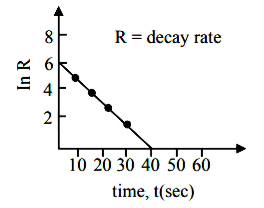
Options:
A. 9.15 sec
B. 6.93 sec
C. 2.62 sec
D. 4.62 sec
Correct Answer: D
Year: 20 Jul 2021 Shift 2
Solution: $R = R_0 e^{-\lambda t} \implies \ln R = \ln R_0 - \lambda t$. $-\lambda$ is slope of straight line. $\lambda = 3/20$. $t_{1/2} = \frac{\ln 2}{\lambda} = 4.62$.
Step Solution:
1. Identify the decay rate equation: $R = R_0 e^{-\lambda t}$.
2. Convert to linear form by taking the natural logarithm: $\ln R = \ln R_0 - \lambda t$.
3. Determine the decay constant ($\lambda$) from the slope of the $\ln R$ vs $t$ graph: $\lambda = 3/20 = 0.15 \text{ s}^{-1}$.
4. Recall the half-life formula: $t_{1/2} = \frac{\ln 2}{\lambda}$.
5. Calculate the result using $\ln 2 \approx 0.693$: $t_{1/2} = \frac{0.693}{0.15} = 4.62 \text{ sec}$.
Difficulty Level: Medium
Concept Name: Radioactive Decay Law - Graphical Analysis
Short cut solution: The magnitude of the slope of a $\ln(\text{Activity})$ vs time graph is the decay constant $\lambda$. Divide $0.693$ by the slope value ($0.15$) to quickly find the half-life ($4.62 \text{ s}$).
Question 162
Question: The radius $R$ of a nucleus of mass number $A$ can be estimated by the formula $R = (1.3 \times 10^{-15})A^{1/3}$. It follows that the mass density of a nucleus is of the order of : ($M_{prot.} \cong M_{neut.} \simeq 1.67 \times 10^{-27} \text{ kg}$)
Options:
A. $10^{3} \text{ kg m}^{-3}$
B. $10^{10} \text{ kg m}^{-3}$
C. $10^{24} \text{ kg m}^{-3}$
D. $10^{17} \text{ kg m}^{-3}$
Correct Answer: D
Year: Sep. 03, 2020 (II)
Solution: Density of nucleus, $\rho = \frac{\text{Mass}}{\text{Volume}} = \frac{mA}{\frac{4}{3} \pi R^3} \Rightarrow \rho = \frac{mA}{\frac{4}{3} \pi (R_0 A^{1/3})^3} (\because R = R_0 A^{1/3})$. Here $m = \text{mass of a nucleon}$. $\rho = \frac{3 \times 1.67 \times 10^{-27}}{4 \times 3.14 \times (1.3 \times 10^{-15})^3} (\text{Given, } R_0 = 1.3 \times 10^{-15}) \Rightarrow 2.38 \times 10^{17} \text{ kg/m}^3$.
Step Solution:
1. State the formula for nuclear density: $\rho = \frac{\text{Mass}}{\text{Volume}} = \frac{A \cdot m}{\frac{4}{3} \pi R^3}$, where $m$ is the mass of a nucleon.
2. Substitute the empirical radius formula $R = R_0 A^{1/3}$ into the volume: $\rho = \frac{A \cdot m}{\frac{4}{3} \pi R_0^3 A}$.
3. Cancel the mass number $A$ to show density is constant: $\rho = \frac{3m}{4 \pi R_0^3}$.
4. Plug in the given values ($m = 1.67 \times 10^{-27}$ and $R_0 = 1.3 \times 10^{-15}$): $\rho = \frac{3 \times 1.67 \times 10^{-27}}{4 \times 3.14 \times (1.3 \times 10^{-15})^3}$.
5. Calculate the result: $\rho \approx 2.38 \times 10^{17} \text{ kg/m}^3$, which is of the order $10^{17}$.
Difficulty Level: Medium
Concept Name: Nuclear Density Calculation
Short cut solution: Nuclear density is a universal constant for all nuclei, roughly $2.3 \times 10^{17} \text{ kg/m}^3$. Recognizing this standard physical constant allows for an immediate selection of Option D.
Question 184
Question: The ratio of the mass densities of nuclei of $^{40}\text{Ca}$ and $^{16}\text{O}$ is close to :
Options:
A. 1
B. 0.1
C. 5
D. 2
Correct Answer: A
Year: 8 April 2019 II
Solution: Nuclear density is independent of atomic number.
Step Solution:
1. Recall the definition of nuclear density: $\rho = \frac{\text{Mass}}{\text{Volume}}$.
2. Identify that mass is proportional to $A$ and Volume is proportional to $R^3$.
3. Apply the radius relation $R \propto A^{1/3}$, which makes Volume $\propto A$.
4. Note that the ratio $\frac{\text{Mass}}{\text{Volume}} \propto \frac{A}{A}$, which cancels the dependency on the mass number.
5. Conclude that since density is constant for all nuclei, the ratio between any two elements is 1 : 1.
Difficulty Level: Easy
Concept Name: Constant Nuclear Density
Short cut solution: Because nuclear mass and volume both scale linearly with $A$, density remains constant across the periodic table. The ratio of densities for any two nuclei is always 1.
Question 192
Question: An unstable heavy nucleus at rest breaks into two nuclei which move away with velocities in the ratio of 8:27. The ratio of the radii of the nuclei (assumed to be spherical ) is:
Options:
A. 8 : 27
B. 2 : 3
C. 3 : 2
D. 4 : 9
Correct Answer: C
Year: Online April 15, 2018
Solution: Let heavy nucleus breaks into two nuclei of mass $m_1$ and $m_2$ and move away with velocities $V_1$ and $V_2$ respectively. $\frac{V_1}{V_2} = \frac{8}{27}$. $m_1 V_1 = m_2 V_2$ (Law of momentum conservation) $\Rightarrow \frac{m_1}{m_2} = \frac{V_2}{V_1} = \frac{27}{8}$. $\rho = \frac{\text{mass}}{\text{volume}}$. $\Rightarrow (\frac{R_1}{R_2})^3 = \frac{27}{8} \Rightarrow \frac{R_1}{R_2} = \frac{3}{2}$.
Step Solution:
1. Apply the Law of Conservation of Momentum: Since the original nucleus was at rest, $m_1 v_1 = m_2 v_2$.
2. Find the mass ratio using the given velocity ratio (8:27): $\frac{m_1}{m_2} = \frac{v_2}{v_1} = \frac{27}{8}$.
3. Relate mass to radius: Since density is constant, $m \propto R^3$.
4. Set up the radius proportionality: $(\frac{R_1}{R_2})^3 = \frac{m_1}{m_2} = \frac{27}{8}$.
5. Solve for the radius ratio by taking the cube root: $\frac{R_1}{R_2} = (\frac{27}{8})^{1/3} = \frac{3}{2}$.
Difficulty Level: Medium
Concept Name: Momentum Conservation and Nuclear Radius Relation
Short cut solution: In a split, mass is inversely proportional to velocity ($m \propto 1/v$) and radius is proportional to the cube root of mass ($R \propto m^{1/3}$). Therefore, $R \propto (1/v)^{1/3}$. The radius ratio is the cube root of the inverse velocity ratio: $(\frac{27}{8})^{1/3} = \mathbf{3 : 2}$.
Question 253
Question: If radius of the $_{13}^{27}\text{Al}$ nucleus is estimated to be 3.6 fermi then the radius of $_{52}^{125}\text{Te}$ nucleus be nearly
Options:
A. 8 fermi
B. 6 fermi
C. 5 fermi
D. 4 fermi
Correct Answer: B
Year: 2005
Solution: Radius of a nucleus, $R = R_0(A)^{1/3}$. Here, $R_0$ is a constant, $A =$ atomic mass number. $\therefore \frac{R_1}{R_2} = \left( \frac{A_1}{A_2} \right)^{1/3} = \left( \frac{27}{125} \right)^{1/3} = \frac{3}{5} \Rightarrow R_2 = \frac{5}{3} \times 3.6 = 6$ fermi.
Step Solution:
1. Identify the relationship between nuclear radius ($R$) and mass number ($A$): $R = R_0 A^{1/3}$.
2. Set up the ratio for the two nuclei: $\frac{R_{Te}}{R_{Al}} = \left( \frac{A_{Te}}{A_{Al}} \right)^{1/3}$.
3. Substitute the given mass numbers ($A_{Te} = 125$, $A_{Al} = 27$): $\frac{R_{Te}}{R_{Al}} = \left( \frac{125}{27} \right)^{1/3}$.
4. Calculate the cube root ratio: $\frac{R_{Te}}{R_{Al}} = \frac{5}{3}$.
5. Solve for $R_{Te}$ using the given radius for Aluminum (3.6 fermi): $R_{Te} = \frac{5}{3} \times 3.6 = 5 \times 1.2 = 6 \text{ fermi}$.
Difficulty Level: Medium
Concept Name: Nuclear Radius and Mass Number Relation
Short cut solution: Since $R \propto A^{1/3}$ and the mass ratio is $125/27$, the radius must scale by the cube root of that ratio. $\sqrt{125/27} = 5/3$. Thus, $3.6 \times \frac{5}{3} = 6$.
Question 258
Question: A nucleus disintegrated into two nuclear parts which have their velocities in the ratio of 2 : 1. The ratio of their nuclear sizes will be
Options:
A. $3^{1/2} : 1$
B. $1 : 2^{1/3}$
C. $2^{1/3} : 1$
D. $1 : 3^{1/2}$
Correct Answer: B
Year: 2004
Solution: Given : $\frac{v_1}{v_2} = \frac{2}{1}$. From conservation of momentum $m_1 v_1 = m_2 v_2 \Rightarrow \left( \frac{m_1}{m_2} \right) = \left( \frac{v_2}{v_1} \right) = \frac{1}{2}$. We know that mass of nucleus, $m \propto A$. Nuclear size $R \propto A^{1/3} \propto m^{1/3}$. $\frac{R_1}{R_2} = \left( \frac{m_1}{m_2} \right)^{1/3} \Rightarrow \frac{R_1^3}{R_2^3} = \frac{1}{2} \Rightarrow \left( \frac{R_1}{R_2} \right) = \left( \frac{1}{2} \right)^{1/3}$.
Step Solution:
1. Apply the Law of Conservation of Momentum: Since the original nucleus was at rest, the fragments must have equal and opposite momentum magnitude: $m_1 v_1 = m_2 v_2$.
2. Determine the mass ratio from the given velocity ratio ($\frac{v_1}{v_2} = 2$): $\frac{m_1}{m_2} = \frac{v_2}{v_1} = \frac{1}{2}$.
3. Use the relationship between mass ($m \propto A$) and nuclear size ($R \propto A^{1/3}$): $R \propto m^{1/3}$.
4. Set up the ratio for the nuclear radii: $\frac{R_1}{R_2} = \left( \frac{m_1}{m_2} \right)^{1/3}$.
5. Substitute the mass ratio to find the final size ratio: $\frac{R_1}{R_2} = \left( \frac{1}{2} \right)^{1/3}$, which is $1 : 2^{1/3}$.
Difficulty Level: Medium
Concept Name: Momentum Conservation and Nuclear Radius Relation
Short cut solution: In a nuclear split, radius is proportional to the cube root of the inverse velocity ratio ($R \propto \frac{1}{v^{1/3}}$). Since the velocity ratio is $2:1$, the radius ratio is $1 : \sqrt{2}$.