Hydrocarbons


X is:


Among the following reaction(s), which gives(give) tert-butyl benzene as the major product is(are)


In the following reactions, the product S is


The major product U in the following reactions is


In the following reaction, the major product is


The correct statement with respect to product Y is

Among P, Q, R and S, the aromatic compound(s) is(are)


The major product of the following reaction is


The total number of alkenes possible by dehydrobromination of 3-bromo-3-cyclopentylhexane using alcoholic KOH is _______.
Explanation:

(2) Since, bromide (Br–) is a good leaving group, elimination using strong base takes place using strong base (KOH) take via E2 mechanism. This is also called $\beta $ elimination.
(3) There are 3 different types of protons :


(iv) The strong base abstracts $\beta $ hydrogen (H1 or H2 or H3) with simultaneous loss of bromide ion forming an alkene. This alkene can exist in 2 conformations, E and Z.
(a) Elimination of H1 proton :

This product can exist in 2 conformations, E and Z.

(b) Elimination of H2 proton :

Since, the groups about sp2 hybridised carbon of cyclopentane is fixed no E and Z forms are possible. This molecule has only one conformation.
(c) Elimination of H3 proton :

This product can exist in 2 conformations, E and Z.

Hence, a total of 5 products are possible.
The maximum number of isomers (including stereoisomers) that are possible on mono-chlorination of the following compound, is ____________.

Explanation:
(i) The monochlorination products obtained depends upon the kinds of hydrogen present in the molecule.
(ii) There are four different types of hydrogen in the molecule; $\mathrm{H}_a, \mathrm{H}_b, \mathrm{H}_c$ and $\mathrm{H}_d$.

(iii) The monochlorination products obtained on replacement of these hydrogen are as follows :
(a) Replacing $\mathrm{H}_a$ with chlorine :

Since, the carbon is a chiral; only one monochlorination isomer is possible when $\mathrm{H}_a$ is replaced by chlorine.
(b) Replacing $\mathrm{H}_b$ with chlorine :

Since all the carbons are a chiral; only one monochlorination product is possible by when $\mathrm{H}_b$ replaced by Cl .
(c) Replacing $\mathrm{H}_c$ with chlorine

The carbon on which hydrogen is replaced by chlorine becomes chiral; hence R/S isomers exist.
Also, carbon adjacent to the carbon on which hydrogen $\left(\mathrm{H}_c\right)$ is replaced, is also chiral; hence, it will also exist as a pair of enantiomer $R / S$ four monochlorination products (which are stereoisomers or optical isomers) are possible.
(d) Replacing $\mathrm{H}^d$ by chlorine :

The central carbon $\left({ }^*\right)$ becomes chiral when $\mathrm{H}^d$ is replaced by chlorine; hence $R / S$ isomers exist. Two monochlorination products are possible (stereoisomers or optical isomers) are possible.
Total number of isomers possible are 8.
$\,\,\,\,\,\,\,\,\,\,\,\,\,\,\,\,\,\,\,\,\,\,$ ${C_6}{H_5}C{H_2}CH\left( {OH} \right)CH{\left( {C{H_3}} \right)_2}\buildrel {conc.{H_2}S{O_4}} \over \longrightarrow \,?$


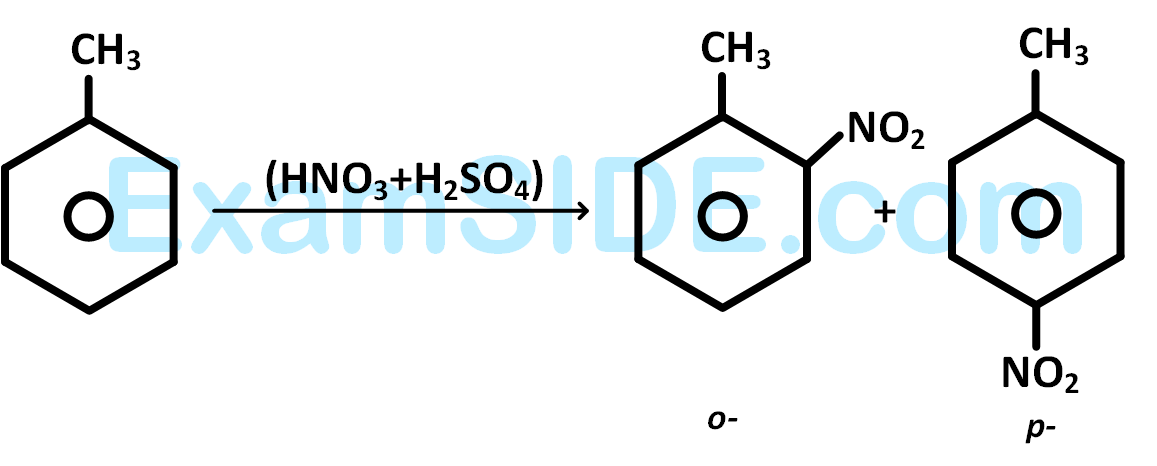


CH3 - CH = CH - CH3 $\buildrel {{O_3}} \over \longrightarrow $ A $\mathrel{\mathop{\kern0pt\longrightarrow} \limits_{Zn}^{H{}_2O}} $ B
The compound B is


In the following reaction,

The structure of the major 'X' is


The reagent(s) for the following conversion,


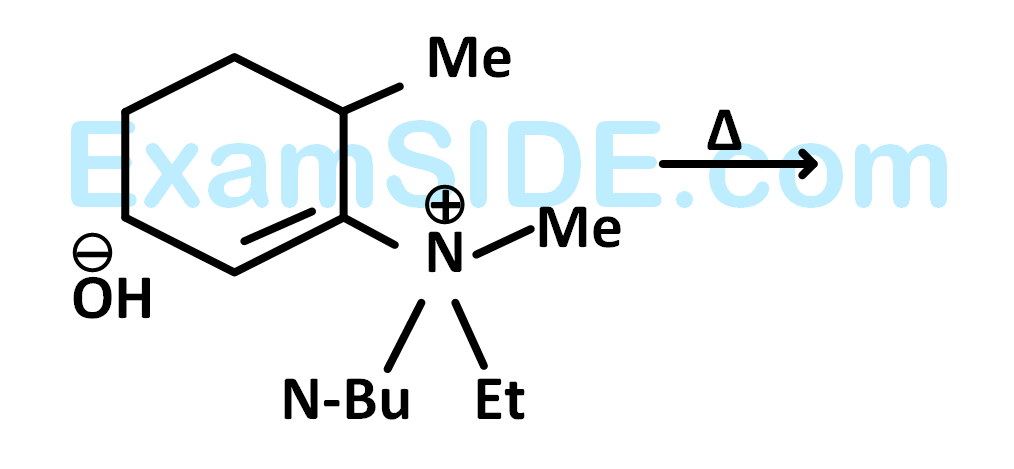
The alkene formed as a major product in the above elimination reaction is


$ \begin{aligned} &\mathrm{CH}_3-\mathrm{CH}=\mathrm{CH}_2+\mathrm{NOCl} \rightarrow \mathrm{P}\\ &\text { Identify the adduct. } \end{aligned} $


 Step 3:
The IUPAC name of $\mathrm{C}_6 \mathrm{H}_5 \mathrm{COCl}$ is
Benzoyl chloride
Benzene chloroketone
Benzene carbonyl chloride
Chlorophenyl ketone
 The IUPAC name of the compound is benzene carbonyl chloride.
$ \text { The major products } \mathbf{P} \text { and } \mathbf{Q} \text { are } $


 $ \text { It is a two step reaction: } $
 Hence, product $P$ is cumene.
 The cumene hydroperoxide on acidic hydrolysis produces phenol and acetone.


Explanation:

Now, assume moles of ${C_2}{H_6} = x$
$\therefore$ Moles of ${C_2}{H_5}Br = x$ when 100% yield.
Given that 90% yield of ${C_2}{H_5}Br$ happens.
$\therefore$ Moles of ${C_2}{H_5}Br = x \times {{90} \over {100}} = 0.9x$
Now, from 2 moles of ${C_2}{H_5}Br$ 1 mole of ${C_4}{H_{10}}$ produced.
$\therefore$ From 0.9x moles of ${C_2}{H_5}Br$ ${1 \over 2} \times 0.9x$ moles of ${C_4}{H_{10}}$ produced when 100% yield happens. But given that 85% yield of ${C_4}{H_{10}}$ happens.
$\therefore$ Moles of ${C_4}{H_{10}} = {1 \over 2} \times 0.9x \times {{85} \over {100}}$
$ = {{(0.9 \times 0.85)x} \over 2}$
According to question,
${{(0.9 \times 0.85)x} \over 2} = {{55} \over {58}}$
$ \Rightarrow x = {{55} \over {29 \times 0.9 \times 0.85}} = 2.48$
$\therefore$ Volume of ${C_2}{H_6} = 2.48 \times 22.4$ Litres
$ = 55.552$ Litres