Hydrocarbons
Two isomers 'A' and 'B' with molecular formula C4H8 give different products on oxidation with KMnO4 in acidic medium. Isomer 'A' on reaction with KMnO4/H+ results in effervescence of a gas and gives ketone. The compound 'A' is

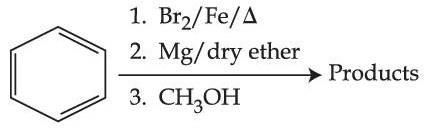
What will be the major product of following sequence of reactions?


Product 'A' of following sequence of reactions is


The major product in the following reaction


The product formed in the following reaction.


Given below are two statements :
Statement I : The presence of weaker $\pi$-bonds make alkenes less stable than alkanes.
Statement II : The strength of the double bond is greater than that of carbon-carbon single bond.
In the light of the above statements, choose the correct answer from the options given below :
Which of the following reagents / reactions will convert 'A' to 'B' ?


The major product 'A' of the following given reaction has _____________ sp2 hybridized carbon atoms.

Explanation:

Number of sp2 hybridised carbon atoms = 2

Explanation:


Explanation:


Explanation:

If the reaction sequence given below is carried out with 15 moles of acetylene, the amount of the product $\mathbf{D}$ formed (in $\mathrm{g}$ ) is ___________ .

The yields of $\mathbf{A}, \mathbf{B}, \mathbf{C}$ and $\mathbf{D}$ are given in parentheses.
[Given: Atomic mass of $\mathrm{H}=1, \mathrm{C}=12, \mathrm{O}=16, \mathrm{Cl}=35$ ]
Explanation:

Molecular formula of D is C8H8O2
Molar mass of D is ($12\times8+8\times1+16\times2$) = 136 g
$\therefore$ Mass of D is 136


The organic compound 5-allylcyclohex-3-ene-1-ol is reacted with cold, dilute, aqueous solution of $\mathrm{KMnO}_4$. The total number of hydroxyl group(s) $(-\mathrm{OH})$ present in the product is
1
2
3
5

 $ \text { In this product, } 5-\mathrm{OH} \text { are present. } $
The molecular formula of the product formed when benzene is reacted with excess of chlorine molecules under ultra-violet light is
$\mathrm{C}_6 \mathrm{Cl}_6$
$\mathrm{C}_6 \mathrm{H}_3 \mathrm{Cl}_3$
$\mathrm{C}_6 \mathrm{H}_2 \mathrm{Cl}_4$
$\mathrm{C}_6 \mathrm{H}_6 \mathrm{Cl}_6$

The order of decreasing reactivity towards an electrophilic reagent, for the following compounds, is
(i) benzene
(iii) chlorobenzene
(ii) toluene
(iv) phenol
i $>$ ii $>$ iii $>$ iv
ii $>$ iv $>$ i $>$ iii
iv $>$ iii $>$ ii $>$ i
iv $>$ ii $>$ i $>$ iii

The major product of the following reaction is
$ \text { Glucose } \frac{\text { (i) } \mathrm{HI}, \Delta}{\text { (ii) } \mathrm{Mo}_2 \mathrm{O}_3, 773 \mathrm{~K}, 10 \cdot 20 \mathrm{am}} $
cyclohexane
benzene
cyclohexadiene
hexane


The major products $P$ and $Q$ in the following reactions, respectively, are

| P | Q |
|---|---|
| $ \text { Alkene (cis) } $ |
$ \text { Alkene (cis) } $ |
| P | Q |
|---|---|
| $ \text { Alkane } $ |
$ \text { Alkene (trans) } $ |
| P | Q |
|---|---|
| $ \text { Alkene (cis) } $ |
$ \text { Alkene (trans) } $ |
| P | Q |
|---|---|
| $ \text { Alkene (trans) } $ |
$ \text { Alkene (trans) } $ |


The major product formed in the following reaction sequence is


The most suitable solvent for Wurtz reaction is
dry acetonitrile
dry dichloromethane
dry ethanol
dry ether
The correct order of rate of addition of $\mathrm{Br}_2$ /water to the following alkenes is


$[D]>[C]>[A]>[B]$
$[D]>[C]>[B]>[A]$
$[A]>[B]>[C]>[D]$
$[A]>[B]>[D]>[C]$


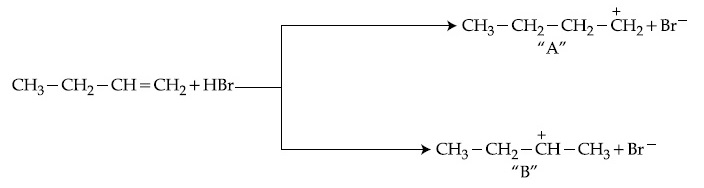
The reaction of C6H5CH = CHCH3 with HBr produces




(ii) Cl2, HCl
(iii) NaNO2, HCl, 0$^\circ$C
(iv) H2O/H+
(ii) NaNO2, HCl, 0$^\circ$C
(iii) H2O/H+
(iv) Cl2, FeCl3
(ii) Fe, HCl
(iii) NaNO2, HCl, 0$^\circ$C
(iv) H2O/H+
(ii) NaNO2, HCl, 0$^\circ$C
(iii) Fe, HCl
(iv) H2O/H+

CH4 + I2 $\mathrel{\mathop{\kern0pt\rightleftharpoons} \limits_{{\mathop{\rm Re}\nolimits} versible}^{hv}} $ CH3 $-$ I + HI
Compound 'A' also yields compound 'B' an ozonolysis. Compound 'A' is :


Major product P of above reaction, is :


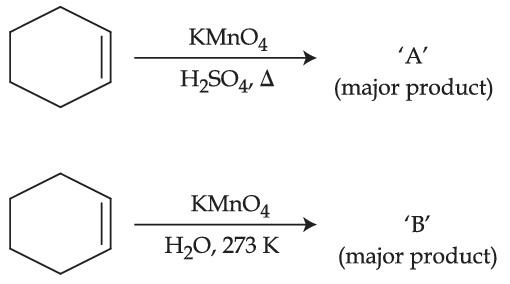
For above chemical reactions, identify the correct statement from the following :


List - I (Chemicals)
(a) Alcoholic potassium hydroxide
(b) Pd/BaSO4
(c) BHC (Benzene hexachloride)
(d) Polyacetylene
List - II (Use / Preparation / Constituent)
(i) Electrodes in batteries
(ii) Obtained by addition reaction
(iii) Used for $\beta$ - elimination reaction
(iv) Lindlar's catalyst
Choose the most appropriate match :
Statement I : 2-methylbutane on oxidation with KMnO4 gives 2-methylbutan-2-ol.
Statement II : n-alkanes can be easily oxidised to corresponding alcohols with KMnO4.
Choose the correct option :


Consider the above chemical reaction. The total number of stereoisomers possible for Product 'P' is _____________.
Explanation:

The total number of products possible = 2
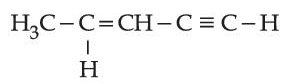
is _______________.
Explanation:

Numbers of $\sigma$ bonds = 10

The number of sp2 hybridized carbon atom(s) present in the product is ________.
Explanation:

All the 7-carbon-atoms in product are sp2 hybridised.


x g and y g are mass of R and U, respectively.
(Use : Molar mass (in g mol$-$1) of H, C and O as 1, 12 and 16, respectively)
The value of x is ________.
Explanation:
$M{g_2}{C_3} + 4{H_2}O \to 2Mg{(OH)_2} + C{H_3} - \mathop {\mathop C\limits_{(P)} }\limits_{{\mathop{\rm Propyne}\nolimits} } \equiv CH$
Sodium amide (NaNH2) takes proton from alkyne to form acetylide ion which, attacks on Me$-$I to give an alkyne with one more carbon.

Mass of P formed = 4.0 g
Molar mass of P formed = 40 g mol$-$1
Number of moles of P = ${{Mass\,of\,P(W)} \over {Molar\,mass\,of\,P(M)}} = {4 \over {40}} = 0.1$ mol
1 mole of P forms 75% i.e., 0.75 = 0.075 mole of Q
Polymerisation of alkyne (Butyne) occurs in presence of red hot iron tube to form benzene derivative.

3 moles of alkyne forms 40% i.e., 0.40 mole of benzene derivative, R.
0.075 mole of Q forms ${{0.40} \over 3} \times 0.075 = 0.01$ mole of R.
Molar mass of R = 162 g/mol
Mass of R formed or value of x = Molar mass $\times$ Number of moles = 162 $\times$ 0.01 = 1.62 g
Explanation:

$ 60+32+8=100 $
The value of $\mathrm{Y}=0.032 \times 100=3.2$
The product formed when a hydrocarbon $X$ of molecular formula $\mathrm{C}_6 \mathrm{H}_{10}$ is reacted with sodamide is subjected to ozonolysis, followed by hydrolysis with $\mathrm{Zn} / \mathrm{H}_2 \mathrm{O}_2$ and upon further oxidation gave two carboxylic acids, of which one is optically active. The hydrocarbon '$X$' is


Identify the product of the following reaction.

