Hydrocarbons
Consider the following reaction of benzene.

In compound $(Q)$, the percentage of oxygen is $\_\_\_\_$ %. (Nearest integer)
Explanation:

Molecular mass of compound $Q$ is $157$.
In $Q$, oxygen contributes mass $16$ (for one oxygen atom).
So, percentage of oxygen in $Q$ is $\% \text{ of oxygen in product ' } Q \text{ ' is }=\frac{16}{157} \times 100=10.19 \%$
Nearest integer $=10$%.
The cycloalkene $(\mathrm{X})$ on bromination consumes one mole of bromine per mole of $(\mathrm{X})$ and gives the product $(\mathrm{Y})$ in which $\mathrm{C}: \mathrm{Br}$ ratio is 3:1. The percentage of bromine in the product $(\mathrm{Y})$ is $\_\_\_\_$ %. (Nearest integer)
(Given : molar mass in $\mathrm{g} \mathrm{mol}^{-1} \mathrm{H}: 1, \mathrm{C}: 12, \mathrm{O}: 16, \mathrm{Br}: 80$ )
Explanation:
Bromination of a cycloalkene (one double bond) consumes 1 mole of $Br_2$ per mole of alkene, which means 2 bromine atoms add across the double bond.
So, product $(Y)$ is a dibromo compound.
Given in $(Y)$, the ratio $\mathrm{C}:\mathrm{Br} = 3:1$.
Let number of carbon atoms $= n$.
Number of bromine atoms $= 2$.
So,
$ \frac{n}{2} = \frac{3}{1} \;\Rightarrow\; n = 6 $
Hence $(Y)$ has formula:
$ \mathrm{C_6H_{10}Br_2} $
(since cyclohexene is $\mathrm{C_6H_{10}}$ and it adds $Br_2$)
Now molar mass of $(Y)$:
Carbon: $6 \times 12 = 72$
Hydrogen: $10 \times 1 = 10$
Bromine: $2 \times 80 = 160$
Total molar mass:
$ 72 + 10 + 160 = 242\ \mathrm{g\,mol^{-1}} $
Percentage of bromine:
$ \%Br = \frac{160}{242}\times 100 \approx 66.12\% $
Nearest integer $= \boxed{66\%}$.
Treatment of buta-1,3-diyne with NaNH2 (2 equivalents), followed by reaction with excess of trans-CH3-CH=CH-CH2-Br gives X as the major product. The maximum number of carbon atoms that are collinear (in a straight line) in X is _____.
Explanation:

An alkane $(Y)$ requires 8 moles of oxygen for complete combustion and on chlorination with $\mathrm{Cl}_2 / \mathrm{h} \nu,(\mathrm{Y})$ gives only one monochlorinated product $(\mathrm{Z})$. The total number of primary carbon atoms in $(Y)$ is $\_\_\_\_$ .
Explanation:
$\mathrm{C}_{\mathrm{n}} \mathrm{H}_{2 \mathrm{n}+2}+\left(\frac{3 \mathrm{n}+1}{2}\right) \mathrm{O}_2 \rightarrow \mathrm{nCO}_2+(\mathrm{n}+1) \mathrm{H}_2 \mathrm{O}$
$\begin{aligned} & \frac{3 n+1}{2}=8 \\ & 3 n+1=8 \times 2 \\ & n=5\left(\therefore C_5 H_{12}\right)\end{aligned}$

Number of primary carons = 4
Consider the isomers of hydrocarbon with molecular formula $C_5H_{10}$. These isomers do not decolourise $KMnO_4$ solution. These isomers are subjected to chlorination with chlorine in presence of light to give monochloro compounds. The total number of monochloro compounds (structural isomers only) formed is ________.
Explanation:

$1+4+4+2+3=14$
One mole of an alkane (x) requires 8 mole oxygen for complete combustion. Sum of number of carbon and hydrogen atoms in the alkane (x) is ________.
Explanation:
For an alkane, the general formula is
$ C_nH_{2n+2} $
The combustion reaction of an alkane is
$ C_nH_{2n+2} + \frac{3n+1}{2}O_2 \rightarrow nCO_2 + (n+1)H_2O $
Given that 1 mole of the alkane requires 8 moles of oxygen, so
$ \frac{3n+1}{2} = 8 $
Now solve:
$ 3n+1 = 16 $
$ 3n = 15 $
$ n = 5 $
So the alkane is
$ C_5H_{12} $
Now, total number of carbon and hydrogen atoms is
$ 5 + 12 = 17 $
So, the required answer is
$ \boxed{17} $
Isomeric hydrocarbons → negative Baeyer’s test
(Molecular formula C9H12)
The total number of isomers from above with four different non-aliphatic substitution sites is -
Explanation:
Molecular formula of isomeric hydrocarbon $\to C_9H_{12}$ - Negative Baeyer's test
Baeyers test is given by compounds that contain readily active carbon-carbon double bond.
So, in a negative Baeyer's test, there is no readily active c = c.
Compounds that give negative Baeyer's test are alkanes and aromatic compounds.
C$_9$H$_{12}$ compound is not an alkane
(Alkane general formula C$_n$H$_{2n+2}$)
Hydrocarbons with the formula C$_9$H$_{12}$ are considered as aromatic and isomers of substituted benzene rings.
The possible isomers of C$_9$H$_{12}$ are

From these, total number of the isomers with four different non-aliphatic substitution sites are 2
 |
 |
 |
| Four positions (1,2,3,4) are different. So, it contain four different non-aliphatic substitution sites. | Four position (1,2,3,4) are different. So, it contain four different non-aliphatic substitution sites. | Four position (1,2,3,4) are not different. So, it contain four different non-aliphatic substitution sites. |
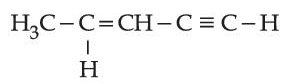
The sum of sigma (σ) and pi (π) bonds in Hex-1,3-dien-5-yne is ________.
Explanation:
The compound given is hex-1,3-dien-5-yne structure is

A doble bond has one $\pi$ bond and one sigma bond.
A triple bond has one sigma bond and two $\pi$ bonds.
For the one triple bond, number of $\pi$ bonds = 2
For one double bond, number of $\pi$ bond = 1
For two double bonds, number of $\pi$ bonds = 2
So, total number of $\pi$ bonds = 2 + 2 = 4
For sigma bonds, count all carbon - carbon bonds and carbon - hydrogen bonds except the $\pi$ bonds in double bonds and triple bond.

The total number of sigma bonds = 11
So, total number of bonds:
$\sigma=11$
$\pi=4$
Sum of $\sigma$ and $\pi$ bonds
$=11+4=15$
The compound with molecular formula $\mathrm{C}_6 \mathrm{H}_6$, which gives only one monobromo derivative and takes up four moles of hydrogen per mole for complete hydrogenation has _________ $\pi$ electrons.
Explanation:

Major product B of the following reaction has ________ $\pi$-bond.

Explanation:

Number of $\pi$ bonds in B = 5
The major product of the following reaction is P.
$\mathrm{CH}_3 \mathrm{C}\equiv\mathrm{C}-\mathrm{CH}_3$ $\xrightarrow[\substack{\text { (ii) dil. } \mathrm{KMnO}_4 \\ 273 \mathrm{~K}}]{\text { (i) } \mathrm{Na} \text { /liq. } \mathrm{NH}_3}$ 'P'
Number of oxygen atoms present in product '$\mathrm{P}$' is _______. (nearest integer)
Explanation:
Product is

Number of oxygen atoms = 2
The major products from the following reaction sequence are product A and product B.

The total sum of $\pi$ electrons in product A and product B are __________ (nearest integer)
Explanation:

Number of $\pi$ electron in A = 2
Number of $\pi$ electron in B = 6
Total Number of $\pi$ electron in (A) and (B) = 8

Consider the given reaction. The total number of oxygen atom/s present per molecule of the product $(\mathrm{P})$ is _________.
Explanation:

Hence, total number of oxygen atom present per molecule  is 1.
is 1.
In the following reaction sequence, the major product $\mathbf{P}$ is formed.

Glycerol reacts completely with excess $\mathbf{P}$ in the presence of an acid catalyst to form $\mathbf{Q}$. Reaction of $\mathbf{Q}$ with excess $\mathrm{NaOH}$ followed by the treatment with $\mathrm{CaCl}_2$ yields Ca-soap $\mathbf{R}$, quantitatively. Starting with one mole of $\mathbf{Q}$, the amount of $\mathbf{R}$ produced in gram is __________.
[Given, atomic weight: $\mathrm{H}=1, \mathrm{C}=12, \mathrm{~N}=14, \mathrm{O}=16, \mathrm{Na}=23, \mathrm{Cl}=35, \mathrm{Ca}=40$ ]
Explanation:


$\therefore 1$ mole $Q$ produce $\frac{3}{2}$ moles $R$
$\therefore$ Mass of $R$ produce $=\frac{3}{2} \times 606=909 \mathrm{~g}$
For the given reaction

The total number of possible products formed by tertiary carbocation of A is ____________.
Explanation:

Total 4 products are possible through 3° carbocation
The number of possible isomeric products formed when 3-chloro-1-butene reacts with $\mathrm{HCl}$ through carbocation formation is __________.
Explanation:

Total Possible Isomeric product = 1+3 = 4
Molar mass of the hydrocarbon (X) which on ozonolysis consumes one mole of $\mathrm{O}_{3}$ per mole of $(\mathrm{X})$ and gives one mole each of ethanal and propanone is _________ $\mathrm{g}~ \mathrm{mol}^{-1}$
(Molar mass of $\mathrm{C}: 12 \mathrm{~g} \mathrm{~mol}^{-1}, \mathrm{H}: 1 \mathrm{~g} \mathrm{~mol}^{-1}$ )
Explanation:

Hydrocarbon $(\mathrm{X})$ is 2-methyl-but-2-ene $\left(\mathrm{C}_5 \mathrm{H}_{10}\right)$
And the molecular mass is $5(12)+10(1)=70$.
Number of bromo derivatives obtained on treating ethane with excess of $\mathrm{Br}_{2}$ in diffused sunlight is ___________
Explanation:

17 mg of a hydrocarbon (M.F. $\mathrm{C_{10}H_{16}}$) takes up 8.40 mL of the H$_2$ gas measured at 0$^\circ$C and 760 mm of Hg. Ozonolysis of the same hydrocarbon yields

The number of double bond/s present in the hydrocarbon is ___________.
Explanation:
Mole of $\mathrm{H}_{2}$ gas
$\Rightarrow 1 \times \frac{8.40}{1000}=\mathrm{n} \times 0.0821 \times 273$
$\Rightarrow \mathrm{n}=3.75 \times 10^{-4}$
Hydrogen molecule used for 1 molecule of hydrocarbon is 3
$=\frac{3.75 \times 10^{-4}}{1.25 \times 10^{-4}}=3$
Maximum number of isomeric monochloro derivatives which can be obtained from 2,2,5,5-tetramethylhexane by chlorination is _____________
Explanation:

Total numbers of isomer = 03
The major product 'A' of the following given reaction has _____________ sp2 hybridized carbon atoms.

Explanation:

Number of sp2 hybridised carbon atoms = 2

Explanation:


Explanation:


Explanation:

If the reaction sequence given below is carried out with 15 moles of acetylene, the amount of the product $\mathbf{D}$ formed (in $\mathrm{g}$ ) is ___________ .

The yields of $\mathbf{A}, \mathbf{B}, \mathbf{C}$ and $\mathbf{D}$ are given in parentheses.
[Given: Atomic mass of $\mathrm{H}=1, \mathrm{C}=12, \mathrm{O}=16, \mathrm{Cl}=35$ ]
Explanation:

Molecular formula of D is C8H8O2
Molar mass of D is ($12\times8+8\times1+16\times2$) = 136 g
$\therefore$ Mass of D is 136

Consider the above chemical reaction. The total number of stereoisomers possible for Product 'P' is _____________.
Explanation:

The total number of products possible = 2
is _______________.
Explanation:

Numbers of $\sigma$ bonds = 10

The number of sp2 hybridized carbon atom(s) present in the product is ________.
Explanation:

All the 7-carbon-atoms in product are sp2 hybridised.

x g and y g are mass of R and U, respectively.
(Use : Molar mass (in g mol$-$1) of H, C and O as 1, 12 and 16, respectively)
The value of x is ________.
Explanation:
$M{g_2}{C_3} + 4{H_2}O \to 2Mg{(OH)_2} + C{H_3} - \mathop {\mathop C\limits_{(P)} }\limits_{{\mathop{\rm Propyne}\nolimits} } \equiv CH$
Sodium amide (NaNH2) takes proton from alkyne to form acetylide ion which, attacks on Me$-$I to give an alkyne with one more carbon.

Mass of P formed = 4.0 g
Molar mass of P formed = 40 g mol$-$1
Number of moles of P = ${{Mass\,of\,P(W)} \over {Molar\,mass\,of\,P(M)}} = {4 \over {40}} = 0.1$ mol
1 mole of P forms 75% i.e., 0.75 = 0.075 mole of Q
Polymerisation of alkyne (Butyne) occurs in presence of red hot iron tube to form benzene derivative.

3 moles of alkyne forms 40% i.e., 0.40 mole of benzene derivative, R.
0.075 mole of Q forms ${{0.40} \over 3} \times 0.075 = 0.01$ mole of R.
Molar mass of R = 162 g/mol
Mass of R formed or value of x = Molar mass $\times$ Number of moles = 162 $\times$ 0.01 = 1.62 g
Explanation:

$ 60+32+8=100 $
The value of $\mathrm{Y}=0.032 \times 100=3.2$
Explanation:
C4H10(g) + ${{13} \over 2}$O2(g) $ \to $ 4CO2(g) + 5H2O(l)
$ \therefore $ No. of moles of O2 required to oxidise 1 mole of propane = 5
$ \therefore $ No. of moles of O2 required to oxidise 1 mole of butane = ${{13} \over 2}$
So, No. of moles of O2 required to oxidise 1 mole of
propane and 2 moles of butane = 5 + 2 $ \times $ ${{13} \over 2}$ = 18

Explanation:

 (A is a lowest molecular weight alkyne)
Explanation:


Explanation:

Compound (P) has total number of hydroxyl groups = 6
The total number of alkenes possible by dehydrobromination of 3-bromo-3-cyclopentylhexane using alcoholic KOH is _______.
Explanation:

(2) Since, bromide (Br–) is a good leaving group, elimination using strong base takes place using strong base (KOH) take via E2 mechanism. This is also called $\beta $ elimination.
(3) There are 3 different types of protons :


(iv) The strong base abstracts $\beta $ hydrogen (H1 or H2 or H3) with simultaneous loss of bromide ion forming an alkene. This alkene can exist in 2 conformations, E and Z.
(a) Elimination of H1 proton :

This product can exist in 2 conformations, E and Z.

(b) Elimination of H2 proton :

Since, the groups about sp2 hybridised carbon of cyclopentane is fixed no E and Z forms are possible. This molecule has only one conformation.
(c) Elimination of H3 proton :

This product can exist in 2 conformations, E and Z.

Hence, a total of 5 products are possible.
The maximum number of isomers (including stereoisomers) that are possible on mono-chlorination of the following compound, is ____________.

Explanation:
(i) The monochlorination products obtained depends upon the kinds of hydrogen present in the molecule.
(ii) There are four different types of hydrogen in the molecule; $\mathrm{H}_a, \mathrm{H}_b, \mathrm{H}_c$ and $\mathrm{H}_d$.

(iii) The monochlorination products obtained on replacement of these hydrogen are as follows :
(a) Replacing $\mathrm{H}_a$ with chlorine :

Since, the carbon is a chiral; only one monochlorination isomer is possible when $\mathrm{H}_a$ is replaced by chlorine.
(b) Replacing $\mathrm{H}_b$ with chlorine :

Since all the carbons are a chiral; only one monochlorination product is possible by when $\mathrm{H}_b$ replaced by Cl .
(c) Replacing $\mathrm{H}_c$ with chlorine

The carbon on which hydrogen is replaced by chlorine becomes chiral; hence R/S isomers exist.
Also, carbon adjacent to the carbon on which hydrogen $\left(\mathrm{H}_c\right)$ is replaced, is also chiral; hence, it will also exist as a pair of enantiomer $R / S$ four monochlorination products (which are stereoisomers or optical isomers) are possible.
(d) Replacing $\mathrm{H}^d$ by chlorine :

The central carbon $\left({ }^*\right)$ becomes chiral when $\mathrm{H}^d$ is replaced by chlorine; hence $R / S$ isomers exist. Two monochlorination products are possible (stereoisomers or optical isomers) are possible.
Total number of isomers possible are 8.
Explanation:

Now, assume moles of ${C_2}{H_6} = x$
$\therefore$ Moles of ${C_2}{H_5}Br = x$ when 100% yield.
Given that 90% yield of ${C_2}{H_5}Br$ happens.
$\therefore$ Moles of ${C_2}{H_5}Br = x \times {{90} \over {100}} = 0.9x$
Now, from 2 moles of ${C_2}{H_5}Br$ 1 mole of ${C_4}{H_{10}}$ produced.
$\therefore$ From 0.9x moles of ${C_2}{H_5}Br$ ${1 \over 2} \times 0.9x$ moles of ${C_4}{H_{10}}$ produced when 100% yield happens. But given that 85% yield of ${C_4}{H_{10}}$ happens.
$\therefore$ Moles of ${C_4}{H_{10}} = {1 \over 2} \times 0.9x \times {{85} \over {100}}$
$ = {{(0.9 \times 0.85)x} \over 2}$
According to question,
${{(0.9 \times 0.85)x} \over 2} = {{55} \over {58}}$
$ \Rightarrow x = {{55} \over {29 \times 0.9 \times 0.85}} = 2.48$
$\therefore$ Volume of ${C_2}{H_6} = 2.48 \times 22.4$ Litres
$ = 55.552$ Litres