Hydrocarbons
The major product obtained on reaction of 3-methylbutene with HCl is


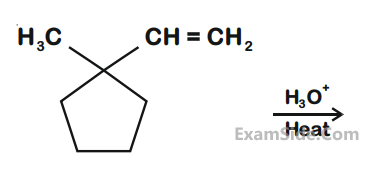


${\left( {C{H_3}} \right)_3}CCH\left( {OH} \right)C{H_3}\buildrel {conc.\,\,\,{H_2}S{O_4}} \over \longrightarrow $
${\left( {C{H_3}} \right)_2}CHCH\left( {Br} \right)C{H_3}\buildrel {alc.\,\,KOH} \over \longrightarrow $
${\left( {C{H_3}} \right)_2}{\rm{ }}CHCH\left( {Br} \right)C{H_3}\buildrel {{{(C{H_3})}_3}{O^\Theta }{K^ \oplus }} \over \longrightarrow $
${\left( {C{H_3}} \right)_2}\mathop C\limits_{\mathop |\limits_{OH} } - C{H_2} - CHO\buildrel \Delta \over \longrightarrow $
Which of these reaction(s) will not produce Saytzeff product ?

Explanation:
C4H10(g) + ${{13} \over 2}$O2(g) $ \to $ 4CO2(g) + 5H2O(l)
$ \therefore $ No. of moles of O2 required to oxidise 1 mole of propane = 5
$ \therefore $ No. of moles of O2 required to oxidise 1 mole of butane = ${{13} \over 2}$
So, No. of moles of O2 required to oxidise 1 mole of
propane and 2 moles of butane = 5 + 2 $ \times $ ${{13} \over 2}$ = 18

Explanation:

 (A is a lowest molecular weight alkyne)
Explanation:


Choose the correct option(s).


The major products $P$ and $Q$ from the below reactions are :
$ \mathrm{CH}_3 \mathrm{CH}=\mathrm{CH}_2 \xrightarrow{\mathrm{HBr}} P $


| P | Q |
|---|---|
| $ \mathrm{CH}_3 \mathrm{CH}_2 \mathrm{CH}_2 \mathrm{Br} $ |
$ \mathrm{CH}_3 \mathrm{CH}_2 \mathrm{CH}_2 \mathrm{OH} $ |
| P | Q |
|---|---|
| $ \mathrm{CH}_3 \mathrm{CH}_2 \mathrm{CH}_2 \mathrm{Br} $ |
$ \mathrm{CH}_3 \mathrm{CH}_2 \mathrm{COOH} $ |


A benzene derivative did not produce white precipitate with the ammonical silver nitrate solution but decolorised the cold dilute alkaline $\mathrm{KMnO}_4$ solution. The compound is
$\mathrm{C}_8 \mathrm{H}_6$
$\mathrm{C}_8 \mathrm{H}_{10}$
$\mathrm{C}_8 \mathrm{H}_8$
$\mathrm{C}_7 \mathrm{H}_8$
 It is a derivative of benzene and decolorised the cold alkaline $\mathrm{KMnO}_4$ solution.
Which of the following can be used as the test for unsaturation with regard to colour change of reaction?
Addition of hydrogen
Addition of hydrogen bromide
Addition of hypobromous acid
Addition of bromine
Ethyl phenyl acetylene (1-phenyl-1-butyne) on reduction with partially deactiveated palladised charcoal (Lindlar's catalyst) gives


Which one of the following methods is suitable to generate aromatic compound(s) from linear aliphatic saturated hydrocarbons with at least six carbon atoms?
Heating at 773 K
$\mathrm{Mo}_2 \mathrm{O}_3, 773 \mathrm{~K}, 10-20 \mathrm{~atm}$
Anhyd. $\mathrm{AlCl}_3$, conc. HCl, $\Delta$
$\mathrm{Cu}, 523 \mathrm{~K}, 100 \mathrm{~atm}$

Identify structure of compound (D).


In the given reaction,

Product (D) is

Identify 'A' and 'B' in the following reaction

Both A and B are

Both A and B are


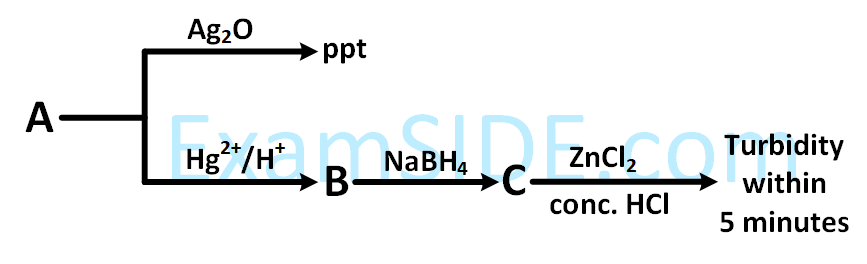
'A' is :

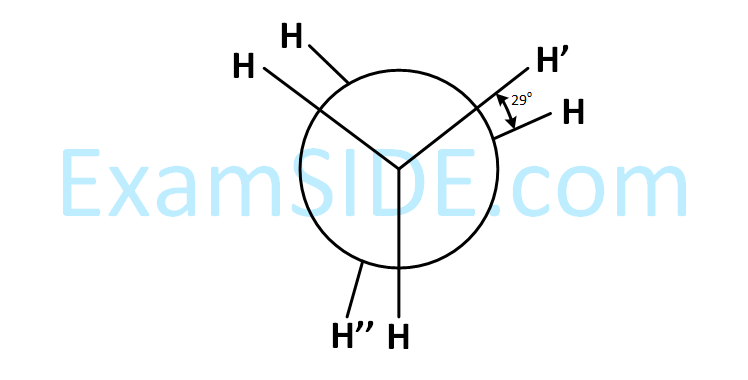

H3C–CH=CH2 $\buildrel {C{l_2}/{H_2}O} \over \longrightarrow $


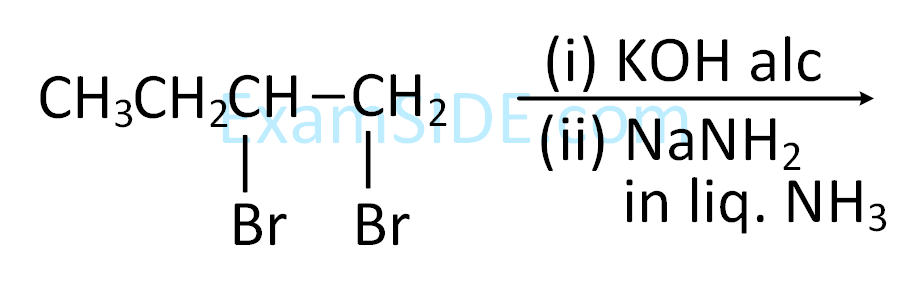






CH $ \equiv $ CH, CH3–C $ \equiv $ CH and CH2 = CH2 is as follows






Explanation:

Compound (P) has total number of hydroxyl groups = 6


