Basics of Organic Chemistry
The correct statement(s) about the compound $\mathrm{H_3C(HO)HC-CH=CH-CH(OH)CH_3~~(X)}$ is (are)




The correct stability order for the following species is :


Hyperconjugation involves overlapping of the following orbitals:
The correct statement(s) concerning the structures E, F and G is(are) :




The number of stereoisomers obtained by bromination of $trans$-2-butene is :


Among the following the least stable resonance structure is :


The number of structural isomers for C$_6$H$_{14}$ is :

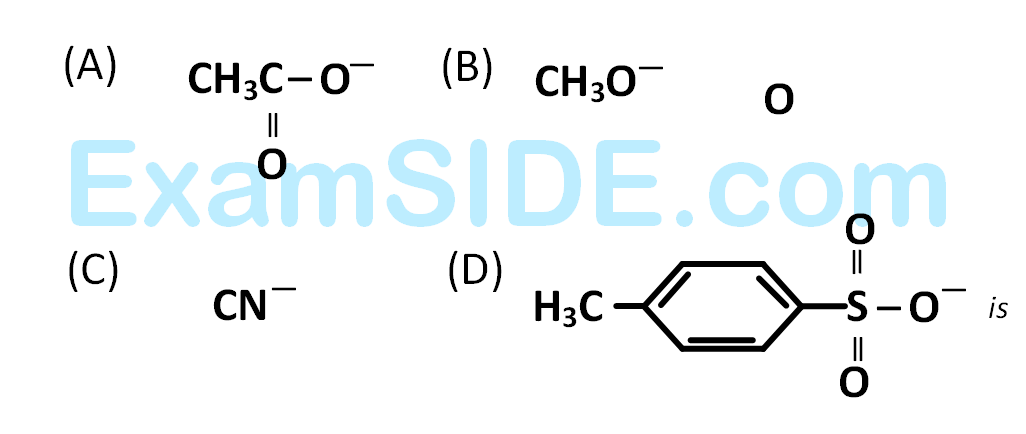
[Nu– = (A) PhO–, (B) AcO–, (C) HO–, (D) CH3O–]

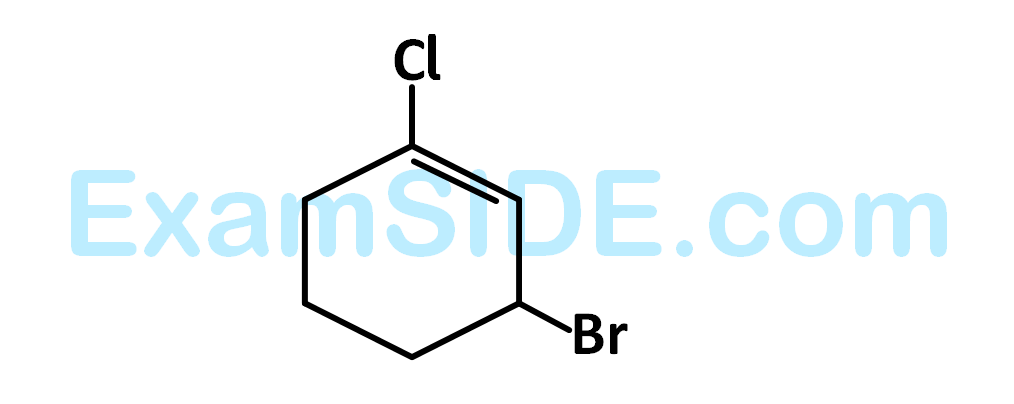


What are N and M?
6,6
6,4
4,4
3,3
 The chlorination yields total 6 different compounds. The compounds I, II, III and IV have chiral centres present in it. The compounds I and II, III and IV are a pair of enantiomers due to presence of chiral centres. Hence, value of N will be 6 .
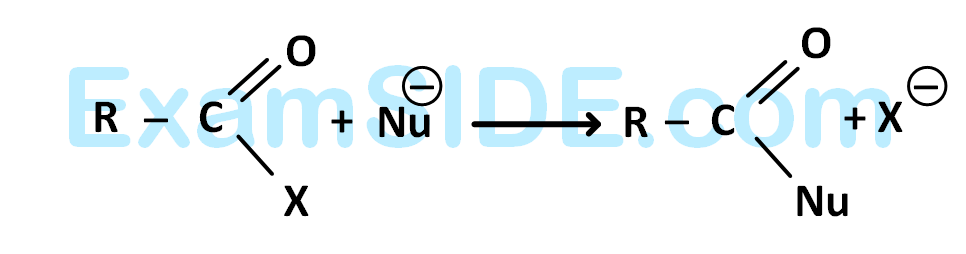
is fastest when $X$ is


(a) PhCOOH
(b) o – NO2C6H4COOH
(c) p – NO2C6H4COOH
(d) m – NO2C6H4COOH
Which of the following order is correct?


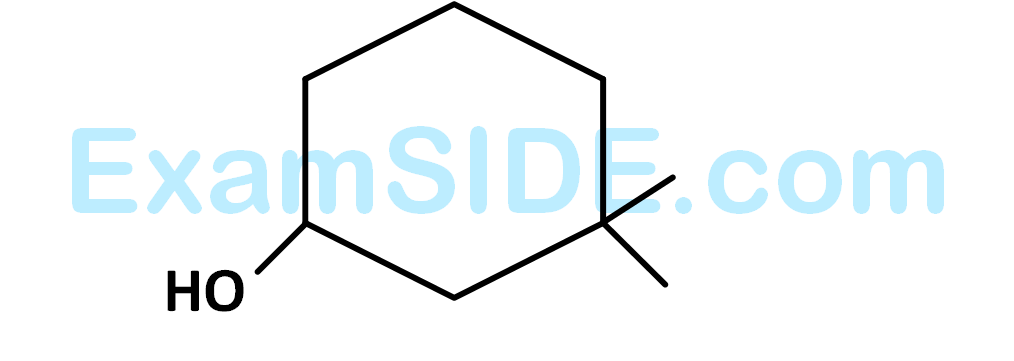


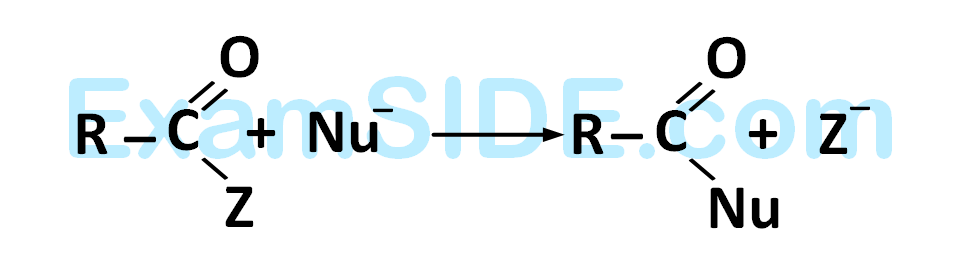
is fastest when $Z$ is


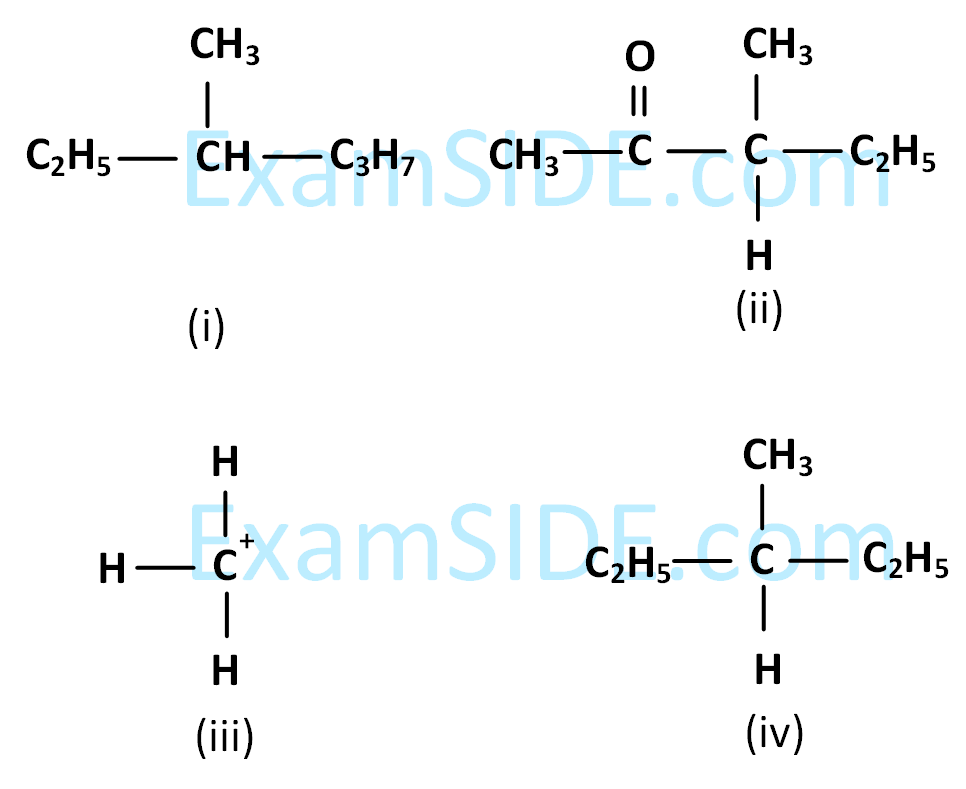
it is true that


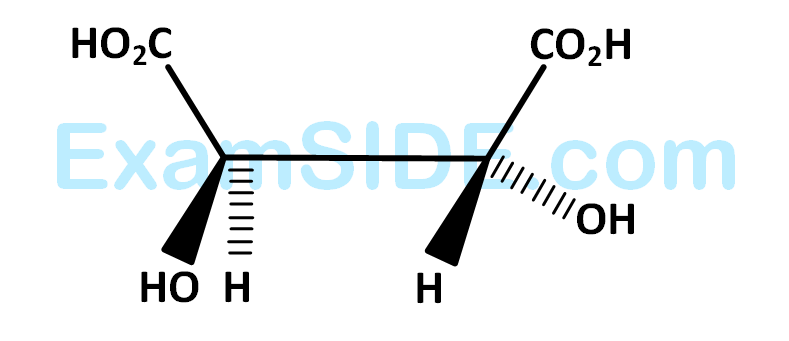
are studied in terms of isomerism in :

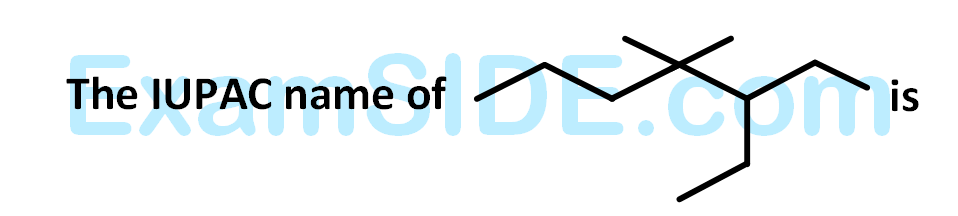
Write the IUPAC name for the following :

Give the IUPAC name of the following compound :

CH2 = CH $-$ CH(CH3)2

CH3CH2CH = CHCOOH
Explanation:

Note :
(1) Here functional group $-$COOH present. All functional groups add as secondary suffix.
(a) If carbon atom of $-$COOH group present in main chain then secondary suffix name is $\to$ oic acid.
(b) If carbon atom of $-$COOH group present not in main chain then secondary suffix name is $\to$ carboxylic acid.
As here carbon atom of $-$COOH group present in main chain that is why we use oic acid.
(2) Functional group should always get lowest possible number.
(3) Alkane, alkene(=) and alkyne($\equiv$) always act as primary suffix.
For alkane we use word "ane".
For alkene we use word "ene".
For alkyne we use word "yne".
Here alkene(=) present so we use word "ene" as primary suffix.
(4) After last e of "ene" if we get a, i, o, u, y as the first letter of secondary suffix then we delete e.
Here in the name $\to$

(5) Naming is done by following way $\to$
Prefix + word root + suffix(p) + suffix(s)
(a) Here no prefix (name of side chain) as there is no side chain present.
(b) Word root represent number of carbon atom in main chain.
Here in main chain 5 carbon atoms present so word root is "pent".
(c) Primary suffix is alkene.
(d) Secondary suffix is function group $-$COOH. It's name oic acid.
(6) If functional group's carbon get number "1" then we can ignore it in nomenclature. So it's nomenclature can be also $\to$
$\mathrm{pent - 2 - enoic\,acid}$

