Basics of Organic Chemistry
Which technique among the following, is most appropriate in separation of a mixture of $100 \,\mathrm{mg}$ of $p$-nitrophenol and picric acid ?
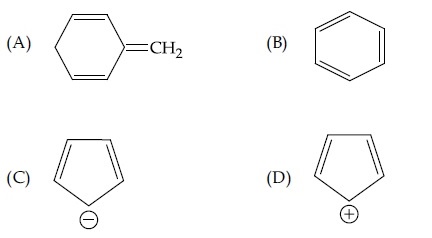
Which of the following compounds is not aromatic?


Arrange the following in decreasing acidic strength.


Which of the following carbocations is most stable?


The correct IUPAC name of the following compound is :


Which one of the following techniques is not used to spot components of a mixture separated on thin layer chromatographic plate?
Which of the following structure are aromatic in nature?

Which of the following is most stable?


The correct order of nucleophilicity is


Given below are two statements : one is labelled as Assertion A and the other is labelled as Reason R.
Assertion A : A mixture contains benzoic acid and napthalene. The pure benzoic acid can be separated out by the use of benzene.
Reason R : Benzoic acid is soluble in hot water.
In the light of the above statements, choose the most appropriate answer from the options given below.
Phenol on reaction with dilute nitric acid, gives two products. Which method will be most efficient for large scale separation?

In the following structures, which on is having staggered conformation with maximum dihedral angle?


The IUPAC name of ethylidene chloride is :
Arrange the following carbocations in decreasing order of stability.


Which of the following is an example of conjugated diketone?


Optical activity of an enantiomeric mixture is $+12.6^{\circ}$ and the specific rotation of $(+)$ isomer is $+30^{\circ}$. The optical purity is __________$\%$.
Explanation:
$ \begin{aligned} &=\frac{12 \cdot 6}{30} \times 100 \\\\ &=42 \% \end{aligned} $
Total number of isomers (including stereoisomers) obtained on monochlorination of methylcyclohexane is ___________.
Explanation:
Compounds formed on mono-chlorination of methylcyclohexane are :

$\therefore$ Total mono-chlorinated products formed = 12
The separation of two coloured substances was done by paper chromatography. The distances travelled by solvent front, substance A and substance B from the base line are 3.25 cm, 2.08 cm and 1.05 cm, respectively. The ratio of Rf values of A to B is _____________.
Explanation:
$\left(R_{f}\right)_{A}=\frac{2.08}{3.25}$
$\left(R_{f}\right)_{B}=\frac{1.05}{3.25}$
$\frac{\left(R_{f}\right)_{A}}{\left(R_{f}\right)_{B}} \simeq 2$
The total number of monobromo derivatives formed by the alkanes with molecular formula C5H12 is (excluding stereo isomers) __________.
Explanation:
Total monobromo derivatives = 8

Observe structures of the following compounds

The total number of structures/compounds which possess asymmetric carbon atoms is ______________.
Explanation:

The number of compounds containing asymmetric carbons is three.
Total number of possible stereoisomers of dimethyl cyclopentane is ____________.
Explanation:


will show stereo isomerism, Its stereo isomers are


will show stereo isomerism, Its stereo isomers are

Number of electrophilic centres in the given compound is _______________.

Explanation:

Number of electrophilic centres = 3
Which of the following is not an example of benzenoid compound?


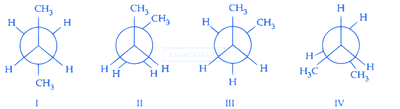


Assertion (A) : A simple distillation can be used to separate a mixture of propanol and propanone.
Reason (R) : Two liquids with a difference of more than 20$^\circ$ in their boiling points can be separated by simple distillations.
In the light of the above statements, choose the most appropriate answer from the options given below :
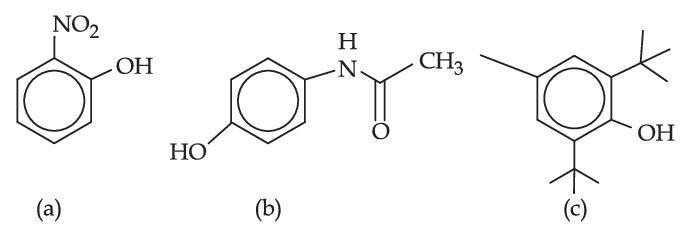


Statement I : Hyperconjugation is a permanent effect.
Statement II : Hyperconjugation in ethyl cation $\left( {C{H_3} - \mathop C\limits^ + {H_2}} \right)$ involves the overlapping of ${C_{s{p^2}}} - {H_{1s}}$ bond with empty 2p orbital of other carbon.
Choose the correct option :
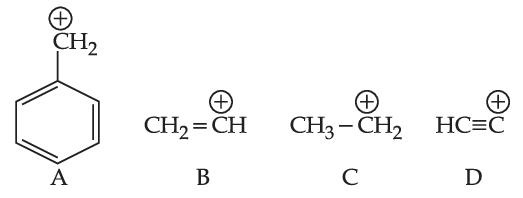
The correct order of stability of given carbocation is :


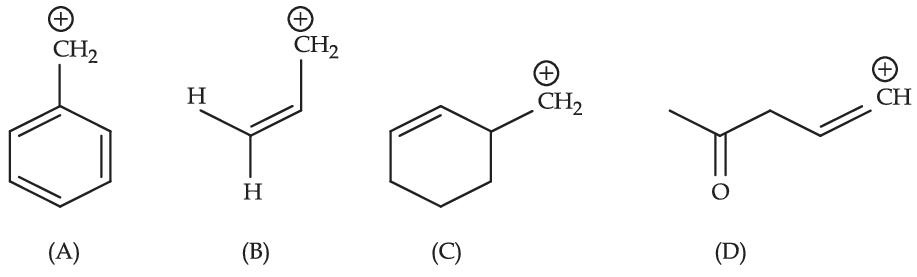
Among the given species the Resonance stabilised carbocations are :


Hybridisation of Carbon a, b, and c respectively are :


Statement I : Retardation factor (Rf) can be measured in meter/centimeter.
Statement II : Rf value of a compound remains constant in all solvents.
Choose the most appropriate answer from the options given below :
Choose the correct answer from the following options :


Statement I : A mixture of chloroform and aniline can be separated by simple distillation.
Statement II : When separating aniline from a mixture of aniline and water by steam distillation aniline boils below its boiling point.
In the light of the above statements, choose the most appropriate answer from the options given below :


