Basics of Organic Chemistry
0.53 g of an organic compound $(\mathrm{x})$ when heated with excess of nitric acid (concentrated) and then with silver nitrate gave 0.75 g of silver bromide precipitate. 1.0 g of $(\mathrm{x})$ gave 1.32 g of $\mathrm{CO}_2$ gas on combustion. The percentage of hydrogen in the compound $(x)$ is $\_\_\_\_$ %. [Nearest Integer]
[Given: Molar mass in $\mathrm{g} \mathrm{mol}^{-1} \mathrm{H}: 1, \mathrm{C}: 12, \mathrm{Br}: 80, \mathrm{Ag}: 108, \mathrm{O}: 16$; Compound (x) : $\left.\mathrm{C}_{\mathrm{x}} \mathrm{H}_{\mathrm{y}} \mathrm{Br}_{\mathrm{z}}\right]$
Explanation:
From the given data, the compound is of type $C_xH_yBr_z$.
1) Percentage of bromine from AgBr precipitate
Molar mass of $\mathrm{AgBr} = 108 + 80 = 188\ \mathrm{g\,mol^{-1}}$
Moles of $\mathrm{AgBr}$ formed:
$n(\mathrm{AgBr})=\frac{0.75}{188}=0.003989\ \mathrm{mol}$
Each mole of $\mathrm{AgBr}$ contains 1 mole of Br, so
$n(\mathrm{Br})=0.003989\ \mathrm{mol}$
Mass of Br in $0.53\ \mathrm{g}$ of compound:
$m(\mathrm{Br})=0.003989\times 80=0.3191\ \mathrm{g}$
So, mass fraction of Br:
$\text{Br fraction}=\frac{0.3191}{0.53}=0.602$
Hence, in $1.0\ \mathrm{g}$ of compound:
$m(\mathrm{Br})=0.602\ \mathrm{g}$
2) Mass of carbon from $\mathrm{CO_2}$ on combustion
Given $1.0\ \mathrm{g}$ compound gives $1.32\ \mathrm{g\ CO_2}$.
Moles of $\mathrm{CO_2}$:
$n(\mathrm{CO_2})=\frac{1.32}{44}=0.03\ \mathrm{mol}$
Moles of carbon $= 0.03\ \mathrm{mol}$, so mass of carbon:
$m(\mathrm{C})=0.03\times 12=0.36\ \mathrm{g}$
3) Mass and percentage of hydrogen
In $1.0\ \mathrm{g}$ compound:
$m(\mathrm{H})=1.0-(0.602+0.36)=0.038\ \mathrm{g}$
Therefore, percentage of hydrogen:
$\%\,\mathrm{H}=\frac{0.038}{1.0}\times 100=3.8\%$
Nearest integer $= \boxed{4\%}$.
The total number of structural isomers possible for the substituted benzene derivatives with the molecular formula $\mathrm{C}_9 \mathrm{H}_{12}$ is________.
Explanation:
$\mathrm{MF}=\mathrm{C}_9 \mathrm{H}_{12}$

The hydrocarbon $(\mathrm{X})$ with molar mass $80 \mathrm{~g} \mathrm{~mol}^{-1}$ and $90 \%$ carbon has _______ degree of unsaturation.
Explanation:
Mass of carbon $=\frac{80 \times 90}{100}=72 \mathrm{gm}$
Number of C-atoms $=\frac{72}{12}=6$
Mass of hydrogen $=\frac{80 \times 10}{800}=8 \mathrm{gm}$
Number of H -atoms $=\frac{8}{1}=8$
So molecular formula $\mathrm{C}_6 \mathrm{H}_8$
D.U. $=6+1-8 / 2=7-4=3$
The possible number of stereoisomers for 5-phenylpent-4-en-2-ol is ________.
Explanation:

$\mathrm{n}($stereogenic unit$)=2,2^2=4$ stereoisomers are possible.
In Carius method for estimation of halogens, 180 mg of an organic compound produced 143.5 mg of AgCl . The percentage composition of chlorine in the compound is _________ %. (Given : molar mass in $\mathrm{g} \mathrm{~mol}^{-1}$ of $\mathrm{Ag}: 108, \mathrm{Cl}: 35.5$ )
Explanation:
To find the percentage composition of chlorine in an organic compound using the Carius method, we follow these steps:
Calculate Millimoles of AgCl:
Since 143.5 mg of AgCl is produced, and the molar mass of AgCl is 143.5 g/mol, the millimoles of AgCl is:
$ \text{Millimoles of AgCl} = \frac{143.5 \, \text{mg}}{143.5 \, \text{mg/mmol}} = 1 \, \text{mmol} $
Determine Millimoles of Cl:
In AgCl, there is a 1:1 ratio of Ag to Cl, so the millimoles of Cl are equal to that of AgCl:
$ \text{Millimoles of Cl} = 1 \, \text{mmol} $
Calculate Mass of Cl:
Using the molar mass of Cl (35.5 g/mol), the mass of Cl is:
$ \text{Mass of Cl} = 35.5 \times 10^{-3} \, \text{g} = 35.5 \, \text{mg} $
Compute Percentage by Mass of Cl:
The total mass of the organic compound is 180 mg, so the percentage of chlorine is:
$ \% \text{ Cl by mass} = \left( \frac{35.5 \, \text{mg}}{180 \, \text{mg}} \right) \times 100 = 19.72\% $
Round to the Nearest Integer:
Rounding 19.72% to the nearest integer gives 20%.
Thus, the percentage composition of chlorine in the compound is approximately 20%.
How many compounds among the following compounds show inductive, mesomeric as well as hyperconjugation effects?

Explanation:

are the compounds show inductive, mesomeric as well as hyperconjugation.
Total number of aromatic compounds among the following compounds is ______.

Explanation:
The aromatic compounds is  only in the given compounds.
The number of optically active compounds from the following is _________.

Explanation:
The optically active compound is :

The number of optical isomers in following compound is : __________.

Explanation:

$\begin{aligned} \text { Total stereogenic centre }=5 \\ \begin{aligned} \text { Total optical isomer } & =2^n \\ & =2^5=32 \end{aligned} \end{aligned}$
Number of carbocations from the following that are not stabilized by hyperconjugation is _______.

Explanation:

Using the given figure, the ratio of $\mathrm{R}_f$ values of sample $\mathrm{A}$ and sample $\mathrm{C}$ is $x \times 10^{-2}$. Value of $x$ is __________.

Explanation:
To determine the ratio of the $\mathrm{R}_f$ values of sample $\mathrm{A}$ and sample $\mathrm{C}$, follow these steps:
- Understanding the $\mathrm{R}_f$ Value:
The $\mathrm{R}_f$ value (Retention factor) is calculated using the formula:
$\mathrm{R}_{\mathrm{f}} = \frac{\text{Distance travelled by the substance from the base line }(\mathrm{x})}{\text{Distance travelled by the solvent from the base line }(\mathrm{y})}$
- Calculate $\mathrm{R}_f$ for Sample $A$:
- Distance travelled by substance $A$ (from the figure): 5 cm
- Distance travelled by the solvent: 12.5 cm
- So, $\left(R_f\right)_A = \frac{5}{12.5}$
- Calculate $\mathrm{R}_f$ for Sample $C$:
- Distance travelled by substance $C$ (from the figure): 10 cm
- Distance travelled by the solvent: 12.5 cm
- So, $\left(R_f\right)_C = \frac{10}{12.5}$
- Ratio of $\mathrm{R}_f$ values for $A$ and $C$:
- The ratio is given by:
$\frac{\left(R_f\right)_A}{\left(R_f\right)_C} = \frac{\frac{5}{12.5}}{\frac{10}{12.5}}$
- Simplify the ratio:
$\frac{\left(R_f\right)_A}{\left(R_f\right)_C} = \frac{5}{12.5} \times \frac{12.5}{10} = \frac{5}{10} = 0.5$
- Converting to the given form:
- The simplified ratio (0.5) should be expressed in the form $x \times 10^{-2}$.
- Since $0.5 = 50 \times 10^{-2}$,
we can identify $x = 50$.
Therefore, the value of $x$ is 50.
The total number of 'sigma' and 'pi' bonds in 2-oxohex-4-ynoic acid is ______.
Explanation:

Total number of $\sigma$ & $\pi$ bonds = 18
The number of different chain isomers for C$_7$H$_{16}$ is __________.
Explanation:
(1) heptane
(2) 2-methylhexane
(3) 3-methylhexane
(4) 2,2-dimethylpentane
(5) 2,3-dimethylpentane
(6) 2,4-dimethylpentane
(7) 3,3-dimethylpentane
(8) 3-ethylpentane
(9) 2,2,3-trimethylbutane
Explanation:

Explanation:

Explanation:

There is one chiral centre present in given compound.
So, Total optical isomers $=2$

Number of isomeric products formed by monochlorination of 2-methylbutane in presence of sunlight is ________.
Explanation:

$\therefore$ Number of isomeric products = 6
Number of geometrical isomers possible for the given structure is/are _________.

Explanation:
3 stereocenteres, symmetrical
Total Geometrical isomers $\rightarrow 4$. EE, ZZ, EZ (two isomers)

Total number of compounds with Chiral carbon atoms from following is _________.

Explanation:
Chiral carbons are marked by,

3-Methylhex-2-ene on reaction with $\mathrm{HBr}$ in presence of peroxide forms an addition product (A). The number of possible stereoisomers for '$\mathrm{A}$' is ________.
Explanation:

Among the given organic compounds, the total number of aromatic compounds is

Explanation:
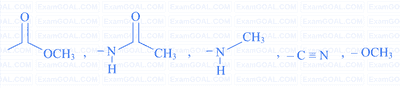
Among the following, total number of meta directing functional groups is (Integer based)
$-\mathrm{OCH}_3,-\mathrm{NO}_2,-\mathrm{CN},-\mathrm{CH}_3-\mathrm{NHCOCH}_3, -\mathrm{COR},-\mathrm{OH},-\mathrm{COOH},-\mathrm{Cl}$
Explanation:
Here's how to identify the meta-directing functional groups and determine the total :
Meta-Directing Groups:- Meta-directing groups are electron-withdrawing. They destabilize the intermediate carbocation that forms during electrophilic aromatic substitution at the ortho and para positions more than at the meta position.
- Common meta-directing groups include:
- -NO₂ (nitro)
- -CN (cyano)
- -COR (carbonyl groups, like ketones and aldehydes)
- -COOH (carboxylic acid)
- -SO₃H (sulfonic acid)
Identifying Meta-Directing Groups in the List:
- -OCH₃: Ortho/para-directing (electron-donating)
- -NO₂: Meta-directing
- -CN: Meta-directing
- -CH₃: Ortho/para-directing (electron-donating)
- -NHCOCH₃: Ortho/para-directing (electron-donating)
- -COR: Meta-directing
- -OH: Ortho/para-directing (electron-donating)
- -COOH: Meta-directing
- -Cl: Ortho/para-directing (weakly deactivating)
Total Count:
There are four meta-directing groups in the list: -NO₂, -CN, -COR, -COOH
Answer:The total number of meta-directing functional groups is 4.
Three organic compounds A, B and $\mathrm{C}$ were allowed to run in thin layer chromatography using hexane and gave the following result (see figure). The $\mathrm{R}_{\mathrm{f}}$ value of the most polar compound is ____________ $\times 10^{-2}$

Explanation:
$\therefore \mathrm{R}_{\mathrm{f}}$ value for most polar compound
$ \begin{aligned} & =\frac{2}{8}=0.25 \\\\ & =25 \times 10^{-2} \end{aligned} $
The total number of chiral compound/s from the following is ______________.

Explanation:


Following chromatogram was developed by adsorption of compound 'A' on a 6 cm TLC glass plate. Retardation factor of the compound 'A' is _________ $\times 10^{-1}$.

Explanation:
$=\frac{3.0 \mathrm{~cm}}{5.0 \mathrm{~cm}}=0.6$ or $6 \times 10^{-1}$
Optical activity of an enantiomeric mixture is $+12.6^{\circ}$ and the specific rotation of $(+)$ isomer is $+30^{\circ}$. The optical purity is __________$\%$.
Explanation:
$ \begin{aligned} &=\frac{12 \cdot 6}{30} \times 100 \\\\ &=42 \% \end{aligned} $
Total number of isomers (including stereoisomers) obtained on monochlorination of methylcyclohexane is ___________.
Explanation:
Compounds formed on mono-chlorination of methylcyclohexane are :

$\therefore$ Total mono-chlorinated products formed = 12
The separation of two coloured substances was done by paper chromatography. The distances travelled by solvent front, substance A and substance B from the base line are 3.25 cm, 2.08 cm and 1.05 cm, respectively. The ratio of Rf values of A to B is _____________.
Explanation:
$\left(R_{f}\right)_{A}=\frac{2.08}{3.25}$
$\left(R_{f}\right)_{B}=\frac{1.05}{3.25}$
$\frac{\left(R_{f}\right)_{A}}{\left(R_{f}\right)_{B}} \simeq 2$
The total number of monobromo derivatives formed by the alkanes with molecular formula C5H12 is (excluding stereo isomers) __________.
Explanation:
Total monobromo derivatives = 8

Observe structures of the following compounds

The total number of structures/compounds which possess asymmetric carbon atoms is ______________.
Explanation:

The number of compounds containing asymmetric carbons is three.
Total number of possible stereoisomers of dimethyl cyclopentane is ____________.
Explanation:


will show stereo isomerism, Its stereo isomers are


will show stereo isomerism, Its stereo isomers are

Number of electrophilic centres in the given compound is _______________.

Explanation:

Number of electrophilic centres = 3
Explanation:

Explanation:

[Atomic mass : Silver = 108, Bromine = 80]
Explanation:
$\Rightarrow$ Mass of Br = ${{0.2397} \over {188}}$ $\times$ 80 g
therefore % Br in the organic compound
$ = {{{W_{Br}}} \over {{W_T}}}$ $\times$ 100
${{0.2397 \times 80} \over {188 \times 0.15}}$ $\times$ 100 = 0.85 $\times$ 80 = 68
$\Rightarrow$ Nearest integer is '68'.

Fig : Paper chromatography for compounds A and B.
the calculated Rf value of A ________$\times$ 10-1.
Explanation:
On chromatogram distance travelled by compound is = 2 cm
Distance travelled by solvent = 5 cm
So, ${R_f} = {2 \over 5} = $ 4 $\times$ 10$-$1 = 0.4
Explanation:

(i) Mono-bromination of substituted methyl on 1-methylcyclohex-1-ene.

Only one stereoisomer possible as compound (1) is optically active.
(ii) Mono-bromination of allylic carbon (C-3) :

C-3 is optically active on bromine substitution and gives two optically active isomers.
(iii) Mono-bromination of C-4 carbon :

C-4 is optically active on mono-bromination and gives two optically active isomers.
(iv) Mono-bromination of C-5 carbon :

C-5 is optically active on mono-bromination and gives two optically active isomers.
(v) Mono-bromination of C-6 carbon :

C-6 is optically active on mono-bromination and gives two optically active isomers.
(vi) Mono-bromination of C-1 carbon :

C-1 is optically active on mono-bromination and gives two optically active isomers.
(vii) Mono-bromination of C-2 carbon :

C-2 is optically active on mono-bromination and gives two optically active isomers.
So, maximum number of possible isomers are 13.
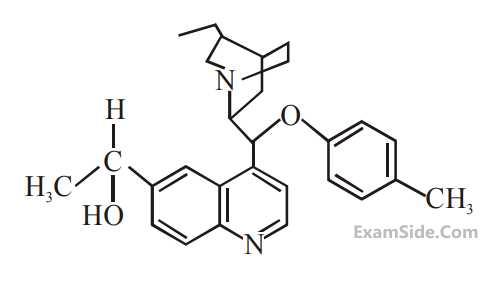
Explanation:

Chiral carbon atom is bonded to 4 different atoms or group of atoms. The given structure has 5 chiral carbon-atoms.
Explanation:

Total number of isomers of cyclic ether with molecular formula, C4H8O are 10.


Explanation:


Explanation:

Also

(i) Both the rings in compound is cyclic.
(ii) Due to the presence of alternate carboncarbon double bond in benzene ring all carbon are $s p^2$ hybridised and planner. But all carbons in second ring are not conjugated as carbons nine and ten are $s p^3$ hybridised. This makes second ring non-aromatic.
(iii) There are $(4 n+2) \pi$ electrons in aromatic ring (benzene); hence, it's aromatic. Even if one ring in compound is aromatic, the entire molecule becomes aromatic.
Hence, there are total of 5 aromatic compounds in the given list of compounds.

Explanation:
(a) Bromination at carbon atom 1 :

(b) Bromination at carbon atom 2 :

all carbon become a chiral.
(c) Bromination at carbon atom 3 :


(d) Bromination at carbon atom 4 :

(e) Bromination at carbon atom 5 :

Monobrominated products (I), (III), (IV), (VI) and (VII) are chiral products.
The total number of stereoisomers that can exist for M is ___________.

Explanation:
The total number of stereo isomers = 2n = 22 = 4, where n is the number of chiral centres.
However, in bridge/bicycle compounds, the number of stereo-isomers is equal to the number of chiral centres because no carbon centres rotation is possible. Therefore, two stereoisomers would be possible for the given compound.


Explanation:

These three have non-zero dipole moment due to non-cancellation of all dipole moment created by C$-$Cl and C$-$Br bond.
When the following aldohexose exists in its D-configuration, the total number of stereoisomers in its pyranose form is ____________.

Explanation:
The structure of aldohexose in D-configuration can be represented as

The total number of contributing structure showing hyper-conjugation (involving C-H bonds) for the following carbocation is _________.

Explanation:
(i) Hyper conjugation involves the electrons of $\mathrm{C}-\mathrm{H}$ sigma ( $\sigma$ ) bond, of alkyl group is delocalised with an atom containing empty $p$-orbital (i.e., a carbocation) or unsaturated system.
(ii) For the given carbocation, hypercojugation involves the delocalisation of $\mathrm{C}-\mathrm{H}$ sigma ( $\sigma$ ) bond, of alkyl group with the adjacent atom containing unshared $p$-orbital.
(iii) The different kinds of hydrogen that will be involved in hyperconjugation are as follows :

There are three different kinds of hydrogen; $\mathrm{H}_{a^{\prime}} \mathrm{H}_b$ and $\mathrm{H}_c$.
(iv) Hyperconjugative structure due to different kind of hydrogens are as follows :
(a) Hyperconjugation due to $\mathrm{C}-\mathrm{H}_a$ sigma (or $\sigma)$ bond.

Similarly, two more hyperconjugative structures are possible due to two other hydrogen atoms.
A total of three hyperconjugative structures of carbocation are possible due to delocalisation of $\mathrm{C}-\mathrm{H}_a$ ( $\sigma$ bond) with empty $p$-orbital (on carbocation).
(b) Hyperconjugation due to $\mathrm{C}-\mathrm{H}_b$ sigma (or $\sigma)$ bond.

Similarly, one more hyperconjugative structure is possible due to other hydrogen $\left(\mathrm{H}_b\right)$. A total of two hyperconjugative structures of carbocations are possible due to delocalisation of $\mathrm{C}-\mathrm{H}_b$ ( $\sigma$ bond) with empty $p$-orbital (on carbocation).
(c) Hyperconjugation due to $\mathrm{C}-\mathrm{H}_c$ sigma (or $\sigma)$ bond.

There is only one $\mathrm{H}^c$ hydrogen; hence, one hyperconjugative structure is possible due to delocalisation of $\mathrm{C}-\mathrm{H}_c$ ( $\sigma$ bond) with empty $p$-orbital (on carbocation).
The total number of cyclic structural as well as stereoisomers possible for a compound with the molecular formula C$_5$H$_{10}$ is ____________.
Explanation:
Cyclic C$_5$H$_{10}$

For third structure, 2 $cis-trans$ and 1 optical isomer are possible. So, a total of 7 structures are.
Write the IUPAC name for the following :
