Basics of Organic Chemistry
Explanation:

Total number of isomers of cyclic ether with molecular formula, C4H8O are 10.


| List - I | List - II | ||
|---|---|---|---|
| (A) | Coloured impurity | (P) | Steam distilation |
| (B) | Mixture of o-nitrophenol and p-nitrophenol |
(Q) | Fractional distilation |
| (C) | Crude Naphtha | (R) | Charcoal treatment |
| (d) | Mixture of glycerol and sugars |
(S) | Distillation under reduced pressure |


Explanation:


Geometrical isomerism is not possible at site (s) :





Explanation:

Also

(i) Both the rings in compound is cyclic.
(ii) Due to the presence of alternate carboncarbon double bond in benzene ring all carbon are $s p^2$ hybridised and planner. But all carbons in second ring are not conjugated as carbons nine and ten are $s p^3$ hybridised. This makes second ring non-aromatic.
(iii) There are $(4 n+2) \pi$ electrons in aromatic ring (benzene); hence, it's aromatic. Even if one ring in compound is aromatic, the entire molecule becomes aromatic.
Hence, there are total of 5 aromatic compounds in the given list of compounds.


is :


Explanation:
(a) Bromination at carbon atom 1 :

(b) Bromination at carbon atom 2 :

all carbon become a chiral.
(c) Bromination at carbon atom 3 :


(d) Bromination at carbon atom 4 :

(e) Bromination at carbon atom 5 :

Monobrominated products (I), (III), (IV), (VI) and (VII) are chiral products.

The total number of stereoisomers that can exist for M is ___________.

Explanation:
The total number of stereo isomers = 2n = 22 = 4, where n is the number of chiral centres.
However, in bridge/bicycle compounds, the number of stereo-isomers is equal to the number of chiral centres because no carbon centres rotation is possible. Therefore, two stereoisomers would be possible for the given compound.

Isomers of hexane, based on their branching, can be divided into three distinct classes as shown in the figure.

The correct order of their boiling point is

Explanation:

These three have non-zero dipole moment due to non-cancellation of all dipole moment created by C$-$Cl and C$-$Br bond.


When the following aldohexose exists in its D-configuration, the total number of stereoisomers in its pyranose form is ____________.

Explanation:
The structure of aldohexose in D-configuration can be represented as

Which of the given statement(s) about N, O, P and Q with respect to M is(are) correct?


Which of the following molecules, in pure form, is(are) unstable at room temperature?


The total number of contributing structure showing hyper-conjugation (involving C-H bonds) for the following carbocation is _________.

Explanation:
(i) Hyper conjugation involves the electrons of $\mathrm{C}-\mathrm{H}$ sigma ( $\sigma$ ) bond, of alkyl group is delocalised with an atom containing empty $p$-orbital (i.e., a carbocation) or unsaturated system.
(ii) For the given carbocation, hypercojugation involves the delocalisation of $\mathrm{C}-\mathrm{H}$ sigma ( $\sigma$ ) bond, of alkyl group with the adjacent atom containing unshared $p$-orbital.
(iii) The different kinds of hydrogen that will be involved in hyperconjugation are as follows :

There are three different kinds of hydrogen; $\mathrm{H}_{a^{\prime}} \mathrm{H}_b$ and $\mathrm{H}_c$.
(iv) Hyperconjugative structure due to different kind of hydrogens are as follows :
(a) Hyperconjugation due to $\mathrm{C}-\mathrm{H}_a$ sigma (or $\sigma)$ bond.

Similarly, two more hyperconjugative structures are possible due to two other hydrogen atoms.
A total of three hyperconjugative structures of carbocation are possible due to delocalisation of $\mathrm{C}-\mathrm{H}_a$ ( $\sigma$ bond) with empty $p$-orbital (on carbocation).
(b) Hyperconjugation due to $\mathrm{C}-\mathrm{H}_b$ sigma (or $\sigma)$ bond.

Similarly, one more hyperconjugative structure is possible due to other hydrogen $\left(\mathrm{H}_b\right)$. A total of two hyperconjugative structures of carbocations are possible due to delocalisation of $\mathrm{C}-\mathrm{H}_b$ ( $\sigma$ bond) with empty $p$-orbital (on carbocation).
(c) Hyperconjugation due to $\mathrm{C}-\mathrm{H}_c$ sigma (or $\sigma)$ bond.

There is only one $\mathrm{H}^c$ hydrogen; hence, one hyperconjugative structure is possible due to delocalisation of $\mathrm{C}-\mathrm{H}_c$ ( $\sigma$ bond) with empty $p$-orbital (on carbocation).
Among the given options, the compound(s) in which all the atoms are in one plane in all the possible conformations (if any) is(are)


In the Newman projection for 2,2-dimethylbutane, X and Y can, respectively, be


In the following carbocation, H/CH$_3$ that is most likely to migrate to the positively charged carbon is :


The correct stability order of the following resonance structures is

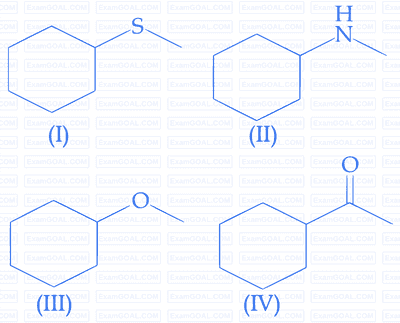
The correct acidity order of the following is

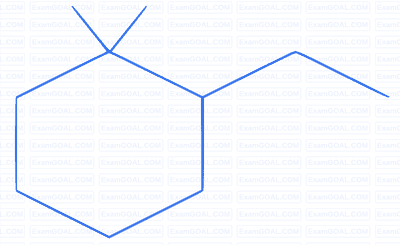
The IUPAC name of the following compound is


The total number of cyclic structural as well as stereoisomers possible for a compound with the molecular formula C$_5$H$_{10}$ is ____________.
Explanation:
Cyclic C$_5$H$_{10}$

For third structure, 2 $cis-trans$ and 1 optical isomer are possible. So, a total of 7 structures are.