Kjeldahl’s method is not applicable to
compounds containing nitrogen in nitro, azo
groups and nitrogen present in ring (pyridine).
2020
JEE Mains
MCQ
iCON Education HYD, 79930 92826, 73309 72826JEE Main 2020 (Online) 8th January Morning Slot
A flask contains a mixture of isohexane and 3-methylpentane. One of the liquids boils at 63oC while the
other boils at 60oC What is the best way to separate the two liquids and which one will be distilled out first ?
A.
fractional distillation, 3-methylpentane
B.
simple distillation, 3-methylpentane
C.
fractional distillation, isohexane
D.
simple distillation, isohexane
Correct Answer: C
Explanation:
Isohexane and 3 Methylpentane Having same molecular formula.
Isohexane boil at 60oC and 3-Methyl pentane boil at 63oC. Both Having low Boiling point difference so
Fractional distillation is useful for separation and Isohexane Having low Boiling point So comes out first.
2020
JEE Mains
MCQ
iCON Education HYD, 79930 92826, 73309 72826JEE Main 2020 (Online) 7th January Evening Slot
A chromatography column, packed with silica gel as stationary phase, was used to separate a
mixture of compounds consisting of (A) benzanilide (B) aniline and (C) acetophenone. When the
column is eluted with a mixture of solvents, hexane : ethylacelate (20:80), the sequence of
obtained compounds is :
A.
(A), (B) and (C)
B.
(B), (A) and (C)
C.
(C), (A) and (B)
D.
(B), (C) and (A)
Correct Answer: C
Explanation:
In column chromatography, we separate different parts of a mixture by washing it with solvents. The part of the mixture that gets most strongly attached to the moving solvent (or mobile phase) moves down the column quicker and comes out first. This is marked by a high Rf value. Other parts of the mixture follow in the order of decreasing Rf values.
In this particular separation, we're using a very polar solvent because most of it is ethyl acetate (80%). This means that the most polar part of the mixture (the one with the highest dipole moment) will have the highest Rf value and will be the first to come out. We measure the dipole moments of the mixture's components to determine this order.
$\therefore$ The sequence of obtained compounds is
$
(C)>(A)>(B)
$
2020
JEE Mains
MCQ
iCON Education HYD, 79930 92826, 73309 72826JEE Main 2020 (Online) 7th January Morning Slot
The increasing order to Pkb for the following compounds will be :
A.
(A) < (B) < (C)
B.
(C) < (A) < (B)
C.
(B) < (A) < (C)
D.
(B) < (C) < (A)
Correct Answer: C
Explanation:
pKb = –logKb
So, as Kb increases, pKb decreases.
Kb : (B) $>$ (A) $>$ (C)
pKb : (B) $<$ (A) $<$ (C)
Base strength order
2020
JEE Mains
Numerical
iCON Education HYD, 79930 92826, 73309 72826JEE Main 2020 (Online) 2nd September Morning Slot
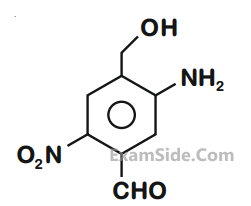
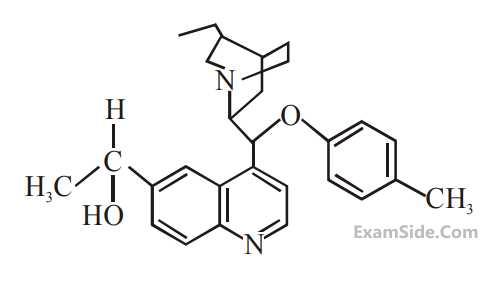
The number of chiral carbons present in the
molecule given below is _____ .
Correct Answer: 5
Explanation:
Chiral carbon atom is bonded to 4 different
atoms or group of atoms. The given structure
has 5 chiral carbon-atoms.
2020
JEE Mains
MSQ
iCON Education HYD, 79930 92826, 73309 72826JEE Main 2020 (Online) 5th September Evening Slot
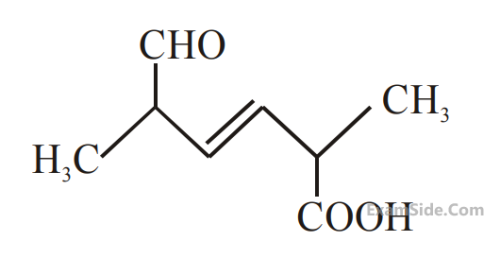
Among the following compounds, geometrical isomerism is exhibited by :
According to the IUPAC rules, first of all select the longest carbon chain (6-carbon atoms) then numbering should be start from most prior functional group, which is carboxylic acid in the given compound, thus
The Fischer projection of D-erythrose is shown below :
D-erythrose and its isomers are listed as P, Q, R, and S in Column - I. Choose the correct relationship of P, Q, R, and S with D-erythrose from Column - II.
A.
P
Q
R
S
2
3
2
2
B.
P
Q
R
S
3
1
1
2
C.
P
Q
R
S
2
1
1
3
D.
P
Q
R
S
2
3
3
1
Correct Answer: C
Explanation:
First of all, we need to convert wedge-dash formula into Fischer projection formula.
Now we can clearly see, that compound P is same as given compound, thus compound P is identical to D-erythrose.
Compound Q and D-erythrose are not mirror images of one another and are non-superimposable on one another. Thus, they are diastereomers.
Compound R and D-erythrose are also not mirror images of one another and are non-superimposable on one another. Thus, they are diastereomers.
Compound S and D-erythrose are chiral molecules. They are mirror images of one another. Furthermore, the molecules are non-superimposable on one another. This means that the molecules cannot be placed on top of one another and give the same molecule. Chiral molecules with one or more stereocenters can be enantiomers.
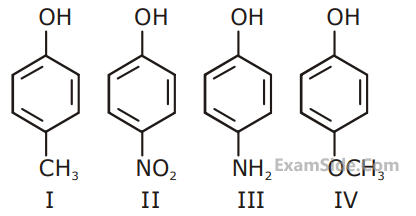
Consider the following four compounds, I, II, III, and IV.
Choose the correct statement(s)
A.
The order of basicity is II > I > III > IV.
B.
The magnitude of pKb difference between I and II is more than that between III and IV.
C.
Resonance effect is more in III than in IV.
D.
Steric effect makes compound IV more basic than III.
Correct Answer: C,D
Explanation:
The correct basic strength order is
(IV) > (II) > (I) > (III);
(IV) is strongest base due to steric inhibition to resonance effect.
(III) is weakest base due to $-$M group of three nitro groups present at ortho and para positions.
(II) is stronger than (I) since (III) is tertiary and (I) primary aromatic amine.
So, option (a) is incorrect.
(b) pKb different between I and II is 0.53 and that of III and IV is 4.6. So, option (b) is incorrect.
(c) and (d) In 2, 4, 6-trinitro aniline (III) due to strong $-$R effect of $-$NO2 groups, the lone pair of $-$NH2 is more involved with benzene ring hence it has least basic strength. Whereas (IV) N, N-dimethyl 2, 4, 6-trinitro aniline, due to steric inhibition to resonance (SIR) effect; the lone pair of nitrogen is not in the plane of benzene, hence makes it lone pair more free to protonate.
Cyclopentadiene (IV) is acidic because its conjugate base is aromatic.
Nitrobenzene is more acidic than benzene because nitro group is electron withdrawing. It will stabilise the conjugate base of benzene by $-$R and $-$I effect.
The acidic strength order on the basis of pKa data is
IV > V > I > II > III.
Hence, the correct options are (a), (b) and (c) only.
2019
JEE Mains
MCQ
iCON Education HYD, 79930 92826, 73309 72826JEE Main 2019 (Online) 12th April Evening Slot
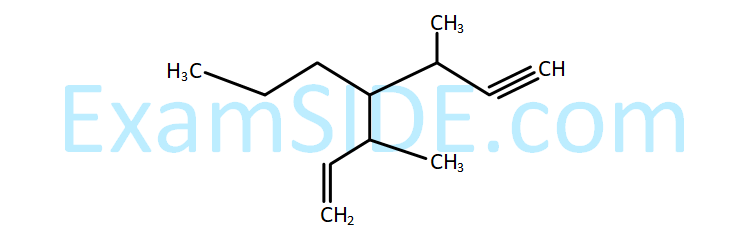
The IUPAC name for the following compound is :
A.
3, 5-dimethyl-4-propylhept-1-en-6-yne
B.
3-methyl-4-(3-methylprop-1-enyl)-1-heptyne
C.
3-methyl-4-(1-methylprop-2-enyl)-1-heptene
D.
3,5-dimethyl-4-propylhept-6-en-1-yne
Correct Answer: A
Explanation:
IUPAC Name - 3, 5-dimethyl-4-propylhept-1-en-6-yne
2019
JEE Mains
MCQ
iCON Education HYD, 79930 92826, 73309 72826JEE Main 2019 (Online) 12th April Morning Slot
The increasing order of the pKb of the following compound is :
A.
(C) < (A) < (D) < (B)
B.
(B) < (D) < (C) < (A)
C.
(B) < (D) < (A) < (C)
D.
(A) < (C) < (D) < (B)
Correct Answer: C
Explanation:
Electron Withdrawing Group attached to benzene ring will reduce the
basic strength and increase pKb while Electron Donating Group
decreases pKb.
Correct order of pKb
(B) < (D) < (A) < (C)
2019
JEE Mains
MCQ
iCON Education HYD, 79930 92826, 73309 72826JEE Main 2019 (Online) 10th April Evening Slot
In chromatography, which of the following statements is incorrect for Rf ?
A.
Rf value depends on the type of chromatography.
B.
Higher Rf
value means higher adsorption.
C.
Rf
value is dependent on the mobile phase.
D.
The value of Rf
can not be more than one.
Correct Answer: B
Explanation:
Rf = ${x \over y}$
$x$ = Distance moved by the substance from baseline
$y$ = Distance moved by the solvent from baseline
Option A : Correct. The Rf value can depend on the type of chromatography being used because different methods can use different stationary and mobile phases, which can influence how far a substance travels.
Option B : Incorrect. The Rf value is actually inversely related to adsorption. A higher Rf value indicates that the substance is less strongly adsorbed to the stationary phase, and therefore moves further along with the mobile phase.
Option C : Correct. The nature of the mobile phase can greatly influence the Rf value. The more compatible the substance is with the mobile phase, the further it will travel, leading to a higher Rf value.
Option D : Correct. By definition, the Rf value cannot exceed one, as a substance cannot travel further than the solvent.
So, Option B is incorrect for the Rf value in chromatography.
2019
JEE Mains
MCQ
iCON Education HYD, 79930 92826, 73309 72826JEE Main 2019 (Online) 10th April Evening Slot
Which of these factors does not govern the stability of a conformation in acyclic compounds?
A.
Angle strain
B.
Torsional strain
C.
Electrostatic forces of interaction
D.
Steric interactions
Correct Answer: A
Explanation:
Angle strain is not present in acyclic
compounds.
2019
JEE Mains
MCQ
iCON Education HYD, 79930 92826, 73309 72826JEE Main 2019 (Online) 10th April Evening Slot
The increasing order of nucleophilicity of the following nucleophiles is :
(a) CH3CO2$-$ (b) H2O
(c) CH3SO3$-$ (d) $\mathop O\limits^ - H$
A.
(b) < (c) < (a) < (d)
B.
(b) < (c) < (d) < (a)
C.
(a) < (d) < (c) < (b)
D.
(d) < (a) < (c) < (b)
Correct Answer: A
Explanation:
When stability of nucleophile increases then nucleophilicity decreases.
So Nucleophilicity order :
H2O < CH3SO3$-$ < CH3CO2$-$ < $\mathop O\limits^ - H$
2019
JEE Mains
MCQ
iCON Education HYD, 79930 92826, 73309 72826JEE Main 2019 (Online) 10th April Morning Slot
The principle of column chromatography is :
A.
Gravitational force.
B.
Capillary action.
C.
Differential adsorption of the substances on the solid phase.
D.
Differential absorption of the substances on the solid phase.
Correct Answer: C
Explanation:
The principle of column chromatography is based on the differential adsorption of substances on the solid phase. This means that different substances in a mixture will interact with the solid stationary phase to different extents. Some substances will adsorb more strongly to the solid phase and will therefore move more slowly through the column, while others will adsorb less strongly and will therefore move more quickly. This differential adsorption allows for the separation of the substances in the mixture.
So, the correct answer is :
Option C : Differential adsorption of the substances on the solid phase.
2019
JEE Mains
MCQ
iCON Education HYD, 79930 92826, 73309 72826JEE Main 2019 (Online) 10th April Morning Slot
The increasing order of the reactivity of the following compounds towards electrophilic aromatic substitution reactions is :
A.
III < II < I
B.
III < I < II
C.
II < I < III
D.
I < III < II
Correct Answer: B
Explanation:
CH3 group increases
the electron density of benzene by +I effect and hyper
conjugation effects and hence makes the
compound more reactive towards electrophilic aromatic substitution reaction.
Cl
group decreases the electron density of
benzene by –I effect.
COCH3 group
strongly decreases the electron density of
benzene by –I and –R effects.
$ \therefore $ Correct increasing order is
2019
JEE Mains
MCQ
iCON Education HYD, 79930 92826, 73309 72826JEE Main 2019 (Online) 9th April Morning Slot
The correct IUPAC name of the following
compound is :
A.
2-methyl-5-nitro-1-chlorobenzene
B.
2-chloro-1-methyl-4-nitrobenzene
C.
3-chloro-4-methyl-1-nitrobenzene
D.
5-chloro-4-methyl-1-nitrobenzene
Correct Answer: B
Explanation:
Note :
(1) For numbering the carbon of main ring, follow the lowest sum rule for the functional group.
(2) Write the name of functional group in alphabetical order. First chloro then methyl then nitro group.
2019
JEE Mains
MCQ
iCON Education HYD, 79930 92826, 73309 72826JEE Main 2019 (Online) 9th April Morning Slot
The increasing order of reactivity of the
following compounds towards aromatic
electrophilic substitution reaction is :
A.
A < B < C < D
B.
D < A < C < B
C.
D < B < A < C
D.
B < C < A < D
Correct Answer: B
Explanation:
In aromatic
electrophilic substitution reaction, electrofile attacks to the ring whose electron density is more.
Note : -M effect is more powerful than -I effect, that is why electron density will be less in the ring for -M effect.
2019
JEE Mains
MCQ
iCON Education HYD, 79930 92826, 73309 72826JEE Main 2019 (Online) 8th April Evening Slot
Which of the following compounds will show
the maximum 'enol' content?
A.
CH3COCH3
B.
CH3COCH2COCH3
C.
CH3COCH2COOC2H5
D.
CH3COCH2CONH2
Correct Answer: B
Explanation:
Hydrogen removed from the $\alpha $ carbon should be acidic in nature because ehen hydrogen is more acidic then enol formation is easy.
2019
JEE Mains
MCQ
iCON Education HYD, 79930 92826, 73309 72826JEE Main 2019 (Online) 8th April Morning Slot
The IUPAC name of the following compound is :
A.
3-Hydroxy-4-methylpentanoic acid
B.
4,4-Dimethyl-3-hydroxybutanoic acid
C.
2-Methyl-3-hydroxypentan-5-oic acid
D.
4-Methyl-3-hydroxypentanoic acid
Correct Answer: A
Explanation:
Note :
1. Here -OH and -COOH functional group present. And priority of -COOH group is higher so numbering start from -COOH group.
2. Here -COOH acts as main functional group and -OH acts as substitute. So we take prefix of -OH group (Hydroxy) and suffix of -COOH group (-oic acid).
3. Here two substitude -CH3(methyl) and -OH(Hydroxy) present. And 'H' of Hydroxy comes before 'm' of methyl in alphabetical order. So IUPAC name stars with Hydroxy substitude.
Functional group (priority order)
suffix(s)
prefix
(1)
Oic acid(when carbon(C) of this functional group present in the main chain) or Carboxylic acid (when carbon(C) of this functional group is not present in the main chain)
Carboxy
(2)
sulphonic acid
sulpho
(3)
Oic anhydrid (when carbon(C) of this functional group present in the main chain) or Carboxylic anhydride (when carbon(C) of this functional group is not present in the main chain)
$ - $
(4)
Oate (when carbon(C) of this functional group present in the main chain) or Carboxylate (when carbon(C) of this functional group is not present in the main chain)
$ - $
(5)
Oyl halide (when carbon(C) of this functional group present in the main chain) or Carboxyl halide (when carbon(C) of this functional group is not present in the main chain)
haloflormyl
(6)
amide (when carbon(C) of this functional group present in the main chain) or carbamide (when carbon(C) of this functional group is not present in the main chain)
carbamoyl
(7)
cynide ($ - $ C $ \equiv $ N)
nitrile (when carbon(C) of this functional group present in the main chain) or carbonitrile (when carbon(C) of this functional group is not present in the main chain)
cyano
(8)
Carbylamine
isocyano
(9)
al (when carbon(C) of this functional group present in the main chain) or Carbaldehyde (when carbon(C) of this functional group is not present in the main chain)
formyl (oxo)
(10)
one
oxo
(11)
$ - $ OH
ol
hydroxy
(12)
$ - $ SH
thiol
mercapto
(13)
$ - $ NH$_2$
amine
amino
From this table you can see -COOH has highest priority and -NH2 has lowest priority among all functional groups.
2019
JEE Mains
MCQ
iCON Education HYD, 79930 92826, 73309 72826JEE Main 2019 (Online) 8th April Morning Slot
In the following compounds, the decreasing order of basic strength will be :
A.
(C2H5)2NH > NH3 > C2H5NH2
B.
NH3 > C2H5NH2 > (C2H5)2NH
C.
(C2H5)2NH > C2H5NH2 > NH3
D.
C2H5NH2 > NH3 > (C2H5)2NH
Correct Answer: C
Explanation:
Because of +I effect of -C2H5 group, C2H5NH2 and (C2H5)2NH are more basic than NH3.
When with amine ethyl group (-C2H5) present then basic strength order :
2o amine > 3o amine > 1o amine
Note :
When with amine methyl group (-CH3) present then basic strength order :
2o amine > 1o amine > 3o amine
2019
JEE Mains
MCQ
iCON Education HYD, 79930 92826, 73309 72826JEE Main 2019 (Online) 12th January Morning Slot
Among the following four aromatic compounds, which one will have the lowest melting point ?
A.
B.
C.
D.
Correct Answer: B
Explanation:
More the intermolecular interaction more will be the
melting point. Among the given, naphthalene has least
intermolecular interaction and hence it has lowest melting point.
M.P. of Napthalene = 80°C
2019
JEE Mains
MCQ
iCON Education HYD, 79930 92826, 73309 72826JEE Main 2019 (Online) 11th January Evening Slot
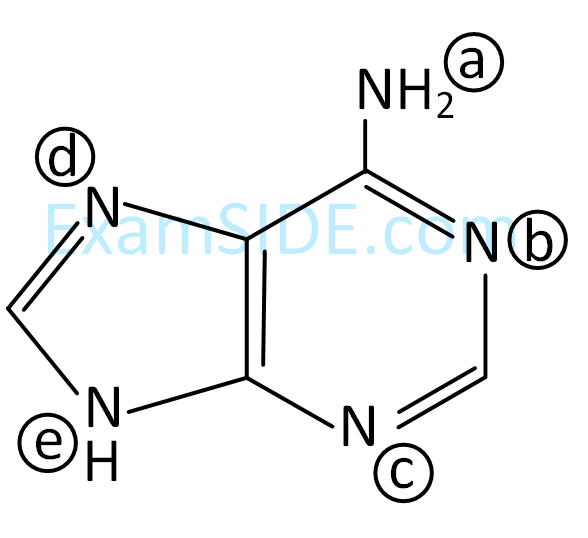
In the following compound,
the favourable site/s for protonation is/are :
A.
(b), (c) and (d)
B.
(a) and (e)
C.
(a) and (d)
D.
(a)
Correct Answer: A
Explanation:
At (a) position lone pair of N atom is in resonance with $\pi $ bond so lone pair can't donate easily to H+ ion.
At (b) position N atom is directly connected with double bond so lone pair of N atom don't perticipate in resonance so lone pair can be donated easily to H+ ion.
At (c) position N atom is directly connected with double bond so lone pair of N atom don't perticipate in resonance so lone pair can be donated easily to H+ ion.
At (d) position N atom is directly connected with double bond so lone pair of N atom don't perticipate in resonance so lone pair can be donated easily to H+ ion.
At (e) position lone pair of N atom is in resonance with $\pi $ bond so lone pair can't donate easily to H+ ion.
$ \therefore $ (b), (c) and (d) are the favourable sites for protonation.
2019
JEE Mains
MCQ
iCON Education HYD, 79930 92826, 73309 72826JEE Main 2019 (Online) 11th January Morning Slot
The correct match between items I and II is :
Item-I (Mixture)
Item-II (Seperation method)
(A)
H2O : Sugar
(P)
Sublimation
(B)
H2O : Aniline
(Q)
Recrystallization
(C)
H2O : Toluene
(R)
Steam distillation
(S)
Differential extraction
A.
A$ \to $(R); (B)$ \to $(P); (C)$ \to $(S)
B.
A$ \to $(Q); (B)$ \to $(R); (C)$ \to $(S)
C.
A$ \to $(Q); (B)$ \to $(P); (C)$ \to $(R)
D.
A$ \to $(S); (B)$ \to $(R); (C)$ \to $(P)
Correct Answer: B
Explanation:
To find the correct match, let's understand what each separation method does :
Sublimation : The process where a substance changes directly from a solid to a gas without passing through the liquid state. This method is not applicable to any mixtures here as all components are either liquid or soluble in liquid.
Recrystallization : A method used to purify a solid. The impure compound is dissolved in a hot solvent and then allowed to slowly crystallize out as the solution cools. This could be used to separate sugar from water.
Steam Distillation : A separation process which consists in distilling water together with other volatile and non-volatile components. This could be used to separate aniline from water as aniline has a higher boiling point.
Differential extraction : It's a method that is used to separate a substance from a mixture by using an extracting solvent. This could be used to separate toluene from water as toluene is less polar and wouldn't dissolve well in water.
So, the correct match would be :
A -> Q : Water and sugar can be separated by recrystallization.
B -> R : Water and aniline can be separated by steam distillation.
C -> S : Water and toluene can be separated by differential extraction.
So, the correct option is Option C : A$ \to $(Q); (B)$ \to $(R); (C)$ \to $(S)
2019
JEE Mains
MCQ
iCON Education HYD, 79930 92826, 73309 72826JEE Main 2019 (Online) 10th January Evening Slot
What is the IUPAC name of the following compound ?
A.
4–Bromo-3-methylpent-2-ene
B.
3–Bromo 1, 2-dimethylbut-1-ene
C.
3–Bromo-3-methyl-1, 2-dimethylprop-1-ene
D.
2-Bromo-3-methylpent-3-ene
Correct Answer: A
Explanation:
Note : While numbering, double bond should get least possible number on the longest path.
2019
JEE Mains
MCQ
iCON Education HYD, 79930 92826, 73309 72826JEE Main 2019 (Online) 10th January Morning Slot
If dichloromethane (DCM) and water (H2O) are used for differential extraction, which one of the following statements is correct ?
A.
DCM and H2O would stay as upper and lower layer respectively in the separating funnel (S.F.)
B.
DCM and H2O will make turbid/colloidal mixture
C.
DCM and H2O would stay as lower and upper layer respectively in the separating funnel(S.F).
D.
DCM and H2O will be miscible clearly
Correct Answer: C
Explanation:
Density of DCM = 1.39 and density of H2O = 1.0.
Dichloromethane (DCM) is a denser solvent than water. Therefore, when a mixture of DCM and water is allowed to settle in a separating funnel, the DCM forms the lower layer due to its higher density, while the water forms the upper layer. The two solvents are immiscible, meaning they do not mix and form two distinct layers.
So, the correct answer is :
Option C : DCM and H2O would stay as lower and upper layer respectively in the separating funnel(S.F).
2019
JEE Mains
MCQ
iCON Education HYD, 79930 92826, 73309 72826JEE Main 2019 (Online) 9th January Evening Slot
The increasing basicity order of the following compounds is :
A.
A < B < D < C
B.
D < C < A < B
C.
D < C < B < A
D.
A < B < C < D
Correct Answer: B
Explanation:
(A) In the first compound, because of +I effect of CH3CH2- group electron density increses on N atom.
(B) In the second compound, because of +I effect of two CH3CH2- group electron density is more on N atom than first compound so it is more basic than compound A.
(C) Three -CH3 group creates steric hindrance around N atom, for that reason N atom can't donate lone pair easily.
(D) Here lone pair of N atom, perticipate in resonance with benzene ring so N atom can't donate lone pair. That is why it is least basic among this four compounds.
So correct order is D < C < A < B.
2019
JEE Mains
MCQ
iCON Education HYD, 79930 92826, 73309 72826JEE Main 2019 (Online) 9th January Evening Slot
Which of the following compounds is not aromatic ?
A.
B.
C.
D.
Correct Answer: A
Explanation:
Do not have (4n + 2) $\pi $ electron It has 4n$\pi $ electrons
So it is Anti aromatic.
2019
JEE Mains
MCQ
iCON Education HYD, 79930 92826, 73309 72826JEE Main 2019 (Online) 9th January Morning Slot
The correct decreasing order for acid strength is :
A.
NO2CH2COOH > FCH2COOH > CNCH2COOH > ClCH2COOH
B.
FCH2COOH > NCCH2COOH > NO2CH2COOH > ClCH2COOH
C.
CNCH2COOH > O2NCH2COOH > FCH2COOH > ClCH2COOH
D.
NO2CH2COOH > NCCH2COOH > FCH2COOH > ClCH2COOH
Correct Answer: D
Explanation:
After releasing proton (H+) the more stable anion is more acidic nature. The 4 anions are $ \to $
Here $-$NO2, $-$ CN, $-$Cl, $-$F all of them have $-$ I effective and all have same distance from the anion ($-$ O$-$).
So depending on which one have more power $-$ I effect will be more stable.
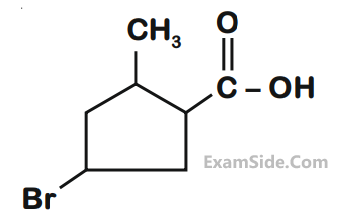
Total number of isomers, considering both structural and stereoisomers of cyclic ethers with the molecular formula C4H8O is .................
Correct Answer: 10
Explanation:
The structure of cyclic ether with molecular formula, C4H8O are as follows :
Total number of isomers of cyclic ether with molecular formula, C4H8O are 10.
2018
JEE Mains
MCQ
iCON Education HYD, 79930 92826, 73309 72826JEE Main 2018 (Online) 15th April Evening Slot
On treatment of the following compound with a strong acid, the most susceptible site for bond cleavage is :
A.
Cl $-$ O2
B.
O2 $-$ C3
C.
C4 $-$ O5
D.
O5 $-$ C6
Correct Answer: D
Explanation:
Here the lone pair of electrons on O2 is involved in resonace with C = C.
So, O2 will not be protonated.
The lone pair electrons of O5 is not involved in resonance with any C = C. So, O5 can be protonated.
When we use strong acid like HCl then chloride ion will attack least substituted C atom (C6).
2018
JEE Mains
MCQ
iCON Education HYD, 79930 92826, 73309 72826JEE Main 2018 (Online) 15th April Evening Slot
Two compounds I and II are eluted by column chromatography (adsorption of I > II). Which one of following is a correct statement ?
A.
I moves faster and has higher Rf value than II
B.
II movesfaster and has higher Rf value than I
C.
I moves slower and has higher Rf value than II
D.
II moves slower and has higher Rf value than I
Correct Answer: B
Explanation:
According to question,
Absorption of I > II, it means I is firmly attached to column. Hence it will move slowly and move little distance. As II is loosely attached to column.
So, it will move faster and will move larger distance.
2018
JEE Mains
MCQ
iCON Education HYD, 79930 92826, 73309 72826JEE Main 2018 (Online) 15th April Morning Slot
The correct match between items of List-I and List-II is :
List - I
List - II
(A)
Coloured impurity
(P)
Steam distilation
(B)
Mixture of o-nitrophenol and p-nitrophenol
(Q)
Fractional distilation
(C)
Crude Naphtha
(R)
Charcoal treatment
(d)
Mixture of glycerol and sugars
(S)
Distillation under reduced pressure
A.
(A)-(R), (B)-(S), (C)-(P), (D)-(Q)
B.
(A)-(R), (B)-(P), (C)-(S), (D)-(Q)
C.
(A)-(R), (B)-(P), (C)-(Q), (D)-(S)
D.
(A)-(P), (B)-(S), (C)-(R), (D)-(Q)
Correct Answer: C
Explanation:
(a) Charcoal treatment removes coloured impurity through adsorption.
(b) Steam distillation separates the mixture of o-nitrophenol and p-nitrophenol. The o-nitrophenol is
steam volatile (due to intramolecular hydrogen bonding), and the para isomer is not volatile.
(c) Fractional distillation separates crude naphtha. Naphtha is a flammable liquid hydrocarbon
mixture.
(d) Distillation under reduced pressure separates mixture of glycerol and sugars. Vacuum distillation
lowers the boiling point and prevents decomposition.
2018
JEE Mains
MCQ
iCON Education HYD, 79930 92826, 73309 72826JEE Main 2018 (Online) 15th April Morning Slot
The IUPAC name of the following compound is :
A.
4-methyl-3-ethylhex-4-ene
B.
3-ethyl-4-methylhex-4-ene
C.
4-ethyl-3-methylhex-2-ene
D.
4, 4- diethyl-3-methylbut-2-ene
Correct Answer: C
Explanation:
The IUPAC name of the compound is 4-ethyl-3-methyl-hex-2-ene.
For the given compound $X,$ the total number of optically active stereoisomers is ____________.
Correct Answer: 7
Explanation:
There are total 7 optically active stereoisomers. Their structures are as follows:
2017
JEE Mains
MCQ
iCON Education HYD, 79930 92826, 73309 72826JEE Main 2017 (Online) 9th April Morning Slot
In the following structure, the double bonds are marked as I, II, III and IV
Geometrical isomerism is not possible at site (s) :
A.
III
B.
I
C.
I and III
D.
III and IV
Correct Answer: B
Explanation:
For geometrical isomerism, different groups should be attached to each sp2 hybridised C $-$ atom.
Here at double bond I, at sp2 hybridised C $-$ atom same group $-$ CH3 is attached, so, at site I isomer is not possible.
2017
JEE Mains
MCQ
iCON Education HYD, 79930 92826, 73309 72826JEE Main 2017 (Online) 9th April Morning Slot
Which of the following compounds will show highest dipole moment ?
A.
(I)
B.
(II)
C.
(III)
D.
(IV)
Correct Answer: A
Explanation:
2-Cyclopropen-1-one cation is a cyclic $\pi $-system with two electrons. It has highest dipole moment which can be explained on the basis that the dipolar resonance structure contributes more to the resonance hybrid as it involves stable aromatic cyclopropenyl cation.
2017
JEE Mains
MCQ
iCON Education HYD, 79930 92826, 73309 72826JEE Main 2017 (Online) 9th April Morning Slot
Which of the following compounds is most reactive to an aqueous solution of sodium
carbonate ?
A.
B.
C.
D.
Correct Answer: C
Explanation:
Among the given compounds, cyclopentadiene is most reactive to an aqueous solution of sodium carbonate. It forms cyclopentadienyl anion which is aromatic and therefore, highly stable.
2017
JEE Mains
MCQ
iCON Education HYD, 79930 92826, 73309 72826JEE Main 2017 (Online) 8th April Morning Slot
The IUPAC name of the following compound is :
A.
1, 1-Dimethyl-2-ethylcylohexane
B.
2-Ethyl-1, 1-dimethylcyclohexane
C.
1-Ethyl-2,2-dimethylcyclohexane
D.
2, 2-Dimethyl-1-ethylcycohexane
Correct Answer: B
Explanation:
The IUPAC name of the compound shown is 2-Ethyl-1,1-dimethylcyclohexane
2017
JEE Mains
MCQ
iCON Education HYD, 79930 92826, 73309 72826JEE Main 2017 (Online) 8th April Morning Slot
A mixture containing the following four compounds is extracted with $1M$ $HCl.$ The compound that goes to aqueous layer is :
A.
(I)
B.
(II)
C.
(III)
D.
(IV)
Correct Answer: B
Explanation:
A water insoluble organic base (amine) can be protonated by reaction with an acidic solution (HCl) and it can thus move from the organic layer into the aqueous layer.
2017
JEE Mains
MCQ
iCON Education HYD, 79930 92826, 73309 72826JEE Main 2017 (Online) 8th April Morning Slot
Which of the following statements is not true about partition chromatography?
A.
Mobile phase can be a gas
B.
Stationary phase is a finely divided solid adsorbent
C.
Separation depends upon equilibration of solute between a mobile and a stationary phase
D.
Paper chromatography is an example of partition chromatography
Correct Answer: B
Explanation:
In partition chromatography, which includes paper chromatography, the stationary phase is typically water held by cellulose fibers in the paper. This paper acts as an inert support. When a mixture is applied to the paper, its components partition between this stationary phase and the mobile phase (which can be a liquid or a gas). The varying affinities of the mixture's components for the stationary and mobile phases allow for their separation.
Now, let's address the options :
Option A : Mobile phase can be a gas - This is true. In partition chromatography, the mobile phase can be either a liquid or a gas.
Option B : Stationary phase is a finely divided solid adsorbent - This is typically false for partition chromatography. Here, the stationary phase is a liquid (like water in paper chromatography) that's held by an inert solid support (like cellulose paper).
Option C : Separation depends upon equilibration of solute between a mobile and a stationary phase - This is true. In partition chromatography, the mixture's components equilibrate between the mobile and stationary phases, leading to their separation.
Option D : Paper chromatography is an example of partition chromatography - This is true. As explained above, in paper chromatography, the stationary phase (water) is held by an inert support (cellulose paper), fitting the definition of partition chromatography.
2017
JEE Mains
MCQ
iCON Education HYD, 79930 92826, 73309 72826JEE Main 2017 (Offline)
Which of the following molecules is least resonance stabilized?