Aldehydes, Ketones and Carboxylic Acids
An optically active alkyl halide $\mathrm{C}_4 \mathrm{H}_9 \mathrm{Br}[\mathrm{A}]$ reacts with hot KOH dissolved in ethanol and forms alkene $[B]$ as major product which reacts with bromine to give dibromide $[C]$. The compound [C] is converted into a gas [D] upon reacting with alcoholic $\mathrm{NaNH}_2$. During hydration 18 gram of water is added to 1 mole of gas [D] on warming with mercuric sulphate and dilute acid at 333 K to form compound [E]. The IUPAC name of compound [ E ] is :

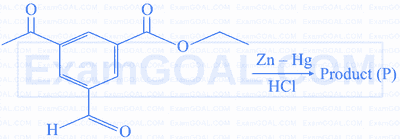
The product (P) formed in the following reaction is :


The total number of compounds from below when treated with hot KMnO4, giving benzoic acid is:

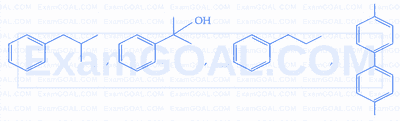
4
3
5
6

Both acetaldehyde and acetone (individually) undergo which of the following reactions?
A. Iodoform Reaction
B. Cannizaro Reaction
C. Aldol Condensation
D. Tollen's Test
E. Clemmensen Reduction
Choose the correct answer from the options given below:
The compounds that produce $\mathrm{CO}_2$ with aqueous $\mathrm{NaHCO}_3$ solution are:

Choose the correct answer from the options given below:
Match List - I with List - II.
| List - I | List - II | ||
|---|---|---|---|
| (A) |  |
(I) | Etard reaction |
| (B) |  |
(II) | Gatterman-Koch reaction |
| (C) |  |
(III) | Rosenmund reduction |
| (D) |  |
(IV) | Stephen reaction |
Choose the correct answer from the options given below :

Which of the following arrangements with respect to their reactivity in nucleophilic addition reaction is correct?

Aman has been asked to synthesise the molecule  He thought of preparing the molecule using an aldol condensation reaction. He found a few cyclic alkenes in his laboratory. He thought of performing ozonolysis reaction on alkene to produce a dicarbonyl compound followed by aldol reaction to prepare " $x$ ". Predict the suitable alkene that can lead to the formation of " $x$ ".


Given below are two statements:
Consider the following reaction

Statement (I): In the case of formaldehyde  is about 2280, due to small substituents, hydration is faster.
Statement (II) : In the case of trichloro acetaldehyde  is about 2000 due to $-$I effect of $-$Cl .
In the light of the above statements, choose the correct answer from the options given below :
The major product of the following reaction is :
$\mathrm{CH}_3 \mathrm{CH}_2 \mathrm{CH}=\mathrm{O} \xrightarrow[\text { reflux }]{\substack{\text { excess } \mathrm{HCHO} \\ \text { alkali }}}$ ?


Residue (A) + HCl (dil) $\rightarrow$ Compound (B)
Structure of residue (A) and compound (B) formed respectively is :


The compounds which give positive Fehling's test are :

Choose the correct answer from the options given below :
Identify the structure of the final product (D) in the following sequence of the reactions :

Total number of $\mathrm{sp}^2$ hybridised carbon atoms in product D is ____________.
Explanation:

$\Rightarrow$ Number of $\mathrm{sp}^2 \mathrm{C}$-atoms in product $\mathrm{D}=7$
Explanation:
Mass of benzaldehyde = 5.3 g
Mass of product = 3.51 g
Claisen - Schmidt reaction :
Condensation of aromatic aldehydes / ketones (without alpha-hydrogen) with diphatic aldehydes /ketones (with alpha-hydrogen) in the presence of weak base to form $\alpha,\beta$-unsaturated aldehydes/ketones.
Given
benzaldehyde $\to$ dibenzalacetone

Formula of percent yield
Percent yield $ = {{actual\,yield} \over {Theoretical\,yield}} \times 100$
Actual yield = 3.51 g
From the reaction, the stoichiometric ratio between benzaldehyde and dibenzal acetone is 2 : 1
benzaldehyde : dibenzalacetone
$2:1$
$1:{1 \over 2}$
Moles of benzaldehyde:
$Moles = {{Mass} \over {Molar\,mass}}$
$ = {{5.3\,g} \over {106.12\,g/mol}}$
= 0.04994 mol
Molarmass of benzaldehyde = 106.12 g/mol
For 1 mole of benzaldehyde, $\frac{1}{2}$ moles product (dibenzalacetone) is formed.
So, for 0.04994 mol benzaldehyde, $\frac{1}{2}\times0.04994$ mol dibenzalacetone is formed.
So, moles of dibenzalacetone = 0.02497 mol
Mass of product dibenzalacetone (Theoretical yield)
Mass = moles $\times$ molarmass
$=0.02497$ mol $\times$ $234.29$ g/mol
= 5.850 g
Percent yield $ = {{3.51\,g} \over {5.85\,g}} \times 100$
$ = 0.6 \times 100 = 60\% $
A compound ' $\mathrm{X}^{\prime}$ absorbs 2 moles of hydrogen and ' X ' upon oxidation with $\mathrm{KMnO}_4 \mid \mathrm{H}^{+}$ gives

The total number of $\sigma$ bonds present in the compound ' $X^{\prime}$ ' is __________.
Explanation:

A molecule ("P") on treatment with acid undergoes rearrangement and gives ("Q"). ("Q") on ozonolysis followed by reflux under alkaline condition gives (" $R$ "). The structure of (" $R$ ") is given below.

The structure of ("P") is


Monocyclic compounds $\mathbf{P}, \mathbf{Q}, \mathbf{R}$ and $\mathbf{S}$ are the major products formed in the reaction sequences given below.


The product having the highest number of unsaturated carbon atom(s) is :
P
Q
R
S


In the above reaction product 'P' is


Which of the following compounds will give silver mirror with ammoniacal silver nitrate?
A. Formic acid
B. Formaldehyde
C. Benzaldehyde
D. Acetone
Choose the correct answer from the options given below :
Identify major product "X" formed in the following reaction :


What is the structure of C?


Identify the product (P) in the following reaction:


Consider the given reaction, identify the major product P.


Which among the following aldehydes is most reactive towards nucleophilic addition reactions?


Identify A and B in the given chemical reaction sequence :


Consider the given chemical reaction :

Product "A" is :

Identify 'A' in the following reaction :


Given below are two statements :
Statements I : Acidity of $\alpha$-hydrogens of aldehydes and ketones is responsible for Aldol reaction.
Statement II : Reaction between benzaldehyde and ethanal will NOT give Cross - Aldol product.
In the light of the above statements, choose the most appropriate answer from the options given below :
Identify the product in the following reaction:


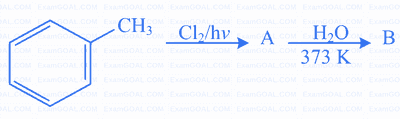


| List I (Reactions) | List II (Reagents) |
|---|---|
(A)  |
(I) CH3MgBr, H2O |
| (B) C6H5COC6H5 ⟶ C6H5CH2C6H5 | (II) Zn(Hg) and conc. HCl |
| (C) C6H5CHO ⟶ C6H5CH(OH)CH3 | (III) NaBH4, H+ |
(D)  |
(IV) DIBAL-H, H2O |
Choose the correct answer from the options given below :

Identify major product 'P' formed in the following reaction.


Identify the name reaction.


Salicylaldehyde is synthesized from phenol, when reacted with


m-chlorobenzaldehyde on treatment with 50% KOH solution yields :


This reduction reaction is known as:

Structure of 4-Methylpent-2-enal is :


Identify the reagents used for the following conversion


The molecular formula of second homologue in the homologous series of mono carboxylic acids is

Highest enol content will be shown by:


Two moles of benzaldehyde and one mole of acetone under alkaline conditions using aqueous $\mathrm{NaOH}$ after heating gives $x$ as the major product. The number of $\pi$ bonds in the product $x$ is ______.
Explanation:

Total number of $\pi$ bonds in $X=9$
The product C in the following sequence of reactions has ________ $\pi$ bonds.

Explanation:

Number of $\pi$ bonds in (C) = 4
In the Claisen-Schmidt reaction to prepare $351 \mathrm{~g}$ of dibenzalacetone using $87 \mathrm{~g}$ of acetone, the amount of benzaldehyde required is _________ g. (Nearest integer)
Explanation:

$\begin{aligned} & \text { mol of benzaldehyde required }=1.5 \times 2 \\ &=3 \mathrm{~mol} \\ & \text { mass }=318 \mathrm{~g} \end{aligned}$
Vanillin compound obtained from vanilla beans, has total sum of oxygen atoms and $\pi$ electrons is __________.
Explanation:
To determine the total sum of oxygen atoms and $\pi$ electrons in vanillin, let's first consider the structure of vanillin. Vanillin is an organic compound with the chemical formula $C_8H_8O_3$. It consists of a benzene ring attached to a methoxy group (-OCH3), a hydroxyl group (-OH), and an aldehyde group (-CHO).
Firstly, let's count the oxygen atoms:
- One from the methoxy group (-OCH3)
- One from the hydroxyl group (-OH)
- One from the aldehyde group (-CHO)
Thus, there are a total of 3 oxygen atoms in vanillin.
Next, let's calculate the total number of $\pi$ electrons:
- The benzene ring has 3 double bonds, contributing 6 $\pi$ electrons.
- The aldehyde group has 1 double bond (C=O), contributing 2 $\pi$ electrons.
- The methoxy group and the hydroxyl group do not contribute any $\pi$ electrons since they do not have $\pi$ bonds in their structures.
Therefore, vanillin has a total of 8 $\pi$ electrons from the benzene ring and the aldehyde group.
Adding the number of oxygen atoms (3) and the $\pi$ electrons (8) gives us a total sum of 11.
Thus, the total sum of oxygen atoms and $\pi$ electrons in vanillin is 11.
The product of the following reaction is P.

The number of hydroxyl groups present in the product P is ________.
Explanation:
Product benzene has zero hydroxyl group

The total number of 'Sigma' and 'Pi' bonds in 2-formylhex-4-enoic acid is _________.
Explanation:

Sigma bonds : 19
pi bonds : 3
From the compounds given below, number of compounds which give positive Fehling's test is _________.
Benzaldehyde, Acetaldehyde, Acetone, Acetophenone, Methanal, 4nitrobenzaldehyde, cyclohexane carbaldehyde.
Explanation:
Acetaldehyde $(\mathrm{CH}_3 \mathrm{CHO})$, Methanal $(\mathrm{HCHO})$, and cyclohexane carbaldehyde 
In the following reaction sequence, the major product $\mathbf{Q}$ is


List-I contains various reaction sequences and List-II contains the possible products. Match each entry in List-I with the appropriate entry in List-II and choose the correct option.
| List-I | List-II |
|---|---|

|

|

|

|

|

|

|

|

|


