Aldehydes, Ketones and Carboxylic Acids
Grignard reagent $\mathrm{RMgBr}(\mathrm{P})$ reacts with water and forms a gas $(\mathrm{Q})$. One gram of Q occupies $1.4 \mathrm{dm}^3$ at STP. (P) on reaction with dry ice in dry ether followed by $\mathrm{H}_3 \mathrm{O}^{+}$forms a compound (Z). 0.1 mole of (Z) will weigh $\_\_\_\_$ g. (Nearest integer)
Explanation:
With water, a Grignard reagent gives the corresponding hydrocarbon:
$ \mathrm{RMgBr + H_2O \rightarrow RH\ (Q) + Mg(OH)Br} $
Given 1 g of $Q$ occupies $1.4\,\text{dm}^3$ at STP.
Moles in $1.4\,\text{dm}^3$:
$ n=\frac{1.4}{22.4}=0.0625\ \text{mol} $
So molar mass of $Q$:
$ M=\frac{1}{0.0625}=16\ \text{g mol}^{-1} $
A hydrocarbon gas with molar mass 16 is methane, $\mathrm{CH_4}$. Hence $R=\mathrm{CH_3}$, and $P=\mathrm{CH_3MgBr}$.
Carboxylation with dry ice followed by acid workup gives:
$ \mathrm{CH_3MgBr \xrightarrow[ether]{CO_2} CH_3COO^{-}MgBr \xrightarrow{H_3O^+} CH_3COOH\ (Z)} $
So $Z$ is acetic acid, $\mathrm{CH_3COOH}$, with molar mass $60\ \text{g mol}^{-1}$.
Mass of $0.1$ mol:
$ 0.1 \times 60 = 6\ \text{g} $
Answer: 6 g
The sum of total number of carbonyl groups ($> {C}= {O}$) present in the major products X and Y in the following reactions is _____.

Explanation:

Number of $>C=O$ groups in $(X)$ and $(Y)$ are 1 and 3 respectively. $(1+3=4)$
' $x$ ' is the product which is obtained from benzene by reacting it with carbon monoxide and hydrogen chloride in the presence of cuprous chloride. ' $y$ ' is the major product obtained from the benzene by reacting it with ethanoyl chloride in the presence of anhydrous $\mathrm{AlCl}_3$. Product (major) obtained by heating $x$ and $y$ in the presence of alkali is $z$. Total number of $\pi$ (pi) electrons in $z$ is $\_\_\_\_$ .
Explanation:


Total number of pi $(\pi)$ electrons in ' $z$ ' $=16 \pi$ electrons.

$ \text { Consider the following sequence of reactions to give the major product }(\mathrm{X}) $

P g of the major product $(\mathrm{X})$ formed is reacted with $\mathrm{NaHCO}_3$ solution to liberate a gas which occupied $11.2 \mathrm{dm}^3$ at STP.
$ \mathrm{P}=\text {______________ g. } $
(Given molar mass in $\mathrm{g} \mathrm{mol}^{-1} \mathrm{H}: 1, \mathrm{C}: 12, \mathrm{O}: 16, \mathrm{Cl}: 35.5$ )
Explanation:

When product $(\mathrm{X})$ reacts with $\mathrm{NaHCO}_3$, it releases $\mathrm{CO}_2$ gas. The volume of this gas at STP is given as $11.2 \,\mathrm{dm}^3$.
At STP, $1$ mole of a gas occupies $22.4 \,\mathrm{dm}^3$. So, moles of gas (and hence moles of $\mathrm{X}$, because $1$ mole acid gives $1$ mole $\mathrm{CO}_2$) are:
Moles of $\mathrm{P}=\frac{11.2}{22.4}=0.5$ mole
Now find the molar mass of $(\mathrm{X})$, which is $\mathrm{C}_7 \mathrm{H}_5 \mathrm{O}_2 \mathrm{Cl}$:
$ \begin{aligned} & \mathrm{M}_{\mathrm{C}_7 \mathrm{H}_5 \mathrm{O}_2 \mathrm{Cl}}=156.5 \mathrm{gm} \\ & \mathrm{~W}_{\mathrm{P}\left(\mathrm{C}_7 \mathrm{H}_5 \mathrm{O}_2 \mathrm{Cl}\right)}=\frac{156.5}{2}=78.25 \approx 78 \text { grams } \end{aligned} $
Identify the structure of the final product (D) in the following sequence of the reactions :

Total number of $\mathrm{sp}^2$ hybridised carbon atoms in product D is ____________.
Explanation:

$\Rightarrow$ Number of $\mathrm{sp}^2 \mathrm{C}$-atoms in product $\mathrm{D}=7$
Explanation:
Mass of benzaldehyde = 5.3 g
Mass of product = 3.51 g
Claisen - Schmidt reaction :
Condensation of aromatic aldehydes / ketones (without alpha-hydrogen) with diphatic aldehydes /ketones (with alpha-hydrogen) in the presence of weak base to form $\alpha,\beta$-unsaturated aldehydes/ketones.
Given
benzaldehyde $\to$ dibenzalacetone

Formula of percent yield
Percent yield $ = {{actual\,yield} \over {Theoretical\,yield}} \times 100$
Actual yield = 3.51 g
From the reaction, the stoichiometric ratio between benzaldehyde and dibenzal acetone is 2 : 1
benzaldehyde : dibenzalacetone
$2:1$
$1:{1 \over 2}$
Moles of benzaldehyde:
$Moles = {{Mass} \over {Molar\,mass}}$
$ = {{5.3\,g} \over {106.12\,g/mol}}$
= 0.04994 mol
Molarmass of benzaldehyde = 106.12 g/mol
For 1 mole of benzaldehyde, $\frac{1}{2}$ moles product (dibenzalacetone) is formed.
So, for 0.04994 mol benzaldehyde, $\frac{1}{2}\times0.04994$ mol dibenzalacetone is formed.
So, moles of dibenzalacetone = 0.02497 mol
Mass of product dibenzalacetone (Theoretical yield)
Mass = moles $\times$ molarmass
$=0.02497$ mol $\times$ $234.29$ g/mol
= 5.850 g
Percent yield $ = {{3.51\,g} \over {5.85\,g}} \times 100$
$ = 0.6 \times 100 = 60\% $
A compound ' $\mathrm{X}^{\prime}$ absorbs 2 moles of hydrogen and ' X ' upon oxidation with $\mathrm{KMnO}_4 \mid \mathrm{H}^{+}$ gives

The total number of $\sigma$ bonds present in the compound ' $X^{\prime}$ ' is __________.
Explanation:

Two moles of benzaldehyde and one mole of acetone under alkaline conditions using aqueous $\mathrm{NaOH}$ after heating gives $x$ as the major product. The number of $\pi$ bonds in the product $x$ is ______.
Explanation:

Total number of $\pi$ bonds in $X=9$
The product C in the following sequence of reactions has ________ $\pi$ bonds.

Explanation:

Number of $\pi$ bonds in (C) = 4
In the Claisen-Schmidt reaction to prepare $351 \mathrm{~g}$ of dibenzalacetone using $87 \mathrm{~g}$ of acetone, the amount of benzaldehyde required is _________ g. (Nearest integer)
Explanation:

$\begin{aligned} & \text { mol of benzaldehyde required }=1.5 \times 2 \\ &=3 \mathrm{~mol} \\ & \text { mass }=318 \mathrm{~g} \end{aligned}$
Vanillin compound obtained from vanilla beans, has total sum of oxygen atoms and $\pi$ electrons is __________.
Explanation:
To determine the total sum of oxygen atoms and $\pi$ electrons in vanillin, let's first consider the structure of vanillin. Vanillin is an organic compound with the chemical formula $C_8H_8O_3$. It consists of a benzene ring attached to a methoxy group (-OCH3), a hydroxyl group (-OH), and an aldehyde group (-CHO).
Firstly, let's count the oxygen atoms:
- One from the methoxy group (-OCH3)
- One from the hydroxyl group (-OH)
- One from the aldehyde group (-CHO)
Thus, there are a total of 3 oxygen atoms in vanillin.
Next, let's calculate the total number of $\pi$ electrons:
- The benzene ring has 3 double bonds, contributing 6 $\pi$ electrons.
- The aldehyde group has 1 double bond (C=O), contributing 2 $\pi$ electrons.
- The methoxy group and the hydroxyl group do not contribute any $\pi$ electrons since they do not have $\pi$ bonds in their structures.
Therefore, vanillin has a total of 8 $\pi$ electrons from the benzene ring and the aldehyde group.
Adding the number of oxygen atoms (3) and the $\pi$ electrons (8) gives us a total sum of 11.
Thus, the total sum of oxygen atoms and $\pi$ electrons in vanillin is 11.
The product of the following reaction is P.

The number of hydroxyl groups present in the product P is ________.
Explanation:
Product benzene has zero hydroxyl group

The total number of 'Sigma' and 'Pi' bonds in 2-formylhex-4-enoic acid is _________.
Explanation:

Sigma bonds : 19
pi bonds : 3
From the compounds given below, number of compounds which give positive Fehling's test is _________.
Benzaldehyde, Acetaldehyde, Acetone, Acetophenone, Methanal, 4nitrobenzaldehyde, cyclohexane carbaldehyde.
Explanation:
Acetaldehyde $(\mathrm{CH}_3 \mathrm{CHO})$, Methanal $(\mathrm{HCHO})$, and cyclohexane carbaldehyde 
An organic compound $\mathbf{P}$ having molecular formula $\mathrm{C}_6 \mathrm{H}_6 \mathrm{O}_3$ gives ferric chloride test and does not have intramolecular hydrogen bond. The compound $\mathbf{P}$ reacts with 3 equivalents of $\mathrm{NH}_2 \mathrm{OH}$ to produce oxime $\mathbf{Q}$. Treatment of $\mathbf{P}$ with excess methyl iodide in the presence of $\mathrm{KOH}$ produces compound $\mathbf{R}$ as the major product. Reaction of $\mathbf{R}$ with excess iso-butylmagnesium bromide followed by treatment with $\mathrm{H}_3 \mathrm{O}^{+}$gives compound $\mathbf{S}$ as the major product.
The total number of methyl $\left(-\mathrm{CH}_3\right)$ group(s) in compound $\mathbf{S}$ is ___.
Explanation:


$\therefore$ Sum of oxygen atoms in $\mathrm{S}$ and $\mathrm{T}=1+1=2$
Explanation:

$\begin{aligned} & \text { Molecular mass of polymers }=(104 \times 500)+(118 \times 500)-18 \times 999 \\\\ & =52000+59000-17982=93018\end{aligned}$
Complete reaction of acetaldehyde with excess formaldehyde, upon heating with conc. $\mathrm{NaOH}$ solution, gives $\mathbf{P}$ and $\mathbf{Q}$. Compound $\mathbf{P}$ does not give Tollens' test, whereas $\mathbf{Q}$ on acidification gives positive Tollens' test. Treatment of $\mathbf{P}$ with excess cyclohexanone in the presence of catalytic amount of $p$-toluenesulfonic acid (PTSA) gives product $\mathbf{R}$.
Sum of the number of methylene groups $\left(-\mathrm{CH}_2-\right)$ and oxygen atoms in $\mathbf{R}$ is __________.
Explanation:

Number of $\mathrm{CH}_2$ groups in $\mathrm{R}=14$
Number of $\mathrm{O}$-atoms $=4$
Required Answer $=14+4=18$

The value of $x$ in compound 'D' is _________.
Explanation:


The mass of NH$_3$ produced when 131.8 kg of cyclohexanecarbaldehyde undergoes Tollen's test is ________ kg. (Nearest Integer)
Molar Mass of
C = 12g/mol
N = 14g/mol
O = 16g/mol
Explanation:
Number of isomeric compounds with molecular formula $\mathrm{C}_{9} \mathrm{H}_{10} \mathrm{O}$ which (i) do not dissolve in $\mathrm{NaOH}$ (ii) do not dissolve in $\mathrm{HCl}$. (iii) do not give orange precipitate with 2,4-DNP (iv) on hydrogenation give identical compound with molecular formula $\mathrm{C}_{9} \mathrm{H}_{12} \mathrm{O}$ is ____________.
Explanation:
2 possibilities

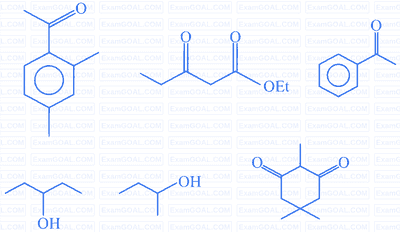
Explanation:

Number of compounds from the following which will not dissolve in cold $\mathrm{NaHCO}_{3}$ and $\mathrm{NaOH}$ solutions but will dissolve in hot $\mathrm{NaOH}$ solution is ________.

Explanation:

will dissolve in hot NaOH solution.
A trisubstituted compound '$\mathrm{A}$', $\mathrm{C}_{10} \mathrm{H}_{12} \mathrm{O}_{2}$ gives neutral $\mathrm{FeCl}_{3}$ test positive. Treatment of compound 'A' with $\mathrm{NaOH}$ and $\mathrm{CH}_{3} \mathrm{Br}$ gives $\mathrm{C}_{11} \mathrm{H}_{14} \mathrm{O}_{2}$, with hydroiodic acid gives methyl iodide and with hot conc. $\mathrm{NaOH}$ gives a compound $\mathrm{B}, \mathrm{C}_{10} \mathrm{H}_{12} \mathrm{O}_{2}$. Compound 'A' also decolorises alkaline $\mathrm{KMnO}_{4}$. The number of $\pi$ bond/s present in the compound '$\mathrm{A}$' is _____________.
Explanation:
$\mathrm{A:C_{10}H_{12}O_2}$
DU of A $=\frac{22-12}{2}=5$
1 DU is due to Ring (Benzene ring)
4 $\pi$-bonds will be there
(3 $\pi$-bonds in ring and 1 $\pi$-bond outside ring) as it decolorises alkaline KMnO$_4$.
Number of compounds giving (i) red colouration with ceric ammonium nitrate and also (ii) positive iodoform test from the following is ___________

Explanation:
The compounds which give red colour with ceric ammonium nitrate and also give positive iodoform test are

The number of stereoisomers formed in a reaction of $(±)\mathrm{Ph}(\mathrm{C}=\mathrm{O}) \mathrm{C}(\mathrm{OH})(\mathrm{CN}) \mathrm{Ph}$ with $\mathrm{HCN}$ is ___________.
$\left[\right.$where $\mathrm{Ph}$ is $-\mathrm{C}_{6} \mathrm{H}_{5}$]
Explanation:

Number of stereoisomers = 3
The spin only magnetic moment of the complex present in Fehling's reagent is __________ B.M. (Nearest integer).
Explanation:
So, spin only magnetic moment
$ =\sqrt{1(1+2)} $
$ \begin{aligned} & =\sqrt{3} \simeq 2 \mathrm{~B} . \mathrm{M} \end{aligned} $
In the given reaction

The number of chiral carbon/s in product A is ___________.
Explanation:

2 chiral carbons are there in product A.
A hydrocarbon 'X' is found to have molar mass of 80. A 10.0 mg of compound 'X' on hydrogenation consumed 8.40 mL of H2 gas (measured at STP). Ozonolysis of compound 'X' yields only formaldehyde and dialdehyde. The total number of fragments/molecules produced from the ozonolysis of compound 'X' is _____________.
Explanation:
moles consumed of $\mathrm{H}_{2}=\frac{8.4}{22.4} 0.375 \mathrm{~m} \mathrm{~mol}$.
$\frac{\mathrm{n}_{\mathrm{H}_{2}}}{\mathrm{n}_{\mathrm{X}}}=\frac{0.375}{0.125}=3$
So, the compound $\mathrm{X}$ have 3 double bond.
Ozonolysis of the compound yield formaldehyde and dialdehyde.
The compound is
$ \mathrm{H}_{2} \mathrm{C}=\mathrm{CH}-\mathrm{CH}=\mathrm{CH}-\mathrm{CH}=\mathrm{CH}_{2} $
Molecular mass $=(12 \times 6)+1 \times 8=72+8=80 \,\mathrm{amu}$
Ozonolysis form:

In the given reaction,

The number of $\pi$ electrons present in the product 'P' is _________.
Explanation:

Explanation:

Total 2e- transfer to Tollen's reagent.

Consider the above reaction where 6.1 g of Benzoic acid is used to get 7.8 g of m-bromo benzoic acid. The percentage yield of the product is __________
(Round off to the Nearest Integer).
[Given : Atomic masses : C : 12.0 u, H : 1.0 u, O : 16.0 u, Br : 80.0 u]
Explanation:
So, weight of m-bromobenzoic acid = ${{6.1} \over {122}}$ $\times$ 201 gm
= 10.05 gm
% yield = ${{Actual\,weight} \over {Theoretical\,weight}} \times 100$
$ = {{7.8} \over {10.05}} \times 100$ = 77.61%
Explanation:

Number of C–C sigma bonds = 5
(A) Sulphanilic acid
(B) Picric acid
(C) Aspirin
(D) Ascorbic acid
Explanation:
(A) Sulphanilic acid

(B) Picric acid

(C) Aspirin

(D) Ascorbic Acid

$ \therefore $ Only 1 compound has –COOH group

Explanation:

Carbonyl compounds react with NH2OH to give oximes.

There are four sp2-carbon atoms, four sp2-nitrogen atoms and four sp2-oxygen atoms as shown in structures I and II.
Therefore, total number of atoms having sp2-hybridisation are twelve (12).

The mass percentage of carbon in A is ______.
Explanation:

% carbon = ${{48} \over {72}} \times 100$ = 66.67

What is the degree of unsaturation of Q?
Explanation:

Number of rings = 4 + 1 = 5
$\pi $-bonds = 4 $ \times $ 3 + 1 = 13
Thus, the degree of unsaturation of Q is 18.
(Atomic weights in $g\,mo{l^{ - 1}}:H = 1,C = 12,$ $N = 14,O = 16,$ $Br = 80.$. The yield (%) corresponding to the product in each step is given in the parenthesis)

Explanation:

The amount of D formed in mol is ${{60} \over {100}} \times {{50} \over {100}} \times {{50} \over {100}} \times 10 = 1.5$ mol
Amount of D in grams is = 1.5 $\times$ 330 g = 495 g
Among the following the number of reactions that produces benzaldehyde is _________.

Explanation:


Therefore, the number of reactions leading to the formation of benzaldehyde is 4.
Explanation:

The total number of carboxylic acid groups is the product P is _________.

Explanation:
The reaction involved is

The number of carboxylic acid groups in the product is 2.
In the scheme given below, the total number of intra molecular aldol condensation products formed from Y is ____________.

Explanation:
There is only one product formed in intramolecular aldol condensation, which is explained as follows:

Amongst the following, the total number of compounds soluble in aqueous NaOH is _________.

Explanation:
Aromatic alcohols and carboxylic acids forms salt with NaOH, will dissolve in aqueous NaOH :

Benzylic alcohol is less acidic than water and hence does dissolve in aqueous NaOH.