Question 1
Question: The area of the region, inside the circle $(x - 2\sqrt{3})^2 + y^2 = 12$ and outside the parabola $y^2 = 2\sqrt{3}x$ is:
Options:
A. $3\pi - 8$
B. $6\pi - 8$
C. $3\pi + 8$
D. $6\pi - 16$
Correct Answer: D
Year: JEE Main 2025 (Online) 22nd January Morning Shift
Solution: 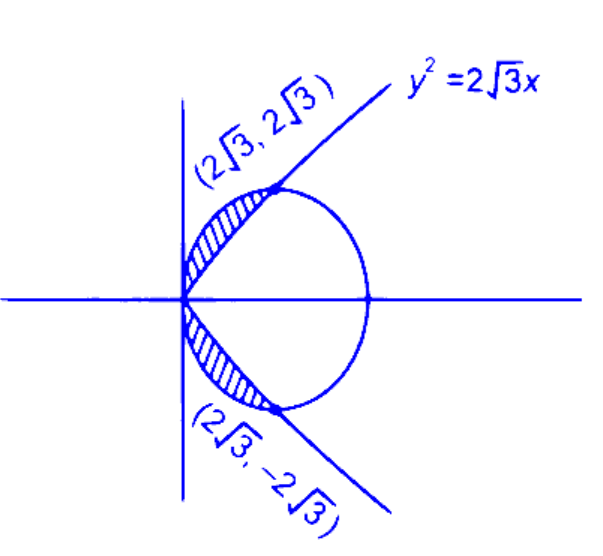
$$Area = 2 \int_{0}^{2\sqrt{3}} (\sqrt{4\sqrt{3}x - x^2} - \sqrt{2\sqrt{3}x}) dx$$
$$= 2 \int_{0}^{2\sqrt{3}} (\sqrt{12 - (x - 2\sqrt{3})^2} - \sqrt{2\sqrt{3}x}) dx$$
$$= 2 \left[ \frac{x - 2\sqrt{3}}{2} \sqrt{12 - (x - 2\sqrt{3})^2} + \frac{12}{2} \sin^{-1} \left( \frac{x - 2\sqrt{3}}{2\sqrt{3}} \right) - \frac{\sqrt{2\sqrt{3}}x^{3/2}}{3/2} \right]_{0}^{2\sqrt{3}}$$
Step Solution:
1. Identify Curves: Circle $(x - 2\sqrt{3})^2 + y^2 = 12$ (center $(2\sqrt{3}, 0)$, radius $\sqrt{12}$) and Parabola $y^2 = 2\sqrt{3}x$.
2. Find Intersection: Substitute $y^2$ in the circle equation: $(x - 2\sqrt{3})^2 + 2\sqrt{3}x = 12 \implies x^2 - 4\sqrt{3}x + 12 + 2\sqrt{3}x = 12 \implies x^2 - 2\sqrt{3}x = 0$, giving $x = 0$ and $x = 2\sqrt{3}$.
3. Setup Integral: Area $= 2 \int_{0}^{2\sqrt{3}} (\text{Circle} - \text{Parabola}) dx = 2 \int_{0}^{2\sqrt{3}} (\sqrt{12 - (x - 2\sqrt{3})^2} - \sqrt{2\sqrt{3}x}) dx$.
4. Integrate: Evaluate the terms to get $2[\frac{x-2\sqrt{3}}{2}\sqrt{y^2} + 6\sin^{-1}(\frac{x-2\sqrt{3}}{2\sqrt{3}}) - \frac{2}{3}\sqrt{2\sqrt{3}}x^{3/2}]_0^{2\sqrt{3}}$.
5. Evaluate Limits: Upper limit gives $-16$; lower limit gives $-6\pi$. Result: $-16 - (-6\pi) = 6\pi - 16$.
Difficulty Level: Hard
Concept Name: Area bounded by Circle and Parabola
Short cut solution: The area is calculated by taking the area of the semi-circle ($6\pi$) and subtracting the area bounded between the parabola and the diameter chord ($16$).
Question 9
Question: Let the area enclosed between the curves $|y| = 1 - x^2$ and $x^2 + y^2 = 1$ be $\alpha$. If $9\alpha = \beta\pi + \gamma; \beta, \gamma$ are integers, then the value of $|\beta - \gamma|$ equals:
Options:
A. 15
B. 18
C. 33
D. 27
Correct Answer: C
Year: JEE Main 2025 (Online) 29th January Evening Shift
Solution: $\alpha = 4 \times [\text{Area of circle in 1st quad} - \int_0^1 (1 - x^2) dx]$ 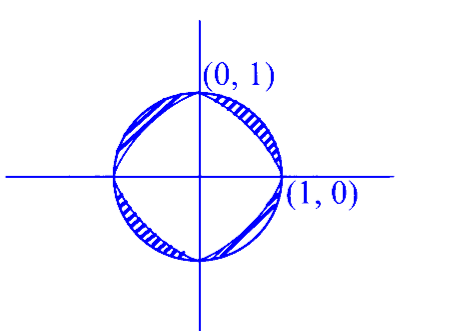
$\alpha = 4 \left[ \frac{\pi}{4} - \left[ x - \frac{x^3}{3} \right]_0^1 \right] = \pi - \frac{8}{3}$
$3\alpha = 3\pi - 8 \implies 9\alpha = 9\pi - 24$.
$\beta = 9, \gamma = -24 \implies |\beta - \gamma| = 33$.
Step Solution:
1. Define Region: The curve $|y| = 1 - x^2$ consists of two parabolas ($y = 1 - x^2$ and $y = x^2 - 1$) and $x^2 + y^2 = 1$ is a circle.
2. Use Symmetry: The required area $\alpha$ is 4 times the area in the first quadrant bounded between the circle and the parabola $y = 1 - x^2$.
3. Calculate $\alpha$: $\alpha = 4 \times [\int_0^1 \sqrt{1 - x^2} dx - \int_0^1 (1 - x^2) dx]$.
4. Evaluate Integrals: $\alpha = 4[\frac{\pi}{4} - (1 - \frac{1}{3})] = \pi - \frac{8}{3}$.
5. Find Final Value: Multiply by 9 to get $9\alpha = 9\pi - 24$. Thus, $\beta = 9, \gamma = -24$, and $|\beta - \gamma| = |9 - (-24)| = 33$.
Difficulty Level: Medium
Concept Name: Area under curves using symmetry
Short cut solution: The area $\alpha$ is the difference between the area of the circle ($\pi$) and the area enclosed between the two parabolas ($2 \times \int_{-1}^1 (1-x^2) dx = 8/3$), hence $\alpha = \pi - 8/3$.
Question 14
Question: If the area of the larger portion bounded between the curves $x^2 + y^2 = 25$ and $y = |x - 1|$ is $\frac{1}{4}(b\pi + c), b, c \in N$, then $b + c$ is equal to
Options: (Numerical answer required)
Correct Answer: 77
Year: JEE Main 2025 (Online) 23rd January Morning Shift
Solution: The smaller area is found by integrating $\int_{-3}^4 \sqrt{25 - x^2} dx$ and subtracting the area of the triangle formed by the lines. This leads to the area of the larger portion being $\frac{1}{4}(75\pi + 2)$.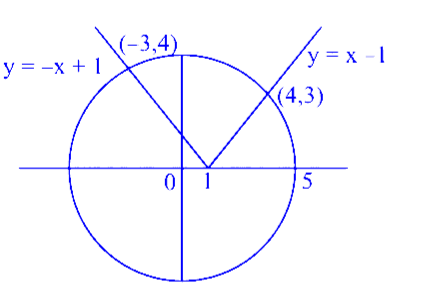
Step Solution:
1. Find Intersections: Set $x^2 + (x - 1)^2 = 25 \implies 2x^2 - 2x - 24 = 0 \implies (x - 4)(x + 3) = 0$. Points are $(4, 3)$ and $(-3, 4)$.
2. Calculate Smaller Area: $A_{small} = \int_{-3}^4 \sqrt{25 - x^2} dx - \text{Area of triangle with vertices } (1, 0), (4, 3), (-3, 4)$.
3. Integration: $\int_{-3}^4 \sqrt{25 - x^2} dx = [\frac{x}{2}\sqrt{25-x^2} + \frac{25}{2}\sin^{-1}\frac{x}{5}]_{-3}^4 = 12 + \frac{25\pi}{4}$.
4. Larger Area Formula: $A_{large} = \text{Total Circle Area} - A_{small} = 25\pi - \frac{25\pi}{4} + \text{constant}$.
5. Final Values: The area simplifies to $\frac{75\pi + 2}{4}$, giving $b = 75$ and $c = 2$. $b + c = 77$.
Difficulty Level: Hard
Concept Name: Area bounded by Circle and Modulus function
Short cut solution: Use the property that the area of the smaller segment plus the triangle area involves $\frac{1}{4}$ of the circle's area, then subtract from the total $25\pi$.
Question 23
Question: If the area of the triangle formed by the positive x-axis, the normal and the tangent to the circle $(x - 2)^2 + (y - 3)^2 = 25$ at the point (5, 7) is $A$, then $24A$ is equal to...
Options: Numerical answer required.
Correct Answer: 1225
Year: 24 Feb 2021 Shift 2
Solution: 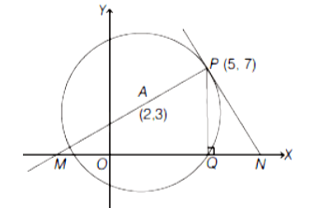
Circle $(x - 2)^2 + (y - 3)^2 = 5^2$, center $C = (2, 3)$, $r = 5$.
Equation of normal at $P(5, 7)$ (line PA): $(y - 7) = \frac{7 - 3}{5 - 2}(x - 5) \Rightarrow 4x - 3y + 1 = 0$.
Putting $y = 0$ in normal: $x = -1/4 \Rightarrow M(-1/4, 0)$.
Equation of tangent at $P(5, 7)$ (slope is $-1/(\text{slope of normal}) = -3/4$): $y - 7 = \frac{-3}{4}(x - 5) \Rightarrow 3x + 4y = 43$.
Putting $y = 0$ in tangent: $x = 43/3 \Rightarrow N(43/3, 0)$.
Area $(A) = \frac{1}{2} \times MN \times \text{height} = \frac{1}{2} \times (\frac{43}{3} + \frac{1}{4}) \times 7$.
$24A = 24 \times \frac{1}{2} \times \frac{175}{12} \times 7 = 1225$.
Step Solution:
1. Find Normal Equation: Slope of $CP = \frac{7-3}{5-2} = \frac{4}{3}$. Normal line: $y-7 = \frac{4}{3}(x-5) \Rightarrow 4x-3y+1=0$.
2. Find Tangent Equation: Slope = $-3/4$. Tangent line: $y-7 = -\frac{3}{4}(x-5) \Rightarrow 3x+4y-43=0$.
3. Find X-intercepts: For normal, set $y=0 \Rightarrow x = -1/4$. For tangent, set $y=0 \Rightarrow x = 43/3$.
4. Calculate Area $A$: Base $= \frac{43}{3} - (-\frac{1}{4}) = \frac{175}{12}$. Height (y-coordinate of P) $= 7$. Area $A = \frac{1}{2} \cdot \frac{175}{12} \cdot 7 = \frac{1225}{24}$.
5. Final Result: Multiply $A$ by 24: $24 \times \frac{1225}{24} = 1225$.
Difficulty Level: Medium
Concept Name: Tangents and Normals to a Circle
Short cut solution: The distance between the x-intercepts of the tangent and normal (the base) for circle $(x-h)^2 + (y-k)^2 = r^2$ at $(x_1, y_1)$ is $\left| \frac{y_1(x_1-h)}{y_1-k} + \frac{y_1(y_1-k)}{x_1-h} \right|$.
Question 24
Question: The area (in sq. units) of the part of the circle $x^2 + y^2 = 36$, which is outside the parabola $y^2 = 9x$, is:
Options:
A. $24\pi + 3\sqrt{3}$
B. $12\pi - 3\sqrt{3}$
C. $24\pi - 3\sqrt{3}$
D. $12\pi + 3\sqrt{3}$
Correct Answer: C
Year: 24 Feb 2021 Shift 1
Solution: Required area = Total circle area - Area inside both curves. Intersecting $x^2 + 9x - 36 = 0$ gives $x = 3$.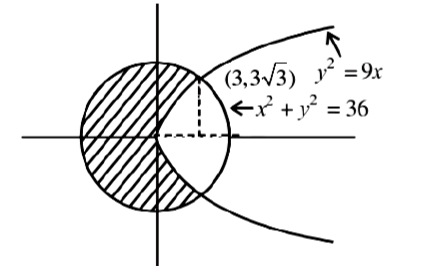
Step Solution:
1. Find Intersection: Solve $x^2 + y^2 = 36$ and $y^2 = 9x \Rightarrow x^2 + 9x - 36 = 0 \Rightarrow (x+12)(x-3)=0$. Thus, $x=3$.
2. Setup Inner Area: Area inside $= 2 [ \int_0^3 \sqrt{9x} dx + \int_3^6 \sqrt{36-x^2} dx ]$.
3. Integrate Parabola Part: $2 \int_0^3 3\sqrt{x} dx = 2 [2x^{3/2}]_0^3 = 4(3\sqrt{3}) = 12\sqrt{3}$.
4. Integrate Circle Part: $2 \int_3^6 \sqrt{36-x^2} dx = 2 [ \frac{x}{2}\sqrt{36-x^2} + 18\sin^{-1}\frac{x}{6} ]_3^6 = 12\pi - 9\sqrt{3}$.
5. Calculate Final Area: Total Circle ($36\pi$) - Area Inside ($12\pi + 3\sqrt{3}$) = $24\pi - 3\sqrt{3}$.
Difficulty Level: Hard
Concept Name: Area bounded by Circle and Parabola
Short cut solution: Calculate the area of the circular segment and the area under the parabolic arch separately; the parabolic area is $\frac{2}{3}$ of its circumscribing rectangle ($2 \times \frac{2}{3} \times 3 \times 3\sqrt{3} = 12\sqrt{3}$).
Question 37
Question: The area of the region, enclosed by the circle $x^2 + y^2 = 2$ which is not common to the region bounded by the parabola $y^2 = x$ and the straight line $y = x$, is:
Options:
A. $(24\pi - 1)$
B. $(6\pi - 1)$
C. $(12\pi - 1)$
D. $(12\pi - 1)/6$
Correct Answer: D
Year: Jan. 7, 2020 (I)
Solution: 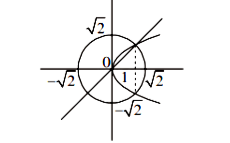
Total area – enclosed area between line and parabola
$= 2\pi - \int_0^1 (\sqrt{x} - x) dx$
$= 2\pi - (\frac{2x^{3/2}}{3} - \frac{x^2}{2})_0^1 = 2\pi - (\frac{2}{3} - \frac{1}{2}) = 2\pi - \frac{1}{6} = \frac{12\pi - 1}{6}$.
Step Solution:
1. Total Area: Area of circle $x^2 + y^2 = 2$ is $\pi r^2 = \pi(\sqrt{2})^2 = 2\pi$.
2. Find Common Region Intersections: Parabola $y^2 = x$ and line $y = x$ intersect where $x^2 = x \Rightarrow x(x-1)=0$, so $x=0$ and $x=1$.
3. Calculate Common Area: Area $= \int_0^1 (\text{Parabola} - \text{Line}) dx = \int_0^1 (\sqrt{x} - x) dx$.
4. Integrate: $[\frac{2}{3}x^{3/2} - \frac{x^2}{2}]_0^1 = \frac{2}{3} - \frac{1}{2} = \frac{1}{6}$.
5. Subtract from Total: Required Area $= 2\pi - \frac{1}{6} = \frac{12\pi - 1}{6}$.
Difficulty Level: Medium
Concept Name: Area between curves using subtraction
Short cut solution: The area between $y^2 = 4ax$ and $y = mx$ is $\frac{8a^2}{3m^3}$. Here $4a=1$ and $m=1$, so area $= \frac{8(1/4)^2}{3(1)^3} = \frac{8/16}{3} = \frac{1}{6}$. Total circle $2\pi - 1/6 = \frac{12\pi - 1}{6}$.
Question 65
Question: The area (in sq. units) of the smaller portion enclosed between the curves, $x^2 + y^2 = 4$ and $y^2 = 3x$, is:
Options:
A. $\frac{1}{2\sqrt{3}} + \frac{\pi}{3}$
B. $\frac{1}{\sqrt{3}} + \frac{2\pi}{3}$
C. $\frac{1}{2\sqrt{3}} + \frac{2\pi}{3}$
D. $\frac{1}{\sqrt{3}} + \frac{4\pi}{3}$
Correct Answer: D
Year: Online April 8, 2017
Solution: 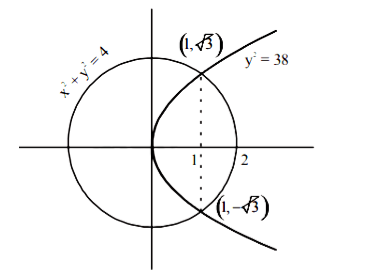 From the equations we get; $x^2 + 3x - 4 = 0 \Rightarrow (x + 4)(x - 1) = 0 \Rightarrow x = -4, x = 1$. When $x = 1, y = \sqrt{3}$.
$$\text{Area} = \left( \sqrt{3} \left( \frac{13^2 2}{3.72} \right)_0^1 + \left( \frac{1}{2} \sqrt{4 - x^2} + 2\sin^{-1} \frac{1}{2} \right)_1^2 \right) \times 2 = \left( \frac{1}{2\sqrt{3}} + \frac{2\pi}{3} \right) \times 2 = \frac{1}{\sqrt{3}} + \frac{4\pi}{3} \text{}$$
Step Solution:
1. Find Intersection: Solve $x^2 + 3x = 4 \Rightarrow x^2 + 3x - 4 = 0$, giving $x = 1$ (as $x > 0$ for $y^2=3x$).
2. Setup Area Integral: The total area is $2 \times [\int_0^1 \sqrt{3x} dx + \int_1^2 \sqrt{4 - x^2} dx]$.
3. Integrate Parabola: $2 \int_0^1 \sqrt{3}x^{1/2} dx = 2\sqrt{3} [\frac{2}{3}x^{3/2}]_0^1 = \frac{4\sqrt{3}}{3} = \frac{4}{\sqrt{3}}$.
4. Integrate Circle: $2 \int_1^2 \sqrt{4 - x^2} dx = 2 [\frac{x}{2}\sqrt{4-x^2} + 2\sin^{-1}\frac{x}{2}]_1^2 = 2[(0 + \pi) - (\frac{\sqrt{3}}{2} + \frac{\pi}{3})] = \frac{4\pi}{3} - \sqrt{3}$.
5. Final Result: Total area $= \frac{4}{\sqrt{3}} - \sqrt{3} + \frac{4\pi}{3} = \frac{4-3}{\sqrt{3}} + \frac{4\pi}{3} = \frac{1}{\sqrt{3}} + \frac{4\pi}{3}$.
Difficulty Level: Hard
Concept Name: Area bounded by Circle and Parabola
Short cut solution: The area is the sum of the parabolic segment and the circular segment. Parabolic part is $\frac{2}{3} \cdot 1 \cdot \sqrt{3} = \frac{2\sqrt{3}}{3}$. Adding the circular segment part gives the result.
Question 66
Question: The area (in sq. units) of the region $\{ ( x , y ) : y^2 \geq 2x$ and $x^2 + y^2 \leq 4x, x \geq 0, y \geq 0 \}$ is:
Options:
A. $\pi - \frac{4\sqrt{2}}{3}$
B. $\frac{\pi}{2} - \frac{2\sqrt{2}}{3}$
C. $\pi - 4/3$
D. $\pi - 8/3$
Correct Answer: D
Year: 2016
Solution: 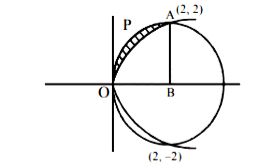 Points of intersection of the two curves are $(0,0), (2,2)$ and $(2,-2)$. Area = Area (OPAB) $-$ area under parabola ($0$ to $2$) $= \frac{\pi \times (2)^2}{4} - \int_0^2 \sqrt{2} \sqrt{x} dx = \pi - \frac{8}{3}$.
Step Solution:
1. Identify Curves: Circle $(x-2)^2 + y^2 = 4$ (center $(2,0)$, radius $2$) and parabola $y^2 = 2x$.
2. Find Intersection: $x^2 + 2x = 4x \Rightarrow x^2 - 2x = 0 \Rightarrow x = 0, 2$.
3. Define Region: The region is in the first quadrant ($y \geq 0$), inside the circle and above the parabola.
4. Calculate Area: Area $= \int_0^2 (\text{Circle} - \text{Parabola}) dx$ which is Area of quarter circle - Area under parabola.
5. Evaluate: $\frac{1}{4}\pi(2)^2 - \int_0^2 \sqrt{2x} dx = \pi - \sqrt{2}[\frac{2}{3}x^{3/2}]_0^2 = \pi - \frac{8}{3}$.
Difficulty Level: Medium
Concept Name: Area between curves using subtraction
Short cut solution: Area of the quarter circle is $\pi$. The area under the parabola $y^2=2x$ from $x=0$ to $2$ is $\frac{2}{3} \cdot 2 \cdot 2 = \frac{8}{3}$. Subtracting gives $\pi - 8/3$.
Question 70
Question: The area of the region described by $A = \{ ( x , y ) : x^2 + y^2 \leq 1$ and $y^2 \leq 1 - x \}$ is:
Options:
A. $\frac{\pi}{2} - \frac{2}{3}$
B. $\frac{\pi}{2} + \frac{2}{3}$
C. $\pi/2 + 4/3$
D. $\frac{\pi}{2} - \frac{4}{3}$
Correct Answer: C
Year: 2014
Solution: 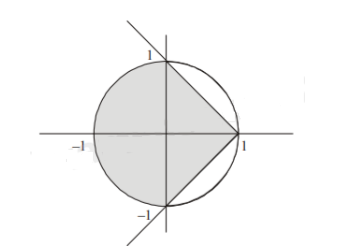 Given curves are $x^2 + y^2 = 1$ and $y^2 = 1 - x$. Intersecting points are $x = 0, 1$. Required Area = Area of semi-circle + Area bounded by parabola $= \frac{\pi r^2}{2} + 2 \int_0^1 \sqrt{1 - x} dx = \frac{\pi}{2} + 2 [\frac{(1 - x)^{3/2}}{-3/2}]_0^1 = \frac{\pi}{2} - \frac{4}{3}(-1) = \frac{\pi}{2} + \frac{4}{3}$ sq. unit.
Step Solution:
1. Find Intersections: $x^2 + (1 - x) = 1 \Rightarrow x^2 - x = 0$, so $x = 0$ and $x = 1$.
2. Divide Region: The region consists of a left semi-circle from $x = -1$ to $0$ and a parabolic region from $x = 0$ to $1$.
3. Area of Semi-circle: For $x^2 + y^2 = 1$, the area of the left half is $\frac{1}{2} \pi (1)^2 = \pi/2$.
4. Area of Parabolic Part: $\int_0^1 2\sqrt{1-x} dx = 2 [-\frac{2}{3}(1-x)^{3/2}]_0^1 = 2 [0 - (-\frac{2}{3})] = 4/3$.
5. Total Area: Sum of both parts $= \pi/2 + 4/3$.
Difficulty Level: Medium
Concept Name: Area of composite regions (Circle and Parabola)
Short cut solution: Recognize the left side is exactly half a circle ($\pi/2$). The right side is a parabolic arch with base $2$ (from $y=-1$ to $1$) and height $1$ (from $x=0$ to $1$), area $= \frac{2}{3} \cdot 2 \cdot 1 = 4/3$. Total $= \pi/2 + 4/3$.
Question 81
Question: If a straight line $y - x = 2$ divides the region $x^2 + y^2 \leq 4$ into two parts, then the ratio of the area of the smaller part to the area of the greater part is
Options:
A. $3\pi - 8 : \pi + 8$
B. $\pi - 3 : 3\pi + 3$
C. $3\pi - 4 : \pi + 4$
D. $\pi - 2 : 3\pi + 2$
Correct Answer: D
Year: Online May 12, 2012
Solution: 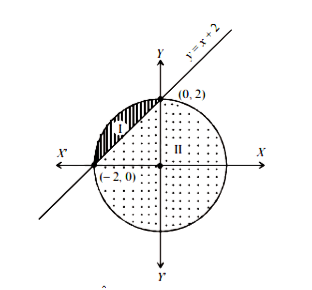 Area of $I = \int_{-2}^{0} [\sqrt{4 - x^2} - (x + 2)] dx = [\frac{x}{2}\sqrt{4 - x^2} + \frac{4}{2}\sin^{-1}(\frac{x}{2})]_{-2}^{0} - [\frac{x^2}{2} + 2x]_{-2}^{0} = \pi - 2$. Area of $II = \text{Area of circle} - \text{Area of } I = 4\pi - (\pi - 2) = 3\pi + 2$. Required ratio $= \frac{\pi - 2}{3\pi + 2}$.
Step Solution:
1. Identify Region: The region is a circle $x^2 + y^2 \leq 4$ (center $(0,0)$, radius 2) divided by the line $y = x + 2$.
2. Find Intersections: Solving $x^2 + (x+2)^2 = 4$ gives $2x^2 + 4x = 0$, so $x = 0$ and $x = -2$. The points are $(0,2)$ and $(-2,0)$.
3. Calculate Smaller Area (I): This is the area of a quarter circle in the second quadrant minus the area of the right-angled triangle formed by $(0,0), (-2,0), (0,2)$.
4. Integration/Geometry: Area $I = \frac{1}{4}\pi(2^2) - \frac{1}{2}(2)(2) = \pi - 2$.
5. Calculate Greater Area (II) and Ratio: Area $II = \text{Total Circle} - \text{Area } I = 4\pi - (\pi - 2) = 3\pi + 2$. Ratio $= (\pi - 2) : (3\pi + 2)$.
Difficulty Level: Medium
Concept Name: Area of Circular Segments
Short cut solution: The line passes through the intercepts $(0,2)$ and $(-2,0)$, forming a segment that is exactly a quarter-circle minus a triangle. Smaller area $= \frac{\pi r^2}{4} - \frac{r^2}{2}$. For $r=2$, area $= \pi - 2$.
Question 83
Question: The parabola $y^2 = x$ divides the circle $x^2 + y^2 = 2$ into two parts whose areas are in the ratio
Options:
A. $9\pi + 2 : 3\pi - 2$
B. $9\pi - 2 : 3\pi + 2$
C. $7\pi i - 2 : 2\pi - 3$
D. $7\pi + 2 : 3\pi + 2$
Correct Answer: B
Year: Online May 7, 2012
Solution: 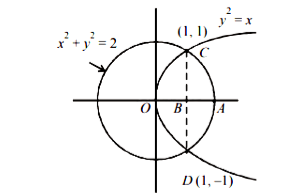 Area of OCADO = $2\int_0^1 \sqrt{x} dx + 2\int_1^{\sqrt{2}} \sqrt{2 - x^2} dx = \frac{4}{3} + 2[\frac{x}{2}\sqrt{2-x^2} + \sin^{-1}(\frac{x}{\sqrt{2}})]_1^{\sqrt{2}} = \frac{3\pi + 2}{6}$. Bigger area $= 2\pi - \frac{3\pi+2}{6} = \frac{9\pi-2}{6}$. Ratio $9\pi - 2 : 3\pi + 2$.
Step Solution:
1. Find Intersection: Solve $x^2 + x = 2 \implies (x+2)(x-1)=0$. Intersection is at $x=1$.
2. Setup Smaller Area Integral: Area $= 2 [\int_0^1 \text{parabola } dx + \int_1^{\sqrt{2}} \text{circle } dx]$.
3. Evaluate Parabolic Part: $2 \int_0^1 x^{1/2} dx = 2 [\frac{2}{3}x^{3/2}]_0^1 = 4/3$.
4. Evaluate Circular Part: $2 \int_1^{\sqrt{2}} \sqrt{2-x^2} dx = 2 [\frac{x}{2}\sqrt{2-x^2} + \sin^{-1}\frac{x}{\sqrt{2}}]_1^{\sqrt{2}} = \frac{\pi}{2} - 1$.
5. Final Ratio: Smaller area $= 4/3 + \pi/2 - 1 = \frac{3\pi+2}{6}$. Greater area $= 2\pi - \text{Smaller Area} = \frac{9\pi-2}{6}$. Ratio $= (9\pi-2) : (3\pi+2)$.
Difficulty Level: Hard
Concept Name: Area between Circle and Parabola
Short cut solution: Use the formula for the area of a parabolic segment ($2/3$ of the rectangle) for the first part and the standard circular segment formula for the second part.
Question 22
Question: The area of the region $R = \{ (x, y) : 5x^2 \leq y \leq 2x^2 + 9 \}$ is
Options:
A. $11\sqrt{3}$ square units
B. $12\sqrt{3}$ square units
C. $9\sqrt{3}$ square units
D. $6\sqrt{3}$ square units
Correct Answer: B
Year: 24 Feb 2021 Shift 2
Solution: $5x^2 = 2x^2 + 9 \Rightarrow x^2 = 3 \Rightarrow x = \pm\sqrt{3}$. Area $= \int_{-\sqrt{3}}^{\sqrt{3}} (2x^2 + 9 - 5x^2) dx = 2 \int_0^{\sqrt{3}} (9 - 3x^2) dx = 2[9x - x^3]_0^{\sqrt{3}} = 12\sqrt{3}$ sq units.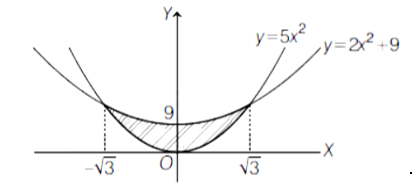
Step Solution:
1. Identify Curves: The curves are two parabolas: $y = 5x^2$ (opening upwards) and $y = 2x^2 + 9$ (opening upwards, vertex at $(0,9)$).
2. Find Points of Intersection: Set $5x^2 = 2x^2 + 9 \implies 3x^2 = 9 \implies x = \pm\sqrt{3}$.
3. Setup Integral: Area $= \int_{-\sqrt{3}}^{\sqrt{3}} (\text{Upper Parabola} - \text{Lower Parabola}) dx = \int_{-\sqrt{3}}^{\sqrt{3}} (2x^2 + 9 - 5x^2) dx$.
4. Apply Symmetry and Integrate: Area $= 2 \int_0^{\sqrt{3}} (9 - 3x^2) dx = 2 [9x - x^3]_0^{\sqrt{3}}$.
5. Evaluate: $2 [9\sqrt{3} - (\sqrt{3})^3] = 2 [9\sqrt{3} - 3\sqrt{3}] = 12\sqrt{3}$.
Difficulty Level: Easy
Concept Name: Area bounded by two Parabolas
Short cut solution: The area between two parabolas $y = ax^2 + c_1$ and $y = bx^2 + c_2$ is given by $\frac{4}{3} |x_0| \cdot |y_{upper}(0) - y_{lower}(0)|$ where $x_0$ is the positive intersection point. Here: $\frac{4}{3} (\sqrt{3}) (9) = 12\sqrt{3}$.
Question 31
Question: The area (in sq. units) of the region bounded by the curves $x^2 + 2y - 1 = 0$, $y^2 + 4x - 4 = 0$ and $y^2 - 4x - 4 = 0$ in the upper half plane is.
Options: (Options not explicitly listed in source; answer is numerical)
Correct Answer: 2
Year: 22 Jul 2021 Shift 2
Solution: Required Area (shaded) $= 2 \left[ \int_{0}^{2} \left( \frac{4 - y^2}{4} \right) dy - \int_{0}^{1} \left( \frac{1 - x^2}{2} \right) dx \right] = 2 \left[ \frac{4}{3} - \frac{1}{3} \right] = 2$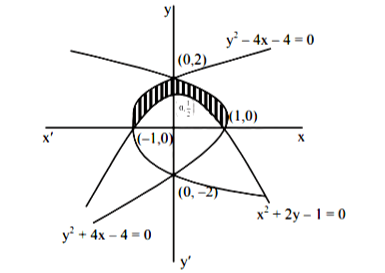
Step Solution:
1. Identify Curves: The curves are three parabolas: $y = \frac{1 - x^2}{2}$ (opening downwards, vertex $(0, 1/2)$), $x = 1 - \frac{y^2}{4}$ (opening left, vertex $(1, 0)$), and $x = \frac{y^2}{4} - 1$ (opening right, vertex $(-1, 0)$).
2. Define Region: The region is in the upper half plane ($y \geq 0$) and is bounded by these three curves. It is symmetric about the y-axis ($x = 0$).
3. Setup Integral using Symmetry: Total Area $= 2 \times [\text{Area between } y\text{-axis and right parabola} - \text{Area under top parabola}]$.
4. Integrate: $Area = 2 \left[ \int_{0}^{2} (1 - \frac{y^2}{4}) dy - \int_{0}^{1} (\frac{1 - x^2}{2}) dx \right]$.
5. Calculate: $2 \left[ (y - \frac{y^3}{12})_0^2 - \frac{1}{2}(x - \frac{x^3}{3})_0^1 \right] = 2 \left[ (2 - \frac{8}{12}) - \frac{1}{2}(1 - \frac{1}{3}) \right] = 2 [\frac{4}{3} - \frac{1}{3}] = 2$.
Difficulty Level: Hard
Concept Name: Area bounded by Multiple Parabolas
Short cut solution: Use the property that the area of a parabolic segment is $2/3$ of its bounding rectangle. The area of the larger parabolic segment (sideways) is $2 \times (\frac{2}{3} \cdot 1 \cdot 2) = \frac{8}{3}$. The area under the small downward parabola is $2 \times (\frac{2}{3} \cdot 1 \cdot \frac{1}{2}) = \frac{2}{3}$. Subtracting gives $\frac{8}{3} - \frac{2}{3} = 2$.
Question 45
Question: The area (in sq. units) of the region enclosed by the curves $y = x^2 - 1$ and $y = 1 - x^2$ is equal to:
Options:
A. 4/3
B. 8/3
C. 7/2
D. 16/3
Correct Answer: B
Year: Sep. 06, 2020 (II)
Solution: Required area $= 2 \int_{-1}^1 ((1 - x^2) - (x^2 - 1)) dx = 4 \int_0^1 (1 - x^2) dx = 4 (x - \frac{x^3}{3})_0^1 = \frac{8}{3}$.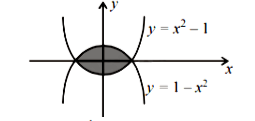
Step Solution:
1. Find Intersections: Set $x^2 - 1 = 1 - x^2 \implies 2x^2 = 2 \implies x^2 = 1 \implies x = \pm 1$.
2. Determine Upper/Lower Curve: In the interval $[-1, 1]$, $1 - x^2 \geq x^2 - 1$.
3. Setup Integral: Area $= \int_{-1}^{1} [(1 - x^2) - (x^2 - 1)] dx = \int_{-1}^{1} (2 - 2x^2) dx$.
4. Use Symmetry: Area $= 2 \int_{0}^{1} (2 - 2x^2) dx = 4 \int_{0}^{1} (1 - x^2) dx$.
5. Integrate: $4 [x - \frac{x^3}{3}]_0^1 = 4 (1 - \frac{1}{3}) = 4 (\frac{2}{3}) = \frac{8}{3}$.
Difficulty Level: Easy
Concept Name: Area between two Parabolas
Short cut solution: The area between two parabolas $y = a(x-h)^2 + k$ and $y = -a(x-h)^2 + m$ is $\frac{4}{3} \times (\text{width}) \times (\text{height difference at center})$. Width $= 2$, Height difference $= 2$. Area $= \frac{2}{3} \times 2 \times 2 = \frac{8}{3}$.
Question 51
Question: If the area enclosed between the curves $y = kx^2$ and $x = ky^2$, $(k > 0)$, is 1 square unit. Then k is:
Options:
A. $\frac{\sqrt{3}}{2}$
B. $\frac{1}{\sqrt{3}}$
C. $\sqrt{3}$
D. $\frac{2}{\sqrt{3}}$
Correct Answer: B
Year: Jan. 10, 2019 (I)
Solution: 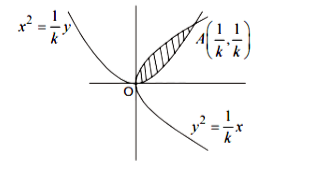 Two curves will intersect in the 1st quadrant at $A(\frac{1}{k}, \frac{1}{k})$. Integration leads to $\frac{1}{3k^2} = 1 \implies k = \frac{1}{\sqrt{3}}$.
Step Solution:
1. Identify Intersection: The curves $y = kx^2$ and $x = ky^2$ (or $y = \sqrt{x/k}$) intersect where $kx^2 = \sqrt{x/k} \implies k^2x^4 = x/k \implies x^3 = 1/k^3 \implies x = 1/k$. Point is $(1/k, 1/k)$.
2. Setup Integral: Area $= \int_{0}^{1/k} (\sqrt{\frac{x}{k}} - kx^2) dx$.
3. Integrate: $[\frac{1}{\sqrt{k}} \frac{x^{3/2}}{3/2} - \frac{kx^3}{3}]_0^{1/k} = [\frac{2}{3\sqrt{k}} x^{3/2} - \frac{kx^3}{3}]_0^{1/k}$.
4. Evaluate Limits: $(\frac{2}{3\sqrt{k}} \cdot \frac{1}{k\sqrt{k}}) - (\frac{k}{3} \cdot \frac{1}{k^3}) = \frac{2}{3k^2} - \frac{1}{3k^2} = \frac{1}{3k^2}$.
5. Solve for k: Set $\frac{1}{3k^2} = 1 \implies k^2 = 1/3 \implies k = 1/\sqrt{3}$ (since $k > 0$).
Difficulty Level: Medium
Concept Name: Area between two Parabolas
Short cut solution: The area between $y^2 = 4ax$ and $x^2 = 4by$ is $\frac{16ab}{3}$. Here $4a = 1/k$ and $4b = 1/k$. Area $= \frac{(1/k)(1/k)}{3} = \frac{1}{3k^2}$. Given area $= 1 \implies 1/3k^2 = 1 \implies k = 1/\sqrt{3}$.
Question 69
Question: The area (in square units) of the region bounded by the curves $y + 2x^{2} = 0$ and $y + 3x^{2} = 1$ is equal to.
Options:
A. $\frac{3}{5}$
B. $\frac{1}{3}$
C. $\frac{4}{3}$
D. $\frac{3}{4}$.
Correct Answer: C.
Year: JEE Main (Online) April 10, 2015.
Solution (as Given in the Source): 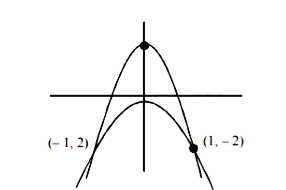 Solving $y + 2x^{2} = 0$ and $y + 3x^{2} = 1$, the points of intersection are $(1, -2)$ and $(-1, -2)$. $\text{Area} = 2 \int_{0}^{1} ((1 - 3x^{2}) - (-2x^{2})) dx = 2 \int_{0}^{1} (1 - x^{2}) dx = 2(x - \frac{x^{3}}{3})_{0}^{1} = \frac{4}{3}$.
Step Solution:
1. Equate the curves to find intersection points: $-2x^{2} = 1 - 3x^{2}$, which simplifies to $x^{2} = 1$, so $x = \pm 1$.
2. Set up the area integral between limits $-1$ and $1$: $\text{Area} = \int_{-1}^{1} [(1 - 3x^{2}) - (-2x^{2})] dx$.
3. Simplify the integrand: $\int_{-1}^{1} (1 - x^{2}) dx$.
4. Apply integration: $[x - \frac{x^{3}}{3}]_{-1}^{1}$.
5. Calculate the final value: $(1 - \frac{1}{3}) - (-1 + \frac{1}{3}) = \frac{2}{3} - (-\frac{2}{3}) = \frac{4}{3}$.
The difficulty level: Easy.
The Concept Name: Area between two parabolas.
Short cut solution: For two parabolas of the form $y = a_{1}x^{2} + b_{1}$ and $y = a_{2}x^{2} + b_{2}$, the area is $\frac{4}{3}|x_{0}| \times |y_{vertex1} - y_{vertex2}|$, where $x_{0}$ is the positive intersection point. Here: $\frac{4}{3}(1) \times |1 - 0| = \frac{4}{3}$.
Question 78
Question: The area between the parabolas $x^{2} = \frac{y}{4}$ and $x^{2} = 9y$ and the straight line $y = 2$ is:.
Options:
A. $20\sqrt{2}$
B. $\frac{10\sqrt{2}}{3}$
C. $\frac{20\sqrt{2}}{3}$
D. $10\sqrt{2}$.
Correct Answer: C.
Year: JEE Main 2012.
Solution (as Given in the Source):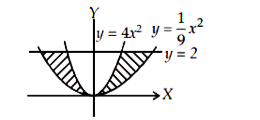 $= 2 \int_{0}^{2} (3\sqrt{y} - \frac{\sqrt{y}}{2}) dy = 2 [\frac{2}{3} \times 3 \cdot y^{\frac{3}{2}} - \frac{1}{2} \times \frac{2}{3} \cdot y^{\frac{3}{2}}]_{0}^{2} = 2 \times [\frac{5}{3} y^{\frac{3}{2}}]_{0}^{2} = 2 \cdot \frac{5}{3} 2\sqrt{2} = \frac{20\sqrt{2}}{3}$.
Step Solution:
1. Express $x$ in terms of $y$ for the right half of the parabolas: $x_{1} = 3\sqrt{y}$ and $x_{2} = \frac{\sqrt{y}}{2}$.
2. The area is symmetric about the y-axis, so $\text{Area} = 2 \int_{0}^{2} (x_{1} - x_{2}) dy$.
3. Substitute the expressions: $2 \int_{0}^{2} (3\sqrt{y} - \frac{\sqrt{y}}{2}) dy = 2 \int_{0}^{2} \frac{5}{2}\sqrt{y} dy = 5 \int_{0}^{2} y^{1/2} dy$.
4. Perform integration: $5 [\frac{y^{3/2}}{3/2}]_{0}^{2} = \frac{10}{3} [y^{3/2}]_{0}^{2}$.
5. Substitute $y=2$: $\frac{10}{3}(2^{3/2}) = \frac{10}{3}(2\sqrt{2}) = \frac{20\sqrt{2}}{3}$.
The difficulty level: Medium.
The Concept Name: Integration with respect to the y-axis.
Short cut solution: The area between $x^{2}=ay$ and $x^{2}=by$ up to $y=h$ is $\frac{4}{3}h^{3/2}(\sqrt{b} - \sqrt{a})$. Here $b=9, a=1/4, h=2$: $\frac{4}{3}(2^{3/2})(3 - 1/2) = \frac{4}{3}(2\sqrt{2})(\frac{5}{2}) = \frac{20\sqrt{2}}{3}$.
Question 84
Question: The area bounded by the curves $y^{2} = 4x$ and $x^{2} = 4y$ is:.
Options:
A. $\frac{32}{3}$ sq. units
B. $\frac{16}{3}$ sq. units
C. $\frac{8}{3}$ sq. units
D. 0 sq. units.
Correct Answer: B.
Year: JEE Main 2011 RS.
Solution (as Given in the Source): 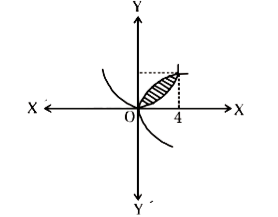 $\text{Required area} = \int_{0}^{4} (2\sqrt{x} - \frac{x^{2}}{4}) dx = [2(\frac{x^{3/2}}{3/2}) - \frac{x^{3}}{12}]_{0}^{4} = \frac{4}{3} \times 8 - \frac{64}{12} = \frac{32}{3} - \frac{16}{3} = \frac{16}{3}$ sq. units.
Step Solution:
1. Find intersection points: Substitute $y = \frac{x^{2}}{4}$ into $y^{2} = 4x$ to get $(\frac{x^{2}}{4})^{2} = 4x \implies x^{4} = 64x$, giving $x = 0, 4$.
2. Set up the integral for the area between the upper curve ($y = 2\sqrt{x}$) and lower curve ($y = \frac{x^{2}}{4}$): $\int_{0}^{4} (2\sqrt{x} - \frac{x^{2}}{4}) dx$.
3. Integrate the terms: $[\frac{4}{3}x^{3/2} - \frac{x^{3}}{12}]_{0}^{4}$.
4. Evaluate at the upper limit $x=4$: $(\frac{4}{3} \cdot 4^{3/2}) - \frac{4^{3}}{12} = (\frac{4}{3} \cdot 8) - \frac{64}{12}$.
5. Simplify: $\frac{32}{3} - \frac{16}{3} = \frac{16}{3}$.
The difficulty level: Easy.
The Concept Name: Area between two standard parabolas.
Short cut solution: The area between $y^{2} = 4ax$ and $x^{2} = 4by$ is given by the formula $\frac{16}{3}ab$. Here $4a=4 \implies a=1$ and $4b=4 \implies b=1$. Thus, $\text{Area} = \frac{16}{3}(1)(1) = \frac{16}{3}$.
Question 88
Question: The area of the plane region bounded by the curves $x + 2y^2 = 0$ and $x + 3y^2 = 1$ is equal to.
Options:
A. $\frac{5}{3}$
B. $\frac{1}{3}$
C. $\frac{2}{3}$
D. $\frac{4}{3}$.
Correct Answer: D.
Year: 2008.
Solution (as Given in the Source): 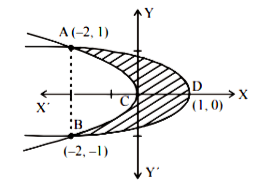 Given $x + 2y^2 = 0 \Rightarrow y^2 = -\frac{x}{2}$ and $x + 3y^2 = 1 \Rightarrow y^2 = -\frac{1}{3}(x - 1)$. On solving these two equations, we get the points of intersection as $(-2, 1)$ and $(-2, -1)$. The required area is $A = 2 \{ \frac{1}{\sqrt{3}} \int \sqrt{1 - x} dx - \frac{1}{\sqrt{2}} \int_{-2}^{0} \sqrt{-x} dx \}$, which simplifies through integration to $\frac{4}{3}$.
Step Solution:
1. Find intersection points: Equate the curves in terms of $x$: $-2y^2 = 1 - 3y^2$, which gives $y^2 = 1$, so $y = \pm 1$.
2. Identify boundaries: The right-hand curve is $x = 1 - 3y^2$ and the left-hand curve is $x = -2y^2$.
3. Set up integral: Integrate with respect to $y$: $\text{Area} = \int_{-1}^{1} [(1 - 3y^2) - (-2y^2)] dy$.
4. Simplify and Integrate: $\int_{-1}^{1} (1 - y^2) dy = [y - \frac{y^3}{3}]_{-1}^{1}$.
5. Calculate final value: $(1 - \frac{1}{3}) - (-1 + \frac{1}{3}) = \frac{2}{3} - (-\frac{2}{3}) = \frac{4}{3}$.
The difficulty level: Easy.
The Concept Name: Area between two parabolas (Integration along the y-axis).
Short cut solution: For two parabolas $x = f(y)$ and $x = g(y)$ that meet at $y = \pm y_0$, the area is $\frac{4}{3} |y_0| \times |x_{vertex1} - x_{vertex2}|$. Here $y_0 = 1$, vertices are at $x=1$ and $x=0$. Area $= \frac{4}{3}(1)(1 - 0) = \frac{4}{3}$.
Question 92
Question: The parabolas $y^2 = 4x$ and $x^2 = 4y$ divide the square region bounded by the lines $x = 4, y = 4$ and the coordinate axes. If $S_1, S_2, S_3$ are respectively the areas of these parts numbered from top to bottom; then $S_1 : S_2 : S_3$ is.
Options:
A. 1 : 2 : 1
B. 1 : 2 : 3
C. 2 : 1 : 2
D. 1 : 1 : 1.
Correct Answer: D.
Year: 2005.
Solution (as Given in the Source): 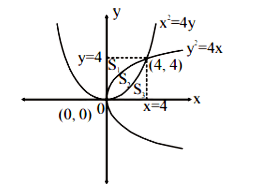 On solving, we get intersection points of $x^2 = 4y$ and $y^2 = 4x$ are $(0,0)$ and $(4,4)$. By symmetry, $S_1 = S_3 = \int_0^4 \frac{x^2}{4} dx = [\frac{x^3}{12}]_0^4 = \frac{16}{3}$. $S_2 = \int_0^4 (2\sqrt{x} - \frac{x^2}{4}) dx = [\frac{4}{3}x^{3/2} - \frac{x^3}{12}]_0^4 = \frac{32}{3} - \frac{16}{3} = \frac{16}{3}$. Thus $S_1 : S_2 : S_3 = 1 : 1 : 1$.
Step Solution:
1. Total Area: The square area is $4 \times 4 = 16$. Intersection points of $y^2=4x$ and $x^2=4y$ are $(0,0)$ and $(4,4)$.
2. Calculate $S_3$ (bottom): Area under $y = \frac{x^2}{4}$ is $\int_0^4 \frac{x^2}{4} dx = [\frac{x^3}{12}]_0^4 = \frac{64}{12} = \frac{16}{3}$.
3. Calculate $S_2$ (middle): Area between $y = 2\sqrt{x}$ and $y = \frac{x^2}{4}$ is $\int_0^4 (2\sqrt{x} - \frac{x^2}{4}) dx = [\frac{4}{3}x^{3/2} - \frac{x^3}{12}]_0^4 = \frac{32}{3} - \frac{16}{3} = \frac{16}{3}$.
4. Calculate $S_1$ (top): Area above $y = 2\sqrt{x}$ within the square is $\text{Total Area} - (S_2 + S_3) = 16 - (\frac{16}{3} + \frac{16}{3}) = \frac{48-32}{3} = \frac{16}{3}$.
5. Ratio: $S_1 : S_2 : S_3 = \frac{16}{3} : \frac{16}{3} : \frac{16}{3} = 1 : 1 : 1$.
The difficulty level: Medium.
The Concept Name: Partitioning of area by parabolas.
Short cut solution: It is a standard result that the curves $y^2 = 4ax$ and $x^2 = 4ay$ divide the square of side $4a$ into three equal parts. Since the total area is $16a^2$, each part is $\frac{16a^2}{3}$. Here $a=1$, so each part is $\frac{16}{3}$, making the ratio $1:1:1$.