Question 4
Question: A spherical chocolate ball has a layer of ice-cream of uniform thickness around it. When the thickness of the ice-cream layer is 1 cm, the ice-cream melts at the rate of $81 \text{ cm}^3/\text{min}$ and the thickness of the ice-cream layer decreases at the rate of $\frac{1}{4\pi} \text{ cm/min}$. The surface area (in $\text{cm}^2$) of the chocolate ball (without the ice-cream layer) is :
Options:
A. $128\pi$
B. $196\pi$
C. $225\pi$
D. $256\pi$
Correct Answer: D
Year: JEE Main 2025 (Online) 23rd January Evening Shift
Solution (as Given in the Source):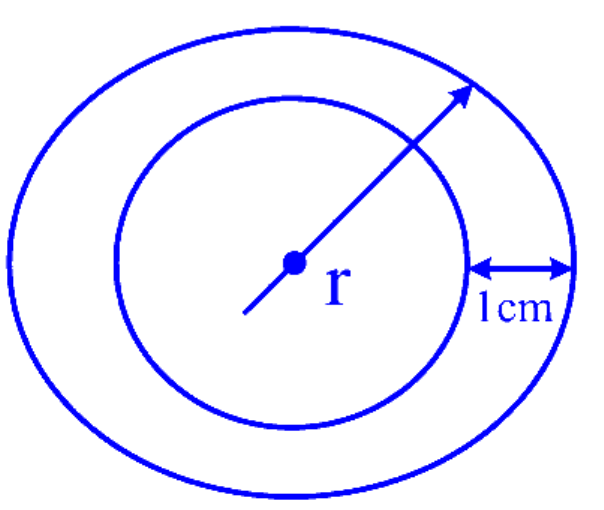
$\mathbf{v} = \frac{4}{3} \pi \mathbf{r}^3$
$\frac{\mathrm{d}\mathbf{v}}{\mathrm{d}t} = 4 \pi \mathbf{r}^2 \frac{\mathrm{d}\mathbf{r}}{\mathrm{d}t}$
$81 = 4 \pi \mathbf{r}^2 \times \frac{1}{4\pi}$
$\mathbf{r}^2 = 81$
$\mathbf{r} = 9$
Surface area of chocolate $= 4 \pi (r - 1)^2 = 256 \pi$
Step Solution:
1. Define Volume and Rate: Let $r$ be the radius of the entire sphere (chocolate + ice cream). The volume is $V = \frac{4}{3} \pi r^3$.
2. Differentiate Volume: Differentiating with respect to time $t$ gives $\frac{dV}{dt} = 4 \pi r^2 \frac{dr}{dt}$.
3. Substitute Given Values: Plug in the melting rate ($dV/dt = 81$) and the rate of thickness decrease ($dr/dt = \frac{1}{4\pi}$). This results in $81 = 4 \pi r^2 \left(\frac{1}{4\pi}\right)$.
4. Solve for Current Radius: Simplifying gives $r^2 = 81$, so the total radius $r = 9 \text{ cm}$.
5. Calculate Inner Surface Area: The thickness of the ice cream is 1 cm, so the radius of the chocolate ball is $R = r - 1 = 8 \text{ cm}$. The surface area is $S = 4 \pi R^2 = 4 \pi (8)^2 = 256\pi \text{ cm}^2$.
Difficulty Level: Medium
Concept Name: Rate of Change of Quantities
Short cut solution: Since the rate of volume change $\frac{dV}{dt}$ is given by Surface Area $\times \frac{dr}{dt}$, you can immediately write $81 = (\text{Surface Area}) \times \frac{1}{4\pi}$. Thus, current Surface Area $= 324\pi$. Since $4\pi r^2 = 324\pi$, then $r^2 = 81 \Rightarrow r = 9$. Inner radius is $9 - 1 = 8$, so inner area $= 4\pi(8^2) = 256\pi$.
Question 50
Question: Water is being filled at the rate of $1 \text{ cm}^3/\text{sec}$ in a right circular conical vessel (vertex downwards) of height 35 cm and diameter 14 cm. When the height of the water level is 10 cm, the rate (in $\text{cm}^2/\text{sec}$) at which the wet conical surface area of the vessel increases is
Options:
A. 5
B. $\frac{\sqrt{21}}{5}$
C. $\frac{\sqrt{26}}{5}$
D. $\frac{\sqrt{26}}{10}$
Correct Answer: C
Year: JEE Main 2022 (Online) 25th June Evening Shift
Solution (as Given in the Source):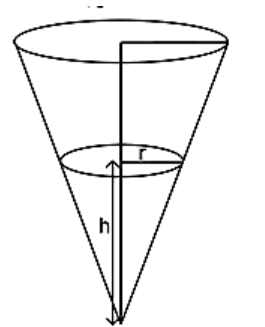
$\because \mathrm{V} = \frac{1}{3} \pi \mathrm{r}^2 \mathrm{h}$ and $\frac{\mathrm{r}}{\mathrm{h}} = \frac{7}{35} = \frac{1}{5} \Rightarrow \mathrm{V} = \frac{1}{75} \pi h^3$
$\frac{\mathrm{d}\mathrm{V}}{\mathrm{d}t} = \frac{1}{25} \pi h^2 \frac{\mathrm{d}\mathrm{h}}{\mathrm{d}t} = 1 \Rightarrow \frac{\mathrm{d}\mathrm{h}}{\mathrm{d}t} = \frac{25}{\pi h^2}$
$\mathbf{S} = \pi \mathbf{r} \mathbf{l} = \pi \left(\frac{h}{5}\right) \sqrt{h^2 + \frac{h^2}{25}} = \frac{\pi}{25} \sqrt{26} \mathbf{h}^2$
$\frac{\mathrm{d}\mathrm{S}}{\mathrm{d}t} = \frac{2\sqrt{26}\pi\mathrm{h}}{25} \cdot \frac{\mathrm{d}\mathrm{h}}{\mathrm{d}t} \Rightarrow \frac{\mathrm{d}\mathrm{S}}{\mathrm{d}t}|_{h=10} = \frac{\sqrt{26}}{5}$
Step Solution:
1. Geometric Relationship: For the cone, the ratio of radius $r$ to height $h$ is constant: $\frac{r}{h} = \frac{7}{35} = \frac{1}{5}$, so $r = \frac{h}{5}$.
2. Relate Volume to Height: Volume $V = \frac{1}{3}\pi r^2 h = \frac{1}{3}\pi (\frac{h}{5})^2 h = \frac{\pi h^3}{75}$.
3. Find $dh/dt$: Differentiate volume with respect to time: $\frac{dV}{dt} = \frac{3\pi h^2}{75} \frac{dh}{dt} = \frac{\pi h^2}{25} \frac{dh}{dt}$. Given $\frac{dV}{dt} = 1$, at $h = 10$, $\frac{dh}{dt} = \frac{25}{100\pi} = \frac{1}{4\pi}$.
4. Define Surface Area: The lateral surface area is $S = \pi r l = \pi (\frac{h}{5}) \sqrt{h^2 + (\frac{h}{5})^2} = \frac{\pi \sqrt{26} h^2}{25}$.
5. Calculate Final Rate: Differentiate $S$: $\frac{dS}{dt} = \frac{2\pi \sqrt{26} h}{25} \frac{dh}{dt}$. Substitute $h = 10$ and $\frac{dh}{dt} = \frac{1}{4\pi}$ to get $\frac{2\pi \sqrt{26} (10)}{25} \times \frac{1}{4\pi} = \frac{20\sqrt{26}}{100} = \frac{\sqrt{26}}{5}$.
Difficulty Level: Medium/Hard
Concept Name: Rate of Change / Similar Triangles in Cones
Short cut solution: Use the direct differential relation $\frac{dS}{dV} = \frac{dS/dt}{dV/dt}$. Since $S = C_1 h^2$ and $V = C_2 h^3$, then $\frac{dS}{dV} = \frac{2 C_1}{3 C_2 h}$. Plugging in the constants derived from geometry ($\frac{r}{h} = \frac{1}{5}$ and $l = \frac{\sqrt{26}}{5}h$) and $h=10$ gives the result $\frac{\sqrt{26}}{5}$ directly when $dV/dt = 1$.
Question 67
Question: The surface area of a balloon of spherical shape being inflated, increases at a constant rate. If initially, the radius of balloon is 3 units and after 5 seconds, it becomes 7 units, then its radius after 9 seconds is:
Options:
A. 9
B. 10
C. 11
D. 12
Correct Answer: A
Year: JEE Main 2022 (Online) 24th June Morning Shift
Solution (as Given in the Source):
Surface area $(s) = 4 \pi r^2 \Rightarrow \frac{ds}{dt} = 8 \pi r \frac{dr}{dt} = k$ (constant)
$k dt = 8 \pi r dr \Rightarrow kt = 4 \pi r^2 + c$
At $t = 0, r = 3 \Rightarrow 0 = 4\pi(9) + c \Rightarrow c = -36\pi$
At $t = 5, r = 7 \Rightarrow 5k = 4\pi(49) - 36\pi = 160\pi \Rightarrow k = 32\pi$
At $t = 9 \Rightarrow (32\pi)(9) = 4\pi r^2 - 36\pi \Rightarrow 72 = r^2 - 9 \Rightarrow r^2 = 81 \Rightarrow r = 9$
Step Solution:
1. Set up Equation: The rate of change of surface area $S = 4\pi r^2$ is constant: $\frac{dS}{dt} = k$. Integrating gives $S(t) = kt + C$, or $4\pi r^2 = kt + C$.
2. Find Initial Constant: At $t = 0$, $r = 3$, so $4\pi(3^2) = k(0) + C \Rightarrow C = 36\pi$.
3. Find Rate Constant $k$: At $t = 5$, $r = 7$, so $4\pi(7^2) = k(5) + 36\pi$. This simplifies to $196\pi = 5k + 36\pi$, which means $160\pi = 5k$, so $k = 32\pi$.
4. Formulate General Equation: The radius equation is $4\pi r^2 = 32\pi t + 36\pi$. Dividing by $4\pi$ gives $r^2 = 8t + 9$.
5. Solve for $t = 9$: Plug in $t = 9$ to find $r^2 = 8(9) + 9 = 72 + 9 = 81$. Thus, $r = 9$.
Difficulty Level: Easy/Medium
Concept Name: Application of Derivatives / Integration in Rates
Short cut solution: Since the surface area increases linearly ($S \propto t$), the square of the radius also increases linearly ($r^2 \propto t$). We have points $(t, r^2)$: $(0, 9)$ and $(5, 49)$. The slope is $\frac{49-9}{5-0} = 8$. The equation is $r^2 = 8t + 9$. For $t=9$, $r^2 = 8(9)+9 = 81 \Rightarrow r=9$.
Question 80
Question: A water tank has the shape of a right circular cone with axis vertical and vertex downwards. Its semivertical angle is $\tan^{-1} \frac{3}{4}$. Water is poured in it at a constant rate of 6 cubic meter per hour. The rate (in square meter per hour), at which the wet curved surface area of the tank is increasing, when the depth of water in the tank is 4 meters, is.
Options: (Not explicitly listed in the source; the correct numerical value is 5).
Correct Answer: 5.
Year: JEE Main 2022 (Online) 27th July Evening Shift.
Solution (as Given in the Source):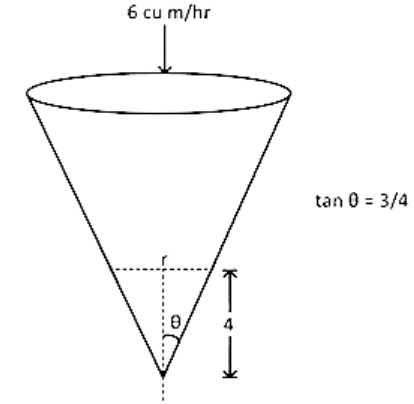
$\tan \theta = 3/4$
$v = \frac{1}{3} \pi r^2 h$.
$v = \frac{1}{3} \pi r^2 \{ \frac{4r}{3} \}$.
$d \frac{d}{dt} = \frac{4\pi}{3} r^2 \frac{dr}{dt} \rightarrow 6 = \frac{4\pi}{3} (3)^2 \frac{dr}{dt} \rightarrow \frac{dr}{dt} = \frac{1}{2\pi}$.
$A = \pi r \sqrt{r^2 + h^2} \rightarrow \frac{dA}{dt} = \frac{1}{5} \pi^3 \cdot \frac{1}{2\pi} \rightarrow 5$.
Step Solution:
1. Geometric Relations: Given $\tan \theta = 3/4$, then radius $r = \frac{3}{4}h$ and slant height $l = \sqrt{r^2 + h^2} = \frac{5}{4}h$.
2. Relate Volume to Height: Volume $V = \frac{1}{3}\pi r^2 h = \frac{1}{3}\pi (\frac{3}{4}h)^2 h = \frac{3\pi h^3}{16}$.
3. Find $\frac{dh}{dt}$: Differentiating gives $\frac{dV}{dt} = \frac{9\pi h^2}{16} \frac{dh}{dt}$. Substituting $\frac{dV}{dt}=6$ and $h=4$: $6 = \frac{9\pi(16)}{16} \frac{dh}{dt} \Rightarrow \frac{dh}{dt} = \frac{2}{3\pi}$.
4. Relate Surface Area to Height: Curved Surface Area $S = \pi r l = \pi (\frac{3h}{4})(\frac{5h}{4}) = \frac{15\pi h^2}{16}$.
5. Calculate Rate of Area Change: $\frac{dS}{dt} = \frac{15\pi h}{8} \frac{dh}{dt}$. Substituting $h=4$ and $\frac{dh}{dt}=\frac{2}{3\pi}$: $\frac{dS}{dt} = \frac{15\pi(4)}{8} \cdot \frac{2}{3\pi} = \frac{120\pi}{24\pi} = 5$.
Difficulty Level: Medium
Concept Name: Rate of Change of Quantities
Short cut solution: Use the differential ratio $\frac{dS}{dV}$. Since $S = C_1 h^2$ and $V = C_2 h^3$, then $\frac{dS}{dV} = \frac{2S}{3V}$. At $h=4$, $r=3$ and $l=5$. Thus $S = 15\pi$ and $V = 12\pi$. Rate $\frac{dS}{dt} = \frac{dV}{dt} \cdot \frac{2(15\pi)}{3(12\pi)} = 6 \cdot \frac{30}{36} = 5$.
Question 120
Question: A spherical iron ball of 10cm radius is coated with a layer of ice of uniform thickness that melts at a rate of $50 \text{ cm}^3/\text{min}$. When the thickness of ice is 5cm, then the rate (in cm/min.) at which the thickness of ice decreases, is:.
Options:
A. $\frac{5}{6\pi}$
B. $\frac{1}{54\pi}$
C. $\frac{1}{36\pi}$
D. $\frac{1}{18\pi}$
Correct Answer: D.
Year: JEE Main 2020 (Online) 9th January Morning Shift.
Solution (as Given in the Source):
Let the thickness of ice layer be $= x \text{ cm}$.
Total volume $V = \frac{4}{3} \pi (10 + x)^3$.
$\frac{dV}{dt} = 4\pi (10 + x)^2 \frac{dx}{dt}$.
$50 = 4\pi (10 + 5)^2 \frac{dx}{dt} \Rightarrow \frac{dx}{dt} = \frac{1}{18\pi} \text{ cm/min}$.
Step Solution:
1. Define Variables: Let $x$ be the thickness of the ice. The total radius of the sphere is $R = 10 + x$.
2. Volume Formula: The volume of the sphere is $V = \frac{4}{3} \pi R^3 = \frac{4}{3} \pi (10 + x)^3$.
3. Differentiate Volume: Using the chain rule with respect to time $t$: $\frac{dV}{dt} = 4 \pi (10 + x)^2 \frac{dx}{dt}$.
4. Substitute Given Values: Plug in the melting rate ($\frac{dV}{dt} = 50$) and current thickness ($x = 5$): $50 = 4 \pi (15)^2 \frac{dx}{dt}$.
5. Final Calculation: $50 = 900\pi \frac{dx}{dt} \implies \frac{dx}{dt} = \frac{50}{900\pi} = \frac{1}{18\pi}$.
Difficulty Level: Easy/Medium
Concept Name: Rate of Change of Quantities
Short cut solution: The rate of change of thickness is $\frac{dV/dt}{\text{Surface Area}}$. The current Surface Area at $x=5$ is $4\pi(15)^2 = 900\pi$. Thus, rate $= 50/900\pi = 1/18\pi$.
Question 127
Question: If the surface area of a cube is increasing at a rate of $3.6 \text{ cm}^2/\text{sec}$, retaining its shape; then the rate of change of its volume (in $\text{cm}^3/\text{sec}$), when the length of a side of the cube is 10 cm, is :.
Options:
A. 18
B. 10
C. 20
D. 9
Correct Answer: D.
Year: JEE Main 2020 (Online) 3rd September Evening Shift.
Solution (as Given in the Source):
$S = 6 a^2 \Rightarrow \frac{dS}{dt} = 12a \cdot \frac{da}{dt} \Rightarrow 3.6 = 12a \cdot \frac{da}{dt}$.
$\Rightarrow 12(10) \frac{da}{dt} = 3.6 \Rightarrow \frac{da}{dt} = 0.03$.
$V = a^3 \Rightarrow \frac{dV}{dt} = 3a^2 \cdot \frac{da}{dt} = 3(10)^2 \cdot (0.03) = 9$.
Step Solution:
1. Differentiate Surface Area: $S = 6a^2$. Taking the time derivative: $\frac{dS}{dt} = 12a \frac{da}{dt}$.
2. Calculate $\frac{da}{dt}$: Use $\frac{dS}{dt} = 3.6$ and $a = 10$: $3.6 = 12(10) \frac{da}{dt} \implies \frac{da}{dt} = 0.03 \text{ cm/sec}$.
3. Differentiate Volume: $V = a^3$. Taking the time derivative: $\frac{dV}{dt} = 3a^2 \frac{da}{dt}$.
4. Substitute for Volume: Plug in $a = 10$ and $\frac{da}{dt} = 0.03$: $\frac{dV}{dt} = 3(10)^2(0.03)$.
5. Final Calculation: $\frac{dV}{dt} = 300 \times 0.03 = 9 \text{ cm}^3/\text{sec}$.
Difficulty Level: Easy
Concept Name: Rate of Change of Quantities
Short cut solution: Use the relation $\frac{dV}{dt} = \frac{dV}{dS} \cdot \frac{dS}{dt}$. Since $V = a^3$ and $S = 6a^2$, then $\frac{dV}{dS} = \frac{3a^2}{12a} = \frac{a}{4}$. At $a=10$, rate $= \frac{10}{4} \times 3.6 = 2.5 \times 3.6 = 9$.
Question 153
Question: A spherical iron ball of radius 10 cm is coated with a layer of ice of uniform thickness that melts at a rate of $50 \text{ cm}^3/\text{min}$. When the thickness of the ice is 5 cm, then the rate at which the thickness (in cm/min) of the ice decreases, is :
Options:
A. $\frac{1}{18\pi}$
B. $\frac{1}{36\pi}$
C. $\frac{5}{6\pi}$
D. $\frac{1}{9\pi}$
Correct Answer: A
Year: April 10, 2019 (II)
Solution (as Given in the Source):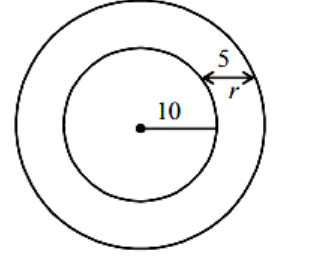
Given that ice melts at a rate of $50 \text{ cm}^3/\text{min}$
$\frac{dV_{ice}}{dt} = 50$
$V_{ice} = \frac{4}{3}\pi(10+r)^3 - \frac{4}{3}\pi(10)^3$
$\Rightarrow \frac{dV}{dt} = \frac{4}{3}\pi \cdot 3(10+r)^2 \frac{dr}{dt} = 4\pi(10+r)^2 \frac{dr}{dt}$
Substitute $r = 5$, $50 = 4\pi(225) \frac{dr}{dt} \Rightarrow \frac{dr}{dt} = \frac{50}{4\pi(225)} = \frac{1}{18\pi} \text{ cm/min}$
Step Solution:
1. Define Variables: Let $r$ be the thickness of the ice layer. The total volume of ice and ball is $V = \frac{4}{3}\pi(10+r)^3$.
2. Differentiate Volume: The rate of change of ice volume is $\frac{dV}{dt} = 4\pi(10+r)^2 \frac{dr}{dt}$.
3. Identify Given Values: The melting rate $\frac{dV}{dt} = 50 \text{ cm}^3/\text{min}$ and the current thickness $r = 5 \text{ cm}$.
4. Substitute into Equation: $50 = 4\pi(10+5)^2 \frac{dr}{dt} = 4\pi(15)^2 \frac{dr}{dt}$.
5. Final Calculation: $50 = 900\pi \frac{dr}{dt} \Rightarrow \frac{dr}{dt} = \frac{50}{900\pi} = \frac{1}{18\pi}$.
Difficulty Level: Easy/Medium
Concept Name: Rate of Change of Quantities
Short cut solution: The rate of change of thickness is simply the $\frac{\text{Rate of Volume Change}}{\text{Current Surface Area}}$. The surface area at $r=5$ is $4\pi(15)^2 = 900\pi$. Thus, rate $= \frac{50}{900\pi} = \frac{1}{18\pi}$.
Question 154
Question: A water tank has the shape of an inverted right circular cone, whose semi-vertical angle is $\tan^{-1}(\frac{1}{2})$. Water is poured into it at a constant rate of 5 cubic meter per minute. Then the rate (in m/min.), at which the level of water is rising at the instant when the depth of water in the tank is 10 m; is:
Options:
A. $1/15\pi$
B. $1/10\pi$
C. $2/\pi$
D. $1/5\pi$
Correct Answer: D
Year: 2010
Solution (as Given in the Source):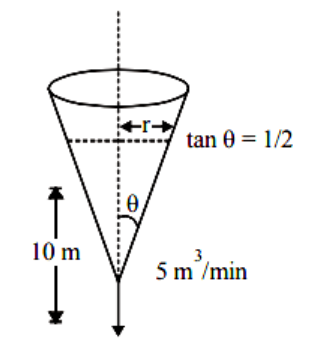
Given $\frac{dV}{dt} = 5 \text{ m}^3/\text{min}$. Volume $V = \frac{1}{3}\pi r^2 h$.
By the diagram, $\frac{r}{h} = \frac{1}{2} \Rightarrow h = 2r \Rightarrow \frac{dh}{dt} = 2 \frac{dr}{dt}$.
Differentiate eq. (i) w.r.t. ‘t’: $\frac{dV}{dt} = \frac{1}{3}(\pi 2r \frac{dr}{dt}h + \pi r^2 \frac{dh}{dt})$.
Putting $h=10, r=5$ and $\frac{dV}{dt}=5$: $5 = \frac{75\pi}{3} \frac{dh}{dt} \Rightarrow \frac{dh}{dt} = \frac{1}{5\pi} \text{ m/min}
Step Solution:
1. Geometric Relationship: From the semi-vertical angle, $\tan\theta = \frac{r}{h} = \frac{1}{2}$, so $r = \frac{h}{2}$.
2. Relate Volume to Height: $V = \frac{1}{3}\pi r^2 h = \frac{1}{3}\pi(\frac{h}{2})^2 h = \frac{\pi h^3}{12}$.
3. Differentiate w.r.t. Time: $\frac{dV}{dt} = \frac{3\pi h^2}{12} \frac{dh}{dt} = \frac{\pi h^2}{4} \frac{dh}{dt}$.
4. Substitute Values: Given $\frac{dV}{dt} = 5$ and $h = 10$, then $5 = \frac{\pi(10)^2}{4} \frac{dh}{dt} = 25\pi \frac{dh}{dt}$.
5. Final Calculation: $\frac{dh}{dt} = \frac{5}{25\pi} = \frac{1}{5\pi}$.
Difficulty Level: Medium
Concept Name: Rate of Change / Geometric Applications
Short cut solution: Rate of height rise is $\frac{dV/dt}{\text{Area of water surface}}$. At $h=10$, $r=5$, so Area $= \pi(5)^2 = 25\pi$. Rate $= \frac{5}{25\pi} = \frac{1}{5\pi}$.
Question 166
Question: A 2 m ladder leans against a vertical wall. If the top of the ladder begins to slide down the wall at the rate 25 cm/sec., then the rate (in cm/sec.) at which the bottom of the ladder slides away from the wall on the horizontal ground when the top of the ladder is 1 m above the ground is:
Options:
A. $25\sqrt{3}$
B. $25/\sqrt{3}$
C. $25/3$
D. 25
Correct Answer: B
Year: April 12, 2019 (I)
Solution (as Given in the Source):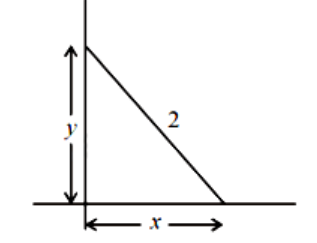
$\frac{dy}{dt} = -25$ at $y = 1$
By Pythagoras theorem, $x^2 + y^2 = 4$
When $y = 1 \Rightarrow x = \sqrt{3}$
Diff. equation (i) w. r. t. t, $2x \frac{dx}{dt} + 2y \frac{dy}{dt} = 0$
$\Rightarrow x \frac{dx}{dt} + y \frac{dy}{dt} = 0 \Rightarrow \sqrt{3} \frac{dx}{dt} + (-25) = 0 \Rightarrow \frac{dx}{dt} = \frac{25}{\sqrt{3}} \text{ cm/s}$
Step Solution:
1. Pythagorean Relation: Let $x$ be the distance from the wall and $y$ be the height. $x^2 + y^2 = 2^2 = 4$.
2. Find Current Position: When height $y = 1$, then $x = \sqrt{4 - 1^2} = \sqrt{3}$.
3. Apply Derivatives: Differentiating w.r.t time $t$ gives $2x \frac{dx}{dt} + 2y \frac{dy}{dt} = 0 \Rightarrow x \frac{dx}{dt} + y \frac{dy}{dt} = 0$.
4. Substitute Rates: The top slides down at $\frac{dy}{dt} = -25 \text{ cm/s}$. So, $\sqrt{3} \frac{dx}{dt} + 1(-25) = 0$.
5. Solve for Result: $\sqrt{3} \frac{dx}{dt} = 25 \Rightarrow \frac{dx}{dt} = \frac{25}{\sqrt{3}}$.
Difficulty Level: Easy/Medium
Concept Name: Related Rates
Short cut solution: Use the velocity vector relation: $V_{bottom} = V_{top} \cdot \cot \theta$. Since $y=1$ and $hypotenuse=2$, the angle with the ground $\theta$ satisfies $\sin \theta = 1/2$, so $\theta = 30^\circ$. Rate $= 25 \cdot \cot(30^\circ)$ would be wrong here as $\theta$ is the angle with the wall or ground; using $x \dot{x} + y \dot{y} = 0$ is fastest: $\dot{x} = -\frac{y}{x} \dot{y} = -\frac{1}{\sqrt{3}}(-25) = \frac{25}{\sqrt{3}}$.
Question 192
Question: From the top of a 64 metres high tower, a stone is thrown upwards vertically with the velocity of $48 \text{ m/s}$. The greatest height (in metres) attained by the stone, assuming the value of the gravitational acceleration $g = 32 \text{ ms}^2$, is:
Options:
A. 128
B. 88
C. 112
D. 100
Correct Answer: D
Year: JEE Main Online April 11, 2015
Solution (as Given in the Source):
Let 'u' be the velocity
$\therefore u = 48 \text{ m/s}$, Given, $g = 32$
At maximum height $v = 0$
Now, we know $v^2 = u^2 - 2gh$
$\Rightarrow 0 = (48)^2 - 2(32)h \Rightarrow h = 36$
Maximum height $= 36 + 64 = 100 \text{ mt}$
Step Solution:
1. Identify Constants: Initial velocity $u = 48 \text{ m/s}$, gravitational acceleration $g = 32 \text{ m/s}^2$, and initial height $H_0 = 64 \text{ m}$.
2. Condition for Max Height: At the greatest height, the final velocity $v$ is $0 \text{ m/s}$.
3. Apply Kinematic Equation: Use $v^2 = u^2 - 2gh$ to find the displacement $h$ from the top of the tower: $0 = (48)^2 - 2(32)h$.
4. Solve for $h$: $64h = 2304 \implies h = \frac{2304}{64} = 36 \text{ m}$.
5. Calculate Total Height: Add the tower height to the upward displacement: $64 + 36 = 100 \text{ m}$.
Difficulty Level: Easy
Concept Name: Application of Derivatives / Kinematics (Motion under gravity)
Short cut solution: Use the formula $H_{max} = H_0 + \frac{u^2}{2g}$. Total height $= 64 + \frac{48^2}{2 \times 32} = 64 + \frac{2304}{64} = 64 + 36 = 100 \text{ m}$.
Question 193
Question: If the volume of a spherical ball is increasing at the rate of $4\pi \text{ cc/sec}$, then the rate of increase of its radius (in cm/sec), when the volume is $288\pi \text{ cc}$, is:
Options:
A. $\frac{1}{6}$
B. $\frac{1}{9}$
C. $\frac{1}{36}$
D. $\frac{1}{24}$
Correct Answer: C
Year: JEE Main Online April 19, 2014
Solution (as Given in the Source):
Volume of sphere $V = \frac{4}{3} \pi r^3$
$\frac{dv}{dt} = \frac{4}{3} \cdot 3\pi r^2 \cdot \frac{dr}{dt}$
$\frac{d\pi}{d\pi} = 4\pi r^2 \cdot \frac{dr}{dt}$
$\frac{1}{r^2} = \frac{dr}{dt}$
Since, $V = 288\pi$, therefore from (i), we have
$288\pi = \frac{4}{3}\pi(r^3) \Rightarrow \frac{288 \times 3}{4} = r^3 \Rightarrow 216 = r^3 \Rightarrow r = 6$
Hence, $\frac{dr}{dt} = \frac{1}{36}$.
Step Solution:
1. Volume Formula: The volume of a sphere is $V = \frac{4}{3}\pi r^3$.
2. Differentiate w.r.t. Time: $\frac{dV}{dt} = \frac{4}{3}\pi(3r^2)\frac{dr}{dt} = 4\pi r^2 \frac{dr}{dt}$.
3. Find Current Radius: Given $V = 288\pi$, solve $\frac{4}{3}\pi r^3 = 288\pi \implies r^3 = 216 \implies r = 6 \text{ cm}$.
4. Substitute Rate and Radius: Plug in $\frac{dV}{dt} = 4\pi$ and $r = 6$ into the differentiated formula: $4\pi = 4\pi(6^2)\frac{dr}{dt}$.
5. Final Calculation: $4\pi = 144\pi \frac{dr}{dt} \implies \frac{dr}{dt} = \frac{4\pi}{144\pi} = \frac{1}{36} \text{ cm/sec}$.
Difficulty Level: Easy/Medium
Concept Name: Rate of Change of Quantities
Short cut solution: Use the direct relation $\frac{dr}{dt} = \frac{dV/dt}{\text{Surface Area}}$. At $V = 288\pi \implies r = 6$. Surface area $S = 4\pi(6)^2 = 144\pi$. Rate $= \frac{4\pi}{144\pi} = \frac{1}{36}$.
Question 194
Question: Two ships A and B are sailing straight away from a fixed point O along routes such that $\angle AOB$ is always $120^\circ$. At a certain instance, $OA = 8 \text{ km}$, $OB = 6 \text{ km}$ and the ship A is sailing at the rate of $20 \text{ km/hr}$ while the ship B sailing at the rate of $30 \text{ km/hr}$. Then the distance between A and B is changing at the rate (in km/hr):
Options:
A. $\frac{260}{\sqrt{37}}$
B. $\frac{260}{37}$
C. $\frac{80}{\sqrt{37}}$
D. $80/37$
Correct Answer: A
Year: JEE Main Online April 11, 2014
Solution (as Given in the Source):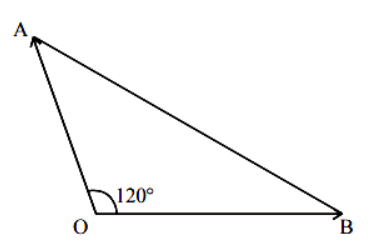
Let $OA = x \text{ km}$, $OB = y \text{ km}$, $AB = R$
$(AB)^2 = (OA)^2 + (OB)^2 - 2(OA)(OB) \cos 120^\circ$
$R^2 = x^2 + y^2 - 2xy(-1/2) \Rightarrow R^2 = x^2 + y^2 + xy$
R at $x = 8 \text{ km}$, and $y = 6 \text{ km} \implies R = \sqrt{6^2 + 8^2 + 6 \times 8} = 2\sqrt{37}$
Differentiating equation (i) with respect to $t$
$2R \frac{dR}{dt} = 2x \frac{dx}{dt} + 2y \frac{dy}{dt} + (x \frac{dy}{dt} + y \frac{dx}{dt})$
$= \frac{1}{2R} [2 \times 8 \times 20 + 2 \times 6 \times 30 + (8 \times 30 + 6 \times 20)]$
$\frac{dR}{dt} = \frac{1}{2 \times 2\sqrt{37}} = \frac{260}{\sqrt{37}}$
Step Solution:
1. Apply Law of Cosines: The distance $R$ between ships satisfies $R^2 = x^2 + y^2 - 2xy \cos(120^\circ) = x^2 + y^2 + xy$.
2. Find Current Distance: At $x=8$ and $y=6$, calculate $R = \sqrt{8^2 + 6^2 + (8 \times 6)} = \sqrt{64 + 36 + 48} = \sqrt{148} = 2\sqrt{37} \text{ km}$.
3. Differentiate Equation: Use implicit differentiation w.r.t time $t$: $2R\frac{dR}{dt} = 2x\frac{dx}{dt} + 2y\frac{dy}{dt} + x\frac{dy}{dt} + y\frac{dx}{dt}$.
4. Substitute Rates: Given $\frac{dx}{dt} = 20$ and $\frac{dy}{dt} = 30$, plug into the equation: $2(2\sqrt{37})\frac{dR}{dt} = 2(8)(20) + 2(6)(30) + (8)(30) + (6)(20)$.
5. Solve for $\frac{dR}{dt}$: $4\sqrt{37}\frac{dR}{dt} = 320 + 360 + 240 + 120 = 1040 \implies \frac{dR}{dt} = \frac{1040}{4\sqrt{37}} = \frac{260}{\sqrt{37}} \text{ km/hr}$.
Difficulty Level: Hard
Concept Name: Related Rates / Geometric Application of Derivatives
Short cut solution: There is no simple shortcut for this related rate problem; standard differentiation of the Law of Cosines is the most efficient method. Be careful to use the positive value of $\cos 120^\circ$ correctly in the expanded form $R^2 = x^2 + y^2 + xy$.
Question 200
Question: A spherical balloon is being inflated at the rate of 35 cc/min. The rate of increase in the surface area (in $\text{cm}^2/\text{min.}$) of the balloon when its diameter is 14 cm, is :
Options:
A. 10
B. $\sqrt{10}$
C. 100
D. $10\sqrt{10}$
Correct Answer: A
Year: JEE Main Online April 25, 2013
Solution (as Given in the Source):
Volume of sphere $V = \frac{4}{3}\pi r^3$
$\frac{dV}{dt} = \frac{4}{3} \cdot \pi \cdot 3r^2 \cdot \frac{dr}{dt}$
$35 = 4\pi r^2 \cdot \frac{dr}{dt}$ or $\frac{dr}{dt} = \frac{35}{4\pi r^2}$... (i)
Surface area of sphere $S = 4\pi r^2$
$\frac{dS}{dt} = 4\pi \times 2r \times \frac{dr}{dt} = 8\pi r \cdot \frac{dr}{dt}$
$\frac{dS}{dt} = \frac{70}{r}$ (By using (i))
Now, diameter $= 14 \text{ cm}, r = 7$
$\therefore \frac{dS}{dt} = 10$
Step Solution:
1. Define Rates: Let $r$ be the radius and $V$ be the volume. Given $\frac{dV}{dt} = 35 \text{ cc/min}$.
2. Find $dr/dt$: Differentiating $V = \frac{4}{3}\pi r^3$ gives $\frac{dV}{dt} = 4\pi r^2 \frac{dr}{dt}$, so $35 = 4\pi r^2 \frac{dr}{dt} \implies \frac{dr}{dt} = \frac{35}{4\pi r^2}$.
3. Relate to Surface Area: Let $S$ be the surface area $4\pi r^2$. Its rate is $\frac{dS}{dt} = 8\pi r \frac{dr}{dt}$.
4. Substitute $dr/dt$: $\frac{dS}{dt} = 8\pi r \left( \frac{35}{4\pi r^2} \right) = \frac{70}{r}$.
5. Final Calculation: At diameter 14 cm, $r = 7 \text{ cm}$. Thus, $\frac{dS}{dt} = \frac{70}{7} = 10 \text{ cm}^2/\text{min}$.
Difficulty Level: Easy
Concept Name: Rate of Change of Quantities
Short cut solution: Use the relation $\frac{dS}{dt} = \frac{dS}{dV} \cdot \frac{dV}{dt}$. Since $S = 4\pi r^2$ and $V = \frac{4}{3}\pi r^3$, then $\frac{dS}{dV} = \frac{dS/dr}{dV/dr} = \frac{8\pi r}{4\pi r^2} = \frac{2}{r}$. Rate $= \frac{2}{7} \times 35 = 10$.
Question 201
Question: If the surface area of a sphere of radius r is increasing uniformly at the rate $8 \text{ cm}^2/\text{s.}$, then the rate of change of its volume is :
Options:
A. constant
B. proportional to $\sqrt{r}$
C. proportional to $r^2$
D. proportional to $r$
Correct Answer: D
Year: JEE Main Online April 9, 2013
Solution (as Given in the Source):
$V = \frac{4}{3} \pi r^3 \Rightarrow \frac{dV}{dt} = 4 \pi r^2 \cdot \frac{dr}{dt}$ ... (i)
$S = 4 \pi r^2 \Rightarrow \frac{dS}{dt} = 8 \pi r \cdot \frac{dr}{dt}$
$\Rightarrow 8 = 8 \pi r \frac{dr}{dt} \Rightarrow \frac{dr}{dt} = \frac{1}{\pi r}$
Putting the value of $\frac{dr}{dt}$ in (i), we get
$\frac{dV}{dt} = 4 \pi r^2 \times \frac{1}{\pi r} = 4r \Rightarrow \frac{dV}{dt}$ is proportional to r.
Step Solution:
1. Given Rate: The rate of change of surface area $S = 4\pi r^2$ is $\frac{dS}{dt} = 8$.
2. Find $dr/dt$: Differentiate $S$ w.r.t. $t$: $\frac{dS}{dt} = 8\pi r \frac{dr}{dt}$. Substituting 8 gives $8 = 8\pi r \frac{dr}{dt} \implies \frac{dr}{dt} = \frac{1}{\pi r}$.
3. Find Volume Rate: Differentiate volume $V = \frac{4}{3}\pi r^3$ w.r.t. $t$: $\frac{dV}{dt} = 4\pi r^2 \frac{dr}{dt}$.
4. Substitute $dr/dt$: $\frac{dV}{dt} = 4\pi r^2 \left( \frac{1}{\pi r} \right) = 4r$.
5. Conclusion: Since $\frac{dV}{dt} = 4r$, the rate of change is proportional to $r$.
Difficulty Level: Easy
Concept Name: Rate of Change of Quantities
Short cut solution: The derivative of volume with respect to surface area is $\frac{dV}{dS} = \frac{r}{2}$. Therefore, $\frac{dV}{dt} = \frac{r}{2} \cdot \frac{dS}{dt} = \frac{r}{2} \cdot 8 = 4r$, showing direct proportionality to $r$.
Question 208
Question: A spherical balloon is filled with $4500\pi$ cubic meters of helium gas. If a leak in the balloon causes the gas to escape at the rate of $72\pi$ cubic meters per minute, then the rate (in meters per minute) at which the radius of the balloon decreases 49 minutes after the leakage began is:
Options:
A. 9/7
B. 7/9
C. 2/9
D. 9/2
Correct Answer: C
Year: JEE Main 2012
Solution (as Given in the Source):
Volume of spherical balloon $= V = \frac{4}{3} \pi r^3$
$\frac{dV}{dt} = 4 \pi r^2 \left( \frac{dr}{dt} \right)$
$\therefore$ After 49 min
Volume $= (4500 - 49 \times 72) \pi = (4500 - 3528) \pi = 972\pi \text{ m}^3$
$\dots 972\pi = \frac{4}{3} \pi r^3$
$\Rightarrow r^3 = 3 \times 243 = 3 \times 3^5 = 3^6 = (3^2)^3 \Rightarrow r = 9$
Given $\frac{dV}{dt} = 72\pi$. Putting $\frac{dV}{dt} = 72\pi$ and $r = 9$, we get
$\therefore 72\pi = 4\pi \times 9 \times 9 \left( \frac{dr}{dt} \right) \Rightarrow \frac{dr}{dt} = \left( \frac{2}{9} \right)$
Step Solution:
1. Calculate Current Volume: After 49 minutes of leaking at $72\pi \text{ m}^3/\text{min}$, the volume is $V = 4500\pi - (49 \times 72\pi) = 972\pi \text{ m}^3$.
2. Calculate Current Radius: Solve $\frac{4}{3}\pi r^3 = 972\pi \implies r^3 = 729$, so $r = 9 \text{ m}$.
3. Relate Volume and Radius Rates: Differentiate $V = \frac{4}{3}\pi r^3$ to get $\frac{dV}{dt} = 4\pi r^2 \frac{dr}{dt}$.
4. Substitute Values: Plug in the leak rate $\frac{dV}{dt} = 72\pi$ and $r = 9$: $72\pi = 4\pi(9^2) \frac{dr}{dt}$.
5. Final Calculation: $72 = 4 \times 81 \frac{dr}{dt} \implies 72 = 324 \frac{dr}{dt} \implies \frac{dr}{dt} = \frac{72}{324} = \frac{2}{9} \text{ m/min}$.
Difficulty Level: Medium
Concept Name: Rate of Change of Quantities
Short cut solution: Calculate the radius at the required time using $r = \sqrt{\frac{3V}{4\pi}}$. At $t = 49, r = 9$. The rate of radius decrease is $\frac{\text{Volume Rate}}{\text{Surface Area}} = \frac{72\pi}{4\pi(9^2)} = \frac{72}{324} = \frac{2}{9}$.
Question 209
Question: If a metallic circular plate of radius 50cm is heated so that its radius increases at the rate of 1mm per hour, then the rate at which, the area of the plate increases (in $\text{cm}^2$ / hour) is
Options:
A. $5\pi$
B. $10\pi$
C. $100\pi$
D. $50\pi$
Correct Answer: B
Year: JEE Main Online May 26, 2012
Solution (as Given in the Source):
Let $\mathbf{A} = \pi \mathbf{r}^2$ be area of metalic circular plate of $\mathbf{r} = 50 \text{ cm}$. Also, given $\frac{d\mathbf{r}}{dt} = 1 \text{ mm} = \frac{1}{10} \text{ cm}$.
$\therefore A = \pi r^2 \Rightarrow \frac{d\mathbf{A}}{dt} = 2\pi \mathbf{r} \frac{d\mathbf{r}}{dt} = 2\pi \cdot 50 \cdot \frac{1}{10} = 10\pi$.
Hence, area of plate increases in $10\pi \text{ cm}^2/\text{hour}$.
Step Solution:
1. Identify Given Values: Radius $r = 50 \text{ cm}$ and rate of radius increase $\frac{dr}{dt} = 1 \text{ mm/hr} = 0.1 \text{ cm/hr}$.
2. Define Area Formula: The area of the circular plate is $A = \pi r^2$.
3. Differentiate with respect to Time: Applying the chain rule, $\frac{dA}{dt} = 2\pi r \frac{dr}{dt}$.
4. Substitute Values: Plug in $r = 50$ and $\frac{dr}{dt} = 0.1$: $\frac{dA}{dt} = 2\pi(50)(0.1)$.
5. Final Calculation: $\frac{dA}{dt} = 100\pi(0.1) = 10\pi \text{ cm}^2/\text{hr}$.
Difficulty Level: Easy
Concept Name: Rate of Change of Quantities
Short cut solution: The rate of change of area is always Circumference $\times$ Rate of radius change. Here, $(2\pi \times 50) \times 0.1 = 10\pi$.
Question 210
Question: The weight W of a certain stock of fish is given by $\mathbf{W} = \mathbf{nw}$, where n is the size of stock and w is the average weight of a fish. If n and w change with time t as $\mathbf{n} = 2\mathbf{t}^2 + 3$ and $\mathbf{w} = \mathbf{t}^2 - \mathbf{t} + 2$, then the rate of change of W with respect to t at $\mathbf{t} = 1$ is
Options:
A. 1
B. 8
C. 13
D. 5
Correct Answer: C
Year: JEE Main Online May 19, 2012
Solution (as Given in the Source):
Let $W = nw \Rightarrow \frac{dW}{dt} = n \frac{dw}{dt} + w \cdot \frac{dn}{dt}$.
Given: $w = t^2 - t + 2$ and $n = 2t^2 + 3$. $\frac{dw}{dt} = 2t - 1$ and $\frac{dn}{dt} = 4t$.
$\therefore \frac{dW}{dt} = (2t^2 + 3)(2t - 1) + (t^2 - t + 2)(4t)$.
Thus, $\left. \frac{dW}{dt} \right|_{t=1} = (2 + 3)(2 - 1) + (1 - 1 + 2)(4) = 5(1) + 8 = 13$.
Step Solution:
1. State the Product Rule: Since $W = n \cdot w$, the rate of change is $\frac{dW}{dt} = n\frac{dw}{dt} + w\frac{dn}{dt}$.
2. Calculate n and w at $t=1$: $n(1) = 2(1)^2 + 3 = 5$; $w(1) = (1)^2 - (1) + 2 = 2$.
3. Find the Derivatives: $\frac{dn}{dt} = \frac{d}{dt}(2t^2+3) = 4t$; $\frac{dw}{dt} = \frac{d}{dt}(t^2-t+2) = 2t-1$.
4. Evaluate Derivatives at $t=1$: $\frac{dn}{dt} = 4(1) = 4$; $\frac{dw}{dt} = 2(1)-1 = 1$.
5. Calculate Final Rate: $\frac{dW}{dt} = (5)(1) + (2)(4) = 5 + 8 = 13$.
Difficulty Level: Easy
Concept Name: Product Rule / Rate of Change
Short cut solution: Evaluate the individual functions and their derivatives at the point $t=1$ first, then plug them into the product rule formula $n w' + w n'$. This avoids expanding the full polynomial.
Question 211
Question: Consider a rectangle whose length is increasing at the uniform rate of 2 m/sec, breadth is decreasing at the uniform rate of $3 \text{ m/sec}$ and the area is decreasing at the uniform rate of $5 \text{ m}^2/\text{sec}$. If after some time the breadth of the rectangle is $2 \text{ m}$ then the length of the rectangle is
Options:
A. 2 m
B. 4 m
C. 1 m
D. 3 m
Correct Answer: D
Year: JEE Main Online May 12, 2012
Solution (as Given in the Source):
Let A be the area, b be the breadth and $l$ be the length of the rectangle.
Given: $\frac{dA}{dt} = -5, \frac{dl}{dt} = 2, \frac{db}{dt} = -3$.
We know, $A = l \times b \Rightarrow \frac{dA}{dt} = l \cdot \frac{db}{dt} + b \cdot \frac{dl}{dt} = -3l + 2b$.
$\Rightarrow -5 = -3l + 2b$.
When $b = 2$, we have $-5 = -3l + 4 \Rightarrow 3l = 9 \Rightarrow l = \frac{9}{3} = 3 \text{ m}$.
Step Solution:
1. Define Area Relation: For a rectangle, Area $A = l \cdot b$.
2. Apply Derivative: Differentiating with respect to time $t$ gives $\frac{dA}{dt} = l\frac{db}{dt} + b\frac{dl}{dt}$.
3. Plug in Given Rates: Substitute $\frac{dA}{dt} = -5$, $\frac{dl}{dt} = 2$, and $\frac{db}{dt} = -3$: $-5 = l(-3) + b(2)$.
4. Substitute Instantaneous Breadth: Given $b = 2$ at the instant, the equation becomes $-5 = -3l + 2(2)$.
5. Solve for Length: $-5 = -3l + 4 \implies 3l = 9 \implies l = 3 \text{ meters}$.
Difficulty Level: Easy/Medium
Concept Name: Related Rates
Short cut solution: Use the rate balance equation: $\text{Rate of Area} = (l \times \text{Rate of Breadth}) + (b \times \text{Rate of Length})$. Plugging in values: $-5 = l(-3) + 2(2)$, leads directly to $l=3$.
Question 212
Question: An angle of intersection of the curves, $\frac{\mathrm{x}^2}{\mathrm{a}^2} + \frac{\mathrm{y}^2}{\mathrm{b}^2} = 1$ and $\mathbf{x}^2 + \mathbf{y}^2 = \mathbf{ab}$, $\mathbf{a} > \mathbf{b}$, is
Options:
A. $\tan^{-1} \left( \frac{\mathfrak{a} + \mathfrak{b}}{\sqrt{\mathfrak{ab}}} \right)$
B. $\tan^{-1} \left( \frac{a - b}{2\sqrt{ab}} \right)$
C. $\tan^{-1} \left( \frac{a - b}{\sqrt{ab}} \right)$
D. $\tan^{-1} (2\sqrt{ab})$
Correct Answer: C
Year: JEE Main 31 Aug 2021 Shift 2
Solution (as Given in the Source):
From Eqs. (ii) $\mathbf{y}^2 = \mathbf{ab} - \mathbf{x}^2$.
From Eq. (i), $\mathrm{b}^2 \mathrm{x}^2 + \mathrm{a}^2(\mathrm{ab} - \mathrm{x}^2) = \mathrm{a}^2 \mathrm{b}^2 \implies \mathrm{x}^2 = \frac{\mathrm{a}^2 \mathrm{b}}{\mathrm{a} + \mathrm{b}}$ and $\mathrm{y}^2 = \frac{\mathrm{a} \mathrm{b}^2}{\mathrm{a} + \mathrm{b}}$.
Point of intersection $\left( \sqrt{\frac{\mathrm{a}^2 \mathrm{b}}{\mathrm{a} + \mathrm{b}}} , \sqrt{\frac{\mathrm{a} \mathrm{b}^2}{\mathrm{a} + \mathrm{b}}} \right)$.
Differentiating Eq. (i) w.r.t. $\mathsf{x}$, $\frac{\mathrm{d} \mathbf{y}}{\mathrm{d} \mathbf{x}} = -\frac{\mathbf{b}^2 \mathbf{x}}{\mathbf{a}^2 \mathbf{y}} = \mathbf{m}_1$.
$\tan \theta = | \frac{m_1 - m_2}{1 + m_1 m_2} | = | \frac{a - b}{\sqrt{ab}} | \Rightarrow \Theta = \tan^{-1} ( \frac{a - b}{\sqrt{ab}} )$.
Step Solution:
1. Find Intersection Points: Substitute $y^2 = ab - x^2$ from the circle into the ellipse equation to get $\frac{x^2}{a^2} + \frac{ab - x^2}{b^2} = 1$; solving for $x^2$ gives $x^2 = \frac{a^2b}{a+b}$ and $y^2 = \frac{ab^2}{a+b}$.
2. Calculate Slopes: Differentiate both curves; the ellipse slope is $m_1 = -\frac{b^2x}{a^2y}$ and the circle slope is $m_2 = -\frac{x}{y}$.
3. Evaluate $x/y$: From the intersection point, $\frac{x}{y} = \sqrt{\frac{a^2b}{ab^2}} = \sqrt{\frac{a}{b}}$.
4. Apply Angle Formula: Use $\tan \theta = \left| \frac{m_1 - m_2}{1 + m_1m_2} \right| = \left| \frac{-(b^2/a^2)(x/y) + (x/y)}{1 + (b^2/a^2)(x/y)^2} \right|$.
5. Simplify Expression: $\tan \theta = \left| \frac{\sqrt{a/b}(1 - b^2/a^2)}{1 + (b^2/a^2)(a/b)} \right| = \left| \frac{\sqrt{a/b}(\frac{a^2-b^2}{a^2})}{\frac{a+b}{a}} \right| = \frac{a-b}{\sqrt{ab}}$.
Difficulty Level: Hard
Concept Name: Angle of Intersection of Curves
Short cut solution: At the point of intersection, notice that $\frac{m_1}{m_2} = \frac{b^2}{a^2}$. Using the formula $\tan \theta = \left| \frac{m_2(m_1/m_2 - 1)}{1 + m_2^2(m_1/m_2)} \right|$ and substituting $m_2 = -\sqrt{a/b}$ and $\frac{m_1}{m_2} = \frac{b^2}{a^2}$ leads directly to the result $\frac{a-b}{\sqrt{ab}}$ after basic algebraic simplification.
Question 232
Question: A spherical iron ball 10cm in radius is coated with a layer of ice of uniform thickness that melts at a rate of $\mathbf{50 cm}^3 / \mathbf{m}\mathbf{in}$. When the thickness of ice is 5cm,then the rate at which the thickness of ice decreases is
Options:
A. $\frac{1}{36\pi} \mathrm{cm/min}$
B. $\frac{1}{18\pi} \mathrm{cm/min}$
C. $\frac{1}{54\pi} \mathrm{cm/min}$
D. $\frac{5}{6\pi} \mathrm{cm/min}$
Correct Answer: B
Year: 2005
Solution (as Given in the Source):
Given that Total radius $\mathbf{r} = 10 + 5 = 15 \mathrm{cm}$.
$\frac{\mathrm{d} \mathrm{v}}{\mathrm{d} \mathrm{t}} = 50 \mathrm{cm}^3 / \mathrm{min} \Rightarrow \frac{\mathrm{d}}{\mathrm{d} \mathrm{t}}\left(\frac{4}{3} \pi \mathrm{r}^3\right) = 50$.
$\Rightarrow 4 \pi \mathrm{r}^2 \frac{\mathrm{d} \mathrm{r}}{\mathrm{d} \mathrm{t}} = 50$.
$\Rightarrow \frac{\mathrm{d} \mathrm{r}}{\mathrm{d} \mathrm{t}} = \frac{50}{4 \pi\left(15\right)^2} = \frac{1}{18 \pi} \mathrm{cm} / \mathrm{min}$.
Step Solution:
1. Determine Current Radius: The total radius $r$ is the sum of the iron ball radius and the ice thickness: $r = 10 + 5 = 15 \text{ cm}$.
2. State Volume Formula: The volume of the entire sphere (ball + ice) is $V = \frac{4}{3}\pi r^3$.
3. Differentiate Volume: Differentiating with respect to time $t$ gives $\frac{dV}{dt} = 4 \pi r^2 \frac{dr}{dt}$.
4. Substitute Values: Plug in the given melting rate $\frac{dV}{dt} = 50$ and the radius $r = 15$: $50 = 4\pi(15)^2 \frac{dr}{dt}$
5. Calculate Final Rate: $\frac{dr}{dt} = \frac{50}{900\pi} = \frac{1}{18\pi} \text{ cm/min}$.
Difficulty Level: Easy/Medium
Concept Name: Rate of Change of Quantities
Short cut solution: The rate of change of thickness is $\frac{\text{Rate of Volume Change}}{\text{Surface Area}}$. At the instant the thickness is 5cm, $r=15$, so Surface Area $= 4\pi(15)^2 = 900\pi$. Rate $= 50 / 900\pi = 1/18\pi$.
Question 235
Question: A point on the parabola $\mathbf{y}^2 = \mathbf{18x}$ at which the ordinate increases at twice the rate of the abscissa is
Options:
A. $\left( \frac{9}{8}, \frac{9}{2} \right)$
B. (2,-4)
C. $\left( \frac{-9}{8}, \frac{9}{2} \right)$
D. (2,4)
Correct Answer: A
Year: 2004
Solution (as Given in the Source):
Given y 2 = 18x $\Rightarrow$ 2y dy = 18 $\Rightarrow$ dy = 9.
ATQ $\frac{\mathrm{d} \mathrm{y}}{\mathrm{d} \mathrm{t}} = \frac{2 \mathrm{~d} \mathrm{x}}{\mathrm{d} \mathrm{t}} \Rightarrow \frac{\mathrm{d} \mathrm{y}}{\mathrm{d} \mathrm{x}} = 2$.
$\Rightarrow \frac{9}{\mathrm{y}} = 2 \Rightarrow \mathrm{y} = \frac{9}{2}$.
Putting in $y^2 = 18\mathrm{x} \Rightarrow \mathrm{x} = \frac{9}{8}$.
Step Solution:
1. Differentiate the Curve: Differentiate $y^2 = 18x$ implicitly with respect to time $t$: $2y \frac{dy}{dt} = 18 \frac{dx}{dt}$.
2. Relate Rates: The problem states the rate of change of the ordinate ($y$) is twice the rate of the abscissa ($x$), so $\frac{dy}{dt} = 2\frac{dx}{dt}$.
3. Substitute the Rate Relation: Replace $\frac{dy}{dt}$ in the differentiated equation: $2y(2\frac{dx}{dt}) = 18\frac{dx}{dt}$.
4. Solve for y-coordinate: Divide by $2\frac{dx}{dt}$ to get $2y = 9$, which means $y = 9/2$.
5. Find x-coordinate: Substitute $y = 9/2$ into the original parabola equation: $(9/2)^2 = 18x \implies 81/4 = 18x \implies x = 81/72 = 9/8$. The point is $(9/8, 9/2)$.
Difficulty Level: Easy
Concept Name: Related Rates / Application of Derivatives
Short cut solution: Use the derivative $\frac{dy}{dx} = \frac{dy/dt}{dx/dt}$. From the problem, $\frac{dy}{dx} = 2$. For $y^2 = 18x$, differentiating gives $2y \frac{dy}{dx} = 18$, so $2y(2) = 18 \implies y = 18/4 = 9/2$. Then $x = y^2/18 = (81/4)/18 = 9/8$.