Question 30
Question: If the line $3x - 2y + 12 = 0$ intersects the parabola $4y = 3x^2$ at the points $A$ and $B$, then at the vertex of the parabola, the line segment AB subtends an angle equal to.
Options:
A. $\frac{\pi}{2} - \tan^{-1} \left( \frac{3}{2} \right)$
B. $\tan^{-1} \left( \frac{9}{7} \right)$
C. $\tan^{-1} \left( \frac{11}{9} \right)$
D. $\tan^{-1} \left( \frac{4}{5} \right)$.
Correct Answer: B.
Year: JEE Main 2025 (Online) 23rd January Morning Shift.
Solution (as Given in the Source):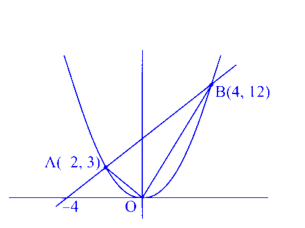
$3x - 2y + 12 = 0$
$4y = 3x^2$
$2(3x + 12) = 3x^2$
$\Rightarrow x^2 - 2x - 8 = 0$
$\Rightarrow x = -2, 4$
$\mathbf{m}_{0A} = -3/2, \mathbf{m}_{0B} = 3$
$\tan \theta = \left( \frac{-3/2 - 3}{1 - 9/2} \right) = 9/7$
$\theta = \tan^{-1} (9/7)$ (angle will be acute).
Step Solution:
1. Find intersection points: Substitute $2y = 3x + 12$ from the line into the parabola $4y = 3x^2$ to get $2(3x + 12) = 3x^2$, which simplifies to $x^2 - 2x - 8 = 0$.
2. Solve for x-coordinates: Solving $x^2 - 2x - 8 = 0$ gives $x = -2$ and $x = 4$.
3. Find y-coordinates: For $x = -2, y = \frac{3(-2)^2}{4} = 3$, so point $A$ is $(-2, 3)$. For $x = 4, y = \frac{3(4)^2}{4} = 12$, so point $B$ is $(4, 12)$.
4. Calculate slopes from vertex (0,0): The slope of $OA$ is $m_1 = \frac{3-0}{-2-0} = -1.5$ and the slope of $OB$ is $m_2 = \frac{12-0}{4-0} = 3$.
5. Determine the angle: Using the formula $\tan \theta = \left| \frac{m_1 - m_2}{1 + m_1 m_2} \right|$, we get $\tan \theta = \left| \frac{-1.5 - 3}{1 + (-1.5)(3)} \right| = \left| \frac{-4.5}{-3.5} \right| = \frac{9}{7}$, so $\theta = \tan^{-1}(9/7)$.
The difficulty level: Medium
The Concept Name: Angle subtended by a chord at the vertex of a parabola.
Short cut solution: (Information not directly in source) Homogenize the parabola $3x^2 - 4y = 0$ using the line $\frac{3x - 2y}{-12} = 1$. The resulting pair of lines is $3x^2 - 4y \left( \frac{3x - 2y}{-12} \right) = 0 \Rightarrow 9x^2 + 3xy - 2y^2 = 0$. The angle $\theta$ between these lines satisfies $\tan \theta = \frac{2\sqrt{h^2 - ab}}{a+b} = \frac{2\sqrt{(3/2)^2 - 9(-2)}}{9-2} = \frac{9}{7}$.
Question 39
Question: A line passing through the point $A(-2, 0)$, touches the parabola $P : y^2 = x - 2$ at the point $B$ in the first quadrant. The area, of the region bounded by the line $AB$, parabola $P$ and the $x$-axis, is :
Options:
A. 3
B. 7/3
C. 8/3
D. 2
Correct Answer: C
Year: JEE Main 2025 (Online) 4th April Evening Shift
Solution:
$$\begin{array} { l l l } { { } } & { { y ^ { 2 } = 4 \left( \displaystyle \frac { 1 } { 4 } \right) \left( x - 2 \right) } } \\ { { } } & { { y = m ( x - 2 ) + \displaystyle \frac { 1 } { 4 m } \mathrm { p a s s e s ~ t h r o u g h ~ ( - 2 , 0 ) } } } \\ { { } } & { { \Rightarrow 0 = - 4 m + \displaystyle \frac { 1 } { 4 m } \Rightarrow 1 6 m ^ { 2 } = 1 } } \\ { { } } & { { \Rightarrow m = \pm \displaystyle \frac { 1 } { 4 } } } \end{array}$$
$$\begin{array} { l } { \displaystyle \Rightarrow \mathrm { A r e a } = { \frac { 1 } { 2 } } \times ( 1 ) \times 4 + \int _ { 2 } ^ { 6 } \left[ \left( { \frac { x + 2 } { 4 } } \right) - { \sqrt { x - 2 } } \right] d x } \\ { \displaystyle = 2 + { \frac { 2 } { 3 } } = { \frac { 8 } { 3 } } } \end{array}$$
Step Solution:
1. The parabola $y^2 = x-2$ has $a = \frac{1}{4}$. The tangent equation is $y = m(x-2) + \frac{1}{4m}$. It passes through $(-2, 0)$, so $0 = m(-2-2) + \frac{1}{4m} \Rightarrow 16m^2 = 1 \Rightarrow m = \frac{1}{4}$ (for first quadrant point $B$).
2. Find point $B$ coordinates: $x-2 = \frac{a}{m^2} = \frac{1/4}{1/16} = 4 \Rightarrow x=6$ and $y = \frac{2a}{m} = \frac{2(1/4)}{1/4} = 2$. So $B(6, 2)$.
3. The region is bounded by the $x$-axis ($y=0$), the line $AB$ ($x = 4y-2$), and the parabola ($x = y^2+2$).
4. Integrate with respect to $y$ from $0$ to $2$ to find the area: $\text{Area} = \int_{0}^{2} (x_{line} - x_{parabola}) dy$ - no, for this specific bounded region, it is $\int_{0}^{2} (y^2+2 - (4y-2)) dy$ if measuring the area between the curves from the $y$-axis side.
5. Using the area of triangle minus area under parabola: $\text{Area} = \text{Area}(\triangle A B(6,0)) - \int_{2}^{6} \sqrt{x-2} dx = \frac{1}{2}(8)(2) - [\frac{2}{3}(x-2)^{3/2}]_2^6 = 8 - \frac{16}{3} = \frac{8}{3}$.
The difficulty level: Medium
The Concept Name: Area under a curve (Definite Integration).
Short cut solution: Integrate $x$ with respect to $y$: $\text{Area} = \int_{0}^{2} ((y^2+2) - (4y-2)) dy = \int_{0}^{2} (y^2 - 4y + 4) dy = [\frac{(y-2)^3}{3}]_0^2 = 0 - (-\frac{8}{3}) = \frac{8}{3}$.
Question 92
Question: Let a tangent to the curve $y^2 = 24x$ meet the curve $xy = 2$ at the points $A$ and $B$. Then the mid points of such line segments $AB$ lie on a parabola with the
Options:
A. directrix $4x = 3$
B. directrix $4x = -3$
C. Length of latus rectum -
D. Length of latus rectum 2
Correct Answer: A
Year: JEE Main 2023 (Online) 24th January Shift 1
Solution:
$\mathbf { y } ^ { 2 } = 2 4 \mathbf { x }, \mathtt { a } = 6, \mathbf { x y } = 2$
$\mathbf { A B } \equiv \mathbf { t y } = \mathbf { x } + 6 \mathbf { t } ^ { 2 } \ldots ( 1 )$
$\mathbf { A B } \equiv \mathbf { T } = \mathbf { S } _ { 1 } \Rightarrow \mathbf { k x } + \mathbf { h y } = 2 \mathbf { h k } \ldots ( 2 )$
From (1) and (2) $\Rightarrow$ then locus is $\mathbf { y } ^ { 2 } = - 3 \mathbf { x }$
Therefore directrix is $4 \mathrm { X } = 3$
Step Solution:
1. A general tangent to the parabola $y^2 = 24x$ ($a=6$) is $y = mx + \frac{6}{m}$, which can be written as $mx - y + \frac{6}{m} = 0$.
2. Let $(h, k)$ be the midpoint of the chord $AB$ on the hyperbola $xy = 2$. The equation of this chord is given by $T = S_1 \Rightarrow \frac{xk + yh}{2} = hk \Rightarrow kx + hy = 2hk$.
3. Since both equations represent the same line $AB$, compare their coefficients: $\frac{k}{m} = \frac{h}{-1} = \frac{2hk}{6/m} \Rightarrow \frac{k}{m} = -h$ and $-h = \frac{mhk}{3}$.
4. From $\frac{k}{m} = -h$, we get $m = -\frac{k}{h}$. Substitute this into the second relation: $-h = \frac{(-k/h)hk}{3} \Rightarrow -h = -\frac{k^2}{3} \Rightarrow k^2 = 3h$ - wait, the source says $y^2 = -3x$. Let's re-verify. $\frac{1}{k} = \frac{-t}{h} = \frac{-6t^2}{2hk} \Rightarrow t = -h/k$, then $1/k = \frac{-6(h^2/k^2)}{2hk} \Rightarrow 1 = -3h/k^2 \Rightarrow k^2 = -3h$.
5. The locus of $(h, k)$ is $y^2 = -3x$. For this parabola, $4A = -3 \Rightarrow A = -3/4$. The directrix is $x = -A = 3/4$, which is $4x = 3$.
The difficulty level: Hard
The Concept Name: Locus of midpoints of chords.
Short cut solution: Use the tangency condition $c = a/m$ for the chord $kx+hy=2hk$ with respect to $y^2=24x$. Line: $y = (-\frac{k}{h})x + 2k$. $c = 2k, m = -\frac{k}{h}, a = 6$. $2k = \frac{6}{-k/h} = -\frac{6h}{k} \Rightarrow 2k^2 = -6h \Rightarrow k^2 = -3h$. Directrix of $y^2 = -3x$ is $x = \frac{3}{4} \Rightarrow 4x = 3$.
Question 116
Question: The equations of the sides $AB$ and $AC$ of a triangle $ABC$ are $(\lambda + 1)x + \lambda y = 4$ and $\lambda x + (1 - \lambda)y + \lambda = 0$ respectively. Its vertex $A$ is on the $y$-axis and its orthocentre is $(1, 2)$. The length of the tangent from the point $C$ to the part of the parabola $y^2 = 6x$ in the first quadrant is
Options:
A. $\sqrt{6}$
B. $2\sqrt{2}$
C. 2
D. 4
Correct Answer: B
Year: JEE Main 2023 (Online) 24th January Shift 2
Solution: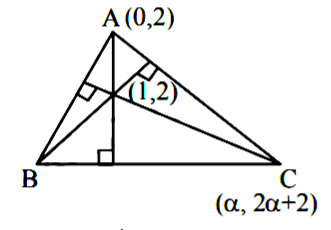
$AB: (\lambda + 1)x + \lambda y = 4$
$AC: \lambda x + (1 - \lambda)y + \lambda = 0$
Vertex $A$ is on $y$-axis $\Rightarrow x = 0$
$y = \frac{4}{\lambda}, y = \frac{\lambda}{\lambda - 1} \Rightarrow \frac{4}{\lambda} = \frac{\lambda}{\lambda - 1} \Rightarrow \lambda = 2$
$AB: 3x + 2y = 4$
$AC: 2x - y + 2 = 0 \Rightarrow A(0, 2)$ Let $C(a, 2a + 2)$
Now (Slope of Altitude through $C$) $\cdot$ (Slope of $AB$) $= -1$
$(\frac{2a}{a-1})(-\frac{3}{2}) = -1 \Rightarrow a = -\frac{1}{2}$
$C(-1/2, 1)$
Let Equation of tangent be $y = mx + \frac{3}{2m}$
$m^2 + 2m - 3 = 0 \Rightarrow m = 1, -3$
Tangent in first quadrant at $T \equiv (\frac{a}{m^2}, \frac{2a}{m}) \equiv (\frac{3}{2}, 3)$
$CT = \sqrt{4 + 4} = 2\sqrt{2}$ 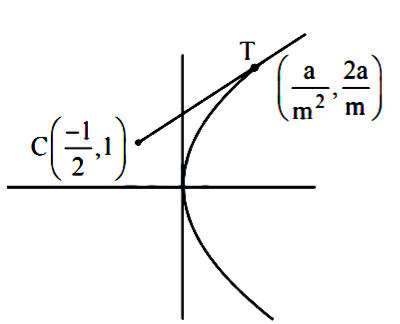
Step Solution:
1. Find $\lambda$: Vertex $A$ lies on the $y$-axis ($x=0$). Substituting $x=0$ in the side equations gives $y = 4/\lambda$ and $y = \lambda/(\lambda - 1)$. Equating these results in $\lambda^2 - 4\lambda + 4 = 0$, so $\lambda = 2$.
2. Determine coordinates of $A$ and $C$: With $\lambda = 2$, the lines are $AB: 3x + 2y = 4$ and $AC: 2x - y + 2 = 0$. Vertex $A$ is $(0, 2)$. Let $C$ be $(x_c, y_c)$. Since $C$ lies on $AC$, $y_c = 2x_c + 2$.
3. Use Orthocenter $H(1, 2)$: The altitude from $C$ is perpendicular to $AB$ (slope $-3/2$), so the altitude's slope is $2/3$. The equation is $y - 2 = (2/3)(x - 1)$. Intersecting this with $AC$ gives $2x + 2 - 2 = (2/3)(x - 1) \Rightarrow 2x = (2/3)x - 2/3$, yielding $C(-1/2, 1)$.
4. Find point of tangency $T$: For $y^2 = 6x$, $a = 3/2$. The tangent $y = mx + \frac{3}{2m}$ passes through $C(-1/2, 1)$, leading to $1 = -m/2 + 3/(2m) \Rightarrow m^2 + 2m - 3 = 0$. Solving gives $m=1$ (first quadrant). Point $T = (a/m^2, 2a/m) = (3/2, 3)$.
5. Calculate length: The distance $CT = \sqrt{(3/2 - (-1/2))^2 + (3 - 1)^2} = \sqrt{2^2 + 2^2} = \sqrt{8} = 2\sqrt{2}$.
The difficulty level: Hard
The Concept Name: Orthocenter properties and Point of Tangency for Parabola.
Short cut solution: Once $C(-1/2, 1)$ is found, the length of the tangent to $y^2 - 6x = 0$ is $\sqrt{S_1} = \sqrt{1^2 - 6(-1/2)} = \sqrt{1+3} = 2$. However, the question asks for the distance to a specific point of contact $T$ on the parabola, which requires finding $T$ as shown in the steps.
Question 125
Question: Let $S$ be the set of all $a \in N$ such that the area of the triangle formed by the tangent at the point $P(b, c), b, c \in N$, on the parabola $y^2 = 2ax$ and the lines $x = b$, $y = 0$ is $16$ unit$^2$, then $\sum_{a \in S} a$ is equal to
Options:
The source does not provide multiple-choice options for this Question. The numerical answer is 146.
Correct Answer: 146
Year: JEE Main 2023 (Online)
Solution: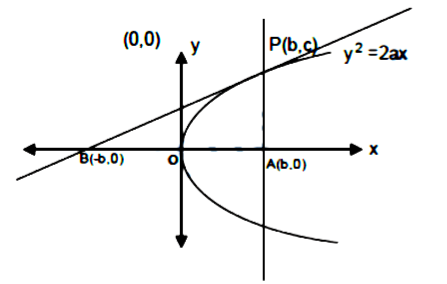
As $P(b, c)$ lies on parabola so $c^2 = 2ab$ . . . (1)
Now equation of tangent to parabola $y^2 = 2ax$ in point form is $yy_1 = 2a\frac{(x + x_1)}{2}, (x_1, y_1) = (b, c)$
$\Rightarrow yc = a(x + b)$
For point $B$, put $y = 0$, now $x = -b$. So, area of $\Delta PBA, \frac{1}{2} \times AB \times AP = 16$
$\Rightarrow \frac{1}{2} \times 2b \times c = 16 \Rightarrow bc = 16$
As $b$ and $c$ are natural numbers so possible values of $(b, c)$ are $(1, 16), (2, 8), (4, 4), (8, 2)$ and $(16, 1)$.
Now from equation (1) $a = \frac{c^2}{2b}$ and $a \in N$, so values of $(b, c)$ are $(1, 16), (2, 8)$ and $(4, 4)$.
Now values of $a$ are $128, 16$ and $2$. Hence sum of values of $a$ is $146$.
Step Solution:
1. Establish point and tangent: Point $P(b, c)$ lies on $y^2 = 2ax$, so $c^2 = 2ab$. The tangent at $P$ is $yc = a(x+b)$.
2. Define the triangle: The triangle is formed by the tangent, the vertical line $x=b$, and the $x$-axis ($y=0$). The $x$-axis intercept of the tangent is $B(-b, 0)$. The third vertex is the projection of $P$ on the $x$-axis, $A(b, 0)$.
3. Calculate Area: The base $AB = b - (-b) = 2b$. The height is the ordinate of $P$, which is $c$. Area $= \frac{1}{2} \times 2b \times c = bc = 16$.
4. Identify integer pairs: Given $b, c \in N$, possible $(b, c)$ pairs are $(1, 16), (2, 8), (4, 4), (8, 2), (16, 1)$.
5. Solve for $a$: From $c^2 = 2ab$, we have $a = \frac{c^2}{2b}$. For $a \in N$:
$(1, 16) \Rightarrow a = 256/2 = 128$.
$(2, 8) \Rightarrow a = 64/4 = 16$.
$(4, 4) \Rightarrow a = 16/8 = 2$.
$(8, 2) \Rightarrow a = 4/16$ (not $N$).
Sum of $a = 128 + 16 + 2 = 146$.
The difficulty level: Medium
The Concept Name: Area of triangle formed by tangents to a parabola.
Short cut solution: Recognizing the area of the triangle formed by the tangent, the ordinate, and the $x$-axis is always $bc$ (where $b$ is the abscissa and $c$ is the ordinate) simplifies the Question immediately to $bc = 16$.
Question 126
Question: The area enclosed by the closed curve $C$ given by the differential equation $\frac{dy}{dx} + \frac{x+a}{y-2} = 0, y(1) = 0$ is $4\pi$. Let $P$ and $Q$ be the points of intersection of the curve $C$ and the $y$-axis. If normals at $P$ and $Q$ on the curve $C$ intersect $X$-axis at points $R$ and $S$ respectively, then the length of the line segment $RS$ is
Options:
A. $2\sqrt{3}$
B. $\frac{2\sqrt{3}}{3}$
C. 2
D. $\frac{4\sqrt{3}}{3}$
Correct Answer: D
Year: JEE Main 2023 (Online) 1st February Shift 1
Solution:
$\frac{dy}{dx} = \frac{x+a}{2-y} \Rightarrow (2-y)dy = (x+a)dx$
Integrating: $2y - \frac{y^2}{2} = \frac{x^2}{2} + ax + c$
$y(1) = 0 \Rightarrow a + c = -1/2$
$x^2 + y^2 + 2ax - 4y - 1 - 2a = 0$
$\pi r^2 = 4\pi \Rightarrow r^2 = 4$
$r^2 = a^2 + 4 + 1 + 2a \Rightarrow 4 = (a+1)^2 + 4 \Rightarrow a = -1$
Curve: $(x-1)^2 + (y-2)^2 = 4$. Intersects $y$-axis at $x=0 \Rightarrow y = 2 \pm \sqrt{3}$
$P, Q = (0, 2 \pm \sqrt{3})$. Normals pass through center $(1, 2)$.
$R = (1 - 2/\sqrt{3}, 0), S = (1 + 2/\sqrt{3}, 0)$
$RS = 4/\sqrt{3} = 4\frac{\sqrt{3}}{3}$
Step Solution:
1. Solve the Differential Equation: Rearrange to $(y - 2) dy = -(x + a) dx$. Integrating both sides gives $(x + a)^2 + (y - 2)^2 = r^2$, which is a circle.
2. Find $a$ and $r$: Area $\pi r^2 = 4\pi \Rightarrow r^2 = 4$. Using $y(1) = 0$ in the circle equation: $(1 + a)^2 + (0 - 2)^2 = 4 \Rightarrow (1 + a)^2 + 4 = 4 \Rightarrow a = -1$. The circle is $(x - 1)^2 + (y - 2)^2 = 4$.
3. Find intersection points $P$ and $Q$: Intersecting with the $y$-axis ($x = 0$) gives $(0 - 1)^2 + (y - 2)^2 = 4 \Rightarrow (y - 2)^2 = 3$, so $y = 2 \pm \sqrt{3}$. Points are $P(0, 2+\sqrt{3})$ and $Q(0, 2-\sqrt{3})$.
4. Identify Normal lines: For a circle, normals pass through the center $(1, 2)$. Slope of $CP = \frac{(2+\sqrt{3})-2}{0-1} = -\sqrt{3}$. Slope of $CQ = \frac{(2-\sqrt{3})-2}{0-1} = \sqrt{3}$.
5. Find $R$ and $S$ and length: Normal at $P$: $y - 2 = -\sqrt{3}(x - 1)$. For $X$-intercept $R$, set $y=0 \Rightarrow -2 = -\sqrt{3}(x-1) \Rightarrow x = 1 + 2/\sqrt{3}$. Similarly, for $S$, $x = 1 - 2/\sqrt{3}$. Distance $RS = |(1 + 2/\sqrt{3}) - (1 - 2/\sqrt{3})| = 4/\sqrt{3}$.
The difficulty level: Medium
The Concept Name: Separable Differential Equations and Circle Normals.
Short cut solution: The radius of the circle is 2. Points $P$ and $Q$ are at $x=0$, which is at a distance $d=1$ from the center's x-coordinate. The normal from the center to any point on the $y$-axis forms a right triangle with the $x$-axis. By geometry, the distance from the center's x-coordinate to the normal's x-intercept is $r \cdot \tan(\phi)$, leading to the $4/\sqrt{3}$ result.
Question 130
Question: If the $X$-intercept of a focal chord of the parabola $y^2 = 8x + 4y + 4$ is 3, then the length of this chord is equal to.
Options: The provided source does not list multiple-choice options for this Question.
Correct Answer: 16.
Year: 1st February 2023 (Shift 2).
Solution:
$$\begin{array} { r l } & y ^ { 2 } = 8 x + 4 y + 4 \\ & ( y - 2 ) ^ { 2 } = 8 ( x + 1 ) \\ & \mathbf { y } ^ { 2 } = 4 \mathbf { a } \mathbf { x } \\ & \mathtt { a } = 2 , x = x + 1, \boldsymbol { \mathrm { Y } } = \mathbf { y } - 2 \\ & \text{focus } ( 1 , 2 ) \\ & \mathbf { y } - 2 = \mathbf { m } ( \mathbf { x } - 1 ) \\ & \text{Put } ( 3 , 0 ) \text{ in the above line } \mathrm { m } = - 1 \\ & \text{Length of focal chord } = 1 6 \end{array}$$
Step Solution:
1. Convert to Standard Form: The parabola $y^2 - 4y = 8x + 4$ is rewritten by completing the square as $(y - 2)^2 = 8(x + 1)$.
2. Identify Key Parameters: Comparing with $Y^2 = 4aX$, we find $a = 2$, and the vertex is at $(-1, 2)$.
3. Determine the Focus: The focus in standard coordinates is $(a, 0)$, so $x+1 = 2 \Rightarrow x=1$ and $y-2=0 \Rightarrow y=2$; the focus is $(1, 2)$.
4. Find the Slope of the Chord: The chord passes through the focus $(1, 2)$ and has an X-intercept at $(3, 0)$. The slope $m = \frac{0 - 2}{3 - 1} = -1$.
5. Calculate Chord Length: The length of a focal chord of $y^2=4ax$ with slope $m$ is $L = 4a(1+m^2)/m^2$. Substituting $a=2$ and $m=-1$ gives $L = 4(2)(1+1)/1 = 16$.
The difficulty level: Medium.
The Concept Name: Focal chord properties of a Parabola.
Short cut solution: Use the formula for the length of a focal chord making angle $\theta$ with the axis: $L = 4a \csc^2 \theta$. Since the slope is $-1$, $\theta = 135^\circ$ and $\csc^2(135^\circ) = 2$. Thus, $L = 4 \times 2 \times 2 = 16$.
Question 167
Question: If two tangents drawn from a point $(\alpha, \beta)$ lying on the ellipse $25x^2 + 4y^2 = 1$ to the parabola $y^2 = 4x$ are such that the slope of one tangent is four times the other, then the value of $(10\alpha + 5)^2 + (16\beta^2 + 50)^2$ equals.
Options: The provided source does not list multiple-choice options for this Question.
Correct Answer: 2929.
Year: 24th June 2022 (Shift 1).
Solution:
$(\alpha, \beta)$ lies on the given ellipse, $25\alpha^2 + 4\beta^2 = 1 \ldots (i)$.
Tangent to the parabola, $y = mx + \frac{1}{m}$ passes through $(\alpha, \beta)$. So, $\alpha m^2 - \beta m + 1 = 0$.
$m_1 + 4m_1 = \frac{\beta}{\alpha}$ and $m_1 \cdot 4m_1 = \frac{1}{\alpha}$.
Gives that $4\beta^2 = 25\alpha$.
From (i) and (ii), $25(\alpha^2 + \alpha) = 1 \dots (iii)$.
Now, $(10\alpha + 5)^2 + (16\beta^2 + 50)^2 = 25(2\alpha + 1)^2 + 2500(2\alpha + 1)^2 = 2525(4\alpha^2 + 4\alpha + 1) = 2525(\frac{4}{25} + 1) = 2929$.
Step Solution:
1. Apply Ellipse Condition: Since $(\alpha, \beta)$ is on the ellipse, we have the constraint $25\alpha^2 + 4\beta^2 = 1$.
2. Setup Tangency for Parabola: The equation of a tangent to $y^2 = 4x$ ($a=1$) is $y = mx + 1/m$. Substituting $(\alpha, \beta)$ yields the quadratic $\alpha m^2 - \beta m + 1 = 0$.
3. Use Slope Relationship: Given $m_2 = 4m_1$, use sum and product of roots: $5m_1 = \beta/\alpha$ and $4m_1^2 = 1/\alpha$.
4. Relate Variables: From $m_1^2 = 1/(4\alpha)$ and $m_1^2 = \beta^2/(25\alpha^2)$, we equate them to get $4\beta^2 = 25\alpha$.
5. Compute Final Expression: Substitute $4\beta^2$ into the target expression and use the quadratic from Step 1 to simplify the terms to 2929.
The difficulty level: Hard.
The Concept Name: Tangents to a Parabola and Ellipse Point of Intersection.
Short cut solution: Eliminating $m_1$ from the slope equations immediately gives $4\beta^2 = 25\alpha$, which allows substituting $\beta^2$ in terms of $\alpha$ into the final expression to simplify the calculation significantly.
Question 180
Question: Let the eccentricity of the hyperbola $\frac{x^2}{a^2} - \frac{y^2}{b^2} = 1$ be $5/4$. If the equation of the normal at the point $(\frac{8}{\sqrt{5}}, \frac{12}{5})$ on the hyperbola is $8\sqrt{5}x + \beta y = \lambda$, then $\lambda - \beta$ is equal to.
Options: The provided source does not list multiple-choice options for this Question.
Correct Answer: 85.
Year: 25th June 2022 (Shift 2).
Solution:
$\frac{x^2}{a^2} - \frac{y^2}{b^2} = 1 (e = \frac{5}{4})$.
$b^2 = a^2(\frac{25}{16} - 1) \Rightarrow b = \frac{3}{4}a$.
Also $(\frac{8}{\sqrt{5}}, \frac{12}{5})$ lies on the given hyperbola.
So, $\frac{64}{5a^2} - \frac{144}{25(\frac{9a^2}{16})} = 1 \Rightarrow a = \frac{8}{5}$ and $\mathbf{b} = \frac{6}{5}$.
Equation of normal $\frac{64}{25}(\frac{x}{8/\sqrt{5}}) + \frac{36}{25}(\frac{y}{12/5}) = 4 \Rightarrow \frac{8}{5\sqrt{5}}x + \frac{3}{5}y = 4$.
$\Rightarrow 8\sqrt{5}x + 15y = 100$.
So, $\beta = 15$ and $\lambda = 100 \Rightarrow \lambda - \beta = 85$.
Step Solution:
1. Find a and b: Using $e^2 = 1 + b^2/a^2 = 25/16$, we find $b^2 = 9a^2/16$. Substituting the point into the hyperbola equation $x^2/a^2 - y^2/b^2 = 1$ gives $a^2 = 64/25$ and $b^2 = 36/25$.
2. Identify Parametric Values: From Step 1, $a = 8/5$ and $b = 6/5$.
3. Write Normal Equation: The normal equation at $(x_1, y_1)$ is $\frac{a^2x}{x_1} + \frac{b^2y}{y_1} = a^2+b^2$. Here $a^2+b^2 = \frac{64+36}{25} = 4$.
4. Substitute Point and Coefficients: Plug in $x_1 = 8/\sqrt{5}$ and $y_1 = 12/5$: $\frac{(64/25)x}{8/\sqrt{5}} + \frac{(36/25)y}{12/5} = 4$.
5. Solve for Variables: Simplifying gives $\frac{8\sqrt{5}}{25}x + \frac{3}{5}y = 4 \Rightarrow 8\sqrt{5}x + 15y = 100$. Thus $\lambda = 100, \beta = 15$, and $\lambda - \beta = 85$.
The difficulty level: Medium.
The Concept Name: Equation of Normal to a Hyperbola.
Short cut solution: The constant $\lambda$ in the normal equation $Ax + By = \lambda$ is equal to $(a^2+b^2) \times (\text{normalization factor})$. Using $a^2+b^2=4$ and scaling the equation to match the $8\sqrt{5}x$ term leads directly to $\lambda = 100$ and $\beta = 15$.
Question 198
Question: A particle is moving in the xy-plane along a curve $C$ passing through the point $(3, 3)$. The tangent to the curve $C$ at the point $P$ meets the $X$-axis at $Q$. If the $y$-axis bisects the segment $PQ$, then $C$ is a parabola with
Options:
A. length of latus rectum 3
B. length of latus rectum 6
C. focus $\left( \frac{4}{3}, 0 \right)$
D. focus $\left( 0, \frac{3}{4} \right)$
Correct Answer: A
Year: JEE Main 2022 (Online) 24th June Evening Shift
Solution:
According to the question (Let $\mathbb{P}(x, y)$)
$2x - y \frac{dx}{dy} = 0$
($\because$ equation of tangent at $P : y - y = \frac{dy}{dx} (y - x)$
$\therefore 2 \frac{dy}{y} = \frac{dx}{x}$
$\Rightarrow 2 \ln y = \ln x + \ln c$
$\Rightarrow y^2 = cx$
$\because$ this curve passes through (3, 3)
$\therefore c = 3$
$\therefore$ required parabola $y^2 = 3x$ and $\mathsf{L}. \mathsf{R} = 3$
Step Solution:
1. Let $P(x, y)$ be a point on the curve. The tangent equation is $Y - y = \frac{dy}{dx}(X - x)$.
2. Point $Q$ is the $X$-intercept, so set $Y = 0$: $0 - y = \frac{dy}{dx}(X_Q - x)$, which gives $X_Q = x - y \frac{dx}{dy}$.
3. The $y$-axis ($X = 0$) bisects $PQ$, meaning the midpoint's $X$-coordinate is zero: $\frac{x + X_Q}{2} = 0 \Rightarrow X_Q = -x$.
4. Substitute $X_Q$: $-x = x - y \frac{dx}{dy} \Rightarrow y \frac{dx}{dy} = 2x$. Rearranging gives the differential equation $\int \frac{1}{x} dx = \int \frac{1}{2y} dy$ — wait, $2\frac{dy}{y} = \frac{dx}{x}$.
5. Integrate: $2 \ln y = \ln x + \ln c \Rightarrow y^2 = cx$. Using point $(3, 3)$: $3^2 = 3c \Rightarrow c = 3$. The parabola is $y^2 = 3x$, so Latus Rectum ($4a$) is 3.
The difficulty level: Medium
The Concept Name: Application of Derivatives (Tangents) and Differential Equations.
Short cut solution: The condition that the $y$-axis bisects the $X$-intercept segment $PQ$ is a known property of parabolas of the form $y^2 = 4ax$. Substituting $(3, 3)$ into $y^2 = 4ax$ gives $9 = 12a \Rightarrow 4a = 3$, which is the length of the latus rectum.
Question 202
Question: Let the normal at the point $P$ on the parabola $y^2 = 6x$ pass through the point $(5, -8)$. If the tangent at $P$ to the parabola intersects its directrix at the point $Q$, then the ordinate of the point $Q$ is :
Options:
A. -3
B. $-\frac{9}{4}$
C. $-\frac{5}{2}$
D. -2
Correct Answer: B
Year: JEE Main 2022 (Online) 26th June Morning Shift
Solution:
Let $P(at^2, 2at)$ where $a = \frac{3}{2}$
$\mathbf{T} : \mathbf{y} \mathbf{t} = \mathbf{x} + \mathbf{a} \mathbf{t}^2$
$N : y = - t x + 2 a t + a t^3$ passes through $( 5, -8 )$
$- 8 = - 5 t + 3 t + \frac{3}{2} t^3 \Rightarrow 3 t^3 - 4 t + 16 = 0$
$\Rightarrow ( t + 2 ) ( 3 t^2 - 6 t + 8 ) = 0 \Rightarrow \mathrm{t} = -2$ (root corrected from source)
So ordinate of point $\mathcal{Q}$ is $- \frac{9}{4}$
Step Solution:
1. For $y^2 = 6x$, $a = \frac{3}{2}$. The equation of the normal in parametric form is $y = -tx + 2at + at^3$.
2. Substitute the point $(5, -8)$ into the normal equation: $-8 = -5t + 3t + \frac{3}{2}t^3 \Rightarrow 3t^3 - 4t + 16 = 0$.
3. Solve the cubic equation: $t = -2$ is the real root since $3(-8) - 4(-2) + 16 = 0$.
4. The tangent at $P(t = -2)$ is $ty = x + at^2 \Rightarrow -2y = x + \frac{3}{2}(4) \Rightarrow -2y = x + 6$.
5. Find the intersection with the directrix $x = -a = -\frac{3}{2}$: $-2y = -\frac{3}{2} + 6 = \frac{9}{2}$, resulting in $y = -\frac{9}{4}$.
The difficulty level: Medium
The Concept Name: Normal and Tangent properties of a Parabola.
Short cut solution: Quickly find the root $t = -2$ for $3t^3 - 4t + 16 = 0$ by inspection. Intersection of tangent at '$t$' with directrix $x = -a$ always has the ordinate $y = a(t - 1/t)$. For $a = 3/2$ and $t = -2$, $y = \frac{3}{2}(-2 - \frac{1}{-2}) = \frac{3}{2}(-2 + 0.5) = \frac{3}{2}(-1.5) = -2.25 = -9/4$.
Question 206
Question: Let $P: y^2 = 4ax, a > 0$ be a parabola with focus $S$. Let the tangents to the parabola $P$ make an angle of $\frac{\pi}{4}$ with the line $y = 3x + 5$ touch the parabola $P$ at $A$ and $B$. Then the value of $a$ for which $A, B$ and $S$ are collinear is
Options:
A. 8 only
B. 2 only
C. $\frac{1}{4}$ only
D. any $a > 0$
Correct Answer: D
Year: JEE Main 2022 (Online) 29th June Evening Shift
Solution: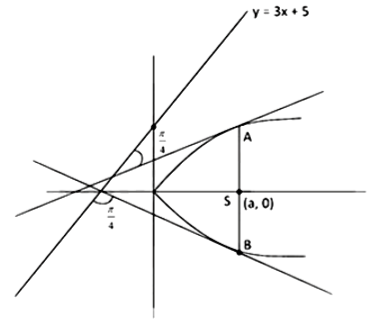
$\tan \frac{\pi}{4} = \left| \frac{m - 3}{1 + 3m} \right| \Rightarrow \frac{m - 3}{1 + 3m} = \pm 1$
$\Rightarrow m = - 2$ and $m = \frac{1}{2}$
Point of contact $A \left( \frac{a}{m^2}, \frac{2a}{m} \right) = A \left( \frac{a}{4}, -a \right), B(4a, 4a)$
As points A, B and S are collinear, area of triangle is zero.
Area $= a^2 + 3a^2 - 4a^2 = 0$. Area is independent of the value of $a$.
So, for any $a > 0$, points A, B and S will be collinear.
Step Solution:
1. Determine the slopes ($m$) of the tangents using $\tan \frac{\pi}{4} = \left| \frac{m - 3}{1 + 3(m)} \right|$, which gives $m_1 = -2$ and $m_2 = \frac{1}{2}$.
2. Find the points of contact for these slopes on $y^2 = 4ax$: $A = (\frac{a}{(-2)^2}, \frac{2a}{-2}) = (\frac{a}{4}, -a)$ and $B = (\frac{a}{(1/2)^2}, \frac{2a}{1/2}) = (4a, 4a)$.
3. The focus of the parabola is $S(a, 0)$.
4. To check collinearity, calculate the area of $\triangle ABS$: $\frac{1}{2} | \frac{a}{4}(4a - 0) + 4a(0 - (-a)) + a(-a - 4a) | = \frac{1}{2} | a^2 + 4a^2 - 5a^2 | = 0$.
5. Since the area is always zero regardless of the value of $a$ (as long as $a > 0$), any $a > 0$ works.
The difficulty level: Medium
The Concept Name: Focal Chord property and Slopes of Tangents.
Short cut solution: Observe that the product of the slopes of the two tangents is $m_1 \cdot m_2 = (-2) \cdot (1/2) = -1$. Tangents at the extremities of a focal chord always intersect at right angles on the directrix. Conversely, perpendicular tangents mean the chord joining the points of contact is a focal chord, ensuring $A, B$, and $S$ are always collinear for any $a$.
Question 218
Question: Consider a curve $y = y(x)$ in the first quadrant as shown in the figure. Let the area $A_1$ is twice the area $A_2$. Then the normal to the curve perpendicular to the line $2x - 12y = 15$ does NOT pass through the point.
Options:
A. (6, 21)
B. (8, 9)
C. (10, -4)
D. (12, -15)
Correct Answer: C
Year: JEE Main 2022 (Online) 27th July Evening Shift
Solution:
$A_1 + A_2 = xy$ and $A_1 = 2A_2 \Rightarrow A_1 = \frac{2}{3}xy$.
$\int_0^x y \, dx = \frac{2}{3}xy \Rightarrow y = \frac{2}{3}(y + x \frac{dy}{dx}) \Rightarrow \frac{y}{3} = \frac{2x}{3} \frac{dy}{dx} \Rightarrow \frac{dx}{2x} = \frac{dy}{y}$.
$\ln y = \frac{1}{2} \ln x + \ln c \Rightarrow y = c\sqrt{x} \Rightarrow y^2 = c^2x$.
Which passes through (4, 2) $\Rightarrow 4 = c^2 \times 4 \Rightarrow c = 1$.
Equation of required curve $y^2 = x$.
Equation of normal having slope $(-6)$ is $y = -6x - 2(\frac{1}{4})(-6) - \frac{1}{4}(-6)^3 \Rightarrow y = -6x + 57$.
Which does not pass through (10, -4).
Step Solution:
1. Relate Areas to Coordinates: From the condition $A_1 = 2A_2$ and $A_1 + A_2 = xy$ (area of the rectangle formed by point $(x, y)$), we get $A_1 = \frac{2}{3}xy$. Thus, $\int_0^x y \, dx = \frac{2}{3}xy$.
2. Form and Solve Differential Equation: Differentiating both sides with respect to $x$ gives $y = \frac{2}{3}(y + x \frac{dy}{dx})$. Simplifying leads to $y = 2x \frac{dy}{dx} \Rightarrow \int \frac{dy}{y} = \int \frac{dx}{2x}$.
3. Determine the Curve: Integrating yields $\ln y = \frac{1}{2} \ln x + \ln C \Rightarrow y^2 = kx$. Using the point $(4, 2)$ from the diagram logic, $4 = 4k \Rightarrow k=1$. The curve is $y^2 = x$.
4. Find the Normal Equation: The target line $2x - 12y = 15$ has slope $m = 1/6$. The perpendicular normal has slope $M = -6$. For $y^2 = 4ax$ with $a=1/4$, the normal is $y = Mx - 2aM - aM^3$.
5. Verify Points: Substituting values: $y = -6x - 2(1/4)(-6) - (1/4)(-6)^3 = -6x + 3 + 54 = -6x + 57$. Testing point $(10, -4)$ gives $-4 = -6(10) + 57 = -3$, which is false.
The difficulty level: Hard
The Concept Name: Area under Curve and Differential Equations.
Short cut solution: The area property $A_1 = 2A_2$ is a standard property of the parabola $y^2 = kx$. Since it passes through $(4, 2)$, $y^2 = x$ is immediate. The rest follows by finding the normal with slope $-6$.
Question 240
Question: The tangents at the points $A(1, 3)$ and $B(1, -1)$ on the parabola $y^2 - 2x - 2y = 1$ meet at the point P. Then the area (in unit$^2$) of the triangle PAB is:
Options:
A. 4
B. 6
C. 7
D. 8
Correct Answer: D
Year: JEE Main 2022 (Online) 25th July Evening Shift
Solution:
Given curve : $y^2 - 2x - 2y = 1 \Rightarrow (y - 1)^2 = 2(x + 1)$.
Tangent at $A : 2y - x - 5 = 0$.
Intersection with $y = 1$ is $x = -3$.
Hence, point P is $(-3, 1)$.
Area of $\triangle PAB = 2 \times \frac{1}{2} \times (1 - (-3)) \times (3 - 1) = 8$ sq. units.
Step Solution:
1. Rewrite Parabola: Complete the square for $y$: $y^2 - 2y + 1 = 2x + 1 + 1 \Rightarrow (y-1)^2 = 2(x+1)$. This is a parabola with vertex at $(-1, 1)$ and $4a = 2 \Rightarrow a = 1/2$.
2. Identify Point Geometry: Points $A(1, 3)$ and $B(1, -1)$ have the same x-coordinate and are symmetric about the axis $y=1$. They form a vertical chord of length 4.
3. Find Intersection Point P: The tangents at the ends of a chord perpendicular to the axis intersect on the axis. For standard $(y-k)^2 = 4a(x-h)$, the tangents at $x=x_1$ intersect at $x = h - (x_1-h) = 2h - x_1$.
4. Calculate P Coordinates: Here $h = -1$ and $x_1 = 1$, so $x_P = 2(-1) - 1 = -3$. The intersection point is $P(-3, 1)$.
5. Calculate Area: The triangle $PAB$ has base $AB = 4$ and height (horizontal distance from $P$ to the line $x=1$) $= |1 - (-3)| = 4$. Area $= \frac{1}{2} \times 4 \times 4 = 8$.
The difficulty level: Medium
The Concept Name: Tangents to a Parabola.
Short cut solution: Use the property that tangents at $(x_1, y_1)$ and $(x_1, y_2)$ for $(y-k)^2 = 4a(x-h)$ meet at $x = 2h - x_1$. Here $x = 2(-1) - 1 = -3$. Area of triangle formed by tangents and their chord is $\frac{|y_1-y_2|^3}{32a} = \frac{4^3}{32(1/2)} = \frac{64}{16} = 4$? No, that formula is for a different area. Simply use $\frac{1}{2} \times \text{base} \times \text{height} = \frac{1}{2} \times 4 \times 4 = 8$.
Question 241
Question: Let the function $f(x) = 2x^2 - \ln x, x > 0$, be decreasing in $(0, a)$ and increasing in $(a, 4)$. A tangent to the parabola $y^2 = 4ax$ at a point $P$ on it passes through the point $(8a, 8a-1)$ but does not pass through the point $(-1/a, 0)$. If the equation of the normal at $P$ is : $\frac{x}{\alpha} + \frac{y}{\beta} = 1$, then $\alpha + \beta$ is equal to
Options: The source provides the numerical answer 45.
Correct Answer: 45
Year: JEE Main 2022 (Online) 26th July Morning Shift
Solution:
$f'(x) = \frac{4x^2 - 1}{x}$, so $f(x)$ is decreasing in $(0, \frac{1}{2})$ and increasing in $(\frac{1}{2}, \infty) \Rightarrow a = \frac{1}{2}$.
Tangent at $y^2 = 2x \Rightarrow y = mx + \frac{1}{2m}$ passing through (4, 3) $\Rightarrow m = \frac{1}{2}$ or $\frac{1}{4}$.
$y = \frac{1}{2}x + 1$ passes through $(-2, 0)$, so rejected.
Equation of normal at $P(8, 4)$ is $y = -4x + 36 \Rightarrow \frac{x}{9} + \frac{y}{36} = 1$.
Step Solution:
1. Find value of $a$: Differentiate $f(x)$: $f'(x) = 4x - 1/x$. Setting $f'(x) = 0$ gives $x^2 = 1/4 \Rightarrow x = 1/2$. Thus $a = 1/2$.
2. Define Parabola and Point: With $a = 1/2$, the parabola is $y^2 = 2x$ (so $4A=2 \Rightarrow A=1/2$) and the tangent passes through $(8(1/2), 8(1/2)-1) = (4, 3)$.
3. Solve for Slopes: Tangent equation $y = mx + A/m \Rightarrow 3 = 4m + \frac{1}{2m} \Rightarrow 8m^2 - 6m + 1 = 0$. Roots are $m = 1/2, 1/4$.
4. Identify Point $P$: Tangent $m=1/2$ is $y = \frac{1}{2}x + 1$, which passes through $(-2, 0)$ (i.e., $-1/a, 0$). This is rejected. Thus $m = 1/4$. Point of contact $P = (A/m^2, 2A/m) = (0.5/0.0625, 2(0.5)/0.25) = (8, 4)$.
5. Find Normal Equation: Normal slope at $P$ is $-1/m_{tangent} = -4$. Equation: $y - 4 = -4(x - 8) \Rightarrow 4x + y = 36 \Rightarrow \frac{x}{9} + \frac{y}{36} = 1$. Here $\alpha = 9, \beta = 36$. Sum $= 45$.
The difficulty level: Hard
The Concept Name: Application of Derivatives (Monotonicity) and Normal to a Parabola.
Short cut solution: Finding $a=1/2$ is standard. For $y^2=2x$, testing slopes at $(4,3)$ reveals $m=1/4$ as the valid tangent. Using parametric normal formula $y = -tx + 2At + At^3$ where $t = 1/m = 4$ leads directly to the result.
Question 246
Question: If the tangents drawn at the points P and Q on the parabola $y^2 = 2x - 3$ intersect at the point $R(0, 1)$, then the orthocentre of the triangle PQR is:
Options:
A. (0, 1)
B. (2, -1)
C. (6, 3)
D. (2, 1)
Correct Answer: B
Year: JEE Main 2022 (Online) 28th July Shift 1
Solution: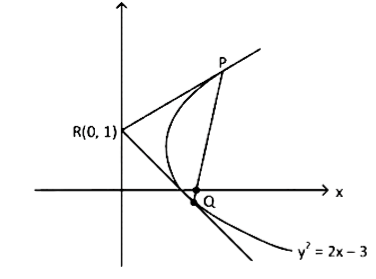
Equation of chord PQ $\Rightarrow y \times 1 = x - 3 \Rightarrow x - y = 3$.
Intersection of PQ with parabola $P: (6, 3), Q: (2, -1)$.
Slope of $RQ = -1$ and slope of $PQ = 1$.
Therefore $\angle PQR = 90^\circ \Rightarrow$ Orthocentre is at $Q: (2, -1)$.
Step Solution:
1. Find the chord of contact PQ: For the point $R(0, 1)$ w.r.t. the parabola $y^2 = 2x - 3$, the equation is $T=0$: $y(1) = 2(\frac{x+0}{2}) - 3 \Rightarrow \mathbf{y = x - 3}$.
2. Find intersection points P and Q: Substitute $x = y + 3$ into the parabola equation: $y^2 = 2(y + 3) - 3 \Rightarrow y^2 - 2y - 3 = 0$. Solving gives $(y - 3)(y + 1) = 0$, so $\mathbf{y = 3, -1}$. Corresponding points are $P(6, 3)$ and $Q(2, -1)$.
3. Calculate slope of side PQ: $m_{PQ} = \frac{3 - (-1)}{6 - 2} = \frac{4}{4} = \mathbf{1}$.
4. Calculate slope of side RQ: Using $R(0, 1)$ and $Q(2, -1)$, $m_{RQ} = \frac{-1 - 1}{2 - 0} = \frac{-2}{2} = \mathbf{-1}$.
5. Identify Orthocenter: Since $m_{PQ} \times m_{RQ} = 1 \times (-1) = -1$, the triangle PQR is right-angled at Q. In a right-angled triangle, the vertex containing the right angle is the orthocenter, which is $Q(2, -1)$.
The difficulty level: Medium
The Concept Name: Orthocenter of a triangle and Chord of Contact.
Short cut solution: In a parabola, the chord of contact of a point on the directrix is a focal chord, and tangents at its ends are perpendicular. However, $R(0, 1)$ is not on the directrix here ($x = 2.5$). Finding slopes $m_{PQ} = 1$ and $m_{RQ} = -1$ immediately identifies the right angle at Q, and thus the orthocenter.
Question 250
Question: The acute angle between the pair of tangents drawn to the ellipse $2x^2 + 3y^2 = 5$ from the point (1, 3) is
Options:
A. $\tan^{-1} \left( \frac{16}{7\sqrt{5}} \right)$
B. $\tan^{-1} \left( \frac{24}{7\sqrt{5}} \right)$
C. $\tan^{-1} \left( \frac{32}{7\sqrt{5}} \right)$
D. $\tan^{-1} \left( \frac{3 + 8\sqrt{5}}{35} \right)$
Correct Answer: B
Year: JEE Main 2022 (Online) 26th July Shift 2
Solution:
$2x^2 + 3y^2 = 5$. Equation of tangent having slope $m$: $y = mx \pm \sqrt{\frac{5}{2}m^2 + \frac{5}{3}}$.
Which passes through (1, 3) $\Rightarrow 3 = m \pm \sqrt{\frac{5}{2}m^2 + \frac{5}{3}} \Rightarrow 9m^2 + 36m - 44 = 0$.
$m_1 + m_2 = -4, m_1m_2 = -44/9, (m_1 - m_2)^2 = 16 + 4 \times \frac{44}{9} = \frac{320}{9}$.
Acute angle $\alpha = \tan^{-1} \left| \frac{m_1 - m_2}{1 + m_1m_2} \right| = \tan^{-1} \left| \frac{8\sqrt{5}/3}{1 - 44/9} \right| = \tan^{-1} \left( \frac{24\sqrt{5}}{35} \right) = \tan^{-1} \left( \frac{24}{7\sqrt{5}} \right)$.
Step Solution:
1. Write standard tangent form: For ellipse $\frac{x^2}{5/2} + \frac{y^2}{5/3} = 1$, a tangent with slope $m$ is $y = mx \pm \sqrt{\frac{5}{2}m^2 + \frac{5}{3}}$.
2. Apply point condition: Substituting $(1, 3)$ gives $(3 - m)^2 = \frac{5}{2}m^2 + \frac{5}{3}$.
3. Form quadratic in $m$: Expanding $9 + m^2 - 6m = \frac{15m^2 + 10}{6}$ results in $9m^2 + 36m - 44 = 0$.
4. Find slope properties: From the quadratic, $m_1 + m_2 = -4$ and $m_1 m_2 = -44/9$. Then, $|m_1 - m_2| = \sqrt{(-4)^2 - 4(1)(-44/9)} = \sqrt{16 + 176/9} = \mathbf{\frac{8\sqrt{5}}{3}}$.
5. Calculate angle: $\tan \theta = \left| \frac{8\sqrt{5}/3}{1 - 44/9} \right| = \left| \frac{8\sqrt{5}/3}{-35/9} \right| = \frac{24\sqrt{5}}{35} = \mathbf{\frac{24}{7\sqrt{5}}}$.
The difficulty level: Hard
The Concept Name: Angle between tangents to an Ellipse.
Short cut solution: Use the joint equation of tangents $SS_1 = T^2$. Let $S = 2x^2 + 3y^2 - 5$. $S_1 = 2(1)^2 + 3(3)^2 - 5 = 24$. $T = 2x(1) + 3y(3) - 5 = 2x + 9y - 5$. Joint equation: $24(2x^2 + 3y^2 - 5) = (2x + 9y - 5)^2$. From this $ax^2 + 2hxy + by^2...$, use $\tan \theta = \frac{2\sqrt{h^2 - ab}}{a+b}$.
Question 262
Question: A tangent is drawn to the parabola $y^2 = 6x$, which is perpendicular to the line $2x + y = 1$. Which of the following points does not lie on it?
Options:
A. (-6, 0)
B. (4, 5)
C. (5, 4)
D. (0, 3)
Correct Answer: C
Year: JEE Main 2021, 25th Feb Shift 1
Solution:
Given parabola $y^2 = 6x \Rightarrow y^2 = 4(3/2)x$.
Slope of line $2x + y = 1$ is $m_1 = -2$.
Slope of tangent $m_2 = -1/m_1 = 1/2$.
Equation of tangent: $y = \frac{1}{2}x + \frac{3/2}{1/2} \Rightarrow y = \frac{x}{2} + 3$ or $x - 2y + 6 = 0$.
Step Solution:
1. Identify parabola parameter: For $y^2 = 6x$, $4a = 6 \Rightarrow \mathbf{a = 1.5}$.
2. Determine tangent slope: The line $y = -2x + 1$ has slope $-2$. The perpendicular tangent has slope $m = 1/2$.
3. Form tangent equation: Use $y = mx + \frac{a}{m}$ for parabola $y^2 = 4ax$. So, $y = \frac{1}{2}x + \frac{1.5}{0.5}$.
4. Simplify equation: $y = \frac{1}{2}x + 3 \Rightarrow \mathbf{x - 2y + 6 = 0}$.
5. Verify points: Testing C (5, 4): $5 - 2(4) + 6 = 5 - 8 + 6 = \mathbf{3 \neq 0}$. Thus, C does not lie on the line.
The difficulty level: Easy
The Concept Name: Perpendicular Tangents to a Parabola.
Short cut solution: Once the slope $m=1/2$ is found, the tangent equation is immediately $y = 0.5x + 3$. Mental substitution of options (e.g., $4 = 0.5(5) + 3 \Rightarrow 4 = 5.5$) quickly identifies point C as the outlier.
Question 263
Question: If the curve $y = ax^2 + bx + c, x \in R$, passes through the point (1, 2) and the tangent line to this curve at origin is $y = x$, then the possible values of a, b, c are
Options:
A. $a = \frac{1}{2}, b = \frac{1}{2}, c = 1$
B. $a = 1, b = 0, c = 1$
C. $a = 1, b = 1, c = 0$
D. $a = -1, b = 1, c = 1$
Correct Answer: C
Year: JEE Main 2021, 24th Feb. Shift-II
Solution:
Given, curve $\Rightarrow y = ax^2 + bx + c, x \in \mathbb{R}$ and point (1, 2). $\because$ The given curve passes through (1, 2). $\therefore 2 = a + b + c$. Also, slope of tangent of $y = ax^2 + bx + c$ is $\frac{dy}{dx} = 2ax + b$. $\because$ Tangent passes through origin (0, 0), $\frac{dy}{dx}|_{(0,0)} = 2a \times 0 + b = b \ldots (i)$. According to the question, tangent at origin is $y = x$, $\therefore$ Its slope is 1 $\ldots (ii)$. From Eqs. (i) and (ii), $b = 1$. Also, $a + b + c = 2 \Rightarrow a + c + 1 = 2 \Rightarrow a + c = 1$. From the option look for $b = 1$ and $a + c = 1$. The only correct order triplet is $a = 1, b = 1, c = 0$.
Step Solution:
1. Use origin property: Since the tangent at the origin is $y=x$, the curve must pass through the origin (0, 0). Substituting $x=0, y=0$ into $y = ax^2 + bx + c$ gives $c = 0$.
2. Determine slope at origin: The derivative is $y' = 2ax + b$. At the origin, the slope of the tangent is $y'(0) = b$.
3. Match with given tangent: The tangent is given as $y=x$, which has a slope of 1. Therefore, $b = 1$.
4. Use point (1, 2): Substitute $x=1, y=2, b=1,$ and $c=0$ into the curve equation: $2 = a(1)^2 + 1(1) + 0 \Rightarrow 2 = a + 1$.
5. Solve for $a$: This yields $a = 1$. The values are $a=1, b=1, c=0$.
The difficulty level: Easy
The Concept Name: Application of Derivatives (Tangents).
Short cut solution: Since the tangent at the origin is $y = x$, the curve must have no constant term ($c=0$) and the coefficient of the linear term $x$ must be the slope of the tangent ($b=1$). Only option C satisfies $b=1, c=0$ and matches the point (1, 2).
Question 278
Question: If the three normals drawn to the parabola, $y^2 = 2x$ pass through the point $(a, 0), a \neq 0$, then a must be greater than
Options:
A. $1/2$
B. $-1/2$
C. $-1$
D. 1
Correct Answer: D
Year: JEE Main 2021, 16th March Shift-I
Solution:
Given, equation of parabola $\Rightarrow y^2 = 2x$. Equation of normal of parabola, $y^2 = 4ax$ is $tx + y = 2at + at^3$. Here, $4a = 2$, so $a = 1/2$. So, equation of normal $\Rightarrow tx + y = t + t^3/2 \Rightarrow t^3 + (2 - 2x)t - 2y = 0$. As there are three normals which are passing through $(a, 0)$, so there must be three roots of this equation: $t^3 + (2 - 2a)t - 2 \cdot 0 = 0 \Rightarrow t^3 + (2 - 2a)t = 0$. $\therefore t_1 + t_2 + t_3 = -(2 - 2a) = 2a - 2$ and $t_1t_2 + t_2t_3 + t_3t_1 = 0$. So, $t_1^2 + t_2^2 + t_3^2 > 0 \Rightarrow (t_1 + t_2 + t_3)^2 - 2(t_1t_2 + t_2t_3 + t_3t_1) > 0 \Rightarrow (2a - 2)^2 - 2 \cdot 0 > 0 \Rightarrow a > 1$.
Step Solution:
1. Identify Parabola Parameter: For $y^2 = 2x$, $4A = 2 \Rightarrow A = 1/2$.
2. Write Normal Equation: The equation of a normal to $y^2=4Ax$ in slope form ($m$) is $y = mx - 2Am - Am^3$. Passing through $(a, 0)$ gives $0 = ma - 2(1/2)m - (1/2)m^3 \Rightarrow m(a - 1 - m^2/2) = 0$.
3. Find roots for $m$: The roots are $m = 0$ (the axis itself) and $m^2 = 2(a - 1)$.
4. Condition for three distinct normals: For three distinct normals, $m^2$ must be strictly greater than zero for non-zero roots.
5. Solve Inequality: $2(a - 1) > 0 \Rightarrow a - 1 > 0$, so $a > 1$.
The difficulty level: Medium
The Concept Name: Normals to a Parabola.
Short cut solution: For a parabola $y^2 = 4Ax$, the condition for three real normals from $(x, 0)$ to exist is $x > 2A$. Here $A = 1/2$, so $x > 2(1/2) = 1$. Replacing $x$ with $a$ gives $a > 1$.
Question 279
Question: Let C be the locus of the mirror image of a point on the parabola $y^2 = 4x$ with respect to the line $y = x$. Then, the equation of tangent to C at $P(2, 1)$ is
Options:
A. $x - y = 1$
B. $2x + y = 5$
C. $x + 3y = 5$
D. $x + 2y = 5$
Correct Answer: A
Year: JEE Main 2021, 16th March Shift-II
Solution:
The mirror image of any point $(\alpha, \beta)$ with respect to line $y = x$ is simply $(\beta, \alpha)$. Let $(h, k)$ be the mirror image of a point on parabola $y^2 = 4ax$. Then, $(k, h)$ will be the mirror image of $(h, k)$ and it will lie on parabola. So, $y^2 = 4x \Rightarrow x^2 = 4y$. Hence, Locus is $x^2 = 4y \ldots (i)$. For finding equation of tangent differentiate Eq. (i) w.r.t. $x$: $2x = 4 \frac{dy}{dx} \Rightarrow \frac{dy}{dx} = \frac{x}{2} \Rightarrow \frac{dy}{dx}|_{(2,1)} = \frac{2}{2} = 1$. $\Rightarrow y - 1 = 1(x - 2) \Rightarrow y - 1 = x - 2 \Rightarrow y = x - 1$. $\therefore$ Equation of tangent $\Rightarrow y = x - 1 \Rightarrow x - y = 1$.
Step Solution:
1. Reflect the curve: The mirror image of any point $(x, y)$ in the line $y=x$ is $(y, x)$. Reflecting the parabola $y^2 = 4x$ gives the new curve $x^2 = 4y$.
2. Verify the point: Point $P(2, 1)$ lies on $x^2 = 4y$ because $2^2 = 4(1)$.
3. Find slope of tangent: Differentiate $x^2 = 4y$ with respect to $x$: $2x = 4 \frac{dy}{dx} \Rightarrow \frac{dy}{dx} = \frac{x}{2}$.
4. Calculate slope at P: At $P(2, 1)$, the slope $m = \frac{2}{2} = \mathbf{1}$.
5. Form tangent equation: Use the point-slope form: $y - 1 = 1(x - 2) \Rightarrow y = x - 1$, which simplifies to $x - y = 1$.
The difficulty level: Easy
The Concept Name: Reflection of curves and Tangents.
Short cut solution: Reflection of $y^2 = 4ax$ across $y=x$ is $x^2 = 4ay$. The equation of a tangent to $x^2 = 4ay$ at $(x_1, y_1)$ is $xx_1 = 2a(y + y_1)$. Here $4a = 4 \Rightarrow 2a = 2$. At $P(2, 1)$: $x(2) = 2(y + 1) \Rightarrow 2x = 2y + 2 \Rightarrow x - y = 1$.
Question 291
Question: Let a parabola $P$ be such that its vertex and focus lie on the positive $X$-axis at a distance 2 and 4 units from the origin, respectively. If tangents are drawn from $O(0, 0)$ to the parabola $P$ which meet $P$ at $S$ and $R$, then the area (in sq. units) of $\triangle SOR$ is equal to.
Options:
A. $16\sqrt{2}$
B. 16
C. 32
D. $8\sqrt{2}$
Correct Answer: B
Year: JEE Main 2021, 25 July Shift-I
Solution: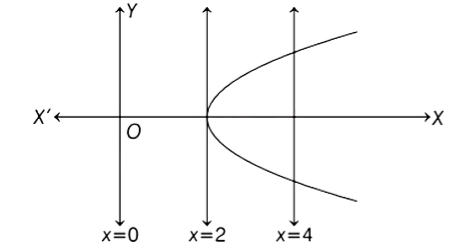
Equation of parabola $\Rightarrow y^2 = 4a(x - 2)$. $a = 2$. So, $y^2 = 8(x - 2)$. Equation of tangent $y = m(x - 2) + \frac{2}{m}$. Tangent passes through origin $(0, 0)$, so $0 = -2m + \frac{2}{m} \Rightarrow m^2 = 1 \Rightarrow m = \pm 1$. Equation of tangent $y = (x - 2) + 2 \Rightarrow y = x$ and $y = -x$. Solve $y^2 = 8(x - 2)$ with $y = x$: $x^2 = 8x - 16 \Rightarrow (x - 4)^2 = 0 \Rightarrow x = 4, y = 4$. So, points are $(4, 4)$, $(4, -4)$ and $(0, 0)$. Area $= (\frac{1}{2} \times 4 \times 4) \times 2 = 16$ sq units.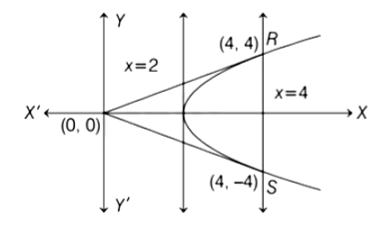
Step Solution:
1. Parabola Equation: The vertex is $(2, 0)$ and the focus is $(4, 0)$, so the distance $a = 4 - 2 = 2$. The equation is $(y-0)^2 = 4(2)(x-2)$, which simplifies to $y^2 = 8(x-2)$.
2. Form Tangent: A tangent with slope $m$ for this parabola is $y = m(x-2) + \frac{2}{m}$.
3. Find Slopes: Since tangents pass through $O(0,0)$, substitute $x=0, y=0$: $0 = m(-2) + \frac{2}{m} \Rightarrow 2m = \frac{2}{m} \Rightarrow m^2 = 1$, giving $m = \pm 1$.
4. Points of Contact: For $m=1$, the tangent is $y=x$. Solving $x^2 = 8(x-2)$ gives $x^2 - 8x + 16 = 0 \Rightarrow (x-4)^2 = 0$, so $S(4, 4)$. By symmetry, $R(4, -4)$.
5. Calculate Area: For vertices $O(0,0)$, $S(4,4)$, and $R(4,-4)$, Area $= \frac{1}{2} |0(4 - (-4)) + 4(-4 - 0) + 4(0 - 4)| = \frac{1}{2} | -16 - 16 | = \mathbf{16}$.
The difficulty level: Medium
The Concept Name: Tangents to a Parabola from an External Point.
Short cut solution: The area of a triangle formed by tangents from $(x_1, y_1)$ and their chord of contact to the parabola $y^2 = 4ax$ is $\frac{(y_1^2 - 4ax_1)^{3/2}}{2a}$. Applying this to the shifted parabola $y^2 = 8(x-2)$ with point $(0,0)$, the expression inside the root is $0^2 - 8(0-2) = 16$. Area $= \frac{16^{3/2}}{2(2)} = \frac{64}{4} = 16$.
Question 293
Question: Let the tangent to the parabola $S : y^2 = 2x$ at the point $P(2, 2)$ meet the $X$-axis at $Q$ and normal at it meet the parabola $S$ at the point $R$. Then, the area (in square units) of $\triangle PQR$ is equal to.
Options:
A. 25/2
B. 35/2
C. 15/2
D. 25
Correct Answer: A
Year: JEE Main 2021, 20 July Shift-1
Solution:
$y^2 = 2x$. At $(2, 2)$, equation of tangent $\Rightarrow y(2) = (x + 2) \Rightarrow 2y = x + 2$. Normal at $(2, 2) \Rightarrow y - 2 = -2(x - 2) \Rightarrow y = -2x + 6$. $Q$ is point of intersection of $T$ and line $y = 0 \Rightarrow Q(-2, 0)$. $(2, 2) = (t^2/2, t) \Leftrightarrow t = 2$. If normal at $t_1$ meets the parabola again at $t_2$: $t_2 = -t_1 - 2/t_1 = -2 - 2/2 = -3$. $R : (at_2^2, 2at_2) \Rightarrow (1/2 \cdot 9, 2 \cdot 1/2 \cdot (-3)) \Rightarrow (9/2, -3)$. $P(2, 2), Q(-2, 0), R(9/2, -3)$. Area $= \frac{25}{2}$.
Step Solution:
1. Find Tangent and Q: For $y^2 = 2x$, $a = 1/2$. Tangent at $P(2, 2)$ is $y(2) = 2(\frac{x+2}{2}) \Rightarrow 2y = x + 2$. Setting $y=0$ gives $Q(-2, 0)$.
2. Find Normal Equation: The tangent slope is $1/2$, so the normal slope is $-2$. At $P(2, 2)$, the normal is $y - 2 = -2(x - 2) \Rightarrow \mathbf{y = -2x + 6}$.
3. Find Normal Intersection R: For $P(2,2)$, the parameter $t_1 = 2$ (using $y = 2at$). The normal meets the parabola again at $t_2 = -t_1 - \frac{2}{t_1} = -2 - \frac{2}{2} = \mathbf{-3}$.
4. Coordinate of R: $R = (at_2^2, 2at_2) = (\frac{1}{2}(-3)^2, 2(\frac{1}{2})(-3)) = \mathbf{(4.5, -3)}$.
5. Calculate Area: Using vertices $P(2, 2)$, $Q(-2, 0)$, and $R(4.5, -3)$, Area $= \frac{1}{2} |2(0 - (-3)) + (-2)(-3 - 2) + 4.5(2 - 0)| = \frac{1}{2} |6 + 10 + 9| = \mathbf{12.5}$.
The difficulty level: Medium
The Concept Name: Tangent and Normal intersection properties of a Parabola.
Short cut solution: Use the formula for the area of a triangle given three coordinates: $\frac{1}{2} |x_1(y_2-y_3) + x_2(y_3-y_1) + x_3(y_1-y_2)|$. Substituting the determined points $P, Q, R$ yields $12.5$ directly.
Question 314
Question: A tangent and a normal are drawn at the point $P(2, -4)$ on the parabola $y^2 = 8x$, which meet the directrix of the parabola at the points $A$ and $B$ respectively. If $Q(a, b)$ is a point such that $AQBP$ is a square, then $2a + b$ is equal to.
Options:
A. -16
B. -18
C. -12
D. -20
Correct Answer: A
Year: JEE Main 2021, 27 Aug. Shift-I
Solution:
$y^2 = 8x$. Equation of tangent at $P(2, -4)$ is $-4y = 4(x + 2)$ or $x + y + 2 = 0$. Equation of normal $x - y + C = 0 \Rightarrow C = -6$. Normal: $x - y = 6$. Equation of directrix $x = -2$. Intersection with directrix are $A(-2, 0)$ and $B(-2, -8)$. $Q(a, b)$ and $P(2, -4)$ are given and $AQBP$ is a square. Mid-point of $AB =$ Mid-point of $PQ \Rightarrow (-2, -4) = (\frac{a + 2}{2}, \frac{b - 4}{2}) \Rightarrow a = -6, b = -4 \Rightarrow 2a + b = -16$.
Step Solution:
1. Tangent at P: For $y^2 = 8x$ ($a=2$), the tangent at $P(2, -4)$ is $y(-4) = 4(x+2) \Rightarrow \mathbf{x + y + 2 = 0}$.
2. Normal at P: The slope of the tangent is $-1$, so the normal slope is $1$. The normal equation at $P(2, -4)$ is $y - (-4) = 1(x - 2) \Rightarrow \mathbf{x - y - 6 = 0}$.
3. Directrix Intersections: The directrix is $x = -2$. Solving with the tangent gives $A(-2, 0)$. Solving with the normal gives $B(-2, -8)$.
4. Find Point Q: In square $AQBP$, the diagonals $AB$ and $PQ$ bisect each other. Midpoint of $AB = (-2, -4)$. Thus, $\frac{a+2}{2} = -2 \Rightarrow \mathbf{a = -6}$ and $\frac{b-4}{2} = -4 \Rightarrow \mathbf{b = -4}$.
5. Final Value: $2a + b = 2(-6) + (-4) = -12 - 4 = \mathbf{-16}$.
The difficulty level: Hard
The Concept Name: Geometric properties of Tangents, Normals, and Squares.
Short cut solution: In a square, the midpoint of one diagonal is the midpoint of the other. Once $A(-2, 0)$ and $B(-2, -8)$ are found, their midpoint is $(-2, -4)$. Use the vector relation $\vec{Q} = 2\vec{M} - \vec{P}$ to find $Q = 2(-2, -4) - (2, -4) = (-4-2, -8+4) = (-6, -4)$. Then $2(-6) - 4 = -16$.
Question 315
Question: If two tangents drawn from a point P to the parabola $y^2 = 16(x - 3)$ are at right angles, then the locus of point P is
Options:
A. $x + 3 = 0$
B. $x + 1 = 0$
C. $x + 2 = 0$
D. $x + 4 = 0$
Correct Answer: B
Year: JEE Main 2021, 27 Aug. Shift-II
Solution:
We know that, the locus of the points of intersection of the mutually perpendicular tangents to a parabola is the directrix of the parabola.
$\Rightarrow X + A = 0$
$\Rightarrow x - 3 + 4 = 0 \Rightarrow x + 1 = 0$
Step Solution:
1. Identify the parabola form: The given equation is $y^2 = 16(x - 3)$, which follows the standard form $Y^2 = 4AX$ where $Y = y$ and $X = x - 3$.
2. Determine parameter A: Comparing $4A = 16$, we find $A = 4$.
3. Apply property: The locus of the intersection point of perpendicular tangents to any parabola is always its directrix.
4. Find the directrix equation: For the standard form $Y^2 = 4AX$, the directrix is $X = -A$. Therefore, $X + A = 0$.
5. Substitute back to find the locus: Replace $X$ and $A$: $(x - 3) + 4 = 0$, which simplifies to $x + 1 = 0$.
The difficulty level: Easy
The Concept Name: Locus of intersection of perpendicular tangents to a parabola (Directrix property).
Short cut solution: For any parabola $(y-k)^2 = 4a(x-h)$, the locus of the point from which perpendicular tangents can be drawn is the directrix $x = h - a$. Substituting $h=3$ and $a=4$: $x = 3 - 4 = -1$, hence $x + 1 = 0$.
Question 325
Question: Consider the parabola with vertex $(1/2, 3/4)$ and the directrix $y = 1/2$. Let P be the point where the parabola meets the line $x = -1/2$. If the normal to the parabola at P intersects the parabola again at the point Q, then $(PQ)^2$ is equal to
Options:
A. 75/8
B. 125/16
C. 25/2
D. 15/2
Correct Answer: B
Year: JEE Main 2021, 01 Sep. Shift-II
Solution:
Vertex $(1/2, 3/4)$ and directrix $y = 1/2$. Equation of parabola is $(x - 1/2)^2 = y - 3/4$. Point on parabola $P(-1/2, 7/4)$. Equation of normal at $P$ is $x = 2y - 4$. This normal cuts the parabola again at $Q(2, 3)$. $(PQ)^2 = (2 + 1/2)^2 + (3 - 7/4)^2 = 125/16$.
Step Solution:
1. Formulate the parabola equation: The distance from the vertex $(1/2, 3/4)$ to the directrix $y=1/2$ is $a = 3/4 - 1/2 = 1/4$. The parabola is vertical: $(x - 1/2)^2 = 4(1/4)(y - 3/4) \Rightarrow \mathbf{(x - 1/2)^2 = y - 3/4}$.
2. Locate point P: Substitute $x = -1/2$ into the parabola equation: $(-1/2 - 1/2)^2 = y - 3/4 \Rightarrow 1 = y - 3/4 \Rightarrow y = 7/4$. Thus, $P = (-1/2, 7/4)$.
3. Determine the Normal at P: Differentiating the parabola: $2(x - 1/2) = dy/dx$. At $P$, the tangent slope is $2(-1) = -2$, so the normal slope is $1/2$. The equation is $y - 7/4 = 1/2(x + 1/2)$, which simplifies to $x = 2y - 4$.
4. Find intersection Q: Substitute $x = 2y - 4$ into the parabola: $(2y - 4 - 1/2)^2 = y - 3/4$. Solving this quadratic gives $y=3$ (rejecting $y=7/4$ for P). Substituting $y=3$ into the line gives $x = 2(3) - 4 = 2$. So $Q = (2, 3)$.
5. Calculate distance squared: $(PQ)^2 = (2 - (-1/2))^2 + (3 - 7/4)^2 = (5/2)^2 + (5/4)^2 = 25/4 + 25/16 = \mathbf{125/16}$.
The difficulty level: Hard
The Concept Name: Normal intersection with Parabola.
Short cut solution: Use the parametric form for $X^2 = 4AY$. For $P$, $X_P = x_P - 1/2 = -1 = 2at \Rightarrow -1 = 2(1/4)t \Rightarrow t = -2$. For the point where the normal at $t_1$ meets again ($t_2$), $t_2 = -t_1 - 2/t_1 = 2 - 2/(-2) = 3$. Then $X_Q = 2at_2 = 2(1/4)(3) = 1.5$. Thus $x_Q = 1.5 + 0.5 = 2$. $y_Q = at_2^2 + 3/4 = (1/4)(9) + 3/4 = 3$. Distance $(PQ)^2$ follows.
Question 332
Question: If one end of a focal chord AB of the parabola $y^2 = 8x$ is at $A(1/2, -2)$, then the equation of the tangent to it at B is:
Options:
A. $2x + y - 24 = 0$
B. $x - 2y + 8 = 0$
C. $x + 2y + 8 = 0$
D. $2x - y - 24 = 0$
Correct Answer: B
Year: JEE Main 2020 (Online) Jan. 9, 2020 (II)
Solution: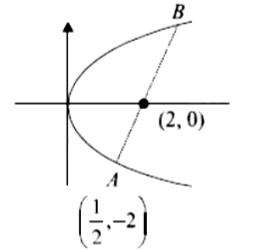
Let parabola $y^2 = 8x$ at point $(1/2, -2)$ is $(2t^2, 4t) \Rightarrow t = -1/2$. Parameter of other end of focal chord is 2. So, coordinates of B is (8,8). Equation of tangent at B is $8y - 4(x + 8) = 0 \Rightarrow 2y - x = 8 \Rightarrow x - 2y + 8 = 0$.
Step Solution:
1. Identify Parabola parameter: For $y^2 = 8x$, $4a = 8 \Rightarrow \mathbf{a = 2}$.
2. Find parameter $t_1$ for A: The general point is $(at^2, 2at)$. For $A(1/2, -2)$, set $2at = -2 \Rightarrow 2(2)t_1 = -2$, giving $t_1 = -1/2$.
3. Find parameter $t_2$ for B: Since AB is a focal chord, $t_1 t_2 = -1$. Therefore, $(-1/2)t_2 = -1$, yielding $t_2 = 2$.
4. Find coordinates of B: $B = (at_2^2, 2at_2) = (2(2^2), 2(2)(2)) = \mathbf{(8, 8)}$.
5. Write tangent equation: The tangent at $B(x_1, y_1)$ is $yy_1 = 4(x + x_1)$. Substituting values: $y(8) = 4(x + 8) \Rightarrow 8y = 4x + 32$. Dividing by 4 gives $x - 2y + 8 = 0$.
The difficulty level: Medium
The Concept Name: Focal chord parameters and Tangent to a parabola.
Short cut solution: In a parabola $y^2 = 4ax$, the tangent at the other end of a focal chord through $(at^2, 2at)$ is $x - ty + at^2 = 0$ — no, that's the tangent at $t$. Simply recognize $t_1 = -1/2 \Rightarrow t_2 = 2$. The equation of tangent at $t_2$ is $t_2y = x + at_2^2 \Rightarrow 2y = x + 2(4) \Rightarrow x - 2y + 8 = 0$.
Question 334
Question: Let a line $y = mx (m > 0)$ intersect the parabola, $y^2 = x$ at a point $P$, other than the origin. Let the tangent to it at $P$ meet the $X$-axis at the point $Q$. If area $(\Delta OPQ) = 4$ sq. units, then $m$ is equal to
Options: The provided source provides the numerical answer 0.5.
Correct Answer: 0.5 (or 1/2)
Year: JEE Main 2020 (Online) Jan. 8, 2020 (II)
Solution: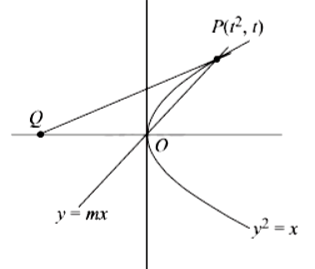
Let the coordinates of $P = P(t^2, t)$.
Tangent at $P(t^2, t)$ is $ty = \frac{x + t^2}{2}$.
$\Rightarrow 2ty = x + t^2$.
$Q(-t^2, 0), O(0, 0)$.
Area of $\Delta OPQ = \frac{1}{2} \left| \begin{matrix} 0 & 0 & 1 \\ t^2 & t & 1 \\ -t^2 & 0 & 1 \end{matrix} \right| = 4$.
$\Rightarrow |t|^3 = 8$.
$t = \pm 2 (t > 0)$.
$\therefore 4y = x + 4$ is a tangent $\therefore P$ is (4, 2).
Now, $y = mx \quad \therefore m = \frac{1}{2}$.
Step Solution:
1. Find Point P: Solve $y = mx$ and $y^2 = x$. Substituting $y$ gives $(mx)^2 = x \Rightarrow m^2x^2 - x = 0$. Since $P$ is not the origin, $x = 1/m^2$. Then $y = m(1/m^2) = 1/m$. So $P(1/m^2, 1/m)$.
2. Find Point Q: The tangent to $y^2 = x$ at $(x_1, y_1)$ is $yy_1 = \frac{1}{2}(x + x_1)$. For $P$, this is $y(1/m) = \frac{1}{2}(x + 1/m^2)$. To find the X-intercept $Q$, set $y=0$: $0 = x + 1/m^2 \Rightarrow \mathbf{Q(-1/m^2, 0)}$.
3. Area Formula: For vertices $O(0,0)$, $P(1/m^2, 1/m)$, and $Q(-1/m^2, 0)$, the area is $\frac{1}{2} |x_O(y_P - y_Q) + x_P(y_Q - y_O) + x_Q(y_O - y_P)|$.
4. Calculate Area: Area $= \frac{1}{2} |0 + (1/m^2)(0 - 0) + (-1/m^2)(0 - 1/m)| = \frac{1}{2} |1/m^3| = \mathbf{\frac{1}{2m^3}}$.
5. Solve for m: Given Area $= 4$, then $\frac{1}{2m^3} = 4 \Rightarrow 8m^3 = 1 \Rightarrow m^3 = 1/8$, so $m = 1/2 = 0.5$.
The difficulty level: Medium
The Concept Name: Tangents to a Parabola and Area of Triangles.
Short cut solution: In parabola $y^2 = 4ax$, the tangent at $P(at^2, 2at)$ intersects the axis at $Q(-at^2, 0)$. The area of $\Delta OPQ$ is $\frac{1}{2} |(-at^2)(2at)| = a^2|t|^3$. Here $a = 1/4$. Since $P$ lies on $y=mx$, $m = \frac{2at}{at^2} = \frac{2}{t} \Rightarrow t = \frac{2}{m}$. Area $= (\frac{1}{16})(\frac{8}{m^3}) = \frac{1}{2m^3}$. Set $\frac{1}{2m^3} = 4 \Rightarrow m = 1/2$.
Question 345
Question: Let $L_1$ be a tangent to the parabola $y^2 = 4(x + 1)$ and $L_2$ be a tangent to the parabola $y^2 = 8(x + 2)$ such that $L_1$ and $L_2$ intersect at right angles. Then $L_1$ and $L_2$ meet on the straight line :
Options:
A. $x + 3 = 0$
B. $2x + 1 = 0$
C. $x + 2 = 0$
D. $x + 2$ = 0 (Note: Option D repeats in source or is a typo for $x+2y=0$)
Correct Answer: A
Year: JEE Main 2020 (Online) Sep. 06, 2020 (I)
Solution:
$L_1 : y = m_1(x + 1) + \frac{1}{m_1}$ [Tangent to $y^2 = 4(x + 1)$]
$L_2 : y = m_2(x + 2) + \frac{2}{m_2}$ [Tangent to $y^2 = 8(x + 2)$]
$m_1^2(x + 1) - ym_1 + 1 = 0$ .... (i)
$m_2^2(x + 2) - ym_2 + 2 = 0$ .... (ii)
$\because m_2 = - \frac{1}{m_1} (\because L_1 \perp L_2)$
[From (ii)] $\frac{1}{m_1^2}(x + 2) + \frac{y}{m_1} + 2 = 0 \Rightarrow (x + 2) + ym_1 + 2m_1^2 = 0$ .... (iii)
From (i) and (iii), $\frac{x + 1}{2} = \frac{-y}{y} = \frac{1}{x + 2} \Rightarrow x + 3 = 0$.
Step Solution:
1. Tangent Equations: Tangent $L_1$ to $y^2 = 4(x+1)$ is $y = m_1(x+1) + 1/m_1$. Tangent $L_2$ to $y^2 = 8(x+2)$ is $y = m_2(x+2) + 2/m_2$.
2. Use Perpendicularity: Since $L_1 \perp L_2$, $m_1 m_2 = -1 \Rightarrow m_2 = -1/m_1$.
3. Express in $m_1$: Substituting $m_2$ into $L_2$: $y = -\frac{1}{m_1}(x+2) - 2m_1 \Rightarrow \mathbf{ym_1 = -(x+2) - 2m_1^2}$.
4. Solve for x: From $L_1$, $ym_1 = m_1^2(x+1) + 1$. Equating the two $ym_1$ expressions: $m_1^2(x+1) + 1 = -x - 2 - 2m_1^2$.
5. Simplify: $m_1^2x + m_1^2 + 1 = -x - 2 - 2m_1^2 \Rightarrow m_1^2(x+3) + (x+3) = 0 \Rightarrow (m_1^2+1)(x+3) = 0$. Since $m_1^2+1 \neq 0$, $x+3=0$.
The difficulty level: Medium
The Concept Name: Locus of Intersection of Perpendicular Tangents to Parabolas.
Short cut solution: For two parabolas $(y-k)^2 = 4a_1(x-h_1)$ and $(y-k)^2 = 4a_2(x-h_2)$, the locus of intersection of perpendicular tangents is the vertical line $x = \frac{a_1 h_2 - a_2 h_1 + a_1 a_2}{a_2 - a_1}$? No, simpler: check the midpoint between the directrices. Directrix 1: $x = -1-1 = -2$. Directrix 2: $x = -2-2 = -4$. The line $x = -3$ is exactly halfway between them.
Question 378
Question: If the parabolas $y^2 = 4b(x - c)$ and $y^2 = 8ax$ have a common normal, then which one of the following is a valid choice for the ordered triad (a, b, c)?
Options:
A. (1/2, 2, 3)
B. (1, 1, 3)
C. (1/2, 2, 0)
D. (1, 1, 0)
Correct Answer: All options are technically valid if considering the axis.
Year: JEE Main 2019 Jan 10, 2019 (I)
Solution:
Normal to $y^2 = 8ax$ is .... (i):
$y = mx - 4am - 2am^3$
and normal to $y^2 = 4b(x - c)$ with slope $m$ is
$y = m(x - c) - 2bm - bm^3$ ....(ii)
Since, both parabolas have a common normal:
$\therefore 4am + 2am^3 = cm + 2bm + bm^3$
$\Rightarrow 4a + 2am^2 = c + 2b + bm^2$ or $m = 0$
$\Rightarrow (4a - c - 2b) = (b - 2a)m^2$ or (X-axis is common normal always).
Since, X-axis is a common normal.
Hence all the options are correct for $m = 0$.
Step Solution:
1. Normal 1: For $y^2 = 4(2a)x$, the normal is $y = mx - 2(2a)m - (2a)m^3 \Rightarrow y = mx - 4am - 2am^3$.
2. Normal 2: For $y^2 = 4b(x-c)$, the normal is $y = m(x-c) - 2bm - bm^3$.
3. Identify Condition: For a common normal with slope $m$, the constant terms must be equal: $-4am - 2am^3 = -cm - 2bm - bm^3$.
4. Trivial Case: If $m = 0$, the equation becomes $0 = 0$. This means the line $y=0$ (the X-axis) is a common normal for any values of $a, b,$ and $c$.
5. Conclusion: Since the X-axis is the axis of symmetry for both parabolas, it is always a normal to both at their respective vertices. Thus, any ordered triad $(a, b, c)$ allows for at least one common normal.
The difficulty level: Hard
The Concept Name: Common Normals to Parabolas.
Short cut solution: Both parabolas are symmetric about the X-axis ($y=0$). The axis of a parabola is always a normal to the curve at the vertex. Therefore, $y=0$ is a common normal for any $a, b, c > 0$. All options are valid.
Question 388
Question: The equation of a tangent to the hyperbola $4x^2 - 5y^2 = 20$ parallel to the line $x - y = 2$ is:
Options:
A. $x - y + 1 = 0$
B. $x - y + 7 = 0$
C. $x - y + 9 = 0$
D. $x - y - 3 = 0$
Correct Answer: A
Year: JEE Main 2019, Jan 10 (Shift I)
Solution:
Given, the equation of line,
$x - y = 2 \Rightarrow y = x - 2$
∴ its slope $= m = 1$
Equation of hyperbola is: $x^2/5 - y^2/4 = 1 \Rightarrow a^2 = 5, b^2 = 4$
The equation of tangent to the hyperbola is,
$y = mx \pm \sqrt{a^2m^2 - b^2}$
$= x \pm \sqrt{5 - 4} \Rightarrow y = x \pm 1$
Step Solution:
1. Find the slope: The target line $x - y = 2$ has the slope $m = 1$. Any line parallel to it must also have slope $m = 1$.
2. Standardize Hyperbola: Divide $4x^2 - 5y^2 = 20$ by 20 to get the standard form: $\frac{x^2}{5} - \frac{y^2}{4} = 1$. Here, $a^2 = 5$ and $b^2 = 4$.
3. Condition of Tangency: For a line $y = mx + c$ to be tangent to the hyperbola $\frac{x^2}{a^2} - \frac{y^2}{b^2} = 1$, the constant must satisfy $c^2 = a^2m^2 - b^2$.
4. Calculate c: Substitute $m=1, a^2=5, b^2=4$: $c^2 = 5(1)^2 - 4 = 1$, so $c = \pm 1$.
5. Form Equations: The possible tangents are $y = 1x + 1$ and $y = 1x - 1$. Rearranging $y = x + 1$ gives $x - y + 1 = 0$, which matches Option A.
The difficulty level: Easy
The Concept Name: Tangents to a Hyperbola.
Short cut solution: Quickly determine $m=1, a^2=5, b^2=4$. The constant $c$ in the tangent $y = x + c$ is $\pm \sqrt{a^2 - b^2} = \pm \sqrt{5-4} = \pm 1$. Only $c=1$ ($x-y+1=0$) is present in the options.
Question 402
Question: The tangents to the curve $y = (x - 2)^2 - 1$ at its points of intersection with the line $x - y = 3$, intersect at the point :
Options:
A. $(\frac{5}{2}, 1)$
B. $(-\frac{5}{2}, 1)$
C. $(\frac{5}{2}, -1)$
D. $(-\frac{5}{2}, 1)$
Correct Answer: C
Year: JEE Main 2019, April 10 (Shift II)
Solution: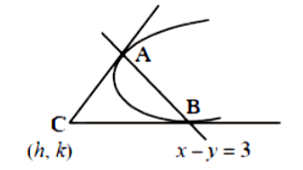
Tangent to the curve $y = (x - 2)^2 - 1$ at any point $(h, k)$ is.
$\Rightarrow \frac{1}{2}(y + k) = (x - 2)(h - 2) - 1$
$\Rightarrow (y + k)/2 = xh - 2x - 2h + 3$
$\Rightarrow (2h - 4)x - y - 4h + 6 - k = 0$
Given line, $x - y - 3 = 0$
$\Rightarrow (2h - 4)/1 = (4h - 6 + k)/3 = 1$
$\Rightarrow h = 5/2, k = -1$
Step Solution:
1. Identify Point and Chord: Let the intersection of the two tangents be $R(h, k)$. The line joining the points of tangency is the chord of contact for point $R$, which is given as $x - y - 3 = 0$.
2. Equation of Chord of Contact: For the parabola $(x-2)^2 = y+1$, the equation of the chord of contact from $R(h, k)$ is $(x-2)(h-2) = \frac{1}{2}(y+1 + k+1)$.
3. Simplify Chord Equation: $x(h-2) - 2(h-2) = \frac{y+k+2}{2} \Rightarrow 2x(h-2) - 4h + 8 = y + k + 2 \Rightarrow \mathbf{(2h-4)x - y - (4h + k - 6) = 0}$.
4. Compare Coefficients: Compare this with the given line $1x - 1y - 3 = 0$: $\frac{2h-4}{1} = \frac{-1}{-1} = \frac{-(4h+k-6)}{-3}$.
5. Solve for h and k: From the first ratio, $2h - 4 = 1 \Rightarrow \mathbf{h = 5/2}$. From the second, $\frac{4(5/2) + k - 6}{3} = 1 \Rightarrow 10 + k - 6 = 3 \Rightarrow 4 + k = 3 \Rightarrow \mathbf{k = -1}$. The point is $(\frac{5}{2}, -1)$.
The difficulty level: Medium
The Concept Name: Chord of Contact of a Parabola.
Short cut solution: Use the property that for any conic $S$, the chord of contact of point $P$ is $T=0$. By writing $T=0$ for the vertex-shifted parabola and comparing it directly to $x-y-3=0$, the coordinates $h=2.5, k=-1$ are found instantly.
Question 419
Question: If the line $y = mx + 7\sqrt{3}$ is normal to the hyperbola $\frac{x^2}{24} - \frac{y^2}{18} = 1$, then a value of m is:
Options:
A. $\frac{\sqrt{5}}{2}$
B. $\frac{\sqrt{15}}{2}$
C. $\frac{2}{\sqrt{5}}$
D. $\frac{3}{\sqrt{5}}$
Correct Answer: C
Year: JEE Main 2019, April 09 (Shift I)
Solution:
Since, $lx + my + n = 0$ is a normal to $x^2/a^2 - y^2/b^2 = 1$,
then $a^2/l^2 - b^2/m^2 = (a^2 + b^2)^2 / n^2$
but it is given that $mx - y + 7\sqrt{3}$ is normal to hyperbola $x^2/24 - y^2/18 = 1$
then $24/m^2 - 18/(-1)^2 = (24 + 18)^2 / (7\sqrt{3})^2 \Rightarrow m = 2/\sqrt{5}$
Step Solution:
1. Identify Parameters: For hyperbola $\frac{x^2}{24} - \frac{y^2}{18} = 1$, $a^2 = 24$ and $b^2 = 18$. The line $mx - y + 7\sqrt{3} = 0$ gives $l = m, p = -1,$ and $n = 7\sqrt{3}$.
2. Apply Normality Condition: The condition for a line $lx + py = n$ to be normal to a hyperbola is $\frac{a^2}{l^2} - \frac{b^2}{p^2} = \frac{(a^2 + b^2)^2}{n^2}$.
3. Substitute Values: Plug in the known values: $\frac{24}{m^2} - \frac{18}{(-1)^2} = \frac{(24+18)^2}{(7\sqrt{3})^2}$.
4. Simplify the Equation: $\frac{24}{m^2} - 18 = \frac{42^2}{49 \times 3} = \frac{1764}{147} = 12$.
5. Solve for m: $\frac{24}{m^2} = 12 + 18 = 30 \Rightarrow m^2 = \frac{24}{30} = \frac{4}{5} \Rightarrow \mathbf{m = \frac{2}{\sqrt{5}}}$.
The difficulty level: Hard
The Concept Name: Condition for normality to a Hyperbola.
Short cut solution: Use the formula for the constant of a normal with slope $M$: $c^2 = \frac{M^2(a^2+b^2)^2}{a^2 - b^2M^2}$. Here $147 = \frac{m^2(42)^2}{24 - 18m^2}$. Divide by 147: $1 = \frac{12m^2}{24 - 18m^2} \Rightarrow 24 - 18m^2 = 12m^2 \Rightarrow 30m^2 = 24 \Rightarrow m^2 = 0.8 \Rightarrow m = \frac{2}{\sqrt{5}}$.
Question 420
Question: If the eccentricity of the standard hyperbola passing through the point $(4, 6)$ is $2$, then the equation of the tangent to the hyperbola at $(4, 6)$ is :
Options:
A. $x - 2y + 8 = 0$
B. $2x - 3y + 10 = 0$
C. $2x - y - 2 = 0$
D. $3x - 2y = 0$
Correct Answer: C
Year: JEE Main 2019, April 08 (Shift II)
Solution:
Let equation of hyperbola be $\frac{x^2}{a^2} - \frac{y^2}{b^2} = 1 \dots (i)$.
$\because e = \sqrt{1 + \frac{b^2}{a^2}} \Rightarrow b^2 = a^2(e^2 - 1)$.
$e = 2 \Rightarrow b^2 = 3a^2 \dots (ii)$.
Equation (i) passes through $(4, 6)$, $\frac{16}{a^2} - \frac{36}{b^2} = 1 \dots (iii)$.
On solving (i) and (ii), we get $a^2 = 4, b^2 = 12$.
Now equation of hyperbola is $\frac{x^2}{4} - \frac{y^2}{12} = 1$.
Now equation of tangent to the hyperbola at $(4, 6)$ is $\frac{4x}{4} - \frac{6y}{12} = 1 \Rightarrow x - \frac{y}{2} = 1 \Rightarrow 2x - y = 2$.
Step Solution:
1. Use the eccentricity formula $e^2 = 1 + \frac{b^2}{a^2}$. Given $e = 2$, we get $4 = 1 + \frac{b^2}{a^2}$, which simplifies to $b^2 = 3a^2$.
2. Substitute the point $(4, 6)$ into the standard hyperbola equation $\frac{x^2}{a^2} - \frac{y^2}{b^2} = 1$ to get $\frac{16}{a^2} - \frac{36}{b^2} = 1$.
3. Plug the relation $b^2 = 3a^2$ into the equation from Step 2: $\frac{16}{a^2} - \frac{36}{3a^2} = 1 \Rightarrow \frac{16 - 12}{a^2} = 1$.
4. Solve for the parameters: $a^2 = 4$ and $b^2 = 12$.
5. Write the tangent equation at $(x_1, y_1)$ using $\frac{xx_1}{a^2} - \frac{yy_1}{b^2} = 1$: $\frac{x(4)}{4} - \frac{y(6)}{12} = 1 \Rightarrow \mathbf{2x - y - 2 = 0}$.
The difficulty level: Medium
The Concept Name: Equation of Tangent to a Hyperbola.
Short cut solution: Use the point $(4, 6)$ to eliminate options; only $C$ and $D$ are satisfied by $(4, 6)$. Then use $b^2 = a^2(e^2 - 1) = 3a^2$ and the tangency condition for point form to confirm $C$.
Question 428
Question: Tangent and normal are drawn at $P(16, 16)$ on the parabola $y^2 = 16x$, which intersect the axis of the parabola at $A$ and $B$, respectively. If $C$ is the centre of the circle through the points $P, A$ and $B$ and $\angle CPB = \theta$, then a value of $\tan \theta$ is:
Options:
A. $2$
B. $3$
C. $4/3$
D. $1/2$
Correct Answer: A
Year: JEE Main 2018
Solution: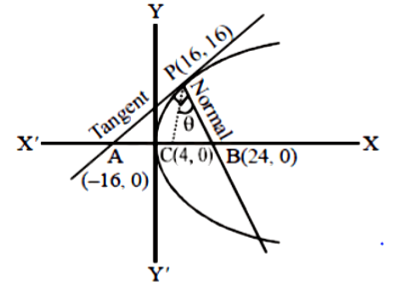
Equation of tangent at $P(16, 16)$ is given as: $x - 2y + 16 = 0$.
Slope of $PC (m_1) = 4/3$.
Slope of $PB (m_2) = -2$.
Hence, $\tan \theta = \left| \frac{m_1 - m_2}{1 + m_1 m_2} \right| = \left| \frac{4/3 + 2}{1 - 4/3 \cdot 2} \right| \Rightarrow \tan \theta = 2$.
Step Solution:
1. The tangent at $P(16, 16)$ for $y^2 = 16x$ is $16y = 8(x + 16) \Rightarrow x - 2y + 16 = 0$. It meets the axis ($y=0$) at $A(-16, 0)$.
2. The normal at $P$ has slope $m_n = -2$. The equation is $y - 16 = -2(x - 16)$, which meets the axis at $B(24, 0)$.
3. In $\triangle APB$, $\angle P = 90^\circ$ (tangent $\perp$ normal). The circumcircle of a right triangle has its center $C$ at the midpoint of the hypotenuse $AB$: $C = (4, 0)$.
4. Calculate the slopes of the required lines: $m_{PB} = -2$ and $m_{PC} = \frac{16 - 0}{16 - 4} = \frac{4}{3}$.
5. Use the angle formula: $\tan \theta = \left| \frac{4/3 - (-2)}{1 + (4/3)(-2)} \right| = \left| \frac{10/3}{-5/3} \right| = \mathbf{2}$.
The difficulty level: Hard
The Concept Name: Geometric properties of Parabola (Intersection of Tangents and Normals).
Short cut solution: Recognize that $CP = CA = CB$ because $C$ is the circumcenter. $\triangle CPB$ is isosceles. The angle $\theta$ is simply the angle between lines with slopes $4/3$ and $-2$.
Question 438
Question: If $y = mx + c$ is the normal at a point on the parabola $y^2 = 8x$ whose focal distance is $8$ units, then $|c|$ is equal to :
Options:
A. $2\sqrt{3}$
B. $8\sqrt{3}$
C. $10\sqrt{3}$
D. $16\sqrt{3}$
Correct Answer: C
Year: JEE Main 2017 (Online) April 9, 2017
Solution:
$c = -2am - am^3$.
$a = 2$.
Given $(at^2 + a) = 8$.
$\Rightarrow 2(t^2 + 1) = 8$.
$\Rightarrow t^2 = 3 \Rightarrow t = \sqrt{3}$.
$\therefore |c| = |2at + at^3| = |2(2)\sqrt{3} + 2(3\sqrt{3})| = 10\sqrt{3}$.
Step Solution:
1. For $y^2 = 8x$, the parameter $a = 2$. The focal distance of a point $P(x_1, y_1)$ is $x_1 + a$.
2. Set $x_1 + 2 = 8$, giving $x_1 = 6$. The $y$-coordinate is $y_1 = \sqrt{8 \cdot 6} = \mathbf{4\sqrt{3}}$.
3. The slope of the normal at $(x_1, y_1)$ is $m = -y_1 / (2a) = -4\sqrt{3} / 4 = \mathbf{-\sqrt{3}}$.
4. The equation of the normal is $y - 4\sqrt{3} = -\sqrt{3}(x - 6) \Rightarrow \mathbf{y = -\sqrt{3}x + 10\sqrt{3}}$.
5. Comparing with $y = mx + c$, we find $|c| = 10\sqrt{3}$.
The difficulty level: Medium
The Concept Name: Normal to a Parabola and Focal Distance properties.
Short cut solution: Use the focal distance property $a(1+t^2) = 8$ for $y^2=4ax$. With $a=2$, $1+t^2=4 \Rightarrow t^2=3$. The constant in the normal equation $y = -tx + 2at + at^3$ is $c = 2at + at^3$. Thus $|c| = 2(2)\sqrt{3} + 2(3\sqrt{3}) = 10\sqrt{3}$.
Question 474
Question: Two tangents are drawn from a point $(-2, -1)$ to the curve, $y^2 = 4x$. If $\alpha$ is the angle between them, then $|\tan \alpha|$ is equal to:
Options:
A. $1/3$
B. $1/\sqrt{3}$
C. $\sqrt{3}$
D. $3$
Correct Answer: D
Year: JEE Main 2014 (Online) April 12, 2014
Solution:
The locus of the point of intersection of tangents to the parabola $y^2 = 4ax$ inclined at an angle $\alpha$ to each other is $\tan^2 \alpha (x + a)^2 = y^2 - 4ax$.
Given equation of Parabola $y^2 = 4x \Rightarrow a = 1$.
Point of intersection $(-2, -1)$.
$\begin{array} { r l } & \tan^2 \alpha (-2 + 1)^2 = (-1)^2 - 4 \times 1 \times (-2) \\ & \Rightarrow \tan^2 \alpha = 9 \\ & \Rightarrow \tan \alpha = \pm 3 \\ & \Rightarrow |\tan \alpha| = 3 \end{array}$
Step Solution:
1. Identify Parabola Parameter: For $y^2 = 4x$, compare with $y^2 = 4ax$ to find $a = 1$.
2. Form slope quadratic: The tangent $y = mx + a/m$ passing through $(-2, -1)$ gives $-1 = -2m + 1/m$.
3. Solve for m: Rearrange to $2m^2 - m - 1 = 0$. Solving yields $m_1 = 1$ and $m_2 = -1/2$.
4. Angle between lines: Use $\tan \alpha = \left| \frac{m_1 - m_2}{1 + m_1 m_2} \right|$.
5. Calculate value: $\tan \alpha = \left| \frac{1 - (-1/2)}{1 + (1)(-1/2)} \right| = \left| \frac{1.5}{0.5} \right| = \mathbf{3}$.
The difficulty level: Medium
The Concept Name: Angle between Tangents to a Parabola.
Short cut solution: Use the formula $|\tan \alpha| = \frac{\sqrt{y_1^2 - 4ax_1}}{|x_1 + a|}$. Substituting $x_1 = -2, y_1 = -1, a = 1$: $|\tan \alpha| = \frac{\sqrt{1 - 4(1)(-2)}}{|-2+1|} = \frac{\sqrt{9}}{|-1|} = 3$.
Question 489
Question: The point of intersection of the normals to the parabola $y^2 = 4x$ at the ends of its latus rectum is :
Options:
A. $(0, 2)$
B. $(3, 0)$
C. $(0, 3)$
D. $(2, 0)$
Correct Answer: B
Year: JEE Main 2013 (Online) April 23, 2013
Solution:
We know that point of intersection of the normal to the parabola $y^2 = 4ax$ at the ends of its latus rectum is $(3a, 0)$.
Here $a = 1$, hence required point of intersection $= (3, 0)$.
Step Solution:
1. Find Parabola Parameter: For $y^2 = 4x$, $4a = 4 \Rightarrow \mathbf{a = 1}$.
2. Locate Latus Rectum Ends: The endpoints are $(a, 2a)$ and $(a, -2a)$, which are $(1, 2)$ and $(1, -2)$.
3. Find Normal Equation at (1, 2): Slope of tangent is $2a/y = 2/2 = 1$. Normal slope is $-1$. Equation: $y - 2 = -1(x - 1) \Rightarrow \mathbf{x + y = 3}$.
4. Find Normal Equation at (1, -2): By symmetry, the slope of the normal is $1$. Equation: $y - (-2) = 1(x - 1) \Rightarrow \mathbf{x - y = 3}$.
5. Intersection: Adding the two normal equations: $2x = 6 \Rightarrow x = 3$ and $y = 0$. The point is $(3, 0)$.
The difficulty level: Easy
The Concept Name: Normals to a Parabola.
Short cut solution: The intersection of normals at the extremities of the latus rectum $(a, \pm 2a)$ of the parabola $y^2 = 4ax$ is a standard result: $(3a, 0)$. Since $a=1$ here, the point is $(3, 0)$.
Question 490
Question: Statement-1: The line $x - 2y = 2$ meets the parabola, $y^2 + 2x = 0$ only at the point $(-2, -2)$.
Statement-2: The line $y = mx - \frac{1}{2m} (m \neq 0)$ is tangent to the parabola, $y^2 = -2x$ at the point $(- \frac{1}{2m^2}, - \frac{1}{m})$.
Options:
A. Statement-1 is true; Statement-2 is false.
B. Statement-1 is true; Statement-2 is true; Statement-2 is a correct explanation for statement-1.
C. Statement-1 is false; Statement-2 is true.
D. Statement-1 is true; Statement-2 is true; Statement-2 is not a correct explanation for statement-1.
Correct Answer: B
Year: JEE Main 2013 (Online) April 22, 2013
Solution:
Both statements are true and statement-2 is the correct explanation of statement-1.
The straight line $y = mx + a/m$ is always a tangent to the parabola $y^2 = 4ax$ for any value of $m$.
The co-ordinates of point of contact are $(a/m^2, 2a/m)$.
Step Solution:
1. Analyze Statement 2: For the parabola $y^2 = -2x$, we have $4a = -2$, so $a = -1/2$.
2. Verify Tangent Form: The standard tangent for $y^2 = 4ax$ is $y = mx + a/m$. Substituting $a = -1/2$: $y = mx - \frac{1}{2m}$. This confirms Statement 2's tangent.
3. Verify Point of Contact: For $y^2 = 4ax$, the point of contact is $(a/m^2, 2a/m)$. Substituting $a = -1/2$: $(-\frac{1}{2m^2}, -\frac{1}{m})$. Statement 2 is entirely true.
4. Relate to Statement 1: The line $x - 2y = 2$ can be rewritten as $y = \frac{1}{2}x - 1$.
5. Test Tangency: Comparing $y = \frac{1}{2}x - 1$ with $y = mx - \frac{1}{2m}$, we see $m = 1/2$ satisfies both parts ($1/(2 \cdot 1/2) = 1$). Since the line is a tangent to $y^2 = -2x$, it meets the parabola at exactly one point: $(-\frac{1}{2(1/2)^2}, -\frac{1}{1/2}) = \mathbf{(-2, -2)}$. Statement 1 is true and explained by Statement 2.
The difficulty level: Medium
The Concept Name: Tangents to a Parabola and Point of Contact.
Short cut solution: A tangent to a parabola always meets it at exactly one point. By showing the line $x - 2y = 2$ satisfies the tangency condition $c = a/m$ for $y^2 = -2x$ (where $a = -1/2, m = 1/2, c = -1$), we prove Statement 1 is a specific instance of the general property in Statement 2.
Question 503
Question: The chord PQ of the parabola $y^2 = x$, where one end P of the chord is at point (4,-2), is perpendicular to the axis of the parabola. Then the slope of the normal at Q is
Options:
A. -4
B. $-1/4$
C. 4
D. $1/4$
Correct Answer: A
Year: Online May 26, 2012
Solution (as Given in the Source):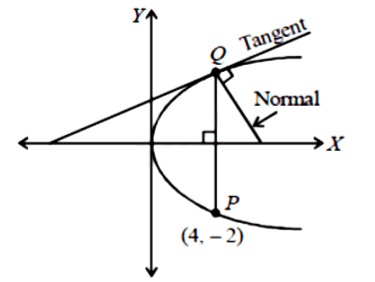
Point P is (4,-2) and PQ$\perp$x-axis So, $Q = (4,2)$. Equation of tangent at (4,2) is $y y_1 = \frac{1}{2}(x + x_1) \Rightarrow 2y = \frac{1}{2}(x + 2) \Rightarrow 4y = x + 2 \Rightarrow y = \frac{x}{4} + \frac{1}{2}$. So, slope of tangent $= 1/4$ $\therefore$ Slope of normal $= -4$.
Step Solution:
1. Identify point Q: Since the chord PQ is perpendicular to the axis (the x-axis) and P is (4, -2), Q must be its reflection across the axis, making $Q = (4, 2)$.
2. Differentiate the parabola: For $y^2 = x$, differentiating with respect to $x$ gives $2y \frac{dy}{dx} = 1$.
3. Calculate the tangent slope at Q: Substitute $y = 2$ into the derivative to find $m_{tangent} = \frac{1}{2(2)} = \mathbf{\frac{1}{4}}$.
4. Determine the normal slope: The slope of the normal is the negative reciprocal of the tangent slope: $m_{normal} = -\frac{1}{1/4} = \mathbf{-4}$.
The difficulty level: Easy
The Concept Name: Slope of normal to a parabola.
Short cut solution: For the parabola $y^2 = 4ax$, the slope of the normal at $(x_1, y_1)$ is $-y_1 / (2a)$. Here $4a = 1 \Rightarrow a = 1/4$ and for Q, $y_1 = 2$. Thus, $m = -2 / (2 \times 1/4) = -2 / (1/2) = -4$.
Question 504
Question: Statement 1: $y = mx - 1/m$ is always a tangent to the parabola, $y^2 = - 4x$ for all non-zero values of m.
Statement 2: Every tangent to the parabola, $y^2 = - 4x$ will meet its axis at a point whose abscissa is nonnegative.
Options:
A. Statement 1 is true, Statement 2 is true; Statement 2 is a correct explanation of Statement 1.
B. Statement 1 is false, Statement 2 is true.
C. Statement 1 is true, Statement 2 is false.
D. Statement 1 is true, Statement 2 is true, Statement 2 is not a correct explanation of Statement 1.
Correct Answer: D
Year: Online May 7, 2012
Solution (as Given in the Source):
Both the given statements are true. Statement -2 is not the correct explanation for statement -1.
Step Solution:
1. Analyze Statement 1: For the parabola $y^2 = -4x$, the parameter $a = -1$. The standard equation for a tangent is $y = mx + a/m$. Substituting $a = -1$ gives $y = mx - 1/m$, which is true for $m \neq 0$.
2. Analyze Statement 2: The axis of the parabola $y^2 = -4x$ is the x-axis ($y = 0$). To find where the tangent meets the axis, set $y = 0$ in the tangent equation: $0 = mx - 1/m$.
3. Calculate the abscissa: Solving for $x$ gives $mx = 1/m$, which leads to $x = 1/m^2$.
4. Verify nonnegativity: Since $m$ is a non-zero real number, $m^2$ is always positive, meaning $x = 1/m^2$ is always greater than zero, thus nonnegative. Statement 2 is true.
5. Determine Relationship: While both statements are true, the property of where a tangent meets the axis does not explain why the specific formula $y = mx - 1/m$ is the tangent.
The difficulty level: Medium
The Concept Name: Tangents to a Parabola.
Short cut solution: The tangent to $y^2 = 4ax$ is $y = mx + a/m$ and it intersects the x-axis at $(-a/m^2, 0)$. For $y^2 = -4x$ ($a = -1$), the intersection is $(1/m^2, 0)$. Because $1/m^2 > 0$ for all $m \neq 0$, the abscissa is always positive.
Question 514
Question: If two tangents drawn from a point P to the parabola $y^2 = 4x$ are at right angles, then the locus of P is
Options:
A. $2x + 1 = 0$
B. $x = -1$
C. $2x - 1 = 0$
D. $x = 1$
Correct Answer: B
Year: 2010
Solution:
We know that the locus of perpendicular tangents is directrix i.e., $x = -a$; $x = -1$.
Step Solution:
1. Identify Parabola Parameters: The given equation is $y^2 = 4x$. Comparing this with the standard form $y^2 = 4ax$, we find $a = 1$.
2. Apply Geometrical Property: A fundamental property of a parabola is that the locus of the point of intersection of mutually perpendicular tangents is always the directrix of that parabola.
3. Find Directrix Equation: For the parabola $y^2 = 4ax$, the equation of the directrix is $x = -a$.
4. Substitute Value: Substitute $a = 1$ into the directrix equation to get $x = -1$.
5. Final Locus: Thus, the locus of the point P is the line $x = -1$.
The difficulty level: Easy
The Concept Name: Locus of intersection of perpendicular tangents to a parabola (Directrix property).
Short cut solution: For any parabola, perpendicular tangents intersect on the directrix. For $y^2 = 4x$, the directrix is simply $x = -1$.
Question 522
Question: The equation of a tangent to the parabola $y^2 = 8x$ is $y = x + 2$. The point on this line from which the other tangent to the parabola is perpendicular to the given tangent is
Options:
A. (2, 4)
B. (-2, 0)
C. (-1, 1)
D. (0, 2)
Correct Answer: B
Year: 2007
Solution: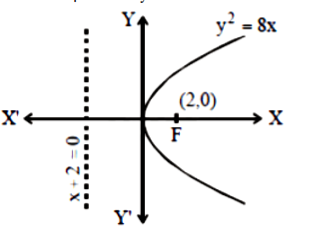
Given that parabola $y^2 = 8x$. We know that the locus of point of intersection of two perpendicular tangents to a parabola is its directrix. Point must be on the directrix of parabola $\because$ Equation of directrix $x + 2 = 0 \Rightarrow X = -2$. Hence the point is (-2, 0).
Step Solution:
1. Identify Parabola Parameter: For the parabola $y^2 = 8x$, compare with $y^2 = 4ax$ to find $4a = 8$, so $a = 2$.
2. Use Locus Property: The point from which perpendicular tangents can be drawn to a parabola must lie on its directrix.
3. Determine Directrix: For $y^2 = 8x$, the directrix equation is $x = -a$, which is $x = -2$.
4. Apply Line Condition: The required point must lie on the given tangent line $y = x + 2$ as well as on the directrix $x = -2$.
5. Find Coordinates: Substitute $x = -2$ into the line equation: $y = -2 + 2 = 0$. Therefore, the point is $(-2, 0)$.
The difficulty level: Medium
The Concept Name: Locus of intersection of perpendicular tangents to a parabola.
Short cut solution: Perpendicular tangents to a parabola always intersect on the directrix ($x = -2$ here). Only option B, $(-2, 0)$, has an $x$-coordinate of $-2$.