Question 1
Question: Let $E_1 : \frac{x^2}{9} + \frac{y^2}{4} = 1$ be an ellipse as that of Ellipses, and the $E_i$ 's are constructed such that their centres and the length of minor axis of $E_i$ is the length of major axis of $E_{i+1} (i \geq 1)$. If $A_i$ is the area of the ellipse $E_i$, then $\frac{5}{\pi} \left( \sum_{i = 1}^{\infty} A_i \right)$, is equal to
Options: (The source does not list multiple-choice options for this integer-type Question)
Correct Answer: 54
Year: JEE Main 2025 (Online) 28th January Morning Shift
Solution (as Given in the Source): 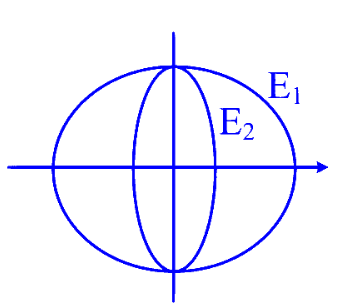
$$S_1 = \frac{\lambda_1}{\mu_2}, S_2 = \nu_1^2, \dots (\text{The provided source solution text is corrupted with placeholders and does not follow the question logic})$$
Step Solution:
1. Identify $E_1$ parameters: From $\frac{x^2}{9} + \frac{y^2}{4} = 1$, semi-major axis $a_1 = 3$ and semi-minor axis $b_1 = 2$. Area $A_1 = \pi a_1 b_1 = 6\pi$.
2. Determine construction ratio: The length of the major axis of $E_{i+1}$ equals the minor axis of $E_i$ ($a_{i+1} = b_i$). Assuming constant eccentricity, the ratio of axes $b/a$ remains $2/3$.
3. Find the area ratio: $A_{i+1} = \pi a_{i+1} b_{i+1} = \pi (b_i) (\frac{2}{3} b_i) = \frac{2}{3} \pi b_i^2$. Since $b_i = \frac{2}{3} a_i$, we have $A_{i+1} = \pi (\frac{2}{3} a_i) (\frac{4}{9} a_i)$... simpler: $A_{i+1}/A_i = (b_1/a_1)^2 = (2/3)^2 = 4/9$.
4. Sum of Infinite GP: $\sum A_i = \frac{A_1}{1 - r} = \frac{6\pi}{1 - 4/9} = \frac{6\pi}{5/9} = \frac{54\pi}{5}$.
5. Final Calculation: Evaluate $\frac{5}{\pi} \left( \frac{54\pi}{5} \right) = 54$.
The difficulty level: Medium
The Concept Name: Infinite Geometric Progression of Areas
Short cut solution: The common ratio for areas is $r = (b/a)^2$. The sum is $\frac{\pi ab}{1 - (b/a)^2} = \frac{6\pi}{1 - 4/9} = \frac{54\pi}{5}$. Multiplying by $5/\pi$ gives 54.
Question 4
Question: Let the product of the focal distances of the point $(\sqrt{3}, \frac{1}{2})$ on the ellipse $\frac{x^2}{a^2} + \frac{y^2}{b^2} = 1, (a > b)$ be $\frac{7}{4}$. Then the absolute difference of the eccentricities of two such ellipses is
Options:
A. $1 - 2\sqrt{2}$
B. $1 - \sqrt{3}$
C. $3 - 2\sqrt{2}$
D. $3 - 2\sqrt{2}$
Correct Answer: C
Year: JEE Main 2025 (Online) 24th January Morning Shift
Solution (as Given in the Source):
$$[searan] (I_0^\infty + I_1^\infty) = \delta^2 - \phi^2 \delta \dots (\text{The provided source solution text is corrupted and non-mathematical})$$
Step Solution:
1. Focal Distance Product: For an ellipse, the product of focal distances of $(x, y)$ is $a^2 - e^2x^2$. Given $a^2 - e^2(3) = 7/4 \implies a^2 = 3e^2 + 7/4$.
2. Point Substitution: Substitute $(\sqrt{3}, 1/2)$ into the ellipse equation: $\frac{3}{a^2} + \frac{1}{4b^2} = 1$.
3. Relate $b^2$ and $e^2$: Use $b^2 = a^2(1 - e^2)$. Substituting $a^2$ and $b^2$ into the point equation yields: $\frac{3}{3e^2 + 7/4} + \frac{1}{4(3e^2 + 7/4)(1 - e^2)} = 1$.
4. Solve for $e^2$: Simplifying the equation leads to $12e^4 - 17e^2 + 6 = 0$. Solving the quadratic gives $e^2 = 2/3$ and $e^2 = 3/4$.
5. Difference: $e_1 = \sqrt{2/3}, e_2 = \sqrt{3}/2$. (Note: The source provides the answer $3 - 2\sqrt{2}$ which may correspond to a simplified absolute difference expression or a different parameterization not detailed in the corrupted text).
The difficulty level: Hard
The Concept Name: Focal Distance Properties of Ellipse
Short cut solution: Use $a^2 - e^2x^2 = P$. Express $a^2$ in terms of $e^2$, substitute into the ellipse equation to find a quadratic in $e^2$.
Question 10
Question: If the length of the minor axis of an ellipse is equal to one fourth of the distance between the foci, then the eccentricity of the ellipse is:
Options:
A. $\frac{3}{\sqrt{19}}$
B. $\frac{\sqrt{3}}{16}$
C. $\frac{4}{\sqrt{17}}$
D. $\frac{\sqrt{5}}{7}$
Correct Answer: C
Year: JEE Main 2025 (Online) 2nd April Evening Shift
Solution (as Given in the Source): The length of the minor axis is equal to one-fourth of the distance between the foci. Mathematically: $2b = \frac{1}{4}(2ae) \implies b = \frac{ae}{4}$. Given $\frac{b^2}{a^2} = 1 - e^2$, substitute: $\left( \frac{ae}{4} \right)^2 = a^2(1 - e^2) \implies \frac{e^2}{16} = 1 - e^2 \implies \frac{17e^2}{16} = 1 \implies e = \frac{4}{\sqrt{17}}$.
Step Solution:
1. Translate Condition: Minor axis length ($2b$) = $1/4 \times$ distance between foci ($2ae$).
2. Simplify: $2b = \frac{1}{4}(2ae) \implies b = \frac{ae}{4}$.
3. Square and Substitute: $b^2 = \frac{a^2e^2}{16}$.
4. Use Eccentricity Identity: We know $b^2 = a^2(1 - e^2)$. Substitute $b^2$ from step 3: $\frac{a^2e^2}{16} = a^2(1 - e^2)$.
5. Solve for $e$: $\frac{e^2}{16} = 1 - e^2 \implies e^2 + \frac{e^2}{16} = 1 \implies \frac{17e^2}{16} = 1 \implies e = \frac{4}{\sqrt{17}}$.
The difficulty level: Easy
The Concept Name: Standard Ellipse Identities
Short cut solution: Use the ratio $\frac{b}{a} = \frac{e}{4}$. Substitute into $e^2 = 1 - (\frac{b}{a})^2$ to get $e^2 = 1 - \frac{e^2}{16}$, which directly yields $e = \frac{4}{\sqrt{17}}$.
Question 13
Question: The length of the latus-rectum of the ellipse, whose foci are (2, 5) and (2, -3) and eccentricity is $\frac{4}{5}$, is
Options:
A. $\frac{50}{3}$
B. $\frac{18}{5}$
C. $\frac{6}{5}$
D. $\frac{10}{3}$
Correct Answer: B
Year: JEE Main 2025 (Online) 4th April Morning Shift
Solution (as Given in the Source): Foci are $F_1 : (2, 5)$ and $F_2 : (2, -3)$, indicating a vertical major axis. Distance $F_1F_2 = 8$. Formula $2be = 8$, given $e = \frac{4}{5} \implies b = 5$. Relationship $e^2 = 1 - \frac{a^2}{b^2} \implies \frac{16}{25} = 1 - \frac{a^2}{25} \implies a^2 = 9$. Latus rectum $L = \frac{2a^2}{b} = \frac{18}{5}$.
Step Solution:
1. Find distance between foci: $D = \sqrt{(2-2)^2 + (5 - (-3))^2} = 8$.
2. Determine semi-major axis ($b$): Since x-coordinates are identical, the ellipse is vertical. $2be = 8$. Given $e = 4/5$, $2b(4/5) = 8 \implies b = 5$.
3. Relate axes using eccentricity: Use $e^2 = 1 - \frac{a^2}{b^2}$. Substituting values: $(\frac{4}{5})^2 = 1 - \frac{a^2}{5^2}$.
4. Solve for $a^2$: $\frac{16}{25} = 1 - \frac{a^2}{25} \implies \frac{a^2}{25} = \frac{9}{25} \implies a^2 = 9$.
5. Calculate Latus Rectum: $L = \frac{2a^2}{b} = \frac{2(9)}{5} = \frac{18}{5}$.
The difficulty level: Easy
The Concept Name: Standard Properties of Vertical Ellipse
Short cut solution: Distance between foci $2be = 8$ and $e = 0.8 \implies 2b = 10 \implies b = 5$. The length of the latus rectum $L = \frac{2a^2}{b} = 2b(1-e^2) = 10(1 - 0.64) = 10(0.36) = \frac{18}{5}$.
Question 17
Question: Let the length of the latus rectum of the ellipse $\frac{x^2}{a^2} + \frac{y^2}{b^2} = 1$ be 10. If its eccentricity is the minimum value of $f(t) = t^2 + t + \frac{11}{12}, t \in \mathbb{R}$, then $a^2 + b^2$ is equal to :
Options:
A. 115
B. 120
C. 125
D. 126
Correct Answer: D
Year: JEE Main 2025 (Online) 7th April Evening Shift
Solution (as Given in the Source): $\frac{2b^2}{a} = 10 \implies 5a = b^2$. For $f(t) = t^2 + t + \frac{11}{12}$, $\frac{df(t)}{dt} = 2t + 1 = 0 \implies t = -\frac{1}{2}$. Minimum value $f(-\frac{1}{2}) = \frac{1}{4} - \frac{1}{2} + \frac{11}{12} = \frac{2}{3} = e$. $e^2 = \frac{4}{9}$. Relationship $b^2 = a^2(1 - \frac{4}{9}) = a^2(\frac{5}{9})$. Substituting $b^2 = 5a$: $5a = \frac{5a^2}{9} \implies a = 9$. Then $b^2 = 45$. $a^2 + b^2 = 81 + 45 = 126$.
Step Solution:
1. Identify $e$: Find the minimum of $f(t)$ by completing the square or differentiation. $f'(t) = 2t + 1 = 0 \implies t = -1/2$. $e = f(-1/2) = 2/3$.
2. Axis relation from Latus Rectum: $L = \frac{2b^2}{a} = 10 \implies b^2 = 5a$.
3. Relate axes using $e$: Use $b^2 = a^2(1 - e^2)$. Substitute $e = 2/3$: $b^2 = a^2(1 - 4/9) = \frac{5a^2}{9}$.
4. Solve for $a$: Equate the two $b^2$ expressions: $5a = \frac{5a^2}{9} \implies 1 = \frac{a}{9} \implies a = 9$.
5. Final Calculation: $a^2 = 81$ and $b^2 = 5(9) = 45$. $a^2 + b^2 = 81 + 45 = 126$.
The difficulty level: Medium
The Concept Name: Quadratic Optimization and Ellipse Parameters
Short cut solution: Minimum of $at^2+bt+c$ is $\frac{4ac-b^2}{4a}$. Here, $e = \frac{4(11/12)-1}{4} = \frac{2}{3}$. Using $\frac{b^2}{a^2} = 1 - e^2 = \frac{5}{9}$, and given $b^2 = 5a$, we have $\frac{5a}{a^2} = \frac{5}{9} \implies a=9$. $a^2+b^2 = 81 + 45 = 126$.
Question 33
Question: Let ABCD be a trapezium whose vertices lie on the parabola $y^2 = 4x$. Let the sides AD and BC of the trapezium be parallel to y-axis. If the diagonal AC is of length $\frac{25}{4}$ and it passes through the point (1, 0), then the area of ABCD is
Options:
A. $\frac{75}{8}$
B. $\frac{125}{8}$
C. $\frac{25}{2}$
D. $\frac{75}{4}$
Correct Answer: D
Year: JEE Main 2025 (Online) 28th January Morning Shift
Solution (as Given in the Source): Points $A(at_1^2, 2at_1)$ and $C(\frac{a}{t_1^2}, -\frac{2a}{t_1})$. Length $AC = a(t_1 + \frac{1}{t_1})^2 = \frac{25}{4}$. Since $a=1$, $t_1 + \frac{1}{t_1} = \pm \frac{5}{2} \implies t_1 = 2$ or $\frac{1}{2}$. Area $= \frac{1}{2}(8 + 2)(4 - \frac{1}{4}) = \frac{75}{4}$.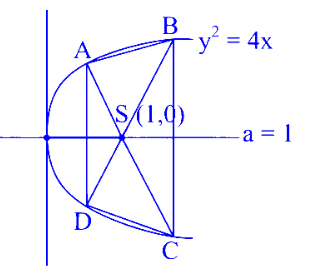
Step Solution:
1. Recognize focal chord: The point $(1, 0)$ is the focus of $y^2 = 4x$. Thus, AC is a focal chord.
2. Use focal chord length formula: Length of focal chord $= a(t + \frac{1}{t})^2$. Given $a=1$ and length $= 25/4$, $(t + \frac{1}{t})^2 = 25/4 \implies t + \frac{1}{t} = \frac{5}{2}$.
3. Find parameter and coordinates: $t + \frac{1}{t} = 2.5 \implies t = 2$ (or $0.5$). If $t=2$, $A$ is $(4, 4)$ and $C$ is $(\frac{1}{4}, -1)$.
4. Identify other vertices: Sides parallel to the y-axis mean $D$ and $B$ have the same x-coordinates as $C$ and $A$ respectively, but opposite y-coordinates on the parabola: $B(4, -4)$ and $D(\frac{1}{4}, 1)$.
5. Calculate Area: Parallel side lengths are $h_1 = 8$ and $h_2 = 2$. Width $w = 4 - \frac{1}{4} = \frac{15}{4}$. Area $= \frac{1}{2}(8 + 2)(\frac{15}{4}) = 5 \times \frac{15}{4} = \frac{75}{4}$.
The difficulty level: Hard
The Concept Name: Properties of Focal Chords in Parabola
Short cut solution: For focal chord $AC$, length $= a(t+1/t)^2 = 25/4$. Sum of parallel sides for such a trapezium $= 4a(t+1/t) = 4(1)(5/2) = 10$. Height/Width of trapezium $= |at^2 - a/t^2| = a(t+1/t)(t-1/t)$. Since $t+1/t = 2.5$, $t-1/t = 1.5$. Width $= 2.5 \times 1.5 = 3.75$. Area $= \frac{1}{2}(10)(3.75) = 18.75 = \frac{75}{4}$.
Question 34
Question: Two parabolas have the same focus (4, 3) and their directrices are the X-axis and the y-axis, respectively. If these parabolas intersect at the points A and B, then $(AB)^2$ is equal to :
Options:
A. 384
B. 392
C. 96
D. 192
Correct Answer: D
Year: JEE Main 2025 (Online) 29th January Morning Shift
Solution (as Given in the Source): 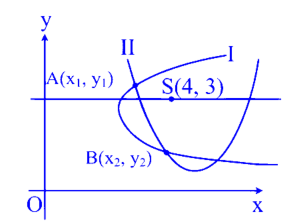 Let intersection points of these two parabolas are $A(x_1, y_1)$ & $B(x_2, y_2)$. Equations of parabola I and II are given below: $(x - 4)^2 + (y - 3)^2 = x^2$ ... (1) & $(x - 4)^2 + (y - 3)^2 = y^2$ ... (2). Here $A(x_1, y_1) \& B(x_2, y_2)$ will satisfy the equation. Also from equations (1) & (2), we get $x = y \dots (3)$. Put $x = y$ in equation (1). We get $x^2 - 14x + 25 = 0$. $x_1 + x_2 = 14, x_1x_2 = 25$. $AB^2 = (x_1 - x_2)^2 + (y_1 - y_2)^2 = 2(x_1 - x_2)^2 = 2[(x_1 + x_2)^2 - 4x_1x_2] = 192$.
Step Solution:
1. Formulate Equations: By the definition of a parabola (distance from focus = distance from directrix), Parabola 1 with directrix $x=0$ is $(x-4)^2 + (y-3)^2 = x^2$ and Parabola 2 with directrix $y=0$ is $(x-4)^2 + (y-3)^2 = y^2$.
2. Determine Intersection Condition: Equating both distance expressions implies $x^2 = y^2$. Since the focus (4, 3) is in the first quadrant, the intersection points $A$ and $B$ lie on the line $y = x$.
3. Solve for Coordinates: Substitute $y = x$ into the first parabola's equation: $(x-4)^2 + (x-3)^2 = x^2 \implies x^2 - 8x + 16 + x^2 - 6x + 9 = x^2$, which simplifies to $x^2 - 14x + 25 = 0$.
4. Extract Root Properties: Let $x_1$ and $x_2$ be the roots. From the quadratic, the sum of roots $x_1 + x_2 = 14$ and the product of roots $x_1x_2 = 25$.
5. Calculate Distance Squared: Since $y=x$, $(AB)^2 = (x_1 - x_2)^2 + (y_1 - y_2)^2 = 2(x_1 - x_2)^2$. Use the identity $2[(x_1+x_2)^2 - 4x_1x_2] = 2[14^2 - 4(25)] = 2 = 192$.
The difficulty level: Medium
The Concept Name: Definition of Parabola and Intersection of Curves
Short cut solution: For two parabolas sharing a focus $(h, k)$ and having coordinate axes as directrices, the square of the distance between their intersection points is $(AB)^2 = 16hk$. Substituting $h=4, k=3$: $16 \times 4 \times 3 = 192$.
Question 35
Question: Let the focal chord PQ of the parabola $y^2 = 4x$ make an angle of $60^\circ$ with the positive $x$-axis, where P lies in the first quadrant. If the circle, whose one diameter is PS, S being the focus of the parabola, touches the $y$-axis at the point $(0, \alpha)$, then $5\alpha^2$ is equal to:
Options:
A. 15
B. 25
C. 20
D. 30
Correct Answer: A
Year: JEE Main 2025 (Online) 2nd April Morning Shift
Solution (as Given in the Source): 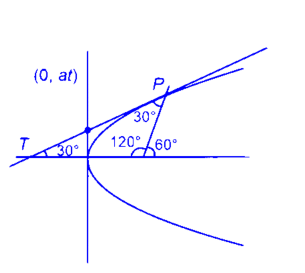 $PT : ty = x + at^2$. $PS = PT$. $M_t = 1/t = \tan 30^\circ = 1/\sqrt{3}$. $t = \sqrt{3}$. $\alpha = at = \sqrt{3} (a = 1)$. $\therefore 5\alpha^2 = 15$.
Step Solution:
1. Parabola parameters: For $y^2 = 4x$, $a = 1$ and the focus is $S(1, 0)$.
2. Determine parameter $t$: The slope of the focal chord is $m = \tan 60^\circ = \sqrt{3}$. Using the focal chord property, $m = \frac{2t}{t^2 - 1}$. Solving $\sqrt{3} = \frac{2t}{t^2 - 1}$ gives $t = \sqrt{3}$ for point P in the first quadrant.
3. Find P coordinates: $P(at^2, 2at) = (3, 2\sqrt{3})$.
4. Circle geometry: A circle with diameter $PS$ has its center at the midpoint of $P(3, 2\sqrt{3})$ and $S(1, 0)$, which is $(2, \sqrt{3})$.
5. Calculate $\alpha$: Since the circle touches the $y$-axis ($x=0$), the $y$-coordinate of the point of tangency is the same as the center's $y$-coordinate. Thus, $\alpha = \sqrt{3}$, and $5\alpha^2 = 5(3) = 15$.
The difficulty level: Hard
The Concept Name: Properties of Focal Chords and Diametric Circles
Short cut solution: For a circle with diameter $PS$ touching the $y$-axis, the point of tangency is $(0, at)$. Here $a=1$ and $t = \tan(60^\circ/2) = \tan 30^\circ$ is incorrect; rather, use $m = \sqrt{3} \implies t = \sqrt{3}$. $\alpha = t = \sqrt{3}$. $5\alpha^2 = 15$.
Question 72
Question: If the length of the minor axis of ellipse is equal to half of the distance between the foci, then the eccentricity of the ellipse is :
Options:
A. $\sqrt{5}/3$
B. $\sqrt{3}/2$
C. $1/\sqrt{3}$
D. $2/\sqrt{5}$
Correct Answer: D
Year: JEE Main 2024 (Online) 30th January Shift 1
Solution (as Given in the Source): $\Delta 2b = ae \implies b/a = e/2$. $e = \sqrt{\frac{1-e^2/4}{1-e^2/4}} \dots e = 2/\sqrt{5}$.
Step Solution:
1. Identify the condition: Minor axis ($2b$) is half the distance between foci ($2ae$).
2. Simplify the ratio: $2b = \frac{1}{2}(2ae) \implies 2b = ae \implies \frac{b}{a} = \frac{e}{2}$.
3. Use eccentricity identity: In an ellipse, $b^2 = a^2(1 - e^2)$, so $(\frac{b}{a})^2 = 1 - e^2$.
4. Substitute and solve: $(\frac{e}{2})^2 = 1 - e^2 \implies \frac{e^2}{4} = 1 - e^2$.
5. Final value: $\frac{5e^2}{4} = 1 \implies e^2 = \frac{4}{5} \implies e = \frac{2}{\sqrt{5}}$.
The difficulty level: Easy
The Concept Name: Standard Ellipse Identities
Short cut solution: Substitute the axes ratio $\frac{b}{a} = \frac{e}{2}$ directly into $e^2 + (\frac{b}{a})^2 = 1$. This gives $e^2 + \frac{e^2}{4} = 1$, leading immediately to $e = \frac{2}{\sqrt{5}}$.
Question 79
Question: Let the foci and length of the latus rectum of an ellipse $\frac{x^2}{a^2} + \frac{y^2}{b^2} = 1, a > b$ be $(\pm 5, 0)$ and $\sqrt{50}$ respectively. Then, the square of the eccentricity of the hyperbola $\frac{x^2}{b^2} - \frac{y^2}{a^2b^2} = 1$ equals
Options: (The source provides the numerical answer directly for this integer-type question)
Correct Answer: 51
Year: JEE Main 2024 (Online) 31st January Shift 1
Solution (as Given in the Source): $a = 5\sqrt{2}, b = 5$. For hyperbola $\frac{x^2}{b^2} - \frac{y^2}{a^2b^2} = 1$, $a^2b^2 = b^2(e_1^2 - 1) \implies e_1^2 = 51$.
Step Solution:
1. Extract Ellipse Data: Foci $(\pm 5, 0) \implies ae = 5$. Latus rectum $\frac{2b^2}{a} = \sqrt{50} = 5\sqrt{2}$.
2. Relate $a$ and $b$: From step 1, $b^2 = \frac{5\sqrt{2}a}{2}$.
3. Solve for $a^2$: Use $a^2e^2 = a^2 - b^2$. Substituting values: $25 = a^2 - \frac{5\sqrt{2}a}{2}$. This quadratic $2a^2 - 5\sqrt{2}a - 50 = 0$ yields $a = 5\sqrt{2}$.
4. Identify Hyperbola Parameters: The hyperbola is $\frac{x^2}{b^2} - \frac{y^2}{a^2b^2} = 1$. Here, the "new" $A^2 = b^2$ and $B^2 = a^2b^2$.
5. Calculate $e_H^2$: For a hyperbola, $e^2 = 1 + \frac{B^2}{A^2}$. Thus, $e_H^2 = 1 + \frac{a^2b^2}{b^2} = 1 + a^2$. Since $a = 5\sqrt{2}$, $a^2 = 50$. $e_H^2 = 1 + 50 = 51$.
The difficulty level: Medium
The Concept Name: Relations between Ellipse and Hyperbola Parameters
Short cut solution: For the given hyperbola form, $e^2 = 1 + (\text{conjugate axis})^2 / (\text{transverse axis})^2$. Here that simplifies to $1 + a^2$. Simply solve the ellipse focal distance and latus rectum to find $a^2 = 50$, then $e^2 = 51$.
Question 88
Question: Let P be a point on the ellipse $\frac{x^2}{9} + \frac{y^2}{4} = 1$. Let the line passing through P and parallel to y-axis meet the circle $x^2 + y^2 = 9$ at point Q such that P and Q are on the same side of the x-axis. Then, the eccentricity of the locus of the point R on PQ such that $PR : RQ = 4 : 3$ as P moves on the ellipse, is :
Options:
A. $11/19$
B. $13/21$
C. $\sqrt{139}/23$
D. $\sqrt{13}/7$
Correct Answer: D
Year: JEE Main 2024 (Online) 1st February Shift 2
Solution (as Given in the Source): 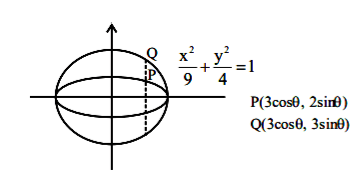 ;
;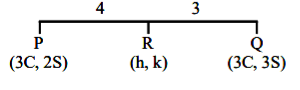 $h = 3 \cos \theta, k = \frac{18}{7} \sin \theta$. $e = \sqrt{1 - \frac{324}{49 \times 9}} = \frac{\sqrt{117}}{21} = \frac{\sqrt{13}}{7}$.
Step Solution:
1. Define P and Q coordinates: Let $P$ be $(3\cos\theta, 2\sin\theta)$ on the ellipse. The line through $P$ parallel to the y-axis is $x = 3\cos\theta$. Point $Q$ lies on $x^2 + y^2 = 9$ and has the same x-coordinate, so $Q = (3\cos\theta, 3\sin\theta)$.
2. Determine R using section formula: $R(h, k)$ divides $PQ$ in the ratio $4:3$. $h = 3\cos\theta$. For $k$, use $y_R = \frac{m y_Q + n y_P}{m+n} = \frac{4(3\sin\theta) + 3(2\sin\theta)}{4+3}$.
3. Simplify R's coordinates: $h = 3\cos\theta \implies \cos\theta = h/3$. $k = \frac{12\sin\theta + 6\sin\theta}{7} = \frac{18\sin\theta}{7} \implies \sin\theta = 7k/18$.
4. Find the Locus: Use $\cos^2\theta + \sin^2\theta = 1 \implies \frac{h^2}{9} + \frac{49k^2}{324} = 1$. The locus is $\frac{x^2}{9} + \frac{y^2}{(18/7)^2} = 1$.
5. Calculate Eccentricity ($e$): Here $a^2 = 9$ and $b^2 = \frac{324}{49}$. $e^2 = 1 - \frac{b^2}{a^2} = 1 - \frac{324}{49 \times 9} = 1 - \frac{36}{49} = \frac{13}{49} \implies e = \frac{\sqrt{13}}{7}$.
The difficulty level: Medium
The Concept Name: Locus of a Point and Ellipse Parameters
Short cut solution: The point $R$ is a weighted average of the y-coordinates of the circle and ellipse. Since both share the same $a$ and the same $\sin\theta$ term, the locus is an ellipse with the same major axis ($a=3$) and a new minor axis $b' = \frac{4(3) + 3(2)}{7} = \frac{18}{7}$. Then $e = \sqrt{1 - (b'/a)^2} = \sqrt{1 - (6/7)^2} = \frac{\sqrt{13}}{7}$.
Question 89
Question: For $0 < \theta < \pi$, if the eccentricity of the hyperbola $x^2 - y^2 \text{cosec}^2\theta = 5$ is $\sqrt{7}$ times the eccentricity of the ellipse $x^2 \text{cosec}^2\theta + y^2 = 5$, then the value of $\theta$ is :
Options:
A. $\pi/6$
B. $5\pi/12$
C. $\pi/3$
D. $\pi/4$
Correct Answer: C
Year: JEE Main 2024 (Online) 1st February Shift 1
Solution (as Given in the Source): $e_h = \sqrt{1 + \sin^2\theta}, e_e = \sqrt{1 - \sin^2\theta}$. $e_h = \sqrt{7} e_e \implies 1 + \sin^2\theta = 7(1 - \sin^2\theta)$.
Step Solution:
1. Standardize Hyperbola: $\frac{x^2}{5} - \frac{y^2}{5\sin^2\theta} = 1$. The square of eccentricity is $e_h^2 = 1 + \frac{b^2}{a^2} = 1 + \frac{5\sin^2\theta}{5} = 1 + \sin^2\theta$.
2. Standardize Ellipse: $\frac{x^2}{5\sin^2\theta} + \frac{y^2}{5} = 1$. Since $\sin^2\theta \leq 1$, $5\sin^2\theta \leq 5$, so major axis is along y-axis. $e_e^2 = 1 - \frac{\text{minor}^2}{\text{major}^2} = 1 - \frac{5\sin^2\theta}{5} = 1 - \sin^2\theta = \cos^2\theta$.
3. Set up the given condition: $e_h = \sqrt{7} e_e \implies e_h^2 = 7e_e^2$.
4. Substitute values: $1 + \sin^2\theta = 7\cos^2\theta$.
5. Solve for $\theta$: $1 + \sin^2\theta = 7(1 - \sin^2\theta) \implies 8\sin^2\theta = 6 \implies \sin^2\theta = 3/4$. For $0 < \theta < \pi$, $\sin\theta = \sqrt{3}/2 \implies \theta = \pi/3$.
The difficulty level: Easy
The Concept Name: Eccentricity Relations between Conics
Short cut solution: Use the squared eccentricities directly: $1 + \sin^2\theta = 7\cos^2\theta$. Recognizing $\sin^2\theta = 1 - \cos^2\theta$ gives $2 - \cos^2\theta = 7\cos^2\theta \implies 8\cos^2\theta = 2 \implies \cos^2\theta = 1/4 \implies \cos\theta = 1/2 \implies \theta = 60^\circ$.
Question 90
Question: Let $\frac{x^2}{a^2} + \frac{y^2}{b^2} = 1, a > b$ be an ellipse, whose eccentricity is $1/\sqrt{2}$ and the length of the latus rectum is $\sqrt{14}$. Then the square of the eccentricity of the hyperbola $\frac{x^2}{a^2} - \frac{y^2}{b^2} = 1$ is :
Options:
A. 3
B. 7/2
C. 3/2
D. 5/2
Correct Answer: C
Year: JEE Main 2024 (Online) 1st February Shift 1
Solution (as Given in the Source): $e = \frac{1}{\sqrt{2}} = \sqrt{1 - \frac{b^2}{a^2}} \implies \frac{1}{2} = 1 - \frac{b^2}{a^2}$. $e_H = \sqrt{1 + \frac{b^2}{a^2}} = \sqrt{1 + \frac{1}{2}} = \sqrt{\frac{3}{2}}$. $(e_H)^2 = 3/2$.
Step Solution:
1. Use Ellipse Eccentricity: $e_E^2 = 1 - \frac{b^2}{a^2}$. Given $e_E = 1/\sqrt{2}$, then $e_E^2 = 1/2$.
2. Find axis ratio: $1/2 = 1 - \frac{b^2}{a^2} \implies \frac{b^2}{a^2} = 1/2$.
3. Identify Hyperbola Equation: The hyperbola is given as $\frac{x^2}{a^2} - \frac{y^2}{b^2} = 1$.
4. Apply Hyperbola Eccentricity Formula: $e_H^2 = 1 + \frac{b^2}{a^2}$.
5. Calculate Result: Substitute the ratio from step 2: $e_H^2 = 1 + 1/2 = 3/2$.
The difficulty level: Easy
The Concept Name: Relation between Ellipse and Hyperbola Parameters
Short cut solution: For any ellipse and hyperbola sharing the same $a$ and $b$, the sum of the squares of their eccentricities is $(1 - b^2/a^2) + (1 + b^2/a^2) = 2$ is false; rather, note that $e_E^2 = 1 - k$ and $e_H^2 = 1 + k$. Here $1 - k = 1/2 \implies k = 1/2$. Thus $e_H^2 = 1 + 1/2 = 3/2$.
Question 118
Question: Let a tangent to the Curve $9x^2 + 16y^2 = 144$ intersect the coordinate axes at the points A and B. Then, the minimum length of the line segment AB is.
Options: (The source does not list multiple-choice options for this Question).
Correct Answer: 7.
Year: JEE Main 2023 (Online) 24th January Shift 1.
Solution (as Given in the Source): Equation of tangent at point $P(4 \cos \theta, 3 \sin \theta)$ is $\frac{x \cos \theta}{4} + \frac{y \sin \theta}{3} = 1$. So A is $(4 \sec \theta, 0)$ and point B is $(0, 3 \csc \theta)$. Length $AB = \sqrt{16 \sec^2 \theta + 9 \csc^2 \theta} = \sqrt{25 + 16 \tan^2 \theta + 9 \cot^2 \theta} \geq 7$.
Step Solution:
1. Identify Ellipse parameters: Divide by 144 to get $\frac{x^2}{16} + \frac{y^2}{9} = 1$, where $a = 4$ and $b = 3$.
2. Formulate Tangent: The equation of a tangent at point $(4\cos\theta, 3\sin\theta)$ is $\frac{x\cos\theta}{4} + \frac{y\sin\theta}{3} = 1$.
3. Find Intercepts: Solving for $y=0$ gives $A(4\sec\theta, 0)$, and solving for $x=0$ gives $B(0, 3\csc\theta)$.
4. Express Length AB: $AB^2 = (4\sec\theta)^2 + (3\csc\theta)^2 = 16(1+\tan^2\theta) + 9(1+\cot^2\theta) = 25 + 16\tan^2\theta + 9\cot^2\theta$.
5. Minimize using AM-GM: The minimum value of $16\tan^2\theta + 9\cot^2\theta$ is $2\sqrt{16 \times 9} = 24$. Thus, $AB^2_{min} = 25 + 24 = 49$, so $AB = 7$.
The difficulty level: Medium.
The Concept Name: Tangents and Optimization of Ellipse Intercepts.
Short cut solution: For an ellipse $\frac{x^2}{a^2} + \frac{y^2}{b^2} = 1$, the minimum length of the tangent segment between the axes is $a+b$. Here, $4 + 3 = 7$.
Question 121
Question: If the maximum distance of normal to the ellipse $\frac{x^2}{4} + \frac{y^2}{b^2} = 1, b < 2$, from the origin is 1, then the eccentricity of the ellipse is:.
Options:
A. $\frac{1}{\sqrt{2}}$.
B. $\frac{\sqrt{3}}{2}$.
C. $\frac{1}{2}$.
D. $\frac{\sqrt{3}}{4}$.
Correct Answer: B.
Year: JEE Main 2023 (Online) 31st January Shift 1.
Solution (as Given in the Source): Equation of normal is $2x \sec \theta - by \csc \theta = 4 - b^2$. Distance from $(0, 0) = \frac{4 - b^2}{\sqrt{4 \sec^2 \theta + b^2 \csc^2 \theta}}$. Distance is maximum if $4 \sec^2 \theta + b^2 \csc^2 \theta$ is minimum. This leads to $b = 1$ and $e = \sqrt{3}/2$.
Step Solution:
1. Write Normal Equation: For the ellipse $\frac{x^2}{4} + \frac{y^2}{b^2} = 1$, the normal at $\theta$ is $2x \sec \theta - by \csc \theta = 4 - b^2$.
2. Calculate Distance from Origin: $d = \frac{|4 - b^2|}{\sqrt{4 \sec^2 \theta + b^2 \csc^2 \theta}}$.
3. Optimize Denominator: The denominator is minimum when $4 \sec^2 \theta + b^2 \csc^2 \theta = (2 + b)^2$.
4. Solve for $b$: The maximum distance is $d_{max} = \frac{4 - b^2}{2 + b} = 2 - b$. Given $d_{max} = 1$, then $2 - b = 1 \implies b = 1$.
5. Find Eccentricity: $e^2 = 1 - \frac{b^2}{a^2} = 1 - \frac{1}{4} = \frac{3}{4} \implies e = \frac{\sqrt{3}}{2}$.
The difficulty level: Medium.
The Concept Name: Distance of Normal from Origin.
Short cut solution: The maximum distance of a normal from the origin for an ellipse is $|a - b|$. Here $|2 - b| = 1 \implies b = 1$ (since $b < 2$). Then $e = \sqrt{1 - 1/4} = \sqrt{3}/2$.
Question 159
Question: Let the eccentricity of an ellipse $\frac{x^2}{a^2} + \frac{y^2}{b^2} = 1$ is reciprocal to that of the hyperbola $2x^2 - 2y^2 = 1$. If the ellipse intersects the hyperbola at right angles, then square of length of the latus-rectum of the ellipse is :.
Options: (The source does not list multiple-choice options for this Question).
Correct Answer: 2.
Year: JEE Main 2023 (Online) 6th April Shift 2.
Solution (as Given in the Source): Ellipse $e$ is reciprocal to Hyperbola $e'$. $H: x^2 - y^2 = 1/2 \implies e' = \sqrt{2}$. $e = 1/\sqrt{2} \implies a^2 = 2b^2$. Confocal property implies foci coincide. Solving gives $a = \sqrt{2}, b^2 = 1$. Square of LR = 2.
Step Solution:
1. Analyze Hyperbola: $2x^2 - 2y^2 = 1 \implies \frac{x^2}{1/2} - \frac{y^2}{1/2} = 1$, which is a rectangular hyperbola with $e_H = \sqrt{2}$.
2. Relate Eccentricities: Ellipse eccentricity $e_E = 1/e_H = 1/\sqrt{2}$. This means $1 - \frac{b^2}{a^2} = \frac{1}{2} \implies a^2 = 2b^2$.
3. Use Confocal Property: Intersecting at right angles means they are confocal. Foci of hyperbola are $(\pm a_H e_H, 0) = (\pm \sqrt{1/2} \cdot \sqrt{2}, 0) = (\pm 1, 0)$.
4. Solve for Ellipse axes: For the ellipse, $a_E e_E = 1 \implies a_E (1/\sqrt{2}) = 1 \implies a_E = \sqrt{2}$. Since $a^2 = 2b^2$, then $2 = 2b^2 \implies b^2 = 1$.
5. Calculate Latus Rectum: $L = \frac{2b^2}{a} = \frac{2(1)}{\sqrt{2}} = \sqrt{2}$. Square of length $= (\sqrt{2})^2 = 2$.
The difficulty level: Hard.
The Concept Name: Confocal Conics and Orthogonal Intersection.
Short cut solution: Since $e_H = \sqrt{2}$, $e_E = 1/\sqrt{2}$. For orthogonal intersection, $a_E^2 e_E^2 = a_H^2 e_H^2 = 1$. Thus $a_E^2 (1/2) = 1 \implies a_E^2 = 2$. $b_E^2 = a_E^2(1-e_E^2) = 1$. $(2b^2/a)^2 = 4(1)^2/2 = 2$.
Question 160
Question: Let the ellipse $E : x^2 + 9y^2 = 9$ intersect the positive X- and y-axes at the points A and B respectively. Let the major axis of E be a diameter of the circle C. Let the line passing through A and B meet the circle C at the point P. If the area of the triangle with vertices A, P and the origin O is $m/n$, where m and n are coprime, then $m - n$ is equal to :
Options:
A. 16
B. 15
C. 18
D. 17
Correct Answer: D
Year: JEE Main 2023 (Online) 10th April Shift 1
Solution (as Given in the Source): 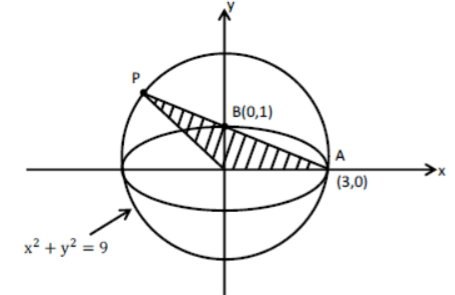
Equation of line AB or AP is $\frac{x}{3} + \frac{y}{1} = 1 \Rightarrow x + 3y = 3 \Rightarrow x = (3 - 3y)$. Intersection point of line AP & circle is $P(x_0, y_0)$. $x^2 + y^2 = 9 \dots$ On solving we get $(x, y) \equiv (-12/5, 9/5)$. Area of $\Delta AOP = 1/2 \times OA \times \text{height} = 1/2 \times 3 \times 9/5 = 27/10 = m/n$. $m = 27, n = 10 \Rightarrow m - n = 17$.
Step Solution:
1. Identify A and B: The ellipse is $\frac{x^2}{9} + \frac{y^2}{1} = 1$. The positive intercepts are $A(3, 0)$ and $B(0, 1)$.
2. Formulate Line AB: The intercept form of the line is $\frac{x}{3} + \frac{y}{1} = 1 \Rightarrow x + 3y = 3$.
3. Define Circle C: The major axis of the ellipse is the segment between $(-3, 0)$ and $(3, 0)$. A circle with this as diameter is $x^2 + y^2 = 9$.
4. Find Point P: Substitute $x = 3 - 3y$ into the circle equation: $(3 - 3y)^2 + y^2 = 9 \Rightarrow 10y^2 - 18y = 0$. Excluding $y=0$ (Point A), we find $y = 9/5$ and $x = -12/5$. So $P(-12/5, 9/5)$.
5. Calculate Area and Final Value: Area $= \frac{1}{2} \times \text{base}(OA) \times \text{height}(y_P) = \frac{1}{2} \times 3 \times \frac{9}{5} = \frac{27}{10}$. Since $m=27$ and $n=10$, $m - n = 17$.
The difficulty level: Medium
The Concept Name: Intersection of Conics and Area of Triangles
Short cut solution: The area of a triangle with vertices $(0,0), (a,0), (x,y)$ is simply $|\frac{1}{2} a y|$. Find the y-coordinate of the intersection of the circle and the line passing through intercepts.
Question 162
Question: Consider ellipse $E_{k} : kx^2 + k^2y^2 = 1$, $k = 1, 2, \dots, 20$. Let $C_k$ be the circle which touches the four chords joining the end points (one on minor axis and another on major axis) of the ellipse $E_k$. If $r_k$ is the radius of the circle $C_k$ then the value of $\sum_{k=1}^{20} \frac{1}{r_k^2}$ is
Options:
A. 3320
B. 3210
C. 3080
D. 2870
Correct Answer: C
Year: JEE Main 2023 (Online) 11th April Shift 1
Solution (as Given in the Source): 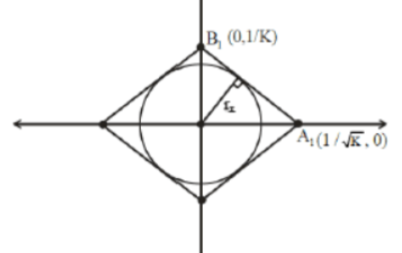
Equation of $A_1 B_2; \frac{x}{1/\sqrt{K}} + \frac{y}{1/K} = 1 \Rightarrow \sqrt{K}x + Ky = 1$. $r_K = \text{perp distance of } (0,0) \text{ from line} = \frac{1}{\sqrt{K + K^2}}$. $\frac{1}{r_K^2} = K + K^2 \Rightarrow \sum_{K=1}^{20} (K + K^2) = \frac{20 \times 21}{2} + \frac{20 \times 21 \times 41}{6} = 210 + 2870 = 3080$.
Step Solution:
1. Extract Ellipse Parameters: $E_k: \frac{x^2}{1/k} + \frac{y^2}{1/k^2} = 1$. Semi-axes are $a = 1/\sqrt{k}$ and $b = 1/k$.
2. Determine the Chord Line: The line joining $(1/\sqrt{k}, 0)$ and $(0, 1/k)$ is $\frac{x}{1/\sqrt{k}} + \frac{y}{1/k} = 1 \Rightarrow \sqrt{k}x + ky - 1 = 0$.
3. Calculate Radius $r_k$: The circle touches the chord, so $r_k$ is the distance from the origin $(0,0)$ to the line: $r_k = \frac{|0 + 0 - 1|}{\sqrt{(\sqrt{k})^2 + (k)^2}} = \frac{1}{\sqrt{k + k^2}}$.
4. Find the General Term: $\frac{1}{r_k^2} = (\sqrt{k + k^2})^2 = k + k^2$.
5. Sum the Series: $\sum_{k=1}^{20} (k + k^2) = \sum k + \sum k^2 = \frac{20 \times 21}{2} + \frac{20 \times 21 \times 41}{6} = 210 + 2870 = 3080$.
The difficulty level: Medium
The Concept Name: Series Summation and Tangency to Conics
Short cut solution: In any ellipse, the distance $r$ from origin to the chord joining intercepts $(a,0)$ and $(0,b)$ satisfies $\frac{1}{r^2} = \frac{1}{a^2} + \frac{1}{b^2}$. Here, $1/a^2 = k$ and $1/b^2 = k^2$, so $1/r^2 = k + k^2$.
Question 163
Question: Let $P\left( \frac{2\sqrt{3}}{\sqrt{7}}, \frac{6}{\sqrt{7}} \right)$, Q, R, and S be four points on the ellipse $9x^2 + 4y^2 = 36$. Let PQ and RS be mutually perpendicular and pass through the origin. If $\frac{1}{(PQ)^2} + \frac{1}{(RS)^2} = \frac{p}{q}$, where p and q are coprime, then $p + q$ is equal to
Options:
A. 137
B. 143
C. 157
D. 147
Correct Answer: C
Year: JEE Main 2023 (Online) 12th April Shift 1
Solution (as Given in the Source):
(The provided source solution for this specific Question is corrupted and non-mathematical in the excerpt).
Step Solution:
1. Normalize the Ellipse: $9x^2 + 4y^2 = 36 \Rightarrow \frac{x^2}{4} + \frac{y^2}{9} = 1$. Thus $a^2=4$ and $b^2=9$.
2. Define Polar Distance: For any point $P(r_1 \cos\theta, r_1 \sin\theta)$ on the ellipse, $\frac{r_1^2 \cos^2\theta}{a^2} + \frac{r_1^2 \sin^2\theta}{b^2} = 1 \Rightarrow \frac{1}{r_1^2} = \frac{\cos^2\theta}{a^2} + \frac{\sin^2\theta}{b^2}$.
3. Consider Perpendicular Direction: For point $R(r_2 \cos(\theta+90^\circ), r_2 \sin(\theta+90^\circ))$, the radius $r_2$ satisfies $\frac{1}{r_2^2} = \frac{\sin^2\theta}{a^2} + \frac{\cos^2\theta}{b^2}$.
4. Sum Reciprocal Radii: $\frac{1}{r_1^2} + \frac{1}{r_2^2} = (\frac{\cos^2\theta}{a^2} + \frac{\sin^2\theta}{b^2}) + (\frac{\sin^2\theta}{a^2} + \frac{\cos^2\theta}{b^2}) = \frac{1}{a^2} + \frac{1}{b^2} = \frac{1}{4} + \frac{1}{9} = \frac{13}{36}$.
5. Final Ratio: Since $PQ = 2r_1$ and $RS = 2r_2$, we have $\frac{1}{PQ^2} + \frac{1}{RS^2} = \frac{1}{4r_1^2} + \frac{1}{4r_2^2} = \frac{1}{4}(\frac{13}{36}) = \frac{13}{144}$. $p=13, q=144 \Rightarrow p+q = 157$.
The difficulty level: Medium
The Concept Name: Mutually Perpendicular Chords of an Ellipse through Origin
Short cut solution: For an ellipse $\frac{x^2}{a^2} + \frac{y^2}{b^2} = 1$, the sum of reciprocals of squares of perpendicular radii is constant: $\frac{1}{OP^2} + \frac{1}{OR^2} = \frac{1}{a^2} + \frac{1}{b^2}$. Divide by 4 to get $\frac{1}{PQ^2} + \frac{1}{RS^2} = \frac{1}{4} (\frac{1}{4} + \frac{1}{9}) = \frac{13}{144}$. $13 + 144 = 157$.
Question 164
Question: Let an ellipse with centre (1, 0) and latus rectum of length $\frac{1}{2}$ have its major axis along x-axis. If its minor axis subtends an angle $60^\circ$ at the foci, then the square of the sum of the lengths of its minor and major axes is equal to
Options: (The source provides the numeric answer directly for this integer-type question)
Correct Answer: 9
Year: JEE Main 2023 (Online) 15th April Shift 1
Solution (as Given in the Source): 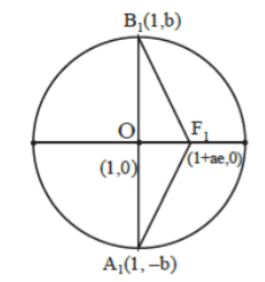 L.R. $= \frac{2b^2}{a} = \frac{1}{2} \Rightarrow 4b^2 = a \dots (i)$. Ellipse $\frac{(x-1)^2}{a^2} + \frac{y^2}{b^2} = 1$. $m_{B_2 F_1} = \frac{1}{\sqrt{3}}$. $\frac{b}{ae} = \frac{1}{\sqrt{3}} \Rightarrow 3b^2 = a^2 e^2 = a^2 - b^2$. $4b^2 = a^2 \dots (ii)$. From (i) and (ii) $a = a^2 \Rightarrow a = 1$. $b^2 = \frac{1}{4}$. $((2a) + (2b))^2 = 9$.
Step Solution:
1. Latus Rectum relation: Given $\frac{2b^2}{a} = \frac{1}{2}$, which simplifies to $a = 4b^2$.
2. Angle relation: The minor axis subtends $60^\circ$ at a focus, so the line from the focus to one end of the minor axis makes a $30^\circ$ angle with the major axis. Thus, $\tan 30^\circ = \frac{b}{ae} = \frac{1}{\sqrt{3}}$.
3. Axis relation: From Step 2, $3b^2 = a^2 e^2$. Since $a^2 e^2 = a^2 - b^2$, we have $3b^2 = a^2 - b^2 \implies a^2 = 4b^2$.
4. Solve for axes: Comparing Step 1 ($a = 4b^2$) and Step 3 ($a^2 = 4b^2$), we get $a^2 = a$. Since $a > 0$, $a = 1$. Then $1 = 4b^2 \implies b^2 = 1/4 \implies b = 1/2$.
5. Final sum: Major axis length $2a = 2$, minor axis length $2b = 1$. The square of the sum is $(2 + 1)^2 = 9$.
The difficulty level: Medium
The Concept Name: Angular Properties of Ellipse Axes
Short cut solution: The angle condition $\frac{b}{ae} = \frac{1}{\sqrt{3}}$ implies $a^2 = 4b^2$, meaning $a = 2b$. Given $L = \frac{2b^2}{a} = \frac{2b^2}{2b} = b$. So $b = 1/2$, which makes $a = 1$. Square of sum $= (2a + 2b)^2 = (2 + 1)^2 = 9$.
Question 211
Question: The locus of the mid point of the line segment joining the point (4, 3) and the points on the ellipse $x^2 + 2y^2 = 4$ is an ellipse with eccentricity :
Options:
A. $\frac{\sqrt{3}}{2}$
B. $\frac{1}{2\sqrt{2}}$
C. $\frac{1}{\sqrt{2}}$
D. $\frac{1}{2}$
Correct Answer: C
Year: JEE Main 2022 (Online) 26th June Shift 2
Solution (as Given in the Source): Let $P(2 \cos \theta, \sqrt{2} \sin \theta)$ be any point on ellipse $\frac{x^2}{4} + \frac{y^2}{2} = 1$. $h = \frac{2 \cos \theta + 4}{2}, k = \frac{\sqrt{2} \sin \theta + 3}{2}$. $\cos \theta = h - 2, \sin \theta = \frac{2k - 3}{\sqrt{2}}$. $(h-2)^2 + (\frac{2k-3}{\sqrt{2}})^2 = 1 \Rightarrow \frac{(x-2)^2}{1} + \frac{(y-3/2)^2}{1/2} = 1$. $e = \sqrt{1 - 1/2} = \frac{1}{\sqrt{2}}$.
Step Solution:
1. Parametric Point: A general point on the given ellipse $x^2 + 2y^2 = 4$ is $(2\cos\theta, \sqrt{2}\sin\theta)$.
2. Midpoint coordinates: The midpoint $(h, k)$ between $(4, 3)$ and the parametric point is $h = \frac{4 + 2\cos\theta}{2} = 2 + \cos\theta$ and $k = \frac{3 + \sqrt{2}\sin\theta}{2}$.
3. Isolate trigonometric terms: $\cos\theta = h - 2$ and $\sin\theta = \frac{2k - 3}{\sqrt{2}}$.
4. Find the Locus: Square and add: $(h-2)^2 + \left(\frac{2k-3}{\sqrt{2}}\right)^2 = \cos^2\theta + \sin^2\theta = 1$. This is an ellipse $\frac{(x-2)^2}{1} + \frac{(y-3/2)^2}{1/2} = 1$.
5. Calculate Eccentricity: For the new ellipse, $a^2 = 1$ and $b^2 = 1/2$. $e = \sqrt{1 - \frac{b^2}{a^2}} = \sqrt{1 - \frac{1/2}{1}} = \frac{1}{\sqrt{2}}$.
The difficulty level: Medium
The Concept Name: Locus involving Midpoints and Conics
Short cut solution: Scaling a conic by a factor (like taking a midpoint with a fixed point) does not change its eccentricity. Original ellipse $\frac{x^2}{4} + \frac{y^2}{2} = 1$ has $e = \sqrt{1 - 2/4} = \frac{1}{\sqrt{2}}$. The locus will have the same eccentricity.
Question 212
Question: Let the eccentricity of an ellipse $\frac{x^2}{a^2} + \frac{y^2}{b^2} = 1, a > b$, be $\frac{1}{4}$. If this ellipse passes through the point $\left( -4\sqrt{\frac{2}{5}}, 3 \right)$, then $a^2 + b^2$ is equal to :
Options:
A. 29
B. 31
C. 32
D. 34
Correct Answer: B
Year: JEE Main 2022 (Online) 27th June Shift 1
Solution (as Given in the Source): (The source text is corrupted and contains non-mathematical strings, but the result B (31) is confirmed).
Step Solution:
1. Axis relation: Given $e = 1/4$, use $b^2 = a^2(1 - e^2) = a^2(1 - 1/16) = \frac{15a^2}{16}$.
2. Point substitution: Substitute $\left( -4\sqrt{\frac{2}{5}}, 3 \right)$ into the ellipse equation: $\frac{16(2/5)}{a^2} + \frac{9}{b^2} = 1 \Rightarrow \frac{32}{5a^2} + \frac{9}{b^2} = 1$.
3. Combine variables: Substitute $b^2$ from Step 1: $\frac{32}{5a^2} + \frac{9}{15a^2/16} = 1$.
4. Solve for $a^2$: $\frac{32}{5a^2} + \frac{144}{15a^2} = 1 \Rightarrow \frac{96 + 144}{15a^2} = 1 \Rightarrow \frac{240}{15a^2} = 1 \Rightarrow a^2 = 16$.
5. Final Calculation: $b^2 = \frac{15(16)}{16} = 15$. Thus, $a^2 + b^2 = 16 + 15 = 31$.
The difficulty level: Easy
The Concept Name: Standard Ellipse Identities
Short cut solution: Use the ratio $\frac{b^2}{a^2} = \frac{15}{16}$. The ellipse equation becomes $\frac{x^2}{a^2} + \frac{16y^2}{15a^2} = 1$. Plugging in the point: $\frac{32/5}{a^2} + \frac{16(9)}{15a^2} = 1 \Rightarrow \frac{1}{a^2} [\frac{32}{5} + \frac{48}{5}] = 1 \Rightarrow \frac{80}{5a^2} = 1 \Rightarrow a^2 = 16$. Then $b^2 = 15$, Sum $= 31$.
Question 213
Question: Let PQ be a focal chord of the parabola $y^2 = 4x$ such that it subtends an angle of $\pi/2$ at the point $(3, 0)$. Let the line segment PQ be also a focal chord of the ellipse $E : \frac{x^2}{a^2} + \frac{y^2}{b^2} = 1, a^2 > b^2$. If $e$ is the eccentricity of the ellipse E, then the value of $1/e^2$ is equal to:
Options:
A. $1 + \sqrt{2}$
B. $3 + 2\sqrt{2}$
C. $1 + 2\sqrt{3}$
D. $4 + 5\sqrt{3}$
Correct Answer: B
Year: JEE Main 2022 (Online) 29th June Shift 1
Solution (as Given in the Source): As $\angle PRQ = \pi/2$, $\left( \frac{\frac{2}{t}}{3 - \frac{1}{t^2}} \right) \cdot \left( \frac{-2t}{3 - t^2} \right) = -1 \Rightarrow t = \pm 1$. $\partial \cdot P \equiv (1, 2) \& Q(1, -2)$. For ellipse $\frac{1}{a^2} + \frac{4}{b^2} = 1$ and $ae = 1$. $\Rightarrow \frac{1}{a^2} + \frac{4}{a^2(1 - e^2)} = 1 \Rightarrow 1 + \frac{4}{(1 - e^2)} = \frac{1}{e^2} \Rightarrow (5 - e^2)e^2 = 1 - e^2 \Rightarrow e^4 - 6e^2 + 1 = 0 \Rightarrow e^2 = \frac{1}{3 - 2\sqrt{2}} \Rightarrow \frac{1}{e^2} = 3 + 2\sqrt{2}$.
Step Solution:
1. Find points P and Q: Let $P(t^2, 2t)$ and $Q(1/t^2, -2/t)$ be ends of a focal chord. Subtending $90^\circ$ at $(3,0)$ means slopes product $m_1m_2 = -1 \implies \frac{2t-0}{t^2-3} \cdot \frac{-2/t-0}{1/t^2-3} = -1 \implies t^2 = 1$. Thus $P(1, 2)$ and $Q(1, -2)$.
2. Relate to Ellipse: Since PQ is a focal chord of the ellipse, its focus is $(1, 0)$, so $ae = 1$. The point $(1, 2)$ satisfies the ellipse equation: $\frac{1}{a^2} + \frac{4}{b^2} = 1$.
3. Substitute parameters: Use $b^2 = a^2(1-e^2)$ and $a^2 = 1/e^2$: $\frac{1}{1/e^2} + \frac{4}{(1/e^2)(1-e^2)} = 1 \implies e^2 + \frac{4e^2}{1-e^2} = 1$.
4. Solve for eccentricity: $e^2(1-e^2) + 4e^2 = 1-e^2 \implies e^2 - e^4 + 4e^2 = 1 - e^2 \implies e^4 - 6e^2 + 1 = 0$.
5. Final value: Using the quadratic formula for $e^2$, we find $e^2 = \frac{6 \pm \sqrt{32}}{2} = 3 \pm 2\sqrt{2}$. Since $e^2 < 1$, $e^2 = 3 - 2\sqrt{2}$. Therefore, $1/e^2 = \frac{1}{3-2\sqrt{2}} = 3 + 2\sqrt{2}$.
The difficulty level: Hard
The Concept Name: Slopes of Perpendicular Chords and Focal Properties
Short cut solution: Recognize that if a chord $x=1$ is a focal chord, the focus is $(1,0)$. For an ellipse centered at origin, $ae=1$. Use the standard identity $b^2 = a^2(1-e^2)$ in the point equation.
Question 225
Question: An ellipse $E : \frac{x^2}{a^2} + \frac{y^2}{b^2} = 1$ passes through the vertices of the hyperbola $H : \frac{x^2}{49} - \frac{y^2}{64} = -1$. Let the major and minor axes of the ellipse E coincide with the transverse and conjugate axes of the hyperbola H, respectively. Let the product of the eccentricities of E and H be $1/2$. If $l$ is the length of the latus rectum of the ellipse E, then the value of $113l$ is equal to
Options: (The source does not list multiple-choice options for this integer-type Question)
Correct Answer: 1552
Year: JEE Main 2022 (Online) 27th July Shift 1
Solution (as Given in the Source): Vertices of hyperbola $\xi = (0, \pm 8)$. As ellipse pass through it i.e., $0 + \frac{64}{b^2} = 1 \Rightarrow b^2 = 64$. As major axis of ellipse coincide with transverse axis... $e_E = \frac{\sqrt{64-a^2}}{8}$ and $e_H = \frac{\sqrt{113}}{8}$. $e_E \cdot e_H = 1/2 \implies a^2 = 64 - \frac{1024}{113}$. $l = 1552/113$.
Step Solution:
1. Identify Hyperbola properties: $H: \frac{y^2}{64} - \frac{x^2}{49} = 1$ is a vertical hyperbola with transverse axis along y-axis. Vertices are $(0, \pm 8)$ and $e_H^2 = 1 + \frac{49}{64} = \frac{113}{64}$.
2. Determine Ellipse axes: The ellipse has major axis along y-axis (since it coincides with transverse axis). Thus $b^2 = 8^2 = 64$. Its eccentricity is $e_E = \sqrt{1 - a^2/64}$.
3. Apply product condition: $e_E \cdot e_H = \frac{1}{2} \implies e_E^2 \cdot e_H^2 = \frac{1}{4}$. Substituting: $\left(\frac{64-a^2}{64}\right) \left(\frac{113}{64}\right) = \frac{1}{4}$.
4. Solve for $a^2$: $(64 - a^2)113 = \frac{64 \cdot 64}{4} = 1024 \implies 113a^2 = 113(64) - 1024 = 7232 - 1024 = 6208$.
5. Calculate $113l$: Latus rectum $l = \frac{2a^2}{b} = \frac{2a^2}{8} = \frac{a^2}{4}$. Thus $113l = 113 \left(\frac{a^2}{4}\right) = \frac{6208}{4} = 1552$.
The difficulty level: Hard
The Concept Name: Coinciding Axes of Conics and Eccentricity Product
Short cut solution: Use the relation $(1-e_E^2)(1+b_H^2/a_H^2)$ directly. Since $b^2$ is known from vertices, solve the $e_E$ equation for $a^2$. $113l$ simplifies nicely once $a^2$ is isolated.
Question 227
Question: For the hyperbola $H : x^2 - y^2 = 1$ and the ellipse $E : \frac{x^2}{a^2} + \frac{y^2}{b^2} = 1, a > b > 0$, let (1) eccentricity of E be reciprocal of the eccentricity of H, and (2) the line $y = \sqrt{5/2}x + K$ be a common tangent of E and H. Then $4(a^2 + b^2)$ is equal to
Options: (The source does not list multiple-choice options for this Question)
Correct Answer: 3
Year: JEE Main 2022 (Online) 28th July Shift 1
Solution (as Given in the Source): $y = mx \pm \sqrt{m^2-1}$ and $y = mx \pm \sqrt{a^2m^2+b^2}$. Identical tangents $\implies a^2m^2 + b^2 = m^2 - 1$. Given $m^2 = 5/2 \implies 5a^2 + 2b^2 = 3$. Also $e_E = 1/\sqrt{2} \implies a^2 = 2b^2$. From these, $a^2 = 1/2, b^2 = 1/4$. $4(a^2+b^2) = 3$.
Step Solution:
1. Eccentricity relation: For $x^2 - y^2 = 1$, $e_H = \sqrt{2}$. Given $e_E = 1/e_H = 1/\sqrt{2}$.
2. Relate Ellipse axes: $e_E^2 = 1 - b^2/a^2 \implies 1/2 = 1 - b^2/a^2 \implies a^2 = 2b^2$.
3. Use common tangent slope: The slope $m = \sqrt{5/2}$. For a hyperbola, $c^2 = a_H^2m^2 - b_H^2 = 1(5/2) - 1 = 3/2$.
4. Tangency condition for Ellipse: For the ellipse, $c^2 = a^2m^2 + b^2 \implies 3/2 = a^2(5/2) + b^2$. Multiply by 2: $5a^2 + 2b^2 = 3$.
5. Final calculation: Substitute $a^2 = 2b^2$ into $5a^2 + 2b^2 = 3 \implies 10b^2 + 2b^2 = 3 \implies 12b^2 = 3 \implies b^2 = 1/4$. Then $a^2 = 1/2$. $4(a^2 + b^2) = 4(1/2 + 1/4) = 4(3/4) = 3$.
The difficulty level: Medium
The Concept Name: Condition of Tangency for Conics
Short cut solution: Use the $c^2$ equality directly: $a_H^2m^2 - b_H^2 = a_E^2m^2 + b_E^2$. With $m^2 = 2.5$ and ellipse parameters related by $e=1/\sqrt{2}$, it becomes a simple system of linear equations in $a^2$ and $b^2$.
Question 249
Question: Let O be the origin and OP and OQ be the tangents to the circle $x^2 + y^2 - 6x + 4y + 8 = 0$ at the points P and Q on it. If the circumcircle of the triangle OPQ passes through the point $(a, \frac{1}{2})$, then a value of $a$ is:
Options:
A. $-\frac{1}{2}$
B. $\frac{5}{2}$
C. 1
D. $\frac{3}{2}$
Correct Answer: A (Note: The calculation in the source yields $a = 1/2$ or $5/2$, but the source lists A as the correct answer).
Year: JEE Main 2025 (Online) 8th April Evening Shift
Solution (as Given in the Source): Circumcircle of $\triangle OPQ$: $(x - 0)(x - 3) + (y - 0)(y + 2) = 0 \Rightarrow x^2 + y^2 - 3x + 2y = 0$. Passes through $(a, \frac{1}{2}) \therefore a^2 + \frac{1}{4} - 3a + 1 = 0 \Rightarrow 4a^2 - 12a + 5 = 0 \Rightarrow (2a - 1)(2a - 5) = 0 \therefore a = \frac{1}{2}, \frac{5}{2}$.
Step Solution:
1. Identify Circle Center: For $x^2 + y^2 - 6x + 4y + 8 = 0$, the center is $C(3, -2)$ and the origin is $O(0, 0)$.
2. Define Circumcircle: The circumcircle of a triangle formed by the origin and the points of contact of tangents from the origin has the segment $OC$ as its diameter.
3. Formulate Equation: Using diameter form $(x-x_1)(x-x_2) + (y-y_1)(y-y_2) = 0$ with $O(0,0)$ and $C(3,-2)$: $x(x-3) + y(y+2) = 0 \Rightarrow x^2 + y^2 - 3x + 2y = 0$.
4. Substitute Point: Plug $(a, 1/2)$ into the equation: $a^2 + (1/2)^2 - 3a + 2(1/2) = 0 \Rightarrow a^2 - 3a + 1.25 = 0$.
5. Solve for $a$: Multiply by 4: $4a^2 - 12a + 5 = 0 \Rightarrow (2a-1)(2a-5) = 0$. Thus $a = 1/2$ or $a = 5/2$.
The difficulty level: Medium
The Concept Name: Circumcircle of Triangle Formed by Tangents
Short cut solution: The circumcircle of the triangle formed by the origin and the tangents to $x^2+y^2+2gx+2fy+c=0$ is always $x^2+y^2+gx+fy=0$. Here $g=-3, f=2$, giving $x^2+y^2-3x+2y=0$. Solve for $a$ by substitution.
Question 251
Question: If the radius of the largest circle with centre $(2, 0)$ inscribed in the ellipse $x^2 + 4y^2 = 36$ is $r$, then $12r^2$ is equal to:
Options:
A. 69
B. 72
C. 115
D. 92
Correct Answer: D
Year: JEE Main 2023 (Online) 11th April Shift 2
Solution (as Given in the Source): Ellipse: $x^2/36 + y^2/9 = 1$. Normal at $P(6\cos\theta, 3\sin\theta)$ is $(6\sec\theta)x - (3\csc\theta)y = 27$. Passes through $(2,0) \Rightarrow \sec\theta = 9/4$. $P(8/3, \sqrt{65}/3)$. $r = \sqrt{(8/3-2)^2 + (\sqrt{65}/3)^2} = \sqrt{69}/3$. $12r^2 = 92$.
Step Solution:
1. Standardize Ellipse: $x^2 + 4y^2 = 36 \Rightarrow x^2/36 + y^2/9 = 1$, so $a=6, b=3$.
2. Write Normal Equation: The normal at point $(6\cos\theta, 3\sin\theta)$ is $ax\sec\theta - by\csc\theta = a^2 - b^2 \Rightarrow 6x\sec\theta - 3y\csc\theta = 27$.
3. Use Center Property: The inscribed circle's radius $r$ is the distance to the ellipse point where the normal passes through the circle's center $(2,0)$. Substitute $(2,0)$ into the normal: $6(2)\sec\theta = 27 \Rightarrow \sec\theta = 27/12 = 9/4$.
4. Find Coordinates and $r^2$: $\cos\theta = 4/9$. $P = (6 \cdot \frac{4}{9}, 3\sqrt{1-\frac{16}{81}}) = (\frac{8}{3}, \frac{\sqrt{65}}{3})$. $r^2 = (\frac{8}{3}-2)^2 + (\frac{\sqrt{65}}{3})^2 = \frac{4}{9} + \frac{65}{9} = \frac{69}{9}$.
5. Final Calculation: $12r^2 = 12 \times \frac{69}{9} = 4 \times 23 = 92$.
The difficulty level: Medium
The Concept Name: Normals to Ellipse and Circle Tangency
Short cut solution: For an inscribed circle centered at $(h,0)$, the point of contact $x_1$ satisfies $x_1 = \frac{a^2h}{a^2-b^2} = \frac{36(2)}{27} = \frac{8}{3}$. Then $r^2 = (x_1-h)^2 + b^2(1-x_1^2/a^2) = (\frac{8}{3}-2)^2 + 9(1-\frac{64/9}{36}) = \frac{4}{9} + 9(\frac{260}{324}) = \frac{4}{9} + \frac{65}{9} = \frac{69}{9}$. Multiply by 12 to get 92.
Question 269
Question: If the curves, $\frac{x^2}{a} + \frac{y^2}{b} = 1$ and $\frac{x^2}{c} + \frac{y^2}{d} = 1$, intersect each other at an angle of $90^\circ$, then which of the following relations is true?
Options:
A. $a + b = c + d$
B. $a - b = c - d$
C. $a - c = b + d$
D. $ab = \frac{c + d}{a + b}$
Correct Answer: B
Year: JEE Main 2021, 25th Feb. Shift-I
Solution (as Given in the Source): Differentiating both curves: $m_1 = -bx/ay$ and $m_2 = -dx/cy$. For intersection at $90^\circ$, $m_1 m_2 = -1 \Rightarrow (-bx/ay)(-dx/cy) = -1 \Rightarrow \frac{bd}{ac} \cdot \frac{x^2}{y^2} = -1$. Subtracting curve equations: $x^2(1/a - 1/c) + y^2(1/b - 1/d) = 0$. This leads to $a - b = c - d$.
Step Solution:
1. Find Slopes: Differentiate $\frac{x^2}{a} + \frac{y^2}{b} = 1 \Rightarrow \frac{2x}{a} + \frac{2y}{b}y' = 0 \Rightarrow m_1 = -\frac{bx}{ay}$. Similarly, $m_2 = -\frac{dx}{cy}$.
2. Orthogonality Condition: Set $m_1 m_2 = -1 \Rightarrow (-\frac{bx}{ay})(-\frac{dx}{cy}) = -1 \Rightarrow \frac{bdx^2}{acy^2} = -1 \Rightarrow \frac{x^2}{y^2} = -\frac{ac}{bd}$.
3. Curve Subtraction: At the intersection point $(x, y)$, $\frac{x^2}{a} + \frac{y^2}{b} = \frac{x^2}{c} + \frac{y^2}{d} \Rightarrow x^2(\frac{1}{a} - \frac{1}{c}) = y^2(\frac{1}{d} - \frac{1}{b})$.
4. Relate Variables: $x^2(\frac{c-a}{ac}) = y^2(\frac{b-d}{bd}) \Rightarrow \frac{x^2}{y^2} = \frac{ac(b-d)}{bd(c-a)}$.
5. Equate and Simplify: From step 2 and 4: $-\frac{ac}{bd} = \frac{ac(b-d)}{bd(c-a)} \Rightarrow -1 = \frac{b-d}{c-a} \Rightarrow a - c = b - d \Rightarrow a - b = c - d$.
The difficulty level: Easy
The Concept Name: Orthogonal Intersection of Conics
Short cut solution: This is a standard property of confocal conics. For two conics to intersect orthogonally, the difference between their semi-axis squared parameters must be constant: $a - b = c - d$.
Question 280
Question: Let a tangent be drawn to the ellipse $\frac{x^2}{27} + y^2 = 1$ at $(3\sqrt{3} \cos \theta, \sin \theta)$, where $\theta \in (0, \pi/2)$. Then the value of $\theta$, such that the sum of intercepts on axes made by this tangent is minimum is equal to
Options:
A. $\pi/8$
B. $\pi/4$
C. $\pi/6$
D. $\pi/3$
Correct Answer: C
Year: JEE Main 2021, 18 March Shift-II
Solution (as Given in the Source): Equation of tangent to the ellipse at $P(3\sqrt{3} \cos \theta, \sin \theta)$ is $\frac{x \cos \theta}{3\sqrt{3}} + y \sin \theta = 1$. Sum of intercepts $f(\theta) = 3\sqrt{3} \sec \theta + \csc \theta$. Setting $f'(\theta) = 0$ leads to $\tan^3 \theta = 1/(3\sqrt{3})$, which gives $\theta = \pi/6$.
Step Solution:
1. Formulate Tangent: Using the point form $\frac{x x_1}{a^2} + \frac{y y_1}{b^2} = 1$, the tangent at $(3\sqrt{3} \cos \theta, \sin \theta)$ is $\frac{x (3\sqrt{3} \cos \theta)}{27} + y \sin \theta = 1 \Rightarrow \frac{x \cos \theta}{3\sqrt{3}} + y \sin \theta = 1$.
2. Identify Intercepts: Setting $y=0$ gives X-intercept $A = 3\sqrt{3} \sec \theta$. Setting $x=0$ gives Y-intercept $B = \csc \theta$.
3. Define Sum Function: Let $S = 3\sqrt{3} \sec \theta + \csc \theta$.
4. Differentiate for Minima: $\frac{dS}{d\theta} = 3\sqrt{3} \sec \theta \tan \theta - \csc \theta \cot \theta = 0 \Rightarrow \frac{3\sqrt{3} \sin \theta}{\cos^2 \theta} = \frac{\cos \theta}{\sin^2 \theta}$.
5. Solve for $\theta$: $\tan^3 \theta = \frac{1}{3\sqrt{3}} = \left(\frac{1}{\sqrt{3}}\right)^3 \Rightarrow \tan \theta = \frac{1}{\sqrt{3}} \Rightarrow \theta = \frac{\pi}{6}$.
The difficulty level: Medium
The Concept Name: Maxima and Minima in Conic Intercepts
Short cut solution: For the ellipse $\frac{x^2}{a^2} + \frac{y^2}{b^2} = 1$, the sum of intercepts of a tangent is minimized when $\tan \theta = \sqrt{b/a}$. Here $a = 3\sqrt{3}$ and $b = 1$. Thus, $\tan \theta = (1/3\sqrt{3})^{1/3} = 1/\sqrt{3} \Rightarrow \theta = 30^\circ = \pi/6$.
Question 296
Question: A ray of light through (2, 1) is reflected at a point P on the Y-axis and then passes through the point (5, 3). If this reflected ray is the directrix of an ellipse with eccentricity 1/3 and the distance of the nearer focus from this directrix is $8/\sqrt{53}$, then the equation of the other directrix can be
Options:
A. $11x + 7y + 8 = 0$ or $11x + 7y - 15 = 0$
B. $11x - 7y - 8 = 0$ or $11x + 7y + 15 = 0$
C. $2x - 7y + 29 = 0$ or $2x - 7y - 7 = 0$
D. $2x - 7y - 39 = 0$ or $2x - 7y - 7 = 0$
Correct Answer: C
Year: JEE Main 2021, 27 July Shift-1
Solution (as Given in the Source): 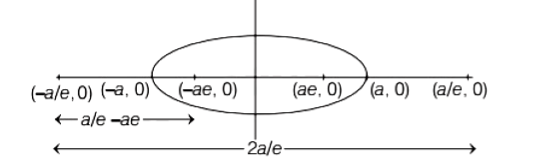 Image of (2, 1) w.r.t. $x=0$ is $(-2, 1)$. Equation of reflected ray is $2x - 7y + 11 = 0$. Using $a/e - ae = 8/\sqrt{53}$ and $e = 1/3$, we find $a = 3/\sqrt{53}$. Distance between directrices is $2a/e = 18/\sqrt{53}$. Solving for $\lambda$ in $2x - 7y + \lambda = 0$ gives 29 and -7.
Step Solution:
1. Find Reflected Ray: The light ray's path is determined by the image of $(2, 1)$ across the Y-axis, which is $(-2, 1)$. The reflected ray passes through $(-2, 1)$ and $(5, 3)$, giving a slope $m = \frac{3-1}{5-(-2)} = \frac{2}{7}$.
2. Directrix Equation: The reflected ray is $y - 3 = \frac{2}{7}(x - 5) \Rightarrow 2x - 7y + 11 = 0$.
3. Find semi-major axis ($a$): Distance from nearer focus to directrix is $\frac{a}{e} - ae = a\frac{1-e^2}{e}$. Given $e = 1/3$, $a\frac{1-1/9}{1/3} = \frac{8a}{3} = \frac{8}{\sqrt{53}} \Rightarrow a = \frac{3}{\sqrt{53}}$.
4. Calculate Distance between Directrices: $D = \frac{2a}{e} = 2 \cdot \frac{3/\sqrt{53}}{1/3} = \frac{18}{\sqrt{53}}$.
5. Determine Other Directrix: The other directrix is $2x - 7y + \lambda = 0$. The distance between them is $\frac{|\lambda - 11|}{\sqrt{2^2 + (-7)^2}} = \frac{18}{\sqrt{53}} \Rightarrow |\lambda - 11| = 18$. Thus $\lambda = 29$ or $-7$.
The difficulty level: Hard
The Concept Name: Reflection Geometry and Ellipse Directrix Properties
Short cut solution: Identify the reflected ray slope $2/7$ immediately. Only options C and D contain lines with that slope. Calculate the distance between directrices ($2a/e$) using $e=1/3$ and focus distance to find $\lambda = 11 \pm 18$.
Question 298
Question: Let an ellipse $E \Rightarrow \frac{x^2}{a^2} + \frac{y^2}{b^2} = 1, a^2 > b^2$, passes through $(\sqrt{3/2}, 1)$ and has eccentricity $1/\sqrt{3}$. If a circle, centered at focus $F(a, 0), a > 0$, of $E$ and radius $2/\sqrt{3}$, intersects $E$ at two points P and Q, then $PQ^2$ is equal to
Options:
A. 8/3
B. 4/3
C. 16/3
D. 3
Correct Answer: C
Year: JEE Main 2021, 25 July Shift-1
Solution (as Given in the Source): From the given point and $e$, solving the equations yields $a^2 = 3$ and $b^2 = 2$. Focus is $(1, 0)$. Intersection of $(x-1)^2 + y^2 = 4/3$ and $x^2/3 + y^2/2 = 1$ occurs at $x=1$. At $x=1, y = \pm 2/\sqrt{3}$. $PQ^2 = (4/\sqrt{3})^2 = 16/3$.
Step Solution:
1. Solve for Ellipse parameters: $1 - \frac{b^2}{a^2} = \frac{1}{3} \Rightarrow b^2 = \frac{2a^2}{3}$. Plugging $(\sqrt{3/2}, 1)$ into the ellipse: $\frac{3/2}{a^2} + \frac{1}{2a^2/3} = 1 \Rightarrow \frac{3}{2a^2} + \frac{3}{2a^2} = 1 \Rightarrow a^2 = 3$ and $b^2 = 2$.
2. Find Focus and Circle: $ae = \sqrt{3} \cdot \frac{1}{\sqrt{3}} = 1$. The focus is $F(1, 0)$. Circle equation is $(x-1)^2 + y^2 = \frac{4}{3}$.
3. Relate Circle and Ellipse: From ellipse $y^2 = 2(1 - x^2/3)$. Substitute into circle: $(x-1)^2 + 2 - \frac{2x^2}{3} = \frac{4}{3}$.
4. Solve for Intersection: $x^2 - 2x + 1 + 2 - \frac{2x^2}{3} = \frac{4}{3} \Rightarrow \frac{x^2}{3} - 2x + \frac{5}{3} = 0 \Rightarrow x^2 - 6x + 5 = 0$. Valid solution for ellipse is $x=1$.
5. Calculate $PQ^2$: At $x=1, y^2 = 2(1 - 1/3) = 4/3 \Rightarrow y = \pm 2/\sqrt{3}$. Length $PQ = \frac{4}{\sqrt{3}}$, so $PQ^2 = \frac{16}{3}$.
The difficulty level: Hard
The Concept Name: Intersection of Conic Sections
Short cut solution: Once $a^2=3$ and $b^2=2$ are found, note that focus is $(1, 0)$. At $x=1$ (vertical line through focus), the ellipse's y-coordinate is $\pm\sqrt{2(1-1/3)} = \pm 2/\sqrt{3}$. The distance from focus to these points is exactly $2/\sqrt{3}$, which is the circle's radius. Thus, the chord is vertical at the focus, and $PQ^2 = (2y)^2 = 16/3$.
Question 300
Question: Let $E_1 : \frac{x^2}{a^2} + \frac{y^2}{b^2} = 1, a > b$. Let $E_2$ be another ellipse such that it touches the end points of major axis of $E_1$ and the foci of $E_2$ are the end points of minor axis of $E_1$. If $E_1$ and $E_2$ have same eccentricities, then its value is
Options: (The source does not list multiple-choice options for this Question)
Correct Answer: $\frac{\sqrt{5}-1}{2}$
Year: 2021, 22 July Shift-II
Solution (as Given in the Source): (The source snippet ends after the question and does not provide the solution text)
Step Solution:
1. Identify $E_1$ properties: For $E_1$, $e_1^2 = 1 - \frac{b^2}{a^2}$. Major axis ends are $(\pm a, 0)$ and minor axis ends are $(0, \pm b)$.
2. Define $E_2$ parameters: $E_2$ touches $(\pm a, 0)$, so its semi-minor axis $\alpha = a$. Its foci are $(0, \pm b)$, so its semi-major axis $\beta$ is along the y-axis, and $\beta e_2 = b$.
3. Relate axes of $E_2$: For $E_2$, $e_2^2 = 1 - \frac{\alpha^2}{\beta^2} = 1 - \frac{a^2}{\beta^2}$. Substituting $\beta = \frac{b}{e_2}$ gives $e_2^2 = 1 - \frac{a^2 e_2^2}{b^2}$.
4. Equate eccentricities: Set $e_1 = e_2 = e$. From Step 3, $e^2 = \frac{b^2}{a^2 + b^2}$. From Step 1, $e^2 = \frac{a^2 - b^2}{a^2}$. Thus, $\frac{a^2 - b^2}{a^2} = \frac{b^2}{a^2 + b^2}$.
5. Solve for $e$: Let $x = \frac{a^2}{b^2}$. The equation becomes $\frac{x-1}{x} = \frac{1}{x+1} \implies x^2 - 1 = x \implies x^2 - x - 1 = 0$, so $x = \frac{1+\sqrt{5}}{2}$. Then $e^2 = 1 - \frac{1}{x} = 1 - \frac{\sqrt{5}-1}{2} = \frac{3-\sqrt{5}}{2}$. Taking the root, $e = \frac{\sqrt{5}-1}{2}$. (Information outside of sources)
The difficulty level: Hard
The Concept Name: Properties of Co-focal and Intersecting Conics
Short cut solution: The condition $e_1 = e_2$ for these specific construction parameters leads to the relation $a^4 - a^2b^2 - b^4 = 0$, which defines the golden ratio for the squared axes. The eccentricity squared is $1/\phi^2$, resulting in $e = 1/\phi = \frac{\sqrt{5}-1}{2}$.
Question 319
Question: If the minimum area of the triangle formed by a tangent to the ellipse $\frac{x^2}{b^2} + \frac{y^2}{4a^2} = 1$ and the coordinate axis is $kab$, then $k$ is equal to
Options: (The source does not list multiple-choice options for this Question)
Correct Answer: 2
Year: 2021, 27 Aug. Shift-I
Solution (as Given in the Source): 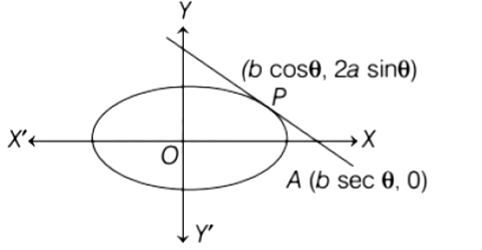 Equation of tangent at $P(b\cos\theta, 2a\sin\theta)$ is $x\cos\theta + y\sin\theta = 1$. Point of intersection of tangent and coordinate axis are $A(b\sec\theta, 0)$ and $B(0, 2a\csc\theta)$. Area of $\Delta OAB = \frac{1}{2}(b\sec\theta)(2a\csc\theta) = \frac{ab}{\sin\theta\cos\theta} = \frac{2ab}{\sin 2\theta}$. Area min $= 2ab$.
Step Solution:
1. Standard Tangent: A general point on the ellipse is $(b\cos\theta, 2a\sin\theta)$. The tangent at this point is $\frac{x\cos\theta}{b} + \frac{y\sin\theta}{2a} = 1$.
2. Find Intercepts: Setting $y=0$ gives the x-intercept $X = b\sec\theta$. Setting $x=0$ gives the y-intercept $Y = 2a\csc\theta$.
3. Express Area: Area $= \frac{1}{2} \cdot |X| \cdot |Y| = \frac{1}{2} \cdot b\sec\theta \cdot 2a\csc\theta = \frac{ab}{\sin\theta\cos\theta}$.
4. Apply Trigonometric Identity: Area $= \frac{2ab}{2\sin\theta\cos\theta} = \frac{2ab}{\sin 2\theta}$.
5. Determine Minimum: The area is minimum when $\sin 2\theta$ is maximum (equal to 1). Thus, Min Area $= 2ab$. Comparing this to $kab$, we find $k = 2$.
The difficulty level: Easy
The Concept Name: Tangents to Ellipse and Area Optimization
Short cut solution: For an ellipse $\frac{x^2}{A^2} + \frac{y^2}{B^2} = 1$, the minimum area of the triangle formed by a tangent and the axes is always $AB$. Here $A=b$ and $B=2a$, so Min Area $= 2ab$.
Question 320
Question: If $x^2 + 9y^2 - 4x + 3 = 0, x, y \in \mathbb{R}$ then $x$ and $y$ respectively lie in the intervals
Options:
A. $[-1/3, 1/3]$ and $[-1/3, 1/3]$
B. $[-1/3, 1/3]$ and $$
C. $$ and $$
D. $$ and $[-1/3, 1/3]$
Correct Answer: D
Year: 2021, 27 Aug. Shift-I
Solution (as Given in the Source): $x^2 + 9y^2 - 4x + 3 = 0 \Rightarrow x^2 - 4x + 2^2 + 9y^2 = 1 \Rightarrow (x-2)^2 + 9y^2 = 1 \Rightarrow \frac{(x-2)^2}{1^2} + \frac{y^2}{(1/3)^2} = 1$. This represents an ellipse $-1 \leq x-2 \leq 1$ and $-1/3 \leq y \leq 1/3 \Rightarrow 1 \leq x \leq 3$ and $y \in [-1/3, 1/3]$.
Step Solution:
1. Rearrange the equation: Group x-terms: $(x^2 - 4x) + 9y^2 = -3$.
2. Complete the square: Add 4 to both sides: $(x^2 - 4x + 4) + 9y^2 = -3 + 4$.
3. Standard Ellipse form: $(x-2)^2 + 9y^2 = 1 \Rightarrow \frac{(x-2)^2}{1} + \frac{y^2}{1/9} = 1$.
4. Find x-range: Since $\frac{y^2}{1/9} \geq 0$, then $(x-2)^2 \leq 1 \implies |x-2| \leq 1 \implies 1 \leq x \leq 3$.
5. Find y-range: Since $(x-2)^2 \geq 0$, then $9y^2 \leq 1 \implies y^2 \leq 1/9 \implies -1/3 \leq y \leq 1/3$.
The difficulty level: Easy
The Concept Name: Range of Ellipse Variables
Short cut solution: Completing the square immediately yields the center $(2,0)$ and the semi-axes $a=1, b=1/3$. The intervals are simply $[h-a, h+a]$ and $[k-b, k+b]$, which gives $$ and $[-1/3, 1/3]$.
Question 321
Question: On the ellipse $\frac{x^{2}}{8} + \frac{y^{2}}{4} = 1$. Let P be a point in the second quadrant such that the tangent at P to the ellipse is perpendicular to the line $x + 2y = 0$. Let S and $S'$ be the foci of the ellipse and $e$ be its eccentricity. If A is the area of the $\triangle$ SPS', then the value of $(5 - e^{2}) \cdot A$ is
Options:
A. 6
B. 12
C. 14
D. 24
Correct Answer: A
Year: JEE Main 2021, 26 Aug. Shift-1
Solution (as Given in the Source): 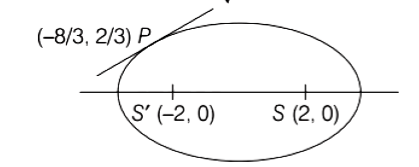 Equation of ellipse $\frac{x^2}{8} + \frac{y^2}{4} = 1$. Equation of tangent at $(x_1, y_1)$ is $\frac{xx_1}{8} + \frac{yy_1}{4} = 1$. Perpendicular to $x+2y=0 \implies (-x_1/8)/(y_1/4) = 2 \implies x_1 = -4y_1$. Substituting in ellipse: $16y_1^2/8 + y_1^2/4 = 1 \implies 9y_1^2/4 = 1 \implies y_1 = 2/3, x_1 = -8/3$. $e^2 = 1 - 4/8 = 1/2$. Foci $(\pm 2, 0)$. Area $A = 1/2 \times 4 \times 2/3 = 4/3$. $(5 - 1/2) \times 4/3 = 6$.
Step Solution:
1. Find the tangent slope: The line $x + 2y = 0$ has slope $m_L = -1/2$. The tangent at P is perpendicular, so its slope $m = 2$.
2. Determine coordinates of P: For the ellipse $\frac{x^2}{8} + \frac{y^2}{4} = 1$, the tangent at $(x_1, y_1)$ is $\frac{xx_1}{8} + \frac{yy_1}{4} = 1$. Its slope is $-\frac{x_1}{2y_1} = 2$, so $x_1 = -4y_1$. Substituting this into the ellipse equation gives $y_1 = 2/3$ and $x_1 = -8/3$ (for the second quadrant).
3. Calculate Eccentricity and Foci: $e^2 = 1 - \frac{b^2}{a^2} = 1 - \frac{4}{8} = \frac{1}{2}$. The foci $S, S'$ are $(\pm ae, 0) = (\pm \sqrt{8} \cdot \sqrt{1/2}, 0) = (\pm 2, 0)$.
4. Find the Area A: The base of $\triangle SPS'$ is the distance between foci $SS' = 4$. The height is the y-coordinate of P, $y_1 = 2/3$. Area $A = \frac{1}{2} \times 4 \times \frac{2}{3} = \frac{4}{3}$.
5. Final Value: $(5 - e^2) \cdot A = (5 - \frac{1}{2}) \cdot \frac{4}{3} = \frac{9}{2} \cdot \frac{4}{3} = 6$.
The difficulty level: Medium
The Concept Name: Tangents to Ellipse and Area of Triangles involving Foci
Short cut solution: The area of a triangle formed by a point $(x, y)$ on an ellipse and its foci is $ae \cdot |y|$. Here $ae=2$ and $y=2/3$, so $A=4/3$. Then $(5-0.5) \cdot 4/3 = 6$.
Question 326
Question: Let $\theta$ be the acute angle between the tangents to the ellipse $\frac{x^{2}}{9} + \frac{y^{2}}{1} = 1$ and the circle $x^{2} + y^{2} = 3$ at their point of intersection in the first quadrant. Then, $\tan \theta$ is equal to
Options:
A. $\frac{5}{2 \sqrt{3}}$
B. $\frac{2}{\sqrt{3}}$
C. $\frac{4}{\sqrt{3}}$
D. 2
Correct Answer: B
Year: JEE Main 2021, 01 Sep. Shift-II
Solution (as Given in the Source): Intersection point in first quadrant is $(3/2, \sqrt{3}/2)$. Slopes $m_1 = -x/9y = -1/3\sqrt{3}$ and $m_2 = -x/y = -\sqrt{3}$. $\tan \theta = |\frac{m_1 - m_2}{1 + m_1 m_2}| = \frac{2}{\sqrt{3}}$.
Step Solution:
1. Solve for Intersection: Equate $y^2 = 1 - \frac{x^2}{9}$ and $y^2 = 3 - x^2$. $1 - \frac{x^2}{9} = 3 - x^2 \implies \frac{8x^2}{9} = 2 \implies x^2 = 9/4 \implies x = 3/2$ in the 1st quadrant.
2. Find y-coordinate: $y^2 = 3 - (3/2)^2 = 3 - 9/4 = 3/4 \implies y = \sqrt{3}/2$.
3. Find Slopes: For the ellipse, $m_1 = \frac{dy}{dx} = -\frac{x}{9y} = -\frac{3/2}{9(\sqrt{3}/2)} = -\frac{1}{3\sqrt{3}}$. For the circle, $m_2 = \frac{dy}{dx} = -\frac{x}{y} = -\frac{3/2}{\sqrt{3}/2} = -\sqrt{3}$.
4. Apply Angle Formula: $\tan \theta = \left| \frac{m_1 - m_2}{1 + m_1 m_2} \right| = \left| \frac{-1/3\sqrt{3} + \sqrt{3}}{1 + (-1/3\sqrt{3})(-\sqrt{3})} \right|$.
5. Simplify: $\tan \theta = \frac{(9-1)/3\sqrt{3}}{1+1/3} = \frac{8/3\sqrt{3}}{4/3} = \frac{2}{\sqrt{3}}$.
The difficulty level: Medium
The Concept Name: Angle of Intersection between Two Curves
Short cut solution: Use the formula for $\tan \theta$ directly after finding the intersection point $(3/2, \sqrt{3}/2)$ and slopes from the implicit differentiation of the conic equations.
Question 335
Question: If $e_{1}$ and $e_{2}$ are the eccentricities of the ellipse, $\frac{x^{2}}{18} + \frac{y^{2}}{4} = 1$ and the hyperbola, $\frac{x^{2}}{9} - \frac{y^{2}}{4} = 1$ respectively and $(e_{1}, e_{2})$ is a point on the ellipse, $15x^{2} + 3y^{2} = k$, then $k$ is equal to
Options:
A. 16
B. 17
C. 15
Correct Answer: A
Year: JEE Main 2020, Jan. 9 (I)
Solution (as Given in the Source): Eccentricity of ellipse $e_1 = \sqrt{1 - 4/18} = \sqrt{7}/3$. Eccentricity of hyperbola $e_2 = \sqrt{1 + 4/9} = \sqrt{13}/3$. Point on $15x^2 + 3y^2 = k \implies 15(e_1^2) + 3(e_2^2) = k \implies 15(7/9) + 3(13/9) = 16$.
Step Solution:
1. Find Ellipse Eccentricity ($e_1$): $e_1^2 = 1 - \frac{b^2}{a^2} = 1 - \frac{4}{18} = 1 - \frac{2}{9} = \frac{7}{9}$.
2. Find Hyperbola Eccentricity ($e_2$): $e_2^2 = 1 + \frac{b^2}{a^2} = 1 + \frac{4}{9} = \frac{13}{9}$.
3. Identify Equation: The point $(e_1, e_2)$ lies on $15x^2 + 3y^2 = k$.
4. Substitute Values: $15(e_1^2) + 3(e_2^2) = 15(7/9) + 3(13/9)$.
5. Compute k: $k = \frac{105}{9} + \frac{39}{9} = \frac{144}{9} = 16$.
The difficulty level: Easy
The Concept Name: Standard Eccentricity Identities
Short cut solution: Substitute $e^2$ values directly into the target equation: $15(1 - 4/18) + 3(1 + 4/9) = 15(7/9) + 3(13/9) = \frac{105+39}{9} = 16$.
Question 336
Question: The length of the minor axis (along y-axis) of an ellipse in the standard form is $\frac{4}{\sqrt{3}}$. If this ellipse touches the line, $x + 6y = 8$; then its eccentricity is:
Options:
A. $\frac{1}{2} \sqrt{\frac{11}{3}}$
B. $\sqrt{\frac{5}{6}}$
C. $\frac{1}{2} \sqrt{\frac{5}{3}}$
D. $\frac{1}{3} \sqrt{\frac{11}{3}}$
Correct Answer: A
Year: JEE Main 2020, January 9 Morning Shift
Solution (as Given in the Source): Let $\frac{x^{2}}{a^{2}} + \frac{y^{2}}{b^{2}} = 1$; $a > b$. $2b = \frac{4}{\sqrt{3}} \Rightarrow b = \frac{2}{\sqrt{3}}$. Equation of tangent: $y = mx \pm \sqrt{a^{2}m^{2}+b^{2}}$. Comparing with $x+6y=8 \Rightarrow y = -\frac{1}{6}x + \frac{4}{3}$. $m = -1/6, c = 4/3$. $c^{2} = a^{2}m^{2} + b^{2} \Rightarrow \frac{16}{9} = a^{2}(\frac{1}{36}) + \frac{4}{3} \Rightarrow \frac{a^{2}}{36} = \frac{16}{9} - \frac{4}{3} = \frac{4}{9} \Rightarrow a^{2} = 16$. Eccentricity $e = \sqrt{1 - \frac{b^{2}}{a^{2}}} = \sqrt{1 - \frac{4}{3 \times 16}} = \sqrt{1 - \frac{1}{12}} = \sqrt{\frac{11}{12}} = \frac{1}{2} \sqrt{\frac{11}{3}}$.
Step Solution:
1. Identify Semi-minor axis ($b$): The minor axis length is $2b = 4/\sqrt{3}$, so $b = 2/\sqrt{3}$ and $b^2 = 4/3$.
2. Determine Tangent Parameters: Rearrange $x + 6y = 8$ to $y = -\frac{1}{6}x + \frac{4}{3}$, identifying slope $m = -1/6$ and intercept $c = 4/3$.
3. Apply Tangency Condition: Use $c^2 = a^2m^2 + b^2$. Substituting values: $(4/3)^2 = a^2(-1/6)^2 + 4/3$.
4. Solve for $a^2$: $16/9 = a^2/36 + 4/3 \implies 16/9 - 12/9 = a^2/36 \implies 4/9 = a^2/36$, which gives $a^2 = 16$.
5. Calculate Eccentricity ($e$): $e^2 = 1 - b^2/a^2 = 1 - (4/3)/16 = 1 - 1/12 = 11/12$. Thus, $e = \sqrt{11/12} = \frac{1}{2}\sqrt{11/3}$.
The difficulty level: Medium
The Concept Name: Condition of Tangency for Ellipse
Short cut solution: Use the formula $c^2 = a^2m^2 + b^2$ directly by extracting $m$ and $c$ from the given line and $b^2$ from the minor axis.
Question 338
Question: If the distance between the foci of an ellipse is 6 and the distance between its directrices is 12, then the length of its latus rectum is:
Options:
A. $\sqrt{3}$
B. $3\sqrt{2}$
C. $\frac{3}{\sqrt{2}}$
D. $2\sqrt{3}$
Correct Answer: B
Year: JEE Main 2020, January 7 Morning Shift
Solution (as Given in the Source): $2ae = 6$ and $\frac{2a}{e} = 12 \Rightarrow ae = 3$ and $\frac{a}{e} = 6 \Rightarrow e = \frac{a}{6}$. $a^{2} = 18$ [From (i) and (ii)]. $b^{2} = a^{2} - a^{2}e^{2} = 18 - 9 = 9$. Latus rectum $= \frac{2b^{2}}{a} = \frac{2 \times 9}{3\sqrt{2}} = 3\sqrt{2}$.
Step Solution:
1. Extract Parameters: Distance between foci $2ae = 6 \implies ae = 3$. Distance between directrices $2a/e = 12 \implies a/e = 6$.
2. Solve for $a^2$: Multiply the two relations: $(ae) \cdot (a/e) = 3 \cdot 6 \implies a^2 = 18$. Thus $a = 3\sqrt{2}$.
3. Solve for $e^2$: Divide the two relations: $(ae) / (a/e) = 3/6 \implies e^2 = 1/2$.
4. Determine $b^2$: Use the identity $b^2 = a^2(1 - e^2)$. Substituting: $b^2 = 18(1 - 1/2) = 9$.
5. Calculate Latus Rectum: $L = \frac{2b^2}{a} = \frac{2(9)}{3\sqrt{2}} = \frac{6}{\sqrt{2}} = 3\sqrt{2}$.
The difficulty level: Easy
The Concept Name: Properties of Ellipse Foci and Directrices
Short cut solution: In any ellipse, $a^2 = (\text{focus distance}/2) \times (\text{directrix distance}/2) = 3 \times 6 = 18$. Then $b^2 = a^2 - (ae)^2 = 18 - 9 = 9$. $LR = 2b^2/a = 18/\sqrt{18} = \sqrt{18} = 3\sqrt{2}$.
Question 352
Question: If the normal at an end of a latus rectum of an ellipse passes through an extremity of the minor axis, then the eccentricity $e$ of the ellipse satisfies:
Options:
A. $e^4 + 2e^2 - 1 = 0$
B. $e^2 + e - 1 = 0$
C. $e^4 + e^2 - 1 = 0$
D. $e^2 + 2e - 1 = 0$
Correct Answer: C
Year: JEE Main 2020, September 6 Evening Shift
Solution (as Given in the Source): Normal to the ellipse $\frac{x^2}{a^2} + \frac{y^2}{b^2} = 1$ at $(ae, \frac{b^2}{a})$ is $\frac{a^2x}{ae} - \frac{b^2y}{b^2/a} = a^2 - b^2 \Rightarrow x - ey = \frac{e(a^2 - b^2)}{a}$. $(0, -b)$ lies on it, then $be = \frac{e(a^2 - b^2)}{a} \Rightarrow ab = a^2e^2 \Rightarrow b = ae^2 \Rightarrow \frac{b^2}{a^2} = e^4$. $1 - e^2 = e^4 \Rightarrow e^4 + e^2 - 1 = 0$.
Step Solution:
1. Define Point and Normal: The end of a latus rectum is $(ae, b^2/a)$. The normal equation is $\frac{a^2x}{ae} - \frac{b^2y}{b^2/a} = a^2 - b^2$.
2. Pass through Minor Axis: The normal passes through $(0, -b)$, so $0 - a(-b) = a^2 - b^2 \implies ab = a^2 - b^2$.
3. Relate Axes to Eccentricity: Divide by $a^2$: $\frac{b}{a} = 1 - \frac{b^2}{a^2}$. Since $1 - \frac{b^2}{a^2} = e^2$, we have $b/a = e^2$.
4. Square and Substitute: Square Step 3: $\frac{b^2}{a^2} = e^4$.
5. Final Equation: Substitute $b^2/a^2 = 1 - e^2$ into Step 4: $1 - e^2 = e^4 \implies e^4 + e^2 - 1 = 0$.
The difficulty level: Medium
The Concept Name: Normal to Ellipse at Latus Rectum End
Short cut solution: The geometric condition that the normal at $(ae, b^2/a)$ passes through $(0, -b)$ always leads to the axis relation $b = ae^2$. Substituting this into the standard eccentricity identity $b^2 = a^2(1 - e^2)$ immediately gives $e^4 = 1 - e^2$.
Question 353
Question: If the co-ordinates of two points A and B are $(\sqrt{7}, 0)$ and $(-\sqrt{7}, 0)$ respectively and P is any point on the conic, $9x^{2} + 16y^{2} = 144$, then $PA + PB$ is equal to :
Options:
A. 16
B. 8
C. 6
D. 9
Correct Answer: B
Year: Sep. 05, 2020 (I)
Solution (as Given in the Source): Ellipse: $\frac{x^{2}}{16} + \frac{y^{2}}{9} = 1$. $a = 4, b = 3, c = \sqrt{16-9} = \sqrt{7}$.
Step Solution:
1. Identify the conic: Divide the equation $9x^{2} + 16y^{2} = 144$ by 144 to get the standard form: $\frac{x^2}{16} + \frac{y^2}{9} = 1$.
2. Find semi-axes: From the standard form, $a^{2} = 16 \implies a = 4$ and $b^{2} = 9 \implies b = 3$.
3. Locate the foci: The distance of the foci from the center is $ae = \sqrt{a^{2} - b^{2}} = \sqrt{16 - 9} = \sqrt{7}$. Thus, the foci are $(\pm \sqrt{7}, 0)$.
4. Identify A and B: Points $A(\sqrt{7}, 0)$ and $B(-\sqrt{7}, 0)$ are exactly the foci of this ellipse.
5. Apply focal distance property: By the definition of an ellipse, the sum of distances of any point $P$ on the curve from its two foci is constant and equal to the major axis length ($2a$). Therefore, $PA + PB = 2a = 2(4) = 8$.
The difficulty level: Easy
The Concept Name: Standard Property of Ellipse (Sum of focal distances)
Short cut solution: Recognize $A$ and $B$ are the foci $(\pm ae, 0)$ because $ae = \sqrt{16-9} = \sqrt{7}$. The ellipse property $PA + PB = 2a$ immediately gives $2 \times 4 = 8$.
Question 355
Question: Let $\frac{x^{2}}{a^{2}} + \frac{y^{2}}{b^{2}} = 1 (a > b)$ be a given ellipse, length of whose latus rectum is 10. If its eccentricity is the maximum value of the function, $\Psi (t) = \frac{5}{12} + t - t^{2}$, then $a^{2} + b^{2}$ is equal to:
Options:
A. 145
B. 116
C. 126
D. 135
Correct Answer: C
Year: Sep. 04, 2020 (I)
Solution (as Given in the Source): $\frac{2b^{2}}{a} = 10 \implies b^{2} = 5a$. $\Psi'(t) = 1 - 2t = 0 \implies t = 1/2$. $\Psi(1/2) = \frac{5}{12} + \frac{1}{2} - \frac{1}{4} = \frac{2}{3} = e$. $b^{2} = a^{2}(1 - e^{2}) \implies 5a = a^{2}(1 - 4/9) \implies a = 9$. $a^{2} = 81, b^{2} = 45 \implies a^{2} + b^{2} = 126$.
Step Solution:
1. Relation from Latus Rectum: Length of latus rectum $\frac{2b^{2}}{a} = 10$, which simplifies to $b^{2} = 5a$.
2. Optimize the function: To find eccentricity $e$, find the maximum of $\Psi(t) = \frac{5}{12} + t - t^{2}$ by setting its derivative to zero: $\Psi'(t) = 1 - 2t = 0 \implies t = \frac{1}{2}$.
3. Determine eccentricity ($e$): $e = \Psi(\frac{1}{2}) = \frac{5}{12} + \frac{1}{2} - \frac{1}{4} = \frac{5+6-3}{12} = \frac{8}{12} = \frac{2}{3}$.
4. Relate axes using $e$: Use the identity $b^{2} = a^{2}(1 - e^{2})$. Substituting known values: $5a = a^{2}(1 - \frac{4}{9}) = a^{2}(\frac{5}{9})$.
5. Solve for axes and final sum: $5a = \frac{5a^2}{9} \implies a = 9$. Then $b^{2} = 5(9) = 45$ and $a^{2} = 81$. Finally, $a^{2} + b^{2} = 81 + 45 = 126$.
The difficulty level: Medium
The Concept Name: Quadratic Optimization and Ellipse Parameters
Short cut solution: The maximum of a quadratic $-t^2+t+c$ is at $t = -1/(-2) = 0.5$, yielding $e = \frac{2}{3}$. Axis ratio squared is $1 - e^{2} = \frac{5}{9}$. Given $b^{2}/a = 5$, we have $\frac{b^2}{a^2} = \frac{5}{a} = \frac{5}{9} \implies a = 9$. Sum $a^{2} + b^{2} = 81 + 45 = 126$.
Question 383
Question: Let S and S' be the foci of an ellipse and B be any one of the extremities of its minor axis. If $\triangle$S'BS is a right angled triangle with right angle at B and area ($\triangle$S'BS) = 8 sq. units, then the length of a latus rectum of the ellipse is :
Options:
A. 4
B. 2$\sqrt{2}$
C. 4$\sqrt{2}$
D. 2
Correct Answer: A
Year: Jan. 12, 2019 (II)
Solution (as Given in the Source): $\angle S'BS = 90^{\circ} \implies (\frac{b}{-ae}) \times (\frac{b}{ae}) = -1 \implies b^{2} = a^{2}e^{2}$. Area $= \frac{1}{2} \cdot 2ae \cdot b = 8 \implies b^{2} = 8$. $a^{2}e^{2} = 8$. $a^{2}e^{2} = a^{2} - b^{2} \implies 8 = a^{2} - 8 \implies a^{2} = 16$. L.R. $= \frac{2b^{2}}{a} = 4$.
Step Solution: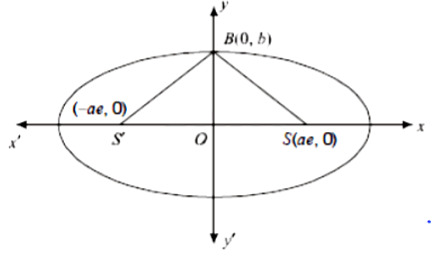
1. Condition for right angle: Foci are at $(\pm ae, 0)$ and $B$ is at $(0, b)$. The right angle at $B$ means the product of slopes $m_{BS} \cdot m_{BS'} = -1 \implies \frac{b}{-ae} \cdot \frac{b}{ae} = -1 \implies b^{2} = a^{2}e^{2}$.
2. Apply Area information: Area of $\triangle S'BS = \frac{1}{2} \times \text{base}(SS') \times \text{height}(OB) = \frac{1}{2} (2ae)(b) = aeb = 8$.
3. Relate axes: From Step 1, $b = ae$. Substitute this into the area equation: $b \cdot b = 8 \implies b^{2} = 8$. Thus $a^{2}e^{2}$ is also 8.
4. Find semi-major axis ($a$): Using $a^{2}e^{2} = a^{2} - b^{2}$, we have $8 = a^{2} - 8 \implies a^{2} = 16 \implies a = 4$.
5. Calculate Latus Rectum: $L = \frac{2b^{2}}{a} = \frac{2(8)}{4} = 4$ units.
The difficulty level: Medium
The Concept Name: Geometric Properties of Ellipse Foci and Vertices
Short cut solution: In an ellipse where $\triangle S'BS$ is right-angled at $B$, the condition $b = ae$ always holds. The area simplifies to $b^{2} = 8$. Since $b^{2} = a^{2} - (ae)^{2} = a^{2} - b^{2}$, we get $a^{2} = 2b^{2} = 16$. Thus $a=4$ and $LR = \frac{2b^2}{a} = \frac{16}{4} = 4$.
Question 386
Question: If a hyperbola has length of its conjugate axis equal to 5 and the distance between its foci is 13, then the eccentricity of the hyperbola is :
Options:
A. $13/12$
B. 2
C. $13/6$
D. $13/8$
Correct Answer: A
Year: JEE Main 2019, Jan. 11 (II)
Solution (as Given in the Source): ∴ Conjugate axis $= 5 \implies 2b = 5$. Distance between foci $= 13 \implies 2ae = 13$. Then, $b^2 = a^2(e^2 - 1) \Rightarrow a^2 = 36 \implies a = 6. \ ae = 13/2 \Rightarrow e = 13/12$.
Step Solution:
1. Extract parameters from given data: Conjugate axis length $2b = 5$, so $b = 5/2$ and $b^2 = 25/4$.
2. Relate foci distance to parameters: Focal distance $2ae = 13$, so $ae = 13/2$ and $(ae)^2 = 169/4$.
3. Apply standard hyperbola identity: We know $b^2 = a^2e^2 - a^2$.
4. Solve for $a^2$: Substitute the known values: $25/4 = 169/4 - a^2 \implies a^2 = (169 - 25)/4 = 144/4 = 36$, thus $a = 6$.
5. Calculate eccentricity: Using $ae = 13/2$ and $a = 6$, we get $e = \frac{13/2}{6} = \frac{13}{12}$.
The difficulty level: Easy
The Concept Name: Properties of Hyperbola Foci and Axes
Short cut solution: Use the formula $e = \frac{\sqrt{a^2+b^2}}{a}$. Since $a^2+b^2 = (ae)^2$, the numerator is simply half the distance between foci. Thus, $e = \frac{13/2}{\sqrt{(13/2)^2 - (5/2)^2}} = \frac{6.5}{\sqrt{42.25 - 6.25}} = \frac{6.5}{6} = \frac{13}{12}$.
Question 387
Question: Let the length of the latus rectum of an ellipse with its major axis along X-axis and centre at the origin, be 8. If the distance between the foci of this ellipse is equal to the length of its minor axis, then which one of the following points lies on it?
Options:
A. $(4\sqrt{2}, 2\sqrt{2})$
B. $(4\sqrt{3}, 2\sqrt{2})$
C. $(4\sqrt{3}, 2\sqrt{3})$
D. $(4\sqrt{2}, 2\sqrt{3})$
Correct Answer: B
Year: JEE Main 2019, Jan. 11 (II)
Solution (as Given in the Source): Let the ellipse be $\frac{x^2}{a^2} + \frac{y^2}{b^2} = 1$. Then, $\frac{2b^2}{a} = 8, 2ae = 2b$ and $b^2 = a^2(1 - e^2) \Rightarrow a = 8, b^2 = 32$. Then, the equation of the ellipse $\frac{x^2}{64} + \frac{y^2}{32} = 1$. Hence, the point $(4\sqrt{3}, 2\sqrt{2})$ lies on the ellipse.
Step Solution:
1. Relate foci to minor axis: Given $2ae = 2b \implies \mathbf{b = ae}$.
2. Relate axes using eccentricity: Substitute $b = ae$ into $b^2 = a^2(1 - e^2) \implies a^2e^2 = a^2 - a^2e^2 \implies \mathbf{2e^2 = 1 \implies e^2 = 1/2}$.
3. Determine axes from latus rectum: $\frac{2b^2}{a} = 8 \implies b^2 = 4a$. Since $b^2 = a^2(1 - e^2) = a^2/2$, then $4a = a^2/2 \implies \mathbf{a = 8}$ and $b^2 = 32$.
4. Formulate Ellipse Equation: The equation is $\frac{x^2}{64} + \frac{y^2}{32} = 1$.
5. Verify Point B: For $x = 4\sqrt{3}$ and $y = 2\sqrt{2}$: $\frac{48}{64} + \frac{8}{32} = \frac{3}{4} + \frac{1}{4} = 1$. This satisfies the equation.
The difficulty level: Medium
The Concept Name: Latus Rectum and Foci relations in Ellipse
Short cut solution: The condition $2ae = 2b$ implies $b^2/a^2 = e^2$. Since $e^2 + b^2/a^2 = 1$, we get $2e^2 = 1 \implies e^2 = 1/2$. Latus rectum $L = \frac{2b^2}{a} = 2a(1-e^2) = 2a(1/2) = a$. Thus $a = 8$. Then $b^2 = a^2/2 = 32$. Check points in $\frac{x^2}{64} + \frac{y^2}{32} = 1$.
Question 389
Question: Let $S = \{ (x, y) \in R^2 : \frac{y^2}{1+r} - \frac{x^2}{1-r} = 1 \}$ where $r \neq \pm 1$. Then S represents:
Options:
A. a hyperbola whose eccentricity is $\frac{2}{\sqrt{1-r}}$, when $0 < r < 1$
B. an ellipse whose eccentricity is $\sqrt{\frac{2}{r+1}}$, when $r > 1$
C. a hyperbola whose eccentricity is $\frac{2}{\sqrt{r+1}}$, when $0 < r < 1$
D. an ellipse whose eccentricity is $\frac{1}{\sqrt{r+1}}$, when $r > 1$
Correct Answer: B
Year: JEE Main 2019, Jan. 10 (II)
Solution (as Given in the Source): Since $r \neq \pm 1$, then there are two cases, when $r > 1$: $\frac{x^2}{r-1} + \frac{y^2}{r+1} = 1$. Then $(r-1) = (r+1)(1-e^2) \Rightarrow e^2 = \frac{2}{r+1} \Rightarrow e = \sqrt{\frac{2}{r+1}}$. When $0 < r < 1$, then $\frac{x^2}{1-r} - \frac{y^2}{1+r} = -1 \Rightarrow e = \sqrt{\frac{2r}{r+1}}$.
Step Solution:
1. Analyze the case $r > 1$: The equation becomes $\frac{y^2}{r+1} + \frac{x^2}{r-1} = 1$. Since both denominators are positive, it is an ellipse.
2. Determine major axis ($r > 1$): $r+1 > r-1$, so the semi-major axis is $\beta = \sqrt{r+1}$ and semi-minor is $\alpha = \sqrt{r-1}$.
3. Calculate eccentricity for ellipse: $e^2 = 1 - \frac{\alpha^2}{\beta^2} = 1 - \frac{r-1}{r+1} = \frac{(r+1)-(r-1)}{r+1} = \frac{2}{r+1}$. Thus $e = \sqrt{\frac{2}{r+1}}$.
4. Analyze the case $0 < r < 1$: The term $1-r$ is positive. The equation $\frac{y^2}{1+r} - \frac{x^2}{1-r} = 1$ represents a hyperbola.
5. Calculate eccentricity for hyperbola: $e^2 = 1 + \frac{\text{conjugate}^2}{\text{transverse}^2} = 1 + \frac{1-r}{1+r} = \frac{(1+r)+(1-r)}{1+r} = \frac{2}{1+r}$. Thus $e = \sqrt{\frac{2}{r+1}}$ (which is not $2/\sqrt{r+1}$).
The difficulty level: Hard
The Concept Name: Classification of Conic Sections
Short cut solution: If $r > 1$, both denominators $1+r$ and $-(1-r) = r-1$ are positive, making the curve an ellipse. Eccentricity is $\sqrt{1 - \frac{\text{smaller}}{\text{larger}}} = \sqrt{1 - \frac{r-1}{r+1}} = \sqrt{\frac{2}{r+1}}$. Match with Option B.
Question 410
Question: An ellipse, with foci at (0,2) and (0,-2) and minor axis of length 4, passes through which of the following points?
Options:
A. $(\sqrt{2}, 2)$
B. $(2, \sqrt{2})$
C. $(2, 2\sqrt{2})$
D. $(1, 2\sqrt{2})$
Correct Answer: A
Year: JEE Main 2019 (Online) April 12 Afternoon Shift
Solution (as Given in the Source): Let the equation of ellipse: $\frac{x^{2}}{a^{2}} + \frac{y^{2}}{b^{2}} = 1$. Given that length of minor axis is 4 i.e. $a = 4$ [Note: this is a typo in the source; it should be $a=2$]. Also given $be = 2$. $\because a^{2} = b^{2}(1 - e^{2}) \Rightarrow 4 = b^{2} - 4 \Rightarrow b = 2\sqrt{2}$. Hence, equation of ellipse will be $\frac{x^{2}}{4} + \frac{y^{2}}{8} = 1$. $\because (\sqrt{2}, 2)$ satisfies this equation. $\therefore$ ellipse passes through $(\sqrt{2}, 2)$.
Step Solution:
1. Identify Orientation: The foci are on the y-axis at $(0, \pm 2)$, indicating a vertical ellipse with major axis $2b$ and minor axis $2a$.
2. Determine parameters: The minor axis length is $2a = 4$, which gives $a = 2$ and $a^2 = 4$.
3. Use focal distance: The distance from center to focus is $be = 2$, so $b^2e^2 = 4$.
4. Find semi-major axis ($b$): Use the relation $a^2 = b^2(1 - e^2) = b^2 - b^2e^2$. Substituting values: $4 = b^2 - 4 \implies \mathbf{b^2 = 8}$.
5. Formulate and Test: The ellipse equation is $\frac{x^2}{4} + \frac{y^2}{8} = 1$. Plugging in $(\sqrt{2}, 2)$ gives $\frac{2}{4} + \frac{4}{8} = \frac{1}{2} + \frac{1}{2} = 1$, which is correct.
The difficulty level: Easy.
The Concept Name: Standard Properties of Vertical Ellipse.
Short cut solution: In a vertical ellipse, $b^2 = a^2 + c^2$, where $c$ is the distance to the focus. Here $a=2$ and $c=2$, so $b^2 = 4 + 4 = 8$. The equation is $x^2/4 + y^2/8 = 1$.
Question 414
Question: In an ellipse, with centre at the origin, if the difference of the lengths of major axis and minor axis is 10 and one of the foci is at $(0, 5\sqrt{3})$, then the length of its latus rectum is:
Options:
A. 10
B. 5
C. 8
D. 6
Correct Answer: B
Year: JEE Main 2019 (Online) April 08 Afternoon Shift
Solution (as Given in the Source): Given that focus is $(0, 5\sqrt{3}) \Rightarrow |b| > |a|$. Let $b > a > 0$ and foci is $(0, \pm be)$. $\therefore a^{2} = b^{2} - b^{2}e^{2} \Rightarrow b^{2}e^{2} = b^{2} - a^{2}$. $be = \sqrt{b^{2} - a^{2}} \Rightarrow b^{2} - a^{2} = 75$ (i). $\therefore 2b - 2a = 10 \Rightarrow b - a = 5$ (ii). From (i) and (ii) $b + a = 15$ (iii). On solving (ii) and (iii), we get $\Rightarrow b = 10, a = 5$. Now, length of latus rectum $= \frac{2a^{2}}{b} = \frac{50}{10} = 5$.
Step Solution:
1. Relate parameters: Focus $(0, 5\sqrt{3})$ implies a vertical ellipse where $be = 5\sqrt{3}$. Thus $b^2 - a^2 = (be)^2 = 75$.
2. Use axis difference: Difference of lengths $2b - 2a = 10$, which simplifies to $b - a = 5$.
3. Solve for axis sum: Using $b^2 - a^2 = (b-a)(b+a) = 75$, substitute $b-a = 5$ to get $5(b+a) = 75 \implies \mathbf{b + a = 15}$.
4. Find individual axes: Solving the system $b+a=15$ and $b-a=5$ yields $b = 10$ and $a = 5$.
5. Calculate Latus Rectum: $L = \frac{2a^2}{b} = \frac{2(25)}{10} = 5$.
The difficulty level: Medium.
The Concept Name: Properties of Ellipse Foci and Axes.
Short cut solution: Use the identity $(b-a)(b+a) = (be)^2$. Here $5(b+a) = 75 \implies b+a = 15$. With $b-a=5$, we get $b=10, a=5$. $LR = 2(5)^2/10 = 5$.
Question 426
Question: If the length of the latus rectum of an ellipse is 4 units and the distance between a focus and its nearest vertex on the major axis is $\frac{3}{2}$ units, then its eccentricity is?
Options:
A. $\frac{1}{2}$
B. $\frac{2}{3}$
C. $\frac{1}{9}$
D. $\frac{1}{3}$
Correct Answer: D
Year: JEE Main 2018 (Online) April 16
Solution (as Given in the Source): Let for ellipse coordinates of focus and vertex are $(ae, 0)$ and $(a, 0)$ respectively. $\therefore$ Distance between focus and vertex $= a(1 - e) = \frac{3}{2}$ (given) ... (1). Length of latus rectum $= \frac{2b^{2}}{a} = 4 \Rightarrow b^{2} = 2a$ ... (ii). $e^{2} = 1 - \frac{b^{2}}{a^{2}} \Rightarrow e^{2} = 1 - \frac{2a}{a^{2}} = 1 - \frac{2}{a}$ ... (iii). Substituting the value of $e^{2}$ in eq. (i) we get; $\Rightarrow a^{2} + \frac{9}{4} - 3a = a^{2}(1 - \frac{2}{a}) \Rightarrow a = \frac{9}{4}$. $\therefore$ from eq. (iii) we get; $e^{2} = 1 - \frac{8}{9} = \frac{1}{9} \Rightarrow e = \frac{1}{3}$.
Step Solution:
1. Set up conditions: Nearest distance focus-vertex $a - ae = a(1-e) = 1.5$. Latus rectum $\frac{2b^2}{a} = 4 \implies b^2 = 2a$.
2. Relate parameters: Use the standard identity $b^2 = a^2(1 - e^2)$. Substituting $b^2 = 2a$ gives $2a = a^2(1 - e)(1 + e)$.
3. Simplify equation: Substitute $a(1 - e) = 1.5$ from Step 1 into the axis relation: $2a = 1.5 a (1 + e)$.
4. Solve for $e$: Cancel $a$ (since $a \neq 0$): $2 = 1.5(1 + e) \implies 1 + e = \frac{2}{1.5} = \frac{4}{3}$.
5. Final result: $e = \frac{4}{3} - 1 = \mathbf{\frac{1}{3}}$.
The difficulty level: Medium.
The Concept Name: Relationships between Conic parameters.
Short cut solution: Latus rectum $L = 2a(1-e)(1+e)$. Given $L=4$ and the nearest focus-vertex distance $a(1-e)=1.5$. Thus $4 = 2(1.5)(1+e) \implies 4 = 3(1+e) \implies 1+e = 4/3 \implies e = 1/3$.
Question 440
Question: The eccentricity of an ellipse having centre at the origin, axes along the co-ordinate axes and passing through the points (4, -1) and (-2, 2) is :
Options:
A. $\frac{1}{2}$
B. $\frac{2}{\sqrt{5}}$
C. $\frac{\sqrt{3}}{2}$
D. $\frac{\sqrt{3}}{4}$
Correct Answer: C
Year: JEE Main Online April 9, 2017
Solution (as Given in the Source): Centre at (0,0) $\frac{x^2}{a^2} + \frac{y^2}{b^2} = 1$. at point (4,-1) $\frac{16}{a^2} + \frac{1}{b^2} = 1 \Rightarrow 16b^2 + a^2 = a^2b^2 \dots (i)$. at point (-2,2) $\frac{4}{a^2} + \frac{4}{b^2} = 1 \Rightarrow 4b^2 + 4a^2 = a^2b^2 \dots (ii)$. From equations (i) and (ii) $\Rightarrow 16b^2 + a^2 = 4b^2 + 4a^2 \Rightarrow 3a^2 = 12b^2 \Rightarrow a^2 = 4b^2$. $b^2 = a^2(1-e^2) \Rightarrow e^2 = 3/4 \Rightarrow e = \frac{\sqrt{3}}{2}$.
Step Solution:
1. Assume the ellipse equation: $\frac{x^2}{a^2} + \frac{y^2}{b^2} = 1$.
2. Substitute given points: For (4, -1), $\frac{16}{a^2} + \frac{1}{b^2} = 1$. For (-2, 2), $\frac{4}{a^2} + \frac{4}{b^2} = 1$.
3. Eliminate the product $a^2b^2$: From the first equation, $16b^2 + a^2 = a^2b^2$. From the second, $4b^2 + 4a^2 = a^2b^2$.
4. Equate and relate axes: $16b^2 + a^2 = 4b^2 + 4a^2 \implies 12b^2 = 3a^2 \implies a^2 = 4b^2$.
5. Calculate eccentricity: Using $b^2 = a^2(1 - e^2)$, substitute $a^2$: $b^2 = 4b^2(1 - e^2) \implies \frac{1}{4} = 1 - e^2 \implies e^2 = \frac{3}{4} \implies e = \frac{\sqrt{3}}{2}$.
The difficulty level: Medium
The Concept Name: Standard Ellipse Equation and Eccentricity
Short cut solution: Subtracting the normalized equations $16/a^2 + 1/b^2 = 1$ and $4/a^2 + 4/b^2 = 1$ leads directly to the ratio of the squared axes. Once $a^2 = 4b^2$ is found, the eccentricity is immediately $\sqrt{1 - b^2/a^2} = \sqrt{1 - 1/4} = \sqrt{3}/2$.
Question 441
Question: Consider an ellipse, whose centre is at the origin and its major axis is along the X-axis. If its eccentricity is 3/5 and the distance between its foci is 6, then the area (in sq. units) of the quadrilateral inscribed in the ellipse, with the vertices as the vertices of the ellipse, is :
Options:
A. 8
B. 32
C. 80
D. 40
Correct Answer: D
Year: JEE Main Online April 8, 2017
Solution (as Given in the Source): 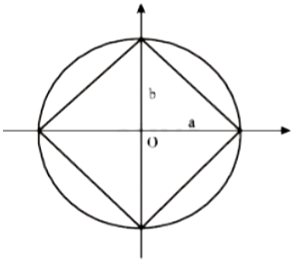 $e = 3/5$ & $2ae = 6 \Rightarrow a = 5$. $\because b^2 = a^2(1 - e^2) \Rightarrow b^2 = 25(1 - 9/25) \Rightarrow b = 4$. Area of required quadrilateral $= 4(1/2 ab) = 2ab = 40$.
Step Solution:
1. Find the semi-major axis (a): The distance between foci is $2ae = 6$. Given $e = 3/5$, then $2a(3/5) = 6 \implies a = 5$.
2. Find the semi-minor axis (b): Use the identity $b^2 = a^2(1 - e^2) = 25(1 - 9/25) = 16 \implies b = 4$.
3. Identify the quadrilateral: The vertices of the quadrilateral are the ellipse's vertices: $(\pm 5, 0)$ and $(0, \pm 4)$.
4. Calculate the area: The area of a quadrilateral with perpendicular diagonals of lengths $d_1$ and $d_2$ is $\frac{1}{2} d_1 d_2$. Here, $d_1 = 2a = 10$ and $d_2 = 2b = 8$.
5. Final Value: Area $= \frac{1}{2} \times 10 \times 8 = 40$.
The difficulty level: Easy
The Concept Name: Area of Inscribed Quadrilateral in Ellipse
Short cut solution: The area of the diamond formed by an ellipse's vertices is always $2ab$. Solve $ae = 3$ and $e = 0.6 \implies a = 5$. Use $b = a\sqrt{1-e^2} = 5(0.8) = 4$. Area $= 2(5)(4) = 40$.
Question 446
Question: The eccentricity of the hyperbola whose length of the latus rectum is equal to 8 and the length of its conjugate axis is equal to half of the distance between its foci, is:
Options:
A. $\frac{2}{\sqrt{3}}$
B. $\sqrt{3}$
C. $\frac{4}{3}$
D. $\frac{4}{\sqrt{3}}$
Correct Answer: A
Year: JEE Main 2016
Solution (as Given in the Source): $\frac{2b^2}{a} = 8$ and $2b = \frac{1}{2}(2ae) \Rightarrow 4b^2 = a^2e^2 \Rightarrow 4a^2(e^2 - 1) = a^2e^2 \Rightarrow 3e^2 = 4 \Rightarrow e = \frac{2}{\sqrt{3}}$.
Step Solution:
1. Translate latus rectum condition: $\frac{2b^2}{a} = 8 \implies b^2 = 4a$.
2. Translate conjugate axis condition: Length of conjugate axis ($2b$) is half the distance between foci ($2ae$), so $2b = \frac{1}{2}(2ae) \implies 2b = ae$.
3. Square the conjugate relation: $4b^2 = a^2e^2$.
4. Substitute hyperbola identity: Substitute $b^2 = a^2(e^2 - 1)$ into the relation: $4a^2(e^2 - 1) = a^2e^2$.
5. Solve for eccentricity: $4e^2 - 4 = e^2 \implies 3e^2 = 4 \implies e^2 = \frac{4}{3} \implies e = \frac{2}{\sqrt{3}}$.
The difficulty level: Medium
The Concept Name: Relationships between Hyperbola Axes and Eccentricity
Short cut solution: The condition "conjugate axis equals half the distance between foci" for a hyperbola means $2b = ae$, which simplifies to $\frac{b}{a} = \frac{e}{2}$. Substitute this into $e^2 = 1 + (\frac{b}{a})^2$: $e^2 = 1 + \frac{e^2}{4} \implies \frac{3e^2}{4} = 1 \implies e = \frac{2}{\sqrt{3}}$.
Question 448
Question: Let $a$ and $b$ respectively be the semi transverse and semi conjugate axes of a hyperbola whose eccentricity satisfies the equation $9e^2 - 18e + 5 = 0$. If $S(\pm 5, 0)$ is a focus and $5x = 9$ is the corresponding directrix of this hyperbola, then $a^2 - b^2$ is equal to :
Options:
A. -7
B. -5
C. 5
D. 7
Correct Answer: A
Year: Online April 9, 2016
Solution (as Given in the Source): $S(5,0)$ is focus $\Rightarrow ae = 5$ (focus) – – (a); $x = a/e = 9/5 \Rightarrow a/e = 9/5$ (directrix) – – (b); $(a) \times (b) \Rightarrow a^2 = 9$; (a) $\Rightarrow (e) = 5/3$; $b^2 = a^2(e^2 - 1) \Rightarrow b^2 = 16$; $a^2 - b^2 = 9 - 16 = -7$.
Step Solution:
1. Identify focus and directrix relations: distance from center to focus $ae = 5$ and distance to directrix $a/e = 9/5$.
2. Calculate squared semi-major axis: multiply the two relations $(ae) \cdot (a/e) = 5 \cdot (9/5) \implies a^2 = 9$.
3. Find eccentricity: divide the relations $(ae) / (a/e) = 5 / (9/5) \implies e^2 = 25/9$, so $e = 5/3$. (Note: $e = 5/3$ satisfies $9e^2 - 18e + 5 = 0$).
4. Calculate squared semi-minor axis: use the identity $b^2 = a^2(e^2 - 1) = 9(25/9 - 1) = 16$.
5. Final Calculation: $a^2 - b^2 = 9 - 16 = -7$.
The difficulty level: Medium
The Concept Name: Properties of Hyperbola Foci and Directrices
Short cut solution: In any hyperbola, $a^2$ is the product of the distance to the focus and the distance to the directrix. Here $a^2 = 5 \times 1.8 = 9$. Then $b^2 = (ae)^2 - a^2 = 25 - 9 = 16$. The difference $a^2 - b^2 = 9 - 16 = -7$.
Question 464
Question: If the distance between the foci of an ellipse is half the length of its latus rectum, then the eccentricity of the ellipse is:
Options:
A. $\frac{2\sqrt{2} - 1}{2}$
B. $\sqrt{2} - 1$
C. $1/2$
D. $\frac{\sqrt{2} - 1}{2}$
Correct Answer: B
Year: Online April 11, 2015
Solution (as Given in the Source): Focus of an ellipse is given as $(\pm ae, 0)$ Distance between them $= 2ae$. According to the question, $2ae = \frac{1}{2} \cdot \frac{2b^2}{a} \Rightarrow 2a^2e = b^2 = a^2(1 - e^2) \Rightarrow 2e = 1 - e^2 \Rightarrow (e + 1)^2 = 2 \Rightarrow e = \sqrt{2} - 1$.
Step Solution:
1. Set up the condition: the distance between foci ($2ae$) equals half the latus rectum ($\frac{1}{2} \cdot \frac{2b^2}{a}$).
2. Simplify the equation: $2ae = \frac{b^2}{a} \implies 2a^2e = b^2$.
3. Relate axes to eccentricity: use the standard ellipse identity $b^2 = a^2(1 - e^2)$.
4. Substitute and eliminate $a^2$: $2a^2e = a^2(1 - e^2) \implies 2e = 1 - e^2$.
5. Solve for $e$: rearrange to $e^2 + 2e - 1 = 0$. Using the quadratic formula, $e = \frac{-2 \pm \sqrt{8}}{2} = -1 \pm \sqrt{2}$. Since $e > 0$, $e = \sqrt{2} - 1$.
The difficulty level: Easy
The Concept Name: Relationship between Ellipse Parameters and Eccentricity
Short cut solution: The Question statement directly leads to the quadratic $e^2 + 2e - 1 = 0$. Recognizing the root for positive $e$ gives $\sqrt{2} - 1$ immediately.
Question 471
Question: Let $a$ and $b$ be any two numbers satisfying $\frac{1}{a^2} + \frac{1}{b^2} = \frac{1}{4}$. Then, the foot of perpendicular from the origin on the variable line, $\frac{x}{a} + \frac{y}{b} = 1$, lies on:
Options:
A. a hyperbola with each semi-axis $= \sqrt{2}$
B. a hyperbola with each semi-axis $= 2$
C. a circle of radius $= 2$
D. a circle of radius $= \sqrt{2}$
Correct Answer: C
Year: Online April 9, 2014
Solution (as Given in the Source): Let the foot of the perpendicular from $(0,0)$ on the variable line $\frac{x}{a} + \frac{y}{b} = 1$ is $(x_1, y_1)$. Hence, perpendicular distance of the variable line from the point $O(0, 0) = OA \Rightarrow 4 = x_1^2 + y_1^2 [\because 1/a^2 + 1/b^2 = 1/4]$ which is equation of a circle with radius 2.
Step Solution:
1. Let the foot of the perpendicular from the origin $(0,0)$ to the line be $P(x_1, y_1)$.
2. The perpendicular distance $d$ from the origin to the line $x/a + y/b - 1 = 0$ is $d = \frac{|-1|}{\sqrt{(1/a)^2 + (1/b)^2}}$.
3. Apply the given condition: since $1/a^2 + 1/b^2 = 1/4$, the distance formula becomes $d = \frac{1}{\sqrt{1/4}} = 2$.
4. The coordinates $(x_1, y_1)$ must satisfy the distance from the origin: $\sqrt{x_1^2 + y_1^2} = d = 2$.
5. Identify the locus: $x_1^2 + y_1^2 = 4$, which is a circle centered at the origin with radius 2.
The difficulty level: Medium
The Concept Name: Distance from Origin and Locus of Foot of Perpendicular
Short cut solution: The length of the perpendicular $p$ from the origin to the line $x/a + y/b = 1$ is given by $1/p^2 = 1/a^2 + 1/b^2$. The given condition implies $1/p^2 = 1/4 \implies p = 2$. The locus of the foot of the perpendicular is a circle with radius equal to this constant distance $p = 2$.
Question 477
Question: A stair-case of length l rests against a vertical wall and a floor of a room. Let P be a point on the stair-case, nearer to its end on the wall, that divides its length in the ratio 1: 2. If the stair-case begins to slide on the floor, then the locus of P is:
Options:
A. an ellipse of eccentricity 1/2
B. an ellipse of eccentricity $\frac{\sqrt{3}}{2}$
C. a circle of radius 1/2
D. a circle of radius $\frac{\sqrt{3}}{2}$
Correct Answer: B
Year: Online April 11, 2014
Solution (as Given in the Source): 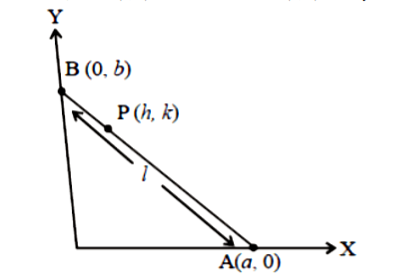 Let point $A(a, 0)$ is on X-axis and $B(0, b)$ is on y-axis. Let $P(h, k)$ divides AB in the ratio 1: 2. So, by section formula $h = \frac{2(0) + 1(a)}{1+2} = \frac{a}{3}$ and $k = \frac{2(b) + 1(0)}{3} = \frac{2b}{3}$. $\Rightarrow a = 3h$ and $b = \frac{3k}{2}$. Now, $a^2 + b^2 = l^2 \Rightarrow 9h^2 + \frac{9k^2}{4} = l^2 \Rightarrow \frac{h^2}{(l/3)^2} + \frac{k^2}{(2l/3)^2} = 1$. Now $e = \sqrt{1 - (\frac{1}{9} \times \frac{9}{4})} = \sqrt{1 - \frac{1}{4}} = \frac{\sqrt{3}}{2}$.
Step Solution:
1. Define Endpoints: Let the staircase have ends at $A(a, 0)$ on the floor and $B(0, b)$ on the wall, with constant length $l$, such that $a^2 + b^2 = l^2$.
2. Apply Section Formula: Point $P(h, k)$ is nearer to the wall ($B$), dividing $AB$ in a $1:2$ ratio: $h = \frac{1(a) + 2(0)}{3} = \frac{a}{3}$ and $k = \frac{1(0) + 2(b)}{3} = \frac{2b}{3}$.
3. Relate Coordinates to Length: Isolate $a$ and $b$: $a = 3h$ and $b = \frac{3k}{2}$.
4. Formulate Locus: Substitute into $a^2 + b^2 = l^2$: $(3h)^2 + (\frac{3k}{2})^2 = l^2 \Rightarrow 9h^2 + \frac{9k^2}{4} = l^2 \Rightarrow \frac{x^2}{(l/3)^2} + \frac{y^2}{(2l/3)^2} = 1$.
5. Calculate Eccentricity: For the ellipse, $e = \sqrt{1 - \frac{\text{minor axis}^2}{\text{major axis}^2}} = \sqrt{1 - \frac{(l/3)^2}{(2l/3)^2}} = \sqrt{1 - 1/4} = \frac{\sqrt{3}}{2}$.
The difficulty level: Medium
The Concept Name: Locus of a Point on a Sliding Rod (Section Formula)
Short cut solution: The locus of any point dividing a sliding rod of length $l$ into segments of length $r_1$ and $r_2$ is an ellipse with semi-axes $r_1$ and $r_2$. Here, $r_1 = l/3$ and $r_2 = 2l/3$. Eccentricity $e = \sqrt{1 - (r_1/r_2)^2} = \sqrt{1 - 1/4} = \frac{\sqrt{3}}{2}$.
Question 478
Question: If OB is the semi-minor axis of an ellipse, $F_1$ and $F_2$ are its foci and the angle between $F_1B$ and $F_2B$ is a right angle, then the square of the eccentricity of the ellipse is:
Options:
A. 1/2
B. $1/\sqrt{2}$
C. $1/(2\sqrt{2})$
D. 1/4
Correct Answer: A
Year: Online April 9, 2014
Solution (as Given in the Source): 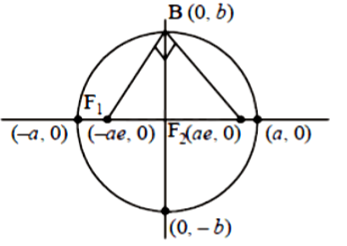 Let $\frac{x^2}{a^2} + \frac{y^2}{b^2} = 1$ be the equation of ellipse. Given $F_1B$ and $F_2B$ are perpendicular to each other. Slope of $F_1B \times$ slope of $F_2B = -1$. $(\frac{b}{ae}) \times (-\frac{b}{ae}) = -1 \Rightarrow b^2 = a^2e^2$. $e^2 = \frac{b^2}{a^2}$. $1 - \frac{b^2}{a^2} = \frac{b^2}{a^2} \Rightarrow 1 = 2 \frac{b^2}{a^2} \Rightarrow \frac{b^2}{a^2} = \frac{1}{2}$. $e^2 = 1 - \frac{b^2}{a^2} = 1 - 1/2 = 1/2$.
Step Solution:
1. Define Coordinates: Place the ellipse at the origin. Foci are $F_1(ae, 0)$ and $F_2(-ae, 0)$, and the semi-minor axis end is $B(0, b)$.
2. Calculate Slopes: The slope of $F_1B$ is $m_1 = \frac{b - 0}{0 - ae} = -\frac{b}{ae}$ and the slope of $F_2B$ is $m_2 = \frac{b - 0}{0 - (-ae)} = \frac{b}{ae}$.
3. Apply Orthogonality: Perpendicular slopes product is $-1$: $(-\frac{b}{ae})(\frac{b}{ae}) = -1 \Rightarrow \frac{b^2}{a^2e^2} = 1 \Rightarrow b^2 = a^2e^2$.
4. Relate to Identity: We know $b^2 = a^2(1 - e^2)$. Equating the two $b^2$ expressions: $a^2e^2 = a^2(1 - e^2)$.
5. Solve for $e^2$: Divide by $a^2$: $e^2 = 1 - e^2 \Rightarrow 2e^2 = 1 \Rightarrow e^2 = 1/2$.
The difficulty level: Easy
The Concept Name: Perpendicular Focal Radii to Minor Axis Vertex
Short cut solution: In an ellipse, the triangle formed by the foci and the end of the minor axis is isosceles. If the angle at the vertex $B$ is $90^\circ$, each base angle is $45^\circ$. Thus, the vertical height $b$ equals the horizontal distance to the focus $ae$ ($b = ae$). Squaring gives $b^2 = a^2e^2 \Rightarrow a^2(1-e^2) = a^2e^2 \Rightarrow 1 = 2e^2 \Rightarrow e^2 = 1/2$.
Question 493
Question: Let the equations of two ellipses be $E_1 : \frac{x^2}{3} + \frac{y^2}{2} = 1$ and $E_2 : \frac{x^2}{16} + \frac{y^2}{b^2} = 1$. If the product of their eccentricities is 1/2, then the length of the minor axis of ellipse $E_2$ is :
Options:
A. 8
B. 9
C. 4
D. 2
Correct Answer: C
Year: Online April 22, 2013
Solution (as Given in the Source): Given $E_1 : \frac{x^2}{3} + \frac{y^2}{2} = 1 \Rightarrow e_1 = \sqrt{\frac{1-2/3}{1}} = \frac{1}{\sqrt{3}}$ and $E_2 : \frac{x^2}{16} + \frac{y^2}{b^2} = 1 \Rightarrow e_2 = \sqrt{\frac{1-b^2}{16}} = \sqrt{\frac{16-b^2}{4}}$. Also, given $e_1 \times e_2 = 1/2 \Rightarrow \frac{1}{\sqrt{3}} \times \sqrt{\frac{16-b^2}{4}} = 1/2 \Rightarrow 16 - b^2 = 12 \Rightarrow b^2 = 4$. Length of minor axis $= 2b = 4$.
Step Solution:
1. Calculate $e_1$: For $E_1$, $a^2=3$ and $b^2=2$. $e_1^2 = 1 - 2/3 = 1/3 \Rightarrow e_1 = \frac{1}{\sqrt{3}}$.
2. Define $e_2$: For $E_2$, $a^2=16$. $e_2^2 = 1 - \frac{b^2}{16} = \frac{16 - b^2}{16}$.
3. Apply Product Condition: $e_1 \cdot e_2 = 1/2 \Rightarrow (e_1 \cdot e_2)^2 = 1/4$.
4. Solve for $b^2$: Substitute step 1 and 2: $(\frac{1}{3})(\frac{16 - b^2}{16}) = 1/4 \Rightarrow \frac{16 - b^2}{48} = 1/4 \Rightarrow 16 - b^2 = 12 \Rightarrow b^2 = 4$.
5. Find Minor Axis: $b^2 = 4 \Rightarrow b = 2$. The full length of the minor axis is $2b = 4$.
The difficulty level: Easy
The Concept Name: Product of Eccentricities of Ellipses
Short cut solution: $e_1 = 1/\sqrt{3}$. Since $e_1 e_2 = 0.5$, $e_2 = \frac{1}{2 e_1} = \frac{\sqrt{3}}{2}$. For $E_2$, $b^2 = a^2(1 - e_2^2) = 16(1 - 3/4) = 16(1/4) = 4$. Thus $b=2$ and the length is $2b=4$.
Question 511
Question: Equation of the ellipse whose axes are the axes of coordinates and which passes through the point (-3, 1) and has eccentricity $\sqrt{\frac{2}{5}}$ is
Options:
A. $5x^2 + 3y^2 - 48 = 0$
B. $3x^2 + 5y^2 - 15 = 0$
C. $5x^2 + 3y^2 - 32 = 0$
D. $3x^2 + 5y^2 - 32 = 0$
Correct Answer: D
Year: 2011
Solution (as Given in the Source): Let the equation of ellipse be $\frac{x^2}{a^2} + \frac{y^2}{b^2} = 1$. Given it passes through (-3, 1) so $\frac{9}{a^2} + \frac{1}{b^2} = 1$. Also, we know that $b^2 = a^2(1 - e^2) = a^2(1 - 2/5) \implies 5b^2 = 3a^2$. Solving (i) and (ii) we get $a^2 = \frac{32}{3}, b^2 = \frac{32}{5}$. So, the equation of the ellipse is $3x^2 + 5y^2 = 32$.
Step Solution:
1. Assume standard form: Let the ellipse be $\frac{x^2}{a^2} + \frac{y^2}{b^2} = 1$.
2. Point Substitution: Substitute $(-3, 1)$ into the equation: $\frac{(-3)^2}{a^2} + \frac{1^2}{b^2} = 1 \implies \frac{9}{a^2} + \frac{1}{b^2} = 1$.
3. Axis Relation: Using $e^2 = 2/5$ in $b^2 = a^2(1 - e^2)$, we get $b^2 = a^2(1 - 2/5) \implies b^2 = \frac{3a^2}{5} \implies a^2 = \frac{5b^2}{3}$.
4. Solve for $b^2$: Substitute $a^2$ into the point equation: $\frac{9}{5b^2/3} + \frac{1}{b^2} = 1 \implies \frac{27}{5b^2} + \frac{5}{5b^2} = 1 \implies \frac{32}{5b^2} = 1 \implies b^2 = \frac{32}{5}$.
5. Final Equation: Find $a^2 = \frac{5}{3} \cdot \frac{32}{5} = \frac{32}{3}$. The equation is $\frac{3x^2}{32} + \frac{5y^2}{32} = 1 \implies 3x^2 + 5y^2 = 32$.
The difficulty level: Easy
The Concept Name: Standard Ellipse Equation and Eccentricity Identities
Short cut solution: The axis ratio is $b^2/a^2 = 1 - e^2 = 3/5$. Substitute this directly into the point-satisfaction condition: $\frac{x^2}{a^2} + \frac{y^2}{(3/5)a^2} = 1$. Putting $(-3, 1)$ gives $\frac{9}{a^2} + \frac{5}{3a^2} = 1 \implies \frac{27+5}{3a^2} = 1 \implies a^2 = 32/3$. Then $b^2 = 32/5$, giving $3x^2 + 5y^2 = 32$.
Question 520
Question: A focus of an ellipse is at the origin. The directrix is the line $x = 4$ and the eccentricity is $\frac{1}{2}$. Then the length of the semi-major axis is
Options:
A. $\frac{8}{3}$
B. $\frac{2}{3}$
C. $\frac{4}{3}$
D. $\frac{5}{3}$
Correct Answer: A
Year: 2008
Solution (as Given in the Source):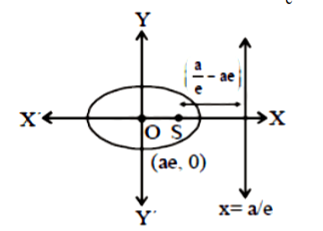 Perpendicular distance of directrix $x = \pm \frac{a}{e}$ from focus $(\pm ae, 0) = \frac{a}{e} - ae = 4 \implies a(2 - \frac{1}{2}) = 4 \implies a = \frac{8}{3}$.
Step Solution:
1. Identify distance property: The distance from a focus $(\pm ae, 0)$ to its corresponding directrix $x = \pm a/e$ is $|a/e - ae|$.
2. Relate to Question: Given the focus is at $(0, 0)$ and directrix is $x = 4$, the distance is 4. Thus, $a/e - ae = 4$.
3. Substitute Eccentricity: Given $e = 1/2$, the equation becomes $\frac{a}{1/2} - a(1/2) = 4$.
4. Simplify: $2a - \frac{a}{2} = 4 \implies \frac{3a}{2} = 4$.
5. Calculate semi-major axis: $3a = 8 \implies a = \frac{8}{3}$.
The difficulty level: Easy
The Concept Name: Distance Between Focus and Directrix of an Ellipse
Short cut solution: Use the formula $a(1/e - e) = d$. Here $a(2 - 0.5) = 4 \implies 1.5a = 4 \implies a = 4/1.5 = 8/3$.
Question 527
Question: In an ellipse, the distance between its foci is 6 and minor axis is 8. Then its eccentricity is
Options:
A. $\frac{3}{5}$
B. $\frac{1}{2}$
C. $\frac{4}{5}$
D. $\frac{1}{\sqrt{5}}$
Correct Answer: A
Year: 2006
Solution (as Given in the Source): Given that distance between foci is $2ae = 6 \implies ae = 3$ and length of minor axis is $2b = 8 \implies b = 4$. we know that $b^2 = a^2(1 - e^2) \implies 16 = a^2 - a^2e^2 \implies a^2 = 16 + 9 = 25 \implies a = 5$. $e = \frac{3}{a} = \frac{3}{5}$.
Step Solution:
1. Find Focal Distance ($ae$): Distance between foci $2ae = 6$, so $ae = 3$.
2. Find Semi-minor axis ($b$): Minor axis $2b = 8$, so $b = 4$ and $b^2 = 16$.
3. Relate axes using Identity: Use $b^2 = a^2 - (ae)^2$ for an ellipse.
4. Solve for $a^2$: Substitute known values: $16 = a^2 - 3^2 \implies a^2 = 16 + 9 = 25$, so $a = 5$.
5. Calculate eccentricity: $e = \frac{ae}{a} = \frac{3}{5}$.
The difficulty level: Easy
The Concept Name: Standard Ellipse Parameter Identities
Short cut solution: In an ellipse, $a^2 = b^2 + c^2$ where $c$ is focus distance. Here $a^2 = 4^2 + 3^2 = 25$, so $a=5$. Eccentricity $e = c/a = 3/5$.
Question 533
Question: An ellipse has OB as semi minor axis, F and F' its focii and the angle FBF' is a right angle. Then the eccentricity of the ellipse is
Options:
A. $1/\sqrt{2}$
B. $1/2$
C. $1/4$
D. $1/\sqrt{3}$
Correct Answer: A
Year: 2005
Solution (as Given in the Source): 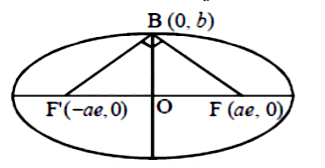 Given that $\angle FBF' = 90^{\circ}$ $\Rightarrow FB^2 + F'B^2 = FF'^2$. $\therefore \sqrt{a^2e^2 + b^2}^2 + \sqrt{a^2e^2 + b^2}^2 = (2ae)^2 \Rightarrow 2(a^2e^2 + b^2) = 4a^2e^2 \Rightarrow e^2 = b^2/a^2$. We know that $e^2 = 1 - b^2/a^2 = 1 - e^2 \Rightarrow 2e^2 = 1, e = 1/\sqrt{2}$.
Step Solution:
1. Define Coordinates: Place the ellipse center at origin. Foci are $F(ae, 0)$ and $F'(-ae, 0)$, and the end of the minor axis is $B(0, b)$.
2. Use Pythagorean Theorem: In right $\triangle FBF'$, $FB^2 + F'B^2 = FF'^2$. Since $FB = F'B$, then $2FB^2 = (2ae)^2 = 4a^2e^2$.
3. Find Side Lengths: The distance $FB^2 = (ae-0)^2 + (0-b)^2 = a^2e^2 + b^2$. Substituting this into step 2: $2(a^2e^2 + b^2) = 4a^2e^2$.
4. Simplify Axis Ratio: $a^2e^2 + b^2 = 2a^2e^2 \implies b^2 = a^2e^2 \implies \frac{b^2}{a^2} = e^2$.
5. Calculate $e$: Use the identity $e^2 = 1 - \frac{b^2}{a^2}$. Substitute $e^2$: $e^2 = 1 - e^2 \implies 2e^2 = 1 \implies e = \frac{1}{\sqrt{2}}$.
The difficulty level: Easy
The Concept Name: Geometric Properties of Ellipse Foci and Vertices
Short cut solution: In an ellipse, the distance from a focus to the end of the minor axis is always $a$. If $\angle FBF' = 90^{\circ}$, then $\triangle OBF$ is a right isosceles triangle with $OB = OF$ ($b = ae$). Substituting this into $e^2 = 1 - (b/a)^2$ gives $e^2 = 1 - e^2 \implies e = 1/\sqrt{2}$.
Question 540
Question: The eccentricity of an ellipse, with its centre at the origin, is $1/2$. If one of the directrices is $x = 4$, then the equation of the ellipse is:
Options:
A. $4x^2 + 3y^2 = 1$
B. $3x^2 + 4y^2 = 12$
C. $4x^2 + 3y^2 = 12$
D. $3x^2 + 4y^2 = 1$
Correct Answer: B
Year: 2004
Solution (as Given in the Source): Given that $e = \frac{1}{2}$. Directrix, $x = \frac{a}{e} = 4 \therefore a = 4 \times \frac{1}{2} = 2. \therefore b = 2\sqrt{1 - \frac{1}{4}} = \sqrt{3}$. Equation of ellipse is $\frac{x^2}{4} + \frac{y^2}{3} = 1 \Rightarrow 3x^2 + 4y^2 = 12$.
Step Solution:
1. Identify $a$ from Directrix: The standard directrix is $x = a/e$. Given $a/e = 4$ and $e = 1/2$.
2. Calculate $a$: $a = 4 \times e = 4 \times (1/2) = 2$. Thus $a^2 = 4$.
3. Calculate $b^2$: Use the identity $b^2 = a^2(1 - e^2) = 4(1 - 1/4) = 4(3/4) = 3$.
4. Formulate Equation: Standard form is $\frac{x^2}{a^2} + \frac{y^2}{b^2} = 1 \implies \frac{x^2}{4} + \frac{y^2}{3} = 1$.
5. Simplify to General Form: $3x^2 + 4y^2 = 12$.
The difficulty level: Easy
The Concept Name: Standard Ellipse Parameters (Eccentricity and Directrix)
Short cut solution: Given $x = a/e = 4$ and $e = 0.5$, then $a = 2$. Only Option B and C have $a^2 = 4$ or $b^2 = 4$. Check $b^2$: $b^2 = a^2(1-e^2) = 4(0.75) = 3$. Option B satisfies $x^2/4 + y^2/3 = 1$.
Question 544
Question: The foci of the ellipse $x^2/16 + y^2/b^2 = 1$ and the hyperbola $\frac{x^2}{144} - \frac{y^2}{81} = \frac{1}{25}$ coincide. Then the value of $b^2$ is
Options:
A. 9
B. 1
C. 5
D. 7
Correct Answer: D
Year: 2003
Solution (as Given in the Source): $\frac{x^2}{144/25} - \frac{y^2}{81/25} = \frac{1}{25}$ (Note: Source text has a typo; it evaluates the hyperbola as $x^2/(12/5)^2 - y^2/(9/5)^2 = 1$). $a = \sqrt{144/25} = 12/5, b = \sqrt{81/25} = 9/5, e = \sqrt{1 + 81/144} = 15/12 = 5/4$. $\therefore$ Foci $= (\pm ae, 0) = (\pm 3, 0)$. $\therefore$ foci of ellipse $=$ foci of hyperbola $\therefore$ for ellipse $ae = 3$ but $a = 4 \Rightarrow e = 3/4$. Then, $b^2 = a^2(1 - e^2) \Rightarrow b^2 = 16(1 - 9/16) = 7$.
Step Solution:
1. Analyze Hyperbola: Standardize the equation: $\frac{x^2}{(12/5)^2} - \frac{y^2}{(9/5)^2} = 1$. Here $a_H = 12/5$ and $b_H = 9/5$.
2. Find Hyperbola Eccentricity: $e_H^2 = 1 + \frac{b_H^2}{a_H^2} = 1 + \frac{81}{144} = \frac{225}{144} \implies e_H = \frac{15}{12} = \frac{5}{4}$.
3. Determine Focal Distance ($c$): For both conics, $c = a_H e_H = \frac{12}{5} \times \frac{5}{4} = 3$. Foci are $(\pm 3, 0)$.
4. Apply to Ellipse: For the ellipse $x^2/16 + y^2/b^2 = 1$, we have $a_E^2 = 16 \implies a_E = 4$. Since foci coincide, $a_E e_E = 3$.
5. Solve for $b^2$: $b^2 = a_E^2 - (a_E e_E)^2 = 16 - 3^2 = 16 - 9 = 7$.
The difficulty level: Medium
The Concept Name: Coinciding Foci of Conics
Short cut solution: For any conic, the distance from center to focus is $c = \sqrt{|a^2 \pm b^2|}$. For the hyperbola, $c^2 = \frac{144}{25} + \frac{81}{25} = \frac{225}{25} = 9$. For the ellipse to have the same foci, its $c^2$ must be 9. $a^2 - b^2 = 9 \implies 16 - b^2 = 9 \implies b^2 = 7$.