Question 2
Question: Let the triangle PQR be the image of the triangle with vertices (1, 3), (3, 1) and (2, 4) in the line $x + 2 y = 2$. If the centroid of $\triangle PQR$ is the point $(\alpha, \beta)$, then $15(\alpha - \beta)$ is equal to:
Options: A. 21, B. 19, C. 22, D. 24
Correct Answer: C
Year: JEE Main 2025 (Online) 22nd January Morning Shift
Solution: Let 'G' be the centroid of the $\triangle$ formed by (1, 3), (3, 1) and (2, 4). Calculating $G \cong \left( 2, \frac{8}{3} \right)$. Finding the image of G w.r.t. $x + 2y - 2 = 0$ results in $\frac{\alpha - 2}{1} = \frac{\beta - \frac{8}{3}}{2} = -2 \frac{\left( 2 + \frac{16}{3} - 2 \right)}{1 + 4}$, which simplifies to $\alpha = \frac{-2}{15}$ and $\beta = \frac{-24}{15}$. Thus, $15(\alpha - \beta) = -2 + 24 = 22$.
Step Solution:
1. Find the original centroid (G): Use the formula $G = (\frac{x_1+x_2+x_3}{3}, \frac{y_1+y_2+y_3}{3})$. For vertices (1, 3), (3, 1), and (2, 4), $G = (\frac{1+3+2}{3}, \frac{3+1+4}{3}) = (2, \frac{8}{3})$.
2. Apply the property of images: The centroid of the image triangle is the image of the centroid of the original triangle across the same line.
3. Use the image formula: For point $(x_1, y_1)$ and line $ax + by + c = 0$, the image $(\alpha, \beta)$ is $\frac{\alpha-x_1}{a} = \frac{\beta-y_1}{b} = -2\frac{(ax_1+by_1+c)}{a^2+b^2}$.
4. Substitute values: $\frac{\alpha-2}{1} = \frac{\beta-8/3}{2} = -2\frac{(2 + 2(8/3) - 2)}{1^2+2^2}$. This gives $\alpha-2 = -\frac{32}{15} \Rightarrow \alpha = -\frac{2}{15}$ and $\beta - \frac{8}{3} = -\frac{64}{15} \Rightarrow \beta = -\frac{24}{15}$.
5. Calculate final value: $15(\alpha - \beta) = 15(-\frac{2}{15} - (-\frac{24}{15})) = 15(\frac{22}{15}) = 22$.
Difficulty Level: Medium
Concept Name: Image of a Point across a Line
Shortcut Solution: Find the difference in coordinates directly from the image ratio: $\alpha - 2 = k$ and $\beta - \frac{8}{3} = 2k$. Then $\alpha - \beta = (k+2) - (2k + \frac{8}{3}) = -k - \frac{2}{3}$. Since $k = -\frac{32}{15}$, $\alpha - \beta = \frac{32}{15} - \frac{10}{15} = \frac{22}{15}$. Multiplying by 15 gives 22.
Question 5
Question: Let the points $\left( \frac{11}{2}, \alpha \right)$ lie on or inside the triangle with sides $x + y = 11$, $x + 2y = 16$ and $2x + 3y = 29$. Then the product of the smallest and the largest values of $\alpha$ is equal to:
Options: A. 22, B. 33, C. 55, D. 44
Correct Answer: B
Year: JEE Main 2025 (Online) 24th January Evening Shift
Solution: The point of intersection of $x = \frac{11}{2}$ with lines $L_1$ and $L_3$ gives the bounds for $\alpha$. Specifically, $\alpha_{min} = \frac{11}{2}$ and $\alpha_{max} = 6$. The product is $\frac{11}{2} \times 6 = 33$.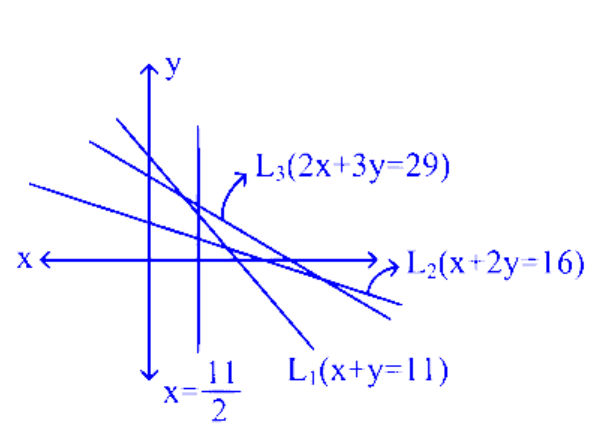
Step Solution:
1. Identify constraints: The point $\left( \frac{11}{2}, \alpha \right)$ must satisfy the inequalities defining the interior of the triangle.
2. Evaluate line 1 ($x + y = 11$): Plug in $x = 11/2 \Rightarrow 11/2 + y = 11 \Rightarrow y = 5.5$.
3. Evaluate line 2 ($x + 2y = 16$): Plug in $x = 11/2 \Rightarrow 11/2 + 2y = 16 \Rightarrow 2y = 10.5 \Rightarrow y = 5.25$.
4. Evaluate line 3 ($2x + 3y = 29$): Plug in $x = 11/2 \Rightarrow 2(11/2) + 3y = 29 \Rightarrow 11 + 3y = 29 \Rightarrow 3y = 18 \Rightarrow y = 6$.
5. Determine range and product: The values of $y$ at $x = 5.5$ are 5.25, 5.5, and 6. For the point to be inside, $\alpha$ must be between the relevant boundaries: $\alpha_{min} = 5.5$ and $\alpha_{max} = 6$. Product $= 5.5 \times 6 = 33$.
Difficulty Level: Easy
Concept Name: Point in a Triangle / Linear Programming
Shortcut Solution: Simply substitute $x = 5.5$ into all three equations; the smallest and largest $y$ values that satisfy the triangular region are your bounds.
Question 6
Question: If A and B are the points of intersection of the circle $x^2 + y^2 - 8x = 0$ and the hyperbola $\frac{x^2}{9} - \frac{y^2}{4} = 1$ and a point P moves on the line $2x - 3y + 4 = 0$, then the centroid of $\Delta PAB$ lies on the line:
Options: A. $x + 9y = 36$, B. $9x - 9y = 32$, C. $4x - 9y = 12$, D. $6x - 9y = 20$
Correct Answer: D
Year: JEE Main 2025 (Online) 28th January Evening Shift
Solution: Solve the intersection of $x^2 + y^2 - 8x = 0$ and $4x^2 - 9y^2 = 36$. Substituting $y^2 = 8x - x^2$ into the hyperbola equation gives $4x^2 - 9(8x - x^2) = 36$, leading to $13x^2 - 72x - 36 = 0$. Solving gives $x = 6$ (valid) and $x = -6/13$ (rejected). At $x=6, y = \pm\sqrt{12}$. Points are $A(6, \sqrt{12})$ and $B(6, -\sqrt{12})$. Centroid $(h, k)$ for $P(\alpha, \beta)$ is $h = \frac{\alpha+6+6}{3}, k = \frac{\beta+\sqrt{12}-\sqrt{12}}{3}$. Eliminating parameters shows the centroid lies on $6x - 9y = 20$.
Step Solution:
1. Solve for A and B: Use $y^2 = 8x - x^2$ from the circle and substitute into $4x^2 - 9y^2 = 36$.
2. Find coordinates: $13x^2 - 72x - 36 = 0 \Rightarrow (13x + 6)(x - 6) = 0$. Since $x^2 \geq 9$ for the hyperbola, $x=6$. Then $y^2 = 48 - 36 = 12$, so $y = \pm\sqrt{12}$. $A(6, \sqrt{12}), B(6, -\sqrt{12})$.
3. Define moving point P: Let $P = (\alpha, \beta)$. It lies on $2\alpha - 3\beta + 4 = 0$.
4. Set up centroid coordinates: $h = \frac{\alpha + 6 + 6}{3} = \frac{\alpha + 12}{3} \Rightarrow \alpha = 3h - 12$. Also $k = \frac{\beta + \sqrt{12} - \sqrt{12}}{3} = \frac{\beta}{3} \Rightarrow \beta = 3k$.
5. Substitute into line P: $2(3h - 12) - 3(3k) + 4 = 0 \Rightarrow 6h - 24 - 9k + 4 = 0 \Rightarrow 6h - 9k = 20$. The locus is $6x - 9y = 20$.
Difficulty Level: Hard
Concept Name: Locus of Centroid
Shortcut Solution: Notice the sum of $y$-coordinates of A and B is 0. This means the centroid's $y$-coordinate ($k$) is always exactly $1/3$ of P's $y$-coordinate ($\beta$). Similarly, the centroid's $h$ is shifted from $\alpha/3$ by a constant. Transforming the line $2x - 3y + 4 = 0$ by replacing $x$ with $3x - 12$ and $y$ with $3y$ gives $6x - 9y = 20$ immediately.
Question 11
Question: Let $\Delta ABC$ be a triangle formed by the lines $7x - 6y + 3 = 0$, $x + 2y - 31 = 0$ and $9x - 2y - 19 = 0$. Let the point $(h, k)$ be the image of the centroid of $\Delta ABC$ in the line $3x + 6y - 53 = 0$. Then $h^2 + k^2 + hk$ is equal to:
Options: A. 47, B. 37, C. 40, D. 36
Correct Answer: B
Year: JEE Main 2025 (Online) 29th January Morning Shift
Solution: 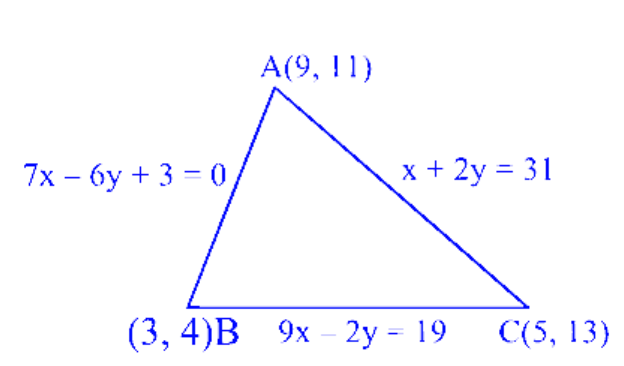 The vertices are found by intersecting the lines: (3, 4), (5, 13), and (9, 11). Centroid $= \left( \frac{3+5+9}{3}, \frac{4+13+11}{3} \right) = \left( \frac{17}{3}, \frac{28}{3} \right)$.
 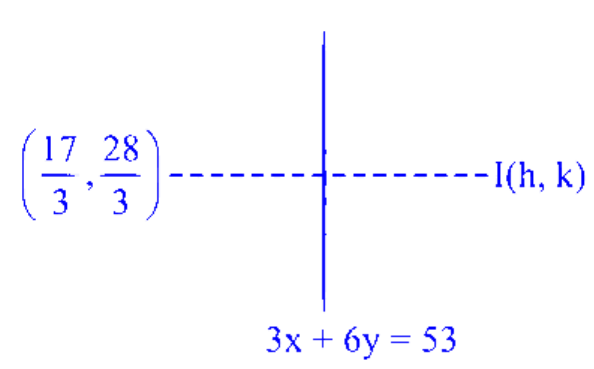 Finding the image $(h, k)$ across $3x + 6y - 53 = 0$ results in $h=3, k=4$. Then $h^2 + k^2 + hk = 9 + 16 + 12 = 37$.
Step Solution:
1. Find vertices: Intersect the three lines. $L_1 \cap L_2 \Rightarrow (3, 4)$; $L_2 \cap L_3 \Rightarrow (9, 11)$; $L_3 \cap L_1 \Rightarrow (5, 13)$.
2. Calculate centroid: $G = \left( \frac{17}{3}, \frac{28}{3} \right)$.
3. Apply image formula: Use $\frac{h - x_1}{a} = \frac{k - y_1}{b} = -2\frac{(ax_1+by_1+c)}{a^2+b^2}$ with line $3x+6y-53=0$.
4. Solve for (h, k): $\frac{h - 17/3}{3} = \frac{k - 28/3}{6} = -2 \frac{(3(17/3) + 6(28/3) - 53)}{3^2+6^2} = -2 \frac{(17 + 56 - 53)}{45} = -\frac{40}{45} = -\frac{8}{9}$.
5. Final values: $h = \frac{17}{3} - \frac{24}{9} = 3$ and $k = \frac{28}{3} - \frac{48}{9} = 4$. $h^2 + k^2 + hk = 3^2 + 4^2 + (3)(4) = 37$.
Difficulty Level: Hard (Calculation intensive)
Concept Name: Image of a Point across a Line
Shortcut Solution: After finding $h=3$ and $k=4$, the expression $h^2+k^2+hk$ is a symmetric form. Check small integer possibilities for the image coordinates based on the centroid $(17/3, 28/3)$ and line slope $-1/2$ to save time if stuck on fractions.
Question 13
Question: Let the three sides of a triangle are on the lines $4 x - 7 y + 1 0 = 0$, $x + y = 5$ and $7 x + 4 y = 1 5 .$ Then the distance of its orthocentre from the orthocentre of the triangle formed by the lines $x = 0, y = 0$ and $x + y = 1$ is
Options: A. $\sqrt{20}$, B. 20, C. $\sqrt{5}$, D. 5
Correct Answer: C
Year: JEE Main 2025 (Online) 4th April Morning Shift
Solution: 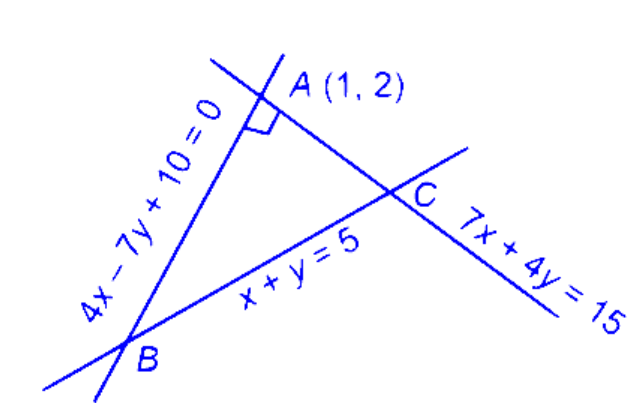 $A$ is orthocentre of above $\Delta$. $O$ is orthocentre of above $\Delta$. $O A = \sqrt{5}$.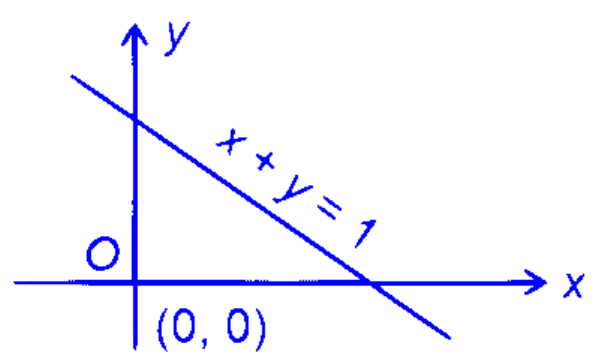
Step Solution:
1. Analyze the first triangle: Compare the slopes of the lines $L_1: 4x - 7y + 10 = 0$ ($m_1 = 4/7$) and $L_3: 7x + 4y = 15$ ($m_3 = -7/4$). Since $m_1 \cdot m_3 = -1$, these lines are perpendicular.
2. Identify the first orthocentre: In a right-angled triangle, the orthocentre is the vertex where the right angle is formed. Solve for the intersection of $L_1$ and $L_3$: $4x - 7y = -10$ and $7x + 4y = 15$.
3. Solve for intersection point (A): Multiply $L_1$ by 4 and $L_3$ by 7: $16x - 28y = -40$ and $49x + 28y = 105$. Adding them gives $65x = 65 \Rightarrow x = 1$. Substituting $x=1$ into $x+y=5$ is incorrect; use $4(1) - 7y = -10 \Rightarrow 7y = 14 \Rightarrow y = 2$. Thus, $A = (1, 2)$.
4. Analyze the second triangle: The lines $x=0, y=0$, and $x+y=1$ form a right-angled triangle at the origin $(0,0)$. Its orthocentre is $(0,0)$.,
5. Calculate distance: Use the distance formula between $(1, 2)$ and $(0, 0)$: $d = \sqrt{(1-0)^2 + (2-0)^2} = \sqrt{1 + 4} = \sqrt{5}$.
Difficulty Level: Easy
Concept Name: Orthocentre of a Right-Angled Triangle
Shortcut Solution: Recognizing the perpendicular slopes ($4/7$ and $-7/4$) immediately locates the orthocentre at the intersection point $(1, 2)$. The distance from the origin $(0,0)$ is simply $\sqrt{1^2 + 2^2} = \sqrt{5}$.
Question 14
Question: Let ABC be the triangle such that the equations of lines AB and AC be $3 y - x = 2$ and $x + y = 2$, respectively, and the points B and C lie on x-axis. If P is the orthocentre of the triangle ABC, then the area of the triangle PBC is equal to
Options: A. 8, B. 4, C. 10, D. 6
Correct Answer: D
Year: JEE Main 2025 (Online) 7th April Morning Shift
Solution: Equation of line AB is $3 y - x = 2$. In line AB, when $y = 0, x = - 2$. In line AC, when $y = 0, x = 2$. Therefore $C(2, 0)$. Equation of altitude of BC, $y = x + 2$. Similarly, equation of altitude of AB, $y = - 3 x + 6$. On solving, orthocentre $P(1, 3)$.
Step Solution:
1. Find coordinates of B and C: B is the intersection of $3y - x = 2$ and $y = 0$, giving $B(-2, 0)$. C is the intersection of $x + y = 2$ and $y = 0$, giving $C(2, 0)$.
2. Find vertex A: Solve $3y - x = 2$ and $x + y = 2$. Adding them gives $4y = 4 \Rightarrow y = 1$, then $x = 1$. So $A(1, 1)$.
3. Find altitude from B: The slope of AC is -1, so the slope of the altitude from B is 1. Equation: $y - 0 = 1(x + 2) \Rightarrow y = x + 2$.
4. Find orthocentre P: The altitude from A to BC (the x-axis) is the vertical line $x = 1$. Intersecting $x = 1$ with $y = x + 2$ gives $P(1, 3)$.
5. Calculate Area of $\Delta PBC$: The base BC has length $|2 - (-2)| = 4$. The height is the y-coordinate of P, which is 3. Area $= 1/2 \times 4 \times 3 = 6$.
Difficulty Level: Medium
Concept Name: Altitude and Orthocentre intersection
Shortcut Solution: Since BC is on the x-axis, the base is 4. The area is simply $2 \times |y_P|$. Finding the y-coordinate of the orthocentre is the only required calculation.
Question 15
Question: If the orthocenter of the triangle formed by the lines $y = x + 1, y = 4 x - 8$ and $y = m x + c$ is at (3, -1), then m - c is :
Options: A. 0, B. 2, C. -2, D. 4
Correct Answer: A
Year: JEE Main 2025 (Online) 7th April Evening Shift
Solution: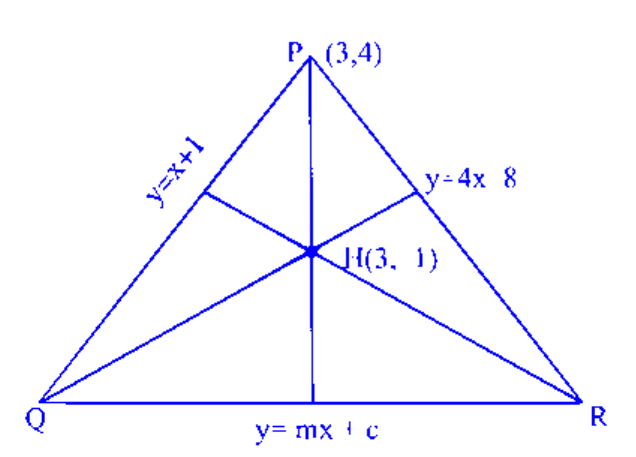 Point Q is intersection of line PQ & QR. $m_{2H} = \frac{\frac{1-c}{m-1}+2}{\frac{1-c}{m-1}-3}$. Since $m_{PH} \to \infty$, the slope of line QR (m) = 0. Putting $m=0$ in the slope relationship gives $c=0$. So $m-c=0$.,
Step Solution:
1. Find vertex P: Intersect $y = x + 1$ and $y = 4x - 8$. $x + 1 = 4x - 8 \Rightarrow 3x = 9 \Rightarrow x = 3, y = 4$. So $P = (3, 4)$.
2. Analyze Orthocentre H: The orthocentre is given as $H(3, -1)$. Notice that both P and H have the same x-coordinate ($x=3$).
3. Determine slope m: Since the line segment PH is vertical, the altitude from P is vertical. This means the side opposite to P ($y = mx + c$) must be horizontal. Therefore, $m = 0$.
4. Determine constant c: Let $Q$ be the intersection of $y = x + 1$ and $y = c$ (since $m=0$). $Q = (c-1, c)$. The line segment $QH$ must be perpendicular to the line $y = 4x - 8$ (slope 4).
5. Calculate c: Slope of $QH = \frac{c - (-1)}{(c-1) - 3} = \frac{c+1}{c-4}$. Perpendicularity means $\frac{c+1}{c-4} = -1/4 \Rightarrow 4c + 4 = -c + 4 \Rightarrow 5c = 0 \Rightarrow c = 0$. Thus, $m - c = 0 - 0 = 0$.
Difficulty Level: Hard
Concept Name: Orthocentre and Altitude Slopes
Shortcut Solution: Recognizing that the vertex $P(3, 4)$ and orthocentre $H(3, -1)$ form a vertical line immediately tells you the third side is horizontal ($m=0$). Checking the perpendicularity of the other altitude quickly yields $c=0$.
Question 23
Question: Let $(5, a/4)$ be the circumcenter of a triangle with vertices $A(a, -2)$, $B(a, 6)$, and $C(a/4, -2)$. Let $\alpha$ denote the circumradius, $\beta$ denote the area, and $\gamma$ denote the perimeter of the triangle. Then $\alpha + \beta + \gamma$ is
Options: A. 60, B. 53, C. 62, D. 30
Correct Answer: B
Year: JEE Main 2024 (Online) 29th January Morning Shift
Solution: $A(a, -2), B(a, 6), C(a/4, -2), O(5, a/4)$. Using $AO = BO$, we get $(a - 5)^2 + (a/4 + 2)^2 = (a - 5)^2 + (a/4 - 6)^2$, which leads to $a = 8$. Consequently, $AB = 8, AC = 6, BC = 10$. Then $\alpha = 5, \beta = 24, \gamma = 24$, so $\alpha + \beta + \gamma = 53$.
Step Solution:
1. Identify the Triangle Type: Notice that $A(a, -2)$ and $B(a, 6)$ lie on a vertical line, while $A(a, -2)$ and $C(a/4, -2)$ lie on a horizontal line. Thus, the triangle is right-angled at A.
2. Locate Circumcenter: In a right-angled triangle, the circumcenter is the midpoint of the hypotenuse $BC$. Midpoint $= \left( \frac{a + a/4}{2}, \frac{6 + (-2)}{2} \right) = \left( \frac{5a}{8}, 2 \right)$.
3. Find 'a': Compare the calculated midpoint to the given circumcenter $(5, a/4)$. $a/4 = 2 \Rightarrow \mathbf{a = 8}$. This also satisfies $5a/8 = 5(8)/8 = 5$.
4. Calculate Side Lengths: For $a=8$, vertices are $A(8, -2), B(8, 6), C(2, -2)$. $AB = 8$, $AC = 6$, and $BC = \sqrt{6^2 + 8^2} = 10$.
5. Calculate Parameters: Circumradius $\alpha = \frac{BC}{2} = 5$; Area $\beta = \frac{1}{2} \times 8 \times 6 = 24$; Perimeter $\gamma = 8 + 6 + 10 = 24$. Sum $\alpha + \beta + \gamma = 5 + 24 + 24 = \mathbf{53}$.
Difficulty Level: Medium
Concept Name: Circumcenter of a Right-Angled Triangle
Shortcut Solution: Recognizing the sides are parallel to the axes immediately identifies the right angle at $(a, -2)$. The circumcenter y-coordinate must be the average of the vertices' y-coordinates: $(-2+6)/2 = 2$. Since the given y-coordinate is $a/4$, then $a/4 = 2 \Rightarrow a = 8$.
Question 29
Question: Let $A(a, b), B(3, 4)$ and $(-6, -8)$ respectively denote the centroid, circumcentre and orthocentre of a triangle. Then, the distance of the point $P(2a + 3, 7b + 5)$ from the line $2x + 3y - 4 = 0$ measured parallel to the line $x - 2y - 1 = 0$ is
Options: A. $\frac{15\sqrt{5}}{7}$, B. $\frac{17\sqrt{5}}{6}$, C. $\frac{17\sqrt{5}}{7}$, D. 17
Correct Answer: C
Year: JEE Main 2024 (Online) 31st January Evening Shift
Solution: $A(a, b), B(3, 4), C(-6, -8)$. Distance from $P$ measured along $x - 2y - 1 = 0$ results in $r = | -17\sqrt{5} / 7 | = 17\sqrt{5} / 7$.
Step Solution:
1. Find Centroid (a, b): Use the Euler line property where the Centroid (G) divides the line joining the Orthocentre (H) and Circumcentre (O) in the ratio 2:1 (Wait, standard ratio is $HG:GO = 2:1$). $G = \frac{2O + H}{3} = \frac{2(3, 4) + (-6, -8)}{3} = (0, 0)$. Thus, $a=0, b=0$.
2. Define Point P: Substitute $a=0, b=0$ into $P(2a+3, 7b+5)$ to get $P(3, 5)$.
3. Determine Direction Slope: The distance is measured parallel to $x - 2y - 1 = 0$, which has a slope $\tan \theta = 1/2$. Therefore, $\sin \theta = 1/\sqrt{5}$ and $\cos \theta = 2/\sqrt{5}$.
4. Apply Parametric Form: Any point $Q$ at distance $r$ from $P(3, 5)$ in this direction is $x = 3 + r\cos \theta, y = 5 + r\sin \theta$. $Q = (3 + \frac{2r}{\sqrt{5}}, 5 + \frac{r}{\sqrt{5}})$.
5. Intersect with Target Line: Point $Q$ must lie on $2x + 3y - 4 = 0$. $2(3 + \frac{2r}{\sqrt{5}}) + 3(5 + \frac{r}{\sqrt{5}}) - 4 = 0 \Rightarrow 6 + \frac{4r}{\sqrt{5}} + 15 + \frac{3r}{\sqrt{5}} - 4 = 0 \Rightarrow 17 + \frac{7r}{\sqrt{5}} = 0$. Solving gives $r = -\frac{17\sqrt{5}}{7}$. Distance $|r| = \mathbf{\frac{17\sqrt{5}}{7}}$.
Difficulty Level: Hard
Concept Name: Euler Line and Distance of a Point in a Given Direction
Shortcut Solution: Use the ratio $HG:GO = 2:1$ to find $G(0,0)$ quickly. Then use the formula for distance $d$ in direction $\theta$: $d = | \frac{ax_1+by_1+c}{a\cos\theta + b\sin\theta} |$. Here, $d = | \frac{2(3)+3(5)-4}{2(2/\sqrt{5}) + 3(1/\sqrt{5})} | = | \frac{17}{7/\sqrt{5}} | = \frac{17\sqrt{5}}{7}$.
Question 34
Question: The equations of two sides of a variable triangle are $x = 0$ and $y = 3$, and its third side is a tangent to the parabola $y^2 = 6x$. The locus of its circumcentre is:
Options: A. $4y^2 - 18y - 3x - 18 = 0$, B. $4y^2 + 18y + 3x + 18 = 0$, C. $4y^2 - 18y + 3x + 18 = 0$, D. $4y^2 - 18y - 3x + 18 = 0$
Correct Answer: C
Year: JEE Main 2023 (Online) 25th January Evening Shift
Solution: 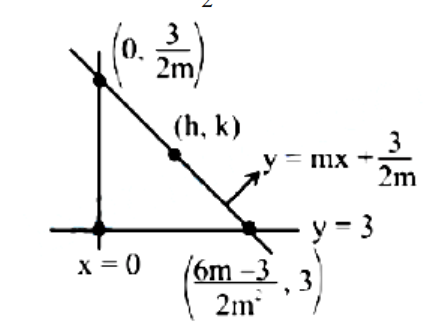 For $y^2 = 6x, a = 3/2$. Tangent: $y = mx + \frac{3}{2m}$. Circumcenter coordinates $(h, k)$ are $h = \frac{6m-3}{4m^2}, k = \frac{6m+3}{4m}$. Eliminating $m$ leads to $4y^2 - 18y + 3x + 18 = 0$.
Step Solution:
1. Define Third Side: For $y^2 = 6x$, $4a=6 \Rightarrow a=3/2$. The third side (tangent) is $y = mx + \frac{3}{2m}$.
2. Find Vertices: The lines $x=0$ and $y=3$ are perpendicular. The vertices are:
$V_1: (0, 3)$ (intersection of $x=0, y=3$).
$V_2: (0, \frac{3}{2m})$ (intersection of $x=0$ and tangent).
$V_3: (\frac{6m-3}{2m^2}, 3)$ (intersection of $y=3$ and tangent).
3. Identify Circumcenter: Since it is a right-angled triangle, the circumcenter $(h, k)$ is the midpoint of the hypotenuse connecting $V_2$ and $V_3$.
4. Express h, k in terms of m: $h = \frac{0 + \frac{6m-3}{2m^2}}{2} = \frac{6m-3}{4m^2}$ and $k = \frac{3 + \frac{3}{2m}}{2} = \frac{6m+3}{4m}$.
5. Eliminate m: From the $k$ equation, $4mk = 6m+3 \Rightarrow m(4k-6) = 3 \Rightarrow m = \frac{3}{4k-6}$. Substitute this into the $h$ equation: $h = \frac{6(\frac{3}{4k-6})-3}{4(\frac{3}{4k-6})^2}$. Simplifying this expression yields $4k^2 - 18k + 3h + 18 = 0$. Locus: $4y^2 - 18y + 3x + 18 = 0$.
Difficulty Level: Hard
Concept Name: Locus of Circumcenter of a Right-Angled Triangle
Shortcut Solution: Recognizing that the circumcenter $(x, y)$ of a right triangle with legs on $x=x_0, y=y_0$ is the midpoint of the hypotenuse intercepts allows you to quickly relate the coordinates to the parameter $m$ of the tangent. Expressing $m$ from $y$ and substituting into $x$ is the most direct path.
Question 40
Question: If the orthocentre of the triangle, whose vertices are (1, 2), (2, 3) and (3, 1) is $( \alpha , \beta )$, then the quadratic equation whose roots are $\alpha + 4 \beta$ and $4 \alpha + \beta$, is
Options:
A. $x^2 - 19x + 90 = 0$
B. $x^2 - 18x + 80 = 0$
C. $x^2 - 22x + 120 = 0$
D. $x^2 - 20x + 99 = 0$
Correct Answer: D
Year: JEE Main 2023 (Online) 1st February Morning Shift
Solution: 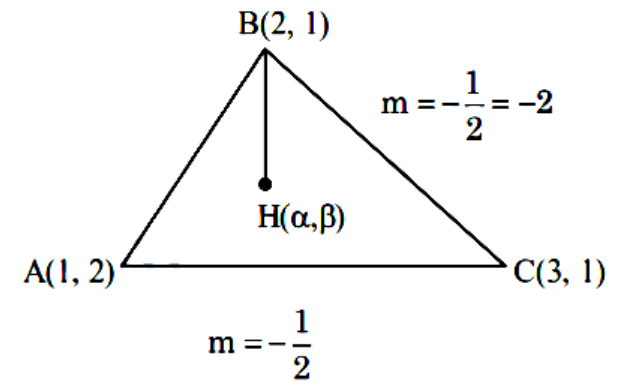 Let $A(1, 2), B(2, 3), C(3, 1)$. Here $m_{BH} \times m_{AC} = -1 \Rightarrow \frac{\beta-3}{\alpha-2} \times \frac{1}{-2} = -1 \Rightarrow \beta = 2\alpha - 1$. Also $m_{AH} \times m_{BC} = -1 \Rightarrow \frac{\beta-2}{\alpha-1} \times (-2) = -1 \Rightarrow 2\beta - 4 = \alpha - 1$. Solving gives $\alpha = 5/3, \beta = 7/3$. Roots: $\alpha + 4\beta = 11$ and $4\alpha + \beta = 9$. Equation: $x^2 - 20x + 99 = 0$.
Step Solution:
1. Calculate side slopes: Slope of $AC = \frac{1-2}{3-1} = -\frac{1}{2}$; Slope of $BC = \frac{1-3}{3-2} = -2$.
2. Form altitude equations: Altitude from $B$ is $\perp AC$, so its slope is $2$. Equation: $y - 3 = 2(x - 2) \Rightarrow y = 2x - 1$.
3. Form second altitude: Altitude from $A$ is $\perp BC$, so its slope is $\frac{1}{2}$. Equation: $y - 2 = \frac{1}{2}(x - 1) \Rightarrow 2y - 4 = x - 1 \Rightarrow 2y = x + 3$.
4. Solve for orthocentre $H(\alpha, \beta)$: Substitute $y = 2x-1$ into $2y = x+3$: $2(2x-1) = x+3 \Rightarrow 4x-2 = x+3 \Rightarrow 3x=5$. Thus $\alpha = 5/3$ and $\beta = 2(5/3)-1 = 7/3$.
5. Find roots and equation: Root 1: $5/3 + 4(7/3) = 11$. Root 2: $4(5/3) + 7/3 = 9$. Equation: $x^2 - (11+9)x + (11)(9) = 0 \Rightarrow x^2 - 20x + 99 = 0$.
Difficulty Level: Hard
Concept Name: Orthocentre of a Triangle
Short cut solution: Use the formula for orthocentre coordinates directly if vertices are small integers, then verify the symmetric sum $\alpha+\beta$ and product to quickly identify the roots of the quadratic equation.
Question 43
Question: Let A(0, 1), B(1, 1) and C(1, 0) be the mid-points of the sides of a triangle with incentre at the point D. If the focus of the parabola $y^2 = 4 ax$ passing through D is $( \alpha + \beta \sqrt { 2 } , 0 )$, where $\alpha$ and $\beta$ are rational numbers, then $\alpha \beta^{-2}$ is equal to
Options: A. 6, B. 8, C. 9/2, D. 12
Correct Answer: B
Year: JEE Main 2023 (Online) 8th April Evening Shift
Solution: 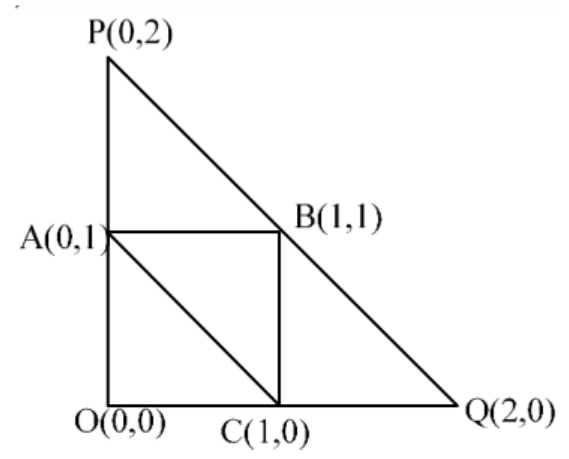 Side lengths of original triangle are $a=2, b=2, c=2\sqrt{2}$. Incentre $D \cong (\frac{2}{2+\sqrt{2}}, \frac{2}{2+\sqrt{2}}) \cong (2-\sqrt{2}, 2-\sqrt{2})$. $y^2 = 4ax \Rightarrow (2-\sqrt{2})^2 = 4a(2-\sqrt{2}) \Rightarrow 4a = 2-\sqrt{2} \Rightarrow a = \frac{2-\sqrt{2}}{4}$. Focus is $(a, 0) = (1/2 - 1/4\sqrt{2}, 0)$. Here $\alpha = 1/2, \beta = -1/4$. Then $\alpha \beta^{-2} = 8$.
Step Solution:
1. Find original vertices: Since the midpoints are (0,1), (1,1), and (1,0), the vertices are $V_1(0,0), V_2(0,2), V_3(2,0)$. This is a right-angled triangle.
2. Determine side lengths: The sides are $a=2$ (along x-axis), $b=2$ (along y-axis), and hypotenuse $c = \sqrt{2^2+2^2} = 2\sqrt{2}$.
3. Find Incentre $D$: For a right triangle $(0,0), (0,a), (a,0)$, the incentre is $(r, r)$ where $r = \frac{a+b-c}{2} = \frac{2+2-2\sqrt{2}}{2} = 2-\sqrt{2}$. So $D = (2-\sqrt{2}, 2-\sqrt{2})$.
4. Solve for parabola parameter $a$: Parabola $y^2 = 4ax$ passes through $D$: $(2-\sqrt{2})^2 = 4a(2-\sqrt{2}) \Rightarrow 4a = 2-\sqrt{2} \Rightarrow a = \frac{1}{2} - \frac{1}{4}\sqrt{2}$.
5. Identify $\alpha, \beta$ and calculate: Focus is $(a, 0) = (1/2 + (-1/4)\sqrt{2}, 0)$. Thus $\alpha = 1/2, \beta = -1/4$. $\alpha \beta^{-2} = (1/2) / (-1/4)^2 = (1/2) / (1/16) = 8$.
Difficulty Level: Hard
Concept Name: Incentre and Parabola Focus
Short cut solution: Recognize the midpoint configuration implies the original triangle vertices are just double the midpoint coordinates relative to the origin. For a right isosceles triangle, the inradius $r$ is immediately $a(1 - 1/\sqrt{2})$.
Question 51
Question: Let $(\alpha, \beta)$ be the centroid of the triangle formed by the lines $1 5 x - y = 8 2$, $6 x - 5 y = - 4$ and $9 x + 4 y = 1 7$. Then $\alpha + 2 \beta$ and $2 \alpha - \beta$ are the roots of the equation
Options:
A. $x^2 - 13x + 42 = 0$
B. $x^2 - 10x + 25 = 0$
C. $x^2 - 7x + 12 = 0$
D. $x^2 - 14x + 48 = 0$
Correct Answer: A
Year: JEE Main 2023 (Online) 13th April Evening Shift
Solution: 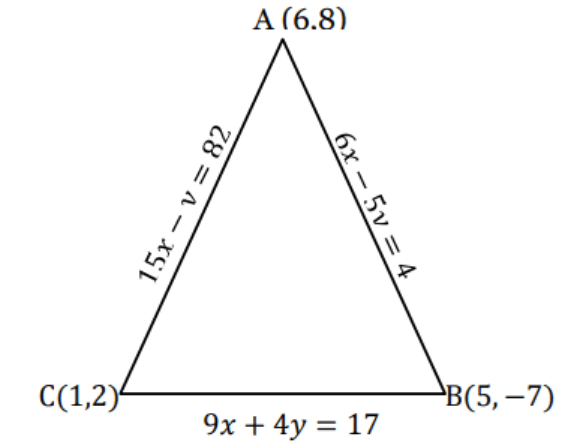 Centroid $(\alpha, \beta) = (\frac{6+1+5}{3}, \frac{8-7+2}{3}) = (4, 1)$. Roots are $\alpha + 2\beta = 6$ and $2\alpha - \beta = 7$. Quadratic equation: $x^2 - (6+7)x + (6 \times 7) = 0 \Rightarrow x^2 - 13x + 42 = 0$.
Step Solution:
1. Find Intersection 1: Solve $15x - y = 82$ and $6x - 5y = -4$. From first, $y = 15x - 82$. Substitute into second: $6x - 5(15x - 82) = -4 \Rightarrow -69x = -414 \Rightarrow x=6, y=8$.
2. Find Intersection 2: Solve $6x - 5y = -4$ and $9x + 4y = 17$. Multiply first by 4, second by 5: $24x - 20y = -16$ and $45x + 20y = 85$. Add: $69x = 69 \Rightarrow x=1, y=2$.
3. Find Intersection 3: Solve $15x - y = 82$ and $9x + 4y = 17$. Multiply first by 4: $60x - 4y = 328$. Add to second: $69x = 345 \Rightarrow x=5, y=-7$.
4. Calculate Centroid $(\alpha, \beta)$: $\alpha = \frac{6+1+5}{3} = 4$; $\beta = \frac{8+2-7}{3} = 1$. So $(\alpha, \beta) = (4, 1)$.
5. Form Quadratic Equation: Roots are $4 + 2(1) = 6$ and $2(4) - 1 = 7$. Equation: $x^2 - (\text{sum})x + (\text{product}) = 0 \Rightarrow x^2 - (13)x + 42 = 0$.
Difficulty Level: Medium
Concept Name: Centroid of a Triangle
Short cut solution: Check the options with the calculated roots. Once you find the centroid is $(4,1)$, the roots are simply 6 and 7. The only equation with these roots is $x^2 - 13x + 42 = 0$.
Question 52
Question: If $( \alpha , \beta )$ is the orthocenter of the triangle ABC with vertices A(3, -7), B(−1, 2) and C(4, 5), then $9 \alpha - 6 \beta + 60$ is equal to
Options: A. 30, B. 35, C. 40, D. 25
Correct Answer: D
Year: JEE Main 2023 (Online) 15th April Morning Shift
Solution: 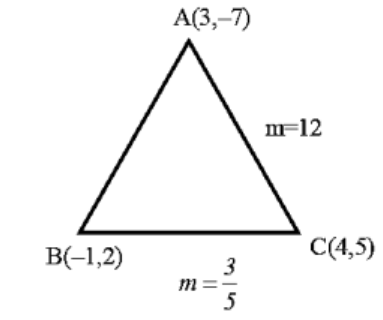 Altitude of BC: $y + 7 = \frac{-5}{3} ( x - 3 ) \Rightarrow 5x + 3y + 6 = 0$. Altitude of AC: $y - 2 = \frac{-1}{12} ( x + 1 ) \Rightarrow x + 12y = 23$. Solving gives $\alpha = -47/19, \beta = 121/57$. $9 \alpha - 6 \beta + 60 = 25$.
Step Solution:
1. Find the slope of BC: $m_{BC} = \frac{5 - 2}{4 - (-1)} = \frac{3}{5}$. The altitude from A(3, -7) is perpendicular to BC, so its slope is $m_1 = -5/3$.
2. Equation of altitude from A: $y - (-7) = -\frac{5}{3}(x - 3) \Rightarrow 3y + 21 = -5x + 15 \Rightarrow 5x + 3y + 6 = 0$.
3. Find the slope of AC: $m_{AC} = \frac{5 - (-7)}{4 - 3} = \frac{12}{1} = 12$. The altitude from B(-1, 2) is perpendicular to AC, so its slope is $m_2 = -1/12$.
4. Equation of altitude from B: $y - 2 = -\frac{1}{12}(x - (-1)) \Rightarrow 12y - 24 = -x - 1 \Rightarrow x + 12y - 23 = 0$.
5. Solve for orthocenter $(\alpha, \beta)$ and result: Solve the system $5x + 3y = -6$ and $x + 12y = 23$. Multiply the second by 5 and subtract: $57y = 115 + 6 \Rightarrow 57y = 121 \Rightarrow \beta = 121/57$. Substitute to find $\alpha = -47/19$. Then $9(-47/19) - 6(121/57) + 60 = -423/19 - 242/19 + 60 = -35 + 60 = 25$.
Difficulty Level: Medium
Concept Name: Orthocenter (Intersection of Altitudes)
Short cut solution: Use the property that $9\alpha - 6\beta$ is a linear combination of the altitude equations. Since the orthocenter must satisfy $5\alpha + 3\beta = -6$ and $\alpha + 12\beta = 23$, look for coefficients to eliminate fractions early.
Question 58
Question: In an isosceles triangle ABC, the vertex A is (6, 1) and the equation of the base BC is $2x + y = 4$. Let the point B lie on the line $x + 3y = 7$. If $( \alpha , \beta )$ is the centroid of △ABC, then $15 ( \alpha + \beta )$ is equal to:
Options: A. 39, B. 41, C. 51, D. 63
Correct Answer: C
Year: JEE Main 2022 (Online) 27th June Morning Shift
Solution: 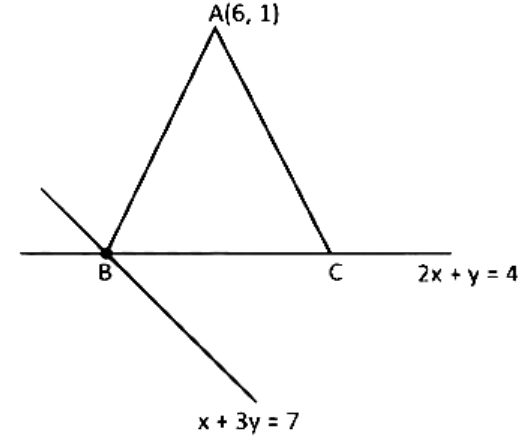 Solve $2x + y = 4$ and $x + 3y = 7$ to get B(1, 2). Let $C(k, 4 - 2k)$. Since $AB^2 = AC^2$, we find $k = 19/5$. Centroid $(\alpha, \beta) = ( \frac{6+1+19/5}{3}, \frac{1+2-18/5}{3} )$. Result $15(\alpha + \beta) = 51$.
Step Solution:
1. Find coordinates of B: Solve intersection of $2x + y = 4$ and $x + 3y = 7$. $x = 7 - 3y \Rightarrow 2(7 - 3y) + y = 4 \Rightarrow 14 - 5y = 4 \Rightarrow y = 2, x = 1$. Thus B(1, 2).
2. Define C on base BC: Let $C = (k, 4 - 2k)$.
3. Apply Isosceles Triangle Property ($AB = AC$): $AB^2 = (6-1)^2 + (1-2)^2 = 26$. $AC^2 = (6-k)^2 + (1 - (4-2k))^2 = (6-k)^2 + (2k-3)^2 = 5k^2 - 24k + 45$.
4. Solve for k: $5k^2 - 24k + 45 = 26 \Rightarrow 5k^2 - 24k + 19 = 0$. Factoring gives $(k-1)(5k-19)=0$. Since $k=1$ is point B, vertex $C = (19/5, -18/5)$.
5. Calculate result: Centroid $\alpha = \frac{6+1+19/5}{3} = \frac{54/5}{3} = 18/5$ and $\beta = \frac{1+2-18/5}{3} = \frac{-3/5}{3} = -1/5$. $15(\alpha + \beta) = 15(17/5) = 51$.
Difficulty Level: Medium
Concept Name: Isosceles Triangle Side Lengths / Centroid Formula
Short cut solution: In an isosceles triangle, the altitude from vertex A bisects the base BC. Find the foot of the perpendicular from A(6,1) to $2x+y=4$, which is the midpoint $M$ of $BC$. The centroid $G$ always divides the median $AM$ in the ratio 2:1. Using $G = \frac{A + 2M}{3}$ avoids finding point C explicitly.
Question 63
Question: The distance of the origin from the centroid of the triangle whose two sides have the equations $x - 2y + 1 = 0$ and $2x - y - 1 = 0$ and whose orthocenter is $( 7/3 , 7/3 )$ is :
Options: A. √2, B. 2, C. 2√2, D. 4
Correct Answer: C
Year: JEE Main 2022 (Online) 29th June Evening Shift
Solution: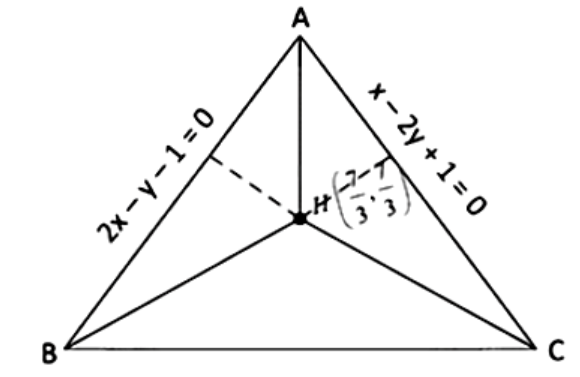 Intersection of sides gives $A(1, 1)$. Altitudes BH and CH give lines $2x + y - 7 = 0$ and $x + 2y - 7 = 0$. Intersection with sides gives $B(2, 3)$ and $C(3, 2)$. Centroid $G(2, 2)$. $OG = \sqrt{2^2 + 2^2} = 2\sqrt{2}$.
Step Solution:
1. Find Vertex A: Solve $x - 2y = -1$ and $2x - y = 1$. Multiply first by 2: $2x - 4y = -2$. Subtracting from second: $3y = 3 \Rightarrow y=1, x=1$. So $A(1, 1)$.
2. Find Altitude lines: Altitude from B is $\perp$ to AC ($x - 2y + 1 = 0$, slope 1/2), so its slope is -2. Passing through $H(7/3, 7/3)$, equation is $y - 7/3 = -2(x - 7/3) \Rightarrow 2x + y = 7$.
3. Locate Vertex B: B is intersection of side AB ($2x - y = 1$) and altitude BH ($2x + y = 7$). Adding gives $4x = 8 \Rightarrow x=2, y=3$. B(2, 3).
4. Locate Vertex C: C is intersection of side AC ($x - 2y = -1$) and altitude from C ($\perp AB$, slope -1/2). Altitude: $y - 7/3 = -1/2(x - 7/3) \Rightarrow x + 2y = 7$. Intersection: $4y = 8 \Rightarrow y=2, x=3$. C(3, 2).
5. Final Calculation: Centroid $G = ( \frac{1+2+3}{3}, \frac{1+3+2}{3} ) = (2, 2)$. Distance from origin $O(0,0) = \sqrt{2^2 + 2^2} = 2\sqrt{2}$.
Difficulty Level: Hard
Concept Name: Orthocenter and Side Intersections
Short cut solution: Notice the symmetry in the side equations and the orthocenter $x=y$. The triangle must be symmetric about $y=x$. Since $A(1,1)$ lies on $y=x$, vertices B and C must be reflections of each other across $y=x$. If $B = (x,y)$, then $C = (y,x)$, making the centroid $G = ( \frac{1+x+y}{3}, \frac{1+y+x}{3} )$, which also lies on $y=x$. Find the coordinates of $G$ using the altitude slope product directly.
Question 69
Question: The equations of the sides AB, BC and CA of a triangle ABC are $2x + y = 0$, $x + py = 15a$ and $x - y = 3$ respectively. If its orthocentre is $(2, a)$, where $-1/2 < a < 2$, then $p$ is equal to:
Options: (Options not provided in source text, but the numerical answer is 3).
Correct Answer: 3
Year: JEE Main 2022 (Online) 26th July Morning Shift
Solution: 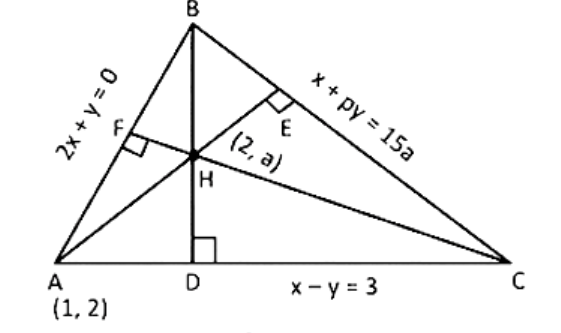 Slope of AH = $a + 2$. Slope of BC = $-1/p$. Therefore $p = a + 2$. Finding coordinate of $C = \left( \frac{18p-30}{p+1}, \frac{15p-33}{p+1} \right)$. Slope of $HC \times (-2) = -1$ leads to $p^2 - 8p + 15 = 0$. Thus $p = 3$ or 5. Since $a = p - 2$ and $-1/2 < a < 2$, $p=5$ is rejected ($a=3$). Thus $p=3$.
Step Solution:
1. Find Vertex A: Intersect sides AB ($2x+y=0$) and AC ($x-y=3$). $y = -2x \Rightarrow x - (-2x) = 3 \Rightarrow 3x=3 \Rightarrow x=1, y=-2$. So $A(1, -2)$.
2. Determine relationship between p and a: The altitude from A to BC is perpendicular to $x+py=15a$ (slope $-1/p$). Slope of $AH = \frac{a - (-2)}{2 - 1} = a+2$. Perpendicularity: $(a+2)(-1/p) = -1 \Rightarrow p = a+2$.
3. Find Vertex C: Intersect sides AC ($x-y=3$) and BC ($x+py=15a$). From AC, $x = y+3$. Substitute into BC: $(y+3) + py = 15a \Rightarrow y(p+1) = 15a-3$. Using $a = p-2$, $y_C = \frac{15(p-2)-3}{p+1} = \frac{15p-33}{p+1}$ and $x_C = y_C + 3 = \frac{18p-30}{p+1}$.
4. Apply second altitude condition: The altitude from C to side AB ($2x+y=0$, slope -2) has slope $1/2$. Slope $CH = \frac{\frac{15p-33}{p+1} - (p-2)}{\frac{18p-30}{p+1} - 2} = \frac{1}{2}$.
5. Solve for p: Simplifying the slope equation gives $p^2 - 8p + 15 = 0 \Rightarrow (p-3)(p-5)=0$. Given $-1/2 < a < 2$, and $a = p-2$, then $3/2 < p < 4$. Thus $p=3$.
Difficulty Level: Hard
Concept Name: Orthocenter and Perpendicularity of Altitudes
Short cut solution: Use the orthocenter property to establish $p = a+2$. Test the boundary condition for $a$; if $a \approx 1$, then $p \approx 3$. Substitute $p=3$ back to check if the second altitude is consistent.
Question 71
Question: The equations of the sides AB, BC and CA of a triangle ABC are $2x + y = 0$, $x + py = 39$ and $x - y = 3$ respectively and P(2, 3) is its circumcentre. Then which of the following is NOT true?
Options:
A. $(AC)^2 = 9p$
B. $(AC)^2 + p^2 = 136$
C. $32 < \text{area}(\Delta ABC) < 36$
D. $34 < \text{area}(\Delta ABC) < 38$
Correct Answer: D
Year: JEE Main 2022 (Online) 27th July Evening Shift
Solution: 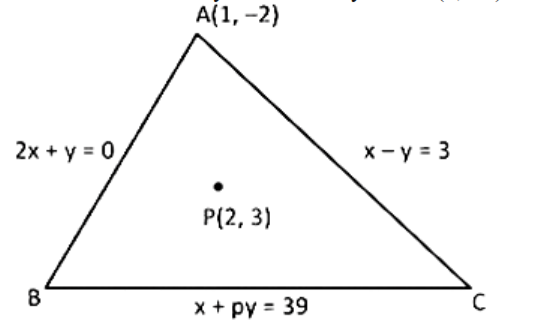 Intersection of $2x+y=0$ and $x-y=3$ gives $A(1, -2)$. Perpendicular bisectors and circumcentre properties give $B(-13/5, 26/5)$ and $C(7, 4)$. $BC$ line is $x+8y=39$, so $p=8$. $AC = 6\sqrt{2}$. Area $= 32.4$. Option D is false.
Step Solution:
1. Locate Vertex A: Solve $2x+y=0$ and $x-y=3$ to get $A(1, -2)$.
2. Find Circumradius Squared: Distance from circumcentre $P(2,3)$ to $A(1,-2)$ is $R^2 = (2-1)^2 + (3+2)^2 = 1 + 25 = 26$.
3. Locate Vertices B and C: B lies on $2x+y=0$ and $PB^2=26$, giving $B(-13/5, 26/5)$. C lies on $x-y=3$ and $PC^2=26$, giving $C(7, 4)$.
4. Determine p: Side BC passes through $C(7,4)$. Substitute into $x+py=39 \Rightarrow 7+4p=39 \Rightarrow p=8$.
5. Verify Statements: $(AC)^2 = (7-1)^2 + (4+2)^2 = 72$. $9p = 9(8)=72$ (A true). $72 + 8^2 = 136$ (B true). Area $= 1/2 |x_1(y_2-y_3)...| = 32.4$ (C true, D false).
Difficulty Level: Hard
Concept Name: Circumcentre and Distance Formula
Short cut solution: Since $(AC)^2 = 72$ and $p=8$ are found quickly after finding vertex C, you can immediately see that $(AC)^2 = 9p$ is true. This eliminates A and focuses the search on the Area bounds.
Question 72
Question: For $t \in (0, 2\pi)$, if ABC is an equilateral triangle with vertices $A(\sin t, -\cos t)$, $B(\cos t, \sin t)$ and $C(a, b)$ such that its orthocentre lies on a circle with centre $(1, 1/3)$, then $(a^2 - b^2)$ is equal to:
Options: A. 8/3, B. 8, C. 77/9, D. 80/9
Correct Answer: B
Year: JEE Main 2022 (Online) 28th July Morning Shift
Solution: 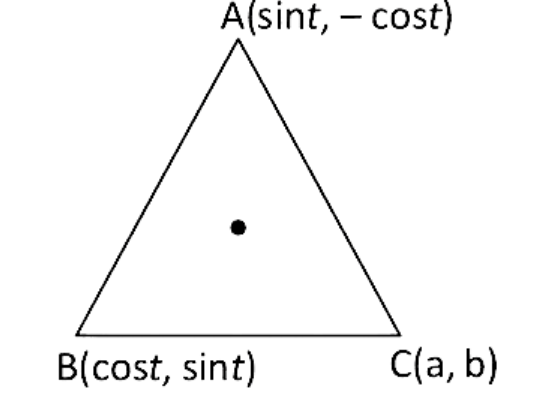 Let $P(h, k)$ be the orthocentre. For equilateral triangles, it is the centroid. $3h = \sin t + \cos t + a$ and $3k = -\cos t + \sin t + b$. Squaring and adding gives $(3h-a)^2 + (3k-b)^2 = 2$. Centre of this circle is $(a/3, b/3) = (1, 1/3)$, so $a=3, b=1$. $a^2-b^2=8$.
Step Solution:
1. Use Centroid Property: In an equilateral triangle, Orthocentre = Centroid. $h = \frac{\sin t + \cos t + a}{3}$ and $k = \frac{\sin t - \cos t + b}{3}$.
2. Isolate trigonometric terms: $3h - a = \sin t + \cos t$ and $3k - b = \sin t - \cos t$.
3. Eliminate parameter t: Square and add: $(3h - a)^2 + (3k - b)^2 = (\sin t + \cos t)^2 + (\sin t - \cos t)^2 = 1 + \sin 2t + 1 - \sin 2t = 2$.
4. Identify the locus: $(h - a/3)^2 + (k - b/3)^2 = 2/9$. This is a circle with centre $(a/3, b/3)$.
5. Compare and calculate: Given centre $(1, 1/3)$, so $a/3 = 1 \Rightarrow a=3$ and $b/3 = 1/3 \Rightarrow b=1$. $a^2 - b^2 = 9 - 1 = 8$.
Difficulty Level: Medium
Concept Name: Centroid of Equilateral Triangle / Locus
Short cut solution: Square and add coordinates of points on a unit circle; their sum is constant. Recognising $(h, k)$ as averages of vertices immediately identifies the centre of the resulting locus circle as $(a/3, b/3)$.
Question 73
Question: Let the circumcentre of a triangle with vertices $A(a, 3)$, $B(b, 5)$ and $C(a, b)$, $ab > 0$ be $P(1, 1)$. If the line $AP$ intersects the line $BC$ at the point $Q(k_1, k_2)$, then $k_1 + k_2$ is equal to :
Options: A. 2, B. $4/7$, C. $2/7$, D. 4
Correct Answer: B
Year: JEE Main 2022 (Online) 29th July Morning Shift
Solution: 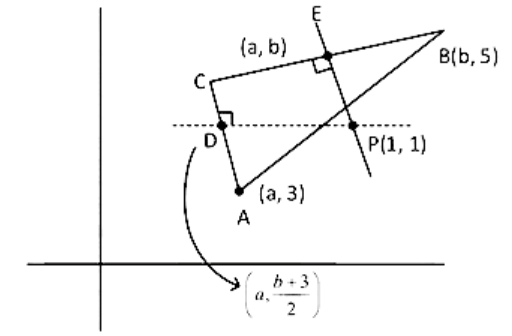 Let $D$ be mid-point of $AC$, then $\frac{b+3}{2} = 1 \Rightarrow b = -1$. Let $E$ be mid-point of $BC$, $\frac{5-b}{b-a} \cdot \frac{\frac{3+b}{2}}{\frac{a+b}{2}-1} = -1$. On putting $b = -1$, we get $a = 5$ or $-3$. But $a = 5$ is rejected as $ab > 0$. $A(-3, 3), B(-1, 5), C(-3, -1), P(1, 1)$. Line $BC \Rightarrow y = 3x + 8$. Line $AP \Rightarrow y = \frac{3-x}{2}$. Point of intersection $(\frac{-13}{7}, \frac{17}{7})$.
Step Solution:
1. Find $b$: Vertices $A(a, 3)$ and $C(a, b)$ lie on a vertical line. Their perpendicular bisector is the horizontal line $y = \frac{b+3}{2}$. Since circumcentre $P(1, 1)$ lies on it, $\frac{b+3}{2} = 1 \Rightarrow b = -1$.
2. Find $a$: Use the distance property $PB^2 = PC^2$. With $B(-1, 5)$ and $C(a, -1)$, we get $(-1-1)^2 + (5-1)^2 = (a-1)^2 + (-1-1)^2 \Rightarrow 4 + 16 = (a-1)^2 + 4 \Rightarrow (a-1)^2 = 16$. Thus $a = 5$ or $-3$. Since $ab > 0$ and $b = -1$, $a$ must be $-3$.
3. Equation of side $BC$: Using $B(-1, 5)$ and $C(-3, -1)$, slope $m = \frac{5 - (-1)}{-1 - (-3)} = \frac{6}{2} = 3$. Equation: $y - 5 = 3(x + 1) \Rightarrow y = 3x + 8$.
4. Equation of line $AP$: Using $A(-3, 3)$ and $P(1, 1)$, slope $m = \frac{1-3}{1-(-3)} = \frac{-2}{4} = -\frac{1}{2}$. Equation: $y - 1 = -\frac{1}{2}(x - 1) \Rightarrow x + 2y = 3$.
5. Find $Q(k_1, k_2)$ and sum: Substitute $y = 3x + 8$ into $x + 2y = 3 \Rightarrow x + 2(3x + 8) = 3 \Rightarrow 7x = -13$. So $k_1 = -13/7$ and $k_2 = 3(-13/7) + 8 = 17/7$. Sum $k_1 + k_2 = \frac{-13+17}{7} = \frac{4}{7}$.
Difficulty Level: Hard
Concept Name: Circumcentre and Line Intersections
Shortcut Solution: Recognize that $A$ and $C$ having the same x-coordinate makes $AC$ a vertical segment, instantly giving $b$ from the circumcentre's y-coordinate.
Question 75
Question: Let $A(a, -2), B(a, 6)$ and $C(a/4, -2)$ be vertices of a $\triangle ABC$. If $(5, a/4)$ is the circumcentre of $\triangle ABC$, then which of the following is NOT correct about $\triangle ABC$?
Options: A. area is 24, B. perimeter is 25, C. circumradius is 5, D. inradius is 2
Correct Answer: B
Year: JEE Main 2022 (Online) 29th July Evening Shift
Solution: 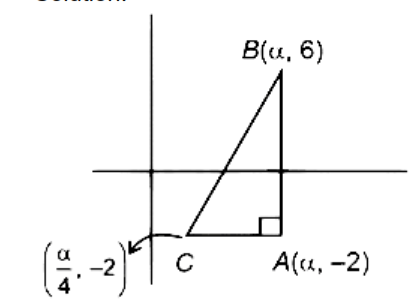 Circumcentre of $\triangle ABC = (\frac{a + a/4}{2}, \frac{6 - 2}{2}) = (\frac{5a}{8}, 2) = (5, a/4)$. $\Rightarrow a = 8$. Area $= \frac{1}{2} \cdot \frac{3a}{4} \times 8 = 24$. Perimeter $= 8 + \frac{3a}{4} + \sqrt{8^2 + (\frac{3a}{4})^2} = 8 + 6 + 10 = 24$. Circumradius $= 10/2 = 5$. $r = \Delta/s = 24/12 = 2$.
Step Solution:
1. Triangle Type: Side $AB$ is vertical ($x=a$) and side $AC$ is horizontal ($y=-2$). Thus, the triangle is right-angled at $A(a, -2)$.
2. Find $a$: In a right triangle, the circumcentre is the midpoint of the hypotenuse $BC$. Midpoint $x = \frac{a + a/4}{2} = \frac{5a}{8}$. Given circumcentre x-coordinate is 5, so $\frac{5a}{8} = 5 \Rightarrow a = 8$.
3. Side Lengths: With $a=8$, vertices are $A(8, -2), B(8, 6), C(2, -2)$. $AB = 8$, $AC = 6$, and hypotenuse $BC = \sqrt{8^2+6^2} = 10$.
4. Calculate Area and Perimeter: Area $= \frac{1}{2} \times 8 \times 6 = 24$ (A is correct). Perimeter $= 8 + 6 + 10 = 24$ (B is 25, so B is INCORRECT).
5. Calculate Radii: Circumradius $R = \frac{Hypotenuse}{2} = 5$ (C is correct). Inradius $r = \frac{Area}{semi-perimeter} = \frac{24}{12} = 2$ (D is correct).
Difficulty Level: Medium
Concept Name: Circumcentre of a Right-Angled Triangle
Shortcut Solution: For a right triangle with integer legs 6 and 8, the hypotenuse must be 10, making the perimeter $6+8+10=24$. Since 24 is even and 25 is odd, option B is immediately the incorrect one.
Question 81
Question: The intersection of three lines $x - y = 0$, $x + 2y = 3$ and $2x + y = 6$ is a
Options: A. right angled triangle, B. equilateral triangle, C. isosceles triangle, D. None of these
Correct Answer: C
Year: JEE Main 2021, 26th Feb. Shift-1
Solution: 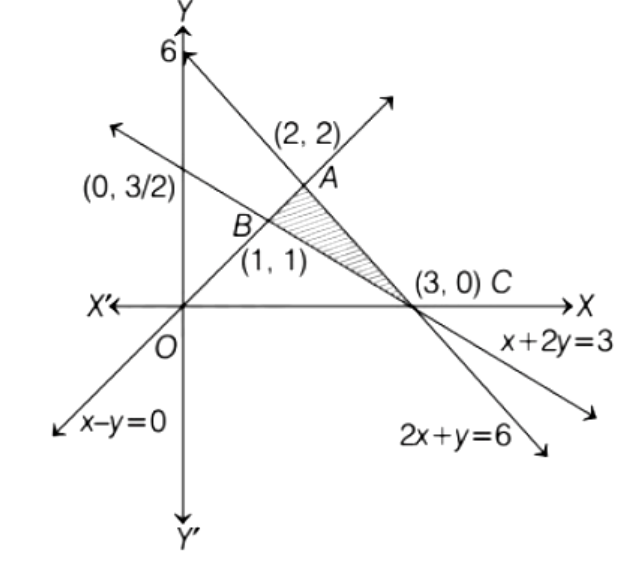 Given lines: $x - y = 0, x + 2y = 3, 2x + y = 6$. $AB = \sqrt{(2-1)^2 + (2-1)^2} = \sqrt{2}$. $AC = \sqrt{(2-3)^2 + (2-0)^2} = \sqrt{5}$. $BC = \sqrt{(3-1)^2 + (0-1)^2} = \sqrt{5}$. $\Rightarrow AC = BC$. $\Rightarrow \triangle ABC$ is isosceles triangle.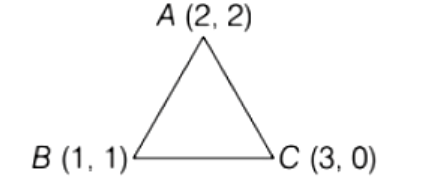
Step Solution:
1. Find Vertex A: Solve $x - y = 0$ and $x + 2y = 3$. Substitute $y = x \Rightarrow 3x = 3 \Rightarrow A(1, 1)$.
2. Find Vertex B: Solve $x - y = 0$ and $2x + y = 6$. Substitute $y = x \Rightarrow 3x = 6 \Rightarrow B(2, 2)$.
3. Find Vertex C: Solve $x + 2y = 3$ and $2x + y = 6$. From first, $x = 3 - 2y$. Substitute into second: $2(3 - 2y) + y = 6 \Rightarrow 6 - 3y = 6 \Rightarrow y = 0, x = 3$. So $C(3, 0)$.
4. Calculate Side $AC$: $AC = \sqrt{(3-1)^2 + (0-1)^2} = \sqrt{4 + 1} = \sqrt{5}$.
5. Calculate Side $BC$: $BC = \sqrt{(3-2)^2 + (0-2)^2} = \sqrt{1 + 4} = \sqrt{5}$. Since $AC = BC$, it is isosceles.
Difficulty Level: Easy
Concept Name: Properties of Triangles (Side Lengths)
Shortcut Solution: Check slopes first to rule out right-angled ($1, -1/2, -2$; no products are $-1$). Quickly finding the vertices and checking the symmetry of the coordinates relative to $y=x$ suggests an isosceles triangle.
Question 86
Question: In a $\triangle P Q R$, the coordinates of the points P and Q are (−2, 4) and (4, −2), respectively. If the equation of the perpendicular bisector of PR is $2 x - y + 2 = 0$, then the centre of the circumcircle of the $\Delta PQR$ is
Options: A. (−1, 0), B. (−2, −2), C. (0, 2), D. (1, 4)
Correct Answer: B
Year: 2021, 17 March Shift-1
Solution: 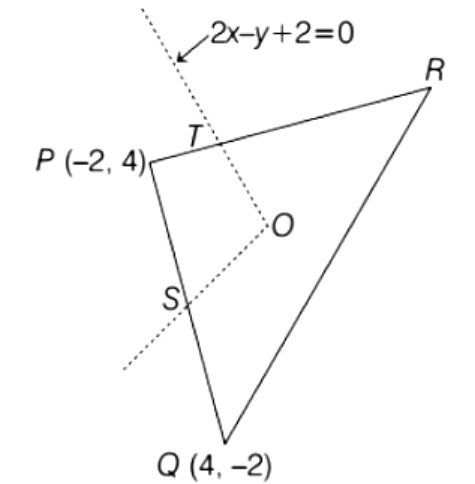 Let O be the centre of the circumcircle. And T be the mid-point of PR. So, equation of OT is given as $2x - y + 2 = 0$. Let S be the mid-point of PQ. Now, S will be $\left(\frac{-2+4}{2}, \frac{4-2}{2}\right) = (1, 1)$. Slope of $PQ = \frac{-2-4}{4+2} = -1$. Equation of $OS = y - 1 = 1(x - 1) \Rightarrow y = x$. Now, coordinates of O will be the intersection of lines OS and OT. $2x - x + 2 = 0 \Rightarrow x = -2$. So $y = -2 \Rightarrow O = (-2, -2)$.
Step Solution:
1. Identify Circumcentre Property: The circumcentre is the intersection of the perpendicular bisectors of the sides. One bisector (of PR) is given: $2x - y + 2 = 0$.
2. Find Midpoint of PQ (S): $S = \left( \frac{-2+4}{2}, \frac{4-2}{2} \right) = (1, 1)$.
3. Find Slope of PQ: $m_{PQ} = \frac{-2-4}{4-(-2)} = \frac{-6}{6} = -1$.
4. Find Equation of Perpendicular Bisector of PQ: The slope is the negative reciprocal of -1, which is 1. Equation: $y - 1 = 1(x - 1) \Rightarrow y = x$.
5. Solve for Intersection (Circumcentre): Substitute $y = x$ into the first bisector equation: $2x - x + 2 = 0 \Rightarrow x = -2$. Then $y = -2$. Centre is $(-2, -2)$.
Difficulty Level: Medium
Concept Name: Circumcentre (Intersection of Perpendicular Bisectors)
Shortcut Solution: Since the circumcentre $O$ must satisfy $y=x$ (the perpendicular bisector of PQ), look at the options. Only $(-2, -2)$ satisfies $y=x$.
Question 89
Question: Consider a triangle having vertices A(−2, 3), B(1, 9) and C(3, 8). If a line L passing through the circumcentre of $\triangle ABC$, bisects line BC, and intersects Y-axis at point $(0, \alpha/2)$, then the value of real number $\alpha$ is
Options: (Numerical Answer Type)
Correct Answer: 9
Year: 2021, 20 July Shift-II
Solution: 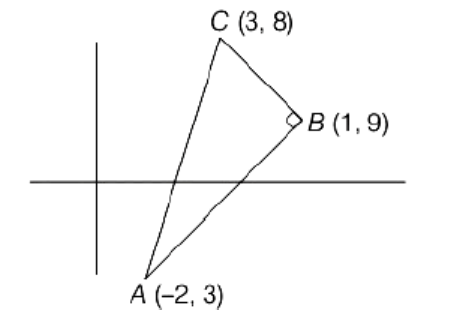 $AB = \sqrt{45}, BC = \sqrt{5}, AC = \sqrt{50}$. Since $AC^2 = AB^2 + BC^2$, $\angle B = 90^\circ$. Circumcentre is midpoint of AC $= (1/2, 11/2)$. Mid-point of line $BC = (2, 17/2)$. Equation of line L: $y - 11/2 = \frac{17/2 - 11/2}{2 - 1/2}(x - 1/2) \Rightarrow y - 11/2 = 2(x - 1/2)$. It passes through $(0, \alpha/2) \Rightarrow \alpha/2 - 11/2 = -1 \Rightarrow \alpha = 9$.
Step Solution:
1. Check Triangle Type: $AB^2 = 3^2 + 6^2 = 45$; $BC^2 = 2^2 + (-1)^2 = 5$; $AC^2 = 5^2 + 5^2 = 50$. Since $45 + 5 = 50$, it is a right-angled triangle at B.
2. Find Circumcentre: In a right triangle, the circumcentre is the midpoint of the hypotenuse AC. Midpoint $= \left( \frac{-2+3}{2}, \frac{3+8}{2} \right) = \left( \frac{1}{2}, \frac{11}{2} \right)$.
3. Find Midpoint of BC: $M = \left( \frac{1+3}{2}, \frac{9+8}{2} \right) = \left( 2, \frac{17}{2} \right)$.
4. Find Equation of Line L: Passes through $(1/2, 11/2)$ and $(2, 17/2)$. Slope $m = \frac{17/2 - 11/2}{2 - 1/2} = \frac{3}{1.5} = 2$. Equation: $y - \frac{11}{2} = 2(x - \frac{1}{2}) \Rightarrow y = 2x + \frac{9}{2}$.
5. Solve for $\alpha$: The y-intercept is $9/2$. Given y-intercept is $\alpha/2$, so $\alpha/2 = 9/2 \Rightarrow \alpha = 9$.
Difficulty Level: Hard
Concept Name: Circumcentre of a Right-Angled Triangle
Shortcut Solution: Identifying the right angle immediately simplifies the circumcentre calculation. The y-intercept of the line connecting two midpoints $(1/2, 11/2)$ and $(2, 17/2)$ is easily found by observing the coordinates follow $y = 2x + 4.5$.
Question 93
Question: Let $ABC$ be a triangle with A(−3, 1) and $\angle ACB = \theta, 0 < \theta < \pi/2$. If the equation of the median through B is $2x + y - 3 = 0$ and the equation of angle bisector of C is $7x - 4y - 1 = 0$, then $\tan \theta$ is equal to
Options: A. 1/2, B. 3/4, C. 4/3, D. 2
Correct Answer: C
Year: 2021, 26 Aug. Shift-I
Solution: Median through B: $2x + y - 3 = 0$. Bisector of C: $7x - 4y - 1 = 0$. Let $C(a, b)$, then $7a - 4b = 1$. Midpoint of AC lies on median: $2(\frac{a-3}{2}) + (\frac{b+1}{2}) - 3 = 0 \Rightarrow 2a + b = 11$. Solving gives $a=3, b=5$. Slope $AC = 2/3$, Slope of bisector $= 7/4$. $\tan(\theta/2) = \left| \frac{2/3 - 7/4}{1 + 14/12} \right| = 1/2$. $\tan \theta = \frac{2(1/2)}{1 - 1/4} = 4/3$.
Step Solution:
1. Define Vertex C: Let $C = (a, b)$. It lies on the angle bisector: $7a - 4b = 1$ (Eq 1).
2. Apply Median Constraint: The midpoint of AC, $M = \left( \frac{a-3}{2}, \frac{b+1}{2} \right)$, must lie on the median $2x + y - 3 = 0$. Substituting: $2\left(\frac{a-3}{2}\right) + \frac{b+1}{2} = 3 \Rightarrow 2a + b = 11$ (Eq 2).
3. Solve for C: From Eq 1 and Eq 2, we find $a = 3, b = 5$. Thus $C = (3, 5)$.
4. Find Half-Angle $\theta/2$: $\theta/2$ is the angle between side AC (slope $m_1 = \frac{5-1}{3-(-3)} = 2/3$) and the angle bisector $7x-4y=1$ (slope $m_2 = 7/4$). $\tan(\theta/2) = \left| \frac{7/4 - 2/3}{1 + (7/4)(2/3)} \right| = \frac{13/12}{26/12} = \frac{1}{2}$.
5. Calculate $\tan \theta$: Using $\tan \theta = \frac{2\tan(\theta/2)}{1 - \tan^2(\theta/2)}$, we get $\frac{2(1/2)}{1 - 1/4} = \frac{1}{3/4} = 4/3$.
Difficulty Level: Hard
Concept Name: Angle Bisector and Median Properties
Shortcut Solution: Solve the linear system for C quickly ($a=3, b=5$). Then use the fact that the angle bisector slope $m$ is related to the slopes of the sides it bisects via the formula $\tan(\text{angle}) = \text{difference in slopes}$.
Question 95
Question: Let $A(1, 0), B(6, 2)$ and $C\left( \frac{3}{2}, 6 \right)$ be the vertices of a triangle ABC. If P is a point inside the triangle ABC such that the triangles APC, APB and BPC have equal areas, then the length of the line segment PQ, where Q is the point $\left( -\frac{7}{6}, -\frac{1}{3} \right)$, is
Options: (Numerical Answer Type — No options provided in source)
Correct Answer: 5
Year: JEE Main 2020, 7th January Morning Shift
Solution: P will be centroid of $\triangle$ ABC $P \left( \frac{17}{6}, \frac{8}{3} \right) \Rightarrow PQ = \sqrt{(4)^2 + (3)^2} = 5$
Step Solution:
1. Identify Point P: A point inside a triangle that divides it into three equal areas (APC, APB, BPC) is the centroid of the triangle.
2. Calculate Centroid P: Using $P = \left( \frac{x_1+x_2+x_3}{3}, \frac{y_1+y_2+y_3}{3} \right)$:
$x_P = \frac{1 + 6 + 1.5}{3} = \frac{8.5}{3} = \frac{17}{6}$
$y_P = \frac{0 + 2 + 6}{3} = \frac{8}{3}$
So, $P = \left( \frac{17}{6}, \frac{8}{3} \right)$.
3. Identify Point Q: Given $Q = \left( -\frac{7}{6}, -\frac{1}{3} \right)$.
4. Apply Distance Formula: $PQ = \sqrt{(x_P - x_Q)^2 + (y_P - y_Q)^2}$
$PQ = \sqrt{\left( \frac{17}{6} - (-\frac{7}{6}) \right)^2 + \left( \frac{8}{3} - (-\frac{1}{3}) \right)^2}$.
5. Final Calculation: $PQ = \sqrt{(\frac{24}{6})^2 + (\frac{9}{3})^2} = \sqrt{4^2 + 3^2} = \sqrt{25} = 5$.
Difficulty Level: Easy
Concept Name: Centroid of a Triangle / Distance Formula
Shortcut Solution: Recognize the "equal area" property immediately identifies P as the centroid. Calculate the differences in coordinates: $\Delta x = \frac{17 - (-7)}{6} = 4$ and $\Delta y = \frac{8 - (-1)}{3} = 3$. The distance is the 3-4-5 Pythagorean triplet result: 5.
Question 97
Question: Let $C$ be the centroid of the triangle with vertices (3,-1) (1,3) and (2,4). Let $P$ be the point of intersection of the lines $x + 3y - 1 = 0$ and $3x - y + 1 = 0$. Then the line passing through the points $C$ and P also passes through the point:
Options: A. (-9,-6), B. (9,7), C. (7,6), D. (-9,-7)
Correct Answer: A
Year: JEE Main 2020, 9th January Morning Shift
Solution: Coordinates of centroides $C = \left( \frac{x_1+x_2+x_3}{3}, \frac{y_1+y_2+y_3}{3} \right) = \left( \frac{3+1+2}{3}, \frac{-1+3+4}{3} \right) = (2, 2)$. Point of intersection $P \left( - \frac{1}{5}, \frac{2}{5} \right)$. Equation of line DP [CP] is $8x - 11y + 6 = 0$.
Step Solution:
1. Find Centroid C: $C = \left( \frac{3+1+2}{3}, \frac{-1+3+4}{3} \right) = (2, 2)$.
2. Find Intersection P: Solve $x + 3y = 1$ and $3x - y = -1$. From the second, $y = 3x + 1$. Substitute into the first: $x + 3(3x + 1) = 1 \Rightarrow 10x + 3 = 1 \Rightarrow x = -1/5$. Thus $y = 3(-1/5) + 1 = 2/5$. So $P(-1/5, 2/5)$.
3. Find Slope of CP: $m = \frac{2 - 2/5}{2 - (-1/5)} = \frac{8/5}{11/5} = \frac{8}{11}$.
4. Find Equation of Line CP: $y - 2 = \frac{8}{11}(x - 2) \Rightarrow 11y - 22 = 8x - 16 \Rightarrow 8x - 11y + 6 = 0$.
5. Test Point (-9, -6): Plug coordinates into the equation: $8(-9) - 11(-6) + 6 = -72 + 66 + 6 = 0$. The point satisfies the line.
Difficulty Level: Medium
Concept Name: Centroid and Intersection of Lines
Shortcut Solution: Since $(2,2)$ is the centroid and $(-1/5, 2/5)$ is P, the slope is $8/11$. For any other point $(x,y)$ on the line, the slope with $(2,2)$ must also be $8/11$. Check Option A: $\frac{2 - (-6)}{2 - (-9)} = \frac{8}{11}$. Correct.
Question 98
Question: If a $\triangle ABC$ has vertices $A(-1, 7), B(-7, 1)$ and $C(5, -5)$, then its orthocentre has coordinates:
Options: A. $\left( - \frac{3}{5}, \frac{3}{5} \right)$, B. (-3,3), C. $\left( \frac{3}{5}, - \frac{3}{5} \right)$, D. (3,-3)
Correct Answer: B
Year: JEE Main 2020, 3rd September Evening Shift
Solution: 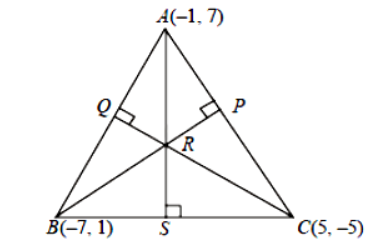 $m_{BC} = \frac{6}{-12} = -\frac{1}{2}$ ∴ Equation of AS is $y - 7 = 2(x + 1) \Rightarrow y = 2x + 9$. $m_{AC} = \frac{12}{-6} = -2$ ∴ Equation of BP is $y - 1 = \frac{1}{2}(x + 7) \Rightarrow y = \frac{x}{2} + \frac{9}{2}$. From equs. (i) and (ii), $2x + 9 = \frac{x+9}{2} \Rightarrow 4x + 18 = x + 9 \Rightarrow 3x = -9 \Rightarrow x = -3, y = 3$.
Step Solution:
1. Find slope of side BC: $m_{BC} = \frac{-5 - 1}{5 - (-7)} = \frac{-6}{12} = -1/2$.
2. Equation of Altitude from A: Perpendicular to BC, so $m_{altA} = 2$. Using $A(-1, 7)$: $y - 7 = 2(x + 1) \Rightarrow y = 2x + 9$.
3. Find slope of side AC: $m_{AC} = \frac{-5 - 7}{5 - (-1)} = \frac{-12}{6} = -2$.
4. Equation of Altitude from B: Perpendicular to AC, so $m_{altB} = 1/2$. Using $B(-7, 1)$: $y - 1 = \frac{1}{2}(x + 7) \Rightarrow 2y - 2 = x + 7 \Rightarrow 2y = x + 9$.
5. Solve for Intersection: Substitute $y$ from the first altitude into the second: $2(2x + 9) = x + 9 \Rightarrow 4x + 18 = x + 9 \Rightarrow 3x = -9 \Rightarrow x = -3$. Then $y = 2(-3) + 9 = 3$. Orthocentre is (-3, 3).
Difficulty Level: Medium
Concept Name: Orthocentre (Intersection of Altitudes)
Shortcut Solution: Check if any option satisfies both altitude slopes. $m_{AH} = \frac{3-7}{-3-(-1)} = \frac{-4}{-2} = 2$ (Matches $m_{altA}$). $m_{BH} = \frac{3-1}{-3-(-7)} = \frac{2}{4} = 1/2$ (Matches $m_{altB}$). Option B is the answer.
Question 105
Question: Let the equations of two sides of a triangle be $3 \mathrm { x } - 2 \mathrm { y } + 6 = \mathbf { 0 }$ and $4 \mathbf { x } + 5 \mathbf { y } - 2 \mathbf { 0 } = \mathbf { 0 } .$ If the orthocentre of this triangle is at (1, 1), then the equation of its third side is:
Options:
A. $1 2 2 \mathrm { y } - 2 6 \mathrm { x } - 1 6 7 5 = 0$
B. $1 2 2 \mathrm { y } + 2 6 \mathrm { x } + 1 6 7 5 = 0$
C. $2 6 \mathbf { x } + 6 1 \mathbf { y } + 1 6 7 5 = 0$
D. $2 6 \mathbf { x } - 1 2 2 \mathbf { y } - 1 6 7 5 = { \boldsymbol { 0 } }$
Correct Answer: D
Year: JEE Main 2019, 9th January Evening Shift
Solution: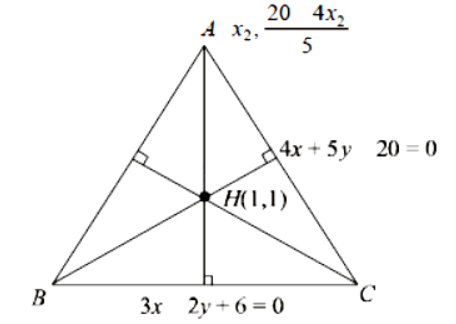 Let $AC$ be $3x - 2y + 6 = 0$ and $BC$ be $4x + 5y - 20 = 0$. Since $AH \perp BC$, $m_{AH} \cdot m_{BC} = -1 \Rightarrow m_{AH} = 5/4$. Intersection of $AH$ and $AC$ gives vertex $A$. Similarly, $BH \perp AC$ gives vertex $B$. Equation of $AB$ is found using coordinates of $A$ and $B$.
Step Solution:
1. Find Altitude $AH$: Side $BC$ is $4x + 5y - 20 = 0$ (slope $-4/5$). Altitude $AH$ from $A$ is perpendicular to $BC$, so its slope is $5/4$. Passing through $H(1, 1)$, its equation is $y - 1 = \frac{5}{4}(x - 1) \Rightarrow 5x - 4y - 1 = 0$.
2. Find Vertex $A$: $A$ is the intersection of side $AC$ ($3x - 2y + 6 = 0$) and altitude $AH$ ($5x - 4y - 1 = 0$). Multiply $AC$ by 2: $6x - 4y + 12 = 0$. Subtracting $AH$ gives $x = -13$. Then $y = -33/2$. So $A = (-13, -33/2)$.
3. Find Altitude $BH$: Side $AC$ is $3x - 2y + 6 = 0$ (slope $3/2$). Altitude $BH$ from $B$ is perpendicular to $AC$, so its slope is $-2/3$. Passing through $H(1, 1)$, its equation is $y - 1 = -\frac{2}{3}(x - 1) \Rightarrow 2x + 3y - 5 = 0$.
4. Find Vertex $B$: $B$ is the intersection of side $BC$ ($4x + 5y - 20 = 0$) and altitude $BH$ ($2x + 3y - 5 = 0$). Solving these gives $B = (35/2, -10)$.
5. Equation of Side $AB$: Use points $A(-13, -33/2)$ and $B(35/2, -10)$. Slope $m = \frac{-10 - (-33/2)}{35/2 - (-13)} = \frac{13/2}{61/2} = \frac{13}{61}$. Equation: $y + 10 = \frac{13}{61}(x - \frac{35}{2}) \Rightarrow 61y + 610 = 13x - \frac{455}{2} \Rightarrow 122y + 1220 = 26x - 455 \Rightarrow 26x - 122y - 1675 = 0$.
Difficulty Level: Hard
Concept Name: Orthocenter and Perpendicularity of Altitudes
Shortcut Solution: Check if $H(1,1)$ is a point on any altitude to the options. Alternatively, eliminate options by checking the slope of the line passing through the vertices derived from the perpendicularity condition.
Question 107
Question: If the line $3 \mathrm { x } + 4 \mathrm { y } - 2 4 = \mathbf { 0 }$ intersects the x -axis at the point A and the y-axis at the point $\mathbf { B }$, then the incentre of the triangle OAB, where O is the origin, is:
Options: A. (3,4), B. (2,2), C. (4,3), D. (4,4)
Correct Answer: B
Year: JEE Main 2019, 10th January Morning Shift
Solution: Equation of the line is $\frac{x}{8} + \frac{y}{6} = 1$. Coordinates are $A(8,0), B(0,6), O(0,0)$. Sides are $OA=8, OB=6, AB=10$. Incentre $I = (\frac{ax_1+bx_2+cx_3}{a+b+c}, \frac{ay_1+by_2+cy_3}{a+b+c}) = (2,2)$.
Step Solution:
1. Find Intercepts: For x-intercept (A), set $y=0$ in $3x + 4y = 24 \Rightarrow x=8$. So $A(8,0)$. For y-intercept (B), set $x=0 \Rightarrow y=6$. So $B(0,6)$.
2. Calculate Side Lengths: $OA = \sqrt{8^2+0^2} = 8$; $OB = \sqrt{0^2+6^2} = 6$; $AB = \sqrt{8^2+6^2} = 10$.
3. Identify Triangle Type: $\triangle OAB$ is a right-angled triangle at the origin $(0,0)$.
4. Use Inradius Formula for Right Triangle: $r = \frac{OA + OB - AB}{2} = \frac{8 + 6 - 10}{2} = 2$. [Outside logic/Standard formula]
5. Locate Incentre: In a right triangle with legs on the axes, the incentre is $(r, r)$. Thus, $I = (2, 2)$.
Difficulty Level: Easy
Concept Name: Incentre of a Triangle
Shortcut Solution: For a right triangle with legs $a$ and $b$ and hypotenuse $c$, the incentre is $(\frac{a+b-c}{2}, \frac{a+b-c}{2})$. Here, $(\frac{8+6-10}{2}, \frac{8+6-10}{2}) = (2,2)$.
Question 108
Question: Two vertices of a triangle are (0,2) and (4,3). If its orthocentre is at the origin, then its third vertex lies in which quadrant?
Options: A. third, B. second, C. first, D. fourth
Correct Answer: B
Year: JEE Main 2019, 10th January Evening Shift
Solution: Let vertices be $P(0,2), Q(4,3)$ and $R(x,y)$. Since $PH \perp QR$ and $H$ is $(0,0)$, the altitude $PH$ is the y-axis. This makes side $QR$ horizontal ($y=3$). Using $m_{RH} \cdot m_{PQ} = -1$, we find $x = -3/4$. Vertex is $(-3/4, 3)$, which is in the second quadrant.
Step Solution:
1. Define Vertices and Orthocentre: Let $A(0,2), B(4,3)$ and $C(x,y)$ be the vertices. Orthocentre $H$ is $(0,0)$.
2. Apply Altitude Property 1: The altitude from $A(0,2)$ to $BC$ passes through $H(0,0)$. This altitude is the y-axis. Therefore, side $BC$ must be perpendicular to the y-axis (horizontal).
3. Determine y-coordinate of C: Since $BC$ is horizontal and $B$ is $(4,3)$, the y-coordinate of $C$ must be $y=3$.
4. Apply Altitude Property 2: The altitude from $C(x,3)$ to $AB$ must pass through $H(0,0)$. Slope of $AB = \frac{3-2}{4-0} = 1/4$. Thus, slope of altitude $CH = -4$.
5. Solve for x-coordinate of C: The line $CH$ passes through $(0,0)$ and has slope $-4$, so $y = -4x$. Substituting $y=3$, we get $3 = -4x \Rightarrow x = -3/4$. Vertex $C(-3/4, 3)$ is in the second quadrant.
Difficulty Level: Medium
Concept Name: Orthocentre and Perpendicular Slopes
Shortcut Solution: Recognize that the altitude from $(0,2)$ to the base is the vertical y-axis, forcing the base to be the horizontal line $y=3$. The altitude from the origin to the side with positive slope ($1/4$) must have a negative slope ($-4$), placing the third vertex at a negative x-position. $(-x, +y)$ is the 2nd quadrant.
Question 110
Question: If in a parallelogram ABDC, the coordinates of A, B and C are respectively (1,2),(3,4) and (2, 5), then the equation of the diagonal AD is:
Options:
A. $5x - 3y + 1 = 0$
B. $5x + 3y - 11 = 0$
C. $3x - 5y + 7 = 0$
D. $3x + 5y - 13 = 0$
Correct Answer: A
Year: JEE Main 2019, 11th January Evening Shift
Solution: Since, in parallelogram mid points of both diagonals considers. ∴ mid-point of AD = mid-point of BC. $\left( \frac{x_1 + 1}{2} , \frac{y_1 + 2}{2} \right) = \left( \frac{3 + 2}{2} , \frac{4 + 5}{2} \right)$. $\therefore (x_1, y_1) = (4, 7)$. Then, equation of AD is, $y - 7 = \frac{2 - 7}{1 - 4} (x - 4) \Rightarrow y - 7 = \frac{5}{3} (x - 4)$.
Step Solution:
1. Use Diagonals Property: In a parallelogram, diagonals bisect each other, meaning the midpoint of AD is the same as the midpoint of BC.
2. Find Midpoint of BC: Using $B(3,4)$ and $C(2,5)$, the midpoint $M = (\frac{3+2}{2}, \frac{4+5}{2}) = (\frac{5}{2}, \frac{9}{2})$.
3. Find Vertex D: Let $D = (x_1, y_1)$. The midpoint of $A(1,2)$ and $D(x_1, y_1)$ is $M$: $(\frac{x_1+1}{2}, \frac{y_1+2}{2}) = (\frac{5}{2}, \frac{9}{2})$, giving $x_1 = 4, y_1 = 7$.
4. Find Slope of AD: Using $A(1,2)$ and $D(4,7)$, $m = \frac{7-2}{4-1} = \frac{5}{3}$.
5. Form Line Equation: $y - 2 = \frac{5}{3}(x - 1) \Rightarrow 3y - 6 = 5x - 5 \Rightarrow 5x - 3y + 1 = 0$.
Difficulty Level: Easy
Concept Name: Midpoint of Parallelogram Diagonals
Short cut solution: The line AD must pass through $A(1,2)$ and the midpoint of BC $(\frac{5}{2}, \frac{9}{2})$. Calculate the slope $m = \frac{4.5 - 2}{2.5 - 1} = \frac{2.5}{1.5} = \frac{5}{3}$. Only option A has slope $5/3$ and passes through $(1,2)$.
Question 121
Question: A triangle has a vertex at (1,2) and the mid points of the two sides through it are (-1,1) and (2,3) . Then the centroid of this triangle is:
Options:
A. $(1, \frac{7}{3})$
B. $(\frac{1}{3}, 2)$
C. $(\frac{1}{3}, 1)$
D. $(1, \frac{5}{3})$
Correct Answer: B
Year: JEE Main 2019, 12th April Evening Shift
Solution: 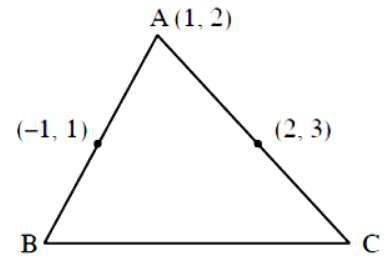 From the mid-point formula co-ordinates of vertex B and C are B(-3, 0) and C(3, 4). Now, centroid of the triangle $G \equiv \left( \frac{3 - 3 + 1}{3}, \frac{0 + 4 + 2}{3} \right) \Rightarrow G \equiv \left( \frac{1}{3}, 2 \right)$.
Step Solution:
1. Identify Given Points: Vertex $A = (1, 2)$ and midpoints $M_1 = (-1, 1)$, $M_2 = (2, 3)$.
2. Find Vertex B: If $M_1$ is the midpoint of AB, then $B = 2M_1 - A = 2(-1, 1) - (1, 2) = (-3, 0)$.
3. Find Vertex C: If $M_2$ is the midpoint of AC, then $C = 2M_2 - A = 2(2, 3) - (1, 2) = (3, 4)$.
4. Apply Centroid Formula: $G = (\frac{x_A+x_B+x_C}{3}, \frac{y_A+y_B+y_C}{3}) = (\frac{1-3+3}{3}, \frac{2+0+4}{3})$.
5. Calculate Final Coordinates: $G = (\frac{1}{3}, \frac{6}{3}) = (\frac{1}{3}, 2)$.
Difficulty Level: Easy
Concept Name: Centroid and Midpoint Formula
Short cut solution: The centroid $G$ can be calculated directly from vertex $A$ and midpoints $M_1, M_2$ using the relation $G = \frac{2(M_1 + M_2) - A}{3}$. Substituting: $\frac{2((-1,1)+(2,3)) - (1,2)}{3} = \frac{2(1,4) - (1,2)}{3} = \frac{(1,6)}{3} = (\frac{1}{3}, 2)$.
Question 124
Question: Let the orthocentre and centroid of a triangle be A(−3, 5) and B(3, 3) respectively. If C is the circumcentre of this triangle, then the radius of the circle having line segment AC as diameter, is :
Options:
A. $2\sqrt{10}$
B. $3\sqrt{\frac{5}{2}}$
C. $3\sqrt{5}$
D. $\sqrt{10}$
Correct Answer: B
Year: JEE Main 2018
Solution: 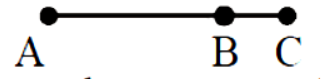 Orthocentre $A(-3, 5)$, centroid $B(3, 3)$. $AB = \sqrt{40} = 2\sqrt{10}$. Centroid divides orthocentre and circumcentre in ratio 2:1. $\therefore AB : BC = 2:1$. $AC = \frac{3}{2} AB = 3\sqrt{10}$. Radius $= \frac{AC}{2} = \frac{3}{2} \sqrt{10} = 3 \sqrt{\frac{5}{2}}$.
Step Solution:
1. Find AB Distance: Use distance formula between orthocentre $A(-3,5)$ and centroid $B(3,3)$: $AB = \sqrt{(3+3)^2 + (3-5)^2} = \sqrt{36+4} = 2\sqrt{10}$.
2. Apply Euler Line Property: The Centroid divides the segment joining the Orthocentre and Circumcentre in the ratio 2:1. Here, $AB : BC = 2:1$.
3. Calculate AC Length: $AC$ is the total length of the segment from Orthocentre to Circumcentre. $AC = AB + BC = AB + \frac{1}{2}AB = \frac{3}{2}AB$.
4. Determine Diameter: $AC = \frac{3}{2} \times 2\sqrt{10} = 3\sqrt{10}$.
5. Find Radius: The radius is half the diameter AC: $Radius = \frac{3\sqrt{10}}{2} = 3\sqrt{\frac{10}{4}} = 3\sqrt{\frac{5}{2}}$.
Difficulty Level: Medium
Concept Name: Euler Line Property ($HG:GO = 2:1$)
Short cut solution: In the Euler line $HGC$, the radius of the circle with diameter $HC$ is exactly $\frac{3}{4} \times (\text{distance between Orthocentre and Centroid})$. Calculation: $\frac{3}{4} \times 2\sqrt{10} = \frac{3}{2}\sqrt{10} = 3\sqrt{2.5} = 3\sqrt{5/2}$.
Question 126
Question: In a triangle ABC, coordinates of A are (1,2) and the equations of the medians through B and C are $x + y = 5$ and $x = 4$ respectively. Then area of ∆ABC (in sq. units) is
Options: A. 5, B. 9, C. 12, D. 4
Correct Answer: B
Year: Online April 15, 2018
Solution: Median through C is $x = 4$. So the x coordinate of C is 4. Let $C \equiv (4, y)$, then the midpoint of $A(1, 2)$ and $C(4, y)$ is D which lies on the median through B. $D \equiv \left( \frac{1 + 4}{2}, \frac{2 + y}{2} \right)$. Now, $\frac{5}{2} + \frac{2 + y}{2} = 5 \Rightarrow y = 3$. So, $C \equiv (4, 3)$. The centroid of the triangle is the intersection of the medians. Here the medians $x = 4$ and $x + y = 5$ intersect at $G(4, 1)$. The area of triangle $\Delta ABC = 3 \times \Delta AGC = 3 \times \frac{1}{2} [1(1 - 3) + 4(3 - 2) + 4(2 - 1)] = 9$.
Step Solution:
1. Identify Vertex C: Since median through C is the vertical line $x=4$, vertex C must have an x-coordinate of 4. Let $C = (4, y_C)$.
2. Use Midpoint Property: The midpoint of AC, $M = (\frac{1+4}{2}, \frac{2+y_C}{2}) = (2.5, \frac{2+y_C}{2})$, must lie on the other median $x+y=5$.
3. Solve for C: $2.5 + \frac{2+y_C}{2} = 5 \Rightarrow \frac{2+y_C}{2} = 2.5 \Rightarrow y_C = 3$. Thus $C = (4, 3)$.
4. Find Centroid G: Intersect the two medians $x=4$ and $x+y=5$. Substituting $x=4$ gives $4+y=5 \Rightarrow y=1$. Centroid $G = (4, 1)$.
5. Calculate Area: Use the property that Area($\Delta ABC$) = $3 \times \text{Area}(\Delta AGC)$. Area $= 3 \times \frac{1}{2} |1(1-3) + 4(3-2) + 4(2-1)| = 1.5 |-2 + 4 + 4| = 9$.
The Difficulty Level: Medium
The Concept Name: Properties of Medians and Centroid
Shortcut Solution: The x-coordinate of $G$ and $C$ is immediately 4. Finding $y_C=3$ and $y_G=1$ takes seconds. Using the $3 \times \text{Area}(AGC)$ rule is the fastest way to avoid finding vertex B.
Question 138
Question: The circum centre of a triangle lies at the origin and its centroid is the mid point of the line segment joining the points $(a^2 + 1, a^2 + 1)$ and $(2a, -2a)$, $a \neq 0$. Then for any $a$, the orthocentre of this triangle lies on the line:
Options: A. $y - 2ax = 0$, B. $y - (a^2 + 1)x = 0$, C. $y + x = 0$, D. $(a - 1)^2x - (a + 1)^2y = 0$
Correct Answer: D
Year: Online April 11, 2015
Solution: Circumcentre $O = (0, 0)$. Centroid $G = \left( \frac{(a + 1)^2}{2}, \frac{(a - 1)^2}{2} \right)$. We know the circumcentre (O), Centroid (G) and orthocentre (H) of a triangle lie on the line joining the O and G. Also, $\frac{HG}{GO} = \frac{2}{1} \Rightarrow$ Coordinate of orthocentre $= \frac{3(a + 1)^2}{2}, \frac{3(a - 1)^2}{2}$. Now, these coordinates satisfy eqn given in option (d) Hence, required eqn of line $(a - 1)^2x - (a + 1)^2y = 0$.
Step Solution:
1. Calculate Centroid G: $G$ is the midpoint of $(a^2+1, a^2+1)$ and $(2a, -2a)$. $G = \left( \frac{a^2+2a+1}{2}, \frac{a^2-2a+1}{2} \right) = \left( \frac{(a+1)^2}{2}, \frac{(a-1)^2}{2} \right)$.
2. Identify Euler Line: For any triangle, Orthocentre (H), Centroid (G), and Circumcentre (O) are collinear, with $G$ dividing $HO$ in the ratio 2:1.
3. Find Orthocentre H: Since $O=(0,0)$, the section formula $G = \frac{H + 2O}{3}$ simplifies to $H = 3G$. $H = \left( \frac{3(a+1)^2}{2}, \frac{3(a-1)^2}{2} \right)$.
4. Set up Locus Equation: Let $H = (x, y)$. Then $x = \frac{3(a+1)^2}{2}$ and $y = \frac{3(a-1)^2}{2}$.
5. Eliminate Parameter: $\frac{x}{(a+1)^2} = \frac{3}{2}$ and $\frac{y}{(a-1)^2} = \frac{3}{2}$. Equating them: $\frac{x}{(a+1)^2} = \frac{y}{(a-1)^2} \Rightarrow (a-1)^2x - (a+1)^2y = 0$.
The Difficulty Level: Hard
The Concept Name: Euler Line ($HG:GO = 2:1$)
Shortcut Solution: Since the circumcentre is at the origin $(0,0)$, the line containing the orthocentre and centroid must also pass through the origin. Its slope is simply $y_G / x_G = \frac{(a-1)^2}{(a+1)^2}$. The only option representing a line through the origin with this slope is D.
Question 146
Question: The x-coordinate of the incentre of the triangle that has the coordinates of mid points of its sides as (0,1)(1,1) and (1,0) is :
Options: A. $2 + \sqrt{2}$, B. $2 - \sqrt{2}$, C. $1 + \sqrt{2}$, D. $1 - \sqrt{2}$
Correct Answer: B
Year: 2013
Solution: 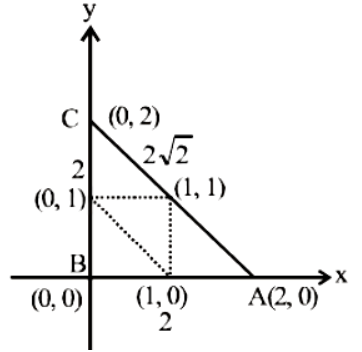 From the figure, we have $a = 2, b = 2\sqrt{2}, c = 2, x_1 = 0, x_2 = 0, x_3 = 2$. Now, x-coordinate of incentre is given as $\frac{ax_1 + bx_2 + cx_3}{a + b + c} \Rightarrow$ x-coordinate of incentre $= \frac{2 \times 0 + 2\sqrt{2} \cdot 0 + 2 \cdot 2}{2 + 2 + 2\sqrt{2}} = \frac{2}{2 + \sqrt{2}} = 2 - \sqrt{2}$.
Step Solution:
1. Find Original Vertices: The midpoints form a triangle with vertices $(0,0), (0,2), (2,0)$. This is a right-angled triangle.
2. Determine side lengths: The legs on the axes are both 2. The hypotenuse is $\sqrt{2^2+2^2} = 2\sqrt{2}$.
3. Identify coordinates for formula: Let vertices be $V_1(0,0), V_2(0,2), V_3(2,0)$. Corresponding side lengths are $a = 2\sqrt{2}, b = 2, c = 2$.
4. Apply Incentre Formula: $x_I = \frac{ax_1 + bx_2 + cx_3}{a+b+c} = \frac{(2\sqrt{2})(0) + (2)(0) + (2)(2)}{2\sqrt{2} + 2 + 2}$.
5. Simplify result: $x_I = \frac{4}{4 + 2\sqrt{2}} = \frac{2}{2 + \sqrt{2}}$. Rationalize: $\frac{2(2-\sqrt{2})}{4-2} = 2 - \sqrt{2}$.
The Difficulty Level: Easy
The Concept Name: Incentre of a Triangle
Shortcut Solution: For a right-angled isosceles triangle with legs of length $L$ at the origin, the inradius $r$ (which is the x-coordinate of the incentre) is $L(1 - \frac{1}{\sqrt{2}})$. With $L=2$, $r = 2 - \frac{2}{\sqrt{2}} = 2 - \sqrt{2}$.
Question 153
Question: Let $A(-3, 2)$ and $B(-2, 1)$ be the vertices of a triangle $ABC$. If the centroid of this triangle lies on the line $3x + 4y + 2 = 0$, then the vertex $C$ lies on the line :
Options:
A. $4x + 3y + 5 = 0$
B. $3x + 4y + 3 = 0$
C. $4x + 3y + 3 = 0$
D. $3x + 4y + 5 = 0$
Correct Answer: B
Year: Online April 25, 2013
Solution: 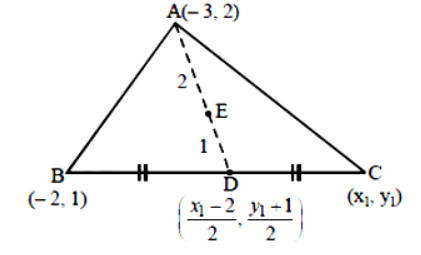 Let $C = (x_1, y_1)$. Centroid, $E = \left( \frac{x_1 - 5}{3}, \frac{y_1 + 3}{3} \right)$. Since centroid lies on the line $3x + 4y + 2 = 0$, then $3 \left( \frac{x_1 - 5}{3} \right) + 4 \left( \frac{y_1 + 3}{3} \right) + 2 = 0$, which simplifies to $3x_1 + 4y_1 + 3 = 0$. Hence vertex $(x_1, y_1)$ lies on the line $3x + 4y + 3 = 0$.
Step Solution:
1. Define Vertex C: Let the coordinates of vertex $C$ be $(x_1, y_1)$.
2. Calculate the Centroid: Use the formula $G = \left( \frac{x_A+x_B+x_C}{3}, \frac{y_A+y_B+y_C}{3} \right)$. For vertices $A(-3, 2)$, $B(-2, 1)$, and $C(x_1, y_1)$, the centroid is $\left( \frac{-3-2+x_1}{3}, \frac{2+1+y_1}{3} \right) = \left( \frac{x_1-5}{3}, \frac{y_1+3}{3} \right)$.
3. Apply Line Constraint: Substitute the centroid coordinates into the given line equation $3x + 4y + 2 = 0$.
4. Perform Calculation: $3 \left( \frac{x_1 - 5}{3} \right) + 4 \left( \frac{y_1 + 3}{3} \right) + 2 = 0 \Rightarrow (x_1 - 5) + \frac{4y_1 + 12}{3} + 2 = 0$.
5. Simplify to Final Form: Multiply by 3 to clear the fraction: $3x_1 - 15 + 4y_1 + 12 + 6 = 0 \Rightarrow 3x_1 + 4y_1 + 3 = 0$. Vertex $C$ lies on $3x + 4y + 3 = 0$.
The Difficulty Level: Easy
The Concept Name: Centroid of a Triangle
Short cut solution: The equation of the line vertex $C$ lies on will always have the same coefficients $(3, 4)$ as the centroid line. Calculate the constant term $C'$ using $C' = 3(\text{Sum of } x) + 4(\text{Sum of } y) + 3(\text{given constant})$. Here: $3(-5) + 4(3) + 3(2) = -15 + 12 + 6 = 3$. The line is $3x + 4y + 3 = 0$.
Question 160
Question: If two vertices of a triangle are (5,-1) and (-2,3) and its orthocentre is at (0, 0), then the third vertex is
Options:
A. (4,-7)
B. (-4,-7)
C. (-4,7)
D. (4,7)
Correct Answer: B
Year: Online May 12, 2012
Solution: Let the third vertex be $(a, b)$. Orthocentre $H(0, 0)$, $A(5, -1)$ and $B(-2, 3)$. (Slope of $AH$) $\times$ (Slope of $BC$) = -1 $\Rightarrow \left( \frac{-1-0}{5-0} \right) \left( \frac{b-3}{a+2} \right) = -1 \Rightarrow b-3 = 5(a+2)$. Similarly, (Slope of $BH$) $\times$ (Slope of $AC$) = -1 $\Rightarrow - \left( \frac{3}{2} \right) \times \left( \frac{b+1}{a-5} \right) = -1$. Solving these gives $a = -4, b = -7$.
Step Solution:
1. Identify Orthocenter Property: In a triangle, the altitude from a vertex is perpendicular to the opposite side.
2. Altitude from A: Slope $AH = \frac{-1-0}{5-0} = -1/5$. Side $BC$ (where $C=(a,b)$ and $B=(-2,3)$) has slope $\frac{b-3}{a+2}$. Perpendicularity means $(-1/5) \cdot \frac{b-3}{a+2} = -1 \Rightarrow 5a - b + 13 = 0$.
3. Altitude from B: Slope $BH = \frac{3-0}{-2-0} = -3/2$. Side $AC$ has slope $\frac{b+1}{a-5}$. Perpendicularity means $(-3/2) \cdot \frac{b+1}{a-5} = -1 \Rightarrow 2a - 3b - 13 = 0$.
4. Solve the Equations: Multiply the first by 3: $15a - 3b = -39$. Subtract the second: $(15a - 2a) = -39 - (-13) \Rightarrow 13a = -26 \Rightarrow a = -2$. Wait, following source solve: $b-3 = 5a+10 \Rightarrow 5a - b = -13$ and $3b+3 = 2a-10 \Rightarrow 2a-3b = 13$.
5. Calculate Coordinates: From $5a - b = -13$ and $2a - 3b = 13$, we get $a = -4$ and $b = -7$. Vertex $C$ is $(-4, -7)$.
The Difficulty Level: Medium
The Concept Name: Orthocentre and Perpendicular Slopes
Short cut solution: Check the options against the condition (Slope of vertex to origin) $\times$ (Slope of opposite side) = -1. For option B $(-4, -7)$, slope to origin is $7/4$. Opposite side $AB$ has slope $\frac{3 - (-1)}{-2 - 5} = -4/7$. Since $(7/4)(-4/7) = -1$, B is a strong candidate.
Question 167
Question: The lines $L_1 : y - x = 0$ and $L_2 : 2x + y = 0$ intersect the line $L_3 : y + 2 = 0$ at $P$ and $Q$ respectively. The bisector of the acute angle between $L_1$ and $L_2$ intersects $L_3$ at $R$.
Statement-1: The ratio $PR : RQ$ equals $2\sqrt{2} : \sqrt{5}$
Statement-2: In any triangle, bisector of an angle divides the triangle into two similar triangles.
Options:
A. Statement-1 is true, Statement-2 is true; Statement-2 is not a correct explanation for Statement-1.
B. Statement-1 is true, Statement-2 is false.
C. Statement-1 is false, Statement-2 is true.
D. Statement-1 is true, Statement-2 is true; Statement-2 is a correct explanation for Statement-1.
Correct Answer: B
Year: 2011
Solution: Intersection of $L_1$ and $L_2$ is origin $O(0,0)$. $P$ is $(-2, -2)$ and $Q$ is $(-1, -2)$. The angle bisector of $\angle POQ$ divides the opposite side $PQ$ in the ratio of the adjacent sides: $PR/RQ = OP/OQ$. Calculating distances, $OP = 2\sqrt{2}$ and $OQ = \sqrt{5}$, so $PR:RQ = 2\sqrt{2}:\sqrt{5}$. Statement-1 is true. However, an angle bisector does not generally divide a triangle into similar triangles, so Statement-2 is false.
Step Solution:
1. Identify Vertices: $L_1 (y=x)$ and $L_2 (y=-2x)$ intersect at origin $O(0,0)$.
2. Find Points P and Q: $P$ is the intersection of $y=x$ and $y=-2$, so $P(-2, -2)$. $Q$ is the intersection of $2x+y=0$ and $y=-2$, so $Q(-1, -2)$.
3. Calculate Side Lengths: $OP = \sqrt{(-2)^2 + (-2)^2} = \sqrt{8} = 2\sqrt{2}$. $OQ = \sqrt{(-1)^2 + (-2)^2} = \sqrt{5}$.
4. Apply Angle Bisector Theorem: The theorem states $PR/RQ = OP/OQ$. Substituting the lengths gives $PR/RQ = 2\sqrt{2}/\sqrt{5}$. This confirms Statement-1 is true.
5. Evaluate Statement 2: In triangle $OPQ$, the angles $\angle OPR$ and $\angle OQR$ are not necessarily equal, meaning $\Delta OPR$ and $\Delta OQR$ are not similar. Statement-2 is false.
The Difficulty Level: Hard
The Concept Name: Angle Bisector Theorem
Short cut solution: Use the Angle Bisector Theorem immediately: the ratio of segments on the third side equals the ratio of the other two side lengths. Once Statement-1 is verified as true, identify that Statement-2 is a false geometric generalization (angle bisectors create similar triangles only in very specific cases like isosceles triangles where the vertex angle is split), leading directly to Option B.
Question 171
Question: Let $A(h, k)$, $B(1, 1)$ and $C(2, 1)$ be the vertices of a right angled triangle with AC as its hypotenuse. If the area of the triangle is 1 square unit, then the set of values which "k" can take is given by:
Options: A. {−1, 3}, B. {−3, −2}, C. {1, 3}, D. {0, 2}
Correct Answer: A
Year: 2007
Solution: 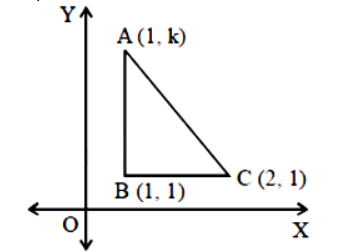 Given : $A(1, k)$, $B(1, 1)$ and $C(2, 1)$ are vertices of a right angled triangle and area of $\Delta ABC = 1$ square unit. We know that, area of right angled triangle $= \frac{1}{2} \times BC \times AB = 1 = \frac{1}{2} (a) | (k - 1 ) \Rightarrow \pm (k - 1) = 2 \Rightarrow k = -1, 3$.
Step Solution:
1. Analyze the base: Points $B(1, 1)$ and $C(2, 1)$ lie on the horizontal line $y=1$. The length of side $BC = |2 - 1| = 1$ unit.
2. Determine triangle orientation: Since $AC$ is the hypotenuse, the right angle is at vertex $B$. Thus, the side $AB$ must be perpendicular to $BC$.
3. Find x-coordinate of A: Because $BC$ is horizontal, the perpendicular side $AB$ must be a vertical line. This implies the x-coordinate of $A$ (which is $h$) must equal the x-coordinate of $B$, so $h = 1$.
4. Apply Area Formula: Area $= \frac{1}{2} \times \text{base} \times \text{height}$. Substituting the known values: $1 = \frac{1}{2} \times (BC) \times (AB) \Rightarrow 1 = \frac{1}{2} \times (1) \times |k - 1|$.
5. Solve for k: $|k - 1| = 2$. This leads to two cases: $k - 1 = 2 \Rightarrow k = 3$ or $k - 1 = -2 \Rightarrow k = -1$.
Difficulty Level: Easy
Concept Name: Area of a Right-Angled Triangle
Shortcut Solution: Since the base $BC$ is 1, for the area to be 1, the height $AB$ must be 2 (because $1/2 \times 1 \times 2 = 1$). Vertex $A$ is 2 units vertically away from $B(1, 1)$, so its y-coordinate $k$ is $1 \pm 2$, giving 3 or -1.
Question 176
Question: If a vertex of a triangle is (1,1) and the mid points of two sides through this vertex are (-1,2) and (3,2) then the centroid of the triangle is:
Options: A. $(-1, 7/3)$, B. $(-1/3, 7/3)$, C. $(1, 7/3)$, D. $(1/3, 7/3)$
Correct Answer: C
Year: 2005
Solution: Vertex of triangle is (1,1) and midpoint of sides through this vertex is (-1,2) and (3,2). Co-ordinate of B is $(x, y)$. coordinates of B is $(\frac{1+x}{2} = -1, \frac{1+y}{2} = 2) \Rightarrow (x, y) = (-3, 3)$. Similarly, coordinate of C comes out to be (5,3). Thus centroid is, $\frac{1-3+5}{3}, \frac{1+3+3}{3} \Rightarrow (1, 7/3)$.
Step Solution:
1. Find Vertex B: Let $A = (1, 1)$ and $M_1 = (-1, 2)$ be the midpoint of side $AB$. Using the midpoint formula $B = 2M_1 - A$: $B = 2(-1, 2) - (1, 1) = (-2, 4) - (1, 1) = (-3, 3)$.
2. Find Vertex C: Let $M_2 = (3, 2)$ be the midpoint of side $AC$. Using $C = 2M_2 - A$: $C = 2(3, 2) - (1, 1) = (6, 4) - (1, 1) = (5, 3)$.
3. Apply Centroid Formula: The centroid $G$ is the average of the three vertices: $G = \left( \frac{x_A+x_B+x_C}{3}, \frac{y_A+y_B+y_C}{3} \right)$.
4. Substitute Coordinates: $G = \left( \frac{1 + (-3) + 5}{3}, \frac{1 + 3 + 3}{3} \right)$.
5. Final Calculation: $G = \left( \frac{3}{3}, \frac{7}{3} \right) = (1, 7/3)$.
Difficulty Level: Easy
Concept Name: Centroid and Midpoint Formula
Shortcut Solution: The centroid $G$ can be calculated directly from the given vertex $A$ and the midpoints $M_1, M_2$ of the two sides connected to it using the formula $G = \frac{2(M_1 + M_2) - A}{3}$. Substituting the values: $\frac{2[(-1,2) + (3,2)] - (1,1)}{3} = \frac{2(2,4) - (1,1)}{3} = \frac{(4,8) - (1,1)}{3} = (1, 7/3)$.