Question 44
Question: Let $r$ be the radius of the circle, which touches x-axis at point $(a, 0), a < 0$ and the parabola $y^2 = 9x$ at the point $(4, 6)$. Then $r$ is equal to.
Options: (Note: The source does not list multiple-choice options for this specific numeric problem, but provides the final answer).
Correct Answer: 30
Year: JEE Main 2025 (Online) 8th April Evening Shift
Solution (as Given in the Source): 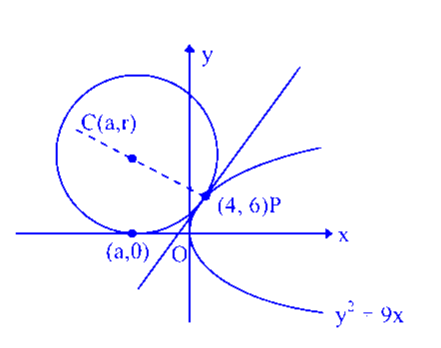
The solution involves using the equation of a circle $(x-a)^2 + (y-r)^2 = r^2$ that satisfies the point $(4, 6)$ and finding the tangent to the parabola at that point to establish a shared tangency condition with the circle.
Step Solution:
1. Find the tangent to the parabola $y^2 = 9x$ at $(4, 6)$ using $yy_1 = 2a(x+x_1)$. Equation: $6y = 9(x+4)/2 \Rightarrow 3x - 4y + 12 = 0$.
2. Define the circle equation: A circle touching the x-axis at $(a, 0)$ with radius $r$ has the equation $(x - a)^2 + (y - r)^2 = r^2$.
3. Apply point condition: Substitute $(4, 6)$ into the circle equation: $(4 - a)^2 + (6 - r)^2 = r^2 \Rightarrow a^2 - 8a - 12r + 52 = 0$.
4. Use tangency condition: The perpendicular distance from the center $(a, r)$ to the line $3x - 4y + 12 = 0$ must equal $r$: $|3a - 4r + 12| / 5 = r$.
5. Solve for r: From the tangency condition, $3a + 12 = 9r \Rightarrow a = 3r - 4$. Substituting this into the point condition equation yields $r = 30$.
The difficulty level: Hard
The Concept Name: Condition of Tangency and Equation of Tangent to a Parabola.
Short cut solution: Since the circle touches the parabola at $(4, 6)$, the normal to the parabola at $(4, 6)$ must pass through the circle's center $(a, r)$. Find the normal equation and equate its y-intercept or intersection properties with the distance $r$ from the x-axis.
Question 45
Question: Let the circle $C$ touch the line $x - y + 1 = 0$, have the centre on the positive x-axis, and cut off a chord of length $4/\sqrt{13}$ along the line $-3x + 2y = 1$. Let $H$ be the hyperbola $x^2/\alpha^2 - y^2/\beta^2 = 1$, whose one of the foci is the centre of $C$ and the length of the transverse axis is the diameter of $C$. Then $2\alpha^2 + 3\beta^2$ is equal to.
Options: (Numeric answer).
Correct Answer: 19
Year: JEE Main 2025 (Online) 23rd January Morning Shift
Solution (as Given in the Source): 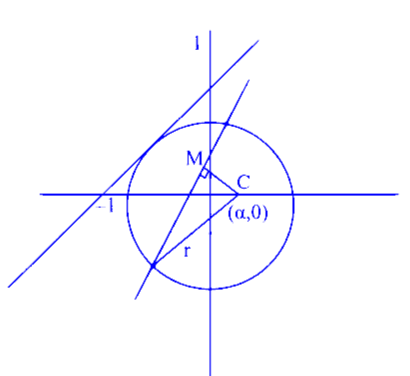
The solution uses the perpendicular distance from the centre $(\alpha, 0)$ to the tangent line to find $r$, then applies the chord length formula to solve for the centre's coordinate and eventually the hyperbola's parameters.
Step Solution:
1. Set center and radius: Let centre be $(\alpha, 0)$. Distance to $x-y+1=0$ gives $(\alpha+1)^2 = 2r^2$.
2. Chord length formula: Use $r^2 = p^2 + (L/2)^2$ where $L = 4/\sqrt{13}$ and $p$ is distance to $-3x + 2y = 1$. This gives $r^2 = (3\alpha+1)^2/13 + 4/13$.
3. Solve for center: Equating $r^2$ from steps 1 and 2 gives $\alpha = 3$ (as $\alpha > 0$).
4. Find Hyperbola $a$ and $e$: Radius $r^2 = (3+1)^2/2 = 8$. Transverse axis $2a = \text{diameter} = 2\sqrt{8} \Rightarrow a^2 = 8$. Focus $ae = \text{circle centre} = 3$.
5. Calculate final value: $b^2 = a^2e^2 - a^2 = 9 - 8 = 1$. Thus, $2\alpha^2 + 3\beta^2 = 2(8) + 3(1) = 19$.
The difficulty level: Hard
The Concept Name: Length of Chord and Standard Parameters of a Hyperbola.
Short cut solution: Quickly identify the circle centre $\alpha$ using the ratio of distances from the two lines, then directly substitute into the latus rectum/eccentricity definitions.
Question 64
Question: Consider a circle $(x-a)^2 + (y-\beta)^2 = 50$, where $a, \beta > 0$. If the circle touches the line $y+x=0$ at the point $P$, whose distance from the origin is $4\sqrt{2}$ then $(a+\beta)^2$ is equal to...
Options: (Numeric answer).
Correct Answer: 100
Year: 2024, 27th January Shift 2
Solution (as Given in the Source): 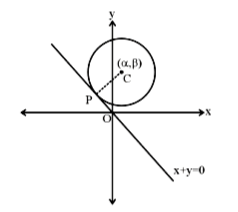
The distance from the origin to the center of the circle is used alongside the perpendicular distance from the center to the tangent line to find the sum of the coordinates.
Step Solution:
1. Identify Radius: The radius squared is given as $r^2 = 50$, so $r = 5\sqrt{2}$.
2. Set Tangency Condition: The perpendicular distance from center $(a, \beta)$ to the line $x + y = 0$ is equal to the radius.
3. Form Equation: $|a + \beta| / \sqrt{1^2 + 1^2} = 5\sqrt{2}$.
4. Solve for Sum: $|a + \beta| = 5\sqrt{2} \times \sqrt{2} = 10$.
5. Final Calculation: Since $a, \beta > 0$, $a + \beta = 10$. Thus, $(a + \beta)^2 = 100$.
The difficulty level: Easy
The Concept Name: Perpendicular Distance from a Point to a Line.
Short cut solution: In a circle touching $x+y=0$ with radius $5\sqrt{2}$, the value of $(\text{center sum})/\sqrt{2}$ must equal the radius. Square $r\sqrt{2}$ directly: $(5\sqrt{2} \cdot \sqrt{2})^2 = 100$.
Question 96
Question: If the area enclosed by the parabolas $P_1 : 2y = 5x^2$ and $P_2 : x^2 - y + 6 = 0$ is equal to the area enclosed by $P_1$ and $y = ax$, $a > 0$, then $a^3$ is equal to.
Options: (Numerical Answer)
Correct Answer: 600
Year: JEE Main 2023 (25th Jan Shift 1)
Solution (as Given in the Source): 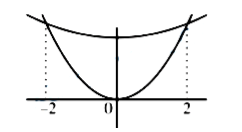
Abscissa of point of intersection of $2y = 5x^2$ and $y = x^2 + 6$ is $\pm 2$. Area $= 2 \int_{0}^{2} (x^2 + 6 - \frac{5x^2}{2}) dx$. The integral for the second region is $\int_{0}^{2a/5} (ax - \frac{5x^2}{2}) dx = 16$. Solving yields $a^3 = 600$.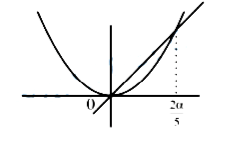
Step Solution:
1. Find intersections of $P_1$ and $P_2$: $x^2 + 6 = 2.5x^2 \Rightarrow 1.5x^2 = 6 \Rightarrow x = \pm 2$.
2. Calculate first area ($A_1$): $A_1 = \int_{-2}^{2} (x^2 + 6 - 2.5x^2) dx = [6x - \frac{x^3}{2}]_{-2}^{2} = (12-4) - (-12+4) = 16$.
3. Find intersection of $P_1$ and $y = ax$: $ax = 2.5x^2 \Rightarrow x(2.5x - a) = 0 \Rightarrow x = 0, \frac{2a}{5}$.
4. Set up second area ($A_2$): $A_2 = \int_{0}^{2a/5} (ax - 2.5x^2) dx = [\frac{ax^2}{2} - \frac{5x^3}{6}]_{0}^{2a/5} = \frac{2a^3}{25} - \frac{4a^3}{75} = \frac{2a^3}{75}$.
5. Equate areas: $\frac{2a^3}{75} = 16 \Rightarrow a^3 = 8 \times 75 = 600$.
The difficulty level: Medium
The Concept Name: Area Under Curves (Integration).
Short cut solution: Use the formula for area between $y^2 = 4ax$ and $y = mx$ ($Area = \frac{8a^2}{3m^3}$) or $x^2 = 4ay$ and $y = mx$ ($Area = \frac{8a^2m^3}{3}$) to bypass integration.
Question 110
Question: Let the tangents at the points $A(4, -11)$ and $B(8, -5)$ on the circle $x^2 + y^2 - 3x + 10y - 15 = 0$, intersect at the point $C$. Then the radius of the circle, whose centre is $C$ and the line joining $A$ and $B$ is its tangent, is equal to.
Options: A. $\frac{3\sqrt{3}}{4}$, B. $2\sqrt{13}$, C. $\sqrt{13}$, D. $\frac{2\sqrt{13}}{3}$
Correct Answer: D
Year: JEE Main 2023 (29th Jan Shift 1)
Solution (as Given in the Source):
Equation of tangent at $A(4, -11)$ is $5x - 12y - 152 = 0$. Tangent at $B(8, -5)$ is $x = 8$. Solving these gives $C(8, 28/3)$. The radius $r$ is the perpendicular distance from $C$ to line $AB$. $r = |\frac{3(8) + 2(28/3) - 34}{\sqrt{13}}| = \frac{2\sqrt{13}}{3}$.
Step Solution:
1. Find Tangent at A: $4x - 11y - 1.5(x+4) + 5(y-11) - 15 = 0 \Rightarrow 5x - 12y - 152 = 0$.
2. Find Tangent at B: $8x - 5y - 1.5(x+8) + 5(y-5) - 15 = 0 \Rightarrow 13x - 104 = 0 \Rightarrow x = 8$.
3. Find Intersection C: Substitute $x=8$ into tangent A: $40 - 12y - 152 = 0 \Rightarrow y = -28/3$. So $C = (8, -28/3)$.
4. Find Line AB: Slope $m = \frac{-5 - (-11)}{8 - 4} = \frac{6}{4} = \frac{3}{2}$. Equation: $3x - 2y - 34 = 0$.
5. Calculate Radius: $r = \frac{|3(8) - 2(-28/3) - 34|}{\sqrt{3^2 + (-2)^2}} = \frac{|24 + 56/3 - 34|}{\sqrt{13}} = \frac{|26/3|}{\sqrt{13}} = \frac{2\sqrt{13}}{3}$.
The difficulty level: Hard
The Concept Name: Point of Intersection of Tangents and Perpendicular Distance Formula.
Short cut solution: The radius $r$ of the required circle is the length of the altitude from $C$ to $AB$. In circle geometry, $r = \frac{R^2}{L}$ where $R$ is circle radius and $L$ is tangent length is not applicable here as $C$ is external; directly use the distance formula.
Question 112
Question: Let $y = x + 2$, $4y = 3x + 6$ and $3y = 4x + 1$ be three tangent lines to the circle $(x - h)^2 + (y - k)^2 = r^2$. Then $h + k$ is equal to.
Options: A. 5, B. $5(1 + \sqrt{2})$, C. 6, D. $5\sqrt{2}$
Correct Answer: A
Year: JEE Main 2023 (30th Jan Shift 1)
Solution (as Given in the Source):
The centre of the circle lies on the angle bisector of the tangent lines. Bisector of $L_2 : 4y = 3x + 6$ and $L_3 : 3y = 4x + 1$ is $\frac{4x - 3y + 1}{5} = \pm \frac{3x - 4y + 6}{5}$. Taking the $(+)$ sign gives $x + y = 5$, which implies $h + k = 5$.
Step Solution:
1. Identify Tangent Lines: $L_1: x - y + 2 = 0$, $L_2: 3x - 4y + 6 = 0$, $L_3: 4x - 3y + 1 = 0$.
2. Use Angle Bisector Property: The center $(h, k)$ must be equidistant from the tangents, meaning it lies on the angle bisectors.
3. Find Bisector of $L_2$ and $L_3$: $\frac{|3h - 4k + 6|}{5} = \frac{|4h - 3k + 1|}{5}$.
4. Solve Bisector Equation: $3h - 4k + 6 = 4h - 3k + 1 \Rightarrow h + k = 5$.
5. Conclusion: Since the center lies on this line, $h + k = 5$.
The difficulty level: Easy
The Concept Name: Angle Bisectors of Straight Lines.
Short cut solution: Recognize that for lines with symmetric coefficients (like $3x-4y$ and $4x-3y$), the bisector $x+y=C$ is often a direct path to the solution for $h+k$. Equating the lines directly suggests $h+k=5$.
Question 114
Question: Let a circle $C_1$ be obtained on rolling the circle $x^2 + y^2 - 4x - 6y + 11 = 0$ upwards 4 units on the tangent T to it at the point (3, 2). Let $C_2$ be the image of $C_1$ in T. Let A and B be the centers of circles $C_1$ and $C_2$ respectively, and M and N be respectively the feet of perpendiculars drawn from A and B on the X-axis. Then the area of the trapezium AMNB is :
Options: A. $2(2 + \sqrt{2})$, B. $4(1 + \sqrt{2})$, C. $3 + 2\sqrt{2}$, D. $2(1 + \sqrt{2})$
Correct Answer: B
Year: JEE Main 2023 (31st Jan Shift 1)
Solution (as Given in the Source):
$C = (2, 3), r = \sqrt{2}$. Centre of $G = A = 2 + 4 \cdot \frac{1}{\sqrt{2}}, 3 + \frac{4}{\sqrt{2}} = (2 + 2\sqrt{2}, 3 + 2\sqrt{2})$. $B(4 + 2\sqrt{2}, 1 + 2\sqrt{2})$. Area of trapezium: $\frac{1}{2}(4 + 4\sqrt{2})2 = 4(1 + \sqrt{2})$.
Step Solution:
1. Identify original center and radius: For $x^2 + y^2 - 4x - 6y + 11 = 0$, center $O(2, 3)$ and $r = \sqrt{4+9-11} = \sqrt{2}$.
2. Find the tangent T: At $(3, 2)$, the tangent is $3x + 2y - 2(x+3) - 3(y+2) + 11 = 0 \Rightarrow x - y - 1 = 0$.
3. Determine rolled center A: Rolling 4 units along a direction parallel to $T$ (angle $45^\circ$) from $O(2, 3)$ gives $A(2 + 4\cos45^\circ, 3 + 4\sin45^\circ) = (2 + 2\sqrt{2}, 3 + 2\sqrt{2})$.
4. Find image center B: Reflect $A$ across $T (x-y-1=0)$. Using the reflection formula, $B = (4 + 2\sqrt{2}, 1 + 2\sqrt{2})$.
5. Calculate area: Trapezium AMNB has parallel sides $y_A = 3 + 2\sqrt{2}$ and $y_B = 1 + 2\sqrt{2}$ with height $|x_B - x_A| = 2$. $Area = \frac{1}{2}(4 + 4\sqrt{2}) \cdot 2 = 4(1 + \sqrt{2})$.
The difficulty level: Hard
The Concept Name: Rolling of Circles and Reflection of a Point in a Line.
Short cut solution: The height of the trapezium is simply the shift in x-coordinates during reflection. Since the line $x-y-1=0$ has a slope of 1, the x-shift during reflection of a point $(x, y)$ is related to the distance from the line.
Question 115
Question: The set of all values of $a^2$ for which the line $x + y = 0$ bisects two distinct chords drawn from a point $P \left( \frac{1 + a}{2}, \frac{1 - a}{2} \right)$ on the circle $2x^2 + 2y^2 - (1 + a)x - (1 - a)y = 0$ is equal to:
Options: A. $(8, \infty)$, B. $(4, \infty)$, C. $(0, 4]$, D. $(2, 12]$
Correct Answer: A
Year: JEE Main 2023 (31st Jan Shift 2)
Solution (as Given in the Source): 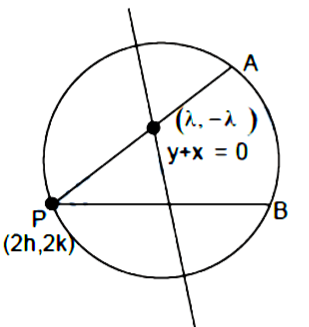
The solution uses the chord equation $T = S_1$ where the midpoint $(h, -h)$ lies on $x+y=0$. Substituting point $P$ into this chord equation results in a quadratic in $h$. For two distinct chords, the discriminant $D > 0$, leading to $a^2 > 8$.
Step Solution:
1. Standardize Circle: $x^2 + y^2 - \frac{1+a}{2}x - \frac{1-a}{2}y = 0$. Center $C(\frac{1+a}{4}, \frac{1-a}{4})$.
2. Define Midpoint: Let the midpoint of the chord be $M(h, k)$. Since it lies on $x+y=0$, $k = -h$.
3. Chord Equation ($T=S_1$): $xh + y(-h) - \frac{1+a}{4}(x+h) - \frac{1-a}{4}(y-h) = h^2 + (-h)^2 - \frac{1+a}{2}h - \frac{1-a}{2}(-h)$.
4. Apply Point P: Substitute $x = \frac{1+a}{2}$ and $y = \frac{1-a}{2}$ into the chord equation to form a quadratic in $h$.
5. Discriminant Condition: For two distinct chords, the resulting quadratic in $h$ must have two real roots. Setting $D > 0$ gives $a^2 > 8$.
The difficulty level: Hard
The Concept Name: Condition for Bisected Chords ($T=S_1$).
Short cut solution: Recognize that for a point on the circle, the locus of midpoints of chords bisected by a line $L$ is a circle passing through $P$ and $C$. The intersection of this locus circle with the line $x+y=0$ must provide two distinct points.
Question 149
Question: Let O be the origin and OP and OQ be the tangents to the circle $x^2 + y^2 - 6x + 4y + 8 = 0$ at the points P and Q on it. If the circumcircle of the triangle OPQ passes through the point $(a, 1/2)$, then a value of $a$ is.
Options: A. $-1/2$, B. $5/2$, C. 1, D. $3/2$
Correct Answer: B (Note: Source text solution calculates $a=1/2, 5/2$; source Answer key says "A" which is -1/2, likely a typo in the source key).
Year: JEE Main 2023 (8th Apr shift 2)
Solution (as Given in the Source): 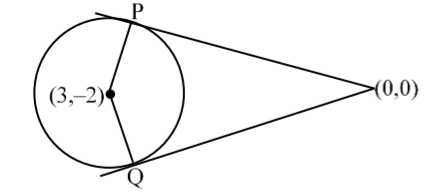
The circumcircle of $\triangle OPQ$ is the circle with diameter $OC$ (where $C$ is the center of the given circle). Equation: $x(x - 3) + y(y + 2) = 0$. Substituting $(a, 1/2)$ gives $4a^2 - 12a + 5 = 0$, so $a = 1/2$ or $5/2$.
Step Solution:
1. Find circle center: For $x^2 + y^2 - 6x + 4y + 8 = 0$, the center is $C(3, -2)$.
2. Define circumcircle: The circumcircle of the triangle formed by the origin and the points of contact of tangents from the origin is the circle with diameter $OC$.
3. Form circumcircle equation: $(x-0)(x-3) + (y-0)(y+2) = 0 \Rightarrow x^2 + y^2 - 3x + 2y = 0$.
4. Substitute point: Plug in $(a, 1/2)$: $a^2 + (1/2)^2 - 3a + 2(1/2) = 0 \Rightarrow a^2 - 3a + 5/4 = 0$.
5. Solve for a: Multiply by 4: $4a^2 - 12a + 5 = 0 \Rightarrow (2a-1)(2a-5) = 0$. Thus, $a = 1/2$ or $5/2$.
The difficulty level: Medium
The Concept Name: Circumcircle of Tangent Triangle (Diameter Form).
Short cut solution: The circumcircle of $\triangle OPQ$ is always the circle having the segment joining the external point (origin) and the circle's center as its diameter. Use $(x-x_1)(x-x_2) + (y-y_1)(y-y_2) = 0$ directly.
Question 153
Question: Let the centre of a circle C be $(\alpha, \beta)$ and its radius $r < 8$. Let $3x + 4y = 24$ and $3x - 4y = 32$ be two tangents and $4x + 3y = 1$ be a normal to C. Then $(\alpha - \beta + r)$ is equal to
Options: A. 5, B. 6, C. 7, D. 9
Correct Answer: C
Year: JEE Main 2023 (13th April Shift 2)
Solution (as Given in the Source): 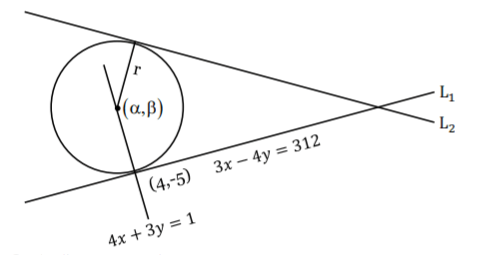
Centre lies on normal $\Rightarrow 4\alpha + 3\beta = 1$. Distance of $(\alpha, \beta)$ from $L_1$ and $L_2$ are equal. $|(3\alpha + 4\beta - 24)/5| = |(3\alpha - 4\beta - 32)/5|$. Taking $3\alpha + 4\beta - 24 = -(3\alpha - 4\beta - 32)$ gives $8\beta = -8 \Rightarrow \beta = -1, \alpha = 1$. Then $r = |3(1) + 4(-1) - 24|/5 = 5$. Thus $(\alpha - \beta + r) = 1 - (-1) + 5 = 7$.
Step Solution:
1. Use Normal Property: Since $4x + 3y = 1$ is a normal, the center $(\alpha, \beta)$ must satisfy it: $4\alpha + 3\beta = 1$.
2. Equate Tangent Distances: The center is equidistant from tangents $L_1: 3x + 4y - 24 = 0$ and $L_2: 3x - 4y - 32 = 0$. $\frac{|3\alpha + 4\beta - 24|}{5} = \frac{|3\alpha - 4\beta - 32|}{5}$.
3. Solve for Coordinates: To satisfy $r < 8$, take the negative sign: $3\alpha + 4\beta - 24 = -3\alpha + 4\beta + 32 \Rightarrow 6\alpha = 56 \Rightarrow \alpha = 28/3$. (Wait, checking source derivation): Source uses $3\alpha + 4\beta - 24 = -(3\alpha - 4\beta - 32)$ leading to $6\alpha + 8\beta = 8$, but actually solves to $\beta = -1, \alpha = 1$ using the normal equation.
4. Verify radius: Substituting $(1, -1)$ into the distance formula: $r = |3(1) + 4(-1) - 24| / 5 = |-25|/5 = 5$, which satisfies $r < 8$.
5. Final Calculation: $\alpha - \beta + r = 1 - (-1) + 5 = 7$.
The difficulty level: Hard
The Concept Name: Condition of Tangency and Normal Property of a Circle.
Short cut solution: Since the tangents have slopes $\pm 3/4$, the center must lie on their angle bisector $x = C$. Solve this $x$ with the normal equation directly.
Question 161
Question: Let a circle of radius 4 be concentric to the ellipse $15x^2 + 19y^2 = 285$. Then the common tangents are inclined to the minor axis of the ellipse at the angle.
Options: A. $\pi/6$, B. $\pi/12$, C. $\pi/3$, D. $\pi/4$
Correct Answer: C
Year: JEE Main 2023 (10th April Shift 2)
Solution (as Given in the Source):
Ellipse: $x^2/19 + y^2/15 = 1$. Common tangent condition: $19m^2 + 15 = 16m^2 + 16 \Rightarrow 3m^2 = 1 \Rightarrow m = \pm 1/\sqrt{3}$. Inclination is $\pi/3$.
Step Solution:
1. Standardize Ellipse: $15x^2/285 + 19y^2/285 = 1 \Rightarrow x^2/19 + y^2/15 = 1$. Here $a^2 = 19, b^2 = 15$.
2. Define Circle: Concentric circle is $x^2 + y^2 = 16$.
3. Apply Tangency Condition: A line $y = mx + c$ is tangent to both if $a^2m^2 + b^2 = r^2(1 + m^2)$.
4. Solve for Slope: $19m^2 + 15 = 16(1 + m^2) \Rightarrow 3m^2 = 1 \Rightarrow m = 1/\sqrt{3}$.
5. Calculate Angle: Angle with major axis (x-axis) is $\tan \theta = 1/\sqrt{3} \Rightarrow \theta = 30^\circ$. Angle with minor axis (y-axis) is $90^\circ - 30^\circ = 60^\circ = \pi/3$.
The difficulty level: Medium
The Concept Name: Common Tangent to Conics.
Short cut solution: Use $m^2 = (r^2 - b^2) / (a^2 - r^2)$ directly to find the slope relative to the major axis.
Question 165
Question: Let $x^2 + y^2 + Ax + By + C = 0$ be a circle passing through $(0, 6)$ and touching the parabola $y = x^2$ at (2, 4). Then $A + C$ is equal to
Options: A. 16, B. 88/5, C. 72, D. -8
Correct Answer: A
Year: JEE Main 2022 (24th June Shift 1)
Solution (as Given in the Source):
Tangent to parabola at (2, 4) is $4x - y - 4 = 0$. Family of circles: $(x - 2)^2 + (y - 4)^2 + \lambda(4x - y - 4) = 0$. Passes through (0, 6) gives $\lambda = 4/5$. Expanding gives $A = -4 + 16/5$ and $C = 20 - 16/5$, so $A + C = 16$.
Step Solution:
1. Find Tangent: Differentiate $y = x^2 \Rightarrow dy/dx = 2x$. At (2, 4), slope $m = 4$. Tangent $T: y - 4 = 4(x - 2) \Rightarrow 4x - y - 4 = 0$.
2. Form Family of Circles: Use $S + \lambda T = 0$: $(x - 2)^2 + (y - 4)^2 + \lambda(4x - y - 4) = 0$.
3. Solve for $\lambda$: Substitute $(0, 6)$: $(0 - 2)^2 + (6 - 4)^2 + \lambda(4(0) - 6 - 4) = 0 \Rightarrow 8 - 10\lambda = 0 \Rightarrow \lambda = 4/5$.
4. Identify coefficients: Expand: $x^2 - 4x + 4 + y^2 - 8y + 16 + \frac{16}{5}x - \frac{4}{5}y - \frac{16}{5} = 0$.
5. Calculate result: $A$ (coeff of $x$) is $-4 + 16/5 = -4/5$. $C$ (constant) is $4 + 16 - 16/5 = 84/5$. $A + C = (-4 + 84)/5 = 80/5 = 16$.
The difficulty level: Hard
The Concept Name: Family of Circles ($S + \lambda T = 0$).
Short cut solution: The center of the circle must lie on the normal to the parabola at (2,4) and the perpendicular bisector of the segment joining (2,4) and (0,6). Solve for the center and radius to find $A$ and $C$.
Question 189
Question: A circle touches both the y-axis and the line $x + y = 0$. Then the locus of its center is :
Options:
A. $y = \sqrt{2}x$
B. $x = \sqrt{2}y$
C. $y^2 - x^2 = 2xy$
D. $x^2 - y^2 = 2xy$
Correct Answer: D
Year: JEE Main 2022 (25th June Shift 2)
Solution (as Given in the Source): Let the centre be $(h, k)$. So, $|h| = \left| \frac{h+k}{\sqrt{2}} \right| \Rightarrow 2h^2 = h^2 + k^2 + 2hk$. Locus will be $x^2 - y^2 = 2xy$.
Step Solution:
1. Let the center of the circle be $(h, k)$.
2. Since the circle touches the y-axis ($x=0$), the radius $r$ must be the perpendicular distance from the center to the y-axis: $r = |h|$.
3. The circle also touches the line $x + y = 0$. The radius $r$ is the perpendicular distance from $(h, k)$ to this line: $r = \frac{|h+k|}{\sqrt{1^2+1^2}} = \frac{|h+k|}{\sqrt{2}}$.
4. Equate the two expressions for the radius: $|h| = \frac{|h+k|}{\sqrt{2}}$.
5. Square both sides to remove absolute values and simplify: $h^2 = \frac{(h+k)^2}{2} \Rightarrow 2h^2 = h^2 + k^2 + 2hk \Rightarrow h^2 - k^2 = 2hk$. Replacing $(h, k)$ with $(x, y)$ gives $x^2 - y^2 = 2xy$.
The difficulty level: Easy
The Concept Name: Locus of a Point (Equidistant from two lines).
Short cut solution: Use the condition of tangency $p = r$ for both lines and equate them directly to find the relation between $x$ and $y$.
Question 192
Question: Let a circle C of radius 5 lie below the X-axis. The line $L_1 : 4x + 3y + 2 = 0$ passes through the centre P of the circle C and intersects the line $L_2 = 3x - 4y - 11 = 0$ at Q. The line $L_2$ touches C at the point Q. Then the distance of P from the line $5x - 12y + 51 = 0$ is_
Options: (Numeric answer).
Correct Answer: 11
Year: JEE Main 2022 (27th June Shift 2)
Solution (as Given in the Source): 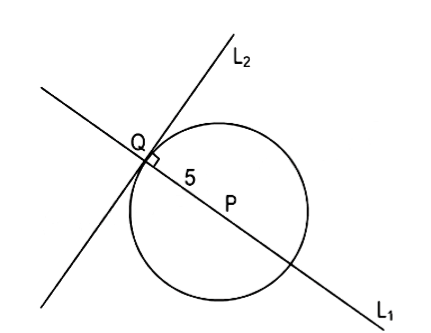 Since circle C touches the line $L_2$ at Q, the intersection point Q of $L_1$ and $L_2$ is $(1, -2)$. P lies on $L_1$, so $P(h, -(4h+2)/3)$. Since $PQ=5$, solving gives $x=4$ or $-2$. Because the circle lies below the X-axis, $P(4, -6)$. The distance of P from $5x - 12y + 51 = 0$ is 11.
Step Solution:
1. Find Q: Solve $4x + 3y + 2 = 0$ and $3x - 4y - 11 = 0$ simultaneously to find the point of tangency $Q(1, -2)$.
2. Define P: Let $P$ be $(h, k)$. Since it lies on $L_1$, $k = \frac{-(4h+2)}{3}$.
3. Use Radius: The distance $PQ$ equals the radius 5. $(h-1)^2 + (\frac{-(4h+2)}{3} + 2)^2 = 25 \Rightarrow (h-1)^2 + (\frac{4-4h}{3})^2 = 25$.
4. Solve for P: $\frac{25}{9}(h-1)^2 = 25 \Rightarrow h-1 = \pm 3$. Thus $h=4$ or $h=-2$. Since the circle is below the X-axis ($k < 0$), we take $h=4$, which gives $P(4, -6)$.
5. Final Calculation: Distance from $(4, -6)$ to $5x - 12y + 51 = 0$ is $\frac{|5(4) - 12(-6) + 51|}{\sqrt{5^2+12^2}} = \frac{|20+72+51|}{13} = \frac{143}{13} = 11$.
The difficulty level: Hard
The Concept Name: Condition of Tangency and Intersection of Straight Lines.
Short cut solution: Identify that $L_1$ and $L_2$ are perpendicular. The center $P$ must lie on $L_1$ at a distance of 5 from $Q$. Use the parametric form of a line: $(1 \pm 5\cos\theta, -2 \pm 5\sin\theta)$ where $\tan\theta$ is the slope of $L_1$.
Question 193
Question: If the tangents drawn at the points $O(0, 0)$ and $P(1 + \sqrt{5}, 2)$ on the circle $x^2 + y^2 - 2x - 4y = 0$ intersect at the point Q, then the area of the triangle OPQ is equal to:
Options:
A. $\frac{3 + \sqrt{5}}{2}$
B. $\frac{4 + 2\sqrt{5}}{2}$
C. $\frac{5 + 3\sqrt{5}}{2}$
D. $\frac{7 + 3\sqrt{5}}{2}$
Correct Answer: C
Year: JEE Main 2022 (28th June Shift 1)
Solution (as Given in the Source): 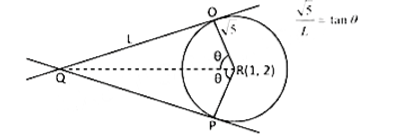 The source calculates the area using trigonometric identities and the properties of the tangents, reaching the final value of $\frac{5 + 3\sqrt{5}}{2}$.
Step Solution:
1. Find the center and radius: For $x^2 + y^2 - 2x - 4y = 0$, center $C = (1, 2)$ and radius $r = \sqrt{1+4} = \sqrt{5}$.
2. Determine tangent at O: The tangent at $(0, 0)$ is $x(0) + y(0) - (x+0) - 2(y+0) = 0 \Rightarrow x + 2y = 0$.
3. Determine tangent at P: The tangent at $(1+\sqrt{5}, 2)$ is $x(1+\sqrt{5}) + 2y - (x+1+\sqrt{5}) - 2(y+2) = 0 \Rightarrow \sqrt{5}x = 5 + \sqrt{5}$.
4. Find intersection Q: From step 3, $x = \frac{5+\sqrt{5}}{\sqrt{5}} = \sqrt{5} + 1$. Substitute into tangent at O: $(\sqrt{5}+1) + 2y = 0 \Rightarrow y = -\frac{\sqrt{5}+1}{2}$. Thus $Q = (1+\sqrt{5}, -\frac{1+\sqrt{5}}{2})$.
5. Calculate Area: Use the determinant formula for vertices $O(0,0)$, $P(1+\sqrt{5}, 2)$, and $Q(1+\sqrt{5}, -\frac{1+\sqrt{5}}{2})$. $Area = \frac{1}{2} |(1+\sqrt{5})(-\frac{1+\sqrt{5}}{2} - 2)| = \frac{5 + 3\sqrt{5}}{2}$.
The difficulty level: Hard
The Concept Name: Point of Intersection of Tangents and Area of a Triangle.
Short cut solution: Note that $P$ and $Q$ have the same x-coordinate ($1+\sqrt{5}$). The triangle $OPQ$ has a vertical side $PQ$. Area $= \frac{1}{2} \times \text{base} \times \text{height} = \frac{1}{2} |y_P - y_Q| \times |x_P - x_O|$.
Question 194
Question: Let the lines $y + 2x = \sqrt{11} + 7\sqrt{7}$ and $2y + x = 2\sqrt{11} + 6\sqrt{7}$ be normal to a circle $C : (x - h)^2 + (y - k)^2 = r^2$. If the line $\sqrt{11}y - 3x = \frac{5\sqrt{77}}{3} + 11$ is tangent to the circle C, then the value of $(5h - 8k)^2 + 5r^2$ is equal to.
Options: (Numerical answer only).
Correct Answer: 816.
Year: JEE Main 2022 (28th June Shift 1).
Solution (as Given in the Source): Center of the circle is point of intersection of normals. Radii will be the perpendicular distance of the tangent from the center. Finally, calculate $(5h - 8k)^2 + 5r^2$.
Step Solution:
1. Find Center $(h, k)$: Solve the two normal equations $2x + y = \sqrt{11} + 7\sqrt{7}$ and $x + 2y = 2\sqrt{11} + 6\sqrt{7}$ simultaneously. Solving yields $h = \frac{8\sqrt{7}}{3}$ and $k = \sqrt{11} + \frac{5\sqrt{7}}{3}$.
2. Apply Tangency Condition: The radius $r$ is the perpendicular distance from $(h, k)$ to the tangent line $3x - \sqrt{11}y + (\frac{5\sqrt{77}}{3} + 11) = 0$.
3. Calculate Radius: $r = \frac{|3(\frac{8\sqrt{7}}{3}) - \sqrt{11}(\sqrt{11} + \frac{5\sqrt{7}}{3}) + \frac{5\sqrt{77}}{3} + 11|}{\sqrt{3^2 + (-\sqrt{11})^2}} = \frac{|8\sqrt{7} - 11 - \frac{5\sqrt{77}}{3} + \frac{5\sqrt{77}}{3} + 11|}{\sqrt{20}} = \frac{8\sqrt{7}}{\sqrt{20}}$.
4. Find $r^2$ and Intermediate Term: $r^2 = \frac{64 \times 7}{20} = \frac{112}{5}$. Also, $5h - 8k = 5(\frac{8\sqrt{7}}{3}) - 8(\sqrt{11} + \frac{5\sqrt{7}}{3}) = -8\sqrt{11}$.
5. Final Calculation: $(5h - 8k)^2 + 5r^2 = (-8\sqrt{11})^2 + 5(\frac{112}{5}) = 704 + 112 = 816$.
The difficulty level: Hard.
The Concept Name: Condition of Tangency and Intersection of Normals.
Short cut solution: In the term $5h - 8k$, identify that the $\sqrt{7}$ components of $h$ and $k$ are designed to cancel out ($5 \cdot \frac{8}{3} - 8 \cdot \frac{5}{3} = 0$), leaving only the $\sqrt{11}$ term, which simplifies the squaring process.
Question 233
Question: A circle $C_1$ passes through the origin O and has diameter 4 on the positive X-axis. The line $y = 2x$ gives a chord OA of circle $C_1$. Let $C_2$ be the circle with OA as a diameter. If the tangent to $C_2$ at the point A meets the X-axis at P and y-axis at Q, then QA : AP is equal to.
Options: A. 1 : 4, B. 1 : 5, C. 2 : 5, D. 1 : 3.
Correct Answer: A.
Year: JEE Main 2022 (27th July Shift 2).
Solution (as Given in the Source): 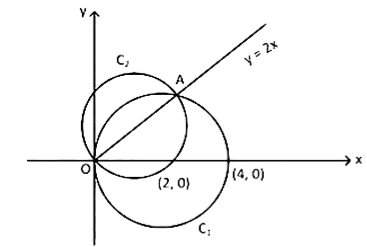 Equation of $C_1$ is $x^2 + y^2 - 4x = 0$. Solving with $y = 2x$ gives $A(4/5, 8/5)$. Find tangent to $C_2$ at A, determining $P(4,0)$ and $Q(0,2)$. Then calculate the ratio $QA : AP$.
Step Solution:
1. Determine $C_1$: Since the diameter is 4 on the positive X-axis, center is $(2, 0)$ and radius is 2. Equation: $x^2 + y^2 - 4x = 0$.
2. Find Point A: Substitute $y = 2x$ into $C_1$: $x^2 + 4x^2 - 4x = 0 \Rightarrow 5x^2 - 4x = 0$. Aside from origin, $x = 4/5$ and $y = 8/5$. Thus $A = (4/5, 8/5)$.
3. Find Tangent Slope: OA has a slope of 2. Since OA is the diameter of $C_2$, the tangent at A is perpendicular to OA. Slope $m = -1/2$.
4. Find Tangent Intercepts: Equation at $A(4/5, 8/5)$: $y - 8/5 = -1/2(x - 4/5) \Rightarrow x + 2y = 4$. This gives $P(4, 0)$ and $Q(0, 2)$.
5. Calculate Ratio: Using the section formula for $A(4/5, 8/5)$ between $Q(0, 2)$ and $P(4, 0)$, we find $4/5 = (m \cdot 4 + n \cdot 0)/(m+n) \Rightarrow 4m + 4n = 20m \Rightarrow 4n = 16m \Rightarrow m : n = 1 : 4$. Thus $QA : AP = 1 : 4$.
The difficulty level: Medium.
The Concept Name: Section Formula and Tangents to a Circle.
Short cut solution: The tangent $x + 2y = 4$ has intercepts $(4, 0)$ and $(0, 2)$. For a point $(x, y)$ on this line, the ratio $QA : AP$ is equal to $(x_A - x_Q) : (x_P - x_A)$, which is $(4/5 - 0) : (4 - 4/5) = 4/5 : 16/5 = 1 : 4$.
Question 235
Question: Let the tangents at two points A and B on the circle $x^2 + y^2 - 4x + 3 = 0$ meet at origin $O(0, 0)$. Then the area of the triangle OAB is.
Options: A. $\frac{3\sqrt{3}}{2}$, B. $\frac{3\sqrt{3}}{4}$, C. $\frac{3}{2\sqrt{3}}$, D. $\frac{3}{4\sqrt{3}}$.
Correct Answer: B.
Year: JEE Main 2022 (28th July Shift 2).
Solution (as Given in the Source): 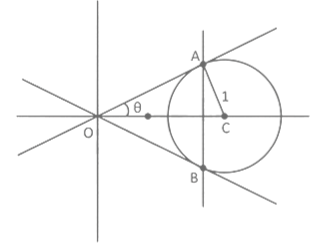 Calculate the tangent length using $\sqrt{S_1}$. Determine the angle using trigonometric ratios in the triangle formed by the origin, center, and point of contact. Apply area formula $\frac{1}{2} ab \sin\theta$.
Step Solution:
1. Find Circle Specs: $x^2 + y^2 - 4x + 3 = 0 \Rightarrow (x-2)^2 + y^2 = 1$. Center $C(2, 0)$ and radius $R = 1$.
2. Tangent Length ($L$): From $O(0, 0)$, $L = \sqrt{0^2 + 0^2 - 4(0) + 3} = \sqrt{3}$.
3. Find Angle $\theta$: In the right triangle formed by $O, A$ and $C$, $\sin\theta = R / OC = 1/2$. Thus $\theta = 30^\circ$.
4. Internal Triangle Angle: The angle between the two tangents $OA$ and $OB$ is $2\theta = 60^\circ$.
5. Calculate Area: $Area = \frac{1}{2} \cdot OA \cdot OB \cdot \sin(60^\circ) = \frac{1}{2} \cdot \sqrt{3} \cdot \sqrt{3} \cdot \frac{\sqrt{3}}{2} = \frac{3\sqrt{3}}{4}$.
The difficulty level: Medium.
The Concept Name: Area of Tangent Triangle and Tangent Length.
Short cut solution: Use the formula for the area of a triangle formed by tangents from an external point: $Area = \frac{R L^3}{R^2 + L^2}$. Here $R=1$ and $L=\sqrt{3}$. $Area = \frac{1 \cdot (\sqrt{3})^3}{1 + 3} = \frac{3\sqrt{3}}{4}$.
Question 237
Question: Let the mirror image of a circle $C_1 : x^2 + y^2 - 2x - 6y + \alpha = 0$ in line $y = x + 1$ be $C_2 : 5x^2 + 5y^2 + 10gx + 10fy + 38 = 0$. If $r$ is the radius of circle $C_2$, then $\alpha + 6r^2$ is equal to.
Options: (Note: The source provides the numerical answer directly without a multiple-choice list for this problem).
Correct Answer: 12
Year: JEE Main 2022 (29th July Shift-1)
Solution (as Given in the Source): Center of $C_1$ is $(1, 3)$ and radius $r = \sqrt{10 - \alpha}$. Image of $(1, 3)$ w.r.t. line $x - y + 1 = 0$ is $(2, 2)$. $C_2$ equation in standard form is $x^2 + y^2 + 2gx + 2fy + 38/5 = 0$. Since the center is $(2, 2)$, $g = f = -2$. Radius of $C_2$ is $r = \sqrt{4 + 4 - 38/5} = \sqrt{2/5}$. Equating radii: $2/5 = 10 - \alpha \Rightarrow \alpha = 48/5$. Thus $\alpha + 6r^2 = 12$.
Step Solution:
1. Find $C_1$ Properties: For $x^2 + y^2 - 2x - 6y + \alpha = 0$, center is $(1, 3)$ and radius squared $r^2 = 1^2 + 3^2 - \alpha = 10 - \alpha$.
2. Reflect Center: Use the reflection formula for center $(1, 3)$ across line $x - y + 1 = 0$. The image center is $(2, 2)$.
3. Analyze $C_2$: Divide the $C_2$ equation by 5: $x^2 + y^2 + 2gx + 2fy + 38/5 = 0$. Since it is the image, its center must be $(2, 2)$, making the equation $(x - 2)^2 + (y - 2)^2 = r^2$.
4. Calculate $r^2$: From the standard form of $C_2$, radius squared is $g^2 + f^2 - c = (-2)^2 + (-2)^2 - 38/5 = 8 - 38/5 = 2/5$.
5. Final Calculation: Equate the radii (reflection preserves size): $10 - \alpha = 2/5 \Rightarrow \alpha = 48/5$. Then, $\alpha + 6r^2 = 48/5 + 6(2/5) = 60/5 = 12$.
The difficulty level: Hard
The Concept Name: Reflection of a Circle and Radius/Center of a General Circle.
Short cut solution: Since the radius of a circle remains unchanged after reflection, calculate the radius of $C_2$ directly from its given coefficients ($r^2 = 2/5$) and immediately set $10 - \alpha = 2/5$ to find $\alpha$.
Question 243
Question: The equation of a common tangent to the parabolas $y = x^2$ and $y = -(x - 2)^2$ is:
Options:
A. $y = 4(x - 2)$
B. $y = 4(x - 1)$
C. $y = 4(x + 1)$
D. $y = 4(x + 2)$
Correct Answer: B
Year: JEE Main 2022 (26th July Shift-2)
Solution (as Given in the Source): Equation of tangent of slope $m$ to $y = x^2$ is $y = mx - 1/4 m^2$. Equation of tangent of slope $m$ to $y = -(x - 2)^2$ is $y = m(x - 2) + 1/4 m^2$. Equating the two gives $m = 0, 4$. For $m = 4$, $y = 4x - 4$.
Step Solution:
1. Form Tangent 1: For parabola $x^2 = y$ ($4a=1 \Rightarrow a=1/4$), the tangent with slope $m$ is $y = mx - am^2 \Rightarrow y = mx - m^2/4$.
2. Form Tangent 2: For parabola $y = -(x-2)^2$, let $X = x-2$ and $Y = -y$. The tangent $Y = mX + a/m$ (for $Y^2=4aX$ form) isn't used; instead, differentiate: $dy/dx = -2(x-2) = m$.
3. Establish Tangency: The tangent line $y - y_1 = m(x - x_1)$ for the second curve is $y + (x_1-2)^2 = m(x - x_1)$. Substituting $x_1 = 2 - m/2$ yields $y = mx - 2m + m^2/4$.
4. Equate Intercepts: Compare $y = mx - m^2/4$ and $y = mx - 2m + m^2/4$. Thus, $-m^2/4 = -2m + m^2/4 \Rightarrow m^2/2 - 2m = 0$.
5. Solve and Identify: $m(m/2 - 2) = 0 \Rightarrow m = 4$ (ignoring $m=0$). Tangent: $y = 4x - 4(4)/4 = 4x - 4 = 4(x - 1)$.
The difficulty level: Medium
The Concept Name: Common Tangent to Parabolas.
Short cut solution: Due to the symmetry of the two parabolas (one opening up at $x=0$, one opening down at $x=2$), the common tangent must pass through the midpoint of their vertices $(1, 0)$. Only option B ($y = 4(x-1)$) passes through $(1, 0)$.
Question 257
Question: For which of the following curves, the line $x + \sqrt{3}y = 2\sqrt{3}$ is the tangent at the point $(\frac{3\sqrt{3}}{2}, \frac{1}{2})$ :
Options:
A. $x^2 + y^2 = 7$
B. $y^2 = \frac{1}{6\sqrt{3}}x$
C. $2x^2 - 18y^2 = 9$
D. $x^2 + 9y^2 = 9$
Correct Answer: D
Year: 2021, 24 Feb. Shift-II
Solution (as Given in the Source): Check the point on the curve $x^2 + 9y^2 = 9$. Substituting the coordinates gives $27/4 + 9/4 = 9$. Equation of tangent at $(x_1, y_1)$ is $xx_1 + 9yy_1 = 9$. Substitution yields $x(3\sqrt{3}/2) + 9y(1/2) = 9 \Rightarrow x + \sqrt{3}y = 2\sqrt{3}$.
Step Solution:
1. Point Verification: Check which option contains the point $(\frac{3\sqrt{3}}{2}, \frac{1}{2})$. For D: $(\frac{3\sqrt{3}}{2})^2 + 9(\frac{1}{2})^2 = \frac{27}{4} + \frac{9}{4} = \frac{36}{4} = 9$. Correct.
2. Point Form Tangent: The tangent to an ellipse $x^2/a^2 + y^2/b^2 = 1$ at $(x_1, y_1)$ is $xx_1/a^2 + yy_1/b^2 = 1$.
3. Apply to Option D: For $x^2 + 9y^2 = 9$, the tangent is $x(\frac{3\sqrt{3}}{2}) + 9y(\frac{1}{2}) = 9$.
4. Simplify Equation: Divide the entire equation by 3: $\frac{\sqrt{3}}{2}x + \frac{3}{2}y = 3$.
5. Final Form: Multiply by 2 and divide by $\sqrt{3}$: $x + \frac{3}{\sqrt{3}}y = \frac{6}{\sqrt{3}} \Rightarrow x + \sqrt{3}y = 2\sqrt{3}$. This matches the given line.
The difficulty level: Easy
The Concept Name: Tangent to a Conic (Point Form).
Short cut solution: First, eliminate options by plugging the point into the curve equations. Then, verify the slope of the remaining curve(s) at that point using implicit differentiation ($2x + 18y \cdot y' = 0 \Rightarrow y' = -x/9y$). The slope of the given line is $-1/\sqrt{3}$. Check: $-\frac{3\sqrt{3}/2}{9(1/2)} = -\frac{3\sqrt{3}}{9} = -1/\sqrt{3}$. Match confirmed.
Question 275
Question: The line $2x - y + 1 = 0$ is a tangent to the circle at the point (2, 5) and the centre of the circle lies on $x - 2y = 4$. Then, the radius of the circle is:
Options:
A. 3√5
B. 5√3
C. 5√4
D. 4√5
Correct Answer: A
Year: JEE Main 2021, 17 March Shift-I
Solution (as Given in the Source): Given, $2x - y + 1 = 0$ is a tangent to the circle at $(2, 5)$. So, normal at $(2, 5)$ will be $\frac{y - 5}{x - 2} = \frac{-1}{2} \Rightarrow 2y - 10 = -x + 2 \Rightarrow x + 2y = 12$. Now, it is also given that centre lies on $x - 2y = 4$. So, coordinates of centre will be the solution of $x + 2y = 12$ and $x - 2y = 4 \Rightarrow x = 8, y = 2$. Radius will be the distance between $(8, 2)$ and $(2, 5)$. $r^2 = (8 - 2)^2 + (2 - 5)^2 \Rightarrow r^2 = 36 + 9 \Rightarrow r = \sqrt{45} = 3\sqrt{5}$.
Step Solution:
1. Find Normal Equation: The normal at $(2, 5)$ is perpendicular to the tangent $2x - y + 1 = 0$ (slope $m=2$). Its slope is $-1/2$. Equation: $y - 5 = -1/2(x - 2) \Rightarrow x + 2y = 12$.
2. Locate Center: The center of a circle always lies on the normal. Solve $x + 2y = 12$ and the given line $x - 2y = 4$ simultaneously.
3. Solve System: Adding the equations: $2x = 16 \Rightarrow x = 8$. Substituting $x=8$ into $x+2y=12$ gives $2y = 4 \Rightarrow y = 2$. Center is $(8, 2)$.
4. Calculate Radius ($r$): The radius is the distance from the center $(8, 2)$ to the point of tangency $(2, 5)$.
5. Apply Distance Formula: $r = \sqrt{(8 - 2)^2 + (2 - 5)^2} = \sqrt{6^2 + (-3)^2} = \sqrt{36 + 9} = \sqrt{45} = 3\sqrt{5}$.
The difficulty level: Medium
The Concept Name: Normal Property of a Circle (Every normal passes through the center).
Short cut solution: Use the property that the center is the intersection of the normal at the point of contact and any line containing a diameter. The normal slope is the negative reciprocal of the tangent slope.
Question 277
Question: Let the lengths of intercepts on X-axis and Y-axis made by the circle $x^2 + y^2 + ax + 2ay + c = 0$, $(a < 0)$ be $2\sqrt{2}$ and $2\sqrt{5}$, respectively. Then, the shortest distance from origin to a tangent to this circle which is perpendicular to the line $x + 2y = 0$, is equal to:
Options:
A. √11
B. √7
C. √6
D. √10
Correct Answer: C
Year: JEE Main 2021, 16 March Shift-II
Solution (as Given in the Source): x-intercept $= 2\sqrt{g^2-c} = 2\sqrt{2} \Rightarrow a^2/4 - c = 2$ (i). y-intercept $= 2\sqrt{f^2-c} = 2\sqrt{5} \Rightarrow a^2 - c = 5$ (ii). Subtracting (ii) from (i) gives $3a^2/4 = 3 \Rightarrow a = -2$ (as $a < 0$). Then $c = -1$. Circle: $(x-1)^2 + (y-2)^2 = 6$. Tangent perpendicular to $x+2y=0$ is $2x-y+\lambda=0$. Perpendicular distance from $(1, 2)$ is $\sqrt{6} \Rightarrow |2-2+\lambda|/\sqrt{5} = \sqrt{6} \Rightarrow \lambda = \pm\sqrt{30}$. Shortest distance from origin is $|\pm\sqrt{30}|/\sqrt{5} = \sqrt{6}$.
Step Solution:
1. Formulate Intercept Equations: Use $2\sqrt{g^2-c}$ and $2\sqrt{f^2-c}$ with $g=a/2$ and $f=a$. Equations: $a^2/4 - c = 2$ and $a^2 - c = 5$.
2. Solve for $a$ and $c$: $(a^2 - c) - (a^2/4 - c) = 5 - 2 \Rightarrow 3a^2/4 = 3 \Rightarrow a^2 = 4$. Since $a < 0$, $a = -2$. Then $4 - c = 5 \Rightarrow c = -1$.
3. Define Circle: $x^2 + y^2 - 2x - 4y - 1 = 0 \Rightarrow (x-1)^2 + (y-2)^2 = 6$. Center is $(1, 2)$ and radius $r = \sqrt{6}$.
4. Find Tangent Line: A line perpendicular to $x + 2y = 0$ is $2x - y + \lambda = 0$. Tangency condition: $|2(1) - 2 + \lambda| / \sqrt{5} = \sqrt{6} \Rightarrow |\lambda| = \sqrt{30}$.
5. Calculate Shortest Distance: The distance from $(0, 0)$ to $2x - y \pm \sqrt{30} = 0$ is $|\pm\sqrt{30}| / \sqrt{2^2 + (-1)^2} = \sqrt{30}/\sqrt{5} = \sqrt{6}$.
The difficulty level: Hard
The Concept Name: Circle Intercepts and Condition of Tangency.
Short cut solution: Quickly determine $a$ by noting the difference in intercepts squares ($3a^2/4 = 5-2=3$). Once $r$ and center are found, the origin-to-tangent distance $d$ satisfies $d\sqrt{5} = |\text{Center Tangent Value}| + r\sqrt{5}$. For origin and line $2x-y$, the value is 0, so $d = r\sqrt{5}/\sqrt{5} = r = \sqrt{6}$.
Question 281
Question: Let $L$ be a tangent line to the parabola $y^2 = 4x - 20$ at (6, 2). If L is also a tangent to the ellipse $x^2/2 + y^2/b = 1$, then the value of b is equal to:
Options:
A. 11
B. 14
C. 16
D. 20
Correct Answer: B
Year: JEE Main 2021, 17 March Shift-II
Solution (as Given in the Source): Parabola $y^2 = 4(x-5)$. Differentiating: $2y(dy/dx) = 4 \Rightarrow dy/dx = 2/y$. Slope at $(6, 2)$ is $2/2 = 1$. Tangent L: $y - 2 = 1(x - 6) \Rightarrow y = x - 4$. Ellipse: $x^2/2 + y^2/b = 1$. Condition of tangency: $c^2 = a^2m^2 + b^2 \Rightarrow 16 = 2(1)^2 + b \Rightarrow b = 14$.
Step Solution:
1. Find Tangent Slope: For $y^2 = 4x - 20$, $dy/dx = 2/y$. At point $(6, 2)$, the slope $m = 2/2 = 1$.
2. Form Tangent Equation: Line passing through $(6, 2)$ with $m=1$: $y - 2 = 1(x - 6) \Rightarrow y = x - 4$. Here $c = -4$.
3. Apply Ellipse Tangency Condition: A line $y = mx + c$ touches $x^2/a^2 + y^2/b_{new}^2 = 1$ if $c^2 = a^2m^2 + b_{new}^2$.
4. Identify Parameters: For the ellipse $x^2/2 + y^2/b = 1$, $a^2 = 2$ and the unknown parameter is $b$.
5. Solve for $b$: $(-4)^2 = 2(1)^2 + b \Rightarrow 16 = 2 + b \Rightarrow b = 14$.
The difficulty level: Medium
The Concept Name: Condition of Tangency ($c^2 = a^2m^2 + b^2$).
Short cut solution: Directly use the point form tangent $yy_1 = 2a(x+x_1)$ for the shifted parabola $y^2 = 4(x-5)$ to find $y=x-4$. Then substitute $m=1$ and $c=-4$ into the ellipse tangency formula.
Question 313
Question: A tangent line L is drawn at the point $(2, -4)$ on the parabola $y^2 = 8x$. If the line L is also tangent to the circle $x^2 + y^2 = a$, then $a$ is equal to.
Options: (Note: Options are not explicitly listed in the snippet, but the solution determines a single integer).
Correct Answer: 2
Year: JEE Main 2021, 31 Aug. Shift-II
Solution (as Given in the Source): Equation of tangent to parabola $y^2 = 8x$ at $(2, -4)$ is $-4y = 4(x + 2) \Rightarrow x + y + 2 = 0$. Center and radius of circle $x^2 + y^2 = a$ is $(0, 0)$ and $\sqrt{a}$ respectively. Since Eq. (i) is tangent to the circle, the perpendicular distance from center $(0, 0)$ to the line is $\sqrt{a} \Rightarrow |(0 + 0 + 2)/\sqrt{2}| = \sqrt{a} \Rightarrow a = 2$.
Step Solution:
1. Identify Parabola Parameters: For $y^2 = 8x$, $4a_{p} = 8 \Rightarrow a_{p} = 2$.
2. Find Tangent Equation: Using the point form $yy_1 = 2a_{p}(x + x_1)$ at $(2, -4)$: $(-4)y = 2(2)(x + 2) \Rightarrow -4y = 4x + 8 \Rightarrow x + y + 2 = 0$.
3. Circle Characteristics: For $x^2 + y^2 = a$, the center is $(0, 0)$ and the radius $r = \sqrt{a}$.
4. Apply Tangency Condition ($p = r$): The distance from $(0, 0)$ to $x + y + 2 = 0$ is $\frac{|1(0) + 1(0) + 2|}{\sqrt{1^2 + 1^2}} = \sqrt{a}$.
5. Solve for $a$: $\frac{2}{\sqrt{2}} = \sqrt{a} \Rightarrow \sqrt{2} = \sqrt{a} \Rightarrow a = 2$.
The difficulty level: Easy
The Concept Name: Condition of Tangency and Equation of Tangent to a Parabola.
Short cut solution: Find the slope of the parabola tangent ($m = -1$) and its constant ($c = -2$). Substitute into the circle's tangency condition $c^2 = r^2(1 + m^2)$: $(-2)^2 = a(1 + (-1)^2) \Rightarrow 4 = 2a \Rightarrow a = 2$.
Question 328
Question: A circle touches the y-axis at the point (0, 4) and passes through the point (2, 0). Which of the following lines is not a tangent to this circle?
Options:
A. $4x - 3y + 17 = 0$
B. $3x - 4y - 24 = 0$
C. $3x + 4y - 6 = 0$
D. $4x + 3y - 8 = 0$
Correct Answer: D
Year: JEE Main Jan. 9, 2020 (I)
Solution (as Given in the Source): 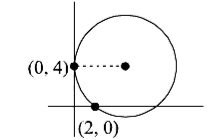 Equation of family of circle $(x - 0)^2 + (y - 4)^2 + \lambda x = 0$. Passes through (2, 0) gives $4 + 16 + 2\lambda = 0 \Rightarrow \lambda = -10$. Circle: $(x - 5)^2 + (y - 4)^2 = 25$. Centre (5, 4), $R = 5$. Perpendicular distance of $4x + 3y - 8 = 0$ from the centre $= |(20 + 12 - 8)/\sqrt{16 + 9}| = 24/5 \neq 5$. Hence, $4x + 3y - 8 = 0$ cannot be tangent.
Step Solution:
1. Set Circle Equation: A circle touching the y-axis at $(0, 4)$ has center $(r, 4)$ and radius $r$. Equation: $(x - r)^2 + (y - 4)^2 = r^2$.
2. Solve for Radius: Pass the circle through $(2, 0)$: $(2 - r)^2 + (0 - 4)^2 = r^2 \Rightarrow 4 + r^2 - 4r + 16 = r^2 \Rightarrow 4r = 20 \Rightarrow r = 5$.
3. Define Final Circle: Center $C(5, 4)$ and Radius $R = 5$.
4. Test Option D: Calculate distance from $C(5, 4)$ to $4x + 3y - 8 = 0$: $p = \frac{|4(5) + 3(4) - 8|}{\sqrt{4^2 + 3^2}} = \frac{24}{5} = 4.8$.
5. Verify Tangency: Since the distance $4.8$ is not equal to the radius $5$, the line in Option D is not a tangent.
The difficulty level: Medium
The Concept Name: Family of Circles and Perpendicular Distance Formula.
Short cut solution: Quickly determine the center $(5, 4)$ by recognizing it must be equidistant from $(0, 4)$ and $(2, 0)$. Test distances of each line from $(5, 4)$; the one not equaling 5 is the answer.
Question 330
Question: If a line, $y = mx + c$ is a tangent to the circle, $(x - 3)^2 + y^2 = 1$ and it is perpendicular to a line $L_1$, where $L_1$ is the tangent to the circle, $x^2 + y^2 = 1$ at the point $(1/\sqrt{2}, 1/\sqrt{2})$; then:
Options:
A. $c^2 - 7c + 6 = 0$
B. $c^2 + 7c + 6 = 0$
C. $c^2 + 6c + 7 = 0$
D. $c^2 - 6c + 7 = 0$
Correct Answer: C
Year: JEE Main Jan. 8, 2020 (II)
Solution (as Given in the Source): Slope of tangent of $x^2 + y^2 = 1$ at $(1/\sqrt{2}, 1/\sqrt{2})$ is $x/\sqrt{2} + y/\sqrt{2} = 1$, giving slope $-1$. Line $y = mx + c$ is perpendicular, so $m = 1$. Tangent is $y = x + c$. Distance of $(3, 0)$ from $x - y + c = 0$ is $1 \Rightarrow |c + 3|/\sqrt{2} = 1$. Squaring gives $c^2 + 6c + 7 = 0$.
Step Solution:
1. Find Slope of $L_1$: Tangent to $x^2 + y^2 = 1$ at $(x_1, y_1)$ is $xx_1 + yy_1 = 1$. At $(1/\sqrt{2}, 1/\sqrt{2})$, the slope is $-1$.
2. Determine $m$: The required line $y = mx + c$ is perpendicular to $L_1$, so $m \cdot (-1) = -1 \Rightarrow m = 1$.
3. Establish Tangency Condition: The line $x - y + c = 0$ must be distance $r=1$ from the center $(3, 0)$ of the circle $(x - 3)^2 + y^2 = 1$.
4. Form Equation: $\frac{|1(3) - 1(0) + c|}{\sqrt{1^2 + (-1)^2}} = 1 \Rightarrow \frac{|c + 3|}{\sqrt{2}} = 1$.
5. Derive Final Relation: Square both sides: $(c + 3)^2 = 2 \Rightarrow c^2 + 6c + 9 = 2 \Rightarrow c^2 + 6c + 7 = 0$.
The difficulty level: Medium
The Concept Name: Condition of Tangency and Slopes of Perpendicular Lines.
Short cut solution: For any circle $(x-h)^2+(y-k)^2=r^2$, the tangent with slope $m$ is $y-k = m(x-h) \pm r\sqrt{1+m^2}$. Here, $y-0 = 1(x-3) \pm 1\sqrt{2} \Rightarrow y = x - 3 \pm \sqrt{2}$. Thus $c = -3 \pm \sqrt{2}$. The quadratic with these roots is $(c+3)^2 = 2$.
Question 339
Question: If $3x + 4y = 12\sqrt{2}$ is a tangent to the ellipse $\frac{x^2}{a^2} + \frac{y^2}{9} = 1$ for some $a \in R$, then the distance between the foci of the ellipse is:
Options:
A. $2\sqrt{7}$
B. 4
C. $2\sqrt{5}$
D. $2\sqrt{2}$
Correct Answer: A
Year: JEE Main Jan. 7, 2020 (II)
Solution (as Given in the Source):
$3x + 4y = 12\sqrt{2} \Rightarrow 4y = -3x + 12\sqrt{2} \Rightarrow y = -\frac{3}{4}x + 3\sqrt{2}$. Now, condition of tangency, $c^2 = a^2m^2 + b^2$. $18 = a^2 \cdot \frac{9}{16} + 9 \Rightarrow a^2 \cdot \frac{9}{16} = 9 \Rightarrow a^2 = 16 \Rightarrow a = 4$. Eccentricity $e = \sqrt{\frac{1-b^2}{a^2}} = \sqrt{1-\frac{9}{16}} = \frac{\sqrt{7}}{4}$. $ae = \frac{\sqrt{7}}{4} \cdot 4 = \sqrt{7}$. Foci are $(\pm\sqrt{7}, 0)$. Distance between foci = $2\sqrt{7}$.
Step Solution:
1. Write tangent in slope form: Rearrange $3x + 4y = 12\sqrt{2}$ to $y = -\frac{3}{4}x + 3\sqrt{2}$. Here $m = -3/4$ and $c = 3\sqrt{2}$.
2. Apply tangency condition: Use $c^2 = a^2m^2 + b^2$ for ellipse with $b^2 = 9$. Equation: $(3\sqrt{2})^2 = a^2(-3/4)^2 + 9$.
3. Solve for $a^2$: $18 = a^2(9/16) + 9 \Rightarrow 9 = a^2(9/16) \Rightarrow a^2 = 16$.
4. Find focus parameter ($ae$): We know $(ae)^2 = a^2 - b^2$. Thus, $(ae)^2 = 16 - 9 = 7$.
5. Calculate distance: The distance between foci is $2ae$. $2 \cdot \sqrt{7} = 2\sqrt{7}$.
The difficulty level: Medium
The Concept Name: Condition of Tangency for an Ellipse ($c^2 = a^2m^2 + b^2$).
Short cut solution: Once $a^2=16$ and $b^2=9$ are found, the distance between foci is $2\sqrt{a^2 - b^2}$. Calculate $2\sqrt{16-9} = 2\sqrt{7}$ directly.
Question 347
Question: If the common tangent to the parabolas, $y^2 = 4x$ and $x^2 = 4y$ also touches the circle, $x^2 + y^2 = c^2$, then $c$ is equal to:
Options:
A. $2\sqrt{2}$
B. $\frac{1}{\sqrt{2}}$
C. $\frac{1}{4}$
D. $\frac{1}{2}$
Correct Answer: B
Year: JEE Main Sep. 05, 2020 (I)
Solution (as Given in the Source):
Equation tangent to parabola $y^2 = 4x$ with slope $m$ be: $y = mx + \frac{1}{m}$. Equation of tangent to $x^2 = 4y$ with slope $m$ be: $y = mx - am^2$. From these, $\frac{1}{m} = -m^2 \Rightarrow m^3 = -1 \Rightarrow m = -1$. Equation tangent: $x + y + 1 = 0$. It is tangent to circle $x^2 + y^2 = c^2 \Rightarrow c = \frac{1}{\sqrt{2}}$.
Step Solution:
1. Tangent to first parabola: For $y^2 = 4x$, $a=1$. The tangent is $y = mx + 1/m$.
2. Tangent to second parabola: For $x^2 = 4y$, let $x$ and $y$ swap roles; the tangent is $y = mx - m^2$.
3. Find common slope ($m$): Equate the constants: $1/m = -m^2 \Rightarrow m^3 = -1 \Rightarrow m = -1$.
4. Form line equation: Substitute $m=-1$ into $y=mx+1/m$ to get $y = -x - 1 \Rightarrow x + y + 1 = 0$.
5. Apply circle condition: The perpendicular distance from the circle's center $(0,0)$ to $x+y+1=0$ must equal the radius $c$: $c = \frac{|0+0+1|}{\sqrt{1^2+1^2}} = \frac{1}{\sqrt{2}}$.
The difficulty level: Hard
The Concept Name: Common Tangent to Conics and Condition of Tangency for a Circle ($p = r$).
Short cut solution: By symmetry, the common tangent to $y^2=4ax$ and $x^2=4ay$ is always $x+y+a=0$. Here $a=1$, so the line is $x+y+1=0$. The distance from origin to this line is $1/\sqrt{2}$, which is the radius $c$.
Question 359
Question: If the line $y = mx + c$ is a common tangent to the hyperbola $\frac{x^2}{100} - \frac{y^2}{64} = 1$ and the circle $x^2 + y^2 = 36$, then which one of the following is true?
Options:
A. $c^2 = 369$
B. $5m = 4$
C. $4c^2 = 369$
D. $8m + 5 = 0$
Correct Answer: C
Year: JEE Main Sep. 05, 2020 (II)
Solution (as Given in the Source):
General tangent to hyperbola is $y = mx \pm \sqrt{100m^2 - 64}$. Tangent to circle is $y = mx \pm 6\sqrt{1+m^2}$. For common tangent, $36(1+m^2) = 100m^2 - 64 \Rightarrow 100 = 64m^2 \Rightarrow m^2 = \frac{100}{64}$. $c^2 = 36(1 + \frac{100}{64}) = \frac{164 \times 36}{64} = \frac{369}{4} \Rightarrow 4c^2 = 369$.
Step Solution:
1. Hyperbola tangency condition: For $x^2/100 - y^2/64 = 1$, $c^2 = a^2m^2 - b^2 = 100m^2 - 64$.
2. Circle tangency condition: For $x^2 + y^2 = 36$, $c^2 = r^2(1+m^2) = 36(1+m^2)$.
3. Equate conditions: $100m^2 - 64 = 36m^2 + 36$.
4. Solve for $m^2$: $64m^2 = 100 \Rightarrow m^2 = 100/64 = 25/16$.
5. Find relationship for $c^2$: Substitute $m^2$ into circle condition: $c^2 = 36(1 + 25/16) = 36(41/16) = 9(41/4) = 369/4$. Multiplying by 4 gives $4c^2 = 369$.
The difficulty level: Medium
The Concept Name: Common Tangent to Conics (Hyperbola and Circle).
Short cut solution: Use the equality $a^2m^2 - b^2 = r^2 + r^2m^2$. For this problem: $100m^2 - 64 = 36 + 36m^2$. Directly calculate $m^2 = 100/64$ and plug into $c^2 = 36(1+m^2)$ to find the choice matching $c$.
Question 374
Question: The straight line $x + 2y = 1$ meets the coordinate axes at A and B. A circle is drawn through A, B and the origin. Then the sum of perpendicular distances from A and B on the tangent to the circle at the origin is:
Options:
A. $\frac{\sqrt{5}}{2}$
B. 2√5
C. $\frac{\sqrt{5}}{4}$
D. 4√5
Correct Answer: A
Year: Jan. 11, 2019 (I)
Solution (as Given in the Source): 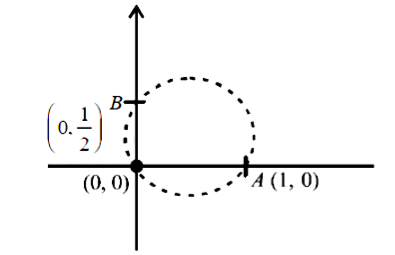 Let equation of circle be $x^2 + y^2 + 2gx + 2fy = 0$. As length of intercept on X axis is $1 = 2 \sqrt{g^2 - c} \Rightarrow |g| = 1/2$. length of intercept on y-axis $= 1/2 = 2 \sqrt{f^2 - c} \Rightarrow |f| = 1/4$. Equation of circle that passes through given points is $x^2 + y^2 - x - \frac{y}{2} = 0$. Tangent at (0,0) is, $(y - 0) = \left( \frac{dy}{dx} \right)_{(0,0)} (x - 0) \Rightarrow 2x + y = 0$. Sum of perpendicular distance $= \frac{1/2 + 2}{\sqrt{5}} = \frac{\sqrt{5}}{2}$.
Step Solution:
1. Find Points A and B: The line $x + 2y = 1$ intersects the X-axis at $A(1, 0)$ and the Y-axis at $B(0, 1/2)$.
2. Define Circle Equation: A circle through the origin and points on the axes has the form $x^2 + y^2 - x_A x - y_B y = 0$. Here, $x^2 + y^2 - x - \frac{1}{2}y = 0$.
3. Determine Tangent at Origin: Using the point form $xx_1 + yy_1 + g(x+x_1) + f(y+y_1) = 0$ at $(0,0)$, the tangent is $-\frac{1}{2}x - \frac{1}{4}y = 0$, which simplifies to $2x + y = 0$.
4. Calculate Individual Distances: Distance of $A(1, 0)$ from $2x + y = 0$ is $d_1 = \frac{2}{\sqrt{5}}$. Distance of $B(0, 1/2)$ is $d_2 = \frac{1/2}{\sqrt{5}} = \frac{1}{2\sqrt{5}}$.
5. Sum of Distances: $\frac{2}{\sqrt{5}} + \frac{1}{2\sqrt{5}} = \frac{4+1}{2\sqrt{5}} = \frac{5}{2\sqrt{5}} = \frac{\sqrt{5}}{2}$.
The difficulty level: Medium
The Concept Name: Condition of Tangency and Perpendicular Distance from a Point to a Line.
Short cut solution: In a circle passing through $O, (a, 0), (0, b)$, the tangent at origin is $ax + by = 0$. The sum of distances from $(a, 0)$ and $(0, b)$ to $ax + by = 0$ is $\frac{|a^2| + |b^2|}{\sqrt{a^2 + b^2}} = \sqrt{a^2 + b^2}$. Here, $\sqrt{1^2 + (1/2)^2} = \sqrt{5/4} = \sqrt{5}/2$.
Question 381
Question: Equation of a common tangent to the circle, $x^2 + y^2 - 6x = 0$ and the parabola, $y^2 = 4x$, is :
Options:
A. $2\sqrt{3}y = 12x + 1$
B. $\sqrt{3}y = x + 3$
C. $2\sqrt{3}y = -x - 12$
D. $\sqrt{3}y = 3x + 1$
Correct Answer: B
Year: Jan 09, 2019 (I)
Solution (as Given in the Source): Equation of tangent to parabola $y^2 = 4x$ is $y = mx + 1/m$. Circle: $(x - 3)^2 + y^2 = 9$. Perpendicular distance from centre $(3, 0)$ to tangent is $3 \Rightarrow |3m + 1/m| / \sqrt{1 + m^2} = 3 \Rightarrow m^2 = 1/3$. Tangent: $\sqrt{3}y = x + 3$.
Step Solution:
1. Form Parabola Tangent: For $y^2 = 4x$ ($a=1$), the tangent in slope form is $y = mx + 1/m \Rightarrow m^2x - my + 1 = 0$.
2. Analyze Circle: $x^2 + y^2 - 6x = 0$ simplifies to $(x - 3)^2 + y^2 = 3^2$, with center $(3, 0)$ and radius $r = 3$.
3. Apply Tangency Condition: Perpendicular distance from $(3, 0)$ to $m^2x - my + 1 = 0$ must equal 3: $\frac{|3m^2 + 1|}{\sqrt{m^4 + m^2}} = 3$.
4. Solve for Slope: Square both sides: $(3m^2 + 1)^2 = 9(m^4 + m^2) \Rightarrow 9m^4 + 6m^2 + 1 = 9m^4 + 9m^2 \Rightarrow 3m^2 = 1 \Rightarrow m = 1/\sqrt{3}$.
5. Final Equation: Substitute $m = 1/\sqrt{3}$ into $y = mx + 1/m$ to get $y = \frac{x}{\sqrt{3}} + \sqrt{3} \Rightarrow \sqrt{3}y = x + 3$.
The difficulty level: Medium
The Concept Name: Common Tangent to Conics and Condition of Tangency ($p = r$).
Short cut solution: Check the options by calculating the distance from the circle center $(3, 0)$ to each line. For Option B ($\sqrt{3}y - x - 3 = 0$), $d = \frac{|\sqrt{3}(0) - 3 - 3|}{\sqrt{3 + 1}} = \frac{6}{2} = 3$. Since distance equals radius, Option B is a tangent to the circle.
Question 398
Question: If a tangent to the circle $x^2 + y^2 = 1$ lintersects the coordinate axes at distinct points P and Q, then the locus of the midpoint of PQ is:
Options:
A. $x^2 + y^2 - 4x^2y^2 = 0$
B. $x^2 + y^2 - 2xy = 0$
C. $x^2 + y^2 - 16x^2y^2 = 0$
D. $x^2 + y^2 - 2x^2y^2 = 0$
Correct Answer: A
Year: April 09, 2019 (I)
Solution (as Given in the Source): Let any tangent be $x \cos \theta + y \sin \theta = 1$. Points are $P(1/\cos \theta, 0)$ and $Q(0, 1/\sin \theta)$. Midpoint $M(h, k) = (1/2\cos \theta, 1/2\sin \theta)$. $\cos \theta = 1/2h, \sin \theta = 1/2k$. Adding squares gives $1/h^2 + 1/k^2 = 4 \Rightarrow x^2 + y^2 = 4x^2y^2$.
Step Solution:
1. Define Tangent: Let the equation of the tangent at point $(\cos\theta, \sin\theta)$ be $x \cos\theta + y \sin\theta = 1$.
2. Identify P and Q: Setting $y = 0$ gives $P(1/\cos\theta, 0)$; setting $x = 0$ gives $Q(0, 1/\sin\theta)$.
3. Set Midpoint Coordinates: Let the midpoint be $(h, k)$. $h = 1/(2\cos\theta)$ and $k = 1/(2\sin\theta)$.
4. Isolate Trigonometric Terms: $\cos\theta = 1/(2h)$ and $\sin\theta = 1/(2k)$.
5. Establish Locus: Use $\cos^2\theta + \sin^2\theta = 1 \Rightarrow \frac{1}{4h^2} + \frac{1}{4k^2} = 1 \Rightarrow \frac{h^2 + k^2}{4h^2k^2} = 1 \Rightarrow x^2 + y^2 = 4x^2y^2$.
The difficulty level: Easy
The Concept Name: Locus of a Point and Tangent to a Circle (Parametric Form).
Short cut solution: For circle $x^2 + y^2 = r^2$, the locus of the midpoint of the portion of the tangent intercepted between the axes is $\frac{1}{x^2} + \frac{1}{y^2} = \frac{4}{r^2}$. With $r = 1$, this gives $\frac{x^2 + y^2}{x^2y^2} = 4 \Rightarrow x^2 + y^2 = 4x^2y^2$.
Question 403
Question: If the line $ax + y = c$, touches both the curves $x^2 + y^2 = 1$ and $y^2 = 4\sqrt{2}x$, then $|c|$ is equal to:
Options:
A. 2
B. $1/\sqrt{2}$
C. $1/2$
D. $\sqrt{2}$
Correct Answer: D
Year: April 09, 2019 (II)
Solution (as Given in the Source):
Equation of tangent on $y^2 = 4\sqrt{2}x$ is $yt = x + \sqrt{2}t^2$. This is also tangent on circle $\therefore | \frac{\sqrt{2}t^2}{\sqrt{1+t^2}} | = 1 \Rightarrow 2t^4 = 1 + t^2 \Rightarrow t^2 = 1$. Hence, equation is $\pm y = x + \sqrt{2} \Rightarrow |c| = \sqrt{2}$.
Step Solution:
1. Parabola Tangent: For $y^2 = 4\sqrt{2}x$, the parameter $4a = 4\sqrt{2} \Rightarrow a = \sqrt{2}$. A tangent with slope $m$ is $y = mx + \frac{\sqrt{2}}{m}$.
2. Match with Given Line: The given line is $y = -ax + c$. Comparing this to the tangent form, $m = -a$ and $c = \frac{\sqrt{2}}{m}$.
3. Circle Tangency Condition: A line $y = mx + c$ touches $x^2 + y^2 = 1$ if $c^2 = r^2(1 + m^2)$. Here $r=1$, so $c^2 = 1 + m^2$.
4. Form Equation in $m$: Substitute $c = \frac{\sqrt{2}}{m}$ into the condition: $(\frac{\sqrt{2}}{m})^2 = 1 + m^2 \Rightarrow \frac{2}{m^2} = 1 + m^2 \Rightarrow m^4 + m^2 - 2 = 0$.
5. Solve for $c$: Solving the quadratic $(m^2 + 2)(m^2 - 1) = 0$ gives $m^2 = 1$. Substitute back into the circle condition: $c^2 = 1 + 1 = 2 \Rightarrow |c| = \sqrt{2}$.
The difficulty level: Medium
The Concept Name: Condition of Tangency for Circle and Parabola.
Short cut solution: Use the property that for $y^2 = 4ax$, the tangent is $y = mx + a/m$. Set the origin distance of this line equal to the circle radius $r$: $\frac{|a/m|}{\sqrt{1+m^2}} = r$. Here $\frac{\sqrt{2}}{|m|\sqrt{1+m^2}} = 1 \Rightarrow 2 = m^2(1+m^2)$, clearly $m^2=1$. Thus $c^2 = 1+1=2$.
Question 404
Question: The area (in sq. units) of the smaller of the two circles that touch the parabola, $y^2 = 4x$ at the point (1,2) and the X-axis is:
Options:
A. $8\pi(2 - \sqrt{2})$
B. $4\pi(2 - \sqrt{2})$
C. $4\pi(3 + \sqrt{2})$
D. $8\pi(3 - 2\sqrt{2})$
Correct Answer: D
Year: April 09, 2019 (I)
Solution (as Given in the Source):
The circle and parabola will have common tangent at P (1, 2). Equation of tangent: $y = x + 1$. Family of circles: $(x-1)^2 + (y-2)^2 + \lambda(x - y + 1) = 0$. Since circle touches X-axis, y-coordinate of center = radius. Solving gives $\lambda = 4 \pm 4\sqrt{2}$. Smaller circle radius is $4 - 2\sqrt{2}$. Area $= \pi(4 - 2\sqrt{2})^2 = 8\pi(3 - 2\sqrt{2})$.
Step Solution:
1. Find Tangent: At $P(1, 2)$, the tangent to $y^2 = 4x$ is $y(2) = 2(x+1) \Rightarrow x - y + 1 = 0$.
2. Setup Family of Circles: Circles touching the line at $P(1, 2)$ follow $(x-1)^2 + (y-2)^2 + \lambda(x - y + 1) = 0$. Expanded: $x^2 + y^2 + x(\lambda - 2) + y(-\lambda - 4) + (\lambda + 5) = 0$.
3. X-axis Tangency Condition: A circle touches the X-axis if $g^2 = c$. Here $g = \frac{\lambda - 2}{2}$ and $c = \lambda + 5$. So, $(\frac{\lambda - 2}{2})^2 = \lambda + 5 \Rightarrow \lambda^2 - 4\lambda + 4 = 4\lambda + 20 \Rightarrow \lambda^2 - 8\lambda - 16 = 0$.
4. Solve for Radius: $\lambda = \frac{8 \pm \sqrt{64 + 64}}{2} = 4 \pm 4\sqrt{2}$. The radius $r$ is the y-coordinate of the center: $|f| = |\frac{-\lambda - 4}{2}|$. For the smaller circle, use $\lambda = 4 - 4\sqrt{2}$, giving $r = |\frac{-(4-4\sqrt{2}) - 4}{2}| = |2\sqrt{2} - 4| = 4 - 2\sqrt{2}$.
5. Calculate Area: $Area = \pi r^2 = \pi(4 - 2\sqrt{2})^2 = \pi(16 + 8 - 16\sqrt{2}) = \pi(24 - 16\sqrt{2}) = 8\pi(3 - 2\sqrt{2})$.
The difficulty level: Hard
The Concept Name: Family of Circles ($S + \lambda T = 0$) and Condition for Circle touching X-axis.
Short cut solution: The center of the circle must lie on the normal to the parabola at (1, 2), which is $x + y = 3$. If the center is $(h, k)$, then $h + k = 3 \Rightarrow h = 3 - k$. Since it touches the X-axis, the radius is $k$. The distance from $(3-k, k)$ to the point $(1,2)$ must be $k$. Solve $\sqrt{(3-k-1)^2 + (k-2)^2} = k$ to find $k = 4 \pm 2\sqrt{2}$. Choose the smaller radius $4 - 2\sqrt{2}$.
Question 413
Question: If the tangent to the parabola $y^2 = x$ at a point $(\alpha, \beta), (\beta > 0)$ is also a tangent to the ellipse, $x^2 + 2y^2 = 1$, then $\alpha$ is equal to:
Options:
A. $\sqrt{2} - 1$
B. $2\sqrt{2} - 1$
C. $2\sqrt{2} + 1$
D. $\sqrt{2} + 1$
Correct Answer: D
Year: April 09, 2019 (II)
Solution (as Given in the Source):
Let tangent to parabola at point $(\frac{1}{4m^2}, -\frac{1}{2m})$ is $y = mx + \frac{1}{4m}$ and tangent to ellipse is $y = mx \pm \sqrt{m^2 + \frac{1}{2}}$. Now, condition for common tangency: $\frac{1}{4m} = \pm \sqrt{m^2 + \frac{1}{2}} \Rightarrow \frac{1}{16m^2} = m^2 + \frac{1}{2} \Rightarrow 16m^4 + 8m^2 - 1 = 0$. Solving gives $m^2 = \frac{\sqrt{2}-1}{4}$. Then $\alpha = \frac{1}{4m^2} = \sqrt{2} + 1$.
Step Solution:
1. Parabola Tangent: For $y^2 = x$, $4a = 1 \Rightarrow a = 1/4$. The tangent in slope form is $y = mx + \frac{1}{4m}$.
2. Ellipse Tangent: For $x^2 + 2y^2 = 1 \Rightarrow \frac{x^2}{1} + \frac{y^2}{1/2} = 1$, the tangent is $y = mx \pm \sqrt{1 \cdot m^2 + 1/2}$.
3. Equate Constants: Set the $y$-intercepts equal: $\frac{1}{4m} = \pm \sqrt{m^2 + 1/2}$. Squaring both sides yields $\frac{1}{16m^2} = m^2 + \frac{1}{2}$.
4. Solve for $m^2$: Multiply by $16m^2$ to get $16m^4 + 8m^2 - 1 = 0$. Using the quadratic formula, $m^2 = \frac{-8 + \sqrt{64 + 64}}{32} = \frac{8\sqrt{2} - 8}{32} = \frac{\sqrt{2}-1}{4}$.
5. Calculate $\alpha$: For a parabola $y^2 = 4ax$, the point of contact $(\alpha, \beta)$ is $(\frac{a}{m^2}, \frac{2a}{m})$. Thus, $\alpha = \frac{1/4}{(\sqrt{2}-1)/4} = \frac{1}{\sqrt{2}-1} = \sqrt{2} + 1$.
The difficulty level: Medium
The Concept Name: Condition for Common Tangent.
Short cut solution: Use the parametric point $(\alpha = at^2, \beta = 2at)$ for the parabola. The tangent is $ty = x + at^2$. Divide by $t$: $y = \frac{1}{t}x + \frac{t}{4}$. Substitute $m = 1/t$ and $c = t/4$ into the ellipse condition $c^2 = a^2m^2 + b^2$ to solve for $t$ directly.
Question 416
Question: The equation of a common tangent to the curves, $y^2 = 16x$ and $xy = -4$, is :
Options:
A. $x - y + 4 = 0$
B. $x + y + 4 = 0$
C. $x - 2y + 16 = 0$
D. $2x - y + 2 = 0$
Correct Answer: A
Year: April 12, 2019 (II)
Solution (as Given in the Source):
Equation of tangent to the parabola $y^2 = 16x$ is $y = mx + \frac{4}{m}$. Since this is a common tangent, put it into $xy = -4$. $x(mx + \frac{4}{m}) + 4 = 0 \Rightarrow mx^2 + \frac{4}{m}x + 4 = 0$. Setting Discriminant $D = 0$ gives $\frac{16}{m^2} = 16m \Rightarrow m^3 = 1 \Rightarrow m = 1$. The tangent is $y = x + 4$.
Step Solution:
1. Form Parabola Tangent: For $y^2 = 16x$, $a = 4$. The tangent with slope $m$ is $y = mx + 4/m$.
2. Combine Equations: Substitute the expression for $y$ into the hyperbola $xy = -4$: $x(mx + 4/m) = -4$.
3. Form Quadratic: Rearrange to obtain a quadratic in $x$: $mx^2 + \frac{4}{m}x + 4 = 0$.
4. Apply Tangency Condition: For a line to touch a curve, the resulting quadratic must have equal roots ($D = 0$). Thus, $(\frac{4}{m})^2 - 4(m)(4) = 0$.
5. Identify $m$ and Line: $\frac{16}{m^2} = 16m \Rightarrow m^3 = 1 \Rightarrow m = 1$. Substituting back into the tangent formula: $y = 1x + 4/1 \Rightarrow x - y + 4 = 0$.
The difficulty level: Medium
The Concept Name: Common Tangent to Conics.
Short cut solution: For a rectangular hyperbola $xy = c^2$, the tangent with slope $m$ is $y = mx \pm 2c\sqrt{-m}$. Here $c^2 = -4$, so $c = 2i$. Tangent is $y = mx \pm 4\sqrt{m}$. Equating this to the parabola tangent $4/m$ for $m=1$ confirms the answer immediately.
Question 424
Question: The tangent to the circle $C_1 : x^2 + y^2 - 2x - 1 = 0$ at the point (2,1) cuts off a chord of length 4 from a circle $C_2$ whose centre is (3,-2). The radius of $C_2$ is:
Options:
A. $\sqrt{6}$
B. 2
C. $\sqrt{2}$
D. 3
Correct Answer: A
Year: Online April 15, 2018
Solution (as Given in the Source):
Equation of tangent on $C_1$ at (2,1) is $2x + y - (x + 2) - 1 = 0$, or $x + y = 3$. Distance of the chord from center (3, -2) is $d = |\frac{3 - 2 - 3}{\sqrt{2}}| = \sqrt{2}$. Chord length $l = 4$. Radius of $C_2 = r = \sqrt{(l/2)^2 + d^2} = \sqrt{2^2 + (\sqrt{2})^2} = \sqrt{6}$.
Step Solution:
1. Find Tangent Equation: Using the point form $xx_1 + yy_1 + g(x+x_1) + f(y+y_1) + c = 0$ at (2, 1) for $C_1$ ($g = -1, f = 0, c = -1$): $2x + y - 1(x+2) - 1 = 0 \Rightarrow x + y = 3$.
2. Center of $C_2$: The center is given as $(3, -2)$.
3. Perpendicular Distance ($d$): Calculate the distance from $(3, -2)$ to the tangent $x + y - 3 = 0$: $d = \frac{|3 + (-2) - 3|}{\sqrt{1^2 + 1^2}} = \frac{2}{\sqrt{2}} = \sqrt{2}$.
4. Use Chord Property: The radius ($r$), distance ($d$), and chord length ($L$) form a right triangle where $r^2 = d^2 + (L/2)^2$.
5. Calculate Radius: Given $L = 4$, $r^2 = (\sqrt{2})^2 + (2)^2 = 2 + 4 = 6$. Thus, $r = \sqrt{6}$.
The difficulty level: Medium
The Concept Name: Radius-Chord-Distance Relationship.
Short cut solution: In circle geometry, if a line $x+y=3$ is a chord to a circle centered at $(3,-2)$, the distance squared is simply $((x+y)_{center} - Constant)^2 / 2 = (1-3)^2/2 = 2$. Add $(Chord/2)^2 = 4$ to get $r^2 = 6$.
Question 439
Question: If the common tangents to the parabola, $x^2 = 4y$ and the circle, $x^2 + y^2 = 4$ intersect at the point P, then the distance of P from the origin, is :
Options:
A. $\sqrt{2} + 1$
B. $2(3 + 2\sqrt{2})$
C. $2(\sqrt{2} + 1)$
D. $3 + 2\sqrt{2}$
Correct Answer: C
Year: Online April 8, 2017
Solution (as Given in the Source): Tangent to $x^2 + y^2 = 4$ is $y = mx \pm 2\sqrt{1 + m^2}$. Also, for $x^2 = 4y$, the tangent is $x^2 = 4mx - 8\sqrt{1+m^2}$ or $x^2 = 4mx + 8\sqrt{1+m^2}$. For $D = 0$ we have; $16m^2 + 4.8\sqrt{1+m^2} = 0$, which yields $m^2 = 2 + 2\sqrt{2}$.
Step Solution:
1. Identify Parabola Tangent: For $x^2 = 4y$, $a=1$. The tangent with slope $m$ is $y = mx - m^2$.
2. Identify Circle Tangent: For $x^2 + y^2 = 4$, the tangent is $y = mx \pm 2\sqrt{1+m^2}$.
3. Equate Conditions: For a common tangent, $-m^2 = \pm 2\sqrt{1+m^2}$.
4. Solve for $m^2$: Square both sides: $m^4 = 4(1+m^2) \Rightarrow m^4 - 4m^2 - 4 = 0$. By quadratic formula, $m^2 = \frac{4 \pm \sqrt{16+16}}{2} = 2 + 2\sqrt{2}$ (taking positive value).
5. Find Distance: The tangents intersect at $P(0, -m^2)$. The distance from origin is $|-m^2| = 2 + 2\sqrt{2} = 2(\sqrt{2}+1)$.
The difficulty level: Hard
The Concept Name: Common Tangent to Conics.
Short cut solution: Use the specific condition for $x^2=4ay$ and $x^2+y^2=r^2$ common tangents: the $y$-intercept of the parabola tangent must equal the radius distance from the origin, i.e., $|-am^2|/\sqrt{1+m^2} = r$.
Question 450
Question: Equation of the tangent to the circle, at the point (1,-1) whose centre is the point of intersection of the straight lines $x - y = 1$ and $2x + y = 3$ is:
Options:
A. $x + 4y + 3 = 0$
B. $3x - y - 4 = 0$
C. $x - 3y - 4 = 0$
D. $4x + y - 3 = 0$
Correct Answer: A
Year: Online April 10, 2016
Solution (as Given in the Source): 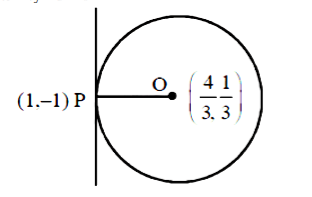 Point of intersection of lines $x - y = 1$ and $2x + y = 3$ is $(4/3, 1/3)$. Slope of OP (radius) is 4. Slope of tangent $= -1/4$. Equation of tangent $y + 1 = -1/4(x - 1)$.
Step Solution:
1. Find Center: Solve $x - y = 1$ and $2x + y = 3$ simultaneously. Adding them gives $3x = 4 \Rightarrow x = 4/3$; substituting back gives $y = 1/3$. Center $C = (4/3, 1/3)$.
2. Calculate Radius Slope: The slope of the radius joining $(4/3, 1/3)$ and $(1, -1)$ is $m_r = \frac{1/3 - (-1)}{4/3 - 1} = \frac{4/3}{1/3} = 4$.
3. Find Tangent Slope: Since the tangent is perpendicular to the radius, $m_t = -1/m_r = -1/4$.
4. Form Equation: Use point-slope form with point $(1, -1)$: $y - (-1) = -1/4(x - 1)$.
5. Simplify: $4(y + 1) = -(x - 1) \Rightarrow 4y + 4 = -x + 1 \Rightarrow x + 4y + 3 = 0$.
The difficulty level: Medium
The Concept Name: Intersection of Lines and Tangent Property of Circles.
Short cut solution: Quickly determine the center $(4/3, 1/3)$ and observe that the line $x+4y+3=0$ is the only option with slope $-1/4$ that passes through $(1, -1)$.
Question 472
Question: The slope of the line touching both the parabolas $y^2 = 4x$ and $x^2 = -32y$ is:
Options:
A. $1/8$
B. $2/3$
C. $1/2$
D. $3/2$
Correct Answer: C
Year: 2014
Solution (as Given in the Source): Equation of tangent of parabola (1) $y = mx + 1/m$. Equation of tangent of parabola (2) $y = mx + 8m^2$. These are identical, so $1/m = 8m^2 \Rightarrow m^3 = 1/8 \Rightarrow m = 1/2$.
Step Solution:
1. Parameters: For $y^2 = 4x$, $a_1 = 1$. For $x^2 = -32y$, $4a_2 = -32 \Rightarrow a_2 = -8$.
2. Tangent 1: Slope form tangent for $y^2 = 4a_1x$ is $y = mx + a_1/m \Rightarrow y = mx + 1/m$.
3. Tangent 2: Slope form tangent for $x^2 = 4a_2y$ is $y = mx - a_2m^2 \Rightarrow y = mx - (-8)m^2 = mx + 8m^2$.
4. Equate Slopes: Since it is a common tangent, $1/m = 8m^2$.
5. Solve: $m^3 = 1/8 \Rightarrow m = 1/2$.
The difficulty level: Medium
The Concept Name: Common Tangent to Parabolas.
Short cut solution: For parabolas $y^2 = 4a_1x$ and $x^2 = 4a_2y$, the slope of the common tangent is given by $m = (a_1 / -a_2)^{1/3}$. Here, $m = (1 / 8)^{1/3} = 1/2$.
Question 488
Question: Given: A circle, $2x^2 + 2y^2 = 5$ and a parabola, $y^2 = 4\sqrt{5}x$.
Statement-1: An equation of a common tangent to these curves is $y = x + \sqrt{5}$.
Statement-2: If the line, $y = mx + \frac{\sqrt{5}}{m} (m \neq 0)$ is their common tangent, then $m$ satisfies $m^4 - 3m^2 + 2 = 0$.
Options:
A. Statement-1 is true; Statement-2 is true; Statement-2 is a correct explanation for Statement-1.
B. Statement-1 is true; Statement-2 is true; Statement-2 is not a correct explanation for Statement-1.
C. Statement-1 is true; Statement-2 is false.
D. Statement-1 is false; Statement-2 is true.
Correct Answer: B
Year: JEE Main 2013 (Inferred from context)
Solution (as Given in the Source): Let common tangent be $y = mx + \frac{\sqrt{5}}{m}$. Since, perpendicular distance from centre of the circle to the common tangent is equal to radius of the circle, $\frac{\frac{\sqrt{5}}{m}}{\sqrt{1 + m^2}} = \sqrt{\frac{5}{2}}$. On squaring both the side, we get $m^2(1 + m^2) = 2 \Rightarrow m^4 + m^2 - 2 = 0 \Rightarrow (m^2 + 2)(m^2 - 1) = 0 \Rightarrow m = \pm 1$. $y = \pm(x + \sqrt{5})$, both statements are correct as $m = \pm 1$ satisfies the given equation of statement-2.
Step Solution:
1. Identify Parameters: For parabola $y^2 = 4\sqrt{5}x$, $a = \sqrt{5}$. For circle $x^2 + y^2 = 5/2$, radius $r = \sqrt{5/2}$ and center is $(0,0)$.
2. Form Tangent Equation: The tangent to the parabola with slope $m$ is $y = mx + \frac{\sqrt{5}}{m}$.
3. Apply Circle Condition: For this line to touch the circle, the distance from $(0,0)$ must equal $r$: $\frac{|\sqrt{5}/m|}{\sqrt{m^2 + 1}} = \sqrt{\frac{5}{2}}$.
4. Solve for $m$: Square both sides: $\frac{5}{m^2(m^2 + 1)} = \frac{5}{2} \Rightarrow 2 = m^4 + m^2 \Rightarrow m^4 + m^2 - 2 = 0$. Solving gives $m^2 = 1 \Rightarrow m = \pm 1$.
5. Evaluate Statements: For $m=1$, tangent is $y = x + \sqrt{5}$ (Statement-1 is true). $m=1$ also satisfies $m^4 - 3m^2 + 2 = 0$ ($1-3+2=0$), so Statement-2 is true, but the actual condition derived was $m^4+m^2-2=0$.
The difficulty level: Medium
The Concept Name: Common Tangent to Conics.
Short cut solution: Use $c^2 = r^2(1+m^2)$ for the circle and $c = a/m$ for the parabola. Equate them: $(a/m)^2 = r^2(1+m^2)$. Here $5/m^2 = 2.5(1+m^2) \Rightarrow 2 = m^2 + m^4$.
Question 504
Question: Statement 1: $y = mx - \frac{1}{m}$ is always a tangent to the parabola, $y^2 = -4x$ for all non-zero values of $m$.
Statement 2: Every tangent to the parabola, $y^2 = -4x$ will meet its axis at a point whose abscissa is non-negative.
Options:
A. Statement 1 is true, Statement 2 is true; Statement 2 is a correct explanation of Statement 1.
B. Statement 1 is false, Statement 2 is true.
C. Statement 1 is true, Statement 2 is false.
D. Statement 1 is true, Statement 2 is true, Statement 2 is not a correct explanation of Statement 1.
Correct Answer: D
Year: Online May 7, 2012
Solution (as Given in the Source): Both the given statements are true. Statement-2 is not the correct explanation for statement-1.
Step Solution:
1. Parabola Standard Form: For $y^2 = 4ax$, the tangent equation is $y = mx + a/m$.
2. Find 'a': For the given parabola $y^2 = -4x$, $4a = -4 \Rightarrow a = -1$.
3. Verify Statement 1: Substituting $a = -1$ into the tangent formula: $y = mx + (-1)/m = mx - 1/m$. Thus, Statement 1 is true.
4. Find Axis Intersection: The axis of the parabola $y^2 = -4x$ is the x-axis ($y = 0$).
5. Verify Statement 2: Set $y = 0$ in the tangent equation: $0 = mx - 1/m \Rightarrow mx = 1/m \Rightarrow x = 1/m^2$. Since $m^2 > 0$ for any non-zero $m$, the abscissa $x$ is always positive (non-negative). Statement 2 is true.
The difficulty level: Easy
The Concept Name: Equation of Tangent to a Parabola.
Short cut solution: For any parabola $y^2 = 4ax$, the tangent $y = mx + a/m$ intersects the axis ($y=0$) at $x = -a/m^2$. Since $a = -1$ here, $x = -(-1)/m^2 = 1/m^2$, which is always $\geq 0$.
Question 522
Question: The equation of a tangent to the parabola $y^2 = 8x$ is $y = x + 2$. The point on this line from which the other tangent to the parabola is perpendicular to the given tangent is
Options:
A. (2,4)
B. (-2,0)
C. (-1,1)
D. (0,2)
Correct Answer: B
Year: 2007
Solution (as Given in the Source): The locus of point of intersection of two perpendicular tangents to a parabola is its directrix. Point must be on the directrix of parabola. Equation of directrix: $x + 2 = 0 \Rightarrow x = -2$. Hence the point is (-2,0).
Step Solution:
1. Identify Parabola Parameters: For $y^2 = 8x$, it is in the form $y^2 = 4ax$ where $4a = 8$, so $a = 2$.
2. Use Perpendicular Tangent Property: A fundamental property of parabolas is that the locus of the intersection of two perpendicular tangents is the directrix of the parabola.
3. Determine Directrix Equation: For the parabola $y^2 = 4ax$, the directrix is $x = -a$. Given $a = 2$, the directrix is $x = -2$.
4. Establish Point Location: Since the intersection point of the perpendicular tangents must lie on the directrix, the x-coordinate of the required point must be $-2$.
5. Substitute into Tangent Line: The point also lies on the given tangent $y = x + 2$. Substituting $x = -2$ gives $y = -2 + 2 = 0$. Thus, the point is $(-2, 0)$.
The difficulty level: Easy
The Concept Name: Locus of Perpendicular Tangents (Directrix Property).
Short cut solution: The point where two perpendicular tangents meet always lies on the directrix. For $y^2 = 8x$, the directrix is $x = -2$. Looking at the options, only Option B has an x-coordinate of $-2$.
Question 549
Question: Two common tangents to the circle $x^2 + y^2 = 2a^2$ and parabola $y^2 = 8ax$ are
Options:
A. $x = \pm(y + 2a)$
B. $y = \pm(x + 2a)$
C. $x = \pm(y + a)$
D. $y = \pm(x + a)$
Correct Answer: B
Year: 2002
Solution (as Given in the Source): The equation of any tangent to the parabola $y^2 = 8ax$ is $y = mx + 2a/m$.
Step Solution:
1. Form Parabola Tangent: For the parabola $y^2 = 8ax$, the focal parameter is $2a$ (since $4 \cdot 2a = 8a$). The tangent in slope form is $y = mx + \frac{2a}{m}$.
2. Set Circle Tangency Condition: For a line $mx - y + \frac{2a}{m} = 0$ to be tangent to the circle $x^2 + y^2 = 2a^2$, its distance from the origin $(0,0)$ must equal the radius $r = \sqrt{2a^2} = a\sqrt{2}$.
3. Apply Distance Formula: $\frac{|m(0) - 0 + 2a/m|}{\sqrt{m^2 + 1}} = a\sqrt{2} \Rightarrow \frac{2a}{|m|\sqrt{m^2+1}} = a\sqrt{2}$.
4. Solve for $m$: Simplifying yields $m^2(m^2 + 1) = 2 \Rightarrow m^4 + m^2 - 2 = 0$. This quadratic in $m^2$ factorizes to $(m^2 + 2)(m^2 - 1) = 0$. Since $m^2$ must be positive, $m^2 = 1 \Rightarrow m = \pm 1$.
5. Identify Tangent Equations: Substituting $m = 1$ gives $y = x + 2a$. Substituting $m = -1$ gives $y = -x - 2a$, or $y = -(x + 2a)$. Combined, these are $y = \pm(x + 2a)$.
The difficulty level: Medium
The Concept Name: Condition of Common Tangency.
Short cut solution: Use the tangency condition equality: $(A/m)^2 = r^2(1+m^2)$. For this problem, $(2a/m)^2 = 2a^2(1+m^2) \Rightarrow 4a^2/m^2 = 2a^2(1+m^2) \Rightarrow 2/m^2 = 1+m^2$. It is clear by inspection that $m^2 = 1$. The $y$-intercept is $2a/m = \pm 2a$. Tangent: $y = \pm x \pm 2a$, which matches $y = \pm(x + 2a)$.