Haloalkanes and Haloarenes


KI in acetone, undergoes SN2 reaction with each of P, Q, R and S. The rates of the reaction vary as


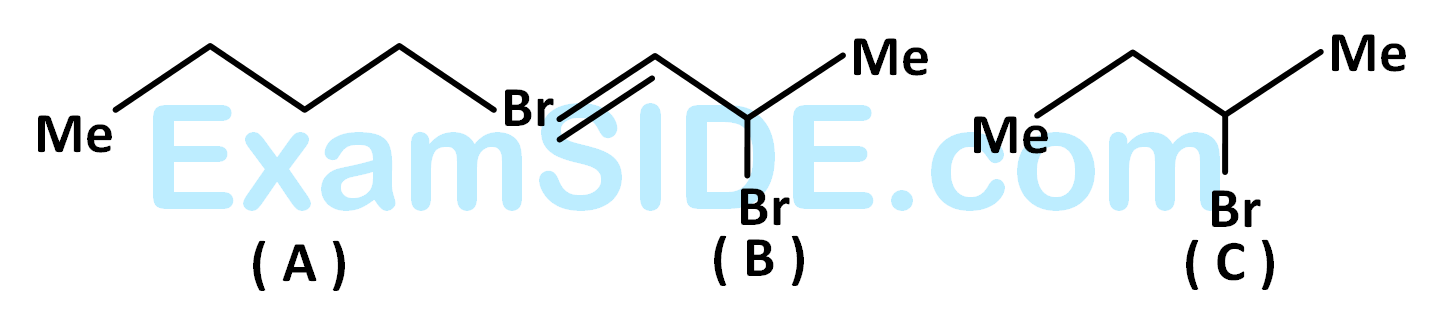
The correct order of ${S_N}1$ reactive is


The correct statement(s) about the compound given below is(are):


The major product of the following reaction is:


Statement 1 : Bromobenzene upon reaction with Br$_2$/Fe gives 1, 4-dibromobenzene as the major product.
and
Statement 2: In bromobenzene, the inductive effect of the bromo group is more dominant than the mesomeric effect in directing the incoming electrophile.


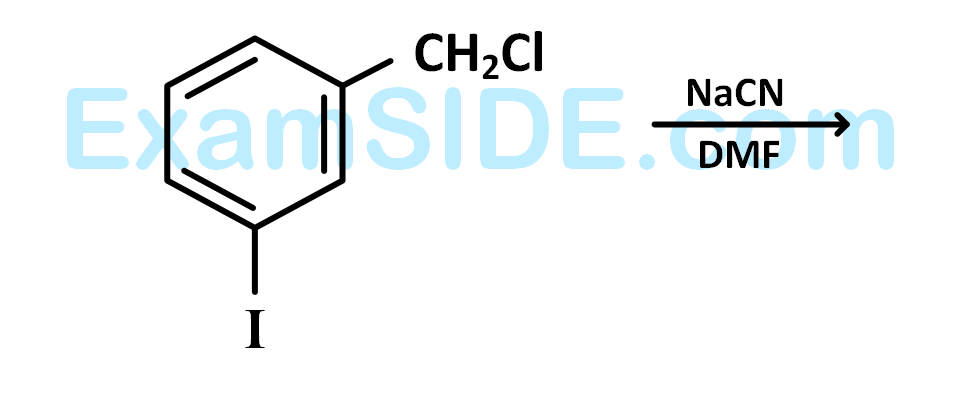
is


 Hughes and Ingold proposed that bimolecular elimination
reactions take place when the two groups to be eliminated are
trans and lie in one plane with the two carbon atoms to which
they are attached i.e. E2 reactions are stereoselectively trans.
Hughes and Ingold proposed that bimolecular elimination
reactions take place when the two groups to be eliminated are
trans and lie in one plane with the two carbon atoms to which
they are attached i.e. E2 reactions are stereoselectively trans.

Give reasons :


Explanation:
(A) (i) When (2-bromopropan-2-yl)benzene on reaction with aqueous ethanol, an ether is formed by replacement of bromide ion by ethoxy ion. The products formed are an ether and an acid, hydrogen bromide.
The presence of HBr makes the solution acidic.

(ii) The 1-bromo-4-(propan-2-yl)benzene does not react with aqueous ethanol. Thus, solution is neutral in nature.

(B) (i) The reaction between given compound with aqueous NaOH is an example of bimolecular reaction. The fluoride group at ortho position is replaced with hydroxy group. The fluoride ion is liberated during the reaction. The rate of reaction is enhanced by the presence of electron withdrawing groups at ortho and para positions.

(ii) In this case, a bimolecular reaction does not occur. Thus, fluoride ion does not get eliminated from the compound.

(C) (i) The nitrosobenzene on reaction with mixture of conc. HNO$_3$ and conc. H$_2$SO$_4$ undergoes nitration. The nitrogen atom has a lone pair of electrons on it. Also, nitro so group is both ortho and para directing. Therefore, H atoms at ortho and para will be replaced by nitro group producing mixture of ortho and para products.

(ii) The nitrobenzene on further nitration using the mixture of conc. HNO$_3$ and conc. H$_2$SO$_4$, produces dinitrobenzene, by substituting H atom at meta position by nitro group. The nitro group is electron withdrawing group and is meta directing in nature.

(D) The reaction of compound with hydrogen gas in presence of Pd/C as a catalyst, the compound undergoes reduction producing following product.

In the given compound, there is a central benzene ring attached to three four membered rings which further attached to terminal benzene rings. The three 4 membered rings are antiaromatic in nature. During a chemical reaction, the rings will be undergoing reaction such that most stable product will be formed.
When a central benzene ring will undergo reduction, the stability of three antiaromatic rings will be achieved. Thus, compound obtained is quite stable.
If the reduction of one of the terminal benzene rings occurs, only one four membered antiaromatic ring will attain stability. Thus, the compound produced will be less stable as compared to that of first compound.
Final Answer :
(A) (i) Due to formation of acid, HBr
(ii) No reaction
(B) (i) Bimolecular reaction occurs.
(ii) No bimolecular reaction.
(C) (i) Nitro group is both ortho and para directing in this case and N atom of NO group has a lone pair of electrons on it.
(ii) In this case, nitro group is meta directing.
(D) The reduction of central benzene ring will give stability to 3 four membered antiaromatic rings, producing a stable compound.
Hints :
The reaction between (2-bromopropan-2-yl) benzene with aqueous ethanol, produces an ether with HBr which is an acid. Hence, the solution becomes acidic in nature.

${(CH)_3}C - Br\buildrel {{H_2}O} \over \longrightarrow {(CH)_3}C - OH$
