Haloalkanes and Haloarenes
The major products $Y$ and $Z$ in the following reactions are


$ \text { Match the following. } $
$ \begin{array}{llll} \hline \text { (A) } & \mathrm{CH}_3 \mathrm{CH}_2 \mathrm{CH}_2 \xrightarrow{\mathrm{Aq} . \mathrm{KOH}} & \text { I } & \mathrm{S}_{\mathrm{N}} 1 \\ \hline \text { (B) } & \left(\mathrm{CH}_3\right)_3 \mathrm{Cl} \xrightarrow{\mathrm{H}_2 \mathrm{O}} & \text { II } & \mathrm{E} 2 \\ \hline \text { (C) } & \mathrm{CH}_3 \mathrm{CH}_2 \mathrm{CH}_2 \xrightarrow{\text { Alc. } \mathrm{KOH}} & \text { III } & \mathrm{E} 1 \\ \hline \text { (D) } & \left(\mathrm{CH}_3\right)_3 \mathrm{COH} \xrightarrow{\mathrm{H}^{+}} & \text {IV } & \mathrm{S}_{\mathrm{N}} 2 \\ \hline \end{array} $
$ \text { The correct match is } $
| A | B | C | D |
|---|---|---|---|
| I | II | III | IV |
| A | B | C | D |
|---|---|---|---|
| IV | II | III | I |
| A | B | C | D |
|---|---|---|---|
| IV | I | II | III |
| A | B | C | D |
|---|---|---|---|
| IV | II | I | III |


$ \text { The major product of the following reaction is } $


Suitable reagents $X$ and $Y$, respectively, in the following reactions are


aq. KOH, $\mathrm{CrO}_3$
alc. $\mathrm{KOH}, \frac{\mathrm{Cu}}{\Delta}$
aq. $\mathrm{NaHCO}_3 \cdot \mathrm{KMnO}_4$
alc. $\mathrm{KOH}, \mathrm{NaOI}$


$ \text { The major product in the following reaction is } $


$ \text { The major product in the following reaction is } $


$ \text { The major product of the following reactions is } $


I $<$ IV $<$ III $<$ II
IV $<$ II $<$ III $<$ I
III $<$ II $<$ I $<$ IV
I $<$ III $<$ II $<$ IV
Identify the major product of the following reaction.


The major product of the following reaction is


Finkelstein reaction is used for the synthesis of
Which among the following will have highest density?
Identify the major product (Y) from the following reaction,


Identify the major product of the following reaction.


Identify the major product of the following reaction,


Identify the major product formed from the following.


When 1-chlorobutane is treated with aqueous KOH it gives P. However, when it is treated with alcoholic KOH it gives Q. Identify the products P and Q respectively


X and Y are


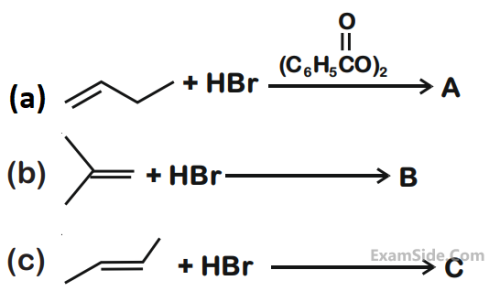
The compounds B and C respectively are :-




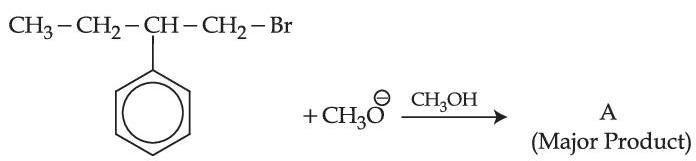


Consider the given reaction, the product A is :


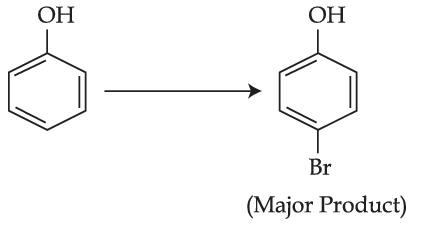
The given reaction can occur in the presence of :
(a) Bromine water
(b) Br2 in CS2, 273 K
(c) Br2/FeBr3
(d) Br2 in CHCl3, 273 K
Choose the correct answer from the options gien below :
Statement I : C2H5OH and AgCN both can generate nucleophile.
Statement II : KCN and AgCN both will generate nitrile nucleophile with all reaction conditions.
Choose the most appropriate option :


(A) AgCN/KCN
(B) RCOOAg/RCOOK
(C) AgNO2/KNO2
(D) AgI/KI
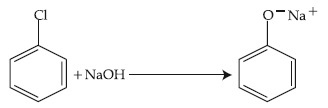
The above reaction requires which of the following reaction conditions?

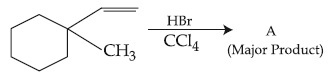
Product ''A'' in the above chemical reaction is :


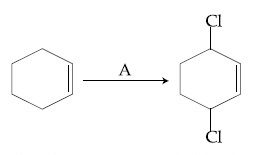
Identify the reagent(s) 'A' and condition(s) for the reaction

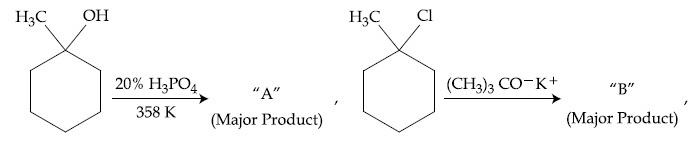
The products ''A'' and ''B'' formed in above reactions are :


Choose the correct answer from the options given below :


What is 'A'?


What is 'A'?


with excess $\mathrm{Mg/Et_2O}$ ($\mathrm{Et=C_2H_5}$) is


(i) forms aldehydes on ozonolysis followed by the hydrolysis.
(ii) when vaporized completely 1.53 g of A, gives 448 mL of vapour at STP.
The number of carbon atoms in a molecule of compound A is ___________.
Explanation:
22400 ml of A $\Rightarrow$ ${{1.53} \over {448}}$ $\times$ 22400 gm A = 76.5 Agm
$\mathop {{H_3}CHC - CH - Cl}\limits_{It\,has\,3\,carbon\,atoms} \mathrel{\mathop{\kern0pt\longrightarrow} \limits_{Zn/{H_2}O}^{{O_3}}} \mathop {C{H_3} - CH = O}\limits_{Aldehyde} $
& MM is 36 + 5 + 35.5 = 76.5
An organic compound of molecular formula $\mathrm{C_6H_6Br_2}$ has six carbon atoms in a ring system, two non-conjugate double bonds and two bromo groups at 1, 4-positions. Then the compound is

Identify the major product of the following reaction.



CH3CH = CHCH(CH3)2 $\buildrel {HBr} \over \longrightarrow $


