Haloalkanes and Haloarenes
272 Questions
Start JEE Mains Test
2020
Q201
JEE Mains
MCQ
14 Mar 2026
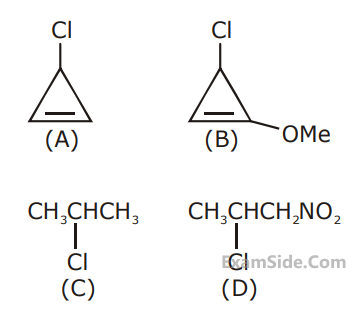
The decreasing order of reactivity of the
following organic molecules towards AgNO3
solution is :
A.
(B) > (A) > (C) > (D)
B.
(A) > (B) > (C) > (D)
C.
(A) > (B) > (D) > (C)
D.
(C) > (D) > (A) > (B)


2020
Q202
JEE Mains
MCQ
14 Mar 2026
The decreasing order of reactivity of the
following compounds towards nucleophilic
substitution (SN2) is :

A.
(IV) > (II) > (III) > (I)
B.
(II) > (III) > (IV) > (I)
C.
(II) > (III) > (I) > (IV)
D.
(III) > (II) > (IV) > (I)

2020
Q203
JEE Mains
MCQ
14 Mar 2026
The major product in the following reaction is :

A.

B.

C.

D.


2020
Q204
JEE Mains
MCQ
14 Mar 2026
The mechanism of SN1 reaction is given as :

A student writes general characteristics based on the given mechanism as :
(a) The reaction is favoured by weak nucleophiles.
(b) R+ would be easily formed if the substituents are bulky.
(c) The reaction is accompanied by racemization.
(d) The reaction is favoured by non-polar solvents.
A student writes general characteristics based on the given mechanism as :
(a) The reaction is favoured by weak nucleophiles.
(b) R+ would be easily formed if the substituents are bulky.
(c) The reaction is accompanied by racemization.
(d) The reaction is favoured by non-polar solvents.
A.
(a) and (b)
B.
(a), (b) and (c)
C.
(a) and (c)
D.
(b) and (d)
2020
Q205
JEE Mains
MCQ
14 Mar 2026
The major product obtained from
E2 - elimination of 3-bromo-2-fluoropentane is
A.


B.


C.

D.


2020
Q206
JEE Mains
MCQ
14 Mar 2026
Consider the reaction sequence given below:
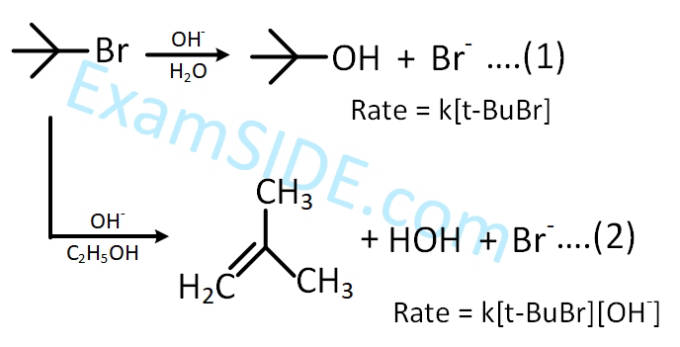
Which of the following statements is true?

Which of the following statements is true?
A.
Changing the concentration of base will
have no effect on reaction (1)
B.
Changing the concentration of base will
have no effect on reaction (2)
C.
Changing the base from OH- to -OR will
have no effect on reaction (2)
D.
Doubling the concentration of base will
double the rate of both the reactions
2020
Q207
JEE Mains
MCQ
14 Mar 2026
Which of the following compunds will show
retention in configuration on nucleophilic
substitution by OH– ion?
A.

B.

C.

D.


2020
Q208
JEE Mains
MCQ
14 Mar 2026
Which of the following reactions will not
produce a racemic product?
A.

B.

C.

D.


2020
Q209
JEE Mains
MCQ
14 Mar 2026
Which of these will produce the highest yield
in Friedel Crafts reaction?
A.

B.

C.

D.


2020
Q210
JEE Mains
MCQ
14 Mar 2026
The decreasing order of reactivity towards dehydrohalogenation (E1) reaction of the following compounds is :

A.
B $>$ D $>$ A $>$ C
B.
D $>$ B $>$ C $>$ A
C.
B $>$ A $>$ D $>$ C
D.
B $>$ D $>$ C $>$ A
2020
Q211
JEE Mains
MCQ
14 Mar 2026
Consider the following reactions :


Which of these reactions are possible ?
Which of these reactions are possible ?
A.
(b), (c) and (d)
B.
(a) and (b)
C.
(a) and (d)
D.
(b) and (d)


2020
Q212
JEE Mains
MCQ
14 Mar 2026
For the following reactions

Ks and Ke, are respectively, the rate constants for substitution and elimination and $\mu = {{{k_s}} \over {{k_e}}}$ the correct options is
Ks and Ke, are respectively, the rate constants for substitution and elimination and $\mu = {{{k_s}} \over {{k_e}}}$ the correct options is
A.
${\mu _B} > {\mu _A}$ and Ke(A) > Ke(B)
B.
${\mu _A} > {\mu _B}$ and Ke(B) > Ke(A)
C.
${\mu _B} > {\mu _A}$ and Ke(B) > Ke(A)
D.
${\mu _A} > {\mu _B}$ and Ke(A) > Ke(B)
2020
Q213
JEE Mains
MCQ
14 Mar 2026
1- methyl ethylene oxide when treated with an excess of HBr produces :
A.

B.

C.

D.


2020
Q214
TS-EAMCET
MCQ
20 May 2026
Arrange the following in the correct order of reactivity towards nucleophilic substitution reaction.
I. 1-chloro-2-nitrobenzene
II. Chlorobenzene
III. 1-chloro-3-nitrobenzene
A.
II $>$ I $>$ III
B.
III $>$ I $>$ II
C.
I $>$ III $>$ II
D.
II $>$ III $>$ I

2020
Q215
TS-EAMCET
MCQ
20 May 2026
$ \text { The major product in the following reaction sequence is } $

A.

B.

C.

D.


2020
Q216
BITSAT
MCQ
11 Jun 2026
1-phenyl-1, 3-dibromopropane on treatment with alc. KOH givens diastereomeric mixture in which compound (A) is major product. (A) gives the following reaction
(A) $\buildrel {AlC{l_3}/\Delta } \over \longrightarrow $ (B) $\buildrel {:CuBr} \over \longrightarrow $ (C) + (D)
Compound (C) and (D) are
A.

B.

C.

D.


2019
Q217
JEE Mains
MCQ
14 Mar 2026
Which one of the following is likely to give a precipitate with AgNO3 solution ?
A.
CHCl3
B.
(CH3)3CCl
C.
CCl4
D.
CH2=CH–Cl
2019
Q218
JEE Mains
MCQ
14 Mar 2026
An 'Assertion' and a 'Reason' are given below. Choose the correct answer from the following options :
Assertion (A) : Vinyl halides do not undergo nucleophilic substitution easily.
Reason (R) : Even though the intermediate carbocation is stabilized by loosely held p-electrons, the cleavage is difficult because of strong bonding.
Assertion (A) : Vinyl halides do not undergo nucleophilic substitution easily.
Reason (R) : Even though the intermediate carbocation is stabilized by loosely held p-electrons, the cleavage is difficult because of strong bonding.
A.
Both (A) and (R) are correct statements but (R) is not the correct explanation of (A)
B.
Both (A) and (R) are correct statements and (R) is the correct explanation of (A)
C.
(A) is correct statement but (R) is a wrong statement
D.
Both (A) and (R) are wrong statements.

2019
Q219
JEE Mains
MCQ
14 Mar 2026
Heating of 2-chloro-1-phenylbutane with EtOK/EtOH gives X as the major product. Reaction of X with
Hg(OAc)2/H2O followed by NaBH4 gives Y as the major product. Y is :
A.

B.

C.

D.


2019
Q220
JEE Mains
MCQ
14 Mar 2026
The major product 'Y' in the following reactions is :


A.


B.


C.


D.


2019
Q221
JEE Mains
MCQ
14 Mar 2026
The major product obtained in the given reaction is :

A.

B.

C.


D.


2019
Q222
JEE Mains
MCQ
14 Mar 2026
Increasing rate of SN1 reaction in the following compounds is :

A.
(B) < (A) < (D) < (C)
B.
(A) < (B) < (C) < (D)
C.
(A) < (B) < (D) < (C)
D.
(B) < (A) < (C) < (D)

2019
Q223
JEE Mains
MCQ
14 Mar 2026
The major product of the following reaction is :


A.


B.


C.


D.


2019
Q224
JEE Mains
MCQ
14 Mar 2026
Which one of the following alkenes when
treated with HCl yields majorly an anti
Markovnikov product?
A.
Cl – CH = CH2
B.
F3C – CH = CH2
C.
CH3O – CH = CH2
D.
H2N – CH = CH2

2019
Q225
JEE Mains
MCQ
14 Mar 2026
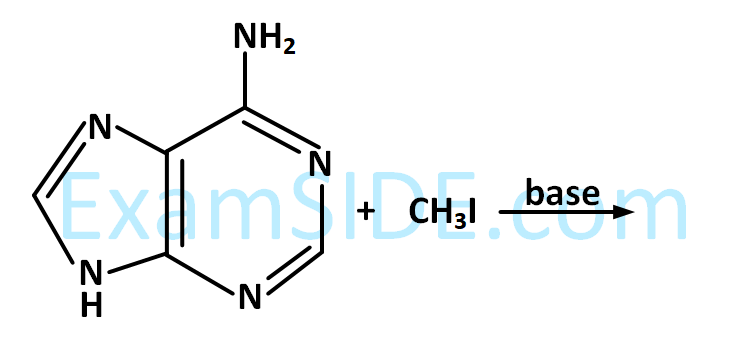
The major product in the following reaction is :
A.

B.

C.

D.


2019
Q226
JEE Mains
MCQ
14 Mar 2026
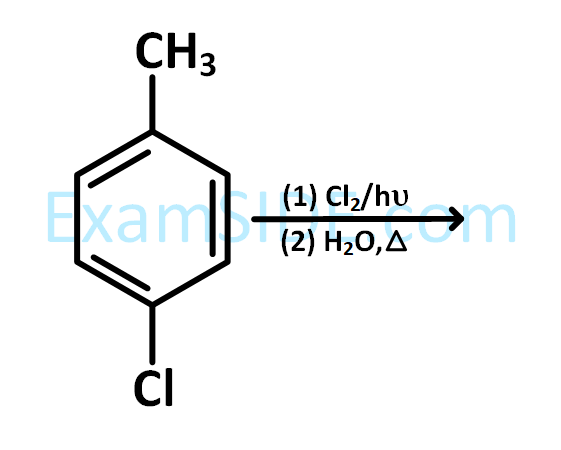
The major product of the following reaction is:
A.

B.

C.

D.


2019
Q227
JEE Mains
MCQ
14 Mar 2026
The major product in the following conversion is –

A.

B.

C.

D.


2019
Q228
JEE Mains
MCQ
14 Mar 2026
Which of the following compounds will produce a precipitate with AgNO3 ?
A.

B.

C.

D.


2019
Q229
JEE Mains
MCQ
14 Mar 2026
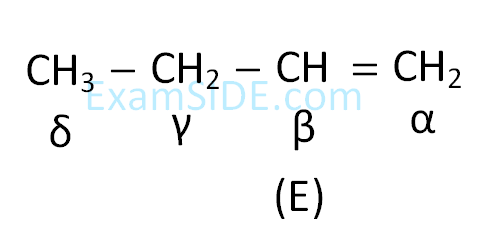
Which hydrogen in compound (E) is easily replaceable during bromination reaction in presence of light ?
A.
$\beta $ $-$ hydrogen
B.
$\alpha $ $-$ hydrogen
C.
$\gamma $ $-$ hydrogen
D.
$\delta $ $-$ hydrogen
2019
Q230
JEE Mains
MCQ
14 Mar 2026
The major product of the following reaction is :

A.

B.

C.

D.


2019
Q231
JEE Mains
MCQ
14 Mar 2026
The compounds A and B in the following reaction are, respectively :

A.
A = Benzyl alcohol, B = Benzyl cyanide
B.
A = Benzyl chloride, B = Benzyl cyanide
C.
A = Benzyl alcohol, B = Benzyl isocyanide
D.
A = Benzyl chloride, B = Benzyl isocyanide


2019
Q232
JEE Mains
MCQ
14 Mar 2026
The major product of the following reaction is :

A.

B.

C.

D.


2018
Q233
JEE Mains
MCQ
14 Mar 2026
The most polar compound among the following is :
A.

B.

C.

D.

2018
Q234
JEE Mains
MCQ
14 Mar 2026
The major product of the following reaction is :

A.

B.

C.

D.


2018
Q235
JEE Mains
MCQ
14 Mar 2026
The major product of the following reaction is:

A.

B.

C.

D.


2017
Q236
JEE Mains
MCQ
14 Mar 2026
In the following reaction sequence :

The compound I is :
The compound I is :
A.

B.

C.

D.


2017
Q237
JEE Mains
MCQ
14 Mar 2026
The major product of the following reaction is :

A.
CH2 = CHCH2CH = CHCH3
B.
CH2 = CHCH = CHCH2CH3
C.
CH3CH = C = CHCH2CH3
D.
CH3CH = CH − CH = CHCH3

2017
Q238
JEE Mains
MCQ
14 Mar 2026
The major product of the following reaction is :

A.

B.

C.

D.


2017
Q239
JEE Mains
MCQ
14 Mar 2026
Which of the following compounds will not undergo Friedel Craft’s reaction with benzene ?
A.

B.

C.

D.

2017
Q240
JEE Mains
MCQ
14 Mar 2026
Which of the following, upon treatment with tert-BuONa followed by addition of bromine water, fails to
decolorize the colour of bromine?
A.

B.

C.

D.


2017
Q241
JEE Mains
MCQ
14 Mar 2026
3-Methyl-pent-2-ene on reaction with HBr in presence of peroxide forms an addition product. The number
of possible stereoisomers for the product is :
A.
Zero
B.
Two
C.
Four
D.
Six


2017
Q242
JEE Mains
MCQ
14 Mar 2026
The increasing order of the reactivity of the following halides for the SN1 reaction is :

A.
(II) < (I) < (III)
B.
(I) < (III) < (II)
C.
(II) < (III) < (I)
D.
(III) < (II) < (I)

2017
Q243
JEE Mains
MCQ
14 Mar 2026
The major product obtained in the following reaction is :

A.
C6H5CH = CHC6H5
B.
(+) - C6H5CH(Ot-Bu)CH2C6H5
C.
(-) - C6H5CH(Ot-Bu)CH2C6H5
D.
($ \pm $) - C6H5CH(Ot-Bu)CH2C6H5

2016
Q244
JEE Mains
MCQ
14 Mar 2026
Bromination of cyclohexene under conditions given below yields :

A.

B.

C.

D.


2016
Q245
JEE Mains
MCQ
14 Mar 2026
Which one of the following reagents is not suitable for the elimination reaction ?

A.
NaOH/H2O
B.
NaOEt/EtOH
C.
NaOH/H2O-EtOH
D.
NaI

2015
Q246
JEE Mains
MCQ
14 Mar 2026
The synthesis of alkyl fluorides is best accomplished by:
A.
Sandmeyer’s reaction
B.
Finkelstein reaction
C.
Swarts reaction
D.
Free radical fluorination
2015
Q247
JEE Advanced
MSQ
14 Mar 2026
Compound(s) that on hydrogenation produce(s) optically inactive compound(s) is(are)
A.

B.

C.

D.


2014
Q248
JEE Mains
MCQ
14 Mar 2026
In SN2 reactions, the correct order of reactivity for the following compounds:
CH3Cl, CH3CH 2Cl, (CH3)2CHCl and (CH3)3CCl is:
CH3Cl, CH3CH 2Cl, (CH3)2CHCl and (CH3)3CCl is:
A.
CH3CH2Cl > CH3Cl > (CH3)2CHCl > (CH3)3CCl
B.
(CH3)2CHCl > CH3CH2Cl > CH3Cl > (CH3)3CCl
C.
CH3Cl > (CH3)2CHCl > CH3CH2Cl > (CH3)3CCl
D.
CH3Cl > CH3CH2Cl > (CH3)2CHCl > (CH3)3CCl
2014
Q249
JEE Mains
MCQ
14 Mar 2026
The major organic compound formed by the reaction of 1, 1, 1– trichloroethane with silver powder is:
A.
2- Butyne
B.
2- Butene
C.
Acetylene
D.
Ethene

2013
Q250
JEE Mains
MCQ
14 Mar 2026
A solution of (–$l$) – chloro –1 – phenylethane in toluene racemises slowly in the presence of a small
amount of SbCl5, due to the formation of :
A.
carbene
B.
carbocation
C.
free radical
D.
carbanion
