Consider the following reaction :
$ \begin{aligned} & 2 \mathrm{~A}(\mathrm{~g})+\mathrm{B}(\mathrm{~g}) \rightarrow 2 \mathrm{D}(\mathrm{~g}) \\ & \Delta \mathrm{U}^{\ominus}=-10 \mathrm{~kJ} \mathrm{~mol}^{-1} \text { and } \Delta \mathrm{S}^{\ominus}=-44 \mathrm{JK}^{-1} \text { at } 298 \mathrm{~K} . \end{aligned} $
Identify the correct option with $\Delta \mathrm{G}^{\ominus}$ for the reaction and spontaneity of the reaction at 298 K .
(Given : $\mathrm{R}=8.31 \mathrm{~J} \mathrm{~mol}^{-1} \mathrm{~K}^{-1}$ )
$-1.635 \mathrm{~kJ} \mathrm{~mol}^{-1}$, spontaneous
$-0.63568 \mathrm{~kJ} \mathrm{~mol}^{-1}$, spontaneous
$+0.63568 \mathrm{~kJ} \mathrm{~mol}^{-1}$, non-spontaneous
$+1.635 \mathrm{~kJ} \mathrm{~mol}^{-1}$, non-spontaneous
At a certain temperature, $\mathrm{T}(\mathrm{K})$, during a process, 500 J is absorbed by the system and work of 200 J is done by the system. Then change in internal energy of the system is :
400 J
300 J
700 J
500 J
Two moles of an ideal gas undergo free expansion from 10 L to 100 L at 300 K . The values of $\Delta \mathrm{S}_{\text {system }}$ and $\Delta \mathrm{S}_{\text {surroundings }}$ are
( $R$ is universal gas constant)
$\Delta \mathrm{S}_{\text {system }}=4.606 \mathrm{R} ; \Delta \mathrm{S}_{\text {surroundings }}=0$
$\Delta \mathrm{S}_{\text {system }}=0 ; \Delta \mathrm{S}_{\text {surroundings }}=0$
$\Delta \mathrm{S}_{\text {system }}=4.606 \mathrm{R} ; \Delta \mathrm{S}_{\text {surroundings }}=-4.606 \mathrm{R}$
$\Delta \mathrm{S}_{\text {system }}=0 ; \Delta \mathrm{S}_{\text {surroundings }}=4.606 \mathrm{R}$
$ \text { Consider the reversible processes for } 1.0 \mathrm{~mol} \text { of an ideal gas as shown in the figure. } $

$w_1, w_2, w_3$ and $w_4$ represent work done (in calories) in the processes $1,2,3$ and 4 , respectively; $\Delta U_2$ and $\Delta U_4$ are changes in the internal energy for the processes 2 and 4, respectively.
[use $\mathrm{R}=2 \mathrm{cal} \mathrm{K}^{-1} \mathrm{~mol}^{-1}$ ]
The correct option is
$\mathrm{w}_1+\mathrm{w}_2+\mathrm{w}_3+\mathrm{w}_4=0$
$\mathrm{w}_1+\mathrm{w}_3=-2 \mathrm{~T}_1 \ln \frac{\mathrm{~V}_2}{\mathrm{~V}_1}-2 \mathrm{~T}_2 \ln \frac{\mathrm{~V}_4}{\mathrm{~V}_3}$
$\mathrm{w}_2+\mathrm{w}_4=\Delta \mathrm{U}_2-\Delta \mathrm{U}_4$
$\mathrm{w}_1+\mathrm{w}_2=2 \mathrm{~T}_1 \ln \frac{\mathrm{~V}_2}{\mathrm{~V}_1}$
A protein undergoes reversible thermal denaturation from its initial state $\mathbf{N}$ to denatured state $\mathbf{D}$ according to $\mathbf{N} \rightleftharpoons \mathbf{D}$. At $60^{\circ} \mathrm{C}$, the concentrations of both $\mathbf{N}$ and $\mathbf{D}$ are equal at equilibrium, and the standard enthalpy change of denaturation is $666 \mathrm{~kJ} \mathrm{~mol}^{-1}$. The standard entropy change $\Delta \mathrm{S}^{\circ}$ in $\mathrm{kJ} \mathrm{K}^{-1} \mathrm{~mol}^{-1}$ ) of the protein upon denaturation at $60^{\circ} \mathrm{C}$ is closest to
11.1
2.0
2000.0
333.0
The standard heat of formation, in $\mathrm{kcal} / \mathrm{mol}$ of $\mathrm{Ba}^{2+}$ is : [Given : standard heat of formation of $\mathrm{SO}_4^{2-}$ ion $(\mathrm{aq})=-216 \mathrm{kcal} / \mathrm{mol}$, standard heat of crystallisation of $\mathrm{BaSO}_4(\mathrm{~s})=-4.5 \mathrm{kcal} / \mathrm{mol}$, standard heat of formation of $\left.\mathrm{BaSO}_4(\mathrm{~s})=-349 \mathrm{kcal} / \mathrm{mol}\right]$
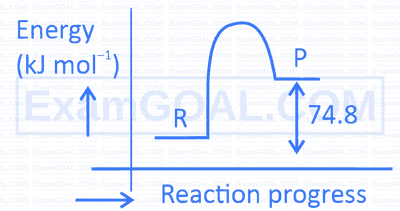
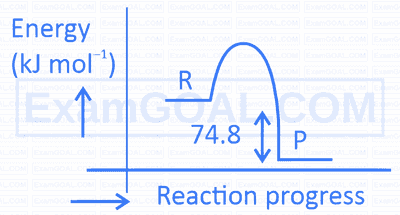
$\mathrm{C}(\mathrm{s})+2 \mathrm{H}_2(\mathrm{~g}) \rightarrow \mathrm{CH}_4(\mathrm{~g}) ; \Delta \mathrm{H}=-74.8 \mathrm{~kJ} \mathrm{~mol}^{-1}$. Which of the following diagrams gives an accurate representation of the above reaction? [ $\mathrm{R} \rightarrow$ reactants; $\mathrm{P} \rightarrow$ products]


Choose the correct statement for the work done in the expansion and heat absorbed or released when 5 litres of an ideal gas at 10 atmospheric pressure isothermally expands into vacuum until volume is 15 litres :
For an endothermic reaction:
(A) $\mathrm{q}_{\mathrm{p}}$ is negative.
(B) $\Delta_{\mathrm{r}} \mathrm{H}$ is positive.
(C) $\Delta_r \mathrm{H}$ is negative.
(D) $\mathrm{q}_{\mathrm{p}}$ is positive.
Choose the correct answer from the options given below:

For the following reaction at $300 \mathrm{~K}$
$\mathrm{A}_2(\mathrm{~g})+3 \mathrm{~B}_2(\mathrm{~g}) \rightarrow 2 \mathrm{AB}_3(\mathrm{~g})$
the enthalpy change is $+15 \mathrm{~kJ}$, then the internal energy change is :
In which of the following processes entropy increases?
A. A liquid evaporates to vapour.
B. Temperature of a crystalline solid lowered from $130 \mathrm{~K}$ to $0 \mathrm{~K}$.
C. $2 \mathrm{NaHCO}_{3(\mathrm{~s})} \rightarrow \mathrm{Na}_2 \mathrm{CO}_{3(\mathrm{~s})}+\mathrm{CO}_{2(\mathrm{~g})}+\mathrm{H}_2 \mathrm{O}_{(\mathrm{g})}$
D. $\mathrm{Cl}_{2(g)} \rightarrow 2 \mathrm{Cl}_{(g)}$
Choose the correct answer from the options given below:
Match List I with List II.
| List I (Process) |
List II (Conditions) |
||
|---|---|---|---|
| A. | Isothermal process | I. | No heat exchange |
| B. | Isochoric process | II. | Carried out at constant temperature |
| C. | Isobaric process | III. | Carried out at constant volume |
| D. | Adiabatic process | IV. | Carried out at constant pressure |
Choose the correct answer from the options given below:
The work done during reversible isothermal expansion of one mole of hydrogen gas at $25^{\circ} \mathrm{C}$ from pressure of 20 atmosphere to 10 atmosphere is (Given $\mathrm{R}=2.0 \mathrm{~cal} \mathrm{~K}^{-1} \mathrm{~mol}^{-1}$)
Consider the following reaction :-
$2 \mathrm{H}_2(\mathrm{~g})+\mathrm{O}_2(\mathrm{~g}) \rightarrow 2 \mathrm{H}_2 \mathrm{O}(\mathrm{g}) \Delta_{\mathrm{r}} \mathrm{H}^{\circ}=-483.64 \mathrm{~kJ} \text {. }$
What is the enthalpy change for decomposition of one mole of water? (Choose the right option).
The equilibrium concentrations of the species in the reaction $\mathrm{A}+\mathrm{B} \rightleftharpoons \mathrm{C}+\mathrm{D}$ are $2,3,10$ and $6 \mathrm{~mol}$ $\mathrm{L}^{-1}$, respectively at $300 \mathrm{~K} . \Delta \mathrm{G}^{0}$ for the reaction is $(\mathrm{R}=2 \mathrm{cal} / \mathrm{mol} ~\mathrm{K})$
Which amongst the following options is the correct relation between change in enthalpy and change in internal energy?
One mole of an ideal gas at 300 K is expanded isothermally from 1 L to 10 L volume. $\Delta$U for this process is :
(Use R = 8.314 J k$-$1 mol$-$1)
A vessel contains 3.2 g of dioxygen gas at STP (273.15 K and 1 atm pressure). The gas is now transferred to another vessel at constant temperature, where pressure becomes one third of the original pressure. The volume of new vessel in L is : (Given : molar volume at STP is 22.4 L)
Which of the following p-V curve represents maximum work done?


Sucrose + H2O ⇌ Glucose + Fructose
If the equilibrium constant (Kc) is 2 $ \times $ 1013 at 800 K, the value of $\Delta r{G^\Theta }$ at the same temperature will be :
The correct relation is
At $25^{\circ} \mathrm{C}, 1$ mole of butane is heated then $\mathrm{CO}_2$ and $\mathrm{H}_2 \mathrm{O}$ liquid is formed work done is
Assertion : $U$ is state function.
Reason : $T$ is an intensive property.
In an adiabatic process, no transfer of heat takes place between system and surroundings. Choose the correct option for free expansion of an ideal gas under adiabatic condition from the following
$\Delta H$ and $\Delta E$ for the reaction,
$\mathrm{Fe}_2 \mathrm{O}_3(s)+3 \mathrm{H}_2(g) \longrightarrow 2 \mathrm{Fe}(s)+\mathrm{H}_2 \mathrm{O}(l)$
at constant temperature are related as
$\Delta $U = 2.1 kcal, $\Delta $S = 20 cal K$-$1 at 300 K
Hence, G is
(i) C(graphite) + O2(g) $ \to $ CO2(g); $\Delta $rHo = x kJ mol$-$1
(ii) C(graphite) + ${1 \over 2}$O2(g) $ \to $ CO(g); $\Delta $rHo = y kJ mol$-$1
(iii) CO(g) + ${1 \over 2}$O2(g) $ \to $ CO2(g); $\Delta $rHo = z kJ mol$-$1
Based on the above equations, find out which of the relationship given below is correct.
| H (kJ/mol) | |
|---|---|
| 1/2A $ \to $ B | +150 |
| 3B $ \to $ 2C + D | -125 |
| E + A $ \to $ 2D | +350 |
For B + D $ \to $ E + 2C, $\Delta $H will be
4H(g) $ \to $ 2H2(g) is $-$869.6 kJ
The dissociation energy of H $-$ H bond is