Thermodynamics

86 Questions
2025 NEET MCQ
NEET 2025

The standard heat of formation, in $\mathrm{kcal} / \mathrm{mol}$ of $\mathrm{Ba}^{2+}$ is : [Given : standard heat of formation of $\mathrm{SO}_4^{2-}$ ion $(\mathrm{aq})=-216 \mathrm{kcal} / \mathrm{mol}$, standard heat of crystallisation of $\mathrm{BaSO}_4(\mathrm{~s})=-4.5 \mathrm{kcal} / \mathrm{mol}$, standard heat of formation of $\left.\mathrm{BaSO}_4(\mathrm{~s})=-349 \mathrm{kcal} / \mathrm{mol}\right]$

A.
+133.0
B.
+220.5
C.
$-$128.5
D.
$-$133.0
2025 NEET MCQ
NEET 2025

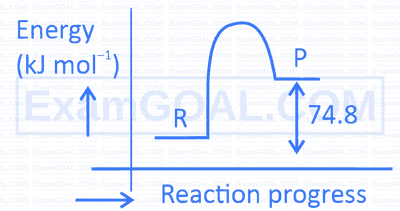
$\mathrm{C}(\mathrm{s})+2 \mathrm{H}_2(\mathrm{~g}) \rightarrow \mathrm{CH}_4(\mathrm{~g}) ; \Delta \mathrm{H}=-74.8 \mathrm{~kJ} \mathrm{~mol}^{-1}$. Which of the following diagrams gives an accurate representation of the above reaction? [ $\mathrm{R} \rightarrow$ reactants; $\mathrm{P} \rightarrow$ products]

A.
NEET 2025 Chemistry - Thermodynamics Question 1 English Option 1
B.
NEET 2025 Chemistry - Thermodynamics Question 1 English Option 2
C.
NEET 2025 Chemistry - Thermodynamics Question 1 English Option 3
D.
NEET 2025 Chemistry - Thermodynamics Question 1 English Option 4
2024 NEET MCQ
NEET 2024 (Re-Examination)

Choose the correct statement for the work done in the expansion and heat absorbed or released when 5 litres of an ideal gas at 10 atmospheric pressure isothermally expands into vacuum until volume is 15 litres :

A.
Both the heat and work done will be greater than zero
B.
Heat absorbed will be less than zero and work done will be positive
C.
Work done will be zero and heat will also be zero
D.
Work done will be greater than zero and heat will remain zero
2024 NEET MCQ
NEET 2024 (Re-Examination)

For an endothermic reaction:

(A) $\mathrm{q}_{\mathrm{p}}$ is negative.

(B) $\Delta_{\mathrm{r}} \mathrm{H}$ is positive.

(C) $\Delta_r \mathrm{H}$ is negative.

(D) $\mathrm{q}_{\mathrm{p}}$ is positive.

Choose the correct answer from the options given below:

A.
B and D
B.
C and D
C.
A and B
D.
A and C
2024 NEET MCQ
NEET 2024 (Re-Examination)

For the following reaction at $300 \mathrm{~K}$

$\mathrm{A}_2(\mathrm{~g})+3 \mathrm{~B}_2(\mathrm{~g}) \rightarrow 2 \mathrm{AB}_3(\mathrm{~g})$

the enthalpy change is $+15 \mathrm{~kJ}$, then the internal energy change is :

A.
$19988.4 \mathrm{~J}$
B.
$200 \mathrm{~J}$
C.
$1999 \mathrm{~J}$
D.
$1.9988 \mathrm{~kJ}$
2024 NEET MCQ
NEET 2024

In which of the following processes entropy increases?

A. A liquid evaporates to vapour.

B. Temperature of a crystalline solid lowered from $130 \mathrm{~K}$ to $0 \mathrm{~K}$.

C. $2 \mathrm{NaHCO}_{3(\mathrm{~s})} \rightarrow \mathrm{Na}_2 \mathrm{CO}_{3(\mathrm{~s})}+\mathrm{CO}_{2(\mathrm{~g})}+\mathrm{H}_2 \mathrm{O}_{(\mathrm{g})}$

D. $\mathrm{Cl}_{2(g)} \rightarrow 2 \mathrm{Cl}_{(g)}$

Choose the correct answer from the options given below:

A.
A and C
B.
A, B and D
C.
A, C and D
D.
C and D
2024 NEET MCQ
NEET 2024

Match List I with List II.

List I
(Process)
List II
(Conditions)
A. Isothermal process I. No heat exchange
B. Isochoric process II. Carried out at constant temperature
C. Isobaric process III. Carried out at constant volume
D. Adiabatic process IV. Carried out at constant pressure

Choose the correct answer from the options given below:

A.
A-IV, B-III, C-II, D-I
B.
A-IV, B-II, C-III, D-I
C.
A-I, B-II, C-III, D-IV
D.
A-II, B-III, C-IV, D-I
2024 NEET MCQ
NEET 2024

The work done during reversible isothermal expansion of one mole of hydrogen gas at $25^{\circ} \mathrm{C}$ from pressure of 20 atmosphere to 10 atmosphere is (Given $\mathrm{R}=2.0 \mathrm{~cal} \mathrm{~K}^{-1} \mathrm{~mol}^{-1}$)

A.
0 calorie
B.
$-$413.14 calories
C.
413.14 calories
D.
100 calories
2023 NEET MCQ
NEET 2023 Manipur

Consider the following reaction :-

$2 \mathrm{H}_2(\mathrm{~g})+\mathrm{O}_2(\mathrm{~g}) \rightarrow 2 \mathrm{H}_2 \mathrm{O}(\mathrm{g}) \Delta_{\mathrm{r}} \mathrm{H}^{\circ}=-483.64 \mathrm{~kJ} \text {. }$

What is the enthalpy change for decomposition of one mole of water? (Choose the right option).

A.
120.9 kJ
B.
241.82 kJ
C.
18 kJ
D.
100 kJ
2023 NEET MCQ
NEET 2023

The equilibrium concentrations of the species in the reaction $\mathrm{A}+\mathrm{B} \rightleftharpoons \mathrm{C}+\mathrm{D}$ are $2,3,10$ and $6 \mathrm{~mol}$ $\mathrm{L}^{-1}$, respectively at $300 \mathrm{~K} . \Delta \mathrm{G}^{0}$ for the reaction is $(\mathrm{R}=2 \mathrm{cal} / \mathrm{mol} ~\mathrm{K})$

A.
$-137.26 ~\mathrm{cal}$
B.
$-1381.80 ~\mathrm{cal}$
C.
$-13.73 ~\mathrm{cal}$
D.
$1372.60 ~\mathrm{cal}$
2023 NEET MCQ
NEET 2023

Which amongst the following options is the correct relation between change in enthalpy and change in internal energy?

A.
$\Delta \mathrm{H}=\Delta \mathrm{U}+\Delta \mathrm{n_g R T}$
B.
$\Delta \mathrm{H}-\Delta \mathrm{U}=-\Delta \mathrm{nRT}$
C.
$\Delta \mathrm{H}+\Delta \mathrm{U}=\Delta \mathrm{nR}$
D.
$\Delta \mathrm{H}=\Delta \mathrm{U}-\Delta \mathrm{n_g R T}$
2022 NEET MCQ
NEET 2022 Phase 2

One mole of an ideal gas at 300 K is expanded isothermally from 1 L to 10 L volume. $\Delta$U for this process is :

(Use R = 8.314 J k$-$1 mol$-$1)

A.
0 J
B.
1260 J
C.
2520 J
D.
5040 J
2022 NEET MCQ
NEET 2022 Phase 2

A vessel contains 3.2 g of dioxygen gas at STP (273.15 K and 1 atm pressure). The gas is now transferred to another vessel at constant temperature, where pressure becomes one third of the original pressure. The volume of new vessel in L is : (Given : molar volume at STP is 22.4 L)

A.
67.2
B.
6.72
C.
2.24
D.
22.4
2022 NEET MCQ
NEET 2022 Phase 1

Which of the following p-V curve represents maximum work done?

A.
NEET 2022 Phase 1 Chemistry - Thermodynamics Question 14 English Option 1
B.
NEET 2022 Phase 1 Chemistry - Thermodynamics Question 14 English Option 2
C.
NEET 2022 Phase 1 Chemistry - Thermodynamics Question 14 English Option 3
D.
NEET 2022 Phase 1 Chemistry - Thermodynamics Question 14 English Option 4
2021 NEET MCQ
NEET 2021
Which one among the following is the correct option for right relationship between CP and CV for one mole of ideal gas?
A.
CV = RCP
B.
CP + CV = R
C.
CP $-$ CV = R
D.
CP = RCV
2021 NEET MCQ
NEET 2021
For irreversible expansion of an ideal gas under isothermal condition, the correct option is :
A.
$\Delta$U $\ne$ 0, $\Delta$Stotal = 0
B.
$\Delta$U = 0, $\Delta$Stotal = 0
C.
$\Delta$U $\ne$ 0, $\Delta$Stotal $\ne$ 0
D.
$\Delta$U = 0, $\Delta$Stotal $\ne$ 0
2020 NEET MCQ
NEET 2020 Phase 1
Hydrolysis of sucrose is given by the following reaction.
Sucrose + H2O ⇌ Glucose + Fructose
If the equilibrium constant (Kc) is 2 $ \times $ 1013 at 800 K, the value of $\Delta r{G^\Theta }$ at the same temperature will be :
A.
8.314 J $mo{l^{ - 1}}{K^{ - 1}} \times 300K \times In(2 \times {10^{13}})$
B.
8.314 J $mo{l^{ - 1}}{K^{ - 1}} \times 300K \times In(3 \times {10^{13}})$
C.
$ - $ 8.314 J $mo{l^{ - 1}}{K^{ - 1}} \times 300K \times In(4 \times {10^{13}})$
D.
-8.314 J $mo{l^{ - 1}}{K^{ - 1}} \times 300K \times In(2 \times {10^{13}})$
2020 NEET MCQ
NEET 2020 Phase 1
For the reaction, 2Cl(g) $ \to $ Cl2(g), the correct option is :
A.
${\Delta _r}H > 0$ and ${\Delta _r}S < 0$
B.
${\Delta _r}H < 0$ and ${\Delta _r}S > 0$
C.
${\Delta _r}H < 0$ and ${\Delta _r}S < 0$
D.
${\Delta _r}H > 0$ and ${\Delta _r}S > 0$
2020 NEET MCQ
NEET 2020 Phase 1
The correct option for free expansion of an ideal gas under adiabatic condition is :
A.
q = 0, $\Delta $ T < 0 and w > 0
B.
q < 0, $\Delta $ T = 0 and w = 0
C.
q > 0, $\Delta $ T > 0 and w > 0
D.
q = 0, $\Delta $ T = 0 and w = 0
2019 NEET MCQ
NEET 2019
In which case change in entropy is negative?
A.
Sublimation of solid to gas
B.
2H(g) $ \to $ H2(g)
C.
Evaporation of water
D.
Expansion of a gas at temperature
2019 NEET MCQ
NEET 2019
Under isothermal condition, a gas at 300 K expands from 0.1 L to 0.25 L against a constant external pressure of 2 bar. The work done by the gas is [Given that 1 L bar = 100 J]
A.
25 J
B.
30 J
C.
-30 J
D.
5 kJ
2018 NEET MCQ
NEET 2018
The bond dissociation energies of X2 , Y2 and XY are in the ratio of 1 : 0.5 : 1. $\Delta $H for the formation of XY is –200 kJ mol–1. The bond dissociation energy of X2 will be
A.
800 kJ mol–1
B.
200 kJ mol–1
C.
400 kJ mol–1
D.
100 kJ mol–1
2017 NEET MCQ
NEET 2017
A gas is allowed to expand in a well insulated container against a constant external pressure of 2.5 atm from an initial volume of 2.50 L to a final volume of 4.50 L. The change in internal energy $\Delta $U of the gas in joules will be
A.
$-$ 500 J
B.
$-$ 505 J
C.
+ 505 J
D.
1136.25 J
2017 NEET MCQ
NEET 2017
For a given reaction, $\Delta $H = 35.5 kJ mol$-$1 and $\Delta $S = 83.6 J K$-$1 mol$-$1. The reaction is spontaneous at (Assume that $\Delta $H and $\Delta $S do not vary with temperature.)
A.
T > 425 K
B.
all temperatures
C.
T > 298 K
D.
T < 425 K
2016 NEET MCQ
NEET 2016 Phase 2
For a sample of perfect gas when its pressure is changed isothermally from pi to pf, the entropy change is given by
A.
$\Delta S = nR\,\ln \left( {{{{p_f}} \over {{p_i}}}} \right)$
B.
$\Delta S = nR\,\ln \left( {{{{p_i}} \over {{p_f}}}} \right)$
C.
$\Delta S = nRT\,\ln \left( {{{{p_f}} \over {{p_i}}}} \right)$
D.
$\Delta S = RT\,\ln \left( {{{{p_i}} \over {{p_f}}}} \right)$
2015 NEET MCQ
AIPMT 2015
The heat of combination of carbon to CO2 is $-$393.5 kJ/mol. The heat released upon formation of 35.2 g of CO2 from carbon and oxygen gas is
A.
+ 315 kJ
B.
$-$630 kJ
C.
$-$ 3.15 kJ
D.
$-$ 315 kJ
2014 NEET MCQ
AIPMT 2014
For the reaction, ${X_2}{O_{4\left( l \right)}}\,\, \to \,\,2X{O_{2(g)}}$

$\Delta $U = 2.1 kcal, $\Delta $S = 20 cal K$-$1 at 300 K

Hence, G is
A.
2.7 kcal
B.
$-$ 2.7 kcal
C.
9.3 kcal
D.
$-$ 9.3 kcal
2014 NEET MCQ
AIPMT 2014
Which of the following statements is correct for the spontaneous adsorption of a gas?
A.
$\Delta $S is negative and, therefore $\Delta $H should be highly positive.
B.
$\Delta $S is negative and therefore, $\Delta $H should be highly negative.
C.
$\Delta $S is positive and therefore, $\Delta $H should be negative .
D.
$\Delta $S is positive and therefore, $\Delta $H should also be highly positive.
2013 NEET MCQ
NEET 2013 (Karnataka)
When 5 litres of a gas mixture of methane and propane is perfectly combusted at 0oC and 1 atmosphere, 16 litres of oxygen at the same temperature and pressure is consumed, The amount of heat released from this combustion in kJ ($\Delta $Hcomb. (CH4) = 890 kJ mol$-$1, $\Delta $Hcomb. (C3H8) = 2220 kJ mol$-$1) is
A.
38
B.
317
C.
477
D.
32
2013 NEET MCQ
NEET 2013 (Karnataka)
Three thermochemical equations are given below
(i)  C(graphite) + O2(g) $ \to $ CO2(g); $\Delta $rHo = x kJ mol$-$1
(ii)  C(graphite) + ${1 \over 2}$O2(g) $ \to $ CO(g); $\Delta $rHo = y kJ mol$-$1
(iii)  CO(g) + ${1 \over 2}$O2(g) $ \to $ CO2(g); $\Delta $rHo = z kJ mol$-$1
Based on the above equations, find out which of the relationship given below is correct.
A.
z = x + y
B.
x = y + z
C.
y = 2z $-$ x
D.
x = y $-$ z
2013 NEET MCQ
NEET 2013
A reaction having equal energies of activation for forward and reverse reactions has
A.
$\Delta $H = 0
B.
$\Delta $H = $\Delta $G = $\Delta $S = 0
C.
$\Delta $S = 0
D.
$\Delta $G = 0
2012 NEET MCQ
AIPMT 2012 Prelims
In which of the following reactions, standard reaction entropy change ($\Delta $So) is positive and standard Gibb's energy change ($\Delta $Go) decreases sharply with increasing temperature ?
A.
C(graphite) + ${1 \over 2}$O2(g) $ \to $ CO(g)
B.
CO(g) + ${1 \over 2}$O2(g) $ \to $ CO2(g)
C.
Mg(s) + ${1 \over 2}$O2(g) $ \to $ MgO(g)
D.
${1 \over 2}$C(graphite) + ${1 \over 2}$O2(g) $ \to $ ${1 \over 2}$CO2(g)
2012 NEET MCQ
AIPMT 2012 Prelims
Standard enthalpy of vaporisation $\Delta $vapHo for water at 100oC is 40.66 kJ mol$-$1. The internal energy of vaporisation of water at 100oC (in kJ mol$-$1) is
A.
+37.56
B.
$-$43.76
C.
+ 43.76
D.
+ 40.66
2012 NEET MCQ
AIPMT 2012 Prelims
The enthalpy of fusion of water is 1.435 kcal/mol. The molar entropy change for the melting of ice at 0oC is
A.
10.52 cal/(mol K)
B.
21.04 cal/(mol K)
C.
5.260 cal/(mol K)
D.
0.526 cal/(mol K)
2011 NEET MCQ
AIPMT 2011 Mains
Consider the following processes :

H (kJ/mol)
1/2A $ \to $ B +150
3B  $ \to $ 2C + D -125
E + A  $ \to $ 2D +350

For B + D $ \to $ E + 2C, $\Delta $H will be
A.
525 kJ/mol
B.
$-$175 kJ/mol
C.
$-$ 325 kJ/mol
D.
325 kJ/mol
2011 NEET MCQ
AIPMT 2011 Prelims
If the enthalpy change for the transition of liquid water to steam is 30 kJ mol$-$1 at 27oC, the entropy change for the process would be
A.
10 J mol$-$1 K$-$1
B.
1.0 J mol$-$1 K$-$1
C.
0.1 J mol$-$1 K$-$1
D.
100 J mol$-$1 K$-$1
2011 NEET MCQ
AIPMT 2011 Prelims
Which of the following is correct option for free expansion of an ideal gas under adiabatic condition ?
A.
q = 0, $\Delta $T $ \ne $ 0, w = 0
B.
q $ \ne $ 0,   $\Delta $T = 0,   w = 0
C.
q = 0,   $\Delta $T = 0,   w = 0
D.
q = 0,  $\Delta $T < 0, w $ \ne $ 0
2011 NEET MCQ
AIPMT 2011 Prelims
Enthalpy change for the reaction,
4H(g)  $ \to $  2H2(g) is $-$869.6 kJ
The dissociation energy of H $-$ H bond is
A.
434.8 kJ
B.
$-$ 869.6 kJ
C.
+ 434.8 kJ
D.
+ 217.4 kJ
2010 NEET MCQ
AIPMT 2010 Mains
Three moles of an ideal gas expanded spontaneously into vacuum. The work done will be
A.
infinite
B.
3 Joules
C.
9 Joules
D.
zero
2010 NEET MCQ
AIPMT 2010 Mains
Match List I (Equations) with List II (Type of processes) and select the correct option.

List I List II
Equations Type of processes
A. Kp > Q (i) Non- spontaneous
B. $\Delta $Go < RT ln Q (ii) Equilibrium
C. Kp = Q (iii) Spontaneous and
endothermic
D. T > ${{\Delta H} \over {\Delta S}}$ (iv) Spontaneous
A.
A - (i), B - (ii), C - (iii), D - (iv)
B.
A - (iii), B - (iv), C - (ii), D - (i)
C.
A - (iv), B - (i), C - (ii), D - (iii)
D.
A - (ii), B - (i), C - (iv), D - (iii)
2010 NEET MCQ
AIPMT 2010 Mains
For vaporization of water at 1 atmospheric pressure, the values of $\Delta $H and $\Delta $S are 40.63 kJ mol$-$1 and 108.8 J K$-$1 mol$-$1, respectively. The temperature when Gibb's energy change ($\Delta $G) for this transformation will be zero, is
A.
273.4 K
B.
393.4 K
C.
373.4 K
D.
293.4 K
2010 NEET MCQ
AIPMT 2010 Mains
The following two reactions are known

Fe2O3(s) + 3CO(g) $ \to $ 2Fe(s) + 3CO2(g); $\Delta $H = $-$ 26.8 kJ

FeO(s) + CO(g) $ \to $  Fe(s) + CO2(g); $\Delta $H = $-$ 16.5 kJ

The value of $\Delta $H for the following reaction

Fe2O3(s) + CO(g) $ \to $  2FeO(s) + CO2(g) is
A.
+ 10.3 kJ
B.
$-$ 43.3 kJ
C.
$-$ 10.3 kJ
D.
+ 6.2 kJ
2010 NEET MCQ
AIPMT 2010 Prelims
Standard entropies of X2, Y2 and XY3 are 60, 40 and 50 J K$-$1 mol$-$1 respectively. For the reaction

1/2X2 + 3/2Y2 $\rightleftharpoons$ XY3, $\Delta $H = $-$ 30 kJ,

to be at equilibrium, the temperature should be
A.
750 K
B.
1000 K
C.
1250 K
D.
500 K
2010 NEET MCQ
AIPMT 2010 Prelims
For an endothermic reaction, energy of activation is Ea and enthalpy of reaction is $\Delta $H (both of these in kJ/mol). Minimum value of Ea will be
A.
less than $\Delta $H
B.
equal to $\Delta $H
C.
more than $\Delta $H
D.
equal to zero
2009 NEET MCQ
AIPMT 2009
The values of $\Delta $H and $\Delta $S for the reaction,

C(graphite) + CO2(g) $ \to $  2CO(g)

are 170 kJ and 170 J K$-$1, respectively. This reaction will be spontaneous at
A.
910 K
B.
1110 K
C.
510 K
D.
710 K
2009 NEET MCQ
AIPMT 2009
From the following bond energies :
H $-$ H bond energy   : 431.37 kJ mol$-$1
C $=$ C bond energy   : 606.10 kJ mol$-$1
C $-$ C bond energy   : 336.49 kJ mol$-$1
C $-$ H bond energy   : 410.50 kJ mol$-$1
Enthalpy for the reaction,
AIPMT 2009 Chemistry - Thermodynamics Question 57 English
will be
A.
$-$ 243.6 kJ mol$-$1
B.
$-$ 120.0 kJ mol$-$1
C.
553.0 kJ mol$-$1
D.
1523.6 kJ mol$-$1
2008 NEET MCQ
AIPMT 2008
For the gas phase reaction,

PCl5(g)  $\rightleftharpoons$ PCl3(g) + Cl2(g)

which of the following conditions are correct ?
A.
$\Delta $H < 0 and $\Delta $S < 0
B.
$\Delta $H > 0 and $\Delta $S < 0
C.
$\Delta $H = 0 and $\Delta $S < 0
D.
$\Delta $H > 0 and $\Delta $S > 0
2008 NEET MCQ
AIPMT 2008
Bond dissociation enthalpy of H2, Cl2 and HCl are 434, 242 and 431 kJ mol$-$1 respectively. Enthalpy of formation of HCl is
A.
$-$ 93 kJ mol$-$1
B.
245 kJ mol$-$1
C.
93 kJ mol$-$1
D.
$-$ 245 kJ mol$-$1
2008 NEET MCQ
AIPMT 2008
Which of the following are not state functions ?
(I) q + w     (II) q
(III) w        (IV) H $-$ TS
A.
(I), (II) and (III)
B.
(II) and (III)
C.
(I) and (IV)
D.
(II), (III) and (IV)
2007 NEET MCQ
AIPMT 2007
Given that bond energies of H $-$ H and Cl $-$ Cl are 430 kJ mol$-$1 and 240 kJ mol$-$1 respectively and $\Delta $Hf for HCl is $-$ 90 kJ mol$-$1, bond enthalpy of HCl is
A.
380 kJ mol$-$1
B.
425 kJ mol$-$1
C.
245 kJ mol$-$1
D.
290 kJ mol$-$1