Consider the following reaction :
$ \begin{aligned} & 2 \mathrm{~A}(\mathrm{~g})+\mathrm{B}(\mathrm{~g}) \rightarrow 2 \mathrm{D}(\mathrm{~g}) \\ & \Delta \mathrm{U}^{\ominus}=-10 \mathrm{~kJ} \mathrm{~mol}^{-1} \text { and } \Delta \mathrm{S}^{\ominus}=-44 \mathrm{JK}^{-1} \text { at } 298 \mathrm{~K} . \end{aligned} $
Identify the correct option with $\Delta \mathrm{G}^{\ominus}$ for the reaction and spontaneity of the reaction at 298 K .
(Given : $\mathrm{R}=8.31 \mathrm{~J} \mathrm{~mol}^{-1} \mathrm{~K}^{-1}$ )
$-1.635 \mathrm{~kJ} \mathrm{~mol}^{-1}$, spontaneous
$-0.63568 \mathrm{~kJ} \mathrm{~mol}^{-1}$, spontaneous
$+0.63568 \mathrm{~kJ} \mathrm{~mol}^{-1}$, non-spontaneous
$+1.635 \mathrm{~kJ} \mathrm{~mol}^{-1}$, non-spontaneous
At a certain temperature, $\mathrm{T}(\mathrm{K})$, during a process, 500 J is absorbed by the system and work of 200 J is done by the system. Then change in internal energy of the system is :
400 J
300 J
700 J
500 J
Two moles of an ideal gas undergo free expansion from 10 L to 100 L at 300 K . The values of $\Delta \mathrm{S}_{\text {system }}$ and $\Delta \mathrm{S}_{\text {surroundings }}$ are
( $R$ is universal gas constant)
$\Delta \mathrm{S}_{\text {system }}=4.606 \mathrm{R} ; \Delta \mathrm{S}_{\text {surroundings }}=0$
$\Delta \mathrm{S}_{\text {system }}=0 ; \Delta \mathrm{S}_{\text {surroundings }}=0$
$\Delta \mathrm{S}_{\text {system }}=4.606 \mathrm{R} ; \Delta \mathrm{S}_{\text {surroundings }}=-4.606 \mathrm{R}$
$\Delta \mathrm{S}_{\text {system }}=0 ; \Delta \mathrm{S}_{\text {surroundings }}=4.606 \mathrm{R}$
$ \text { Consider the reversible processes for } 1.0 \mathrm{~mol} \text { of an ideal gas as shown in the figure. } $

$w_1, w_2, w_3$ and $w_4$ represent work done (in calories) in the processes $1,2,3$ and 4 , respectively; $\Delta U_2$ and $\Delta U_4$ are changes in the internal energy for the processes 2 and 4, respectively.
[use $\mathrm{R}=2 \mathrm{cal} \mathrm{K}^{-1} \mathrm{~mol}^{-1}$ ]
The correct option is
$\mathrm{w}_1+\mathrm{w}_2+\mathrm{w}_3+\mathrm{w}_4=0$
$\mathrm{w}_1+\mathrm{w}_3=-2 \mathrm{~T}_1 \ln \frac{\mathrm{~V}_2}{\mathrm{~V}_1}-2 \mathrm{~T}_2 \ln \frac{\mathrm{~V}_4}{\mathrm{~V}_3}$
$\mathrm{w}_2+\mathrm{w}_4=\Delta \mathrm{U}_2-\Delta \mathrm{U}_4$
$\mathrm{w}_1+\mathrm{w}_2=2 \mathrm{~T}_1 \ln \frac{\mathrm{~V}_2}{\mathrm{~V}_1}$
A protein undergoes reversible thermal denaturation from its initial state $\mathbf{N}$ to denatured state $\mathbf{D}$ according to $\mathbf{N} \rightleftharpoons \mathbf{D}$. At $60^{\circ} \mathrm{C}$, the concentrations of both $\mathbf{N}$ and $\mathbf{D}$ are equal at equilibrium, and the standard enthalpy change of denaturation is $666 \mathrm{~kJ} \mathrm{~mol}^{-1}$. The standard entropy change $\Delta \mathrm{S}^{\circ}$ in $\mathrm{kJ} \mathrm{K}^{-1} \mathrm{~mol}^{-1}$ ) of the protein upon denaturation at $60^{\circ} \mathrm{C}$ is closest to
11.1
2.0
2000.0
333.0
The standard heat of formation, in $\mathrm{kcal} / \mathrm{mol}$ of $\mathrm{Ba}^{2+}$ is : [Given : standard heat of formation of $\mathrm{SO}_4^{2-}$ ion $(\mathrm{aq})=-216 \mathrm{kcal} / \mathrm{mol}$, standard heat of crystallisation of $\mathrm{BaSO}_4(\mathrm{~s})=-4.5 \mathrm{kcal} / \mathrm{mol}$, standard heat of formation of $\left.\mathrm{BaSO}_4(\mathrm{~s})=-349 \mathrm{kcal} / \mathrm{mol}\right]$
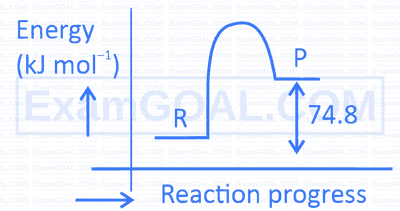
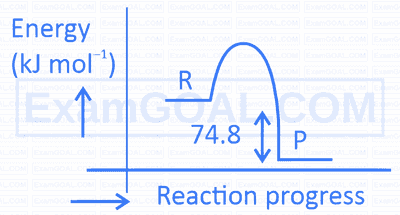
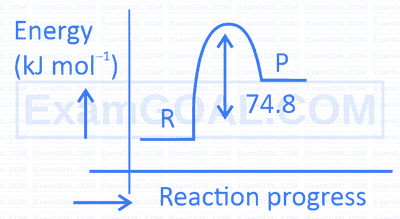
$\mathrm{C}(\mathrm{s})+2 \mathrm{H}_2(\mathrm{~g}) \rightarrow \mathrm{CH}_4(\mathrm{~g}) ; \Delta \mathrm{H}=-74.8 \mathrm{~kJ} \mathrm{~mol}^{-1}$. Which of the following diagrams gives an accurate representation of the above reaction? [ $\mathrm{R} \rightarrow$ reactants; $\mathrm{P} \rightarrow$ products]

Choose the correct statement for the work done in the expansion and heat absorbed or released when 5 litres of an ideal gas at 10 atmospheric pressure isothermally expands into vacuum until volume is 15 litres :
For an endothermic reaction:
(A) $\mathrm{q}_{\mathrm{p}}$ is negative.
(B) $\Delta_{\mathrm{r}} \mathrm{H}$ is positive.
(C) $\Delta_r \mathrm{H}$ is negative.
(D) $\mathrm{q}_{\mathrm{p}}$ is positive.
Choose the correct answer from the options given below:

For the following reaction at $300 \mathrm{~K}$
$\mathrm{A}_2(\mathrm{~g})+3 \mathrm{~B}_2(\mathrm{~g}) \rightarrow 2 \mathrm{AB}_3(\mathrm{~g})$
the enthalpy change is $+15 \mathrm{~kJ}$, then the internal energy change is :
In which of the following processes entropy increases?
A. A liquid evaporates to vapour.
B. Temperature of a crystalline solid lowered from $130 \mathrm{~K}$ to $0 \mathrm{~K}$.
C. $2 \mathrm{NaHCO}_{3(\mathrm{~s})} \rightarrow \mathrm{Na}_2 \mathrm{CO}_{3(\mathrm{~s})}+\mathrm{CO}_{2(\mathrm{~g})}+\mathrm{H}_2 \mathrm{O}_{(\mathrm{g})}$
D. $\mathrm{Cl}_{2(g)} \rightarrow 2 \mathrm{Cl}_{(g)}$
Choose the correct answer from the options given below:
Match List I with List II.
| List I (Process) |
List II (Conditions) |
||
|---|---|---|---|
| A. | Isothermal process | I. | No heat exchange |
| B. | Isochoric process | II. | Carried out at constant temperature |
| C. | Isobaric process | III. | Carried out at constant volume |
| D. | Adiabatic process | IV. | Carried out at constant pressure |
Choose the correct answer from the options given below:
The work done during reversible isothermal expansion of one mole of hydrogen gas at $25^{\circ} \mathrm{C}$ from pressure of 20 atmosphere to 10 atmosphere is (Given $\mathrm{R}=2.0 \mathrm{~cal} \mathrm{~K}^{-1} \mathrm{~mol}^{-1}$)
Consider the following reaction :-
$2 \mathrm{H}_2(\mathrm{~g})+\mathrm{O}_2(\mathrm{~g}) \rightarrow 2 \mathrm{H}_2 \mathrm{O}(\mathrm{g}) \Delta_{\mathrm{r}} \mathrm{H}^{\circ}=-483.64 \mathrm{~kJ} \text {. }$
What is the enthalpy change for decomposition of one mole of water? (Choose the right option).
The equilibrium concentrations of the species in the reaction $\mathrm{A}+\mathrm{B} \rightleftharpoons \mathrm{C}+\mathrm{D}$ are $2,3,10$ and $6 \mathrm{~mol}$ $\mathrm{L}^{-1}$, respectively at $300 \mathrm{~K} . \Delta \mathrm{G}^{0}$ for the reaction is $(\mathrm{R}=2 \mathrm{cal} / \mathrm{mol} ~\mathrm{K})$
Which amongst the following options is the correct relation between change in enthalpy and change in internal energy?
One mole of an ideal gas at 300 K is expanded isothermally from 1 L to 10 L volume. $\Delta$U for this process is :
(Use R = 8.314 J k$-$1 mol$-$1)
A vessel contains 3.2 g of dioxygen gas at STP (273.15 K and 1 atm pressure). The gas is now transferred to another vessel at constant temperature, where pressure becomes one third of the original pressure. The volume of new vessel in L is : (Given : molar volume at STP is 22.4 L)
Which of the following p-V curve represents maximum work done?


Sucrose + H2O ⇌ Glucose + Fructose
If the equilibrium constant (Kc) is 2 $ \times $ 1013 at 800 K, the value of $\Delta r{G^\Theta }$ at the same temperature will be :
$\Delta $U = 2.1 kcal, $\Delta $S = 20 cal K$-$1 at 300 K
Hence, G is
(i) C(graphite) + O2(g) $ \to $ CO2(g); $\Delta $rHo = x kJ mol$-$1
(ii) C(graphite) + ${1 \over 2}$O2(g) $ \to $ CO(g); $\Delta $rHo = y kJ mol$-$1
(iii) CO(g) + ${1 \over 2}$O2(g) $ \to $ CO2(g); $\Delta $rHo = z kJ mol$-$1
Based on the above equations, find out which of the relationship given below is correct.
| H (kJ/mol) | |
|---|---|
| 1/2A $ \to $ B | +150 |
| 3B $ \to $ 2C + D | -125 |
| E + A $ \to $ 2D | +350 |
For B + D $ \to $ E + 2C, $\Delta $H will be
4H(g) $ \to $ 2H2(g) is $-$869.6 kJ
The dissociation energy of H $-$ H bond is
| List I | List II | ||
|---|---|---|---|
| Equations | Type of processes | ||
| A. | Kp > Q | (i) | Non- spontaneous |
| B. | $\Delta $Go < RT ln Q | (ii) | Equilibrium |
| C. | Kp = Q | (iii) | Spontaneous and endothermic |
| D. | T > ${{\Delta H} \over {\Delta S}}$ | (iv) | Spontaneous |
Fe2O3(s) + 3CO(g) $ \to $ 2Fe(s) + 3CO2(g); $\Delta $H = $-$ 26.8 kJ
FeO(s) + CO(g) $ \to $ Fe(s) + CO2(g); $\Delta $H = $-$ 16.5 kJ
The value of $\Delta $H for the following reaction
Fe2O3(s) + CO(g) $ \to $ 2FeO(s) + CO2(g) is
1/2X2 + 3/2Y2 $\rightleftharpoons$ XY3, $\Delta $H = $-$ 30 kJ,
to be at equilibrium, the temperature should be
