Thermodynamics

(R = 8.314 JK–1 mol–1)
(i) 2Fe2O3(s) $ \to $ 4Fe(s) + 3O2(g);
$\Delta $rGo = + 1487.0 kJ mol-1
(ii) 2CO(g) + O2(g) $ \to $ 2CO2(g);
$\Delta $rGo = $-$ 514.4 kJ mol-1
Free energy change, $\Delta $rGo for the reaction
2Fe2O3(s) + 6CO(g) $ \to $ 4Fe(s) + 6CO2(g) will be :

$\Delta $UBC = $-$5 kJ mol-1, qAB = $2$ kJ mol-1, WAB = $-$5 kJ mol-1, WCA = 3 kJ mol-1. Heat absorbed by the system during process $CA$ is :
${P_{H2}}$ is the minimum partial pressure of ${H_2}$ (in bar) needed to prevent the oxidation at $1250$ $K.$ The value of $\ln \left( {{P_{H2}}} \right)$ is ________.
Given: total pressure $=1$ bar, $R$ (universal gas constant ) $=$ $8J{K^{ - 1}}\,\,mo{l^{ - 1}},$ $\ln \left( {10} \right) = 2.3.\,$ $Cu(s)$ and $C{u_2}O\left( s \right)$ are naturally immiscible.
At $1250$ $K:2Cu(s)$ $ + {\raise0.5ex\hbox{$\scriptstyle 1$} \kern-0.1em/\kern-0.15em \lower0.25ex\hbox{$\scriptstyle 2$}}{O_2}\left( g \right) \to C{u_2}O\left( s \right);$ $\Delta {G^ \circ } = - 78,000J\,mo{l^{ - 1}}$
${H_2}\left( g \right) + {\raise0.5ex\hbox{$\scriptstyle 1$} \kern-0.1em/\kern-0.15em \lower0.25ex\hbox{$\scriptstyle 2$}}{O_2}\left( g \right) \to {H_2}O\left( g \right);$
$\,\,\,\,\,\,\,\,\,\,\,\,\,\,\,\,\,\,\,$ $\Delta {G^ \circ } = - 1,78,000J\,mo{l^{ - 1}};$ ($G$ is the Gibbs energy)
Explanation:
$2Cu(s) + {1 \over 2}{O_2}(g) \to C{u_2}O(s);\Delta {G^o} = - 78,000$ J mol$-$1 ...... (1)
${H_2}(g) + {1 \over 2}{O_2}(g) \to {H_2}O(g);\Delta {G^o} = - 1,78,000$ J mol$-$1 ..... (2)
Subtracting Eq. (1) $-$ Eq. (2), we get
$2Cu(s) + {H_2}O(g) \to C{u_2}O(s) + {H_2}(g);\Delta {G^o} = + 100000$ J mol$-$1 ..... (3)
Now, $\Delta G = \Delta {G^o} + RT\ln \left( {{{{p_{{H_2}}}} \over {{p_{{H_2}O}}}}} \right)$
For the reaction (3) to not occur,
$\Delta G > 0$ or $\Delta {G^o} + RT\ln \left( {{{{p_{{H_2}}}} \over {{p_{{H_2}O}}}}} \right) > 0$
$ \Rightarrow 100000 + 8 \times 1250\ln \left( {{{{p_{{H_2}}}} \over {{p_{{H_2}O}}}}} \right) > 0$
$ \Rightarrow 100000 + 8 \times 1250\ln \left( {{{{p_{{H_2}}}} \over {{p_{{H_2}O}}}}} \right) > {{ - 100000} \over {8 \times 1250}}$
$ \Rightarrow \ln \left( {{{{p_{{H_2}}}} \over {{p_{{H_2}O}}}}} \right) > - 10$
$\ln {p_{{H_2}}} > - 10 + \ln {p_{{H_2}O}}$
Now, ${p_{{H_2}O}} = {x_{{H_2}O}} \times {p_T} = 0.01 \times 1 = {10^{ - 2}}$
So, $\ln {p_{{H_2}}} > - 10 - 2\ln 10 \Rightarrow {p_{{H_2}}} > - 14.6$ bar

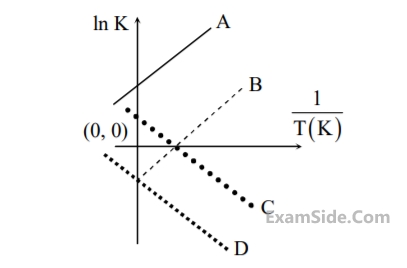
If ${T_2} > {T_1},$ the correct statement(s) is (are) (Assume $\Delta {H^ \circ }$ and $\Delta {S^ \circ }$ are independent of temperature and ratio of $lnK$ at ${T_1}$ to $lnK$ at ${T_2}$ is greater than ${{{T_2}} \over {{T_1}}}.$ Here $H,$ $S,G$ and $K$ are enthalpy, entropy, Gibbs energy and equilibrium constant, respectively.)

The correct option(s) is (are)
(Given $\Delta $fusH = 6 kJ mol$-$1 at 0oC,
Cp(H2O, $\ell $ = 75.3J mol$-$1 K$-$1)
Cp(H2O s) =36.8 J mol$-$1 K$-$1)
The correct statement for the reaction is :
${\Delta _r}{H^o}$ = - 393.5 kJ mol-1
${{\rm H}_2}(g)$ + ${1 \over 2}{O_2}(g)$$\to {{\rm H}_2}{\rm O}(l)$
${\Delta _r}{H^o}$ = - 285.8 kJ mol-1
$C{O_2}(g)$ + $2{{\rm H}_2}{\rm O}(l) \to$ $C{H_4}(g)$ + $2{O_2}(g)$
${\Delta _r}{H^o}$ = + 890.3 kJ mol-1
Based on the above thermochemical equations, the value of ${\Delta _r}{H^o}$ at 298 K for the reaction
${C_{(graphite)}}$ + $2{{\rm H}_2}(g) \to$ $C{H_4}(g)$ will be :


${\Delta _f}{G^0}$ [$C$(graphite)] $ = 0kJmo{l^{ - 1}}$
${\Delta _f}{G^0}$ [$C$(diamond)] $ = 2.9kJmo{l^{ - 1}}$
The standard state means that the pressure should be $1$ bar, and substance should be pure at a given temperature. The conversion of graphite [$C$(graphite)] to diamond [$C$(diamond)] reduces its volume by $2 \times {10^{ - 6}}\,{m^3}\,mo{l^{ - 1}}$ If $C$(graphite) is converted to $C$(diamond) isothermally at $T=298$ $K,$ the pressure at which $C$(graphite) is in equilibrium with $C$(diamond), is
[Useful information : $1$ $J=1$ $kg\,{m^2}{s^{ - 2}};1\,Pa = 1\,kg\,{m^{ - 1}}{s^{ - 2}};$ $1$ bar $ = {10^5}$ $Pa$]
2H2O2(l) $\rightleftharpoons$ 2H2O(l) + O2(g)
(R = 8.3 J K $-$1 mol$-$1)
M(s) + ${1 \over 2}$ O2(g) $ \to $ MO(s) and
C(s) + ${1 \over 2}$ O2(g) $ \to $ CO(s)

Identify the correct statement :
MO(s) + C(s) $ \to $ M(s) + CO(g) is spontaneous.
A(g) + B(g) $ \to $ C(g) + D(g), $\Delta $Ho and $\Delta $So are, respectively, − 29.8 kJ mol−1 and −0.100 kJ K−1 mol−1 at 298 K. The equilibrium constant for the reaction at 298 K is :
2NO(g) + O2 (g) $\leftrightharpoons$ 2NO2 (g)
The standard free energy of formation of NO(g) is 86.6 kJ/mol at 298 K. What is the standard free energy of formation of NO2(g) at 298 K? (KP = 1.6 × 10¹²)
Column I
(A) Freezing water at 273 K and 1 atm
(B) Expansion of 1 mol of an ideal gas into a vacuum under isolated conditions.
(C) Mixing of equal volumes of two ideal gases at constant temperature and pressure in an isolated container.
(D) Reversible heating of H2(g) at 1 atm from 300K to 600K, followed by reversible cooling to 300K at 1 atm
Column II
(p) q = 0
(q) w = 0
(r) $\Delta S_{sys}$ < 0
(s) $\Delta U$ = 0
(t) $\Delta G$ = 0
H2O(l) $\to$ H2O(g)
at T = 100oC and 1 atmosphere pressure, the correct choice is
(R = 8.314 J/mol K) ( l n 7.5 = 2.01)
The succeeding operations that enable this transformation of states are

The pair of isochoric processes among the transformation of states is
The reversible expansion of an ideal gas under adiabatic and isothermal conditions is shown in the figure. Which of the following statement(s) is(are) correct?

For an ideal gas, consider only P-V work in going from an initial state X to the final state Z. The final state Z can be reached by either of the two paths shown in the figure. Which of the following choice(s) is(are) correct? (Take $\Delta$S as change in entropy and W as work done)

Using the data provided, calculate the multiple bond energy (kJ mol$-$1) of a C=C bond in C2H2. That energy is (take the bond energy of C-H bond as 350 kJ mol$-$1).
$\matrix{ \hfill {2C(s) + {H_2}(g) \to {C_2}{H_2}} & \hfill {\Delta H = 225\,kJ\,mo{l^{ - 1}}} \cr \hfill {2C(s) \to 2C(g)} & \hfill {\Delta H = 1410\,kJ\,mo{l^{ - 1}}} \cr \hfill {{H_2}(g) \to 2H(g)} & \hfill {\Delta H = 330\,kJ\,mo{l^{ - 1}}} \cr } $
Column I
(A) CO2(s) $\to$ CO2(g)
(B) CaCO3(s) $\to$ CaO(s) + CO2(g)
(C) 2H $\to$ H2(g)
(D) P(white, solid) $\to$ P(red, solid)
Column II
(p) phase transition
(q) allotropic change
(r) $\Delta H$ is positive
(s) $\Delta S$ is positive
(t) $\Delta S$ is negative
One mole of an ideal gas is taken from $\mathbf{a}$ to $\mathbf{b}$ along two paths denoted by the solid and the dashed lines as shown in the graph below. If the work done along the solid line path is $W_{\text {s }}$ and that dotted line path is $W_{\mathrm{d}}$, then the integer closest to the ratio $W_{\mathrm{d}} / W_{\mathrm{s}}$ is

Explanation:
For calculating work done, we need to calculate the area under curve for solid and dotted lines.

Let ' $w_d$ and ' $w$ ' be work done along the dotted and solid path respectively.
$ \begin{aligned} & \mathrm{W}_d=\text { Area ABCD }+ \text { Area EFGC + Area FGIH } \\\\ & w_d =4 \times 1.5+1 \times 1+2.5 \times 2 / 3 \\\\ & =8.65 \end{aligned} $
$ \begin{aligned} &\text { Process of work done }\left(w_s\right) \text { is isothermal }\\\\ &\begin{aligned} w_s & =2 \times 2.303 \log \frac{5.5}{0.5} \\\\ & =2 \times 2.303 \times \log 11 \\\\ & =2 \times 2.303 \times 1.0414=4.79 \\\\ \frac{w_d}{w_s} & =\frac{8.65}{4.79}=1.80 \simeq 2 \end{aligned} \end{aligned} $($\Delta _fG^oH^+_{(aq)}$ = 0)
H2O(l) $\to$ H+(aq) + OH-(aq); $\Delta H$ = 57.32 kJ
H2(g) + ${1 \over 2} O_2(g) \to$ H2O(l); $\Delta H$ = -286.20 kJ
The value of enthalpy of formation of OH− ion at 25oC is :
In a constant volume calorimeter, 3.5 g of a gas with molecular weight 28 was burnt in excess oxygen at 298.0 K. The temperature of the calorimeter was found to increase from 298.0 K to 298.45 K due to the combustion process. Given that the heat capacity of the calorimeter is 2.5 kJ K$^{-1}$, the numerical value for the enthalpy of combustion of the gas in kJ mol$^{-1}$ is ____________.
Explanation:
To find the numerical value for the enthalpy of combustion of the gas in kJ mol$^{-1}$, we first need to determine the total heat released by the combustion of the gas within the calorimeter. We then convert this amount of heat into per mole of the gas. Step 1: Calculate the total heat released, $ q $.
The heat released, $ q $, due to combustion in the calorimeter can be calculated using the formula:
$ q = C \cdot \Delta T $
where:
- $ C $ is the heat capacity of the calorimeter, and
- $ \Delta T $ is the change in temperature.
In this problem:
- $ C = 2.5 \text{ kJ K}^{-1} $
- $ \Delta T = 298.45 \text{ K} - 298.0 \text{ K} = 0.45 \text{ K} $
Substituting these values into the equation gives:
$ q = 2.5 \text{ kJ K}^{-1} \times 0.45 \text{ K} = 1.125 \text{ kJ} $
The total heat released by the process is therefore 1.125 kJ, where this amount of heat is a measure of energy released and absorbed by the calorimeter, therefore it is positive.
Step 2: Convert the heat released to a molar basis.To convert the heat released into per mole of the gas, we first need to calculate the number of moles of the gas that was burnt. The number of moles, $ n $, can be calculated from the mass of the gas and its molecular weight:
$ n = \frac{\text{mass}}{\text{molecular weight}} $
In this problem:
- The mass of the gas = 3.5 g
- Molecular weight of the gas = 28 g mol$^{-1}$
Substituting these values gives:
$ n = \frac{3.5 \text{ g}}{28 \text{ g mol}^{-1}} = 0.125 \text{ mol} $
Step 3: Calculate the enthalpy of combustion per mole.The enthalpy of combustion per mole, $ \Delta H $, is given by:
$ \Delta H = \frac{q}{n} $
Substituting the values we obtained:
$ \Delta H = \frac{1.125 \text{ kJ}}{0.125 \text{ mol}} = 9 \text{ kJ mol}^{-1} $
Therefore, the enthalpy of combustion of the gas is $ -9 \text{ kJ mol}^{-1} $.
Note: The negative sign indicates that the process is exothermic (releases heat).
Among the following, the state function(s) is(are)