iCON Education HYD, 79930 92826, 73309 7282611 Jun 2026
For the complete combustion of ethanol, ${C_2}{H_5}OH(I) + 3{O_2}(g) \to 2C{O_2}(g) + 3{H_2}O(I)$, the amount of heat produced as measured in bomb calorimeter is 1364.47 kJ mol$-$1 at 25$^\circ$C. Assuming ideality the enthalpy of combustion, $\Delta$HC, for the reaction will be (R = 8.314 JK$-$1 mol$-$1)
iCON Education HYD, 79930 92826, 73309 7282614 Mar 2026
For a reaction,
4M(s) + nO2(g) $ \to $ 2M2On(s)
the free energy change is plotted as a function
of temperature. The temperature below which
the oxide is stable could be inferred from the
plot as the point at which :
A.
the free energy change shows a change
from negative to positive value
B.
the slope changes from positive to negative
C.
the slope changes from negative to positive
D.
the slope changes from positive to zero
Correct Answer: A
Explanation:
$\Delta $G = $\Delta $H – T$\Delta $S
$\Delta $G = –ve (stable oxide)
$\Delta $G = +ve (unstable oxide)
2020
Q254
JEE Mains
MCQ
iCON Education HYD, 79930 92826, 73309 7282614 Mar 2026
Lattice enthalpy and enthalpy of solution of NaCl are 788 kJ mol–1, and 4 kJ mol–1, respectively.
The hydration enthalpy of NaCl is :
A.
–780 kJ mol–1
B.
–784 kJ mol–1
C.
780 kJ mol–1
D.
784 kJ mol–1
Correct Answer: B
Explanation:
$\Delta $Hsol = Lattice enthalpy + $\Delta $Hhyd
$ \Rightarrow $ 4 = 788 + $\Delta $Hhyd
$ \Rightarrow $ $\Delta $Hhyd = –784 kJ mol–1
2020
Q255
JEE Mains
MCQ
iCON Education HYD, 79930 92826, 73309 7282614 Mar 2026
Five moles of an ideal gas at 1 bar and 298 K
is expanded into vacuum to double the volume.
The work done is :
A.
Zero
B.
-RT $\ln {{{V_2}} \over {{V_1}}}$
C.
CV (T2 – T1)
D.
– RT (V2 – V1)
Correct Answer: A
Explanation:
As the expansion is done in vacuum that is in absence of pext so
pext = 0
$ \therefore $ W = - pext$\Delta $V
= 0
2020
Q256
JEE Mains
MCQ
iCON Education HYD, 79930 92826, 73309 7282614 Mar 2026
The process that is NOT endothermic in nature
is :
A.
Ar(g) + e- $ \to $ Ar-(g)
B.
H(g) + e- $ \to $ H-(g)
C.
Na(g) $ \to $ Na+(g) + e-
D.
O-(g) + e- $ \to $ O2-(g)
Correct Answer: B
Explanation:
H(g) + e- $ \to $ H-(g) is exothermic
rest of all endothermic process.
2020
Q257
JEE Mains
MCQ
iCON Education HYD, 79930 92826, 73309 7282614 Mar 2026
For one mole of an ideal gas, which of these
statements must be true?
(a) U and H each depends only on temperature
(b) Compressibility factor z is not equal to 1
(c) CP, m – CV, m = R
(d) dU = CVdT for any process
A.
(a), (c) and (d)
B.
(a) and (c)
C.
(c) and (d)
D.
(b), (c) and (d)
Correct Answer: A
Explanation:
For 1 mole of ideal gas :
1. Both internal energy (U) and Enthalpy (H)
depends on temperature
2. Compressibility factor Z = 1
3. CP, m – CV, m = R
4. dU = CVdT for all process
2020
Q258
JEE Mains
MCQ
iCON Education HYD, 79930 92826, 73309 7282614 Mar 2026
The true statement amongst the following is :
A.
S is a function of temperature but $\Delta $S is not
a function of temperature.
B.
Both S and $\Delta $S are not functions of
temperature.
C.
Both $\Delta $S and S are functions of temperature.
D.
S is not a function of temperature but $\Delta $S is
a function of temperature.
Correct Answer: C
Explanation:
$\Delta S = \int {{{d{q_{rev}}} \over T}} $
S = Kln(w)
Both entropy and change in entropy are
function of temperature.
2020
Q259
JEE Mains
MCQ
iCON Education HYD, 79930 92826, 73309 7282614 Mar 2026
If enthalpy of atomisation for Br2(1) is x kJ/mol
and bond enthalpy for Br2 is y kJ/mol, the
relation between them :
A.
does not exist
B.
is x < y
C.
is x > y
D.
is x = y
Correct Answer: C
Explanation:
$ \therefore $ $\Delta $Hatomisation = $\Delta $HVap + Bond Energy
$ \Rightarrow $ x = $\Delta $HVap + y
$ \Rightarrow $ x $>$ y
2020
Q260
JEE Mains
Numerical
iCON Education HYD, 79930 92826, 73309 7282614 Mar 2026
For a dimerization reaction,
2A(g) $ \to $ A2(g)
at 298 K, $\Delta $Uo
= –20 kJ mol–1, $\Delta $So
= –30
JK–1 mol–1, then the $\Delta $Go
will be _____ J.
iCON Education HYD, 79930 92826, 73309 7282614 Mar 2026
The heat of combustion of ethanol into carbon
dioxide and water is – 327 kcal at constant
pressure. The heat evolved (in cal) at constant
volume and 27oC (if all gases behave ideally) is
(R = 2 cal mol–1 K–1) ________.
iCON Education HYD, 79930 92826, 73309 7282614 Mar 2026
At constant volume, 4 mol of an ideal gas when
heated from 300 K to 500K changes its internal
energy by 5000 J. The molar heat capacity at
constant volume is _______.
Correct Answer: 6.25
Explanation:
$\Delta $U = nCv$\Delta $T
$ \Rightarrow $ 5000 = 4 × Cv(500 – 300)
$ \Rightarrow $ Cv = 6.25 JK–1mol–1
2020
Q264
JEE Mains
Numerical
iCON Education HYD, 79930 92826, 73309 7282614 Mar 2026
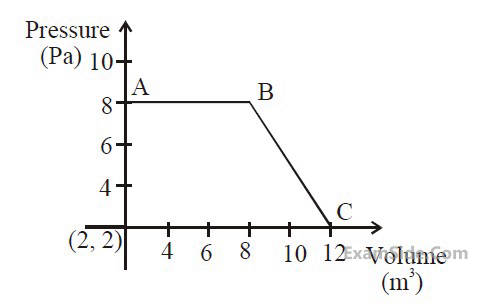
The magnitude of work done by a gas that undergoes a reversible expansion along the path ABC shown in
the figure is _______.
Correct Answer: 48
Explanation:
Work done = Area covered by the diagram
= $1\over2$ × (sum of parallel sides) × height
= $1\over2$ × (10+6) × 6
= $1\over2$ × 16 × 6
= 48 Joule
Note : Here pressure difference = 8 - 2 = 6 Pa and volume difference = 12 - 2 = 10
2020
Q265
JEE Mains
Numerical
iCON Education HYD, 79930 92826, 73309 7282614 Mar 2026
The standard heat of formation $\left( {{\Delta _f}H_{298}^0} \right)$ of ethane (in kj/mol), if the heat of combustion of
ethane, hydrogen and graphite are - 1560, -393.5 and -286 Kj/mol, respectively is :
iCON Education HYD, 79930 92826, 73309 7282614 Mar 2026
Tin is obtained from cassiterite by reduction with coke. Use the data given below to determine the minimum temperature (in K) at which the reduction of cassiterite by coke would take place.
At $298K:{\Delta _f}H^\circ [Sn{O_2}(s)] = - 581.0$ mol-1,
But, it is not applicable for irreversible process which are carried out very fast. So, work done is calculated assuming final pressure remains constant throughout the process. Thus, statement (a), (b) and (c) correct while statement (d) is incorrect.
2020
Q269
TS-EAMCET
MCQ
iCON Education HYD, 79930 92826, 73309 7282620 May 2026
Which of the following statements regarding the first law of thermodynamics is correct?
A.
The energy of the isolated system plus the energy of the surrounding is constant.
B.
The energy of the isolated system minus the energy of the surrounding is constant.
C.
The energy of an isolated system is constant.
D.
The energy of an isolated system varies.
Correct Answer: C
Explanation:
∵ According to first law of thermodynamics, the total energy of an isolated system remains constant, through it may change from one form to another. Thus, statement (c) is correct. Hence, option (c) is the correct answer.
2020
Q270
TS-EAMCET
MCQ
iCON Education HYD, 79930 92826, 73309 7282620 May 2026
(ii) $\mathrm{CO}_2(g) \longrightarrow \mathrm{CO}(g)+\frac{1}{2} \mathrm{O}_2(g) ; \Delta n_g=\left(1+\frac{1}{2}\right)-1=\frac{1}{2}$
So, $\Delta S>0$
2020
Q271
TS-EAMCET
MCQ
iCON Education HYD, 79930 92826, 73309 7282620 May 2026
Which of the following statement is correct?
A.
$\Delta G$ is equal to $\Delta G^{\circ}$ when the system is at the standard state.
B.
$\Delta G^{\circ}$ is zero when the system is at equilibrium.
C.
$\Delta G$ measures activation energy of a reaction.
D.
When $\Delta G$ is positive, the reaction should proceed forward to form more product.
Correct Answer: A
Explanation:
(a) $\Delta G=\Delta G^{\circ}$ for a standard system of STP condition $\left(25^{\circ} \mathrm{C}, 1 \mathrm{~atm}\right)$.
The corrected statements of options-(a), (c) and (d) will be like,
(b) At equilibrium state, $\Delta G=0$.
(c) $\Delta G$ measures spontaneity of a reaction.
(d) When $\Delta G>0$, the reaction will proceed in backward direction.
2020
Q272
TS-EAMCET
MCQ
iCON Education HYD, 79930 92826, 73309 7282620 May 2026
What will be the $\Delta U$ value, when one mole of oxygen $\left(\mathrm{O}_2\right)$ is going from $-20^{\circ} \mathrm{C}$ to $40^{\circ} \mathrm{C}$ at constant volume? (Molar heat capacity for oxygen $\simeq 20.8 \mathrm{~J} \mathrm{~mol}^{-1} \mathrm{~K}^{-1}$ )
A.
2496 J
B.
20.8 J
C.
416 J
D.
1248 J
Correct Answer: D
Explanation:
∵ Given, Molar heat capacity for oxygen
$ \begin{aligned} & =20.8 \mathrm{~J} \mathrm{~mol}^{-1} \mathrm{~K}^{-1} \\ Q & =n C \Delta T \end{aligned} $
where, $Q=$ value of $\Delta U$ in J
$ \begin{aligned} n & =\text { number of moles }(=1) \\ C & =\text { heat capacity } \\ \Delta T & =\text { temperature } \\ Q & =1 \times 20.8 \times 60 \end{aligned} $
Thus, $\Delta T=(-) 20$ to $(+) 40=60^{\circ} \mathrm{C}$
Hence, for one mole of oxygen, value of $\Delta U=60 \times 20.8=1248 \mathrm{~J}$ Hence, option (d) is the correct answer.
2020
Q273
TS-EAMCET
MCQ
iCON Education HYD, 79930 92826, 73309 7282620 May 2026
$\Delta H$ and $\Delta S$ for a reaction are $+30.0 \mathrm{~kJ} \mathrm{~mol}^{-1}$ and 0.06 $\mathrm{kJK}^{-1} \mathrm{~mol}^{-1}$ at 1 atm pressure. The temperature at which free energy change is equal to zero and nature of the reaction below this temperature are
A.
$500^{\circ} \mathrm{C}$ and non-spontaneous
B.
$227^{\circ} \mathrm{C}$ and non-spontaneous
C.
$400^{\circ} \mathrm{C}$ and spontaneous
D.
$127^{\circ} \mathrm{C}$ and spontaneous
Correct Answer: A
Explanation:
Given,
$ \begin{aligned} \Delta H & =+30.0 \mathrm{~kJ} \mathrm{~mol}^{-1} \\ \Delta S & =0.06 \mathrm{~kJ} \mathrm{~K}^{-1} \mathrm{~mol}^{-1} \\ p & =1 \mathrm{~atm} \\ \Delta G & =0 \end{aligned} $
We know that,
$ \Delta G=\Delta H-T \Delta S \Rightarrow 0=\Delta H-T \Delta S $
if, we put temperature $227^{\circ} \mathrm{C}$ or
$ 227+273=500 \mathrm{~K} $
In equation then the value of free energy is obtained will be zero.
iCON Education HYD, 79930 92826, 73309 7282611 Jun 2026
Which of the following statement is correct?
A.
$\Delta$S for ${1 \over 2}$Cl2(g) $\to$ Cl(g) is positive.
B.
$\Delta$E < 0 for combustion of CH4(g) in a sealed container with rigid adiabatic system.
C.
$\Delta$G is always zero for a reversible process in a closed system.
D.
$\Delta$G$^\circ$ for an ideal gas reaction is a function of pressure.
Correct Answer: A
Explanation:
Statement (a) is correct. Rest of the all statements are incorrect. These are explained as follows:
(a) Cl2(g) $\to$ 2Cl(g)
As randomness is increasing. Therefore, $\Delta$S is positive for this reaction.
$\therefore$ Statement is correct.
(b) In closed container, $\Delta$V = 0, hence work done is zero. There is no heat exchange. Hence, $\Delta$E = q + W = 0.
$\therefore$ Statement is incorrect.
(c) $\Delta$G will be zero only when equilibrium is reached.
$\therefore$ Statement is incorrect.
(d) $\Delta$G$^\circ$ = $-$RT ln Keq, not a function of pressure. Thus, this statement is also incorrect.
2020
Q275
BITSAT
MCQ
iCON Education HYD, 79930 92826, 73309 7282611 Jun 2026
At the top of a mountain the thermometer reads 0$^\circ$C and the barometer reads 710 mm Hg. At the bottom of the mountain the temperature is 30$^\circ$C and the pressure is 760 mm Hg. The ratio of the density of air at the top to that of the bottom is
A.
1 : 1.04
B.
0.4 : 1
C.
1.04 : 1
D.
1 : 04
Correct Answer: C
Explanation:
At top of a mountain,
T1 = 0 + 273 K, ${p_1} = {{710} \over {760}}$ atm and density = $\rho$1
iCON Education HYD, 79930 92826, 73309 7282611 Jun 2026
The enthalpies of combustion of carbon and carbon monoxide in excess of oxygen at 298 K and constant pressure are $-$393.5 kJ/mol and $-$280.0 kj/mol respectively. The heat of formation of carbon monoxide at constant volume is
A.
+ 111.7 kJ/mol
B.
$-$ 1111.7 kJ/mol
C.
$-$ 111.7 kJ/mol
D.
$-$ 11.7 kJ/mol
Correct Answer: C
Explanation:
Heat change at constant pressure means enthalpy change ($\Delta$rH = qp).
iCON Education HYD, 79930 92826, 73309 7282614 Mar 2026
An ideal gas is allowed to expand form 1 L to 10 L against a constant external pressure of I bar. The work
done in kJ is :
A.
+10.0
B.
–0.9
C.
– 2.0
D.
– 9.0
Correct Answer: B
Explanation:
This is an irreverseable process as gas is expanding against a constant external process.
Work done in irreverseable process
W = - Pext$\Delta $V
= - 1 bar $ \times $ 9 L
= - 105 Pa $ \times $ 9 $ \times $ 10-3 m3
= - 9 $ \times $ 102 N-m
= - 900 J
= - 0.9 kJ
2019
Q278
JEE Mains
MCQ
iCON Education HYD, 79930 92826, 73309 7282614 Mar 2026
Enthalpy of sublimation of iodine is 24 cal g–1
at 200 oC. If specific heat of I2(s) and l2 (vap) are 0.055 and
0.031 cal g–1K
–1
respectively, then enthalpy of sublimation of iodine at 250 oC in cal g–1
is :
$ \Rightarrow $ ${\Delta {H_{250^\circ C}}}$ = 22.8 cal g–1
2019
Q279
JEE Mains
MCQ
iCON Education HYD, 79930 92826, 73309 7282614 Mar 2026
The difference between $\Delta $H and $\Delta $U ($\Delta $H – $\Delta $U), when the combustion of one mole of heptane(l) is carried
out at a temperature T, is equal to :
A.
– 4 RT
B.
3 RT
C.
– 3 RT
D.
4 RT
Correct Answer: A
Explanation:
We know,
$\Delta $H - $\Delta $U = $\Delta $ngRT
C7H16($l$) + 11O2(g) $ \to $ 7CO2(g) + 8H2O($l$)
Here $\Delta $ng = 7 - 11 = - 4
$ \therefore $ $\Delta $H - $\Delta $U = - 4RT
2019
Q280
JEE Mains
MCQ
iCON Education HYD, 79930 92826, 73309 7282614 Mar 2026
A process will be spontaneous at all temperatures if :
A.
$\Delta $H < 0 and $\Delta $S > 0
B.
$\Delta $H < 0 and $\Delta $S < 0
C.
$\Delta $H > 0 and $\Delta $S < 0
D.
$\Delta $H > 0 and $\Delta $S > 0
Correct Answer: A
Explanation:
A reaction is spontaneous if $\Delta $G is negative.
and we know that
$\Delta $G = $\Delta $H – T$\Delta $S
If $\Delta $H = –ve and $\Delta $S = + ve then at all the temperature the process will be spontaneous.
2019
Q281
JEE Mains
MCQ
iCON Education HYD, 79930 92826, 73309 7282614 Mar 2026
During compression of a spring the work done
is 10kJ and 2kJ escaped to the surroundings as
heat. The change in internal energy, $\Delta $U(inkJ)
is :
A.
- 12
B.
8
C.
- 8
D.
12
Correct Answer: B
Explanation:
Here heat is released so q is negative.
$ \therefore $ q = - 2 kJ
Work done on the system, w = 10 kJ
From first law of thermodynamics,
$\Delta $U = q + w = -2 + 10 = 8 kJ
2019
Q282
JEE Mains
MCQ
iCON Education HYD, 79930 92826, 73309 7282614 Mar 2026
Among the following, the set of parameters that
represents path function, is :
(A) q + w
(B) q
(C) w
(D) H–TS
A.
(B) and (C)
B.
(A) and (D)
C.
(B), (C) and (D)
D.
(A), (B) and (C)
Correct Answer: A
Explanation:
(A) q + w = $\Delta $E, state function
(B) q, Path function
(C) w, Path function
(D) H – TS = G, State function
2019
Q283
JEE Mains
MCQ
iCON Education HYD, 79930 92826, 73309 7282614 Mar 2026
5 moles of an ideal gas at 100 K are allowed
to undergo reversible compression till its
temperature becomes 200 K.
If CV = 28 JK–1mol–1, calculate $\Delta $U and $\Delta $pV for
this process. (R = 8.0 JK–1 mol–1]
iCON Education HYD, 79930 92826, 73309 7282614 Mar 2026
Which one of the following equations does not correctly represent the first law of thermodynamics
for the given processes involving an ideal gas? (Assume non-expansion work is zero)
A.
Adiabatic process : $\Delta $U= – w
B.
Cyclic process : q = –w
C.
Isochoric process : $\Delta $U= q
D.
Isothermal process : q = – w
Correct Answer: A
Explanation:
From 1st law of thermodynamics we know,
$\Delta $U = q + W
Option A :
In adiabatic process exchage of heat = 0
$ \therefore $ q = 0
$ \therefore $ From 1st law of thermodynaics, $\Delta $U = W
So option A is wrong.
Option B :
U is a state function. In cyclic process, initial state and final state both are same. So change in all the state function in cyclic process will be zero.
$ \therefore $ $\Delta $U = 0
$ \therefore $ From 1st law of thermodynaics,
q + W = 0 $ \Rightarrow $ q = -W
So option B is correct..
Option C :
In isochoric process volume (V) is constant. So dV = 0.
We know, W = $ - \int {{P_{ex}}} dV$
$ \therefore $ W = 0
$ \therefore $ From 1st law of thermodynaics,
$\Delta $U = q
So option C is correct.
Option D :
In isothermal process temerature (T) is constant. So dT = 0.
We know, $\Delta $U = nCvdT
$ \therefore $ $\Delta $U = 0
$ \therefore $ From 1st law of thermodynaics,
q + W = 0 $ \Rightarrow $ q = -W
So option D is correct.
2019
Q285
JEE Mains
MCQ
iCON Education HYD, 79930 92826, 73309 7282614 Mar 2026
For silver, Cp(J K–1 mol–1) = 23 +0.01 T. If the temperature (T) of 3 moles of silver is raised from 300
K to 1000 K at 1 atm pressure, the value of $\Delta H$ will be close to :
Based on the above thermochemical equations, find out which one of the following algebraic relationships is correct?
A.
z = x + y
B.
x = y + z
C.
x = y – z
D.
y = 2z – x
Correct Answer: B
Explanation:
In reaction (i), the product is CO2
If we add reaction (ii) and (iii) we get,
C + O2 $ \to $ CO2 here also product is CO2 from same reactant C and O2.
So according to hess law, we can say
x = y + z
2019
Q287
JEE Mains
MCQ
iCON Education HYD, 79930 92826, 73309 7282614 Mar 2026
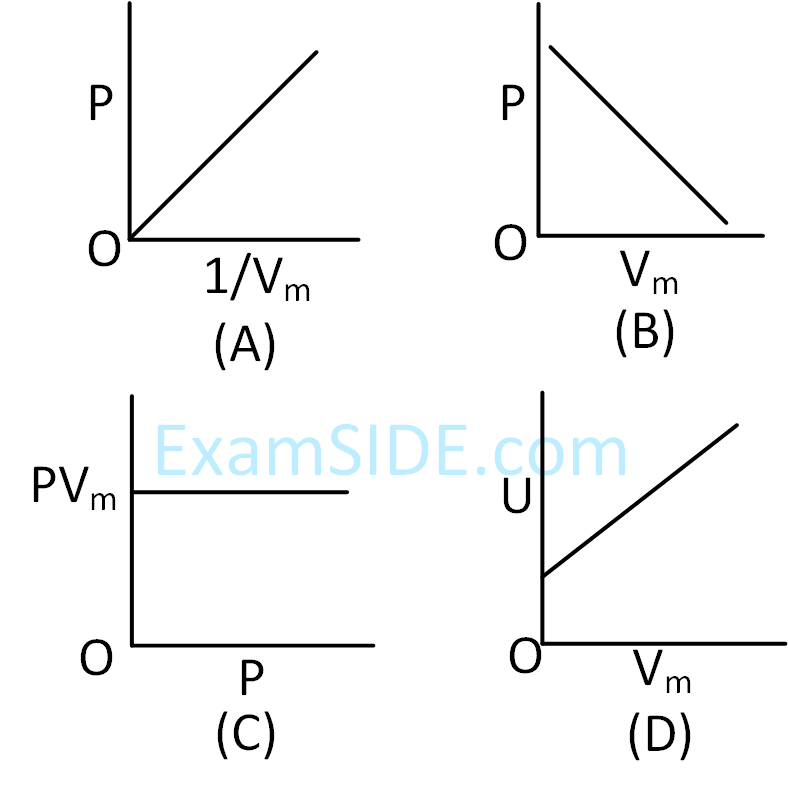
The combination of plots which does not represent isothermal expansion of an ideal gas is –
A.
A and D
B.
B and D
C.
B and C
D.
A and C
Correct Answer: B
Explanation:
For isothermal process of ideal gas,
PV = constants = K
$ \therefore $ P = ${k \over v}$
So, the graph between P and ${1 \over v}$ is straight line passing through the origin. So, graph (A) is correct.
As PV = K so the P and V curve is hyperbola. So, graph (B) is wrong.
In isothermal PV = constant.
So, graph (C) is right.
We know internal energy (u) = ${f \over 2}$ nRT. Internal energy is function of temperature (T) only. So, U does not change when volume(V) changes. So, graph (D) is wrong.
2019
Q288
JEE Mains
MCQ
iCON Education HYD, 79930 92826, 73309 7282614 Mar 2026
For diatomic ideal gas in a closed system, which of the following plots does not correctly describe the relation between various thermodynamic quantities?
A.
B.
C.
D.
Correct Answer: D
Explanation:
CP does not changes with change in pressure.
2019
Q289
JEE Mains
MCQ
iCON Education HYD, 79930 92826, 73309 7282614 Mar 2026
The reaction, MgO(s) + C(s) $ \to $ Mg(s) + CO(g), for which $\Delta $rHo + 491.1 kJ mol–1 and $\Delta $rSo = 198.0 JK–1 mol–1, is not feasible at 298 K. Temperature above which reaciton will be feasible is :
A.
2480.3 K
B.
2040.5 K
C.
2380.5 K
D.
1890.0 K
Correct Answer: A
Explanation:
We know,
$\Delta $Go = $\Delta $Ho - T$\Delta $So
For a reaction to be spontaneous $\Delta $Go must be negative i.e.,
T$\Delta $So > $\Delta $Ho
iCON Education HYD, 79930 92826, 73309 7282614 Mar 2026
The standard reaction Gibbs energy for a chemical reaction at an absolute temperature T is given by
$\Delta $rGo = A – BT
Where A and B are non-zero constants. Which of the following is TRUE about this reaction?
A.
Exothermic if B < 0
B.
Endothermic if A > 0
C.
Exothermic if A > 0 and B < 0
D.
Endothermic if A < 0 and B > 0
Correct Answer: B
Explanation:
$\Delta $Go = $\Delta $Ho - T$\Delta $So
Given that A and B are non-zero constants, i.e., A = $\Delta $Ho, B = $\Delta $So
If $\Delta $Ho is positive means reaction is endothermic.
2019
Q292
JEE Mains
MCQ
iCON Education HYD, 79930 92826, 73309 7282614 Mar 2026
For the chemical reaction X $\rightleftharpoons$ Y, the standard reaction Gibbs energy depends on temperature T (in K) as
$\Delta $rGo (in kJ mol–1) = 120 $ - {3 \over 8}$ T.
The major component of the reaction mixture at T is :
A.
Y if T = 300 K
B.
Y if T = 280 K
C.
X if T = 350 K
D.
X if T = 315 K
Correct Answer: D
Explanation:
X $\rightleftharpoons$ Y
Keq = ${{\left[ Y \right]} \over {\left[ X \right]}}$
If Keq > 1 $ \Rightarrow $ [Y] > [X]
and Keq < 1 $ \Rightarrow $ [Y] < [X]
We know, $\Delta $Go = -RT ln(Keq)
So when Keq > 1 then $\Delta $Go < 0 and Y is major.
And when Keq < 1 then $\Delta $Go > 0 and X is major.
Temperature at which Go = 0 is
120 $ - {3 \over 8}$ T = 0
$ \Rightarrow $ T = 320 K
For T > 320 K
$\Delta $Go < 0 and Y is major.
For T < 320 K
$\Delta $Go > 0 and X is major.
2019
Q293
JEE Mains
MCQ
iCON Education HYD, 79930 92826, 73309 7282614 Mar 2026
Two blocks of the same metal having same mass and at temperature T1 and T2, respectively, are brought in contact with each other and allowed to attain thermal equilibrium at constant pressure. The change in entropy, $\Delta $S, for this process is :
iCON Education HYD, 79930 92826, 73309 7282614 Mar 2026
An ideal gas undergoes isothermal compression from 5m3 to 1 m3 against a constant external pressure of 4 Nm–2. Heat released in this process is used to increase the temperature of 1 mole of Al. If molar heat capacity of Al is 24 J mol–1 K–1, the temperature of Al increases by :
A.
${2 \over 3}K$
B.
${3 \over 2}K$
C.
1 K
D.
2 K
Correct Answer: A
Explanation:
Work done on isothermal irreversible for ideal gas
iCON Education HYD, 79930 92826, 73309 7282614 Mar 2026
A process has $\Delta $H = 200 J mol–1 and $\Delta $S = 40 JK–1 mol–1. Out of the values given below, choose the minimum temperature above which the process will be spontaneous :
iCON Education HYD, 79930 92826, 73309 7282614 Mar 2026
The entropy change associated with the conversion of 1 kg of ice at 273 K to water vapours at 383 K is :
(Specific heat of water liquid and water vapour are 4.2 kJ K$-$1 kg$-$1 and 2.0 kJ K$-$1 kg$-$1; heat of liquid fusion and vapourisation of water are 334 kJ$-$1 and 2491 kJ kg$-$1, respectively). (log 273 = 2.436, log 373 = 2.572, log 383 = 2.583)
iCON Education HYD, 79930 92826, 73309 7282614 Mar 2026
Consider the reversible isothermal expansion of an ideal gas in a closed system at two different temperatures T1 and T2 (T1 < T2). The correct graphical depiction of the dependence of work done (w) on the final volume (V) is :
We get slope is nRT and intercept $-$ nRT lnV1 in $\left| W \right|$ and lnV graph.
As T2 > T1 So,
Slope nRT2 > nRT1
and intercept
$-$ nRT2 lnV1 < $-$ nRT1 lnV1
So, we can say
(1) slope of T2 line is more then T1
(2) intercept of T1 line is less negative than T2 line, and intercept of T1 can't be positive, it can be 0 or less than 0 as $-$ nRT1lnV1 always $ \le $ 0
2019
Q299
JEE Advanced
MSQ
iCON Education HYD, 79930 92826, 73309 7282614 Mar 2026
Choose the reaction(s) from the following options, for which the standard enthalpy of reaction of equal to the standard enthalpy of formation.
A.
2C(g) + 3H2(g) $ \to $ C2H6(g)
B.
2H2(g) + O2(g) $ \to $ 2H2O(l)
C.
${3 \over 2}$O2(g) $ \to $ O3(g)
D.
${1 \over 8}$S8(s) + O2(g) $ \to $ SO2(g)
Correct Answer: C,D
Explanation:
The standard enthalpy of formation is defined as standard enthalpy change for formation of 1 mole of a substance from its elements, present in their most stable state of aggregation.
${3 \over 2}$O2(g) $ \to $ O3(g);
${1 \over 8}$S8(s) + O2(g) $ \to $ SO2(g)
In the above two reactions standard enthalpy of reaction is equal to standard enthalpy of formation.
2019
Q300
JEE Advanced
MSQ
iCON Education HYD, 79930 92826, 73309 7282614 Mar 2026
Which of the following statement(s) is(are) correct regarding the root mean square speed (Urms) and average translational kinetic energy (Eav) of a molecule in a gas at equilibrium?
A.
Urms is inversely proportional to the square root of its molecular mass.
B.
Urms is doubled when its temperature is increased four times.
C.
Eavg is doubled when its temperature is increased four times.
D.
Eavg at a given temperature does not depend on its molecular mass.
Correct Answer: A,B,D
Explanation:
The explanation of given statements are as follows :
(a) Urms is inversely proportional to the square root of its molecular mass.
${U_{rms}} = \sqrt {{{3RT} \over M}} $
Hence, option (a) is correct.
(b) When temperature is increased four times then Urms become doubled.
${U_{rms}} = \sqrt {{{3R} \over M} \times 4T} $
${U_{rms}} = 2 \times \sqrt {{{3RT} \over M}} $
Hence, option (b) is correct.
(c) and (d) Eav is directly proportional to temperature but does not depends on its molecular mass at a given temperature as ${E_{av}} = {3 \over 2}KT$. If temperature raised four times than Eav becomes four time multiple.
Thus, option (c) is incorrect and option (d) is correct.