Chemical Kinetics and Nuclear Chemistry
224 Questions
Start JEE Mains Test
2006
Q201
JEE Mains
MCQ
14 Mar 2026
Rate of a reaction can be expressed by Arrhenius equation as:
$$k = A\,{e^{ - E/RT}}$$ In this equation, E represents
$$k = A\,{e^{ - E/RT}}$$ In this equation, E represents
A.
the energy above which all the colliding molecules will react
B.
the energy below which colliding molecules will not react
C.
the total energy of the reacting molecules at a temperature, T
D.
the fraction of molecules with energy greater than the activation energy of the reaction
2006
Q202
JEE Mains
MCQ
14 Mar 2026
In the transformation of ${}_{92}^{238}U$ to ${}_{92}^{234}U$, if one emission is an α-particle, what should be the other
emission(s)?
A.
Two $\beta^-$
B.
Two $\beta^-$ and one $\beta^+$
C.
One $\beta^-$ and one $\gamma$
D.
One $\beta^+$ and One $\beta^-$
2006
Q203
JEE Mains
MCQ
14 Mar 2026
The following mechanism has been proposed for the reaction of NO with Br2 to form NOBr:
NO(g) + Br2 (g) $\leftrightharpoons$ NOBr2 (g)
NOBr2 (g) + NO (g) $\to$ 2NOBr (g)
If the second step is the rate determining step, the order of the reaction with respect to NO(g) is
NO(g) + Br2 (g) $\leftrightharpoons$ NOBr2 (g)
NOBr2 (g) + NO (g) $\to$ 2NOBr (g)
If the second step is the rate determining step, the order of the reaction with respect to NO(g) is
A.
1
B.
0
C.
3
D.
2
2006
Q204
JEE Mains
MCQ
14 Mar 2026
A reaction was found to be second order with respect to the concentration of carbon monoxide. If the
concentration of carbon monoxide is doubled, with everything else kept the same, the rate of reaction
will
A.
remain unchanged
B.
triple
C.
increase by a factor of 4
D.
double
2005
Q205
JEE Mains
MCQ
14 Mar 2026
A reaction involving two different reactants can never be
A.
Unimolecular reaction
B.
First order reaction
C.
second order reaction
D.
Bimolecular reaction
2005
Q206
JEE Mains
MCQ
14 Mar 2026
Hydrogen bomb is based on the principle of
A.
Nuclear fission
B.
Natural radioactivity
C.
Nuclear fusion
D.
Artificial radioactivity
2005
Q207
JEE Mains
MCQ
14 Mar 2026
A schematic plot of $ln$ ${K_{eq}}$ versus inverse of temperature for a reaction is shown below
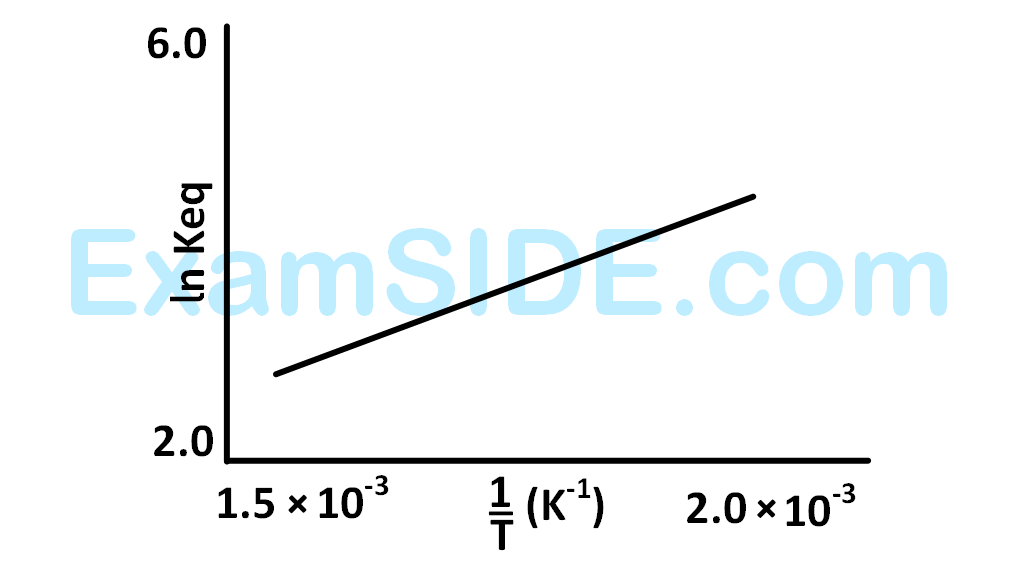
The reaction must be
The reaction must be
A.
highly spontaneous at ordinary temperature
B.
one with negligible enthalpy change
C.
endothermic
D.
exothermic
2005
Q208
JEE Mains
MCQ
14 Mar 2026
t1/4 can be taken as the time taken for the concentration of a reactant to drop to $3 \over 4$ of its initial value. If the rate constant for a first order reaction is K, the t1/4 can be written as
A.
0.10 / K
B.
0.29 / K
C.
0.69 / K
D.
0.75 / K
2005
Q209
JEE Mains
MCQ
14 Mar 2026
The photon of hard gamma radiation knocks a proton out of ${}_{12}^{24}Mg$ nucleus to form
A.
the isotope of parent nucleus
B.
the isobar of parent nucleus
C.
the nuclide ${}_{11}^{23}Na$
D.
the isobar of ${}_{11}^{23}Na$
2004
Q210
JEE Mains
MCQ
14 Mar 2026
Consider the following nuclear reactions
${}_{92}^{238}M \to {}_Y^XN + 2{}_2^4He$
${}_Y^XN \to {}_B^AL + 2{\beta ^ + }$
The number of neutrons in the element L is
${}_{92}^{238}M \to {}_Y^XN + 2{}_2^4He$
${}_Y^XN \to {}_B^AL + 2{\beta ^ + }$
The number of neutrons in the element L is
A.
140
B.
144
C.
142
D.
146
2004
Q211
JEE Mains
MCQ
14 Mar 2026
The rate equation for the reaction 2A + B $\to$ C is found to be: rate k[A][B]. The correct
statement in relation to this reaction is that the
A.
unit of K must be s-1
B.
values of k is independent of the initial concentration of A and B
C.
rate of formation of C is twice the rate of disappearance of A
D.
t1/2 is a constant
2004
Q212
JEE Mains
MCQ
14 Mar 2026
In a first order reaction, the concentration of the reactant decreases from 0.8 M to 0.4 M in 15
minutes. The time taken for the concentration to change from 0.1 M to 0.025 M is
A.
30 minutes
B.
60 minutes
C.
7.5 minutes
D.
15 minutes
2004
Q213
JEE Mains
MCQ
14 Mar 2026
The half – life of a radioisotope is four hours. If the initial mass of the isotope was 200 g, the
mass remaining after 24 hours undecayed is
A.
1.042 g
B.
4.167 g
C.
3.125 g
D.
2.084 g
2003
Q214
JEE Mains
MCQ
14 Mar 2026
The half-life of a radioactive isotope is three hours. If the initial mass of the isotope were 256 g, the mass of
it remaining undecayed after 18 hours would be
A.
8.0 g
B.
12.0 g
C.
16.0 g
D.
4.0 g
2003
Q215
JEE Mains
MCQ
14 Mar 2026
For the reaction system:
2NO(g) + O2(g) $\to$ 2NO2(g) volume is suddenly reduce to half its value by increasing the pressure on it. If the reaction is of first order with respect to O2 and second order with respect to NO, the rate of reaction will
2NO(g) + O2(g) $\to$ 2NO2(g) volume is suddenly reduce to half its value by increasing the pressure on it. If the reaction is of first order with respect to O2 and second order with respect to NO, the rate of reaction will
A.
diminish to one-eighth of its initial value
B.
increase to eight times of its initial value
C.
increase to four times of its initial value
D.
diminish to one-fourth of its initial value
2003
Q216
JEE Mains
MCQ
14 Mar 2026
The rate law for a reaction between the substances A and B is given by Rate = k[A]n [B]m On doubling the concentration of A and halving the concentration of B, the ratio of the new rate to the earlier rate of the reaction will be as
A.
(m + n)
B.
(n - m)
C.
2( n - m)
D.
${1 \over {{2^{(m + n)}}}}$
2003
Q217
JEE Mains
MCQ
14 Mar 2026
The radionucleide ${}_{90}^{234}Th$ undergoes two successive $\beta$ -decays followed by one $\alpha$-decay. The atomic number
and the mass number respectively of the resulting radionucleide are
A.
94 and 230
B.
90 and 230
C.
92 and 230
D.
92 and 234
2003
Q218
JEE Mains
MCQ
14 Mar 2026
In respect of the equation k = Ae-Ea/RT in chemical kinetics, which one of the following statements is correct?
A.
A is adsorption factor
B.
Ea is energy of activation
C.
R is Rydberg’s constant
D.
k is equilibrium constant
2002
Q219
JEE Mains
MCQ
14 Mar 2026
The integrated rate equation is Rt = log C0 - log Ct . The straight line graph is obtained by
plotting
A.
time vs log Ct
B.
${1 \over {time}}$ vs Ct
C.
time vs Ct
D.
${1 \over {time}}$ vs ${1 \over {{C_t}}}$
2002
Q220
JEE Mains
MCQ
14 Mar 2026
Units of rate constant of first and zero order reactions in terms of molarity M unit are respectively
A.
sec-1, Msec-1
B.
sec-1, M
C.
Msec-1, sec-1
D.
M, sec-1
2002
Q221
JEE Mains
MCQ
14 Mar 2026
$\beta$ - particle is emitted in radioactivity by
A.
conversion of proton to neutron
B.
from outermost orbit
C.
conversion of neutron to proton
D.
$\beta$ -particle is not emitted
2002
Q222
JEE Mains
MCQ
14 Mar 2026
If half-life of a substance is 5 yrs, then the total amount of substance left after 15 years, when initial amount is 64 grams is
A.
16 grams
B.
2 grams
C.
32 grams
D.
8 grams
2002
Q223
JEE Mains
MCQ
14 Mar 2026
For the reaction A + 2B $\to$ C, rate is given by R = [A] [B]2 then the order of the reaction is
A.
3
B.
6
C.
5
D.
7
2002
Q224
JEE Mains
MCQ
14 Mar 2026
The differential rate law for the reaction H2 + I2 $\to$ 2HI is
A.
$ - {{d\left[ {{H_2}} \right]} \over {dt}}$ = $ - {{d\left[ {{I_2}} \right]} \over {dt}}$ = $ - {{d\left[ {{HI}} \right]} \over {dt}}$
B.
$ {{d\left[ {{H_2}} \right]} \over {dt}}$ = $ {{d\left[ {{I_2}} \right]} \over {dt}}$ = $ {{d\left[ {{HI}} \right]} \over {dt}}$
C.
${1 \over 2}{{d\left[ {{H_2}} \right]} \over {dt}}$ = ${1 \over 2}{{d\left[ {{I_2}} \right]} \over {dt}}$ = $ - {{d\left[ {{HI}} \right]} \over {dt}}$
D.
$ - 2{{d\left[ {{H_2}} \right]} \over {dt}}$ = $ - 2{{d\left[ {{I_2}} \right]} \over {dt}}$ = ${{d\left[ {{HI}} \right]} \over {dt}}$