Biomolecules
A certain compound gives negative test with ninhydrin and positive test with Benedict's solution, it is
Given below are two statements. One is labelled as Assertion A and the other is labelled as Reason R.
Assertion A: Amylose is insoluble in water.
Reason R: Amylose is a long linear molecule with more than 200 glucose units.
In the light of the above statements, choose the correct answer from the options given below.
The formulas of A and B for the following reaction sequence

are

For the below given cyclic hemiacetal (X), the correct pyranose structure is :


Match List - I with Match List - II.
| List - I | List - II | ||
|---|---|---|---|
| (A) | Glucose + HI | (I) | Gluconic acid |
| (B) | Glucose + Br$_2$ water | (II) | Glucose pentacetate |
| (C) | Glucose + acetic anhydride | (III) | Saccharic acid |
| (D) | Glucose + HNO$_3$ | (IV) | Hexane |
Choose the correct answer from the options given below:

A sugar 'X' dehydrates very slowly under acidic condition to give furfural which on further reaction with resorcinol gives the coloured product after sometime. Sugar 'X' is

Animal starch is the other name of
Which one of the following is a reducing sugar?


Glycosidic linkage between C1 of $\alpha$-glucose and C2 of $\beta$-fructose is found in

During the denaturation of proteins, which of these structures will remain intact?
The sugar produced after complete hydrolysis of DNA is
The structure of protein that is unaffected by heating is
Sugar moiety in DNA and RNA molecules respectively are
When sugar 'X' is boiled with dilute H2SO4 in alcoholic solution, two isomers 'A' and 'B' are formed. 'A' on oxidation with HNO3 yields saccharic acid where as 'B' is laevorotatory. The compound 'X' is :

Stability of $\alpha$-Helix structure of proteins depends upon
Given below are two statements.
Statement I : Maltose has two $\alpha$-D-glucose units linked at C1 and C4 and is a reducing sugar.
Statement II : Maltose has two monosaccharides : $\alpha$-D-glucose and $\beta$-D-glucose linked at C1 and C6 and it is a non-reducing sugar.
In the light of the above statements, choose the correct answer from the options given below :

L-isomer of a compound 'A' (C4H8O4) gives a positive test with [Ag(NH3)2]+. Treatment of 'A' with acetic anhydride yields triacetate derivative. Compound 'A' produces an optically active compound (B) and an optically inactive compound (C) on treatment with bromine water and HNO3 respectively. Compound (A) is :


Match List-I with List-II
| List - I Enzyne |
List - II Conversion of |
||
|---|---|---|---|
| A. | Invertase | I. | Starch into maltose |
| B. | Zymase | II. | Maltose into glucose |
| C. | Diastase | III. | Glucose into ethanol |
| D. | Maltase | IV. | Cane sugar into glucose |
Choose the most appropriate answer from the options given below :
Which one of the following is a water soluble vitamin, that is not excreted easily?
A polysaccharide 'X' on boiling with dil H2SO4 at 393 K under 2-3 atm pressure yields 'Y'. 'Y' on treatment with bromine water gives gluconic acid. 'X' contains $\beta$-glycosidic linkages only. Compound 'X' is :

In a linear tetrapeptide (Constituted with different amino acids), (number of amino acids) $-$ (number of peptide bonds) is ________.
Explanation:
No. of amino acids = 4
No. of peptide bonds = 3
Hence, (1)
C6H12O6 $\buildrel \text{Zymase} \over \longrightarrow $ A $\mathrel{\mathop{\kern0pt\longrightarrow} \limits_\Delta ^\text{NaOI}} $ B + CHI3
The number of carbon atoms present in the product B is _______________.
Explanation:
The number of oxygens present in a nucleotide formed from a base, that is present only in RNA is ___________.
Explanation:

Structure of nucleotides number of 0-9.
How many of the given compounds will give a positive Biuret test ____________ ?
Glycine, Glycylalanine, Tripeptide, Biuret
Explanation:
In alanylglycyl leucyl alanyl valine, the number of peptide linkages is ___________.
Explanation:
$\text { ALA - GLY - LEU - ALA - VAL }$
It has 4 peptide linkages.


Assertion (A) In aqueous solution, amino acids exist in dipolar ion form.
Reason (R) Most of the naturally occurring amino acids have $L$-configuration.
The correct option among the following is
(A) is true, (R) is true and (R) is the correct explanation for (A).
(A) is true, (R) is true but (R) is not the correct explanation for (A).
(A) is true but (R) is false.
(A) is false but (R) is true.

$ \text { Consider the following structures } $


Which of the pairs represent $D$ and $L$-fructose, respectively?
II and I
I and III
III and IV
II and IV


Assertion (A) Both glucose and fructose have the same $D$-configuration.
Reason (R) Both glucose and fructose are dextrorotatory.
The correct option among the following is
(A) is true, (R) is true and (R) is the correct explanation for (A)
(A) is true, (R) is true but (R) is not the correct explanation for (A)
(A) is true but (R) is false
(A) is false but (R) is true

The amount of sucrose needed to produce 1 mole of glucose using acid hydrolysis is
360 g
180 g
342 g
171 g
Assertion (A) The denaturation of proteins can destroy all $1^{\circ}, 2^{\circ}$ and $3^{\circ}$ protein structures.
Reason (R) Curdling of milk is due to denaturation of proteins.
The correct option among the following is
(A) is true, (R) is true and (R) is the correct explanation for (A)
(A) is true, (R) is true but (R) is not the correct explanation for (A)
(A) is true but (R) is false
(A) is false but (R) is true
Match the following
| List - I (Enzyme) | List - II (Reaction) | ||
|---|---|---|---|
| A. | Invertase | I. | Maltose $\rightarrow$ Glucose |
| B. | Pepsin | II. | Sucrose $\rightarrow$ Glucose + Fructose |
| C. | Diastase | III. | Proteins $\rightarrow$ Peptides |
| IV. | Starch $\rightarrow$ Maltose |
Carbohydrates are stored in plants and animals in which of the following forms respectively?
Glycylalanine is a dipeptide of which amino acids?


Pernicious anemia is caused due to deficiency of which vitamin ?
Which of the following vitamins cannot be stored in the body?
Which hormone tends to increase the blood glucose level in human?
Which of the following molecules is eliminated during peptide bond formation?

Glucose reacts with X number of molecules of phenyl hydrazine to yield osazone. The value of X is,


Assertion (A) : Sucrose is a disaccharide and a non-reducing sugar.
Reason (R) : Sucrose involves glycosidic linkage between C1 of $\beta$-glucose and C2 of $\alpha$-fructose.
Choose the most appropriate answer from the options given below :
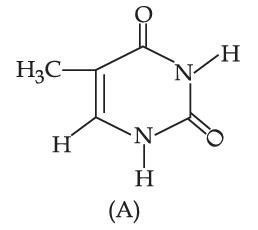
The compound 'A' is a complementary base of _______________ in DNA stands.


