Practical Organic Chemistry
Explanation:
wt. of N = $\left( {{{42} \over {100}} \times 0.8} \right)$ gm
mole of N = ${{{42 \times 0.8} \over {100 \times 14}} = {{2.4} \over {100}}}$ mol
moles of NH3 = ${{{2.4} \over {100}}}$

${{{1.2} \over {100}}}$ = 1 $\times$ V(l)
${ \Rightarrow {V_{{H_2}S{O_4}}} = {{1.2} \over {100}}l = 12}$ ml
Explanation:
10 gm of C6H6 = ${{10} \over {78}}$ mole
Moles of methylbenzene should be obtained = ${{10} \over {78}}$ mole
= $\left( {{{10} \over {78}} \times 92} \right)gm $
$ \therefore $ ${{{A_y}} \over {{T_y}}} = \% $ yield $ = {{9.2} \over {920}} \times 78 \times 100 \Rightarrow 78\% $
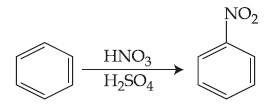
In the above reaction, 3.9 g of benzene on nitration gives 4.92 g of nitrobenzene. The percentage yield of nitrobenzene in the above reaction is ________%. (Round off to the Nearest Integer).
(Given atomic mass : C : 12.0 u, H : 1.0 u, O : 16.0 u, N : 14.0 u)
Explanation:

Weight of (C6H5NO2)Theoretical = ${{{3.9} \over {78}} \times 123}$ = 6.15 g
% yield of reaction = ${{{W_{actual}}} \over {{W_{theoretical}}}} \times 100 = {{4.92} \over {6.15}} \times = 80\% $
Explanation:
Hence actual pressure = (758 – 14)
= 744 mm of Hg.
Moles of ${N_2} = {{\left( {758 - 14} \right)} \over {760}} \times {{30 \times {{10}^{ - 3}}} \over {0.0821 \times 287}}$
$ = 1.246 \times {10^{ - 3}}$ mol
mass of ${N_2} = 1.246 \times {10^{ - 3}} \times 28$
mass % of N2 $ = {{mass\,of\,'N'} \over {total\,mass}} \times 100$
$ = {{1.246 \times 28 \times {{10}^{ - 3}}} \over {0.184}} \times 100$
$ = {{124.6 \times 28} \over {0.184}}\% = 18.96\% $
$ \simeq 19\% $
(i) 4.5 mL
(ii) 4.5 mL
(iii) 4.4 mL
(iv) 4.4 mL
(v) 4.4 mL
If the volume of oxalic acid taken was 10.0 mL then the molarity of the NaOH solution is ________ M. (Rounded off to the nearest integer)
Explanation:
Average burette reading = Volume of NaOH solution (V1)
$ = {{4.5 + 4.5 + 4.4 + 4.4 + 4.4} \over 5}$
= 4.44 mL
Strength of NaOH solution = S1(M) (say) = S1(N)
Volume of oxalic acid solution (V2) = 10 mL
Strength of oxalic acid solution (S2) = 1.25 M = 1.25 $\times$ 2 N
So, ${V_1}{S_1} = {V_2}{S_2}$ ($\because$ Law of equivalence)
$ \Rightarrow {S_1} = {{{V_2}{S_2}} \over {{V_1}}} = {{10 \times (1.25 \times 2)} \over {4.44}} = 5.63$ N
$ \simeq 6M = 6M$
In Lassaigne’s test for halogens, it is necessary to remove X and Y from the sodium fusion extract, if nitrogen and sulphur are present. This is done by boiling the extract with Z. Identify X, Y and Z.


$ \begin{array}{|l|l|l|l|} \hline & \begin{array}{l} \text { Molisch's } \\ \text { Test } \end{array} & \begin{array}{l} \text { Barfoed } \\ \text { Test } \end{array} & \begin{array}{l} \text { Biuret } \\ \text { Test } \end{array} \\ \hline \text { A } & \text { Positive } & \text { Negative } & \text { Negative } \\ \hline \text { B } & \text { Positive } & \text { Positive } & \text { Negative } \\ \hline \text { C } & \text { Negative } & \text { Negative } & \text { Positive } \\ \hline \end{array} $
A, B and C are respectively :
(Atomic mass, Ag = 108, Br = 80 g mol–1)
Explanation:
Mass of AgBr = 1.88 gm
Moles of Br = Moles of AgBr = ${{1.88} \over {188}}$ = 0.01
Mass of Br = 0.01 × 80 = 0.80 gm
% of Br = ${{0.80 \times 100} \over {1.60}}$ = 50 %
Which one of the following methods is suitable to separate a mixture of $n$-pentane and toluene?
Steam distillation
Simple distillation
Sublimation
Vacuum distillation

During the course of estimating nitrogen using Kjeldahl's method, the organic compound is heated with
conc. HCl
dil. $\mathrm{H}_2 \mathrm{SO}_4$
conc. $\mathrm{H}_2 \mathrm{SO}_4$
conc. HI
Sodium fusion extract of aniline when heated with ferrous sulphate solution and then acidified with concentrated $\mathrm{H}_2 \mathrm{SO}_4$ from which of the following complexes?
$\left[\mathrm{Fe}(\mathrm{CN})_6\right]^{4-}$
$\mathrm{Fe}_4\left[\mathrm{Fe}(\mathrm{CN})_6\right]_3 \cdot \times \mathrm{H}_2 \mathrm{O}$
$[\mathrm{Fe}(\mathrm{SCN})]^{2+}$
$\left[\mathrm{Fe}(\mathrm{CN})_5 \mathrm{NOS}\right]^{4-}$
Based on above observation, the element present in the given compound is:

| Test | Inference | |
|---|---|---|
| (a) | Dil. HCl | Insoluble |
| (b) | NaOH solution | soluble |
| (c) | Br2/water | Decolourization |


| Item 'I' (compound) | Item 'II' (reagent) |
||
|---|---|---|---|
| (A) | Lysine | (P) | 1-naphthol |
| (B) | Furfural | (Q) | ninhydrin |
| (C) | Benzylalcohol | (R) | KMnO4 |
| (D) | Styrene | (S) | Ceric ammonium nitrate |
| Test | Inference | |
|---|---|---|
| (a) | 2, 4 - DNP test | Coloured precipitate |
| (b) | Idoform test | Yellow precipitate |
| (c) | Azo-dye test | No dye formation |
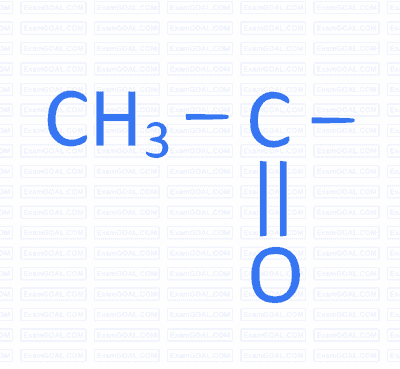
Compound 'X' is :


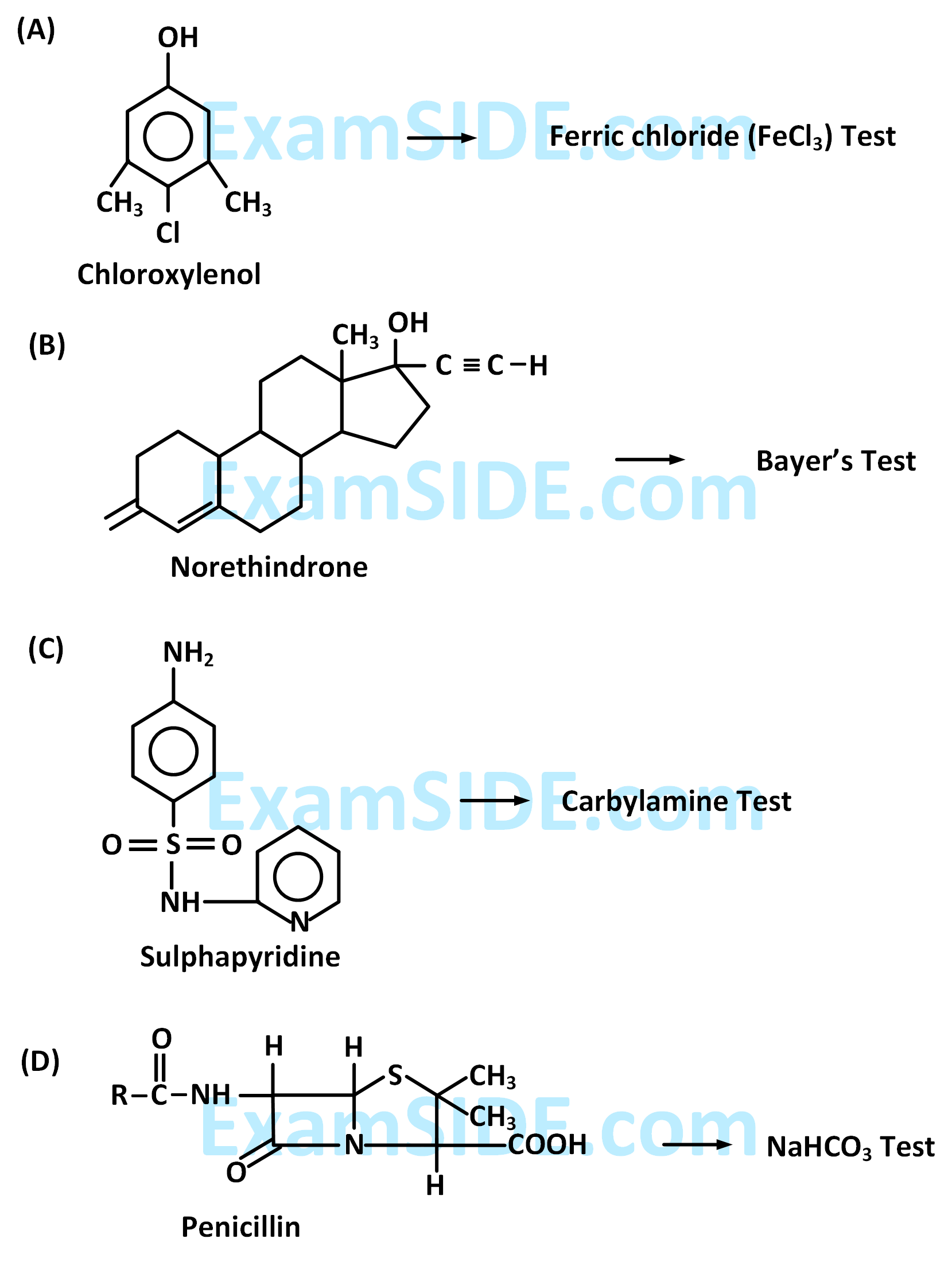
| Item-I (drug) | Item-II (test) | ||
|---|---|---|---|
| A | Chloroxylenol | P | Carbylamine test |
| B | Norethindrone | Q | Sodium hydrogen carbonet test |
| C | Sulphapyridine | R | Ferric chloride test |
| D | Penicillin | S | Bayer's test |
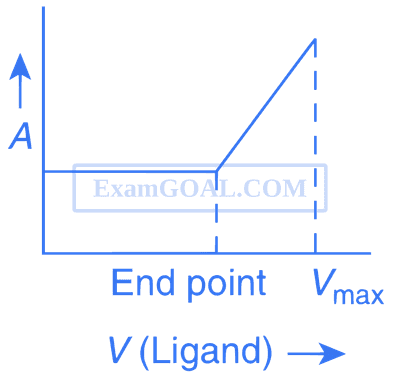
M(Metal ion) + L(Ligand) $ \to $ C(Complex) end point is estimated spectrophoto - metrically (through light absorption). If 'M' and 'C' do not absorb light and only 'L' absorbs, then the titration plot between absorbed light (A) versus volume of ligand 'L' (V) would look like :