Practical Organic Chemistry
In Dumas method for estimation of nitrogen, 0.50 g of an organic compound gave 70 mL of nitrogen collected at 300 K and 715 mm pressure. The percentage of nitrogen in the organic compound is $\_\_\_\_$ $\%$.
(Aqueous tension at 300 K is 15 mm ).
Explanation:
In Dumas method, the nitrogen gas collected over water contains water vapour also. So first we find the pressure of dry nitrogen gas by subtracting aqueous tension.
$\begin{aligned} & \mathrm{P}_{\mathrm{N}_2}=(715-15) \mathrm{mm}=\frac{700}{760} \mathrm{~atm} \\ & \mathrm{~V}_{\mathrm{N}_2}=70 \mathrm{ml}=\frac{70}{1000} l \end{aligned}$
Now use the ideal gas equation $n=\dfrac{PV}{RT}$ to calculate moles of nitrogen gas.
$\begin{aligned} & \mathrm{n}_{\mathrm{N}_2}=\frac{\mathrm{PV}}{\mathrm{RT}}=\frac{\left(\frac{700}{760}\right) \times\left(\frac{70}{1000}\right)}{0.0821 \times 300} \end{aligned}$
Mass of nitrogen obtained is moles $\times$ molar mass of $\mathrm{N}_2$ (which is $28\ \mathrm{g\,mol^{-1}}$).
$\begin{aligned} & \mathrm{~W}_{\mathrm{N}_2}=\frac{700}{760} \times \frac{\frac{70}{1000}}{0.0821 \times 300} \times 28 \end{aligned}$
Finally, percentage of nitrogen in the compound is :
$\begin{aligned} & \% \mathrm{~N}=\frac{\mathrm{W}_{\mathrm{N}_2}}{0.5} \times 100=\frac{700}{760} \times \frac{\frac{70 / 1000}{0.0821 \times 300} \times 28}{0.5} \times 100 \\ & =14.65 \% \approx 15\end{aligned}$
Sodium fusion extract of an organic compound $(\mathrm{Y})$ with $\mathrm{CHCl}_3$ and chlorine water gives violet color to the $\mathrm{CHCl}_3$ layer. 0.15 g of $(\mathrm{Y})$ gave 0.12 g of the silver halide precipitate in Carius method. Percentage of halogen in the compound $(\mathrm{Y})$ is
$\_\_\_\_$ . (Nearest integer)
(Given : molar mass $\mathrm{g} \mathrm{mol}^{-1} \mathrm{C}: 12, \mathrm{H}: 1, \mathrm{Cl}: 35.5, \mathrm{Br}: 80, \mathrm{I}: 127$ )
Explanation:
Violet colour in the $\mathrm{CHCl_3}$ layer on adding chlorine water indicates iodide ion in the sodium fusion extract (chlorine oxidises $\mathrm{I^-}$ to $\mathrm{I_2}$, which is violet in $\mathrm{CHCl_3}$).
So, the silver halide precipitate in Carius method is $\mathrm{AgI}$.
Calculation of % iodine
Molar mass of $\mathrm{AgI} = 108 + 127 = 235\ \mathrm{g\,mol^{-1}}$
Mass of $\mathrm{AgI}$ obtained $= 0.12\ \mathrm{g}$
Mass of iodine in $0.12\ \mathrm{g}$ of $\mathrm{AgI}$:
$ m(\mathrm{I}) = 0.12 \times \frac{127}{235} = 0.06485\ \mathrm{g} $
Mass of compound $(Y) = 0.15\ \mathrm{g}$
Percentage of iodine:
$ \%\,\mathrm{I} = \frac{0.06485}{0.15}\times 100 = 43.23\% $
Nearest integer $= \boxed{43}$
Consider the following reaction sequence in which $\mathbf{J}, \mathbf{K}, \mathbf{L}$ and $\mathbf{M}$ are the major products.

Given:
Atomic mass (in amu) : $\mathrm{H}: 1, \mathrm{C}: 12, \mathrm{~N}: 14, \mathrm{O}: 16, \mathrm{~S}: 32, \mathrm{Br}: 80, \mathrm{Ba}: 137$
The volume of 1 M aqueous $\mathrm{H}_2 \mathrm{SO}_4$ required to completely neutralize the ammonia evolved from 5.72 g of $\mathbf{L}$ in Kjeldahl's method of nitrogen estimation is $\_\_\_\_$ mL .
Explanation:

Step 1: Find moles of compound $ \mathrm{L} $.
The molar mass of compound $ \mathrm{L} $ is 286 g/mol. Moles of $ \mathrm{L} $ are calculated as:
$\text{Moles of } \mathrm{L} = \frac{5.72}{286} = 0.02 \, \text{mol}$
Step 2: Relationship between $ \mathrm{L} $ and $ \mathrm{NH_3} $.
In Kjeldahl’s method, 1 mole of $ \mathrm{L} $ releases 1 mole of $ \mathrm{NH_3} $. Hence, moles of $ \mathrm{NH_3} = 0.02 \, \text{mol}. $
Step 3: Use the concept of gram-equivalents.
During neutralization, gram-equivalents of base = gram-equivalents of acid.
For $ \mathrm{NH_3} $, n-factor = 1 For $ \mathrm{H_2SO_4} $, n-factor = 2
Step 4: Apply the equivalent relation.
$0.02 \times 1 = (1 \times 2) \times V$
Solving for $ V $: $V = \frac{0.02}{2} = 0.01 \, \text{L} = 10 \, \text{mL}$
Final Answer: Volume of $ 1 \, \text{M} \, \mathrm{H_2SO_4} $ required = 10 mL.
Consider the following reaction sequence in which $\mathbf{J}, \mathbf{K}, \mathbf{L}$ and $\mathbf{M}$ are the major products.
Given :
Atomic mass (in amu) : $\mathrm{H}: 1, \mathrm{C}: 12, \mathrm{~N}: 14, \mathrm{O}: 16, \mathrm{~S}: 32, \mathrm{Br}: 80, \mathrm{Ba}: 137$
In sulphur estimation by Carius method, the amount of $\mathrm{BaSO}_4$ formed from 3.79 g of $\mathbf{M}$ is $\_\_\_\_$ g.
Explanation:
Calculate moles of L
The molar mass of compound L is $ 286 \, \text{g mol}^{-1} $. So, the moles of L are:
$ \text{Moles of } \mathrm{L} = \frac{5.72}{286} = 0.02 \, \text{mol} $
Because each mole of L gives one mole of $ \mathrm{NH_3} $, the moles of $ \mathrm{NH_3} $ formed are also $ 0.02 \, \text{mol}. $
Relation between $ \mathrm{NH_3} $ and $ \mathrm{H_2SO_4} $
The number of gram-equivalents of acid and base will be equal at the point of neutralisation.
$ \text{Eq. of } \mathrm{NH_3} = \text{Eq. of } \mathrm{H_2SO_4} $
$ 0.02 \times 1 = (1 \times 2) \times V $ $ \Rightarrow V = \frac{0.02}{2} = 0.01 \, \text{L} = 10 \, \text{mL} $
Calculate moles of M
Molar mass of compound M is $ 379 \, \text{g mol}^{-1} $. So, the moles of M are:
$ \text{Moles of } \mathrm{M} = \frac{3.79}{379} = 0.01 \, \text{mol} $
Relate M to BaSO4 formation
In the Carius method, one mole of M gives one mole of $ \mathrm{BaSO_4} $. Hence, moles of $ \mathrm{BaSO_4} = 0.01 \, \text{mol}. $
Calculate mass of BaSO4
The molar mass of $ \mathrm{BaSO_4} = 233 \, \text{g mol}^{-1} $.
$ \text{Mass of } \mathrm{BaSO_4} = 0.01 \times 233 = 2.33 \, \text{g} $
Final Answer: The mass of $ \mathrm{BaSO_4} $ formed is 2.33 g.
In an estimation of sulphur by Carius method 0.2 g of the substance gave 0.6 g of $\mathrm{BaSO}_4$. The percentage of sulphur in the substance is $\_\_\_\_$%.
(Given molar mass in $\mathrm{g} \mathrm{mol}^{-1} \mathrm{~S}: 32, \mathrm{BaSO}_4: 231$ )
Explanation:
Given:
Mass of the substance = $ 0.2 \, \text{g} $
Mass of $ \mathrm{BaSO_4} $ formed = $ 0.6 \, \text{g} $
Molar mass of $ \mathrm{BaSO_4} = 231 \, \text{g mol}^{-1} $
Molar mass of S = $ 32 \, \text{g mol}^{-1} $
$ \text{Moles of } \mathrm{BaSO_4} = \frac{\text{Mass}}{\text{Molar mass}} = \frac{0.6}{231} $
$ \text{Moles of } \mathrm{BaSO_4} = 0.002597 \, \text{mol} $
In one mole of $ \mathrm{BaSO_4} $, there is one mole of sulphur.
Hence,
$ \text{Moles of sulphur} = \text{Moles of } \mathrm{BaSO_4} = 0.002597 \, \text{mol} $
$ \text{Mass of S} = \text{Moles} \times \text{Atomic mass} = 0.002597 \times 32 $
$ \text{Mass of S} = 0.0831 \, \text{g} $
$ \%\ \text{of S} = \frac{\text{Mass of S}}{\text{Mass of sample}} \times 100 $
$ \%\ \text{of S} = \frac{0.0831}{0.2} \times 100 = 41.55\% $
$ \boxed{\text{Percentage of sulphur in the substance} = 41.55\%} $
In sulphur estimation, $2.0 \times 10^{-3} \mathrm{~mol}$ of an organic compound $(\mathrm{X})$ (molar mass $76 \mathrm{~g} \mathrm{~mol}^{-1}$ ) gave 0.4813 g of barium sulphate (molar mass $233 \mathrm{~g} \mathrm{~mol}^{-1}$ ). The percentage of sulphur in the compound $(\mathrm{X})$ is $\_\_\_\_$ $\times 10^{-1} \%$ (Nearest integer)
Explanation:
We are given the number of moles and the molar mass of compound (X). We can find its total mass using the formula:
$ \text{Mass} = \text{Moles} \times \text{Molar Mass} $
$ \text{Mass of compound (X)} = 2.0 \times 10^{-3} \text{ mol} \times 76 \text{ g mol}^{-1} $
$ \text{Mass of compound (X)} = 152 \times 10^{-3} \text{ g} = 0.152 \text{ g} $
In the Carius method, the sulphur in the organic compound is quantitatively converted into barium sulphate ($ \mathrm{BaSO_4} $).
According to the molar masses:
$1 \text{ mole of } \mathrm{BaSO_4} (233 \text{ g}) \text{ contains } 1 \text{ mole of Sulphur } (32 \text{ g})$.
Therefore, the mass of sulphur in $ 0.4813 \text{ g} $ of $ \mathrm{BaSO_4} $ is:
$ \text{Mass of Sulphur} = \frac{32}{233} \times \text{Mass of } \mathrm{BaSO_4} $
$ \text{Mass of Sulphur} = \frac{32}{233} \times 0.4813 \text{ g} $
$ \% \text{ of Sulphur} = \frac{\text{Mass of Sulphur}}{\text{Total mass of compound (X)}} \times 100 $
Substitute the values we found in Steps 1 and 2:
$ \% \text{ of Sulphur} = \left( \frac{\frac{32}{233} \times 0.4813}{0.152} \right) \times 100 $
$ \% \text{ of Sulphur} = \frac{32 \times 0.4813 \times 100}{233 \times 0.152} $
$ \% \text{ of Sulphur} = \frac{1540.16}{35.416} $
$ \% \text{ of Sulphur} \approx 43.4877 \% $
We need to express the answer in the form of $ \_\_\_\_ \times 10^{-1} \% $. Let us rewrite our percentage:
$ 43.4877 \% = 434.877 \times 10^{-1} \% $
When we round $ 434.877 $ to the nearest integer, we get $ 435 $.
The percentage of sulphur in the compound (X) is 435 $ \times 10^{-1} \% $.
2.0 g of a bromo hydrocarbon $(\mathrm{X})$ was subjected to Carius analysis, gave 3.36 g of AgBr . The percentage of carbon in the compound $(\mathrm{X})$ is $26.7 \%$. Total number of carbon atoms in the empirical formula for compound $(\mathrm{X})$ is $\_\_\_\_$ .
(Given molar mass in $\mathrm{g} \mathrm{mol}^{-1} \mathrm{H}: 1, \mathrm{C}: 12, \mathrm{Br}: 80, \mathrm{Ag}: 108$ )
Explanation:
In Carius analysis, all bromine is converted into $\mathrm{AgBr}$.
Given:
- Mass of $\mathrm{AgBr} = 3.36 \, \mathrm{g}$
Molar mass of $\mathrm{AgBr}$:
$ 108 + 80 = 188 $
So, mass of bromine in $3.36 \, \mathrm{g}$ of $\mathrm{AgBr}$ is
$ \text{Mass of Br} = \frac{80}{188} \times 3.36 $
$ = \frac{268.8}{188} = 1.43 \, \mathrm{g} \text{ (approximately)} $
Mass of compound taken $= 2.0 \, \mathrm{g}$
So, percentage of bromine is
$ \% \mathrm{Br} = \frac{1.43}{2.0} \times 100 = 71.5\% $
Given:
$ \% \mathrm{C} = 26.7\% $
Since it is a hydrocarbon containing only C, H and Br,
$ \% \mathrm{H} = 100 - 26.7 - 71.5 = 1.8\% $
Take $100 \, \mathrm{g}$ of compound.
Then:
Carbon $= 26.7 \, \mathrm{g}$
Hydrogen $= 1.8 \, \mathrm{g}$
Bromine $= 71.5 \, \mathrm{g}$
Now moles:
$ \text{Moles of C} = \frac{26.7}{12} = 2.225 $
$ \text{Moles of H} = \frac{1.8}{1} = 1.8 $
$ \text{Moles of Br} = \frac{71.5}{80} = 0.894 $
$ \mathrm{C} : \mathrm{H} : \mathrm{Br} = \frac{2.225}{0.894} : \frac{1.8}{0.894} : \frac{0.894}{0.894} $
$ = 2.49 : 2.01 : 1 $
This is approximately
$ 2.5 : 2 : 1 $
Now multiply by $2$ to get whole numbers:
$ 5 : 4 : 2 $
So the empirical formula is
$ \mathrm{C}_5\mathrm{H}_4\mathrm{Br}_2 $
From the empirical formula, number of carbon atoms $= 5$.
$ \boxed{5} $
Consider the following reactions sequence

When the product (P) is subjected to Carius analysis using AgNO3, 1.0 g of the product (P) will produce _________ g of the precipitate of AgBr. (Nearest Integer)
(Given : molar mass in g mol-1 C : 12, H : 1, O : 16, N : 14, Br : 80, Ag : 108)
Explanation:

Molar mass of product $=186$
Mass of $\mathrm{AgBr}=\frac{1}{186} \times 188 \approx 1$
Explanation:
Given:
Volume of $N_2$, $V = 50$ mL
Pressure, $P = 715$ mm Hg
Temperature, $T = 300$ K
Aqueous Tension at 300 K = 15 mm Hg
Calculation:
Correct the Pressure for $N_2$:
$ P_{N_2} = 715 \text{ mmHg} - 15 \text{ mmHg} = 700 \text{ mmHg} $
Convert the pressure from mm Hg to atm:
$ P_{N_2} = \frac{700}{760} \text{ atm} $
Calculate the Moles of $N_2$ using the Ideal Gas Law:
$ n_{N_2} = \frac{P_{N_2} \cdot V}{R \cdot T} $
$ n_{N_2} = \frac{\frac{700}{760} \times \frac{50}{1000}}{0.0821 \times 300} $
Calculate the Moles of $N$:
$ n_{N} = 2 \times n_{N_2} $
Calculate the Mass of $N$:
$ \text{Mass of } N = 2 \times n_{N} \times 14 $
Determine the Percentage of Nitrogen in the Organic Compound:
$ \% N = \frac{\text{Mass of } N}{\text{Mass of organic compound}} \times 100 $
$ \% N = \frac{\frac{700}{760} \times \frac{50}{1000} \times 2 \times 14}{0.0821 \times 300} \times \frac{1000}{292} \times 100 $
$ \% N = 18\% $
The percentage of nitrogen in the organic compound is 18%.
In Dumas' method for estimation of nitrogen 1 g of an organic compound gave 150 mL of nitrogen collected at 300 K temperature and 900 mm Hg pressure. The percentage composition of nitrogen in the compound is _______ % (nearest integer)
(Aqueous tension at $300 \mathrm{~K}=15 \mathrm{~mm} \mathrm{~Hg}$ )
Explanation:
Partial pressure of $\mathrm{N}_2=(900-15)=885 \mathrm{~mm} \mathrm{Hg}$
Mole of $\mathrm{N}_2=\frac{\left(\frac{885}{760} \times 0.15\right)}{(0.0821 \times 300)}=0.0071$ moles
$\%$ of nitrogen in organic compound
$\begin{aligned} & =\frac{(0.0071 \times 28)}{1} \times 10 \\ & =19.85 \% \end{aligned}$
0.1 mol of the following given antiviral compound $(\mathrm{P})$ will weigh ________ $\times 10^{-1} \mathrm{~g}$ (nearest integer).

(Given : molar mass in $\mathrm{g} \mathrm{mol}^{-1} \mathrm{H}: 1, \mathrm{C}: 12, \mathrm{~N}: 14, \mathrm{O}: 16, \mathrm{~F}: 19, \mathrm{I}: 127$ )
Explanation:

$\begin{aligned} &\text { Molar mass }=372 \mathrm{gm}\\ &\therefore \quad 0.1 \text { mole has }=372 \times 10^{-1} \mathrm{gm} \end{aligned}$
In the sulphur estimation, 0.20 g of a pure organic compound gave 0.40 g of barium sulphate. The percentage of sulphur in the compound is __________ $\times 10^{-1} \%$.
(Molar mass : $\mathrm{O}=16, \mathrm{~S}=32, \mathrm{Ba}=137$ in $\mathrm{g} ~\mathrm{mol}^{-1}$ )
Explanation:
Mass of pure organic compound = 0.20 g
Mass of barium sulphate obtained = 0.40 g
% of sulphur in the compound = ?
Molar mass of $BaS{O_4} = 134\,g\,mo{l^{ - 1}} + 32\,g\,mo{l^{ - 1}} + (16 \times 4)\,g\,mo{l^{ - 1}} = 233\,g\,mo{l^{ - 1}}$
Moles of $BaS{O_4}:$
Moles $ = {{mass} \over {molar\,mass}}$
$ = {{0.40\,g} \over {233\,g\,mo{l^{ - 1}}}} = 0.001717\,mol$
Moles of sulphur:
From the formula $BaS{O_4}$, 1 mole of $BaS{O_4}$ contains 1 mole of sulphur (s). Therefore, the moles of sulphur in the sample is equal to the moles of $BaS{O_4}$.
Moles of S = 0.001717 mol
Mass of sulphur :
Mass = moles $\times$ molar mass
Moles of S = 0.001717 mol, substitute this value as
Mass of S = 0.001717 mol $\times$ 32 g mol$^{-1}$.
= 0.054944 g
Percentage of sulphur in the organic compound:
The formula is
Percentage of $S = {{mass\,of\,S} \over {mass\,of\,organic\,compound}} \times 100$
Substituting the values,
Percentage of $S = {{0.054944\,g} \over {0.20\,g}} \times 100$
$ = 0.27472 \times 100$
$ = 27.472\% $
$ = 274.72 \times {10^{ - 1}}\% $
$ = 275 \times {10^{ - 1}}\% $
In Carius method of estimation of halogen, 0.25 g of an organic compound gave 0.15 g of silver bromide ( AgBr ). The percentage of Bromine in the organic compound is ________ $\times 10^{-1} \%$ (Nearest integer).
(Given : Molar mass of Ag is 108 and Br is $80 \mathrm{~g} \mathrm{~mol}^{-1}$ )
Explanation:
$\begin{aligned} & \% \text { Bromine }= \frac{\text { Molar Mass of Bro mine }}{\text { Molar Mass of Silver bromide }} \\ & \times \frac{\text { Weight of } \mathrm{AgBr}}{\text { Weight of sample }} \times 100 \\ &=\frac{80}{188} \times \frac{0.165}{0.25} \times 100 \\ &= \frac{4800}{188}=25.53=255 \times 10^{-1} \end{aligned}$

In the given TLC, the distance of spot A & B are 5 cm & 7 cm, from the bottom of TLC plate, respectively.
$\mathrm{R}_{\mathrm{f}}$ value of $\mathrm{B}$ is $x \times 10^{-1}$ times more than $\mathrm{A}$. The value of $x$ is __________.
Explanation:
$\mathrm{R}_{\mathrm{f}}=\frac{\text { Distance moved by substance from base line }}{\text { Distance moved by solvent from base line }}$

$\begin{aligned} & \left(\mathrm{R}_{\mathrm{f}}\right)_A=\frac{4}{8} \quad\left(\mathrm{R}_{\mathrm{f}}\right)_B=\frac{6}{8} \\ & \frac{\left(\mathrm{R}_{\mathrm{f}}\right)_B}{\left(\mathrm{R}_{\mathrm{f}}\right)_A}=\frac{6}{8} \times \frac{8}{4} \\ & \left(\mathrm{R}_{\mathrm{f}}\right)_B=1.5\left(\mathrm{R}_{\mathrm{f}}\right)_A \\ & x=15 \end{aligned}$
Explanation:
To determine the percentage of nitrogen using the Kjeldahl's method, we first need to find out how much ammonia (NH3) was produced and then calculate the equivalent amount of nitrogen in the sample.
The ammonia released reacts with sulfuric acid (H2SO4) in the following stoichiometry :
$ 2 \mathrm{NH}_3 + \mathrm{H}_2 \mathrm{SO}_4 \rightarrow (\mathrm{NH}_4)_2 \mathrm{SO}_4 $Each mole of H2SO4 reacts with 2 moles of NH3. Since 10 mL of 2 M sulfuric acid is neutralized by the ammonia, we can calculate the amount (in moles) of ammonia :
$ n(\mathrm{NH}_3) = 2 \times n(\mathrm{H}_2 \mathrm{SO}_4) $Now calculate the moles of H2SO4 used :
$ n(\mathrm{H}_2 \mathrm{SO}_4) = M \times V $
$ n(\mathrm{H}_2 \mathrm{SO}_4) = 2 \, \mathrm{M} \times 10 \, \mathrm{mL} \times \frac{1 \, \mathrm{L}}{1000\,\mathrm{mL}} $
$ n(\mathrm{H}_2 \mathrm{SO}_4) = 0.02 \, \mathrm{mol} $
Therefore, the number of moles of NH3 released will be twice that of the moles of H2SO4 neutralized :
$ n(\mathrm{NH}_3) = 2 \times 0.02 \, \mathrm{mol} $
$ n(\mathrm{NH}_3) = 0.04 \, \mathrm{mol} $
Next, we use the molar mass of nitrogen (14 g/mol) to find the mass of nitrogen :
$ m(N) = n(N) \times M(N) $
$ m(N) = 0.04 \, \mathrm{mol} \times 14 \, \mathrm{g/mol} $
$ m(N) = 0.56 \, \mathrm{g} $
To find the percentage of nitrogen in the compound, we take the mass of nitrogen divided by the mass of the original sample and multiply by 100% :
$ \mathrm{Percent \, nitrogen} = \left( \frac{m(N)}{m(\mathrm{sample})} \right) \times 100\% $
$ \mathrm{Percent \, nitrogen} = \left( \frac{0.56\, \mathrm{g}}{1\, \mathrm{g}} \right) \times 100\% $
$ \mathrm{Percent \, nitrogen} = 56\% $
The percentage of nitrogen in the compound is 56%.
On a thin layer chromatographic plate, an organic compound moved by $3.5 \mathrm{~cm}$, while the solvent moved by $5 \mathrm{~cm}$. The retardation factor of the organic compound is ________ $\times 10^{-1}$.
Explanation:
Retardation factor $=\frac{\text { Distance travelled by sample/organic compound }}{\text { Distance travelled by solvent }}$
$=\frac{3.5}{5}=7 \times 10^{-1}$
$0.400 \mathrm{~g}$ of an organic compound $(\mathrm{X})$ gave $0.376 \mathrm{~g}$ of $\mathrm{AgBr}$ in Carius method for estimation of bromine. $\%$ of bromine in the compound $(\mathrm{X})$ is ___________.
(Given: Molar mass $\mathrm{AgBr=188~g~mol^{-1}}$
$\mathrm{Br}=80 \mathrm{~g} \mathrm{~mol}^{-1}$)
Explanation:
1. Calculate the moles of AgBr formed:
Moles of AgBr = mass / molar mass = 0.376 g / 188 g/mol = 0.002 mol
Since 1 mol of AgBr contains 1 mol of Br, the moles of Br in the compound X are also 0.002 mol.
2. Calculate the mass of bromine in the compound:
Mass of Br = moles of Br × molar mass of Br = 0.002 mol × 80 g/mol = 0.16 g
3. Calculate the percentage of bromine in the compound X:
Percentage of Br = (mass of Br / mass of compound X) × 100 = (0.16 g / 0.400 g) × 100 = 40%
So, the percentage of bromine in the compound X is 40%.
$\mathrm{KMnO}_{4}$ is titrated with ferrous ammonium sulphate hexahydrate in presence of dilute $\mathrm{H}_{2} \mathrm{SO}_{4}$. Number of water molecules produced for 2 molecules of $\mathrm{KMnO}_{4}$ is ___________.
Explanation:
$ 10\left[\mathrm{FeSO}_4 \cdot\left(\mathrm{NH}_4\right)_2 \mathrm{SO}_4 \cdot 6 \mathrm{H}_2 \mathrm{O}\right]+2 \mathrm{KMnO}_4+8 \mathrm{H}_2 \mathrm{SO}_4 \rightarrow $
$5 \mathrm{Fe}_2\left(\mathrm{SO}_4\right)_3+2 \mathrm{MnSO}_4+10\left(\mathrm{NH}_4\right)_2 \mathrm{SO}_4+\mathrm{K}_2 \mathrm{SO}_4+68 \mathrm{H}_2 \mathrm{O}$
Now, we are asked to find the number of water molecules produced for 2 molecules of KMnO₄.
From the balanced equation, we can observe that 2 moles of KMnO₄ produce 68 moles of H₂O. Therefore, for 2 molecules of KMnO₄, the number of water molecules produced will be:
2 molecules × 34 water molecules per molecule of KMnO₄ = 68 water molecules
So, 68 water molecules are produced for 2 molecules of KMnO₄ in this titration.
The mass (in mg) of $\mathbf{S}$ obtained is ________.
[Use molar mass (in $\mathrm{g} \mathrm{mol}^{-1}$ ) : $\mathrm{H}=1, \mathrm{C}=12, \mathrm{~N}=14, \mathrm{Br}=80$ ]
Explanation:

First, calculate the moles of 4-methyloct-1-ene. The molar mass of 4-methyloct-1-ene is 126 g/mol. So, the moles of 4-methyloct-1-ene are :
$n_{4-\text{methyloct-1-ene}} = \frac{2.52 \, g}{126 \, g/mol} = 0.02 \, mol$
Given that the combined yield is 50%, the amount of isomeric bromides produced will be half of the initial amount, which is 0.01 mol.
The isomeric bromides are produced in a 9 : 1 ratio, so 90% of the product, or 0.009 mol, is the primary alkyl bromide. This is the compound that reacts further with diethylamine.
The reaction with diethylamine leads to the non-ionic product S with 100% yield, so we will still have 0.009 mol of product S.
Based on the chemical structures provided, the molar mass of S is 199 g/mol.
We can now calculate the mass of product S using the equation :
$ \text{Mass of S} = \text{moles of S} \times \text{molar mass of S} = 0.009 \, mol \times 199 \, g/mol = 1.791 \, g$
To convert this into milligrams, we multiply by 1000, yielding a mass of S obtained equal to 1791 mg.
In bromination of Propyne, with Bromine, 1, 1, 2, 2-tetrabromopropane is obtained in 27% yield. The amount of 1, 1, 2, 2-tetrabromopropane obtained from 1 g of Bromine in this reaction is ___________ $\times$ 10$-$1 g. (Nearest integer)
(Molar Mass : Bromine = 80 g/mol)
Explanation:

2 moles $\mathrm{Br}_{2} \equiv 1$ mole 1,1,2,2-tetrabromopropane $\frac{1}{160}$ mole $\mathrm{Br}_{2}$
$\equiv \frac{1}{2} \times \frac{1}{160}$ mole 1,1,2,2-tetrabromopropane
But yield of reaction is only $27 \%$
Moles of 1,1,2,2-tetrabromopropane
$ =\frac{1}{2} \times \frac{1}{160} \times \frac{27}{100} $
Molar mass of 1,1,2,2-tetrabromopropane $=360 \mathrm{~g}$ Mass of 1,1,2,2-tetrabromopropane
$ \begin{aligned} &=\frac{1}{2} \times \frac{1}{160} \times \frac{27}{100} \times 360 \mathrm{~g} \\\\ &\approx 3 \times 10^{-1} \mathrm{~g} \end{aligned} $
A sample of $0.125 \mathrm{~g}$ of an organic compound when analyzed by Duma's method yields $22.78 \mathrm{~mL}$ of nitrogen gas collected over $\mathrm{KOH}$ solution at $280 \mathrm{~K}$ and $759 \mathrm{~mm}\, \mathrm{Hg}$. The percentage of nitrogen in the given organic compound is __________. (Nearest integer)
Given :
(a) The vapour pressure of water of $280 \mathrm{~K}$ is $14.2 \mathrm{~mm} \,\mathrm{Hg}$.
(b) $\mathrm{R}=0.082 \mathrm{~L}$ atm $\mathrm{K}^{-1} \mathrm{~mol}^{-1}$
Explanation:
$ \begin{aligned} \mathrm{n}_{\mathrm{N}_{2}} &=\frac{744.8 \times 22.78}{760 \times 0.0821 \times 280 \times 1000} \\\\ &=0.000971 \mathrm{~mol} \end{aligned} $
Mass of $\mathrm{N}_{2}=0.02719 \,\mathrm{gm}$
Percentage of nitrogen
$ =\frac{0.0271}{0.125} \times 100=21.75 \simeq 22 $

In the above reaction, $5 \mathrm{~g}$ of toluene is converted into benzaldehyde with $92 \%$ yield. The amount of benzaldehyde produced is ______________ $\times 10^{-2} \mathrm{~g}$. (Nearest integer)
Explanation:

Moles $=\frac{5}{92}$
Moles of benzaldehyde produced $=\frac{5}{92} \times 0.92=0.05$
$\therefore$ Mass of benzaldehyde formed
$=0.05 \times 106$
$=5.3 \mathrm{~g}$
$=530 \times 10^{-2}$
While estimating the nitrogen present in an organic compound by Kjeldahl's method, the ammonia evolved from $0.25 \mathrm{~g}$ of the compound neutralized $2.5 \mathrm{~mL}$ of $2 \,\mathrm{M} \,\mathrm{H}_{2} \mathrm{SO}_{4}$. The percentage of nitrogen present in organic compound is ______________.
Explanation:
$\therefore$ Moles of $\mathrm{NH}_{3}$ neutralized $=2.5 \times 2 \times 2$ millimole
$ =10 \times 10^{-3} \text { moles } $
$\therefore$ Weight of $\mathrm{N}$ present in the compound will be
$ \begin{aligned} &=10 \times 10^{-3} \times 14 \\ &=0.14 \mathrm{~g} \end{aligned} $
$\therefore \%$ of ' $\mathrm{N}$ ' in compound
$ \begin{aligned} &=\frac{0.14}{0.25} \times 100 \\ &=56 \% \end{aligned} $
An organic compound with 51.6% sulfur is heated in a Carius tube. The amount of this compound which will form 0.752 g of barium sulphate is ___________ $\times$ 10$-$1 g.
(Given molar mass of barium sulphate 233 g mol$-$1) (Nearest integer).
Explanation:
$0.752 \mathrm{~g}\, \mathrm{BaSO}_{4}$ contains $=\frac{32}{233} \times 0.752=0.1005 \mathrm{~g}$
Sulfur $\%=\frac{\text { Weight of Sulphur }}{\text { Weight of Compound }} \times 100$
$51.6=\frac{0.1005}{\text { Weight of compound }} \times 100$
$\Rightarrow$ Weight of compound $=\frac{0.1005}{51.6} \times 100=1.9 \times 10^{-1} \mathrm{~g}$
$ \approx 2 \times 10^{-1} \mathrm{~g} $
Kjeldahl's method was used for the estimation of nitrogen in an organic compound. The ammonia evolved from 0.55 g of the compound neutralised 12.5 mL of 1 M H2SO4 solution. The percentage of nitrogen in the compound is _____________. (Nearest integer)
Explanation:
12. $5 \times 1 \times 2=25$ meq. of $\mathrm{NH}_3$ $=25$ millimoles of $\mathrm{NH}_3$
So Millimoles of ${ }^{\prime} \mathrm{N}^{\prime}=25$
Moles of $\mathrm{N}^{\prime}=25 \times 10^{-3}$
wt. of $N=14 \times 25 \times 10^{-3}$
$ \begin{aligned} & \% \mathrm{~N}=\frac{14 \times 25 \times 10^{-3}}{0.55} \times 100 \\\\ & =63.66 \\\\ & \approx 64 \% \end{aligned} $
A 2.0 g sample containing MnO2 is treated with HCl liberating Cl2. The Cl2 gas is passed into a solution of KI and 60.0 mL of 0.1 M Na2S2O3 is required to titrate the liberated iodine. The percentage of MnO2 in the sample is _____________. (Nearest integer)
[Atomic masses (in u) Mn = 55; Cl = 35.5; O = 16, I = 127, Na = 23, K = 39, S = 32]
Explanation:
First Step :
MnO2 + 4HCl $\to$ MnCl2 + Cl2 + 2H2O
Here 1 mol of MnO2 produce 1 mol of Cl2
$\therefore$ Mole ratio of ${n_{Mn{O_2}}}:{n_{C{l_2}}} = 1:1$
Second Step :
Cl2 + 2KI $\to$ 2KCl + I2
Here, 1 mol of Cl2 produce 1 mol of I2
Mole ratio of ${n_{C{l_2}}}:{n_{{I_2}}} = 1:1$
Third Step :
I2 + 2Na2S2O3 $\to$ 2NaI + Na2S2O3
1 mol of I2 react with 2 mol of Na2S2O3
Mole ratio of ${n_{{I_2}}}:{n_{{N_2}{S_2}{O_3}}} = 1:2$
Given Na2S2O3 is 60 mL of 0.1 M
$\therefore$ Number of moles of Na2S2O3
= V (in L) $\times$ M (Molarity)
= ${{60} \over {1000}} \times 0.1$
= 0.006 mol
$\therefore$ Number of moles of I2
$ = {1 \over 2}(0.006)$
= 0.003
$\therefore$ Moles of MnO2 = 0.003 (as mole ratio of MnO2 and Cl2 = 1 : 1)
Molar mass of MnO2 = 55 + 32 = 87
$\therefore$ Mass of MnO2 = 0.003 $\times$ 87 = 0.261 gm
Given MnO2 = 2g
$\therefore$ % of MnO2 = ${{0.261} \over 2} \times 100 = 13\% $
In the estimation of bromine, 0.5 g of an organic compound gave 0.40 g of silver bromide. The percentage of bromine in the given compound is _________ % (nearest integer)
(Relative atomic masses of Ag and Br are 108u and 80u, respectively).
Explanation:
$ \therefore 0.4 \mathrm{~g} \mathrm{AgBr}=\frac{80}{188} \times 0.4 $
$\%$ of $\mathrm{Br}$ in given organic compound
$ \begin{aligned} &=\frac{80 \times 0.4}{188 \times 0.5} \times 100 \\\\ &\approx 34 \% \end{aligned} $
0.25 g of an organic compound containing chlorine gave 0.40 g of silver chloride in Carius estimation. The percentage of chlorine present in the compound is ___________. [in nearest integer]
(Given : Molar mass of Ag is 108 g mol$-$1 and that of Cl is 35.5 g mol$-$1)
Explanation:
Given, weight of organic compound = 0.25 g
Moles of AgCl = ${{0.4} \over M}$
Molecular mass of AgCl (M) = 143.5 gm
$\therefore$ Moles of AgCl = ${{0.4} \over 143.5}$
$\therefore$ Mass of Cl = ${{0.4} \over 143.5}$ $\times$ 35.5
Mass % of Cl in the organic compound
$ = {{{{35.5 \times 0.4} \over {143.5}}} \over {0.25}} \times 35.5$
$ = 39.58$
$ \simeq 40$
0.2 g of an organic compound was subjected to estimation of nitrogen by Dumas method in which volume of N2 evolved (at STP) was found to be 22.400 mL. The percentage of nitrogen in the compound is _________. [nearest integer]
(Given : Molar mass of N2 is 28 g mol$-$1. Molar volume of N2 at STP : 22.4 L)
Explanation:
Given volume of N2 = 22.400 mL
$\therefore$ Moles of N2 = ${{22.400} \over {22400}} = {10^{ - 3}}$ mole
$\therefore$ Moles of N atoms = 2 $\times$ 10$-$3 mole
$\therefore$ Weigh of N atoms = 14 $\times$ 2 $\times$ 10$-$3 mole
= 28 $\times$ 10$-$3 mole
$\therefore$ % of N atom in the compound
$ = {{28 \times {{10}^{ - 3}}} \over {0.2}} \times 100$
= 14
Consider the following reaction.

On estimation of bromine in $1.00 \mathrm{~g}$ of $\mathbf{R}$ using Carius method, the amount of $\mathrm{AgBr}$ formed (in $\mathrm{g}$ ) is ___________.
[Given: Atomic mass of $\mathrm{H}=1, \mathrm{C}=12, \mathrm{O}=16, \mathrm{P}=31, \mathrm{Br}=80, \mathrm{Ag}=108]$
Explanation:
$2P+3Br_2\to2PBr_3$

Number of moles in 1 gm of (R) = $\frac{1}{250}$
Number of moles of AgBr formed from (R) = $\frac{2}{250}$
Mass of AgBr formed $=\frac{2\times188}{250}=1.50$ gm
The weight percentage of hydrogen in $\mathbf{Q}$, formed in the following reaction sequence, is ________.

[Given: Atomic mass of $\mathrm{H}=1, \mathrm{C}=12, \mathrm{~N}=14, \mathrm{O}=16, \mathrm{~S}=32, \mathrm{Cl}=35$ ]
Explanation:

Formula of compound = C6H3N3O7
Molar Mass of compound = (12 $\times$ 6 + 3 + 14 $\times$ 3 + 16 $\times$ 7) g = 229 g
Weight % of H = $\frac{3}{229}\times100=1.31$
${C_2}{H_7}N + \left( {2x + {y \over 2}} \right)CuO \to xC{O_2} + {y \over 2}{H_2}O + {z \over 2}{N_2} + \left( {2x + {y \over 2}} \right)Cu$
The value of y is ______________. (Integer answer)
Explanation:
On balancing
${C_2}{H_7}N + {{15} \over 2}CuO \to 2C{O_2} + {7 \over 2}{H_2}O + {1 \over 2}{N_2} + {{15} \over 2}Cu$
On comparing
y = 7
Explanation:
$ \Rightarrow {C_7}{H_{17}}N + {{45} \over 2}CuO \to 7C{O_2} + {{17} \over 2}{H_2}O + {1 \over 2}{N_2} + {{45} \over 2}Cu$
${{{n_{CuO}}\,reacted} \over {\left( {{{45} \over 2}} \right)}} = {{{n_{{C_7}{H_{17}}N}}\,reacted} \over 1}$
$\Rightarrow$ nCuO reacted = $\left( {{{45} \over 2}} \right) \times 0.5 = 11.25$
[Atomic mass of K = 39, Mn = 55, O = 16]
Explanation:

(Equivalents of KMnO4 reacted) = (Equivalents of FeSO4 reacted)
$\Rightarrow$ (5 $\times$ x $\times$ 10 ml) = 1 $\times$ 0.1 $\times$ 10 ml
$\Rightarrow$ x = 0.02 M
Molar mass of KMnO4 = 158 gm/mol
$\Rightarrow$ Strength = (x $\times$ 158) = 3.16 g/l
(Atomic Mass of Ba = 137 u)
Explanation:
$\because$ 233 BaSO4 contain $\to$ 32 g sulphur
$\therefore$ 1.44 g BaSO4 contain $\to$ ${{32} \over {233}}$ $\times$ 1.44 g sulphur given : 0.471 g of organic compound
% of S = ${{32 \times 1.44} \over {233 \times 0.471}} \times 100 = 41.98\% \approx 42\% $
(Atomic masses of Ag and Cl are 107.87 and 35.5 respectively)
Explanation:
Mass of formed AgCl = 0.3849 gm
% of Cl = ${{atomic\,mass\,of\,Cl \times mass\,formed\,AgCl} \over {molecular\,mass\,of\,AgCl \times mass\,of\,organic\,compound}} \times 100$
$ = {{35.5 \times 0.3849} \over {143.37 \times 0.5}} \times 100$
= 19.06
$ \approx $ 19
Explanation:
wt. of N = $\left( {{{42} \over {100}} \times 0.8} \right)$ gm
mole of N = ${{{42 \times 0.8} \over {100 \times 14}} = {{2.4} \over {100}}}$ mol
moles of NH3 = ${{{2.4} \over {100}}}$

${{{1.2} \over {100}}}$ = 1 $\times$ V(l)
${ \Rightarrow {V_{{H_2}S{O_4}}} = {{1.2} \over {100}}l = 12}$ ml
Explanation:
10 gm of C6H6 = ${{10} \over {78}}$ mole
Moles of methylbenzene should be obtained = ${{10} \over {78}}$ mole
= $\left( {{{10} \over {78}} \times 92} \right)gm $
$ \therefore $ ${{{A_y}} \over {{T_y}}} = \% $ yield $ = {{9.2} \over {920}} \times 78 \times 100 \Rightarrow 78\% $
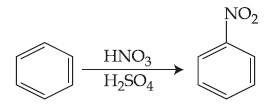
In the above reaction, 3.9 g of benzene on nitration gives 4.92 g of nitrobenzene. The percentage yield of nitrobenzene in the above reaction is ________%. (Round off to the Nearest Integer).
(Given atomic mass : C : 12.0 u, H : 1.0 u, O : 16.0 u, N : 14.0 u)
Explanation:

Weight of (C6H5NO2)Theoretical = ${{{3.9} \over {78}} \times 123}$ = 6.15 g
% yield of reaction = ${{{W_{actual}}} \over {{W_{theoretical}}}} \times 100 = {{4.92} \over {6.15}} \times = 80\% $
Explanation:
Hence actual pressure = (758 – 14)
= 744 mm of Hg.
Moles of ${N_2} = {{\left( {758 - 14} \right)} \over {760}} \times {{30 \times {{10}^{ - 3}}} \over {0.0821 \times 287}}$
$ = 1.246 \times {10^{ - 3}}$ mol
mass of ${N_2} = 1.246 \times {10^{ - 3}} \times 28$
mass % of N2 $ = {{mass\,of\,'N'} \over {total\,mass}} \times 100$
$ = {{1.246 \times 28 \times {{10}^{ - 3}}} \over {0.184}} \times 100$
$ = {{124.6 \times 28} \over {0.184}}\% = 18.96\% $
$ \simeq 19\% $
(i) 4.5 mL
(ii) 4.5 mL
(iii) 4.4 mL
(iv) 4.4 mL
(v) 4.4 mL
If the volume of oxalic acid taken was 10.0 mL then the molarity of the NaOH solution is ________ M. (Rounded off to the nearest integer)
Explanation:
Average burette reading = Volume of NaOH solution (V1)
$ = {{4.5 + 4.5 + 4.4 + 4.4 + 4.4} \over 5}$
= 4.44 mL
Strength of NaOH solution = S1(M) (say) = S1(N)
Volume of oxalic acid solution (V2) = 10 mL
Strength of oxalic acid solution (S2) = 1.25 M = 1.25 $\times$ 2 N
So, ${V_1}{S_1} = {V_2}{S_2}$ ($\because$ Law of equivalence)
$ \Rightarrow {S_1} = {{{V_2}{S_2}} \over {{V_1}}} = {{10 \times (1.25 \times 2)} \over {4.44}} = 5.63$ N
$ \simeq 6M = 6M$
(Atomic mass, Ag = 108, Br = 80 g mol–1)
Explanation:
Mass of AgBr = 1.88 gm
Moles of Br = Moles of AgBr = ${{1.88} \over {188}}$ = 0.01
Mass of Br = 0.01 × 80 = 0.80 gm
% of Br = ${{0.80 \times 100} \over {1.60}}$ = 50 %