Coordination Compounds
Explanation:

Since none of Cl- is present in the co-ordination sphere. Therefore answer is zero.
Explanation:
Co2+ : [Ar]3d74s04p0
For this complex $\Delta$0 < P.E., so pairing of electron does not take place.
sp3d2 hybridisation
Total 3 unpaired electrons are present.
[Co(NH3)6]Cl3
Co3+ : [Ar]3d6 4s0 4p0
d2sp3 hybridistion
NH3 acts as SFL because $\Delta$0 > P.E.
So, here all electrons becomes paired.
Explanation:
Ni+4 $\to$ d6, CN- strong field ligand. So pairing will happen.

Here zero unpaired electron
NiCl2 $\to$ Ni2+ $\to$ d8

$ \therefore $ Change = 2.
[At. no. of Co = 27]
Explanation:
x + 6 $\times$ ($-$1) = $-$4
where, x, 6, $-$1 and $-$4 are the oxidation number of Co, number of CN ligands, charge on one CN and charge on complex.
x = +2, i.e. Co2+
Electronic configuration of Co2+ : [Ar]3d7 and CN$-$ is a strong field ligand which can pair electron of central atom.

It has one unpaired electron (n) in 4d-subshell.
So, spin only magnetic moment ($\mu$) = $\sqrt {n(n + 2)} $ BM = $\sqrt {1(1 + 2)} $ BM = $\sqrt 3 $ BM
where, n = number of unpaired electrons
$\mu$ = $\sqrt 3 $ BM = 1.73 BM
Nearest integer = 2
Explanation:
$3( + 1) + x + 3( - 2) = 0$
$ \Rightarrow x = + 3$
$ \therefore $ ${}_{24}C{r^{ + 3}} = \left[ {Ar} \right]3{d^3}$
$ \therefore $ Number of unpaired electrons = 3
Explanation:

Coordination number = 6
Secondary valency is 6
Explanation:
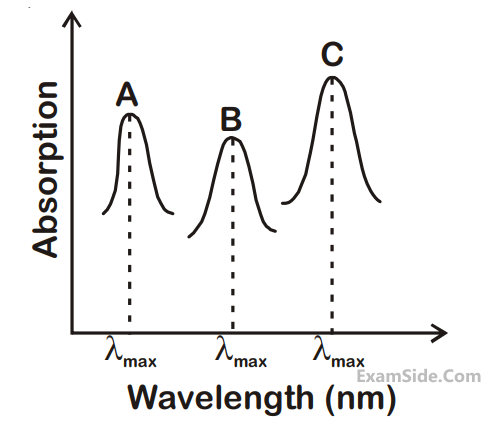
$ = {{6.626 \times {{10}^{ - 34}} \times 3 \times {{10}^8}} \over {498 \times {{10}^{ - 9}}}}$
$ = 3.99 \times {10^{ - 19}}J$
$ \approx 4 \times {10^{ - 19}}$
Explanation:
$[Co{(N{H_3}]_4}C{l_2}]Cl + 2en \to [Co{(en)_2}C{l_2}] + 4N{H_3}$
NH3 is the neutral monodentate ligand. Ethylene diamine is a neutral didentate ligand.
${H_2}\mathop N\limits^{ \bullet \,\, \bullet } - C{H_2} - C{H_2} - \mathop N\limits^{ \bullet \,\, \bullet } {H_2}(en)$
So, two ethylene diamine are equivalent to four 'NH3' ligand.
Explanation:
The coordination compound [Co(ox)2(Br)(NH3)]2$-$ of general formula [M(A - A)2BC] can show both geometrical and optical isomerism (stereoisomerism).

The cis-form produces non-superimposable mirror images, i.e. enantiomeric pairs (optically active)

The trans-form is optically inactive.
So, total number of stereoisomers possible
= cis( $ \pm $ ) + trans = 3
Explanation:

$ \therefore $ Number of bridging CO ligands = 0.
Explanation:
Z = 29 [Cu] $\buildrel { - 2{e^ - }} \over \longrightarrow $ Cu2+ = [Ar] 3d9

Number of unpaired electron, n = 1
$\therefore$ Spin only magnetic moment,
$\mu = \sqrt {n(n + 2)} BM = \sqrt {1(1 + 2)} BM = \sqrt 3 BM$
= 1.73 BM $ \simeq $ 2 BM
Explanation:
Three ionisation isomers are
(i) [Pt(NH3)4Cl2]Br2
(ii) [Pt(NH3)4ClBr]BrCl
(iii) [Pt(NH3)4Br2]Cl
Ionisation isomers are compounds having same molecular formula but have different counter ions.
Each isomer shown above also possess two more geometrical isomers. Geometrical isomers are the compounds having different arrangement of atoms in space but same molecular formula.
The geometrical isomers are :

(Atomic numbers of Cr and Cu are 24 and 29, respectively)


(Note : py = pyridine)
Given : Atomic numbers of Fe, Co, Ni and Cu are 26, 27, 28 and 29, respectively)


$\mathrm{AlF}_3$ is soluble in HF only in the presence of KF due to formation of
Potassium cyanide is made alkaline with NaOH and boiled with thiosulphate ions. The solution is cooled and acidified with HCl and this solution with iron (III) chloride produces
Which of the following complexes formed by nickel is tetrahedral and paramagnetic?
What is coordination number of the metal in $\mathrm{{[Co{(en)_2}C{l_2}]^{2 + }}}$ ?

Permanganate ion (MnO$_4^ - $) is dark purple coloured though Mn is in + 7 oxidation state with d0 configuration. This is due to
Which is true in case of [Ni(CO)4]?


Magnetic moment of in [Co(F6)]2$-$ of unpaired electron .......... .

(Td = tetrahedral)

trans-[Co(en)2Cl2]+ (A) and
cis-[Co(en)2Cl2]+ (B).
The correct statement regarding them is :


gly = glycinato; bpy = 2, 2'-bipyridine
(CFSE) of [CoF3(H2O)3] ($\Delta $0 < P) is :

[Pt(en)(NO2)2] is :

and [Fe(H2O)6]Cl2 , respectively are :


[Given: atomic mass of Cr = 52 amu and Cl = 35 amu]


(i) [M(NCS)6](–6 + n)
(ii) [MF6](–6 + n)
(iii) [M(NH3)6]n+
(I) both the complexes can be high spin.
(II) Ni(II) complex can very rarely be low spin.
(III) with strong field ligands, Mn(II) complexes can be low spin.
(IV)aqueous solution of Mn(II) ions is yellow in colour.
The correct statements are :


(I) [Cr(H2O)6]Br2
(II) Na4[Fe(CN)6]
(III) Na3[Fe(C2O4)3] ($\Delta $0 $>$ P)
(IV) (Et4N)2[CoCl4]

[Note : Ignore the pairing energy]
(A) Ni(CO)4
(B) [Ni(H2O)6]Cl2
(C) Na2[Ni(CN)4]
(D) PdCl2(PPh3)2
(a) [Pt(NH3)3Cl]+
(b) [Pt(NH3)Cl5]–
(c) [Pt(NH3)2Cl(NO2)]
(d) [Pt(NH3)4ClBr]2+

Note : A and B are unidentate netural and unidentate monoanionic ligands, respectively.


(a) Octahedral CO(III) complexes with strong fields ligands have very high magnetic moments.
(b) When $\Delta $0 < P, the d-electron configuration of Co(III) in an octahedral complex is $t_{eg}^4e_g^2$
(c) Wavelength of light absorbed by [Co(en)3]3+ is lower than that of [CoF6]3-
(d) If the $\Delta $0 for an octahedral complex of CO(III) is 18,000 cm-1, the $\Delta $t for its tetrahedral complex with the same ligand be 16,000 cm-1
(in BM) of [Ru(H2O)6]2+ would be _________.
Explanation:
Ru+2 = [Kr]4d6
As $\Delta $0 > P,
$ \therefore $ Pairing of e–s will take place.
No. of unpaired e–s = 0
$ \therefore $ Magnetic moment = 0 B.M