JEE Mains
2026
MCQ
The correct increasing order of spin-only magnetic moment values of the complex ions
[MnBr4]2− (A), [Cu(H2O)6]2+ (B), [Ni(CN)4]2− (C) and [Ni(H2O)6]2+ (D) is :
JEE Mains
2026
MCQ
The correct statement among the following is:
JEE Mains
2026
MCQ
$ \text { The wavelength of light absorbed for the following complexes are in the order } $

JEE Mains
2026
MCQ
Given below are two statements :
Statement I : Hybridisation, shape and spin only magnetic moment of $\mathrm{K}_3\left[\mathrm{Co}\left(\mathrm{CO}_3\right)_3\right]$ is $\mathrm{sp}^3 \mathrm{~d}^2$, octahedral and 4.9 BM respectively.
Statement II : Geometry, hybridisation and spin only magnetic moment values $(B M)$ of the ions $\left[\mathrm{Ni}(\mathrm{CN})_4\right]^{2-},\left[\mathrm{MnBr}_4\right]^{2-}$ and $\left[\mathrm{CoF}_6\right]^{3-}$ respectively are square planar, tetrahedral, octahedral; $\mathrm{dsp}^2, \mathrm{sp}^3, \mathrm{sp}^3 \mathrm{~d}^2$ and $0,5.9,4.9$.
In the light of the above statements, choose the correct answer from the options given below
JEE Mains
2026
MCQ
Given below are two statements:
Statement I : The number of paramagnetic species among $\left[\mathrm{CoF}_6\right]^{3-},\left[\mathrm{TiF}_6\right]^{3-}$, $\mathrm{V}_2 \mathrm{O}_5$ and $\left[\mathrm{Fe}(\mathrm{CN})_6\right]^{3-}$ is 3 .
Statement II :
$\mathrm{K}_4\left[\mathrm{Fe}(\mathrm{CN})_6\right]<\mathrm{K}_3\left[\mathrm{Fe}(\mathrm{CN})_6\right]<\left[\mathrm{Fe}\left(\mathrm{H}_2 \mathrm{O}\right)_6\right] \mathrm{SO}_4 \cdot \mathrm{H}_2 \mathrm{O}<\left[\mathrm{Fe}\left(\mathrm{H}_2 \mathrm{O}\right)_6\right] \mathrm{Cl}_3$ is the correct order in terms of number of unpaired electron(s) present in the complexes.
In the light of the above statements, choose the correct answer from the options given below
JEE Mains
2026
MCQ
Consider a mixture ' X ' which is made by dissolving 0.4 mol of $\left[\mathrm{Co}\left(\mathrm{NH}_3\right)_5 \mathrm{SO}_4\right] \mathrm{Br}$ and 0.4 mol of $\left[\mathrm{Co}\left(\mathrm{NH}_3\right)_5 \mathrm{Br}\right] \mathrm{SO}_4$ in water to make 4 L of solution. When 2 L of mixture ' X ' is allowed to react with excess of $\mathrm{AgNO}_3$, it forms precipitate ' Y '. The rest 2 L of mixture ' X ' reacts with excess $\mathrm{BaCl}_2$ to form precipitate ' Z '. Which of the following statements is CORRECT?
JEE Mains
2026
MCQ
Identify the CORRECT set of details from the following :
A. $\left[\mathrm{Co}\left(\mathrm{NH}_3\right)_6\right]^{3+}$ : Inner orbital complex; $\mathrm{d}^2 \mathrm{sp}^3$ hybridized
B. $\left[\mathrm{MnCl}_6\right]^{3-}$ : Outer orbital complex; $\mathrm{sp}^3 \mathrm{~d}^2$ hybridized
C. $\left[\mathrm{CoF}_6\right]^{3-}$ : Outer orbital complex; $\mathrm{d}^2 \mathrm{sp}^3$ hybridized
D. $\left[\mathrm{FeF}_6\right]^{3-}$ : Outer orbital complex; $\mathrm{sp}^3 \mathrm{~d}^2$ hybridized
E. $\left[\mathrm{Ni}(\mathrm{CN})_4\right]^{2-}$ : Inner orbital complex; $\mathrm{sp}^3$ hybridized
Choose the correct answer from the options given below :
JEE Mains
2026
MCQ
The statements that are incorrect about the nickel(II) complex of dimethylglyoxime are :
A. It is red in colour.
B. It has a high solubility in water at $\mathrm{pH}=9$.
C. The Ni ion has two unpaired d-electrons.
D. The $\mathrm{N}-\mathrm{Ni}-\mathrm{N}$ bond angle is almost close to $90^{\circ}$.
E. The complex contains four five-membered metallacycles (metal containing rings).
Choose the correct answer from the options given below :
JEE Mains
2026
MCQ
Given below are two statements :
Statement I : $\left[\mathrm{CoBr}_4\right]^{2-}$ ion will absorb light of lower energy than $\left[\mathrm{CoCl}_4\right]^{2-}$ ion.
Statement II : In $\left[\mathrm{CoI}_4\right]^{2-}$ ion, the energy separation between the two set of d-orbitals is more than $\left[\mathrm{CoCl}_4\right]^{2-}$ ion.
In the light of the above statements, choose the correct answer from the options given below :
JEE Mains
2026
MCQ
$\left[\mathrm{Ni}\left(\mathrm{PPh}_3\right)_2 \mathrm{Cl}_2\right]$ is a paramagnetic complex. Identify the INCORRECT statements about this complex.
A. The complex exhibits geometrical isomerism.
B. The complex is white in colour.
C. The calculated spin-only magnetic moment of the complex is 2.84 BM .
D. The calculated CFSE (Crystal Field Stabilization Energy) of Ni in this complex is $-0.8 \Delta_{\mathrm{o}}$.
E. The geometrical arrangement of ligands in this complex is similar to that in $\mathrm{Ni}(\mathrm{CO})_4$.
Choose the correct answer from the options given below :
JEE Mains
2026
MCQ
Consider the transition metal ions $\mathrm{Mn}^{3+}, \mathrm{Cr}^{3+}, \mathrm{Fe}^{3+}$ and $\mathrm{Co}^{3+}$ and all form low spin octahedral complexes. The correct decreasing order of unpaired electrons in their respective d-orbitals of the complexes is
JEE Mains
2026
MCQ
A first row transition metal $(\mathrm{M})$ does not liberate $\mathrm{H}_2$ gas from dilute HCl .1 mol of aqueous solution of $\mathrm{MSO}_4$ is treated with excess of aqueous KCN and then $\mathrm{H}_2 \mathrm{~S}(\mathrm{~g})$ is passed through the solution. The amount of MS (metal sulphide) formed from the above reaction is $\_\_\_\_$ mol.
JEE Mains
2026
MCQ
Given below are two statements :
Statement I : Crystal Field Stabilization Energy (CFSE) of [Cr(H2O)6]2+ is greater than that of [Mn(H2O)6]2+.
Statement II : Potassium ferricyanide has a greater spin-only magnetic moment than sodium ferrocyanide.
In the light of the above statements, choose the correct answer from the options given below :
JEE Mains
2026
MCQ
Given below are two statements :
Statement I : Among $\left.\left[\mathrm{Cu}\left(\mathrm{NH}_3\right)_4\right]^{2+},\left[\mathrm{Ni}(\mathrm{en})_3\right)\right]^{2+},\left[\mathrm{Ni}\left(\mathrm{NH}_3\right)_6\right]^{2+}$ and $\left[\mathrm{Mn}\left(\mathrm{H}_2 \mathrm{O}\right)_6\right]^{2+}$, $\left[\mathrm{Mn}\left(\mathrm{H}_2 \mathrm{O}\right)_6\right]^{2+}$ has the maximum number of unpaired electrons.
Statement II : The number of pairs among $\left\{\left[\mathrm{NiCl}_4\right]^{2-},\left[\mathrm{Ni}(\mathrm{CO})_4\right]\right\},\left\{\left[\mathrm{NiCl}_4\right]^{2-},\left[\mathrm{Ni}(\mathrm{CN})_4\right]^{2-}\right\}$ and $\left\{\left[\mathrm{Ni}(\mathrm{CO})_4\right],\left[\mathrm{Ni}(\mathrm{CN})_4\right]^{2-}\right\}$ that contain only diamagnetic species is two.
In the light of the above statements, choose the correct answer from the options given below :
JEE Mains
2026
MCQ
Which of the following sequences of hybridisation, geometry and magnetic nature are correct for the given coordination compounds?
A. $\left[\mathrm{NiCl}_4\right]^{2-}-\mathrm{sp}^3$, tetrahedral, paramagnetic
B. $\left[\mathrm{Ni}\left(\mathrm{NH}_3\right)_6\right]^{2+}-\mathrm{sp}^3 \mathrm{~d}^2$, octahedral, paramagnetic
C. $\left[\mathrm{Ni}(\mathrm{CO})_4\right]-\mathrm{sp}^3$, tetrahedral, paramagnetic
D. $\left[\mathrm{Ni}(\mathrm{CN})_4\right]^{2-}-\mathrm{dsp}^2$, square planar, diamagnetic
Choose the correct answer from the options given below :
JEE Mains
2026
MCQ
$ \text { Match the LIST-I with LIST-II } $
List-I
Electronic configuration of tetrahedral metal ion
|
$
\begin{gathered}
\text { List-II } \\
\text { Crystal Field Stabilization } \\
\text { Energy }\left(\Delta_t\right)
\end{gathered}
$
|
| A. |
$
\mathrm{d}^2
$ |
I. |
-0.6 |
| B. |
$
\mathrm{d}^4
$ |
II. |
-0.8 |
| C. |
$
\mathrm{d}^6
$ |
III. |
-1.2 |
| D. |
$
\mathrm{d}^8
$ |
IV. |
-0.4 |
Choose the correct answer from the options given below:
JEE Mains
2026
MCQ
Which of the following are true about the energy of the given d-orbitals of a tetrahedral complex?
A. $\mathrm{d}_{x y}=\mathrm{d}_{x z}>\mathrm{d}_{{x^2}-\mathrm{y}^2}$
B. $\mathrm{d}_{x y}=\mathrm{d}_{y z}>\mathrm{d}_{z^2}$
C. $\mathrm{d}_{x^2-y^2}>\mathrm{d}_{z^2}>\mathrm{d}_{x z}$
D. $\mathrm{d}_{{x^2}-y^2}=\mathrm{d}_{z^2}<\mathrm{d}_{x z}$
Choose the correct answer from the given below :
JEE Mains
2026
MCQ
Given below are two statements :
Statement I : Presence of large number of unpaired electrons in transition metal atoms results in higher enthalpies of their atomisation.
Statement II : $\quad \mathrm{d}_{x y}=\mathrm{d}_{x z}=\mathrm{d}_{y z}<\mathrm{d}_{x^2-y^2}=\mathrm{d}_{z^2}$ and $\mathrm{d}_{x^2-y^2}=\mathrm{d}_{z^2}<\mathrm{d}_{x y}=\mathrm{d}_{x z}=\mathrm{d}_{y z}$ are the d-orbital splittings in $\left[\mathrm{Fe}\left(\mathrm{H}_2 \mathrm{O}\right)_6\right]^{3+}$ and $\left[\mathrm{Ni}(\mathrm{Cl})_4\right]^{2-}$ complex ions respectively.
In the light of the above statements, choose the correct answer from the options given below :
JEE Mains
2026
MCQ
Identify the correct statements from the following
A. $\left[\mathrm{Fe}\left(\mathrm{C}_2 \mathrm{O}_4\right)_3\right]^{3-}$ is the most stable complex among $\left[\mathrm{Fe}(\mathrm{OH})_6\right]^{3-},\left[\mathrm{Fe}\left(\mathrm{C}_2 \mathrm{O}_4\right)_3\right]^{3-}$ and $\left[\mathrm{Fe}(\mathrm{SCN})_6\right]^{3-}$
B. The stability of $\left[\mathrm{Cu}\left(\mathrm{NH}_3\right)_4\right]^{2+}$ is greater than that of $\left[\mathrm{Cu}(\mathrm{en})_2\right]^{2+}$
C. The hybridization of Fe in $\mathrm{K}_4\left[\mathrm{Fe}(\mathrm{CN})_6\right]$ is $\mathrm{d}^2 \mathrm{sp}^3$
D. $\left[\mathrm{Fe}\left(\mathrm{NO}_2\right)_3 \mathrm{Cl}_3\right]^{3-}$ exhibits linkage isomerism
E. $ \mathrm{NO}_2^{-}$and $\mathrm{SCN}^{-}$ligands are NOT ambidentate ligands
Choose the correct answer from the options given below :
JEE Mains
2026
MCQ
The correct statements about metal carbonyls are
A. The metal-carbon bonds in metal carbonyls possess both $\sigma$ and $\pi$ character.
B. Due to synergic bonding interactions between metal and CO ligand, the metal-carbon bond becomes weak.
C. The metal-carbon $\sigma$ bond is formed by the donation of lone pair of electrons on the carbonyl carbon into a vacant orbital of metal.
D. The metal-carbon $\pi$ bond is formed by the donation of electrons from filled d-orbital of metal into vacant $\pi^*$ orbital of CO .
Choose the correct answer from the options given below :
JEE Mains
2026
MCQ
Given below are two statements:
Statement I: Each electron in $\mathrm{e}_{\mathrm{g}}$ orbitals destabilizes the orbitals by $+0.6 \Delta_{\mathrm{o}}$ and each electron in the $t_{2 g}$ orbitals stabilizes the orbitals by $-0.4 \Delta_0$ in an octahedral field on the basis of crystal field theory.
Statement II: All the d - orbitals of the transition metals have the same energy in their free atomic state but when a complex is formed the ligands destroy the degeneracy of these orbitals on the basis of crystal field theory.
In the light of the above statements, choose the correct answer from the options given below
JEE Mains
2026
MCQ
Consider the metal complexes $\left[\mathrm{Ni}(\mathrm{en})_3\right]^{2+}(\mathrm{A}),\left[\mathrm{NiCl}_4\right]^{2-}(\mathrm{B})$ and $\left[\mathrm{Ni}\left(\mathrm{NH}_3\right)_6\right]^{2+}(\mathrm{C})$. Choose the CORRECT option by considering the number of unpaired electrons present in (A), (B) and (C) respectively and the order of frequency of absorption.
JEE Mains
2026
MCQ
$ \text { Match the LIST-I with LIST-II } $
List-I
Complex ion |
List-II
Calculated spin only magnetic moment (BM) |
| A. |
$
\left[\mathrm{Cr}\left(\mathrm{H}_2 \mathrm{O}\right)_6\right]^{2+}
$ |
I. |
3.87 |
| B. |
$
\left[\mathrm{Co}\left(\mathrm{H}_2 \mathrm{O}\right)_6\right]^{2+}
$ |
II. |
5.92 |
| C. |
$
\left[\mathrm{Cu}\left(\mathrm{H}_2 \mathrm{O}\right)_6\right]^{2+}
$ |
III. |
4.90 |
| D. |
$
\left[\mathrm{Mn}\left(\mathrm{H}_2 \mathrm{O}\right)_6\right]^{2+}
$ |
IV. |
1.73 |
Choose the correct answer from the options given below :
JEE Mains
2026
MCQ
Given below are two statements :
Statement I : Among Zn, Mn, Sc and Cu, the energy required to remove the third valence electron is highest for Zn and lowest for Sc.
Statement II : The correct order of the following complexes in terms of CFSE is $[\text{Co(H}_2\text{O})_6]^{2+} < [\text{Co(H}_2\text{O})_6]^{3+} < [\text{Co(en)}_3]^{3+}$.
In the light of the above statements, choose the correct answer from the options given below :
JEE Mains
2026
MCQ
Which of the following complexes will show coordination isomerism?
A. $[\mathrm{Ag(NH}_3)_2][\mathrm{Ag(CN)}_2]$
B. $[\mathrm{Co(NH}_3)_6][\mathrm{Cr(CN)}_6]$
C. $[\mathrm{Co(NH}_3)_6][\mathrm{Co(CN)}_6]$
D. $[\mathrm{Fe(NH}_3)_6][\mathrm{Co(CN)}_6]$
E. $[\mathrm{Co(NH}_3)_6][\mathrm{Fe(CN)}_6]$
Choose the correct answer from the options given below:
JEE Mains
2026
MCQ
Match List - I with List - II.
|
List - I
Chromium (III) Complexes (en = ethylene diamine) |
List - II
Δ₀ (cm⁻¹) |
| A |
[Cr(CN)₆]³⁻ |
I. 15,060 |
| B |
[CrF₆]³⁻ |
II. 17,400 |
| C |
[Cr(H₂O)₆]³⁺ |
III. 22,300 |
| D |
[Cr(en)₃]³⁺ |
IV. 26,600 |
Choose the correct answer from the options given below:
JEE Mains
2025
MCQ
Match the LIST-I with LIST-II
LIST-I
(Complex/ Species) | LIST-II
(Shape & magnetic moment) |
|---|
| A. [Ni(CO)4] | I. Tetrahedral, 2.8 BM |
| B. [Ni(CN)4]2– | II. Square planar, 0 BM |
| C. [NiCl4]2– | III. Tetrahedral, 0 BM |
| D. [MnBr4]2– | IV. Tetrahedral, 5.9 BM |
Choose the correct answer from the options given below:
JEE Mains
2025
MCQ
The number of species from the following that are involved in sp3d2 hybridization is :
[Co(NH3)6]3+, SF6, [CrF6]3−, [CoF6]3−, [Mn(CN)6]3−, and [MnCl6]3−
JEE Mains
2025
MCQ
Given below are two statements:
Statement I: A homoleptic octahedral complex, formed using monodentate ligands, will not show stereoisomerism.
Statement II: cis- and trans- platin are heteroleptic complexes of Pd.
In the light of the above statements, choose the correct answer from the options given below:
JEE Mains
2025
MCQ
Match List - I with List - II.
| List - I (Complex) |
List - II (Primary valency and Secondary valency) |
| (A) [Co(en)2Cl2]Cl |
(I) 3, 6 |
| (B) [Pt(NH3)2Cl(NO2)] |
(II) 3, 4 |
| (C) Hg [Co(SCN)4] |
(III) 2, 6 |
| (D) [Mg (EDTA)]2− |
(IV) 2, 4 |
Choose the correct answer from the options given below :
JEE Mains
2025
MCQ
The number of unpaired electrons responsible for the paramagnetic nature of the following complex species are respectively :
[Fe(CN)6]3−, [FeF6]3−, [CoF6]3−, [Mn(CN)6]3−
JEE Mains
2025
MCQ
'X' is the number of acidic oxides among VO2, V2O3, CrO3, V2O5 and Mn2O7. The primary valency of cobalt in
[Co(H2NCH2CH2NH2)3]2(SO4)3 is Y. The value of X + Y is _________.
JEE Mains
2025
MCQ
An octahedral complex having molecular composition $\mathrm{Co} \cdot 5 \mathrm{NH}_3 \cdot \mathrm{Cl}^2 . \mathrm{SO}_4$ has two isomers A and B. The solution of A gives a white precipitate with $\mathrm{AgNO}_3$ solution and the solution of B gives white precipitate with $\mathrm{BaCl}_2$ solution. The type of isomerism exhibited by the complex is,
JEE Mains
2025
MCQ
' $X$ ' is the number of electrons in $t_{2 g}$ orbitals of the most stable complex ion among $\left[\mathrm{Fe}\left(\mathrm{NH}_3\right)_6\right]^{3+},\left[\mathrm{FeCl}_6\right]^{3-}, \quad\left[\mathrm{Fe}\left(\mathrm{C}_2 \mathrm{O}_4\right)_3\right]^{3-}$ and $\left[\mathrm{Fe}\left(\mathrm{H}_2 \mathrm{O}\right)_6\right]^{3+}$. The nature of oxide of vanadium of the type $\mathrm{V}_2 \mathrm{O}_{\mathrm{X}}$ is :
JEE Mains
2025
MCQ
The correct order of $\left[\mathrm{FeF}_6\right]^{3-},\left[\mathrm{CoF}_6\right]^{3-},\left[\mathrm{Ni}(\mathrm{CO})_4\right]$ and $\left[\mathrm{Ni}(\mathrm{CN})_4\right]^{2-}$ complex species based on the number of unpaired electrons present is:
JEE Mains
2025
MCQ
Which one of the following complexes will have $\Delta_{\mathrm{o}}=0$ and $\mu=5.96$ B.M?
JEE Mains
2025
MCQ
Number of stereoisomers possible for the complexes, $\left[\mathrm{CrCl}_3(\mathrm{py})_3\right]$ and $\left[\mathrm{CrCl}_2(\mathrm{ox})_2\right]^{3-}$ are respectively
$(p y=$ pyridine,$o x=$ oxalate $)$
JEE Mains
2025
MCQ
Identify the diamagnetic octahedral complex ions from below ;
A. $\left[\mathrm{Mn}(\mathrm{CN})_6\right]^{3-}$
B. $\left[\mathrm{Co}\left(\mathrm{NH}_3\right)_6\right]^{3+}$
C. $\left[\mathrm{Fe}(\mathrm{CN})_6\right]^{4-}$
D. $\left[\mathrm{Co}\left(\mathrm{H}_2 \mathrm{O}\right)_3 \mathrm{~F}_3\right]$
Choose the correct answer from the options given below:
JEE Mains
2025
MCQ
The correct order of the complexes $\left[\mathrm{Co}\left(\mathrm{NH}_3\right)_5\left(\mathrm{H}_2 \mathrm{O}\right)\right]^{3+}(\mathrm{A}),\left[\mathrm{Co}\left(\mathrm{NH}_3\right)_6\right]^{3+}(\mathrm{B}),\left[\mathrm{Co}(\mathrm{CN})_6\right]^{3-}(\mathrm{C})$ and $\left[\mathrm{CoCl}\left(\mathrm{NH}_3\right)_5\right]^{2+}(\mathrm{D})$ in terms of wavelength of light absorbed is
JEE Mains
2025
MCQ
$ \text { Match the LIST-I with LIST-II } $
LIST-I
(Molecules/ion)
|
LIST-II
(Hybridisation of central atom) |
| A. |
$
\mathrm{PF}_5
$ |
I |
$
\mathrm{dsp}^2
$ |
| B |
$
\mathrm{SF}_6
$ |
II |
$
\mathrm{sp}^3 \mathrm{~d}
$ |
| C |
$
\mathrm{Ni}(\mathrm{CO})_4
$ |
III |
$
\mathrm{sp}^3 \mathrm{~d}^2
$ |
| D |
$
\left[\mathrm{PtCl}_4\right]^{2-}
$ |
IV |
$
\mathrm{sp}^3
$ |
$ \text { Choose the correct answer from the options given below: } $
JEE Mains
2025
MCQ
The type of hybridization and the magnetic property of $\left[\mathrm{MnCl}_6\right]^{3-}$ are,
JEE Mains
2025
MCQ
The d-orbital electronic configuration of the complex among $\left[\mathrm{Co}(\mathrm{en})_3\right]^{3+},\left[\mathrm{CoF}_6\right]^{3-}$, $\left[\mathrm{Mn}\left(\mathrm{H}_2 \mathrm{O}\right)_6\right]^{2+}$ and $\left[\mathrm{Zn}\left(\mathrm{H}_2 \mathrm{O}\right)_6\right]^{2+}$ that has the highest CFSE is :
JEE Mains
2025
MCQ
Given below are two statements :
Statement (I) : In octahedral complexes, when $\Delta_0<\mathrm{P}$ high spin complexes are formed. When $\Delta_0>P$ low spin complexes are formed.
Statement (II) : In tetrahedral complexes because of $\Delta_t < P$, low spin complexes are rarely formed.
In the light of the above statements, choose the most appropriate answer from the options given below :
JEE Mains
2025
MCQ
Identify the homoleptic complexes with odd number of $d$ electrons in the central metal :
(A) $\left[\mathrm{FeO}_4\right]^{2-}$
(B) $\left[\mathrm{Fe}(\mathrm{CN})_6\right]^{3-}$
(C) $\left[\mathrm{Fe}(\mathrm{CN})_5 \mathrm{NO}\right]^{2-}$
(D) $\left[\mathrm{CoCl}_4\right]^{2-}$
(E) $\left[\mathrm{Co}\left(\mathrm{H}_2 \mathrm{O}\right)_3 \mathrm{~F}_3\right]$
Choose the correct answer from the options given below :
JEE Mains
2025
MCQ
The calculated spin-only magnetic moments of $K_3[Fe(OH)_6]$ and $K_4[Fe(OH)_6]$ respectively are :
JEE Mains
2025
MCQ
The correct increasing order of stability of the complexes based on $\Delta_0$ value is :
- I. $[\text{Mn}(\text{CN})_6]^{3-}$
- II. $[\text{Co}(\text{CN})_6]^{4-}$
- III. $[\text{Fe}(\text{CN})_6]^{4-}$
- IV. $[\text{Fe}(\text{CN})_6]^{3-}$
JEE Mains
2025
MCQ
Match List - I with List - II.
| List - I (Complex) |
List - II (Hybridisation & Magnetic characters) |
| (A) [MnBr4]2- |
(I) d2sp3 & diamagnetic |
| (B) [FeF6]3- |
(II) sp3d2 & paramagnetic |
| (C) [Co(C2O4)3]3- |
(III) sp3 & diamagnetic |
| (D) [Ni(CO)4] |
(IV) sp3 & paramagnetic |
Choose the correct answer from the options given below :
JEE Mains
2025
MCQ
Match List - I with List - II.
| List - I (Complex) |
List - II (Hybridisation of central metal ion) |
| (A) [CoF6]3- |
(I) d2sp3 |
| (B) [NiCl4]2- |
(II) sp3 |
| (C) [Co(NH3)6]3+ |
(III) sp3d2 |
| (D) [Ni(CN)4]2- |
(IV) dsp2 |
Choose the correct answer from the options given below:
JEE Mains
2025
MCQ
The conditions and consequence that favours the $t_{2 \mathrm{~g}}{ }^3 \mathrm{e}_{\mathrm{g}}{ }^1$ configuration in a metal complex are :
JEE Mains
2025
MCQ
When Ethane-1,2-diamine is added progressively to an aqueous solution of Nickel (II) chloride, the sequence of colour change observed will be:
JEE Mains
2025
MCQ
One mole of the octahedral complex compound $\mathrm{Co}\left(\mathrm{NH}_3\right)_5 \mathrm{Cl}_3$ gives 3 moles of ions on dissolution in water. One mole of the same complex reacts with excess of $\mathrm{AgNO}_3$ solution to yield two moles of $\mathrm{AgCl}_{(\mathrm{s})}$. The structure of the complex is:
JEE Mains
2025
MCQ
Identify the coordination complexes in which the central metal ion has $\mathrm{d}^4$ configuration.
(A) $\left[\mathrm{FeO}_4\right]^{2-}$
(B) $\quad\left[\mathrm{Mn}(\mathrm{CN})_6\right]^{3-}$
(C) $\left[\mathrm{Fe}(\mathrm{CN})_6\right]^{3-}$
(D)  (E) $\left[\mathrm{NiF}_6\right]^{2-}$
Choose the correct answer from the options given below :
JEE Mains
2025
MCQ
$\mathrm{CrCl}_3 \cdot \mathrm{xNH}_3$ can exist as a complex. 0.1 molal aqueous solution of this complex shows a depression in freezing point of $0.558^{\circ} \mathrm{C}$. Assuming $100 \%$ ionisation of this complex and coordination number of Cr is 6 , the complex will be (Given $\mathrm{K}_{\mathrm{f}}=1.86 \mathrm{~K} \mathrm{~kg} \mathrm{~mol}^{-1}$ )
JEE Mains
2025
MCQ
The d-electronic configuration of an octahedral Co (II) complex having magnetic moment of 3.95 BM is:
JEE Mains
2025
MCQ
The complex that shows Facial - Meridional isomerism is :
JEE Mains
2025
MCQ
The correct order of the following complexes in terms of their crystal field stabilization energies is :
JEE Mains
2025
MCQ
Identify the homoleptic complex(es) that is/are low spin.
(A) $\left[\mathrm{Fe}(\mathrm{CN})_5 \mathrm{NO}\right]^{2-}$
(B) $\left[\mathrm{CoF}_6\right]^{3-}$
(C) $\left[\mathrm{Fe}(\mathrm{CN})_6\right]^{4-}$
(D) $\left[\mathrm{Co}\left(\mathrm{NH}_3\right)_6\right]^{3+}$
(E) $\left[\mathrm{Cr}\left(\mathrm{H}_2 \mathrm{O}\right)_6\right]^{2+}$
Choose the correct answer from the options given below :
JEE Mains
2025
MCQ
From the magnetic behaviour of $\left[\mathrm{NiCl}_4\right]^{2-}$ (paramagnetic) and $\left[\mathrm{Ni}(\mathrm{CO})_4\right]$ (diamagnetic), choose the correct geometry and oxidation state.
JEE Mains
2025
MCQ
In which of the following complexes the CFSE, $\Delta_o$ will be equal to zero?
JEE Mains
2024
MCQ
Match List I with List II
|
LIST I |
|
LIST II |
| A. |
$\mathrm{K}_2\left[\mathrm{Ni}(\mathrm{CN})_4\right]$ |
I. |
$sp^3$ |
| B. |
$\left[\mathrm{Ni}(\mathrm{CO})_4\right]$ |
II. |
$sp^3d^2$ |
| C. |
$\left[\mathrm{Co}\left(\mathrm{NH}_3\right)_6\right] \mathrm{Cl}_3$ |
III. |
$dsp^2$ |
| D. |
$\mathrm{Na}_3\left[\mathrm{CoF}_6\right]$ |
IV. |
$d^2sp^3$ |
Choose the correct answer from the options given below:
JEE Mains
2024
MCQ
The coordination environment of $\mathrm{Ca}^{2+}$ ion in its complex with $\mathrm{EDTA}^{4-}$ is :
JEE Mains
2024
MCQ
Given below are two statements : one is labelled as Assertion (A) and the other is labelled as Reason (R).
Assertion (A): The total number of geometrical isomers shown by $[\mathrm{Co}(\mathrm{en})_2 \mathrm{Cl}_2]^{+}$ complex ion is three.
Reason (R): $[\mathrm{Co}(\mathrm{en})_2 \mathrm{Cl}_2]^{+}$ complex ion has an octahedral geometry.
In the light of the above statements, choose the most appropriate answer from the options given below :
JEE Mains
2024
MCQ
Match List I with List II
|
LIST I
(Complex ion) |
|
LIST II
(Spin only magnetic moment in B.M.) |
| A. |
$
\left[\mathrm{Cr}\left(\mathrm{NH}_3\right)_6\right]^{3+}
$ |
I. |
4.90 |
| B. |
$
\left[\mathrm{NiCl}_4\right]^{2-}
$
|
II. |
3.87 |
| C. |
$
\left[\mathrm{CoF}_6\right]^{3-}
$
|
III. |
0.0 |
| D. |
$
\left[\mathrm{Ni}(\mathrm{CN})_4\right]^{2-}
$
|
IV. |
2.83 |
Choose the correct answer from the options given below :
JEE Mains
2024
MCQ
Number of Complexes with even number of electrons in $\mathrm{t_{2 g}}$ orbitals is -
$\left[\mathrm{Fe}\left(\mathrm{H}_2 \mathrm{O}\right)_6\right]^{2+},\left[\mathrm{Co}\left(\mathrm{H}_2 \mathrm{O}\right)_6\right]^{2+},\left[\mathrm{Co}\left(\mathrm{H}_2 \mathrm{O}\right)_6\right]^{3+},\left[\mathrm{Cu}\left(\mathrm{H}_2 \mathrm{O}\right)_6\right]^{2+},\left[\mathrm{Cr}\left(\mathrm{H}_2 \mathrm{O}\right)_6\right]^{2+}$
JEE Mains
2024
MCQ
An octahedral complex with the formula $\mathrm{CoCl}_3 \cdot \mathrm{nNH}_3$ upon reaction with excess of $\mathrm{AgNO}_3$ solution gives 2 moles of $\mathrm{AgCl}$. Consider the oxidation state of $\mathrm{Co}$ in the complex is '$x$'. The value of "$x+n$" is __________.
JEE Mains
2024
MCQ
Given below are two statements:
Statement I: $\mathrm{N}\left(\mathrm{CH}_3\right)_3$ and $\mathrm{P}\left(\mathrm{CH}_3\right)_3$ can act as ligands to form transition metal complexes.
Statement II: As N and P are from same group, the nature of bonding of $\mathrm{N}\left(\mathrm{CH}_3\right)_3$ and $\mathrm{P}\left(\mathrm{CH}_3\right)_3$ is always same with transition metals.
In the light of the above statements, choose the most appropriate answer from the options given below:
JEE Mains
2024
MCQ
Match List I with List II
|
LIST I
(Compound) |
|
LIST II
(Colour] |
| A. |
$\mathrm{Fe}_4\left[\mathrm{Fe}(\mathrm{CN})_6\right]_3 \cdot \mathrm{xH_2O}$ |
I. |
Violet |
| B. |
$\left[\mathrm{Fe}(\mathrm{CN})_5 \mathrm{NOS}\right]^{4-}$ |
II. |
Blood Red |
| C. |
$[\mathrm{Fe}(\mathrm{SCN})]^{2+}$ |
III. |
Prussian Blue |
| D. |
$\left(\mathrm{NH}_4\right)_3 \mathrm{PO}_4\cdot12 \mathrm{MoO}_3$ |
IV. |
Yellow |
Choose the correct answer from the options given below:
JEE Mains
2024
MCQ
Given below are two statements :
Statement I : $\mathrm{PF}_5$ and $\mathrm{BrF}_5$ both exhibit $\mathrm{sp}^3 \mathrm{~d}$ hybridisation.
Statement II : Both $\mathrm{SF}_6$ and $[\mathrm{Co}(\mathrm{NH}_3)_6]^{3+}$ exhibit $\mathrm{sp}^3 \mathrm{~d}^2$ hybridisation.
In the light of the above statements, choose the correct answer from the options given below :
JEE Mains
2024
MCQ
Match List I with List II.
|
LIST I
Tetrahedral Complex |
|
LIST II
Electronic configuration |
| A. |
$
\mathrm{TiCl}_4
$
|
I. |
$
\mathrm{e}^2, \mathrm{t}_2^0
$ |
| B. |
$
\left[\mathrm{FeO}_4\right]^{2-}
$
|
II. |
$
\mathrm{e^4, t_2^3}
$ |
| C. |
$
\left[\mathrm{FeCl}_4\right]^{-}
$
|
III. |
$
\mathrm{e}^0, \mathrm{t}_2^0
$ |
| D. |
$
\left[\mathrm{CoCl}_4\right]^{2-}
$
|
IV. |
$
\mathrm{e}^2, \mathrm{t}_2^3
$ |
Choose the correct answer from the options given below :
JEE Mains
2024
MCQ
The correct IUPAC name of $[\mathrm{PtBr}_2(\mathrm{PMe}_3)_2]$ is :
JEE Mains
2024
MCQ
Consider the following complexes
(A) $\left[\mathrm{CoCl}\left(\mathrm{NH}_3\right)_5\right]^{2+}$, (B) $\left[\mathrm{Co}(\mathrm{CN})_6\right]^{3-}$, (C) $
\left[\mathrm{Co}\left(\mathrm{NH}_3\right)_5\left(\mathrm{H}_2 \mathrm{O}\right)\right]^{3+}
$, (D) $\left[\mathrm{Cu}\left(\mathrm{H}_2 \mathrm{O}\right)_4\right]^{2+}$
The correct order of A, B, C and D in terms of wavenumber of light absorbed is :
JEE Mains
2024
MCQ
Match List I with List II
|
LIST I
(Hybridization) |
|
LIST II
(Orientation in Shape) |
| A. |
sp$^3$ |
I. |
Trigonal bipyramidal |
| B. |
dsp$^2$ |
II. |
Octahedral |
| C. |
sp$^3$d |
III. |
Tetrahedral |
| D. |
sp$^3$d$^2$ |
IV. |
Square planar |
Choose the correct answer from the options given below:
JEE Mains
2024
MCQ
The number of complexes from the following with no electrons in the $t_2$ orbital is ______.
$\mathrm{TiCl}_4,\left[\mathrm{MnO}_4\right]^{-},\left[\mathrm{FeO}_4\right]^{2-},\left[\mathrm{FeCl}_4\right]^{-},\left[\mathrm{CoCl}_4\right]^{2-}$
JEE Mains
2024
MCQ
The metal atom present in the complex MABXL (where A, B, X and L are unidentate ligands and $\mathrm{M}$ is metal) involves $\mathrm{sp}^3$ hybridization. The number of geometrical isomers exhibited by the complex is :
JEE Mains
2024
MCQ
The correct order of ligands arranged in increasing field strength.
JEE Mains
2024
MCQ
Which one of the following complexes will exhibit the least paramagnetic behaviour ?
[Atomic number, $\mathrm{Cr}=24, \mathrm{Mn}=25, \mathrm{Fe}=26, \mathrm{Co}=27$]
JEE Mains
2024
MCQ
If an iron (III) complex with the formula $\left[\mathrm{Fe}\left(\mathrm{NH}_3\right)_x(\mathrm{CN})_y\right]^-$ has no electron in its $e_g$ orbital, then the value of $x+y$ is
JEE Mains
2024
MCQ
The number of unpaired d-electrons in $\left[\mathrm{Co}\left(\mathrm{H}_2 \mathrm{O}\right)_6\right]^{3+}$ is ________.
JEE Mains
2024
MCQ
A first row transition metal in its +2 oxidation state has a spin-only magnetic moment value of $3.86 \mathrm{~BM}$. The atomic number of the metal is
JEE Mains
2024
MCQ
Number of complexes from the following with even number of unpaired "$\mathrm{d}$" electrons is ________ $[\mathrm{V}(\mathrm{H}_2 \mathrm{O})_6]^{3+},[\mathrm{Cr}(\mathrm{H}_2 \mathrm{O})_6]^{2+},[\mathrm{Fe}(\mathrm{H}_2 \mathrm{O})_6]^{3+},[\mathrm{Ni}(\mathrm{H}_2 \mathrm{O})_6]^{3+},[\mathrm{Cu}(\mathrm{H}_2 \mathrm{O})_6]^{2+}$ [Given atomic numbers: $\mathrm{V}=23, \mathrm{Cr}=24, \mathrm{Fe}=26, \mathrm{Ni}=28 \mathrm{Cu}=29$]
JEE Mains
2024
MCQ
The correct sequence of ligands in the order of decreasing field strength is :
JEE Mains
2024
MCQ
$\left[\mathrm{Co}\left(\mathrm{NH}_3\right)_6\right]^{3+}$ and $\left[\mathrm{CoF}_6\right]^{3-}$ are respectively known as :
JEE Mains
2024
MCQ
Given below are two statements :
Statement (I) : Dimethyl glyoxime forms a six-membered covalent chelate when treated with $\mathrm{NiCl}_2$ solution in presence of $\mathrm{NH}_4 \mathrm{OH}$.
Statement (II) : Prussian blue precipitate contains iron both in $(+2)$ and $(+3)$ oxidation states.
In the light of the above statements, choose the most appropriate answer from the options given below :
JEE Mains
2024
MCQ
Which of the following compounds show colour due to d-d transition?
JEE Mains
2024
MCQ
Which of the following complex is homoleptic?
JEE Mains
2024
MCQ
Given below are two statements :
Statement (I) : A solution of $\left[\mathrm{Ni}\left(\mathrm{H}_2 \mathrm{O}\right)_6\right]^{2+}$ is green in colour.
Statement (II) : A solution of $\left[\mathrm{Ni}(\mathrm{CN})_4\right]^{2-}$ is colourless.
In the light of the above statements, choose the most appropriate answer from the options given below :
JEE Mains
2024
MCQ
Select the option with correct property -
JEE Mains
2024
MCQ
Match List I with List II
|
List - I
(Complex ion) |
|
List - II
(Electronic Configuration) |
| (A) |
$\mathrm{[Cr(H_2O)_6]^{3+}}$ |
(I) |
$t_{2 g}{ }^2 e_g^0$
|
| (B) |
$\left[\mathrm{Fe}\left(\mathrm{H}_2 \mathrm{O}\right)_6\right]^{3+}$ |
(II) |
$t_{2 g}{ }^3 e_g{ }^0$ |
| (C) |
$\left[\mathrm{Ni}\left(\mathrm{H}_2 \mathrm{O}\right)_6\right]^{2+}$ |
(III) |
$t_{2 g}{ }^3 e_g{ }^2$ |
| (D) |
$\left[\mathrm{V}\left(\mathrm{H}_2 \mathrm{O}\right)_6\right]^{3+}$ |
(IV) |
$t_{2 g}{ }^6 e_g^2$ |
Choose the correct answer from the options given below:
JEE Mains
2024
MCQ
The correct statements from following are:
A. The strength of anionic ligands can be explained by crystal field theory.
B. Valence bond theory does not give a quantitative interpretation of kinetic stability of coordination compounds.
C. The hybridization involved in formation of $\left[\mathrm{Ni}(\mathrm{CN})_4\right]^{2-}$ complex is $\mathrm{dsp}^2$.
D. The number of possible isomer(s) of cis- $\left[\mathrm{PtCl}_2(\mathrm{en})_2\right]^{2+}$ is one
Choose the correct answer from the options given below:
JEE Mains
2024
MCQ
The coordination geometry around the manganese in decacarbonyldimanganese $(0)$ is
JEE Mains
2024
MCQ
Choose the correct statements from the following :
(A) Ethane-1, 2-diamine is a chelating ligand.
(B) Metallic aluminium is produced by electrolysis of aluminium oxide in presence of cryolite.
(C) Cyanide ion is used as ligand for leaching of silver.
(D) Phosphine act as a ligand in Wilkinson catalyst.
(E) The stability constants of $\mathrm{Ca}^{2+}$ and $\mathrm{Mg}^{2+}$ are similar with EDTA complexes.
Choose the correct answer from the options given below :
JEE Mains
2024
MCQ
A reagent which gives brilliant red precipitate with Nickel ions in basic medium is
JEE Mains
2024
MCQ
Match List I with List II
|
List - I
(Substances) |
|
List - II
(Element Present) |
| (A) |
Ziegler catalyst |
(I) |
Rhodium |
| (B) |
Blood Pigment |
(II) |
Cobalt |
| (C) |
Wilkinson catalyst |
(III) |
Iron |
| (D) |
Vitamin $\mathrm{B_{12}}$ |
(IV) |
Titanium |
Choose the correct answer from the options given below:
JEE Mains
2024
MCQ
In which one of the following metal carbonyls, $\mathrm{CO}$ forms a bridge between metal atoms?
JEE Mains
2024
MCQ
Identity the incorrect pair from the following :
JEE Mains
2024
MCQ
Identify from the following species in which $\mathrm{d}^2 \mathrm{sp}^3$ hybridization is shown by central atom :
JEE Mains
2024
MCQ
Consider the following complex ions
$\begin{aligned}
& \mathrm{P}=\left[\mathrm{FeF}_6\right]^{3-} \\
& \mathrm{Q}=\left[\mathrm{V}\left(\mathrm{H}_2 \mathrm{O}\right)_6\right]^{2+} \\
& \mathrm{R}=\left[\mathrm{Fe}\left(\mathrm{H}_2 \mathrm{O}\right)_6\right]^{2+}
\end{aligned}$
The correct order of the complex ions, according to their spin only magnetic moment values (in B.M.) is :
JEE Mains
2024
MCQ
Yellow compound of lead chromate gets dissolved on treatment with hot $\mathrm{NaOH}$ solution. The product of lead formed is a :
JEE Mains
2023
MCQ
The complex with highest magnitude of crystal field splitting energy $\left(\Delta_{0}\right)$ is :
JEE Mains
2023
MCQ
The total number of stereoisomers for the complex $\left[\mathrm{Cr}(o x)_{2} \mathrm{ClBr}\right]^{3-}$ (where $o x=$ oxalate) is :
JEE Mains
2023
MCQ
Which of the following complexes will exhibit maximum attraction to an applied magnetic field?
JEE Mains
2023
MCQ
The mismatched combinations are
A. Chlorophyll - Co
B. Water hardness - EDTA
C. Photography $-\left[\mathrm{Ag}(\mathrm{CN})_{2}\right]^{-}$
D. Wilkinson catalyst $-\left[\left(\mathrm{Ph}_{3} \mathrm{P}\right)_{3} \mathrm{RhCl}\right]$
E. Chelating ligand - D-Penicillamine
Choose the correct answer from the options given below :
JEE Mains
2023
MCQ
Match List I with List II
|
LIST I
Complex |
|
LIST II
CFSE ($\Delta_0$) |
| A. |
$\mathrm{[Cu(NH_3)_6]^{2+}}$ |
I. |
$-0.6$ |
| B. |
$\mathrm{[Ti(H_2O)_6]^{3+}}$ |
II. |
$-2.0$ |
| C. |
$\mathrm{[Fe(CN)_6]^{3-}}$ |
III. |
$-1.2$ |
| D. |
$\mathrm{[NiF_6]^{4-}}$ |
IV. |
$-0.4$ |
Choose the correct answer from the options given below:
JEE Mains
2023
MCQ
Given below are two statements, one is labelled as Assertion A and the other is labelled as Reason R.
Assertion A : $\left[\mathrm{CoCl}\left(\mathrm{NH}_{3}\right)_{5}\right]^{2+}$ absorbs at lower wavelength of light with respect to $\left[\mathrm{Co}\left(\mathrm{NH}_{3}\right)_{5}\left(\mathrm{H}_{2} \mathrm{O}\right)\right]^{3+}$
Reason R : It is because the wavelength of the light absorbed depends on the oxidation state of the metal ion.
In the light of the above statements, choose the correct answer from the options given below:
JEE Mains
2023
MCQ
If $\mathrm{Ni}^{2+}$ is replaced by $\mathrm{Pt}^{2+}$ in the complex $\left[\mathrm{NiCl}_{2} \mathrm{Br}_{2}\right]^{2-}$, which of the following properties are expected to get changed ?
A. Geometry
B. Geometrical isomerism
C. Optical isomerism
D. Magnetic properties
JEE Mains
2023
MCQ
Match List I with List II
|
LIST I
Complex |
|
LIST II
Colour |
| A. |
$Mg(N{H_4})P{O_4}$ |
I. |
brown |
| B. |
${K_3}[Co{(N{O_2})_6}]$ |
II. |
white |
| C. |
$MnO{(OH)_2}$ |
III. |
yellow |
| D. |
$F{e_4}{[Fe{(CN)_6}]_3}$ |
IV. |
blue |
Choose the correct answer from the options given below :
JEE Mains
2023
MCQ
The magnetic moment is measured in Bohr Magneton (BM).
Spin only magnetic moment of $\mathrm{Fe}$ in $\left[\mathrm{Fe}\left(\mathrm{H}_{2} \mathrm{O}\right)_{6}\right]^{3+}$ and $\left[\mathrm{Fe}(\mathrm{CN})_{6}\right]^{3-}$ complexes respectively is :
JEE Mains
2023
MCQ
The complex that dissolves in water is :
JEE Mains
2023
MCQ
The set which does not have ambidentate ligand(s) is :
JEE Mains
2023
MCQ
Which of the following complex has a possibility to exist as meridional isomer?
JEE Mains
2023
MCQ
The correct order of the number of unpaired electrons in the given complexes is
A. $\left[\mathrm{Fe}(\mathrm{CN})_{6}\right]^{3-}$
B. $\left[\mathrm{Fe} \mathrm{F}_{6}\right]^{3-}$
C. $\left[\mathrm{CoF}_{6}\right]^{3-}$
D. $\left.[\mathrm{Cr} \text { (oxalate})_{3}\right]^{3-}$
E. $\left[\mathrm{Ni}(\mathrm{CO})_{4}\right]$
Choose the correct answer from the options given below:
JEE Mains
2023
MCQ
Match List I with List II
|
List - I
Complex |
|
List - II
Crystal Field splitting energy ($\Delta_0$) |
| A. |
${[Ti{({H_2}O)_6}]^{2 + }}$ |
I. |
$-1.2$ |
| B. |
${[V{({H_2}O)_6}]^{2 + }}$ |
II. |
$-0.6$ |
| C. |
${[Mn{({H_2}O)_6}]^{3 + }}$ |
III. |
0 |
| D. |
${[Fe{({H_2}O)_6}]^{3 + }}$ |
IV. |
$-0.8$ |
Choose the correct answer from the options given below:
JEE Mains
2023
MCQ
The octahedral diamagnetic low spin complex among the following is :
JEE Mains
2023
MCQ
Match List I with List II
|
LIST I
Coordination Complex |
|
LIST II
Number of unpaired electrons |
| A. |
$\left[\mathrm{Cr}(\mathrm{CN})_{6}\right]^{3-}$ |
I. |
0 |
| B. |
$\left[\mathrm{Fe}\left(\mathrm{H}_{2} \mathrm{O}\right)_{6}\right]^{2+}$ |
II. |
3 |
| C. |
$\left[\mathrm{Co}\left(\mathrm{NH}_{3}\right)_{6}\right]^{3+}$ |
III. |
2 |
| D. |
$\left[\mathrm{Ni}\left(\mathrm{NH}_{3}\right)_{6}\right]^{2+}$ |
IV. |
4 |
Choose the correct answer from the options given below:
JEE Mains
2023
MCQ
Which of the following complex is octahedral, diamagnetic and the most stable?
JEE Mains
2023
MCQ
The correct order of spin only magnetic moments for the following complex ions is
JEE Mains
2023
MCQ
The IUPAC name of $\mathrm{K}_{3}\left[\mathrm{Co}\left(\mathrm{C}_{2} \mathrm{O}_{4}\right)_{3}\right]$ is:-
JEE Mains
2023
MCQ
Given below are two statements, one is labelled as Assertion $\mathbf{A}$ and the other is labelled as Reason $\mathbf{R}$.
Assertion A: The spin only magnetic moment value for $\left[\mathrm{Fe}(\mathrm{CN})_{6}\right]^{3-}$ is $1.74 \mathrm{BM}$, whereas for $\left[\mathrm{Fe}\left(\mathrm{H}_{2} \mathrm{O}\right)_{6}\right]^{3+}$ is $5.92 \mathrm{BM}$.
Reason $\mathbf{R}$ : In both complexes, $\mathrm{Fe}$ is present in +3 oxidation state.
In the light of the above statements, choose the correct answer from the options given below:
JEE Mains
2023
MCQ
The complex cation which has two isomers is :
JEE Mains
2023
MCQ
Which of the following complex will show largest splitting of d-orbitals?
JEE Mains
2023
MCQ
Which of the following are the example of double salt?
A. $\mathrm{FeSO}_{4} \cdot\left(\mathrm{NH}_{4}\right)_{2} \mathrm{SO}_{4} \cdot 6 \mathrm{H}_{2} \mathrm{O}$
B. $\mathrm{CuSO}_{4}\cdot 4 \mathrm{NH}_{3} \cdot \mathrm{H}_{2} \mathrm{O}$
C. $\mathrm{K}_{2} \mathrm{SO}_{4} \cdot \mathrm{Al}_{2}\left(\mathrm{SO}_{4}\right)_{3} \cdot 24 \mathrm{H}_{2} \mathrm{O}$
D. $\mathrm{Fe}(\mathrm{CN})_{2}\cdot4 \mathrm{KCN}$
Choose the correct answer :
JEE Mains
2023
MCQ
A solution of $\mathrm{FeCl_3}$ when treated with $\mathrm{K_4[Fe(CN)_6]}$ gives a prussium blue precipitate due to the formation of :
JEE Mains
2023
MCQ
Cobalt chloride when dissolved in water forms pink colored complex $\underline{\mathrm{X}}$ which has
octahedral geometry. This solution on treating with conc $\mathrm{HCl}$ forms deep blue complex, $\underline{\mathrm{Y}}$ which has a $\underline{\mathrm{Z}}$ geometry. $\mathrm{X}, \mathrm{Y}$ and $\mathrm{Z}$, respectively, are
JEE Mains
2023
MCQ
Match List I with List II:
| List I (Complexes) |
List II (Hybridisation) |
| A. |
$\left[\mathrm{Ni}(\mathrm{CO})_{4}\right]$ |
I. |
$\mathrm{sp}^{3}$ |
| B. |
$\left[\mathrm{Cu}\left(\mathrm{NH}_{3}\right)_{4}\right]^{2+}$ |
II. |
dsp$^{2}$ |
| C. |
$\left[\mathrm{Fe}\left(\mathrm{NH}_{3}\right)_{6}\right]^{2+}$ |
III. |
$\mathrm{sp}^{3}\mathrm{d}^{2}$ |
| D. |
$\left[\mathrm{Fe}\left(\mathrm{H}_{2} \mathrm{O}\right)_{6}\right]^{2+}$ |
IV. |
$\mathrm{d}^{2} \mathrm{sp}^{3}$ |
JEE Mains
2023
MCQ
The $\mathrm{Cl}-\mathrm{Co}-\mathrm{Cl}$ bond angle values in a fac- $\left[\mathrm{Co}\left(\mathrm{NH}_{3}\right)_{3} \mathrm{Cl}_{3}\right]$ complex is/are :
JEE Mains
2023
MCQ
To inhibit the growth of tumours, identify the compounds used from the following :
A. EDTA
B. Coordination Compounds of Pt
C. D - Penicillamine
D. Cis - Platin
Choose the correct answer from the option given below :
JEE Mains
2023
MCQ
Which of the following is correct order of ligand field strength?
JEE Mains
2023
MCQ
Correct order of spin only magnetic moment of the following complex ions is :
(Given At.no. Fe : 26, Co : 27)
JEE Mains
2023
MCQ
Chiral complex from the following is :
Here en = ethylene diamine
JEE Mains
2023
MCQ
Match List I with List II
|
List I
Coordination entity |
|
List II
Wavelength of light absorbed in nm |
| A. |
$\mathrm{[CoCl(NH_3)_5]^{2+}}$ |
I. |
310 |
| B. |
$\mathrm{[Co(NH_3)_6]^{3+}}$ |
II. |
475 |
| C. |
$\mathrm{[Co(CN)_6]^{3-}}$ |
III. |
535 |
| D. |
$\mathrm{[Cu(H_2O)_4]^{2+}}$ |
IV. |
600 |
Choose the correct answer from the options given below :
JEE Mains
2023
MCQ
The hybridization and magnetic behaviour of cobalt ion in $\mathrm{[Co(NH_3)_6]^{3+}}$ complex, respectively is :
JEE Mains
2023
MCQ
Which of the following cannot be explained by crystal field theory?
JEE Mains
2023
MCQ
The primary and secondary valencies of cobalt respectively in $\mathrm{[Co(NH_3)_5Cl]Cl_2}$ are :
JEE Mains
2022
MCQ
Octahedral complexes of copper(II) undergo structural distortion (Jahn-Teller). Which one of the given copper (II) complexes will show the maximum structural distortion? (en - ethylenediamine; $\mathrm{H}_{2} \mathrm{~N}_{-} \mathrm{CH}_{2}-\mathrm{CH}_{2}-\mathrm{NH}_{2}$)
JEE Mains
2022
MCQ
Match List I with List II
|
List - I (Complex) |
|
List - II (Hybridization) |
| (A) |
$Ni{(CO)_4}$ |
(I) |
$s{p^3}$ |
| (B) |
${[Ni{(CN)_4}]^{2 - }}$ |
(II) |
$s{p^3}{d^2}$ |
| (C) |
${[Co{(CN)_6}]^{3 - }}$ |
(III) |
${d^2}s{p^3}$ |
| (D) |
${[Co{F_6}]^{3 - }}$ |
(IV) |
$ds{p^2}$ |
Choose the correct answer from the options given below :
JEE Mains
2022
MCQ
Low oxidation state of metals in their complexes are common when ligands :
JEE Mains
2022
MCQ
$\mathrm{Fe}^{3+}$ cation gives a prussian blue precipitate on addition of potassium ferrocyanide solution due to the formation of :
JEE Mains
2022
MCQ
The metal complex that is diamagnetic is (Atomic number: $\mathrm{Fe}, 26 ; \mathrm{Cu}, 29)$
JEE Mains
2022
MCQ
The correct order of energy of absorption for the following metal complexes is :
A : [Ni(en)3]2+ , B : [Ni(NH3)6]2+ , C : [Ni(H2O)6]2+
JEE Mains
2022
MCQ
Correct formula of the compound which gives a white precipitate with BaCl2 solution, but not with AgNO3 solution, is :
JEE Mains
2022
MCQ
Given below are two statements.
$\bullet$ Statement I : In CuSO4 . 5H2O, Cu-O bonds are present.
$\bullet$ Statement II : In CuSO4 . 5H2O, ligands coordinating with Cu(II) ion are O-and S-based ligands.
In the light of the above statements, choose the correct answer from the options given below.
JEE Mains
2022
MCQ
Given below are two statements :
Statement I : [Ni(CN)4]2$-$ is square planar and diamagnetic complex, with dsp2 hybridization for Ni but [Ni(CO)4] is tetrahedral, paramagnetic and with sp3-hybridication for Ni.
Statement II : [NiCl4]2$-$ and [Ni(CO)4] both have same d-electron configuration have same geometry and are paramagnetic.
In light the above statements, choose the correct answer from the options given below :
JEE Mains
2022
MCQ
Arrange the following coordination compounds in the increasing order of magnetic moments. (Atomic numbers : Mn = 25; Fe = 26)
A. [FeF6]3$-$
B. [Fe(CN)6]3$-$
C. [MnCl6]3$-$ (high spin)
D. [Mn(CN)6]3$-$
Choose the correct answer from the options given below :
JEE Mains
2022
MCQ
Which of the following will have maximum stabilization due to crystal field?
JEE Mains
2022
MCQ
Which statement is not true with respect to nitrate ion test?
JEE Mains
2022
MCQ
Transition metal complex with highest value of crystal field splitting ($\Delta$0) will be :
JEE Mains
2022
MCQ
Match List - I with List - II :
|
List - I |
|
List -II |
| (A) |
${[PtC{l_4}]^{2 - }}$ |
(I) |
$s{p^3}d$ |
| (B) |
$Br{F_5}$ |
(II) |
${d^2}s{p^3}$ |
| (C) |
$PC{l_5}$ |
(III) |
$ds{p^2}$ |
| (D) |
${[Co{(N{H_3})_6}]^{3 + }}$ |
(IV) |
$s{p^3}{d^2}$ |
Choose the most appropriate answer from the options given below :
JEE Mains
2021
MCQ
The Crystal Field Stabilization Energy (CFSE) and magnetic moment (spin-only) of an octahedral aqua complex of a metal ion (Mz+) are $-$0.8 $\Delta$0 and 3.87 BM, respectively. Identify (Mz+) :
JEE Mains
2021
MCQ
The potassium ferrocyanide solution gives a Prussian blue colour, when added to :
JEE Mains
2021
MCQ
Spin only magnetic moment in BM of [Fe(CO)4(C2O4)]+ is :
JEE Mains
2021
MCQ
The denticity of an organic ligand, biuret is :
JEE Mains
2021
MCQ
Indicate the complex/complex ion which did not show any geometrical isomerism :
JEE Mains
2021
MCQ
Arrange the following Cobalt complexes in the order of increasing Crystal Field Stabilization Energy (CFSE) value.
Complexes : $\mathop {{{[Co{F_6}]}^{3 - }}}\limits_A ,\mathop {{{[Co{{({H_2}O)}_6}]}^{2 + }}}\limits_B ,\mathop {{{[Co{{(N{H_3})}_6}]}^{3 + }}}\limits_C and \mathop {{{[Co{{({en})}_3}]}^{3 + }}}\limits_D $
Choose the correct option :
JEE Mains
2021
MCQ
Given below are two statements :
Statement I : ${[Mn{(CN)_6}]^{3 - }}$, ${[Fe{(CN)_6}]^{3 - }}$ and ${[Co{({C_2}{O_4})_3}]^{3 - }}$ are d2sp3 hybridised.
Statement II : ${[MnCl)_6}{]^{3 - }}$ and ${[Fe{F_6}]^{3 - }}$ are paramagnetic and have 4 and 5 unpaired electrons, respectively.
In the light of the above statements, choose the correct answer from the options given below :
JEE Mains
2021
MCQ
The type of hybridisation and magnetic property of the complex [MnCl6]3$-$, respectively, are :
JEE Mains
2021
MCQ
The number of geometrical isomers found in the metal
complexes [PtCl2(NH3)2], [Ni(CO)4], [Ru(H2O)3Cl3 and [CoCl2(NH3)4]+ respectively, are :
JEE Mains
2021
MCQ
Which one of the following metal complexes is most stable?
JEE Mains
2021
MCQ
Which one of the following species responds to an external magnetic field?
JEE Mains
2021
MCQ
Spin only magnetic moment of an octahedral complex of Fe2+ in the presence of a strong field ligand in BM is :
JEE Mains
2021
MCQ
Which one of the following species doesn't have a magnetic moment of 1.73 BM, (spin only value)?
JEE Mains
2021
MCQ
According to the valence bond theory the hybridization of central metal atom is dsp2 for which one of the following compounds?
JEE Mains
2021
MCQ
The correct order of intensity of colors of the compounds is :
JEE Mains
2021
MCQ
The secondary valency and the number of hydrogen bonded water molecule(s) in CuSO4 . 5H2O, respectively, are :
JEE Mains
2021
MCQ
The correct structures of trans-[NiBr2(PPh3)2] and meridonial-[Co(NH3)3(NO2)3], respectively, are
JEE Mains
2021
MCQ
Match List - I with List - II :
|
List - I
|
|
List - II
|
| (a) |
$[Co{(N{H_3})_6}][Cr{(CN)_6}]$ |
(i) |
Linkage isomerism |
| (b) |
$[Co{(N{H_3})_3}{(N{O_2})_3}]$ |
(ii) |
Solvate isomerism |
| (c) |
$[Cr{({H_2}O)_6}C{l_3}$ |
(iii) |
Co-ordination isomerism |
| (d) |
$cis - {[CrC{l_2}{(ox)_2}]^{3 - }}$ |
(iv) |
Optical isomerism |
Choose the correct answer from the options given below :
JEE Mains
2021
MCQ
In which of the following order the given complex ions are arranged correctly with respect to their decreasing spin only magnetic moment?
(i) [FeF6]3$-$
(ii) [Co(NH3)6]3+
(iii) [NiCl4]2$-$
(iv) [Cu(NH3)4]2+
JEE Mains
2021
MCQ
The hybridization and magnetic nature of ${[Mn{(CN)_6}]^{4 - }}$ and ${[Fe{(CN)_6}]^{3 - }}$, respectively are :
JEE Mains
2021
MCQ
The calculated magnetic moments (spin only value) for species ${[FeC{l_4}]^{2 - }}$, ${[Co{({C_2}{O_4})_3}]^{3 - }}$ and $MnO_4^{2 - }$ respectively are :
JEE Mains
2020
MCQ
For a d4 metal ion in an octahedral field, the
correct electronic configuration is :
JEE Mains
2020
MCQ
The species that has a spin-only magnetic
moment of 5.9 BM, is :
(Td = tetrahedral)
JEE Mains
2020
MCQ
Consider the complex ions,
trans-[Co(en)2Cl2]+ (A) and
cis-[Co(en)2Cl2]+ (B).
The correct statement regarding them is :
JEE Mains
2020
MCQ
The values of the crystal field stabilization
energies for a high spin d6 metal ion in
octahedral and tetrahedral fields, respectively,
are :
JEE Mains
2020
MCQ
The one that can exhibit highest paramagnetic
behaviour among the following is :
gly = glycinato; bpy = 2, 2'-bipyridine
JEE Mains
2020
MCQ
The Crystal Field Stabilization Energy
(CFSE) of [CoF3(H2O)3] ($\Delta $0 < P) is :
JEE Mains
2020
MCQ
The molecule in which hybrid MOs involve only
one d-orbital of the central atom is :
JEE Mains
2020
MCQ
The pair in which both the species have the
same magnetic moment (spin only) is :
JEE Mains
2020
MCQ
The number of isomers possible for
[Pt(en)(NO2)2] is :
JEE Mains
2020
MCQ
The d-electron configuration of [Ru(en)3
]Cl2
and [Fe(H2O)6]Cl2
, respectively are :
JEE Mains
2020
MCQ
Complex A has a composition of H12O6Cl3Cr. If the complex on treatment with conc.H2SO4
loses
13.5% of its original mass, the correct molecular formula of A is :
[Given: atomic mass of Cr = 52 amu and Cl = 35 amu]
JEE Mains
2020
MCQ
The complex that can show optical activity is :
JEE Mains
2020
MCQ
The electronic spectrum of [Ti(H2O)6]3+ shows a single broad peak with a maximum at 20,300 cm-1
.
The crystal field stabilization energy (CFSE) of the complex ion, in kJ mol-1, is :
JEE Mains
2020
MCQ
The one that is not expected to show isomerism
is :
JEE Mains
2020
MCQ
Simplified absorption spectra of three
complexes ((i), (ii) and (iii)) of Mn
+ ion are
provided below; their $\lambda $
max values are marked
as A, B and C respectively. The correct match
between the complexes and their $\lambda $
max values is
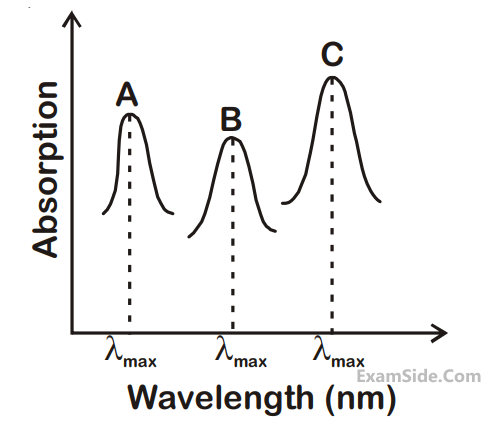
(i) [M(NCS)
6]
(–6 + n)
(ii) [MF
6]
(–6 + n)
(iii) [M(NH
3)
6]
n+
JEE Mains
2020
MCQ
For octahedral Mn(II) and tetrahedral Ni(II)
complexes, consider the following statements:
(I) both the complexes can be high spin.
(II) Ni(II) complex can very rarely be low spin.
(III) with strong field ligands, Mn(II) complexes
can be low spin.
(IV)aqueous solution of Mn(II) ions is yellow in
colour.
The correct statements are :
JEE Mains
2020
MCQ
Consider that a d6 metal ion (M2+) forms a
complex with aqua ligands, and the spin only
magnetic moment of the complex is 4.90 BM.
The geometry and the crystal field stabilization
energy of the complex is
JEE Mains
2020
MCQ
The correct order of the spin-only magnetic
moments of the following complexes is :
(I) [Cr(H2O)6]Br2
(II) Na4[Fe(CN)6]
(III) Na3[Fe(C2O4)3] ($\Delta $0 $>$ P)
(IV) (Et4N)2[CoCl4]
JEE Mains
2020
MCQ
The isomer(s) of [Co(NH3)4Cl2] that has/have
a Cl–Co–Cl angle of 90°, is/are :
JEE Mains
2020
MCQ
Complex X of composition Cr(H2O)6Cln
has a spin only magnetic moment of 3.83
BM. It reacts with AgNO3 and shows
geometrical isomerism. The IUPAC
nomenclature of X is :
JEE Mains
2020
MCQ
[Pd(F)(Cl)(Br)(I)]2– has n number of
geometrical isomers. Then, the spin-only
magnetic moment and crystal field stabilisation
energy [CFSE] of [Fe(CN)6]n–6, respectively,
are:
[Note : Ignore the pairing energy]
JEE Mains
2020
MCQ
The correct order of the calculated spin-only
magnetic moments of complexs (A) to (D) is:
(A) Ni(CO)4
(B) [Ni(H2O)6]Cl2
(C) Na2[Ni(CN)4]
(D) PdCl2(PPh3)2
JEE Mains
2020
MCQ
Among (a) – (d) the complexes that can display
geometrical isomerism are :
(a) [Pt(NH3)3Cl]+
(b) [Pt(NH3)Cl5]–
(c) [Pt(NH3)2Cl(NO2)]
(d) [Pt(NH3)4ClBr]2+
JEE Mains
2020
MCQ
The complex that can show fac- and mer-isomers is :
JEE Mains
2020
MCQ
The number of possible optical isomers for the complexes MA2B2 with sp3 and dsp2 hydridized metal atom. respectively, is :
Note : A and B are unidentate netural and unidentate monoanionic ligands, respectively.
JEE Mains
2020
MCQ
Among the statements(a)-(d) the incorrect ones are :
(a) Octahedral CO(III) complexes with strong fields ligands have very high magnetic moments.
(b) When $\Delta $0 < P, the d-electron configuration of Co(III) in an octahedral complex is $t_{eg}^4e_g^2$
(c) Wavelength of light absorbed by [Co(en)3]3+ is lower than that of [CoF6]3-
(d) If the $\Delta $0 for an octahedral complex of CO(III) is 18,000 cm-1, the $\Delta $t for its tetrahedral complex with the same ligand be 16,000 cm-1
JEE Mains
2020
MCQ
The theory that can completely/properly explain the nature of bonding in [Ni(Co)4] is :
JEE Mains
2020
MCQ
The IUPAC name of complex [Pt(NH3)2Cl(NH2CH3)]Cl is:
JEE Mains
2019
MCQ
The compound used in the treatment of lead poisoning is :
JEE Mains
2019
MCQ
The coordination numbers of Co and Al in [Co(Cl)(en)2]Cl and K3[Al(C2O4)3], respectively, are :
(en = ethane-1, 2-diamine)
JEE Mains
2019
MCQ
Complete removal of both the axial ligands (along the z-axis) from an octahedral complex leads to which of
the following splitting patterns? (relative orbital energies not on scale).
JEE Mains
2019
MCQ
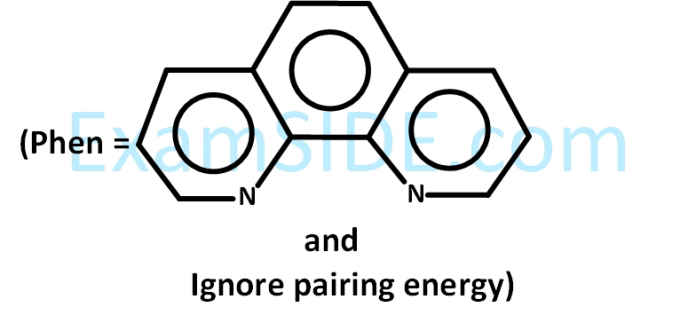
The complex ion that will lose its crystal field stabilization energy upon oxidation of its metal to +3 state is :
JEE Mains
2019
MCQ
The crystal field stabilization energy (CFSE) of [Fe(H2O)6]Cl2 and K2[NiCl4] respectively, are :
JEE Mains
2019
MCQ
The species that can have a trans-isomer is :
(en = ehane-1, 2-diamine, ox = oxalate)
JEE Mains
2019
MCQ
Three complexes,
[CoCl(NH3)5]
2+(I),
[Co(NH3)5H2O]3+ (II) and
[Co(NH3)6]
3+(III)
absorb light in the visible region. The correct order of the wavelength of light absorbed by them is :
JEE Mains
2019
MCQ
The maximum possible denticities of a ligand
given below towards a common transition and
inner-transition metal ion, respectively, are :

JEE Mains
2019
MCQ
The correct statements among I to III are :
(I) Valence bond theory cannot explain the
color exhibited by transition metal
complexes.
(II) Valence bond theory can predict
quantitatively the magnetic properties of
transtition metal complexes.
(III) Valence bond theory cannot distinguish
ligands as weak and strong field ones.
JEE Mains
2019
MCQ
The one that will show optical activity is :
(en = ethane-1,2-diamine)
JEE Mains
2019
MCQ
The degenerate orbitals of [Cr(H2O)6]3+ are :
JEE Mains
2019
MCQ
The compound that inhibits the growth of
tumors is :
JEE Mains
2019
MCQ
The calculated spin-only magnetic moments
(BM) of the anionic and cationic species of
[Fe(H2O)6]2 and [Fe(CN)6], respectively, are :
JEE Mains
2019
MCQ
The correct order of the spin-only magnetic moment of metal ions in the following low-spin
complexes, [V(CN)6]4–,[Fe(CN)6]4–, [Ru(NH3)6]3+, and [Cr(NH3)6]2+ , is :
JEE Mains
2019
MCQ
The following ligand is :

JEE Mains
2019
MCQ
The magnetic moment of an octahedral homoleptic Mn(II) complex is 5.9 BM. The suitable ligand for this complex is -
JEE Mains
2019
MCQ
The metal d-orbitals that are directly facing the ligands in K3[Co(CN)6] are -
JEE Mains
2019
MCQ
Mn2(CO)10 is an organometallic compound due to the presence of -
JEE Mains
2019
MCQ
The pair of metal ions that can give a spin only magnetic moment of 3.9 BM for the complex [M(H2O)6]Cl2, is -
JEE Mains
2019
MCQ
The coordination number of Th in K4[Th(C2O4)4(OH2)2] is :
(C2O${_4^{2 - }}$ = Oxalato)
JEE Mains
2019
MCQ
The number of bridging CO ligand(s) and Co-Co bond(s) in Co2(CO)8, respectively are :
JEE Mains
2019
MCQ
Match the metals (column I) with the coordination compound(s)/enzyme(s) (column II)
(Column I) Metals
|
(Column II) Coordination
compounds(s) enzyme(s)
|
| (A) |
Co |
(i) |
Wilkinson catalyst |
| (B) |
Zn |
(ii) |
Chlorophyl |
| (C) |
Rh |
(iii) |
Vitamin B12 |
| (D) |
Mg |
(iv) |
Carbonic anhydrase |
JEE Mains
2019
MCQ
A reaction of cobalt (III) chloride and ethylenediamine in a 1 : 2 mole ratio generates two isomeric products A (violet coloured) and B (green coloured). A can show optical activity, but B is optically inactive. What
type of isomers does A and B represcent?
JEE Mains
2019
MCQ
The difference in the number of unpaired electrons of a metal ion in its high spin and low-spin octahedral complexes is two. The metal ion is :
JEE Mains
2019
MCQ
The total number of isomers for a square planar complex
[M(F)(Cl)(SCN)(NO2)] is
JEE Mains
2019
MCQ
Homoleptic octahedral complexes of a metal ion 'M3+' with three monodenate ligands L1, L2 and L3 adsorb wavelenths in the region of green, blue and red respectively. The increasing order of the ligands strength is :
JEE Mains
2019
MCQ
The complex that has highest crystal field splitting energy ($\Delta $), is :
JEE Mains
2019
MCQ
Two complexes [Cr(H2O)6]Cl3 (A) and [Cr(NH3)6]Cl3 (B) are violet and yellow coloured, respectively. The incorrect statement regarding them is :
JEE Mains
2018
MCQ
Which of the following complexes will shows geometrical isomerism ?
JEE Mains
2018
MCQ
In Wilkinson's catalyst, the hybridization of central metal ion and its shape are respectively :
JEE Mains
2018
MCQ
Consider the following reaction and statements:
[Co(NH3)4Br2]+ + Br- $\to$ [Co(NH3)3Br3] + NH3
(I) Two isomers are produced if the reactant complex ion is a cis-isomer
(II) Two isomers are produced if the reactant complex ion is a trans-isomer
(III) Only one isomer is produced if the reactant complex ion is a trans-isomer
(IV) Only one isomer is produced if the reactant complex ion is a cis – isomer
The correct statements are
JEE Mains
2018
MCQ
The oxidation states of Cr in [Cr(H2O)6]Cl3, [Cr(C6H6)2] and K2[Cr(CN)2(O)2(O2)(NH3)] respectively are :
JEE Mains
2018
MCQ
The total number of possible isomers for square-planar [Pt(Cl)(NO2)(NO3)(SCN)]2- is :
JEE Mains
2018
MCQ
The correct order of spin-only magnetic moments among the following is :
(Atomic number : Mn = 25, Co = 27, Ni = 28, Zn = 30)
JEE Mains
2018
MCQ
The correct combination is :
JEE Mains
2017
MCQ
[Co2(CO)8] displays :
JEE Mains
2017
MCQ
On treatment of 100 mL of 0.1 M solution of CoCl3. 6H2O with excess AgNO3; 1.2 $\times$ 1022 ions are precipitated. The complex is :
JEE Mains
2016
MCQ
Which of the following is an example of homoleptic complex?
JEE Mains
2016
MCQ
Which one of the following complexes will consume more equivalents of aqueous
solution of Ag(NO3)?
JEE Mains
2016
MCQ
Identify the correct trend given below : (Atomic No.=Ti : 22, Cr : 24 and Mo : 42)
JEE Mains
2016
MCQ
The pair having the same magnetic moment is :
[At. No.: Cr = 24, Mn = 25, Fe = 26, Co = 27]
JEE Mains
2016
MCQ
Which one of the following complexes shows optical isomerism?
(en = ethylenediamine)
JEE Mains
2015
MCQ
Which of the following compounds is not colored yellow?
JEE Mains
2015
MCQ
The number of geometric isomers that can exist for square planar [Pt (Cl) (py) (NH3) (NH2OH)]+ is (py = pyridine) :
JEE Mains
2014
MCQ
The equation which is balanced and represents the correct product(s) is :
JEE Mains
2014
MCQ
The octahedral complex of a metal ion M3+ with four monodentate ligands L1, L2, L3 and L4 absorb wavelengths in the region of red, green, yellow and blue, respectively. The increasing order of ligand strength of the four ligands is :
JEE Mains
2013
MCQ
Which of the following complex species is not expected to exhibit optical isomerism?
JEE Mains
2012
MCQ
Which among the following will be named as dibromidobis (ethylene diamine) chromium(III) bromide?
JEE Mains
2011
MCQ
The magnetic moment (spin only) of [NiCl4]2− is
JEE Mains
2011
MCQ
Which of the following facts about the complex [Cr (NH3)6 ]Cl3 is wrong?
JEE Mains
2010
MCQ
A solution containing 2.675g of CoCl3. 6NH3 (molar mass = 267.5 g mol–1) is passed through a cation exchanger. The chloride ions obtained in solution were treated with excess of AgNO3 to give
4.78 g of AgCl (molar mass = 143.5 g mol–1). The formula of the complex is : (At. Mass of Ag = 108 u)
JEE Mains
2010
MCQ
Which one of the following has an optical isomer ?
(en = ethylenediamine)
JEE Mains
2009
MCQ
Which of the following has an optical isomer ?
JEE Mains
2009
MCQ
Which of the following pairs represents linkage isomers ?
JEE Mains
2008
MCQ
In which of the following octahedral complexes of Co (at. no. 27), will the magnitude of $\Delta _o$ be the highest?
JEE Mains
2008
MCQ
The coordination number and the oxidation state of the element ‘E’ in the complex [E(en)2(C2O4)]NO2 (where (en) is ethylene diamine) are, respectively,
JEE Mains
2007
MCQ
Which one of the following has a square planar geometry?
JEE Mains
2006
MCQ
How many EDTA (ethylenediaminetetraacetic acid) molecules are required to make an octahedral
complex with a Ca2+ ion?
JEE Mains
2006
MCQ
In Fe(CO)5, the Fe – C bond possesses :
JEE Mains
2006
MCQ
Nickel (Z = 28) combines with a uninegative monodentate ligand X– to form a paramagnetic complex [NiX4]2− . The number of unpaired electron(s) in the nickel and geometry of this complex ion are,
respectively
JEE Mains
2006
MCQ
The IUPAC name for the complex [Co(NO2)(NH3)5]Cl2 is
JEE Mains
2005
MCQ
Which one of the following cyano complexes would exhibit the lowest value of
paramagnetic behaviour?
(At. No. Cr = 24, Mn = 25, Fe = 26, Co = 27)
JEE Mains
2005
MCQ
The IUPAC name of the coordination compound K3[Fe(CN)6] is
JEE Mains
2005
MCQ
Which of the following compounds shows optical isomerism?
JEE Mains
2005
MCQ
The oxidation state of Cr in [Cr(NH3)4Cl2]+ is :
JEE Mains
2005
MCQ
The value of the ‘spin only’ magnetic moment for one of the following configurations
is 2.84 BM. The correct one is :
JEE Mains
2004
MCQ
The correct order of magnetic moments (spin only values in B.M.) among is :
(Atomic numbers: Mn = 25; Fe = 26, Co =27)
JEE Mains
2004
MCQ
Among the properties (a) reducing (b) oxidising (c) complexing, the set of properties shown by CN– ion
towards metal species is :
JEE Mains
2004
MCQ
Which one of the following complexes in an outer orbital complex?
JEE Mains
2004
MCQ
Which one the following has largest number of isomers? (R = alkyl group, en = ethylenediamine)
JEE Mains
2004
MCQ
The coordination number of central metal atom in a complex is determined by :
JEE Mains
2004
MCQ
Coordination compound have great importance in biological systems. In this context which of
the following statements is incorrect?
JEE Mains
2003
MCQ
In the coordination compound, K4[Ni(CN)4], the oxidation state of nickel is :
JEE Mains
2003
MCQ
One mole of the complex compound Co(NH3)5Cl3, gives 3 moles of ions on dissolution in water. One mole of the same complex reacts with two moles of AgNO3 solution to yield two moles of AgCl (s). The structure of the complex is :
JEE Mains
2003
MCQ
Ammonia forms the complex ion [Cu(NH3)4]2+ with copper ions in alkaline solutions but not in acidic solutions. What is the reason for it?
JEE Mains
2002
MCQ
The most stable ion is :
JEE Mains
2002
MCQ
CH3 - Mg - Br is an organometallic compound due to :
JEE Mains
2002
MCQ
The type isomerism present in nitropentammine chromium $\left( {{\rm I}{\rm I}{\rm I}} \right)$ chloride is :