Chemical Kinetics and Nuclear Chemistry
$\matrix{ {[A]} & \to & {[B]} \cr {{\mathop{\rm Reactant}\nolimits} } & {} & {{\mathop{\rm Product}\nolimits} } \cr } $
If formation of compound $[\mathrm{B}]$ follows the first order of kinetics and after 70 minutes the concentration of $[\mathrm{A}]$ was found to be half of its initial concentration. Then the rate constant of the reaction is $x \times 10^{-6} \mathrm{~s}^{-1}$. The value of $x$ is ______________. (Nearest Integer)
Explanation:
$=\frac{6930}{7 \times 6} \times 10^{-6}$
$=165 \times 10^{-6} \mathrm{~s}^{-1}$
$2 \mathrm{NO}+2 \mathrm{H}_{2} \rightarrow \mathrm{N}_{2}+2 \mathrm{H}_{2} \mathrm{O}$
The above reaction has been studied at $800^{\circ} \mathrm{C}$. The related data are given in the table below
| Reaction serial number | Initial Pressure of ${H_2}/kPa$ | Initial Pressure of $NO/kPa$ | Initial rate $\left( {{{ - dp} \over {dt}}} \right)/(kPa/s)$ |
|---|---|---|---|
| 1 | 65.6 | 40.0 | 0.135 |
| 2 | 65.6 | 20.1 | 0.033 |
| 3 | 38.6 | 65.6 | 0.214 |
| 4 | 19.2 | 65.6 | 0.106 |
The order of the reaction with respect to NO is ___________.
Explanation:
$ \mathrm{r}=\mathrm{K}[\mathrm{NO}]^{n}\left[\mathrm{H}_{2}\right]^{\mathrm{m}} $
From $1^{\text {st }}$ data
$ 0.135=\mathrm{K}[40]^{\mathrm{n}} \cdot(65.6)^{\mathrm{m}}\quad\quad...(1) $
From $2^{\text {nd }}$ data
$ 0.033=\mathrm{K}(20.1)^{\mathrm{n}} \cdot(65.6)^{\mathrm{m}}\quad\quad...(2) $
On dividing equation (1) by equation (2)
$ \begin{aligned} &\frac{0.135}{0.033}=\left(\frac{40}{20.1}\right)^{n} \\\\ &4=(2)^{n} \\\\ &\therefore n=2 \\\\ &\therefore \text { Order of reaction w.r.t. NO is } 2 . \end{aligned} $
For a reaction $\mathrm{A} \rightarrow 2 \mathrm{~B}+\mathrm{C}$ the half lives are $100 \mathrm{~s}$ and $50 \mathrm{~s}$ when the concentration of reactant $\mathrm{A}$ is $0.5$ and $1.0 \mathrm{~mol} \mathrm{~L}^{-1}$ respectively. The order of the reaction is ______________ . (Nearest Integer)
Explanation:
$ \begin{array}{ll} \mathrm{t}_{1 / 2}=100 \,\mathrm{sec} & \mathrm{a}_{0}=0.5 \\ \mathrm{t}_{1 / 2}=50 \,\mathrm{sec} & \mathrm{a}_{0}=1 \end{array} $
$\frac{100}{50}=\left(\frac{1}{0 \cdot 5}\right)^{n-1}$
$(2)=(2)^{n-1}$
$\mathrm{n}-1=1$
$n=2$
For the decomposition of azomethane.
CH3N2CH3(g) $\to$ CH3CH3(g) + N2(g), a first order reaction, the variation in partial pressure with time at 600 K is given as

The half life of the reaction is __________ $\times$ 10$-$5 s. [Nearest integer]
Explanation:
$ \begin{aligned} &\ln A=\ln A_{0}-k t \\ &\text { Hence Slope }=-k \\ &-k=-3.465 \times 10^{4} \\ &k=\frac{0.693}{t_{1 / 2}} \\ &3.465 \times 10^{4}=\frac{0.693}{t_{1 / 2}} \\ &t_{1 / 2}=2 \times 10^{-5} \mathrm{~s} \end{aligned} $
The half life for the decomposition of gaseous compound $\mathrm{A}$ is $240 \mathrm{~s}$ when the gaseous pressure was 500 Torr initially. When the pressure was 250 Torr, the half life was found to be $4.0$ min. The order of the reaction is ______________. (Nearest integer)
Explanation:
$\left(t_{1 / 2}\right)_{A}=4 \min =4 \times 60=240$ sec when $P=250$ torr
If means half-life is independent of concentration of reactant present.
$\therefore$ Order of reaction $=1$
For the reaction P $\to$ B, the values of frequency factor A and activation energy EA are 4 $\times$ 1013 s$-$1 and 8.3 kJ mol$-$1 respectively. If the reaction is of first order, the temperature at which the rate constant is 2 $\times$ 10$-$6 s$-$1 is _____________ $\times$ 10$-$1 K.
(Given : ln 10 = 2.3, R = 8.3 J K$-$1 mol$-$1, log2 = 0.30)
Explanation:
The equation
k = (6.5 $\times$ 1012s$-$1)e$-$26000K/T
is followed for the decomposition of compound A. The activation energy for the reaction is ________ kJ mol$-$1. [nearest integer]
(Given : R = 8.314 J K$-$1 mol$-$1)
Explanation:
$ \begin{aligned} \frac{E_{a}}{R T} &=\frac{26000}{T} \\\\ E_{a} &=26000 \times 8.314 \\\\ &=216164 \mathrm{~J} \\\\ &=216 \mathrm{~kJ} \end{aligned} $
The activation energy of one of the reactions in a biochemical process is 532611 J mol$-$1. When the temperature falls from 310 K to 300 K, the change in rate constant observed is k300 = x $\times$ 10$-$3 k310. The value of x is ____________.
[Given : $\ln 10 = 2.3$, R = 8.3 J K$-$1 mol$-$1]
Explanation:
where $\mathrm{K}_2$ is at $310 \mathrm{~K} \,\& \mathrm{~K}_1$ is at $300 \mathrm{~K}$
$ \begin{aligned} & \ln \left(\frac{\mathrm{K}_2}{\mathrm{~K}_1}\right)=6.9 \\\\ & =3 \times \ln 10 \\\\ & \ln \frac{\mathrm{K}_2}{\mathrm{~K}_1}=\ln 10^3 \\\\ & \mathrm{~K}_2=\mathrm{K}_1 \times 10^3 \\\\ & \mathrm{~K}_1=\mathrm{K}_2 \times 10^3 \end{aligned} $
So K = 1
A radioactive element has a half life of 200 days. The percentage of original activity remaining after 83 days is ___________. (Nearest integer)
(Given : antilog 0.125 = 1.333, antilog 0.693 = 4.93)
Explanation:
$ \begin{aligned} &\frac{0.693}{200}=\frac{2.303}{83} \log \frac{A_{0}}{A} \\\\ &\frac{A}{A_{0}}=0.75 \end{aligned} $
Hence, percentage of original activity remaining after 83 days is $75 \%$
For a first order reaction A $\to$ B, the rate constant, k = 5.5 $\times$ 10$-$14 s$-$1. The time required for 67% completion of reaction is x $\times$ 10$-$1 times the half life of reaction. The value of x is _____________ (Nearest integer)
(Given : log 3 = 0.4771)
Explanation:
Nearest integer $=16$
It has been found that for a chemical reaction with rise in temperature by 9 K the rate constant gets doubled. Assuming a reaction to be occurring at 300 K, the value of activation energy is found to be ____________ kJ mol$-$1. [nearest integer]
(Given ln10 = 2.3, R = 8.3 J K$-$1 mol$-$1, log 2 = 0.30)
Explanation:
(Rate constant)
$\mathrm{K}_{2}=2 \mathrm{~K}_{1}$, on increase temperature by $9 \mathrm{~K}$
$\mathrm{T}_{2}=309 \mathrm{~K}$
$\mathrm{Ea}=?$
$\log \frac{\mathrm{K}_{2}}{\mathrm{~K}_{1}}=\frac{\mathrm{Ea}}{2.3 \mathrm{R}}\left[\frac{\mathrm{T}_{2}-\mathrm{T}_{1}}{\mathrm{~T}_{2} \cdot \mathrm{T}_{1}}\right]$
$\log 2=\frac{\mathrm{Ea}}{2.3 \times 8.3}\left[\frac{9}{309 \times 300}\right]$
$\mathrm{Ea}=\frac{0.3 \times 309 \times 300 \times 2.3 \times 8.3}{9}$
$=58988.1 \mathrm{~J} / \mathrm{mole}$
$\simeq 59 \mathrm{~kJ} / \mathrm{mole}$
The rate constant for a first order reaction is given by the following equation:
$\ln k = 33.24 - {{2.0 \times {{10}^4}\,K} \over T}$
The activation energy for the reaction is given by ____________ kJ mol$-$1. (In nearest integer) (Given : R = 8.3 J K$-$1 mol$-$1)
Explanation:
Given: $\ln k=33.24-\frac{2.0 \times 10^4}{\mathrm{~T}}$
$ \begin{aligned} &\therefore \text { on comparing } \frac{\mathrm{E}_{\mathrm{A}}}{\mathrm{R}}=2.0 \times 10^4 \\\\ &\therefore \mathrm{E}_{\mathrm{A}}=2.0 \times 10^4 \times \mathrm{R} \\\\ &\Rightarrow \mathrm{E}_{\mathrm{A}}=2.0 \times 10^4 \times 8.3 \mathrm{~J} \\\\ &\Rightarrow \mathrm{E}_{\mathrm{A}}=16.6 \times 10^4 \mathrm{~J}=166 \mathrm{~kJ} \end{aligned} $
Catalyst A reduces the activation energy for a reaction by 10 kJ mol$-$1 at 300 K. The ratio of rate constants, ${{{}^kT,\,Catalysed} \over {{}^kT,\,Uncatalysed}}$ is ex. The value of x is ___________. [nearest integer]
[Assume that the pre-exponential factor is same in both the cases. Given R = 8.31 J K$-$1 mol$-$1]
Explanation:
A catalyst increases the rate of a reaction by lowering the activation energy so that more reactant molecules collide with enough energy to surmount the smaller energy barrier.
In the Question,
Given : $\mathrm{E}_{\text {cat }}-\mathrm{E}_{\text {uncat }}=10 \mathrm{~kJ} / \mathrm{mol}$
$ \mathrm{T}=300 \mathrm{~K} $
According to Arrhenius Equation,
$ \begin{aligned} & \mathrm{K}=A \mathrm{e}^{-\mathrm{Ea} / \mathrm{RT}} \\\\ & \frac{\mathrm{E}_{\text {cat }}}{\mathrm{E}_{\text {uncat }}}=e^{\frac{E a-E_a^1}{R T}} \end{aligned} $
$ \begin{aligned} & =e^{\frac{10 \times 10^3}{8.21 \times 300}} \\\\ & =e^4 \\\\ & =4 \end{aligned} $
A flask is filled with equal moles of A and B. The half lives of A and B are 100 s and 50 s respectively and are independent of the initial concentration. The time required for the concentration of A to be four times that of B is ___________ s.
(Given : ln 2 = 0.693)
Explanation:
$\mathrm{A}_{\mathrm{t}}=\mathrm{A}_0 \times \mathrm{e}^{-\mathrm{k}_{\mathrm{A}} \mathrm{t}}$
$\mathrm{A}_{\mathrm{t}}=\mathrm{A}_0 \times \mathrm{e}^{\left(\frac{-\ln 2}{100} \times \mathrm{t}\right)}$
$\mathrm{B}_{\mathrm{t}}=\mathrm{B}_0 \times \mathrm{e}^{\left(\frac{-\ln 2}{50} \times \mathrm{t}\right)}$
$\mathrm{A}_0=\mathrm{B}_0$
$\& \mathrm{~A}_{\mathrm{t}}=4 \mathrm{~B}_{\mathrm{t}}$
$\mathrm{e}^{-\frac{\ln 2}{100} \times \mathrm{t}}=4 \times \mathrm{e}^{-\frac{\ln 2}{50} \times \mathrm{t}}$
$\mathrm{e}^{\frac{\ln 2}{100} \times \mathrm{t}}=4$
$\mathrm{e}^{\frac{\ln 2}{100} \times \mathrm{t}}=4$
$\frac{\ln 2}{100} \times \mathrm{t}=\ln 4=2 \ln 2$
$\mathrm{t}=200 ~ \mathrm{sec}$
At 345 K, the half life for the decomposition of a sample of a gaseous compound initially at 55.5 kPa was 340 s. When the pressure was 27.8 kPa, the half life was found to be 170 s. The order of the reaction is ____________. [integer answer]
Explanation:
$ \begin{aligned} &\frac{\left(\mathrm{t}_{1 / 2}\right)_{1}}{\left(\mathrm{t}_{1 / 2}\right)_{2}}=\frac{\left[\mathrm{P}_{0}\right]_{2}^{\mathrm{n}-1}}{\left[\mathrm{P}_{0}\right]_{1}^{\mathrm{n}-1}} \\\\ &\frac{340}{170}=\left(\frac{27.8}{55.5}\right)^{\mathrm{n}-1} \\\\ &2=\left(\frac{1}{2}\right)^{\mathrm{n}-1} \\\\ &2=(2)^{1-n} \\\\ &1-\mathrm{n}=1 \\\\ &\mathrm{n}=0 \end{aligned} $
For a given chemical reaction
$\gamma$1A + $\gamma$2B $\to$ $\gamma$3C + $\gamma$4D
Concentration of C changes from 10 mmol dm$-$3 to 20 mmol dm$-$3 in 10 seconds. Rate of appearance of D is 1.5 times the rate of disappearance of B which is twice the rate of disappearance A. The rate of appearance of D has been experimentally determined to be 9 mmol dm$-$3 s$-$1. Therefore, the rate of reaction is _____________ mmol dm$-$3 s$-$1. (Nearest Integer)
Explanation:
$ =\frac{1}{r_{4}}\left(\frac{d[D]}{d t}\right) $
$\frac{\mathrm{d}[\mathrm{D}]}{\mathrm{dt}}=\frac{\mathrm{r}_{4}}{\mathrm{r}_{2}}\left(\frac{-\mathrm{d}[\mathrm{B}]}{\mathrm{dt}}\right)$
$ \frac{r_{4}}{r_{2}}=\frac{3}{2} $
$\frac{-\mathrm{d}[\mathrm{B}]}{\mathrm{dt}}=\frac{\mathrm{r}_{2}}{\mathrm{r}_{1}}\left(\frac{-\mathrm{d}[\mathrm{A}]}{\mathrm{dt}}\right) \Rightarrow \frac{\mathrm{r}_{2}}{\mathrm{r}_{1}}=2$
$r_{2}=2 r_{1}$
$ \begin{aligned} &\mathrm{r}_{4}=1.5 \mathrm{r}_{2}=3 \mathrm{r}_{1} \\\\ &\frac{\mathrm{d}[\mathrm{C}]}{\mathrm{dt}}=1 \mathrm{~m} \cdot \mathrm{mol} ~\mathrm{dm}^{-3} \mathrm{sec}^{-1} \\\\ &\frac{\mathrm{d}[\mathrm{D}]}{\mathrm{dt}}=9 \mathrm{~m} \cdot \mathrm{mol}~ \mathrm{dm}^{-3} \mathrm{sec}^{-1} \\\\ &\frac{\mathrm{d}[\mathrm{D}]}{\mathrm{dt}}=\frac{\mathrm{r}_{4}}{r_{3}} \cdot \frac{\mathrm{d}[\mathrm{C}]}{\mathrm{dt}} \Rightarrow \frac{\mathrm{r}_{4}}{\mathrm{r}_{3}}=9 \\\\ &\mathrm{r}_{4}=9 \mathrm{r}_{3}=3 \mathrm{r}_{1} \\\\ &\Rightarrow \mathrm{r}_{1}=3 \mathrm{r}_{3} \\\\ &\begin{array}{rr} 3 \mathrm{r}_{3} \mathrm{~A}+6 \mathrm{r}_{3} \mathrm{~B} \rightarrow \mathrm{r}_{3} \mathrm{C}+9 \mathrm{r}_{3} \mathrm{D} \end{array} \\\\ &\begin{aligned} \therefore \text { rate of reaction } &=\frac{1}{9} \times 9 \mathrm{~m} \cdot \mathrm{mol}~ \mathrm{dm}^{-3} \mathrm{sec}^{-1} \\\\ &=1 \mathrm{~m} \cdot \mathrm{mol}~ \mathrm{dm}^{-3} \mathrm{sec}^{-1} \end{aligned} \end{aligned} $
The rate constants for decomposition of acetaldehyde have been measured over the temperature range 700 - 1000 K. The data has been analysed by plotting ln k vs ${{{{10}^3}} \over T}$ graph. The value of activation energy for the reaction is ___________ kJ mol$-$1. (Nearest integer)
(Given : R = 8.31 J K$-$1 mol$-$1)

Explanation:
$\ln \mathrm{k}=\ln \mathrm{A}-\frac{\mathrm{E}_{\mathrm{a}}}{\mathrm{RT}}$
$\therefore$ Slope of the graph $=-\frac{E_{a}}{R \times 10^{3}}=-18.5$
$\therefore E_{a}=18.5 \times 8.31 \times 1000 \simeq 154 \mathrm{~kJ} \mathrm{~mol}^{-1}$
For kinetic study of the reaction of iodide ion with $\mathrm{H}_{2} \mathrm{O}_{2}$ at room temperature :
(A) Always use freshly prepared starch solution.
(B) Always keep the concentration of sodium thiosulphate solution less than that of KI solution.
(C) Record the time immediately after the appearance of blue colour.
(D) Record the time immediately before the appearance of blue colour.
(E) Always keep the concentration of sodium thiosulphate solution more than that of KI solution.
Choose the correct answer from the options given below :
At $30^{\circ} \mathrm{C}$, the half life for the decomposition of $\mathrm{AB}_{2}$ is $200 \mathrm{~s}$ and is independent of the initial concentration of $\mathrm{AB}_{2}$. The time required for $80 \%$ of the $\mathrm{AB}_{2}$ to decompose is
Given: $\log 2=0.30$ $\quad \log 3=0.48$
For a first order reaction, the time required for completion of 90% reaction is 'x' times the half life of the reaction. The value of 'x' is
(Given : ln 10 = 2.303 and log 2 = 0.3010)
${\log _{10}}k = 20.35 - {{(2.47 \times {{10}^3})} \over T}$
The energy of activation in kJ mol$-$1 is ____________. (Nearest integer) [Given : R = 8.314 J K$-$1 mol$-$1]
Explanation:
$\log K = 20.35 - {{2.47 \times {{10}^3}} \over T}$
We know
$\log K = \log A - {{{E_a}} \over {2.303RT}}$
$ \Rightarrow {{{E_a}} \over {2.303RT}} = 2.47 \times {10^3}$
${E_a} = 2.47 \times {10^3} \times 2.303 \times {{8.314} \over {1000}}$ KJ/mole
= 47.29 = 47 (Nearest integer)
Explanation:
${{2.303} \over {{t_{50\% }}}}\log {{100} \over {100 - 50}} = {{2.303} \over {{t_{75\% }}}}\log {{100} \over {100 - 75}}$
$ \Rightarrow $ ${t_{75\% }} = 2{t_{50\% }}$
A + B $\to$ M + N in kJ mol$-$ is equal to ___________. (Integer answer)

Explanation:
= 15 $-$ (15 + 45)
= $-$45 KJ/mol
| $\Delta$H | = 45 KJ/mol
[Given R = 8.31 J K$-$ mol$-$1; log 6.36 $\times$ 10$-$3 = $-$2.19, 10$-$4.79 = 1.62 $\times$ 10$-$5]
Explanation:
K600 = x $\times$ 10$-$6s$-$1
Ea = 209 kJ/mol
Applying;
$\log \left( {{{{K_{{T_2}}}} \over {{K_{{T_1}}}}}} \right) = {{ - {E_a}} \over {2.303R}}\left( {{1 \over {{T_2}}} - {1 \over {{T_1}}}} \right)$
$\log \left( {{{{K_{700}}} \over {{K_{600}}}}} \right) = {{ - {E_a}} \over {2.303R}}\left( {{1 \over {700}} - {1 \over {600}}} \right)$
$\log \left( {{{6.36 \times {{10}^{ - 3}}} \over {{K_{600}}}}} \right) = {{ + 209 \times 1000} \over {2.303 \times 8.31}}\left( {{{100} \over {700 \times 600}}} \right)$
log(6.36 $\times$ 10$-$3) $-$ logK600 = 2.6
$\Rightarrow$ logK600 = $-$2.19 $-$ 2.6 = $-$4.79
$\Rightarrow$ K600 = 10$-$4.79 = 1.62 $\times$ 10$-$5
= 1.62 $\times$ 10$-$6
= x $\times$ 10$-$6
$\Rightarrow$ x = 16
$2{K_2}C{r_2}{O_7} + 8{H_2}S{O_4} + 3{C_2}{H_6}O \to 2C{r_2}{(S{O_4})_3} + 3{C_2}{H_4}{O_2} + 2{K_2}S{O_4} + 11{H_2}O$
If the rate of appearance of Cr2(SO4)3 is 2.67 mol min$-$1 at a particular time, the rate of disappearance of C2H6O at the same time is _____________ mol min$-$1. (Nearest integer)
Explanation:
$ = \left( {{{Rate\,of\,disappearance\,of\,C{r_2}{{(S{O_4})}_3}} \over 2}} \right)$
$ \Rightarrow \left( {{{2.67\,mol/\min \, \times 3} \over 2}} \right) = $ rate of disappearance of C2H6O.
$\Rightarrow$ Rate of disappearance of C2H6O = 4.005 mol/min.
2NO(g) + 2H2(g) $\to$ N2(g) + 2H2O(g)

The order of the reaction with respect to NO is ___________. [Integer answer]
Explanation:
2.1 $\times$ 10$-$8 = K $\times$ (24 $\times$ 10$-$5)x (8 $\times$ 10$-$5)y ....... (2)
${1 \over 3} = {\left( {{1 \over 3}} \right)^x} \Rightarrow x = 1$
[Use : ln 2 = 0.69, ln 10 = 2.3]
Properties of logarithms : ln xy = y ln x;
$\ln \left( {{x \over y}} \right) = \ln x - \ln y$
(Round off to the nearest integer)
Explanation:

Now, $t = {{{t_{1/2}}} \over {\ln 2}} \times {{[{A_0}]} \over {[{A_t}]}}$
$100 = {{{t_{1/2}}} \over {\ln 2}} \times \ln {1 \over {0.9}} \Rightarrow {t_{1/2}} = 690$ min (taking ln 3 = 1.11)
Ans. 600 to 700
Explanation:
$\matrix{ {t = 0} & 0 \cr {t = 30\,\min } & {0.2M} \cr } $
Av. rate of reaction = $ - {{\Delta [A]} \over {\Delta t}} = {{\Delta [B]} \over {\Delta t}} = {{(0.2 - 0)} \over {{1 \over 2}}}$
$ = 0.4 = 4 \times {10^{ - 1}}$ mol / L $\times$ hr
In the above first order reaction the initial concentration of N2O5 is 2.40 $\times$ 10$-$2 mol L$-$1 at 318 K. The concentration of N2O5 after 1 hour was 1.60 $\times$ 10$-$2 mol L$-$1. The rate constant of the reaction at 318 K is ______________ $\times$ 10$-$3 min$-$1. (Nearest integer)
[Given : log 3 = 0.477, log 5 = 0.699]
Explanation:
$ = {{2.303} \over {60}}\log {{2.4} \over {1.6}} = 6.76 \times {10^{ - 3}}$ min$-$1 $ \approx $ 7 $\times$ 10$-$3 min$-$1
In the above first order reaction the concentration of PCl5 reduces from initial concentration 50 mol L$-$1 to 10 mol L$-$1 in 120 minutes at 300 K. The rate constant for the reaction at 300 K is x $\times$ 10$-$2 min$-$1. The value of x is __________. [Given log5 = 0.6989]
Explanation:
t = 0
50M
t = 120min
10 M
$ \Rightarrow K = {{2.303} \over t}\log {{[{A_0}]} \over {[{A_t}]}}$
$ \Rightarrow K = {{2.303} \over {120}}\log {{50} \over {10}}$
$ \Rightarrow K = {{2.303} \over {120}} \times 0.6989 = 0.013413$ min$-$1
$ = 1.3413 \times {10^{ - 2}}$ min$-$1
1.34 $\Rightarrow$ Nearest integer = 1
[Use : ln 10 = 2.303; log10 3 = 0.477; property
of logarithm : log xy = y log x]
Explanation:
k $\times$ t = 2.303 log${{{A_0}} \over {{A_t}}}$
k is the rate constant
t is the time
A0 is the initial conc.
At is the conc. at time, t
Using formula,
A0 = 100, At = 90 min 1 min
So, K $\times$ 1 = 2.303 $\times$ log${{100} \over {90}}$
= 2.303 $\times$ (log 10 $-$ 2 log 3)
= 2.303 $\times$ (1 $-$ 2 $\times$ 0.477)
= 0.10593
= 105.93 $\times$ 10$-$3
$\approx$ 106
Hence, the rate constant for viral inactivation is 106.
Explanation:
$ \therefore $ $K = {{\ln 2} \over {{t_{1/2}}}} = {{\ln 2} \over 1}$
From formula we know,
$Kt = \ln \left( {{{100} \over {100 - x}}} \right)$
$ \Rightarrow {{\ln 2} \over 1} = {1 \over t}\ln \left( {{{100} \over {0.1}}} \right)$
$ \Rightarrow 0.3 = {1 \over t}\ln \left( {{{10}^3}} \right)$
$ \Rightarrow 0.3 = {1 \over t} \times 3$
$ \Rightarrow t = 10$ min
This reaction was studied at $-$10$^\circ$ and the following data was obtained
| Run | ${[NO]_0}$ | ${[C{l_2}]_0}$ | ${r_0}$ |
|---|---|---|---|
| 1 | 0.10 | 0.10 | 0.18 |
| 2 | 0.10 | 0.20 | 0.35 |
| 3 | 0.20 | 0.20 | 1.40 |
${[NO]_0}$ and ${[C{l_2}]_0}$ are the initial concentrations and r0 is the initial reaction rate.
The overall order of the reaction is __________. (Round off to the Nearest Integer).
Explanation:
$Rate = K{\left[ A \right]^x}{\left[ B \right]^y}$
Here from,
Exp 1 : $0.18 = K{\left[ {0.1} \right]^x}{\left[ {0.1} \right]^y}$ ..... (1)
Exp. 2 : $0.35 = K{\left[ {0.1} \right]^x}{\left[ {0.2} \right]^y}$ .... (2)
Exp. 3 : $1.40 = K{\left[ {0.2} \right]^x}{\left[ {0.2} \right]^y}$ .... (3)
(2) $\div$ (3)
${{0.35} \over {1.40}} = {{K \times {{\left[ {0.1} \right]}^x}{{\left[ {0.2} \right]}^y}} \over {K \times {{\left[ {0.2} \right]}^x}{{\left[ {0.2} \right]}^y}}}$
$ \Rightarrow {1 \over 4} = {\left( {{1 \over 2}} \right)^x}$
$ \Rightarrow x = 2$
(1) $\div$ (2)
$\left( {{1 \over 2}} \right) = {\left( {{1 \over 2}} \right)^y}$
$ \Rightarrow y = 1$
$ \therefore $ x + y = 3
For a certain quantity of reactants, if the volume of the reaction vessel is reduced by a factor of 3, the rate of the reaction increases by a factor of ____________. (Round off to the Nearest Integer).
Explanation:
Rate = $K{[A]^2}{[{B_2}]^1}$
${r_1} = K{\left( {{a \over V}} \right)^2}{\left( {{b \over V}} \right)^1}$
${r_2} = K{\left( {{{3a} \over V}} \right)^2}{\left( {{{3b} \over V}} \right)^1}$
$\left( {{{{r_2}} \over {{r_1}}}} \right) = 27$
Explanation:
$k = {{2.303} \over {570}}\log \left( {{{100} \over {32}}} \right)$
$k = {{2.303} \over {570}}\left[ {\log ({{10}^2}) - \log {2^5}} \right]$
$k = {{2.303} \over {570}} \times 0.5$
$k = 2 \times {10^{ - 3}}{s^{ - 1}}$
Explanation:
After time 't' min : $\left[ A \right] = 16\left[ B \right]$
$\left[ A \right] = \left[ {{A_0}} \right]{e^{ - {k_A}t}}$
$\left[ B \right] = \left[ {{B_0}} \right]{e^{ - {k_B}t}}$
$ \Rightarrow a\,.\,{e^{ - {k_A}t}} = 16a{e^{ - {k_B}t}}$
$ \Rightarrow {e^{ - \left( {{k_A} - {k_B}} \right)t}} = 16$
$ \Rightarrow \left( {{k_B} - {k_A}} \right)t = \ln 16$
$ \Rightarrow \ln 2\left( {{1 \over {18}} - {1 \over {54}}} \right)t = 4\ln 2$
$ \Rightarrow t = {{54 \times 18 \times 4} \over {36}} = 108$ min
Explanation:
k1 (at 200 K) = ?
k2 (at 300 K) = $1 \times {10^{ - 3}}{s^{ - 1}}$
$\log {{1 \times {{10}^{ - 3}}} \over {{k_1}}} = {{11.488 \times {{10}^3}} \over {2.303 \times 8.314}}\left[ {{1 \over {600}}} \right] = 1$
$ \Rightarrow $ ${{1 \times {{10}^{ - 3}}} \over {{k_1}}} = 10$
$ \Rightarrow $ ${k_1} = 10 \times {10^{ - 5}}{s^{ - 1}}$
products is e$-$x. The value of x is __________. (Rounded off to the nearest integer) [Use R = 8.31 J K$-$1 mol$-$1]
Explanation:
Fraction of molecules able to cross energy barrier = e$-$Ea/RT = e$-$x
x = ${{{E_a}} \over {RT}} = {{80.9 \times 1000} \over {8.31 \times 700}} = 13.91$
$ \Rightarrow $ x $ \simeq $ 14
[R = 8.314 J K$-$1mol$-$1]
Explanation:
Given, temperature coefficient of the reaction,
${\alpha _T} = {{{K_{325}}} \over {{K_{300}}}} = 5$
$\log {{{K_{{T_2}}}} \over {{K_{{T_1}}}}} = {{{E_a}} \over {2.303R}} \times \left( {{{{T_2} - {T_1}} \over {{T_1}{T_2}}}} \right)$
$\log {{{K_{325}}} \over {{K_{300}}}} = {{{E_a}} \over {2.303 \times 8.314}}\left( {{{325 - 300} \over {300 \times 325}}} \right)$
$\log 5 = {{{E_a}} \over {2.303 \times 8.319}} \times {{25} \over {300 \times 325}}$
Ea = 52194.78 J mol$-$
= 52.194 kJ mol$-$1
$\simeq$ 52 kJ mol$-$1

The temperature at which the rate constant of the reaction is 10-4 s-1 is _________ K. (Rounded off to the nearest integer)
[Given : The rate constant of the reaction is 10-5 s-1 at 500 K.]
Explanation:
Slope $ = {{{E_a}} \over {2.303R}} = - 10000$
${\log _{10}}{{{K_2}} \over {{K_1}}} = {{{E_a}} \over {2.303R}} \times \left[ {{1 \over {{T_1}}} - {1 \over {{T_2}}}} \right]$
${\log _{10}}{{{{10}^{ - 4}}} \over {{{10}^{ - 5}}}} = 10000 \times \left[ {{1 \over {500}} - {1 \over T}} \right]$
$ \Rightarrow $ $1 = 10000 \times \left[ {{1 \over {500}} - {1 \over T}} \right]$
$ \Rightarrow $ ${1 \over {10000}} = {1 \over {500}} - {1 \over T}$
$ \Rightarrow $ ${1 \over T} = {1 \over {500}} - {1 \over {10000}}$
$ \Rightarrow $${1 \over T} = {{20 - 1} \over {10000}} = {{19} \over {10000}}$
$ \Rightarrow $ $T = {{10000} \over {19}} = 526$ K
[Assume : ln 10 = 2.303, ln 2 = 0.693]
Explanation:
${t_{1/2}} = {{10} \over 3}h$
At t = 0, a = [A]0 (initial conc.)
t = 9h, a $-$ x = [A]t [conc. at time t]
For using 1st order equation,
$K = {{2.303} \over t}\log {{{{[A]}_0}} \over {{{[A]}_t}}} $
$\Rightarrow {{K \times t} \over {2.303}} = \log {{{{[A]}_0}} \over {{{[A]}_t}}}$
${{\ln 2 \times 9} \over {10/3 \times 2.303}} = \log \left( {{1 \over F}} \right) \Rightarrow \log \left( {{1 \over F}} \right) = 0.8124$ ($\because$ $k = {{\ln 2} \over {{t_{1/2}}}}$)
$\log \left( {{1 \over F}} \right) = 81.24 \times {10^{ - 2}}$
x = 81.24 or x $\approx$ 81
(Rounded off to the nearest integer)
Explanation:

It is a first order isomerisation reaction. Integrated rate law for 1st order reaction is
$kt = \ln {{{{[A]}_0}} \over {{{[A]}_t}}}$ ...(i)
Here,
k = rate constant
${[A]_0}$ = initial concentration
${[A]_t}$ = concentration at time 't'
Given, k = 3.3 $\times$ 10$-$4 s$-$1
${[A]_0} = 100 \Rightarrow {[A]_t} = 100 - 40 = 60$
Put values in Eq. (i), we get
$3.3 \times {10^{ - 4}}{s^{ - 1}} \times t = \ln {{100} \over {60}}$
t = 1547.95 s = 25.79 min (1 min = 60 s or 1s = ${1 \over {60}}$ min) = 26 minutes


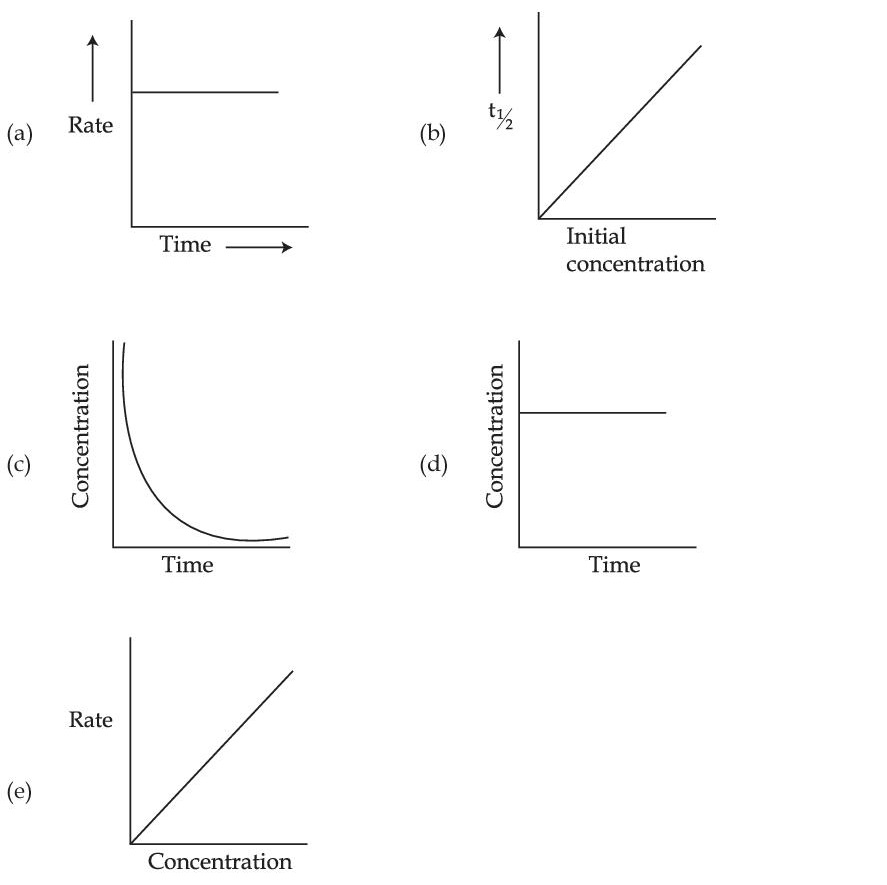
Choose from the options given below, the correct one regarding order of reaction is :


Take; R = 8.314 J mol–1 K–1 ln 3.555 = 1.268
Explanation:
$ \therefore $ $\ln {{{k_2}} \over {{k_1}}} = {{{E_a}} \over R}\left( {{1 \over {{T_1}}} - {1 \over {{T_2}}}} \right)$
$ \Rightarrow $ ln (3.555) = ${{{E_a}} \over {8.314}}\left( {{1 \over {303}} - {1 \over {313}}} \right)$
$ \Rightarrow $ Ea = ${{1.268 \times 8.314 \times 3.3 \times 313} \over {10}}$
= 99980.7 = 99.98 kJ/mol $ \simeq $ 100 kJ/mol
(Take ln 5 = 1.6094; R = 8.314 J mol–1 K–1)
Explanation:
T1 = 300K, T2 = 315K
As per question KT2 = 5KT2 as molecules activated are increased five times so K will increases five time.
$\ln \left( {{{{K_{{T_2}}}} \over {{K_{{T_1}}}}}} \right)$ = ${{{E_a}} \over R}\left( {{1 \over {{T_1}}} - {1 \over {{T_2}}}} \right)$
$ \Rightarrow $ ln 5 = ${{{E_a}} \over R}\left( {{{15} \over {300 \times 315}}} \right)$
$ \Rightarrow $ Ea = ${{1.6094 \times 8.314 \times 300 \times 315} \over {15}}$
= 84297.47 Joules/mole
(Take : log 2 = 0.30; log 2.5 = 0.40)
Explanation:
$ \Rightarrow $ t1/2 = 45 min
Rate constant, K = ${{0.693} \over {45}}$ min-1
Time for completion of 60% of the reaction,
t60% = ${{2.303} \over K}\log {{10} \over 4}$
= ${{2.303 \times 45} \over {0.693}}\log 2.5$
= 60 min
(Given, R = 8.3 J mol–1 K–1, $\ln \left( {{3 \over 2}} \right) = 0.4$, e–3 = 4.0)
Explanation:
K = A${e^{ - {{{E_a}} \over {RT}}}}$
$\ln \left( {{{{k_{400}}} \over {{k_{300}}}}} \right) = {{{E_a}} \over R}\left( {{1 \over {300}} - {1 \over {400}}} \right)$
$ \Rightarrow $ $\ln \left( {{{60} \over {40}}} \right) = {{{E_a}} \over R}\left( {{{100} \over {300 \times 400}}} \right)$
$ \Rightarrow $ $\ln \left( {{3 \over 2}} \right) = {{{E_a}} \over {1200R}}$
$ \therefore $ Ea = 0.4 × 1200 × 8.3 = 3984 J/mol
Ea = 3.984 kJ/mol = 3.98 kJ/mol