Aldehydes, Ketones and Carboxylic Acids
The major product formed in the following reaction is:


Match List I with List II:
| LIST I (Reagents used) | LIST II (Compound with Functional group detected) | ||
|---|---|---|---|
| A. | Alkaline solution of copper sulphate and sodium citrate | I. |  |
| B. | Neutral $\mathrm{FeCl_3}$ | II. |  |
| C. | Alkaline chloroform solution | III. |  |
| D. | Potassium iodide and sodium hypochlorite | IV. |  |
Choose the correct answer from the options given below:


In a reaction,

reagents 'X' and 'Y' respectively are :

The structures of major products A, B and C in the following reaction are sequence.


Consider the following reaction

The correct statement for product B is. It is

Assertion A:
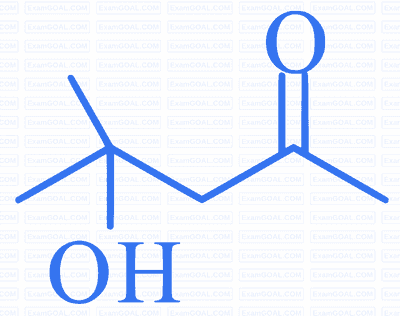 can be easily reduced using $\mathrm{Zn}-\mathrm{Hg} / \mathrm{HCl}$ to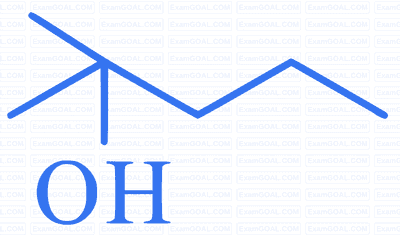
Reason $\mathrm{R}: \mathrm{Zn}-\mathrm{Hg} / \mathrm{HCl}$ is used to reduce carbonyl group to $-\mathrm{CH}_{2}-$ group.
In the light of the above statements, choose the correct answer from the options given below:

What is the correct order of acidity of the protons marked $\mathrm{A}-\mathrm{D}$ in the given compounds ?

Which of the following compounds would give the following set of qualitative analysis ?
(i) Fehling's Test : Positive
(ii) Na fusion extract upon treatment with sodium nitroprusside gives a blood red colour but not prussian blue.


Find out the major products from the following reaction sequence.


'A' in the given reaction is


Identify the product formed (A and E)


'R' formed in the following sequence of reactions is :


Compound (X) undergoes following sequence of reactions to give the Lactone (Y).


The value of $x$ in compound 'D' is _________.
Explanation:


The mass of NH$_3$ produced when 131.8 kg of cyclohexanecarbaldehyde undergoes Tollen's test is ________ kg. (Nearest Integer)
Molar Mass of
C = 12g/mol
N = 14g/mol
O = 16g/mol
Explanation:
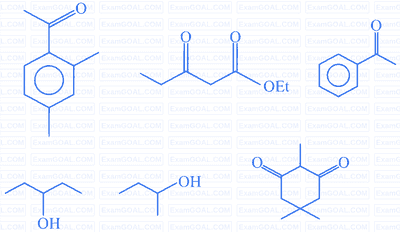
Number of isomeric compounds with molecular formula $\mathrm{C}_{9} \mathrm{H}_{10} \mathrm{O}$ which (i) do not dissolve in $\mathrm{NaOH}$ (ii) do not dissolve in $\mathrm{HCl}$. (iii) do not give orange precipitate with 2,4-DNP (iv) on hydrogenation give identical compound with molecular formula $\mathrm{C}_{9} \mathrm{H}_{12} \mathrm{O}$ is ____________.
Explanation:
2 possibilities

Explanation:

Number of compounds from the following which will not dissolve in cold $\mathrm{NaHCO}_{3}$ and $\mathrm{NaOH}$ solutions but will dissolve in hot $\mathrm{NaOH}$ solution is ________.

Explanation:

will dissolve in hot NaOH solution.
A trisubstituted compound '$\mathrm{A}$', $\mathrm{C}_{10} \mathrm{H}_{12} \mathrm{O}_{2}$ gives neutral $\mathrm{FeCl}_{3}$ test positive. Treatment of compound 'A' with $\mathrm{NaOH}$ and $\mathrm{CH}_{3} \mathrm{Br}$ gives $\mathrm{C}_{11} \mathrm{H}_{14} \mathrm{O}_{2}$, with hydroiodic acid gives methyl iodide and with hot conc. $\mathrm{NaOH}$ gives a compound $\mathrm{B}, \mathrm{C}_{10} \mathrm{H}_{12} \mathrm{O}_{2}$. Compound 'A' also decolorises alkaline $\mathrm{KMnO}_{4}$. The number of $\pi$ bond/s present in the compound '$\mathrm{A}$' is _____________.
Explanation:
$\mathrm{A:C_{10}H_{12}O_2}$
DU of A $=\frac{22-12}{2}=5$
1 DU is due to Ring (Benzene ring)
4 $\pi$-bonds will be there
(3 $\pi$-bonds in ring and 1 $\pi$-bond outside ring) as it decolorises alkaline KMnO$_4$.
Number of compounds giving (i) red colouration with ceric ammonium nitrate and also (ii) positive iodoform test from the following is ___________

Explanation:
The compounds which give red colour with ceric ammonium nitrate and also give positive iodoform test are

Correct structure of $\gamma$-methylcyclohexane carbaldehyde is


Consider the above reaction sequence, the Product 'C' is :


Find out the major product for the above reaction.


The structure of A in the given reaction is :


Match List - I with List - II.
| List - I | List - II | ||
|---|---|---|---|
| (A) |  |
(I) | Gatterman Koch reaction |
| (B) | $C{H_3} - CN\mathrel{\mathop{\kern0pt\longrightarrow} \limits_{{H_3}{O^ + }}^{SnC{l_2}/HCl}} C{H_3} - CHO$ |
(II) | Etard reaction |
| (C) |  |
(III) | Stephen reaction |
| (D) |  |
(IV) | Rosenmund reaction |
Choose the correct answer from the options given below :


Consider the above reaction and predict the major product.


The products formed in the following reaction, A and B are


What is the major product of the following reaction?


$C{H_3} - C{H_2} - CN\mathrel{\mathop{\kern0pt\longrightarrow} \limits_{Ether}^{C{H_3}MgBr}} A\buildrel {{H_3}{O^ + }} \over \longrightarrow B\mathrel{\mathop{\kern0pt\longrightarrow} \limits_{HCl}^{Zn - Hg}} C$
The correct structure of C is


Which one of the following reactions does not represent correct combination of substrate and product under the given conditions?


Consider the given chemical reaction

Identify the product P.


Choose the reaction which is not possible:


Which among the following will be the major product of the given reaction?


Given below are two statements :
Statement I : The esterification of carboxylic acid with an alcohol is a nucleophilic acyl substitution.
Statement II : Electron withdrawing groups in the carboxylic acid will increase the rate of esterification reaction.
Choose the most appropriate option :
Isobutyraldehyde on reaction with formaldehyde and K2CO3 gives compound 'A'. Compound 'A' reacts with KCN and yields compound 'B', which on hydrolysis gives a stable compound 'C'. The compound 'C' is


The correct structure of product 'A' formed in the following reaction.

is


'A' and 'B' respectively are:


Which of the following reactions will yield benzaldehyde as a product?


Oxidation of toluene to benzaldehyde can be easily carried out with which of the following reagents?

The reagent, from the following, which converts benzoic acid to benzaldehyde in one step is


The final product 'A' in the following reaction sequence


(C7H5O2)2 $\buildrel {hv} \over \longrightarrow $ [X] $\to$ 2C6H5 + 2CO2
Consider the above reaction and identify the intermediate 'X'


Which will have the highest enol content?


Which of the following conditions or reaction sequence will NOT give acetophenone as the major product?


Two statements are given below :
Statement I : The melting point of monocarboxylic acid with even number of carbon atoms is higher than that of with odd number of carbon atoms acid immediately below and above it in the series.
Statement II : The solubility of monocarboxylic acids in water decreases with increase in molar mass.
Choose the most appropriate option :
The number of stereoisomers formed in a reaction of $(±)\mathrm{Ph}(\mathrm{C}=\mathrm{O}) \mathrm{C}(\mathrm{OH})(\mathrm{CN}) \mathrm{Ph}$ with $\mathrm{HCN}$ is ___________.
$\left[\right.$where $\mathrm{Ph}$ is $-\mathrm{C}_{6} \mathrm{H}_{5}$]
Explanation:

Number of stereoisomers = 3
The spin only magnetic moment of the complex present in Fehling's reagent is __________ B.M. (Nearest integer).
Explanation:
So, spin only magnetic moment
$ =\sqrt{1(1+2)} $
$ \begin{aligned} & =\sqrt{3} \simeq 2 \mathrm{~B} . \mathrm{M} \end{aligned} $
In the given reaction

The number of chiral carbon/s in product A is ___________.
Explanation:

2 chiral carbons are there in product A.
A hydrocarbon 'X' is found to have molar mass of 80. A 10.0 mg of compound 'X' on hydrogenation consumed 8.40 mL of H2 gas (measured at STP). Ozonolysis of compound 'X' yields only formaldehyde and dialdehyde. The total number of fragments/molecules produced from the ozonolysis of compound 'X' is _____________.
Explanation:
moles consumed of $\mathrm{H}_{2}=\frac{8.4}{22.4} 0.375 \mathrm{~m} \mathrm{~mol}$.
$\frac{\mathrm{n}_{\mathrm{H}_{2}}}{\mathrm{n}_{\mathrm{X}}}=\frac{0.375}{0.125}=3$
So, the compound $\mathrm{X}$ have 3 double bond.
Ozonolysis of the compound yield formaldehyde and dialdehyde.
The compound is
$ \mathrm{H}_{2} \mathrm{C}=\mathrm{CH}-\mathrm{CH}=\mathrm{CH}-\mathrm{CH}=\mathrm{CH}_{2} $
Molecular mass $=(12 \times 6)+1 \times 8=72+8=80 \,\mathrm{amu}$
Ozonolysis form:
