Aldehydes, Ketones and Carboxylic Acids
The correct order of acidic strength of the major products formed in the given reactions, is :
A. $\mathrm{PhNH}_2 \xrightarrow[\substack{\text { (2) } \mathrm{CuCN}^2 \\ \text { (3) } \mathrm{H}_3 \mathrm{O}^{+} / \Delta}]{\text { (1) } \mathrm{NaNO}_2+\mathrm{HCl}\left(<5^{\circ} \mathrm{C}\right)}[\mathrm{A}]$
B. $\mathrm{CH}_3 \mathrm{CH}_2 \mathrm{CHO} \xrightarrow[ \Delta]{\left[\mathrm{Ag}\left(\mathrm{NH}_3\right)_2\right]^{+}, \mathrm{OH}^{-}}[\mathrm{B}]$
C. $\mathrm{CH}_4+\mathrm{O}_2 \xrightarrow[\text { (ii) } \mathrm{Na}_2 \mathrm{Cr}_2 \mathrm{O}_7 / \mathrm{H}^{+}]{\text {(i) } \mathrm{Mo}_2 \mathrm{O}_3}[\mathrm{C}]$
D. $\mathrm{PhCH}_2 \mathrm{MgBr}+\mathrm{CO}_2 \xrightarrow[\mathrm{H}_3 \mathrm{O}^{+}]{\text {Dry ether }}[\mathrm{D}]$
Choose the correct answer from the options given below :
C > A > D > B
A > D > C > B
A > D > B > C
C > B > A > D


$ \text { Given below are two statements for the following reaction sequence. } $
 Statement I : Compound ' $Z$ ' will give yellow precipitate with NaOI .
Statement II : Compound ' Q ' has two different types of ' H ' atoms (aromatic : aliphatic) in the ratio $1: 3$.
In the light of the above statements, choose the correct answer from the options given below :
Statement I is true but Statement II is false
Both Statement I and Statement II are true
Statement I is false but Statement II is true
Both Statement I and Statement II are false

$ \text { Given below are the four isomeric compounds }(\mathrm{P}, \mathrm{Q}, \mathrm{R}, \mathrm{~S}) $

Identify correct statements from below.
A. $\mathrm{Q}, \mathrm{R}$ and S will give precipitate with 2, 4-DNP.
B. $P$ and $Q$ will give positive Bayer's test.
C. Q and R will give sooty flame.
D. R and S will give yellow precipitate with $\mathrm{I}_2 / \mathrm{NaOH}$.
E. Q alone will deposit silver with Tollen's reagent
Choose the correct option.
C and E only
A and E only
A, B, D and E only
A, C and E only
The unsaturated ether on acidic hydrolysis produces carbonyl compounds as shown below :-

Based on this, predict the solution/reagent that will help to distinguish "P" and "Q" obtained in the following reaction :-

Saturated $\mathrm{NaHSO}_3$ solution
Fehling solution
Lucas reagent
2, 4 - DNP reagent

Given below are two statements :
Statement I : Cross aldol condensation between two different aldehydes will always produce four different products.
Statement II : When semicarbazide reacts with a mixture of benzaldehyde and acetophenone under optimum pH , it forms a condensation product with acetophenone only.
In the light of the above statements, choose the correct answer from the options given below
Statement I is true but Statement II is false
Both Statement I and Statement II are false
Both Statement I and Statement II are true
Statement I is false but Statement II is true
$ \text { Consider the following two reactions } \mathrm{A} \text { and } \mathrm{B} \text {. } $

Numerical value of [molar mass of $x+$ molar mass of $y$ ] is $\_\_\_\_$
46
160
88
4
A student is given one compound among the following compounds that gives positive test with Tollen's reagent.

The compound is :
B
D
A
C

Which of the following statements are TRUE about Haloform reaction?
A. Sodium hypochlorite reacts with KI to give KOI .
B. KOI is a reducing agent.
C. $\alpha, \beta$-unsaturated methylketone will give
iodoform reaction.
will give
iodoform reaction.
D. Isopropyl alcohol will not give iodoform test.
E. Methanoic acid will give positive iodoform test.
Choose the correct answer from the options given below :
A, B & C Only
A, C & E Only
B, D & E Only
A & C Only

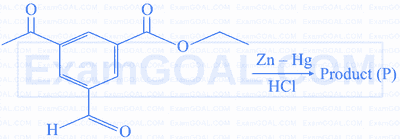
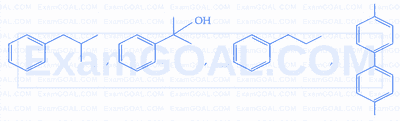
$ \text { Identify (P) } $


Iodoform test can differentiate between
A. Methanol and Ethanol
B. $\mathrm{CH}_3 \mathrm{COOH}$ and $\mathrm{CH}_3 \mathrm{CH}_2 \mathrm{COOH}$
C. Cyclohexene and cyclohexanone
D. Diethyl ether and Pentan-3-one
E. Anisole and acetone
Choose the correct answer from the options given below :
A, B & E Only
A & D Only
A & E Only
B, C & E Only
' $x$ ' is the product which is obtained from propanenitrile and stannous chloride in the presence of hydrochloric acid followed by hydrolysis. ' $y$ ' is the product which is obtained from the but-2-ene by the ozonolysis followed by hydrolysis. From the following, which product is not obtained when one mole of ' $x$ ' and one mole of ' $y$ ' react with each other in the presence of alkali followed by heating?
2-Methylpent-2-enal
2-Methylbut-2-enal
3-Methylbut-2-enal
Pent-2-enal


From the given following (A to D) cyclic structures, those which will not react with Tollen's reagent are:

A and D
A and B
B and D
B and C

The correct sequence of reagents for the above conversion of X to Y is :
(i) $\mathrm{NaOH}(\mathrm{aq})$
(ii) Jones reagent
(iii) $\mathrm{H}_3 \mathrm{O}^{+}$
(i) NaOEt
(ii) $\mathrm{B}_2 \mathrm{H}_6 / \mathrm{H}_2 \mathrm{O}_2$
(iii) Jones reagent
(i) Jones reagent
(ii) NaOEt
(iii) $\mathrm{Hot}\, \mathrm{KMnO}_4 / \mathrm{KOH}$
(i) $\mathrm{B}_2 \mathrm{H}_6 / \mathrm{H}_2 \mathrm{O}_2$
(ii) NaOEt
(iii) Jones reagent

$ \text { Compound ' } \mathrm{P} \text { ' undergoes the following sequence of reactions : } $

$ ' \mathrm{P}^{\prime} \text { is : } $


The compound $\mathrm{A}, \mathrm{C}_8 \mathrm{H}_8 \mathrm{O}_2$ reacts with acetophenone to form a single product via cross-Aldol condensation. The compound A on reaction with conc. NaOH forms a substituted benzyl alcohol as one of the two products. The compound A is :
2-hydroxy acetophenone
4-hydroxy benzylaldehyde
4-methyl benzoic acid
4-methoxy benzaldehyde

$ \text { Match the LIST-I with LIST-II } $
| List-I Reagents | List-II Name of Reaction involving carbonyl compounds | ||
| A. | I. | Tollen's Test | |
| B. | II. | Clemmensen Reduction | |
| C. | Aq. |
III. | Wolff - Kishner Reduction |
| D. | IV. | Fehling's Test | |
Choose the correct answer from the options given below :
A-IV, B-III, C-II, D-I
A-III, B-I, C-IV, D-II
A-II, B-I, C-IV, D-III
A-III, B-IV, C-I, D-II
Match List - I with List - II.
| List – I Reagents |
List – II Reaction Name (Involving aldehydes) |
|---|---|
|
A. H2, Pd–BaSO4 B. SnCl2, HCl C. CrO2Cl2, CS2 D. CO, HCl, Anhyd. AlCl3 |
I. Etard Reaction II. Rosenmund Reduction III. Gattermann–Koch Reaction IV. Stephen Reaction |
Choose the correct answer from the options given below :
Statement I : Compound (X), shown below, dissolves in NaHCO3 solution and has two chiral carbon atoms
Statement II : Compound (Y), shown below, has two carbons with sp3 hybridization, one carbon with sp2 and one carbon with sp hybridization
In the light of the above statements, choose the correct answer from the options given below :
Statement I is true but Statement II is false
Both Statement I and Statement II are true
Both Statement I and Statement II are false
Statement I is false but Statement II is true


An organic compound " P " of molecular formula $\mathrm{C}_6 \mathrm{H}_{12} \mathrm{O}_3$ gives positive Iodoform test but negative Tollen's test. When " P " is treated with dilute acid, it produces " Q ". " Q " gives positive Tollen's test and also iodoform test. The structure of " P " is :


$ \text { Identify A in the following reaction. } $


Grignard reagent $\mathrm{RMgBr}(\mathrm{P})$ reacts with water and forms a gas $(\mathrm{Q})$. One gram of Q occupies $1.4 \mathrm{dm}^3$ at STP. (P) on reaction with dry ice in dry ether followed by $\mathrm{H}_3 \mathrm{O}^{+}$forms a compound (Z). 0.1 mole of (Z) will weigh $\_\_\_\_$ g. (Nearest integer)
Explanation:
With water, a Grignard reagent gives the corresponding hydrocarbon:
$ \mathrm{RMgBr + H_2O \rightarrow RH\ (Q) + Mg(OH)Br} $
Given 1 g of $Q$ occupies $1.4\,\text{dm}^3$ at STP.
Moles in $1.4\,\text{dm}^3$:
$ n=\frac{1.4}{22.4}=0.0625\ \text{mol} $
So molar mass of $Q$:
$ M=\frac{1}{0.0625}=16\ \text{g mol}^{-1} $
A hydrocarbon gas with molar mass 16 is methane, $\mathrm{CH_4}$. Hence $R=\mathrm{CH_3}$, and $P=\mathrm{CH_3MgBr}$.
Carboxylation with dry ice followed by acid workup gives:
$ \mathrm{CH_3MgBr \xrightarrow[ether]{CO_2} CH_3COO^{-}MgBr \xrightarrow{H_3O^+} CH_3COOH\ (Z)} $
So $Z$ is acetic acid, $\mathrm{CH_3COOH}$, with molar mass $60\ \text{g mol}^{-1}$.
Mass of $0.1$ mol:
$ 0.1 \times 60 = 6\ \text{g} $
Answer: 6 g
$ \text { Consider the following reaction. } $

$ \text { The major product }(\mathrm{P}) \text { formed is : } $


' $x$ ' is the product which is obtained by the hydrolysis of prop-1-yne in the presence of mercuric sulphate under dilute acidic medium at 333 K . ' $y$ ' is the product which is obtained by the reaction of ethane nitrile with methyl magnesium bromide in dry ether followed by hydrolysis. IUPAC name of product obtained from ' $x^{\prime}$ and ' $y$ ' in the presence of barium hydroxide followed by heating is :
2 - Methylpent-4-en-3-one
4-Methylpent-3-en-2-one
4-Methylpent-1-ene
2-Methylpent-3-one

An optically active alkyl bromide $\mathrm{C}_4 \mathrm{H}_9 \mathrm{Br}$, reacts with ethanolic KOH to form major compound $[\mathrm{A}]$ which reacts with bromine to give compound $[\mathrm{B}]$. Compound $[\mathrm{B}]$ reacts with ethanolic KOH and sodamide to give compound [C]. One molecule of water adds to compound [C] on warming with mercuric sulphate and dilute sulphuric acid at 333 K to form compound [D]. The functional group in compound D will be confirmed by :
Haloform test
Lucas test
Silver mirror test
Benedict test

Given below are two statements :
Statement I : 2, 6-diethylcyclohexanone and 6-methyl-2-n-propylcyclohexanone are metamers.
Statement II : 2, 2, 6, 6 - tetramethylcyclohexanone exhibits keto-enol tautomerism.
In the light of the above statements, choose the correct answer from the options given below
Both Statement I and Statement II are true
Both Statement I and Statement II are false
Statement I is true but Statement II is false
Statement I is false but Statement II is true


$ \text { Complete the following reaction sequence and give the name of major product ' } \mathrm{P} \text { '. } $

2-Chloropropanoic acid
3-Chloropropanoic acid
1-Chloropropane
2-Chloropropane

Given below are two statements:
Statement I: The condensation reaction between $\mathrm{CH_3-CH=O}$ and 
under optimum pH will produce 
Statement II: The molecule,  will generate $\mathrm{Ph-CH=O}$ in the presence of dilute acid.
In the light of the above statements, choose the correct answer from the options given below:
Both Statement I and Statement II are true
Both Statement I and Statement II are false
Statement I is true but Statement II is false
Statement I is false but Statement II is true


Compound $(\mathrm{X})$ is subjected to the sequence of reactions as shown above. Molar mass of the major product $(\mathrm{Y})$ formed is $\_\_\_\_$ $\mathrm{g} \mathrm{mol}^{-1}$.
(Given molar mass in $\mathrm{g} \mathrm{mol}^{-1} \mathrm{C}: 12, \mathrm{H}: 1, \mathrm{O}: 16$ )
90
118
160
125

An organic compound “x” where molar ratio of C, O and H are equal, on treatment with 50% KOH under reflux followed by acidification produced “y”. The most likely structure of “y” is:
[Molar mass of ‘x’ is 58 g mol−1]


A molecule (X) with following structure under mild acidic condition is hydrolysed to produce (Y) and (Z). Identify the correct statements about (Y) and (Z).

A. Both (Y) and (Z) have same molar mass.
B. (Y) and (Z) can be distinguished from each other by NaHCO$_3$.
C. (Y) and (Z) react with HCN with same rates.
D. (Y) and (Z) undergo addition reaction with 2,4-DNP.
Choose the correct answer from the options given below :
A, B and C Only
B and C Only
C and D Only
A and D Only

Identify compounds A and E in the following reaction sequence.


' $x$ ' is the product which is obtained from benzene by reacting it with carbon monoxide and hydrogen chloride in the presence of cuprous chloride. ' $y$ ' is the major product obtained from the benzene by reacting it with ethanoyl chloride in the presence of anhydrous $\mathrm{AlCl}_3$. Product (major) obtained by heating $x$ and $y$ in the presence of alkali is $z$. Total number of $\pi$ (pi) electrons in $z$ is $\_\_\_\_$ .
Explanation:


Total number of pi $(\pi)$ electrons in ' $z$ ' $=16 \pi$ electrons.

$ \text { Consider the following sequence of reactions to give the major product }(\mathrm{X}) $

P g of the major product $(\mathrm{X})$ formed is reacted with $\mathrm{NaHCO}_3$ solution to liberate a gas which occupied $11.2 \mathrm{dm}^3$ at STP.
$ \mathrm{P}=\text {______________ g. } $
(Given molar mass in $\mathrm{g} \mathrm{mol}^{-1} \mathrm{H}: 1, \mathrm{C}: 12, \mathrm{O}: 16, \mathrm{Cl}: 35.5$ )
Explanation:

When product $(\mathrm{X})$ reacts with $\mathrm{NaHCO}_3$, it releases $\mathrm{CO}_2$ gas. The volume of this gas at STP is given as $11.2 \,\mathrm{dm}^3$.
At STP, $1$ mole of a gas occupies $22.4 \,\mathrm{dm}^3$. So, moles of gas (and hence moles of $\mathrm{X}$, because $1$ mole acid gives $1$ mole $\mathrm{CO}_2$) are:
Moles of $\mathrm{P}=\frac{11.2}{22.4}=0.5$ mole
Now find the molar mass of $(\mathrm{X})$, which is $\mathrm{C}_7 \mathrm{H}_5 \mathrm{O}_2 \mathrm{Cl}$:
$ \begin{aligned} & \mathrm{M}_{\mathrm{C}_7 \mathrm{H}_5 \mathrm{O}_2 \mathrm{Cl}}=156.5 \mathrm{gm} \\ & \mathrm{~W}_{\mathrm{P}\left(\mathrm{C}_7 \mathrm{H}_5 \mathrm{O}_2 \mathrm{Cl}\right)}=\frac{156.5}{2}=78.25 \approx 78 \text { grams } \end{aligned} $
 undergoes intramolecular aldol condensation, the major product formed is :


Choose the correct option for structures of $A$ and $B$, respectively


Which among the following compounds give yellow solid when reacted with $\mathrm{NaOI} / \mathrm{NaOH}$ ?

Choose the correct answer from the options given below :

Aldol condensation is a popular and classical method to prepare $\alpha, \beta$-unsaturated carbonyl compounds. This reaction can be both intermolecular and intramolecular. Predict which one of the following is not a product of intramolecular aldol condensation?


An organic compound $(\mathrm{X})$ with molecular formula $\mathrm{C}_3 \mathrm{H}_6 \mathrm{O}$ is not readily oxidised. On reduction it gives $\mathrm{C}_3 \mathrm{H}_8 \mathrm{O}(\mathrm{Y})$ which reacts with HBr to give a bromide $(\mathrm{Z})$ which is converted to Grignard reagent. This Grignard reagent on reaction with $(\mathrm{X})$ followed by hydrolysis give 2,3-dimethylbutan-2-ol. Compounds $(\mathrm{X}),(\mathrm{Y})$ and $(\mathrm{Z})$ respectively are:

$ \text {The major product }(\mathrm{P}) \text { in the following reaction is : } $



Number of molecules from below which cannot give iodoform reaction is :
Ethanol, Isopropyl alcohol, Bromoacetone, 2-Butanol, 2-Butanone, Butanal, 2-Pentanone, 3-Pentanone, Pentanal and 3-Pentanol.
Consider the following reactions. From these reactions which reaction will give carboxylic acid as a major product ?
(A) $\quad \mathrm{R}-\mathrm{C} \equiv \mathrm{N} \xrightarrow[\text { mild condition }]{\text { (i) } \stackrel{+}{\mathrm{H}} / \mathrm{H}_2 \mathrm{O}}$
(B) $\quad \mathrm{R}-\mathrm{MgX} \xrightarrow[\text { (ii) } \mathrm{H}_3 \mathrm{O}^{+}]{\text {(i) } \mathrm{CO}_2}$
(C) $\mathrm{R}-\mathrm{C} \equiv \mathrm{N} \xrightarrow[\text { (ii) } \mathrm{H}_3 \mathrm{O}^{+}]{\text {(i) } \mathrm{SnCl}_2 / \mathrm{HCl}}$
(D) $\quad \mathrm{R} \cdot \mathrm{CH}_2 \cdot \mathrm{OH} \xrightarrow{\mathrm{PCC}}$
(E) 
Choose the correct answer from the options given below :

Given below are two statements:
Statement I : Vanilin  will react with NaOH and also with Tollen's reagent.
Statement II : Vanilin will undergo self aldol condensation very easily.
In the light of the above statements, choose the most appropriate answer from the options given below :

An optically active alkyl halide $\mathrm{C}_4 \mathrm{H}_9 \mathrm{Br}[\mathrm{A}]$ reacts with hot KOH dissolved in ethanol and forms alkene $[B]$ as major product which reacts with bromine to give dibromide $[C]$. The compound [C] is converted into a gas [D] upon reacting with alcoholic $\mathrm{NaNH}_2$. During hydration 18 gram of water is added to 1 mole of gas [D] on warming with mercuric sulphate and dilute acid at 333 K to form compound [E]. The IUPAC name of compound [ E ] is :

The product (P) formed in the following reaction is :


The total number of compounds from below when treated with hot KMnO4, giving benzoic acid is:

4
3
5
6

Both acetaldehyde and acetone (individually) undergo which of the following reactions?
A. Iodoform Reaction
B. Cannizaro Reaction
C. Aldol Condensation
D. Tollen's Test
E. Clemmensen Reduction
Choose the correct answer from the options given below:
The compounds that produce $\mathrm{CO}_2$ with aqueous $\mathrm{NaHCO}_3$ solution are:

Choose the correct answer from the options given below:
Match List - I with List - II.
| List - I | List - II | ||
|---|---|---|---|
| (A) |  |
(I) | Etard reaction |
| (B) |  |
(II) | Gatterman-Koch reaction |
| (C) |  |
(III) | Rosenmund reduction |
| (D) |  |
(IV) | Stephen reaction |
Choose the correct answer from the options given below :
