Consider a water tank shown in the figure. It has one wall at $x=L$ and can be taken to be very wide in the $z$ direction. When filled with a liquid of surface tension $S$ and density $\rho$, the liquid surface makes angle $\theta_0\left(\theta_0 \ll 1\right)$ with the $x$-axis at $x=L$. If $y(x)$ is the height of the surface then the equation for $y(x)$ is:
(take $\theta(x)=\sin \theta(x)=\tan \theta(x)=\frac{d y}{d x}, g$ is the acceleration due to gravity)
A.
$\frac{d^2 y}{d x^2}=\sqrt{\frac{\rho g}{s}}$
B.
$\frac{d y}{d x}=\sqrt{\frac{\rho g}{s}} x$
C.
$\frac{d^2 y}{d x^2}=\frac{\rho g}{s} x$
D.
$\frac{d^2 y}{d x^2}=\frac{\rho g}{s} y$
Correct Answer: D
Explanation:
$\begin{aligned} & R O C=\text { Radius of curvature at point } A \\ & \text { Curvature }=\frac{1}{R O C}=\frac{\left|\frac{d^2 y}{d x^2}\right|}{\left(1+\left(\frac{d y}{d x}\right)^2\right)^{\frac{3}{2}}}=\frac{\left|\frac{d^2 y}{d x^2}\right|}{(1+0)^{\frac{3}{2}}}=\frac{d^2 y}{d x^2} \quad\left[\because \frac{d y}{d x}=\tan \theta=0\right] \\ & \Delta P=S \times \text { curvature } \\ & \Rightarrow \rho g y=S \frac{d^2 y}{d x^2} \\ & \therefore \frac{d^2 y}{d x^2}=\frac{\rho g y}{S} \end{aligned}$
Alternate Solution :
For the given element, (consider length d in Z direction) Net force in upward direction $=$ Weight $(\mathrm{S} \sin (\theta+\mathrm{d} \theta)-\mathrm{S} \sin \theta) \mathrm{d}=\mathrm{mg}$
Angle is small $\therefore \sin \theta \approx \theta$
An ideal fluid is flowing in a non-uniform cross-sectional tube $X Y$ (as shown in the figure) from end $X$ to end $Y$. If $K_1$ and $K_2$ are the kinetic energy per unit volume of the fluid at $X$ and $Y$ respectively, then the correct option is :
A.
$K_1=K_2$
B.
$2 K_1=K_2$
C.
$K_1>K_2$
D.
$K_1 < K_2$
Correct Answer: C
Explanation:
According to Bernoulli's principle,
Kinetic energy per unit volume + Potential energy per unit volume + Pressure $=$ Constant
$\frac{1}{2} \rho V^2+\rho g h+P=\text { constant }$
Apply Bernoulli's principle at point $X$ and $Y$,
$\begin{aligned}
& P+K_1+\rho g(0)=P+K_2+\rho g(\mathrm{~h}) \\
& K_1=K_2+\rho g h \\
& K_1>K_2
\end{aligned}$
The maximum elongation of a steel wire of $1 \mathrm{~m}$ length if the elastic limit of steel and its Young's modulus, respectively, are $8 \times 10^8 \mathrm{~N} \mathrm{~m}^{-2}$ and $2 \times 10^{11} \mathrm{~N} \mathrm{~m}^{-2}$, is:
A.
4 mm
B.
0.4 mm
C.
40 mm
D.
8 mm
Correct Answer: A
Explanation:
First, we need to find the maximum force that can be applied to the steel wire within its elastic limit. This force can be calculated using the given area under stress and the stress limit provided by the elastic limit of steel.
Let's assume the area of cross-section of the wire is $A$. The force exerted can be given by:
To calculate the elongation ($ \Delta L $) under this force, we use Hooke's Law, which relates force, elongation, cross-sectional area, original length, and Young's modulus as follows:
$ F = \frac{Y \times A \times \Delta L}{L} $
where:
$ Y = 2 \times 10^{11} \mathrm{~N/m}^2 $ (Young's modulus of steel),
$ L = 1 \mathrm{~m} $ (original length of the wire).
Substituting for $ F $ from the earlier expression and rearranging the formula, we get:
$ \sigma \times A = \frac{Y \times A \times \Delta L}{L} $
A thin flat circular disc of radius $4.5 \mathrm{~cm}$ is placed gently over the surface of water. If surface tension of water is $0.07 \mathrm{~N} \mathrm{~m}^{-1}$, then the excess force required to take it away from the surface is
A metallic bar of Young's modulus, $0.5 \times 10^{11} \mathrm{~N} \mathrm{~m}^{-2}$ and coefficient of linear thermal expansion $10^{-5}{ }^{\circ} \mathrm{C}^{-1}$, length $1 \mathrm{~m}$ and area of cross-section $10^{-3} \mathrm{~m}^2$ is heated from $0^{\circ} \mathrm{C}$ to $100^{\circ} \mathrm{C}$ without expansion or bending. The compressive force developed in it is :
A.
$5 \times 10^3 \mathrm{~N}$
B.
$50 \times 10^3 \mathrm{~N}$
C.
$100 \times 10^3 \mathrm{~N}$
D.
$2 \times 10^3 \mathrm{~N}$
Correct Answer: B
Explanation:
Given the properties and conditions of the metallic bar, we are required to calculate the compressive force developed due to heating. Key inputs include the Young's modulus (E), coefficient of linear thermal expansion (α), change in temperature ($\Delta T$), and the original dimensions of the bar.
First, compute the linear expansion of the bar if it were free to expand. The change in length ($\Delta L$) due to thermal expansion can be computed through the formula:
This is the change in length that the bar would undergo if not constrained.
However, in this scenario, the bar is constrained and does not actually expand. This constraint induces a compressive stress (constrained thermal stress) in the bar, which can be calculated using the formula relating stress, Young's modulus, and strain:
$ \sigma = E \epsilon $
Where the strain ($\epsilon$) under constrained conditions due to thermal expansion is:
The amount of elastic potential energy per unit volume (in SI unit) of a steel wire of length $100 \mathrm{~cm}$ to stretch it by $1 \mathrm{~mm}$ is (if Young's modulus of the wire $=2.0 \times 10^{11} \mathrm{Nm}^{-2}$ ) :
The viscous drag acting on a metal sphere of diameter $1 \mathrm{~mm}$, falling through a fluid of viscosity $0.8 \mathrm{~Pa}$ s with a velocity of $2 \mathrm{~m} \mathrm{~s}^{-1}$ is equal to :
The amount of energy required to form a soap bubble of radius $2 \mathrm{~cm}$ from a soap solution is nearly: (surface tension of soap solution $=0.03 \mathrm{~N} \mathrm{~m}^{-1}$ )
A venturi meter is a device used to measure the flow rate of a fluid through a pipe. The venturi meter works on Bernoulli's principle, which states that for an incompressible, non-viscous fluid flowing through a pipe, the sum of the pressure energy, kinetic energy, and potential energy per unit volume remains constant.
Let a wire be suspended from the ceiling (rigid support) and stretched by a weight $W$ attached at its free end. The longitudinal stress at any point of cross-sectional area $A$ of the wire is :
A.
$W / A$
B.
$W / 2 A$
C.
Zero
D.
$2 W / A$
Correct Answer: A
Explanation:
When a wire is suspended from the ceiling and stretched by a weight W attached at its free end, the force acting on the wire is equal to the weight W. This force causes longitudinal stress in the wire.
Longitudinal stress is defined as the force acting on an object divided by its cross-sectional area. In this case, the force acting on the wire is W, and the cross-sectional area of the wire is A.
Thus, the longitudinal stress at any point of the wire with cross-sectional area A is given by :
Two copper vessels A and B have the same base area but of different shapes. A takes twice the volume of water as that B requires to fill upto a particular common height. Then the correct statement among the following is :
A.
Vessel B weighs twice that of A.
B.
Pressure on the base area of vessels A and B is same.
C.
Pressure on the base area of vessels A and B is not same.
D.
Both vessels A and B weigh the same.
Correct Answer: B
Explanation:
In hydrostatic condition,
$P = {P_0} + \rho gh$
Here, P : absolute pressure at depth h, P0 is atmospheric pressure
Since, height of liquid in both vessel is same therefore pressure on the base of both vessel will be same.
The terminal velocity of a copper ball of radius 5 mm falling through a tank of oil at room temperature is 10 cm s$-$1. If the viscosity of oil at room temperature is 0.9 kg m$-$1 s$-$1, the viscous drag force is :
A spherical ball is dropped in a long column of a highly viscous liquid. The curve in the graph shown, which represents the speed of the ball (v) as a function of time (t) is
A.
A
B.
B
C.
C
D.
D
Correct Answer: B
Explanation:
Initial speed of ball is zero and it finally attains terminal speed
Given below are two statements : One is labelled as Assertion (A) and the other is labelled as Reason (R).
Assertion (A) : The stretching of a spring is determined by the shear modulus of the material of the spring.
Reason (R) : A coil spring of copper has more tensile strength than a steel spring of same dimensions.
In the light of the above statements, choose the most appropriate answer from the options given below:
A.
Both (A) and (R) are true and (R) is the correct explanation of (A)
B.
Both (A) and (R) are true and (R) is not the correct explanation of (A)
C.
(A) is true but (R) is false
D.
(A) is false but (R) is true
Correct Answer: C
Explanation:
It is true that stretching of spring is determined by shear modulus of the spring as when coil spring is stretched neither its length nor its volume changes, there is only change in its shape.
Tensile strength of steel is more than that of copper.
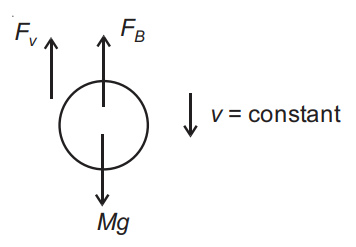
The velocity of a small ball of mass M and density d, when dropped in a container filled with glycerin becomes constant after some time. If the density of glycerin is ${d \over 2}$, then the viscous force acting on the ball will be :
A.
2Mg
B.
${{Mg} \over 2}$
C.
Mg
D.
${{3} \over 2}$Mg
Correct Answer: B
Explanation:
Let Fv be the viscous force and FB be the Bouyant
force acting on the ball.
Then, when body moves with constant velocity
Mg = FB + Fv [a = 0]
Fv = Mg – FB
= $dVg - {d \over 2}Vg$ (Mg = dVg) V = volume of ball.
A capillary tube of radius r is immersed in water and water rises in it to a height h. The mass of the water in the capillary is 5 g. Another capillary tube of radius 2r is immersed in Water. The mass of water that will rise in this tube is :
A.
5.0 g
B.
10.0 g
C.
20.0 g
D.
2.5 g
Correct Answer: B
Explanation:
The weight of water in the capillary is balanced by the surface tension force.
A wire of length L, are of cross section A is hanging from a fixed support. The length of the wire changed to L1 when mass M is suspended from its free end. The expression for Young's modulus is :
A copper rod of 88 cm and an aluminium rod of unknown length have their increase in length independent of increase in tmperature. The length of aluminium rod is : ($\alpha $Cu = 1.7 × 10⁻⁵ K–1 and
$\alpha $Al = 2.2 × 10⁻⁵ K–1)
A soap bubble, having radius of 1 mm, is blown from a detergent solution having a surface tension of 2.5 $ \times $ 10–2 N/m. The pressure inside the bubble equals at a point Z0 below the free surface of water in a container. Taking g = 10 m/s2, density of water = 103 kg/m3, the value of Z0 is :
When a block of mass M is suspended by a long wire of length L, the length of the wire becomes (L + $l$). The elastic potential energy stored in the extended wire is :
A small hole of area of cross-section 2 mm2 present near the bottom of a fully filled open tank of height 2 m. Taking g = 10 m/s2, the rate of flow of water through the open hole would be nearly :
A small sphere of radius ‘r’ falls from rest in a
viscous liquid. As a result, heat is produced
due to viscous force. The rate of production of
heat when the sphere attains its terminal velocity,
is proportional to
The power radiated by a black body is P and it
radiates maximum energy at wavelength, $\lambda $0
. If
the temperature of the black body is now
changed so that it radiates maximum energy at
wavelength ${3 \over 4}{\lambda _0}$, the power radiated by it
becomes nP. The value of n is
Two wires are made of the same material and
have the same volume. The first wire has
cross-sectional area A and the second wire has
cross-sectional area 3A. If the length of the first
wire is increased by $\Delta $l on applying a force F,
how much force is needed to stretch the second
wire by the same amount?
A.
6F
B.
F
C.
9F
D.
4F
Correct Answer: C
Explanation:
Let the wire 1 is of length = l and wire 2 of
length = ${l \over 3}$
A U tube with both ends open to the atmosphere, is partially filled with water. Oil, which is immiscible with water, is poured into one side until it stands at a distance of 10 mm above the water level on the other side. Meanwhile the water rises by 65 mm from its original level (see diagram). The density of the oil is
A spherical black body with a radius of 12 cm radiates 450 watt power at 500 K. If the radius were halved and the temperature doubled, the power radiated in watt would be
Two rods A and B of different materials are welded together as shown in figure. Their thermal conductivities are K1 and K2. The thermal conductivity of the composite will be
A.
${{3\left( {{K_1} + {K_2}} \right)} \over 2}$
B.
${K_1} + {K_2}$
C.
$2\left( {{K_1} + {K_2}} \right)$
D.
${{{K_1} + {K_2}} \over 2}$
Correct Answer: D
Explanation:
Equivalent thermal conductivity of the composite rod in parallel combination will be,
A rectangular film of liquid is extended from (4 cm $ \times $ 2 cm) to (5 cm $ \times $ 4 cm). If the work done is 3 $ \times $ 10$-$4 J, the value of the surface tension of the liquid is
A.
0.250 N m$-$1
B.
0.125 N m$-$1
C.
0.2 N m$-$1
D.
8.0 N m$-$1
Correct Answer: B
Explanation:
We have d = 2700 m, ρ = 103 kg/m3, compressibility = 45.4 × 10⁻¹¹ /pascal
Two identical bodies are made of a material for which the heat capacity increases with temperature. One of these is at 100oC, while the other one is at 0oC. If the two bodies are brought into contact, then, assuming no heat loss, the final common temperature is
A.
50 oC
B.
more than 50 oC
C.
less than 50 oC but greater than 0 oC
D.
0 oC
Correct Answer: B
Explanation:
If the final common temperature is Tc, Cc and Ch average heat capacities of cold and hot bodies then as per principle of calorimetry,
Three liquids of densities $\rho $1, $\rho $2 and $\rho $3 (with $\rho $1 > $\rho $2 > $\rho $3), having the same value of surface tension T, rise to the same height in three identical capillaries. The angles of contact $\theta $1, $\theta $2 and $\theta $3 obey
A body cools from a temperature 3T to 2T in 10 minutes. The room temperature is T. Assume that Newton's law of cooling is applicable. The temperature of the body at the end of next 10 minutes will be
Two non-mixing liquids of densities $\rho $ and n$\rho $ (n > 1) are put in a container. The height of each liquid is h. A solid cylinder of length L and density d is put in this container. The cylinder floats with its axis vertical and length $\rho $L ($\rho $ < 1) in the denser liquid. The density d is equal to
A black body is at a temperature of 5760 K. The energy of radiation emitted by the body at wavelength 250 nm is U1, at wavelength 500 nm is U2 and that at 1000 nm is U3. Wien's constant, b = 2.88 $ \times $ 106 nm K. Which of the following is correct ?
A.
U1 > U2
B.
U2 > U1
C.
U1 = 0
D.
U3 = 0
Correct Answer: B
Explanation:
According to wein's displacement law, maximum amount of emitted radiation corresponding to
A piece of ice falls from a height h so that it melts completely. Only one-quarter of the heat produced is absorbed by the ice and all energy of ice gets converted into heat during its fall. The value of h [Latent heat of ice is $3.4 \times {10^5}$ J/kg and g = 10 N/Kg]
Coefficient of linear expansion of brass and steel rods are $\alpha $1 and $\alpha $2. Lengths of brass and steel rods are $l$1 and $l$2 respectively. If ($l$1 $-$ $l$2) is maintained same at all temperatures, which one of the following relations holds good?
A.
$\alpha $1$l$2 = $\alpha $22$l$1
B.
$\alpha $1$l$1 = $\alpha $2l2
C.
$\alpha $1$l$2 = $\alpha $2$l$1
D.
$\alpha $1$l$22 = $\alpha $2$l$12
Correct Answer: B
Explanation:
From question, $\left( {{l_2} - {l_1}} \right)$ is maintained same at all temperatures hence change in length for both rods should be same
i.e., $\Delta {l_1} = \Delta {l_2}$
As we know, coefficient of linear expansion,
$\alpha = {{\Delta l} \over {{l_0}\Delta T}}$
${l_1}{\alpha _1}\Delta T = {l_2}{\alpha _2}\Delta T$
The cylindrical tube of a spray pump has radius R, one end of which has n fine holes, each of radius r. If the speed of the liquid in the tube is V, the speed of the ejection of the liquid through the holes is
A.
${{VR{}^2} \over {{n^3}{r^2}}}$
B.
${{{V^2}R} \over {nr}}$
C.
${{V{R^2}} \over {{n^2}{r^2}}}$
D.
${{V{R^2}} \over {n{r^2}}}$
Correct Answer: D
Explanation:
Let the speed of the ejection of the liquid through the holes be v. Then according to the equation of continuity,
The value of coefficient of volume expansion of glycerin is 5 $ \times $ 10$-$4 K$-$1. The fractional change in the density of glycerin for a rise of 40oC in its temperature, is
A.
0.025
B.
0.010
C.
0.015
D.
0.020
Correct Answer: D
Explanation:
Let r0 and rT be densities of glycerin at 0°C and T°C respectively. Then,
The Young's modulus of steel is twice that of brass. Two wires of same length and of same area of cross section, one of steel and another of brass are suspended from the same roof. If we want the lower ends of the wires to be at the same level, then the weights added to the steel and brass wires must be in the ratio of
iCON Education HYD, 79930 92826, 73309 72826AIPMT 2015 Cancelled Paper
On observing light from three different starts P, Q and R, it was found that intensity of violet colour is maximum in the spectrum of P, the intensity of green colour is maximum in the spectrum of R and the intensity of red colour is maximum in the spectrum of Q. If TP, TQ and TR are the respective absolute temperatures of P, Q and R, then it can be conclued from the above observations that
A.
TP < TR < TQ
B.
TP < TQ < TR
C.
TP > TQ > TR
D.
TP > TR > TQ
Correct Answer: D
Explanation:
According to Wein’s displacement law
${\lambda _m}T$ = constant …(i)
For star P, intensity of violet colour is maximum. For star Q, intensity of red colour is maximum. For star R, intensity of green colour is maximum.
iCON Education HYD, 79930 92826, 73309 72826AIPMT 2015 Cancelled Paper
The two ends of a metal rod are maintained at temperatures 100oC and 110oC. The rate of heat flow in the rod is found to be 4.0 J/s. If the ends are maintained at temperatures 200oC and 210oC, the rate of heat flow will be
A.
8.0 J/s
B.
4.0 J/s
C.
44.0 J/s
D.
16.8 J/s
Correct Answer: B
Explanation:
As the temperature difference $\Delta T$ = 10°C as well as the thermal resistance is same for both the cases, so thermal current or rate of heat flow will also be same for both the cases.
2015
NEET
MCQ
iCON Education HYD, 79930 92826, 73309 72826AIPMT 2015 Cancelled Paper
The approximate depth of an ocean is 2700 m. The compressiblity of water is 45.4 $ \times $ 10$-$11 Pa$-$1 and density of water is 103 kg/m3. What fractional compression of water will be obtained at the bottom of the ocean?
So, $\left( {{{\Delta V} \over V}} \right) = K\rho gh$
= 45.4 × 10–11 × 103 × 10 × 2700 = 1.2258 × 10⁻²
2015
NEET
MCQ
iCON Education HYD, 79930 92826, 73309 72826AIPMT 2015 Cancelled Paper
A wind with speed 40 m/s blows parallel to the roof of a house. The area of the roof is 250 m2. Assuming that the pressure inside the house is atmospheric pressure, the force exerted by the wind on the roof and the direction of the force will be $({\rho _{air}} = 1.2kg/{m^3})$
A.
2.4 $ \times $ 105 N, upwards
B.
2.4 $ \times $ 105 N, downwards
C.
4.8 $ \times $ 105 N, downwards
D.
4.8 $ \times $ 105 N, upwards
Correct Answer: A
Explanation:
Using Bernoulli's theorem and assuming density constant,
P1+1/2ρv12 = P2+1/2ρv22
where: P2 = pressure outside house P1 = pressure inside house v1 = speed of air inside house v2 = speed of air outside house
Pressure difference,
P1 – P2 = 1/2ρ [v22 – v12]
Now, P1 – P2 = 1/2 × 1.2 [402 – 02]
P1 – P2 = 960 N/m2
Since Pressure P = Force/Area, so force acting on roof will be :
Steam at 100oC is passed into 20 g of water at 10oC. When water acquires a temperature of 80oC, the mass of water present will be
[Take specific heat of water = 1 cal g$-$1oC$-$1 and latent heat of steam = 540 cal g$-$1]
A certain number of spherical drops of a liquid of radius r coalesce to form a single drop of radius R and volume V. If T is the surface tension of the liquid, then
A.
energy = 4VT $\left( {{1 \over r} - {1 \over R}} \right)$ is released.
B.
energy = 3VT$\left( {{1 \over r} + {1 \over R}} \right)$ is absorbed.
C.
energy = 3VT$\left( {{1 \over r} - {1 \over R}} \right)$ is released
D.
energy is neither released nor absorbed.
Correct Answer: C
Explanation:
As surface area decreases so energy is released.
Energy released = $4\pi {R^2}T\left[ {{n^{1/3}} - 1} \right]$
Copper of fixed volume V is drawn into wire of length $l$. When this wire is subjected to a constant force F, the extension produced in the wire is $\Delta $$l$. Which of the following graphs is a straight line ?
A.
$\Delta $$l$ versus 1/$l$
B.
$\Delta $$l$ versus $l$2
C.
$\Delta $$l$ versus 1/$l$2
D.
$\Delta $$l$ versus $l$
Correct Answer: B
Explanation:
From Young Modulus $Y = Fl/A\Delta l = Fl/\left( {V/l} \right)\Delta l$